Now all roads lead to France and heavy is the tread
Of the living; but the dead returning lightly dance.
Edward Thomas, Roads

Tuesday, July 14, 2015

A Day with the Old Folks:Verdun, 1916
Reviewed by Ron Drees


A Day with the Old Folks: Verdun, 1916
by Michael Kihntopf
Outskirts Press, 2015


Some German "Old Folks" in a Trench Susceptible to Flooding

This absorbing work of historical fiction, patterned after A Day in the Life of Ivan Denisovich, but rooted in much historical fact and great detail, follows four German infantrymen for one day as they fight the 1916 battle of Verdun. Jealously nicknamed "the old folks" because they have survived so well for so long, the "grunts," as we would know them in today's parlance, must perform death defying activities to continue surviving, much less kill the enemy.

One fearsome activity is making a run for water and grenades, staples of an infantryman's life. Simply run through "friendly" trenches, synchronize sprints across exposed areas to avoid incoming artillery shells, friendly and unfriendly, pass through more trenches, locate the supplies, attempt to requisition them in spite of general shortages and then reverse the process but with heavy loads swinging from a tree branch on the shoulders of the two supply runners. Additionally, rains have flooded the trenches, washing away landmarks and eroding the trench walls and protection from enemy fire.

The duckboards at the bottom of the trenches are sinking into the mud. At one point, the supply team comes across a group of men vainly struggling to rescue a soldier from sinking into the mud wolf's mouth. Men did sink into the mud to drown and suffocate. Fortunately this time, the supply team uses a tree limb which is long enough to span the rescue effort and his comrades pull him to safety —minus his pants and boots. The jaws of the mud wolf must be appeased.


Order Now
Another episode concerns the reconnaissance effort of a battle-hardened sergeant with decades of experience who is addicted to the thrill of outsmarting the enemy, killing whenever possible, or just surviving an artillery barrage. We enter his mind as he differentiates between flares and their "hang" time, the different sounds of "friendly" versus enemy machine guns and falling artillery shells, and his reactions to them.

The final chapter describes the postwar life of one survivor, suffering from what is now termed post-traumatic stress syndrome. He must travel to the funeral of Paul von Hindenburg, along with many other Wehrmacht survivors. The description of the reunion and the tension with Hitler's SA is chilling as that outcome is too well known.

Read this book to learn how death could come in an instant, plus the small details a WWI grunt needed to know to survive. Learn the workings of a soldier's mind as he defends himself from munitions, weather, and his own emotions. Read it to understand that even when the war ended, other ominous struggles began, both personal and national.

Ron Drees

Monday, July 13, 2015

America's National World War I Museum Is Hosting: A Centenary of Australian War Art

17 July–6 December 2015

"ANZAC Cove (The Landing Place)," 1915, by Horace Moore-Jones;
Anzac Cove was the principal landing area of the Allied forces
on 25 April 1915 on Gallipoli (Çanakkale, Turkey).

Presented for the 100th anniversary of the Allied landing at Gallipoli in April 1915, this exhibition of artworks drawn from the prolific collection of the Australian War Memorial commemorates the role and sacrifice of Australian servicemen and women from the First World War through to the present. 

The exhibition, shown at the National World War I Museum as only the second venue in the United States after the Australian Embassy in Washington, D.C., captures some of the vast geographical area and various theaters of conflict and peacekeeping that Australia has covered and participated in.

Shown here are some pieces from the First World War that will be on display:

"Hospital Ships, Le Havre," 1918, by Charles Bryant

"Dead Beat," 1918, by Private Frank Rossiter Crozier

"El Arish (Sinai Desert)," March 1918, by George Lambert


Sunday, July 12, 2015

Centennial at the Grass Roots: South Carolina's Dress Rehearsal


Apparently, for the 90th Anniversary of America's entry into the war, South Carolina did a bang-up job of commemoration.  Their outstanding work, fortunately, is still on hand on the Internet. Here's a small sample of what they have available. Also, they published a beautiful book as part of their effort. Let's hope South Carolina renews their great effort for the Centennial.

In the Trenches

United States troops arriving in France were immediately coveted by the other Allied powers, who wanted replacements for their own horrifying losses. General Pershing, following Woodrow Wilson’s orders, insisted on the American Expeditionary Force’s independent existence and national chain of command.

The fighting in France was characterized by great lines of fortification dug into the earth, where armies maneuvered in small spaces constricted by artillery and swept by machine gun fire. Thousands of lives might be expended for a gain of a few hundred yards of territory, a gain that was quite likely to be temporary, as the enemy regrouped in a further line of entrenchments to mount a counterattack.

M1918 field shoes of 1st Lt. George D. Levy, 323rd Infantry, 81st Division

The infantryman of the late 19th century had relied on his rifle and expected to march into battle, but in this environment the machine gun dominated long-range fighting and the line tactics of previous generations were suicidal. Trench raids, on the other hand, often devolved into pistol and hand grenade contests where a “trench sweeper” shotgun could prove superior to more conventional long arms. At any range, Western Front fighting was a brutal contest of attrition and had settled into a deadlock that the AEF would help to break.

Adding to the danger and misery was the constant danger of attack by poison gas. Gas warfare originated as an attempt to break the deadlock in the trenches but soon became just another horrific feature of the front. First Sergeant Joseph Etheredge, who served in South Carolina’s Field Hospital Number One (119th Field Hospital, 30th Division), graphically described the effects of a gas attack:

M1917 gas mask of Sgt. William H. Greene, Field Hospital 119,
105th Sanitary Train, 30th Division

In being gassed by Mustard Gas, your throat commences burning as if you have taken a swallow of red-hot lead, your eyes commence burning and swelling shut as if a hive of bees    had stung you, your voice goes from you till you can scarcely whisper, and you have a tremendous pressure on your chest as if there is a weight of from fifty to a hundred pounds there...It was about five weeks from the time I was gassed before I was able to turn over, and in fact it was about Armistice Day when I began to sit up a little.


Saturday, July 11, 2015

Notorious Étaples Camp


Contributed by Martin Middlebrook


Vast Accommodations for the Troops


The most important base for the British Army was at Étaples, using Boulogne as its port for personnel. Calais was used mainly for stores, ammunition, etc. Étaples was the BEF's main infantry base, with sections for every regiment with battalions at the front. In theory, the base held a ten percent reserve for every frontline battalion, but these figures fluctuated significantly depending on the levels of casualties at the front and the supply of fresh troops from England. Troops held at the base were "toughened up" while waiting dispatch to the front. Étaples serviced the Regular and New Army battalions at the front and included 16 hospitals.


Étaples  Cemetery Today

The abundance of military infrastructure in Étaples gave the town a capacity of around 100,000 troops in World War I and made the area a serious target for German aerial bombing raids, from which the town suffered heavily. The combination of withstanding these attacks and giving over their homes to the war effort led to Étaples being awarded the Croix de Guerre in 1920. The base was reopened in World War II but was taken by German forces in 1940. Today the largest Commonwealth Cemetery in France holding 11,500 burials is all that remains of the military presence.


Training in the Bull Ring and a Cartoon Probably
from a Trench Newspaper

Étaples is most remembered today, however, for a September 1917 mutiny.  Wilfred Owen described the camp as the "bull ring" because of the brutality of the instructors — many of whom had not served at the front — and the generally harsh conditions that reigned there. Tensions between the camp authorities and the soldiers boiled over in a series of events in 1916, after which there was an execution of a repeat offender, a soldier from New Zealand. The arrest of another New Zealand soldier on 9 September 1917 triggered a larger and progressively more organized series of acts of disobedience. These included unauthorized leaving of the base by groups, drunkenness, assaults on military policemen — resulting in the the police firing into crowds and killing at least one soldier, sporadic demonstrations around the camp, and attacking an officer. The bad conduct was finally suppressed, after which dozens charged with military offenses and one man executed by firing squad.

Friday, July 10, 2015

Aviation Industry Advertising Takes Off!


Wandering around hyperspace on a completely different mission,  I found archived copies of what appears to be a magazine for businesses and participants in the new super industry of aviation, called Air Power.  I'm not sure if it is connected somehow to the recently defunct periodical Airpower. The 1918 issues, though, have a distinctly modern feel to them, although with the printing technology of the times the didn't allow for the full-color, glossy look of today's magazines. Nonetheless, the selection of ads we are presenting here are well done and collectively show there were lots of ways to make a buck in the new industry.


Thursday, July 9, 2015

Trench Art: World War I Collectible

One of the most popular World War I collectible is Trench Art. The term encompasses objects made from the debris and by-products of the war. Decorated brass shell cases, being available by the millions on the Western Front, are the most recognizable.


Above are two images of a German 77mm shell casing turned into a memento of the battle for Montfaucon. One side has been inscribed with "Montfaucon 1918" and the Corps of Engineers castle insignia in relief on an embossed background. The reverse is decorated with "304th E." [Engineer Regiment] and the badge of its parent formation, the 79th Division (a Cross of Lorraine within a shield) on an embossed background.  

This specimen is from the collection of Trench Art expert and author Jane Kimball. She has published an outstanding source book on her specialty, Trench Art: An Illustrated History, which can be ordered at Amazon, Atlas Books, or at her excellent website: www.trenchart.org

Here is an amazing specimen — a functional clock — I saw firsthand at the the Hill 62 Museum at Ypres on my recently battlefield visit. (Photo from Jane's site.)


Wednesday, July 8, 2015

Recommended:  The Strawfoot of Keith Muchowski


A New Yorker's American History Blog
(With a LOT of Great War Material)

Another blogger I'd like to recommend to you is Keith Muchowski, who is the proprietor of The Strawfoot. Keith meets the "Eye Test" — he has a great eye for interesting topics and terrific images, and the "Won Ton Soup Test" — he serves you lots of won tons in your bowl.

He his given us permission to present one of his entries here in its entirety, but please visit The Strawfoot yourself, go through the archives, and subscribe for new material at:

http://thestrawfoot.com/


10 May 2015: Remembering James Reese Europe & the Lusitania


Happy Mother’s Day, everyone.

Yesterday was the anniversary of the death of James Reese Europe, the bandleader of the 369th Harlem Hellfighters. His death is an unpleasant story: after surviving the horrors of the Great War he was stabbed backstage in the dressing room at a show in Boston by the drummer in his band. I have always suspected that post-traumatic stress disorder played a role in the incident. I am involved in a project regarding Europe and the 369th which, if it comes to fruition, I will discuss here on the blog. Until then, I won’t say too much. Europe’s premature death in May 1919 meant that he was not to be a fixture in the Twenties jazz scene. He very much would have been the equal of Sidney Bechet, King Oliver, and even Louis Armstrong.

Reese's grandson, great-grandson, and other descendants were on hand at the Lusitania commemoration last Thursday here in New York. I spoke to them during the reception and can attest that they inherited the charisma and magnetism for which James Europe himself was known. Great grandson Rob is today a bluesman and provided the entertainment at the reception.

Rob Europe playing at Pier A

Enjoy your Sunday.

(top image/Schomburg Center for Research in Black Culture, Photographs and Prints Division, The New York Public Library. “On patrol in no man’s land” The New York Public Library Digital Collections. 1919. http://digitalcollections.nypl.org/items/7f1c4fdc-9934-b830-e040-e00a180619d8)

Tuesday, July 7, 2015

World War I in Cartoons
Reviewed by David F Beer


World War I in Cartoons
by Mark Bryant
Grub Street Publishing, Reprint Edition 2014 (2006)


We're all familiar with the comic strips or cartoons found in our daily newspapers and magazines. They may consist of a single panel, such as The Far Side, or three or four panels in sequence like Dilbert or Doonesbury. Many are satirical, some can be biting in a critical manner, and they all seek to elicit a response of laughter, scorn, or even anger. Cartoonists and caricaturists have been around for centuries, but it wasn't until the 19th century with the rise of newspapers and magazines that they became popular and available to much of the population. The 1800s saw the publication of journals noted for their cartoons, such as Punch and Vanity Fair in England, Puck and Judge in the United States, Simplicissimus in Germany, and La Caricature in France. In 1890 London's Pall Mall Gazette became the first newspaper to hire a staff cartoonist.


Order Now
It's from sources such as these and many others that Mark Bryant has put together his extremely enjoyable and informative book with over 300 cartoons in color and black and white. World War I in Cartoons, however, is not only an impressive collection of international cartoons on the war, but also a highly readable year-by-year account of the major events of the conflict. After an introduction covering the history of cartoons and details about the major cartoonists of the time, the author presents his material in six chapters, beginning with prewar cartoons and then a chapter for each year of the war from 1914 to 1918. An index and list of sources concludes the book.

You may find some familiar names in this publication, but there will also be plenty that have been forgotten. Perhaps some sources the author uses, such as the Chicago Daily News, the Auckland Observer, and the New York Herald are not so obscure, but when we come to the Hindi Punch, John Bull, Passing Show, and Le Rire, we soon enter the world of ephemera (I love that word). Yet these and many other publications of the time had their say about the war — both editorially and satirically. In like manner the names of cartoonists such as Max Beerbohm, Bruce Bairnsfather, William Heath Robinson, and Louis Raemaekers might ring a bell, but few of us have heard the names of many others on both sides who commented on the war and whose cartoons can be found in this "graphic scrapbook of the Great War" (p. 9).

Nowadays we all recognize cartoon or caricature art when we see it. The frequently sketchy line drawings are rarely realistic. They rely on distortion or exaggeration, especially when portraying human beings. The person represented can appear grotesque, ludicrous, lovable, or god-like, or anywhere along this spectrum. Stock figures became familiar in the cartoons drawn during WWI. Thus John Bull, Britannia, and the British Lion appear frequently in British cartoons, Uncle Sam in American ones, Marianne and the French Cockerel in France, and of course there's the Russian Bear. Whether they appear as grotesque or brave and admirable depends on the nationality of the cartoonist. The Kaiser was a prime target for Entente cartoonists, favorite distortions being his absurd mustache, spiked helmet, and drooping sword. In like manner the dachshund and the sausage are often seen in contorted poses as representatives of Germany.

Typical Pages from World War I in Cartoons

Most cartoons are accompanied by captions to make their point thoroughly clear. Sometimes a caption of the time assumes more knowledge of history or English and classical literature than most readers might possess today, but these are clearly explained by the author. In fact, author Mark Bryant's accompanying text takes us clearly and faithfully through the war in the company of the cartoons he has selected, and it is hard to imagine how anyone could have done a better job. This is a book that's hard to put down, and by the time you finish it you'll not only have enjoyed the journey but also will have learned much about cartoon art and the attitudes, hopes, fears, prejudices, and significant milestones of the First World War.

The author, Dr. Mark Bryant, has a PhD in History from the University of Kent. He was honorary secretary of the British Cartoonists' Association for nine years and he has been secretary of the London Press Club since 2000. He has given lectures on the history of cartoons, has frequently organized cartoon exhibitions, and has served on the jury of international cartoon competitions in many different countries. World War I in Cartoons is an original and refreshing change from the usual histories and analyses of the war.

David F Beer

Monday, July 6, 2015

Fundamentals of Sniping


Watching the great film American Sniper recently reminded me a book recommended by an old friend Jack Savage Wildman on the art of sniping.  I found a copy on line and tried to extract some of the essential points made by the author, Major H. Heskseth-Prichard, a former big game hunter and highly successful sniping instructor for the British Army makes in his 1920 book:

  • Selecting snipers:  candidates should be
  1. A high-class shot
  2. A good and accurate observer
  3. A good judge of distance, wind and light


  • Speed s always the essence of sniping. Snipers not only must be good shots, but quick shots.


  • The most difficult thing to teach a prospective sniper: judging the efficacy of the wind.


  • Sniping must work in pairs, one observing, the other shooting.  Have the observer maintain a note book, it will be invaluable from an Intelligence point of view.


  • It is absolutely essential that the use of the the telescope should be taught from the stalking or big-game point of view. Shooters must be taught that any change, adjustment or cleaning of his scope may redirect the rifle's trajectory. Never touch the lens with fingers or thumb.


  • Open loopholes from the side, and expose a cap badge before looking through.  If the German does not fire for 75 seconds, one may conclude it is fairly safe.  Trenches should have numerous loopholes, functional and blanks.

Doughboy Sniper with Scoped Rifle at a Trench Loophole

  • Best way to locate an enemy sniper: push a dummy head (papier-mâché works well) slowly above the parapet.


  • On camouflage: What is an absolute protective background at eleven o'clock may become quite useless at twelve


  • Preferred targets:  enemy's forward artillery observers, leaders, machine gun teams, flame thrower detachments, and enemy occupying captured ground.


  • Snipers during an advance: after an objective is gained, push forward beyond the position and cover the consolidation from old shell holes or trenches.


  • Was the target hit or just ducking?  Big game hunting teaches that an animal that is fired at and missed always stands tense for a fraction of a second before he bounds away.  But, when an animal is struck by a bullet, there is no pause. It's a very good sign when the Hun's field glasses fall on the wrong side of the parapet.


The Sometimes Fate of the Sniper

Sunday, July 5, 2015

The Battle of the Allies’ Western Fronters Versus the Eastern Fronters

Contributed by Dr. David Payne, Western Front Association

Introduction

As soon as the military situation on Western Front passed from its mobile and "Home by Christmas" status, and undertook the reality of the static nature of trench warfare from the North Sea to the Swiss border, the minds of some British politicians and commanders, and their Allies, began to dwell on other alternative alignments to the fighting effort. The question to be answered, was, "Would not the deployment, or even re-deployment, of large numbers of troops to the existing Eastern Front, or other Fronts in the East, give a better option for a stalemate ending ‘Breakthrough’* than persisting with maximum effort on the Western Front."

In fact, such were the problems encountered in executing a "breakthrough" attack on a sufficient scale, and at the same time coordinating the "follow-through," that a full scale "breakthrough" was only achieved once on the Western Front. And this was the German Spring Offensive in March/April 1918. Even here the "breakthrough" did not have sufficient momentum to cause the Allies’ front to completely collapse in the manner anticipated.

Westerners, Easterners, and Waverers

The British proponents of the strategy of concentrating the major effort on the Western Front were called the "Westerners." Those who favored initiating, or enhancing, effort on the existing and/or potential fronts in the East — i.e. the flanks of the Great Powers — were called "Easterners."  There were also supporters of both options amongst the French politicians and commanders. However, the main French raison d’etre was always focused on the repossession of its territory in mainland France that was occupied by the Germans — everything was secondary to this. The Italian hierarchy, always uncertain about the stability of their own home front, were almost universally Westerners in outlook and inclination.


Westerners


General William Robertson


The principal British Westerners were the military High Command as exemplified by General/Field Marshal Sir Douglas Haig, commander-in-chief of the British Expeditionary Force and General Sir William Robertson, chief of the Imperial General Staff. Throughout their long joint tenure in command they consistently supported each other against the Easterners. They fought a constant battle to keep the emphasis on the supply of men and material to the Western Front and to derail any attempt at diversification to other fronts.


The French Westerners were much better supported throughout the war. This was largely due to the singular power that the French commanders-in-chief exercised over the French state in the conduct of the war, particularly in the early years. The prime such commander was General Joseph Joffre, who was adamant in concentrating all resources into the battle for the recovery of French territory in mainland France, i.e. the Western Front. However, in January 1916, public opinion had forced a reluctant and less dominant Joffre to send forces eastward to Salonika (Greece) to support the British.

In the later years of the war, the French president, Georges Clemenceau, was also a fervent supporter of the Westerners from both his vantage point as a newspaper proprietor (L’Homme libre [The Free Man] cum L’Homme Enchainé [The Man in Chains]) and, after November 1917, as prime minister of France.

Easterners


Prime amongst the British Easterners was Winston Leonard Spencer Churchill, First Lord of the Admiralty (Navy Minister). It was his energy and persuasive powers that led Sir Herbert Asquith’s government – rather by the nose it must said – into the ill-fated Dardanelles Campaign in 1915. In its early form, the Dardannelles Campaign was seen as an attempt by the Asquith Government to open the Dardanelles Straits to free, unhindered, passage by the Royal Navy. This in turn would neutralise Germany’s ally, Turkey; keep the undecided Balkan nations out of the war; open up free passage to Britain’s eastern ally, Russia; and create another front in the East to divert German resources from the Western Front and the existing Eastern Front.


However, although it cost Churchill his job, the disastrous outcome of the Dardanelles Campaign had little discouraging effect on the efforts of the other Easterners.

David Lloyd George

In early 1915, when David Lloyd George was finance minister and later minister of war in Asquith’s government, he became a noted Easterner and supporter of the Mesopotamian and Salonika Expeditions in1914/15. Once the true implications of the British losses on the Somme in 1916 became evident, Lloyd George was determined that the profligacy of the British generals on the Western Front should be reined in. He felt than any new troops that became available should be used more efficaciously on other fronts under more able commanders.

When he became prime minister in December 1916, Lloyd George became even more unequivocal in his support for the Easterners. As indicated earlier, Lloyd George’s attitude regarding the East and West controversy was largely due to his antipathy toward the views and actions of the arch Westerners Haig and Robertson. Lloyd George felt they were squandering the lives of young British volunteers and conscripts on the Western Front with their policy of "ceaseless attrition" or, as Haig preferred to call it, "wearing down of the enemy," for very little discernible territorial gain.

Lloyd George was of the view that other approaches in different theatres of war in the East should be found to turn the enemies’ flank in places where he was more vulnerable than the Western Front. Indeed, he was proved right to some extent by General Allenby’s astounding success in Palestine and Syria in1917–18, when progress on the Western Front was very slow indeed.

Another important Easterner was Andrew Bonar Law. Although he never held a post that was central to the conduct of the war, as the leader of a minority party he had great influence on both the Asquith and Lloyd George Governments.

There were also outspoken French Easterners of whom Generals Serrail and Franchet d’Esperey were probably the most vocal. Both considered that there should be a diversionary attack on the Balkans Front. Also, a large French naval and military force – over 80,000 men – was sent to the Dardanelles as part of the Dardanelles Campaign. The principal reason for the despatch of this large contingent, when France was sorely pressed on the Western Front in 1915, was the determination of the French government not to be left out of the division of the spoils of the Ottoman Empire in the expectation of a successful conclusion of the Dardanelles Campaign. The French had particular interest in Syria, Lebanon, and part of Iraq.

Waverers


H.H. Asquith


The ’Waverers’ were those individuals who supported the Western Front exclusively and then, at a later date, also backed action on the Eastern Front as an important factor in winning the war. A few made several reversals, or vacillated between the two options.


Perhaps, the first of the really prominent British Waverers was the First Sea Lord, Admiral Sir John Fisher who, after initially supporting Churchill over the Dardanelles Campaign in its early conceptual phase, did a complete volte face and thereafter vociferously condemned it, and its architect, Churchill. Fisher’s principal Eastener idea was to use the Baltic Sea as an invasion route, with the Royal Navy in the van. In the end, Fisher resigned in May 1915 over this dispute.

The next military figure to support the Easterners was Field Marshal Lord Kitchener of Khartoum, the minister for war, who until his death at sea in June 1916, vacillated between the two policies and the carrying out of the Gallipoli, Salonika, and Mesopotamia Expeditions.

From the British political side, the first of the British wartime prime ministers, Sir Herbert Henry Asquith, also veered between the two policies.

Postscriptum

Such was the overwhelming effect of the war on the Western Front that those closely caught up in the conduct of it could truly not see much beyond its limited horizons.


Certainly, there was no doubt that the Germans had to be defeated on the Western Front since they occupied vast areas of France and Belgium; there was no hope of any peace in Europe until they were expelled or evacuated these occupied territories of their own will. The latter was unlikely to happen unless they were defeated on the Western Front battlefield or were given their ostensibly unacceptable demands in a peace agreement.

In times of war, the concept of attacking the enemy from his rear, or where his defenses are weakest, is well proven in history. Had the Easterners' Dardanelles Campaign been properly and forcibly executed in almost any of its phases, success for the Allies was a distinct possibility. In that event, it is quite possible that Turkey and the adjacent Balkan countries would have been forced out of the war, a definite reverse for the Central Powers. Unfortunately, the strategic possibilities, limited though they were, were squandered by incompetent leadership and planning by the British, allied with long operational delays that allowed the Turks to reinforce, or deploy, at the critical moment.

A clear illustration of what might have been was the almost faultless, and casualty-free, withdrawal of the entire forces of the Allies in December/January 1916, from the same beaches they had so disastrously invaded nine months earlier.


Dr David Payne is a retired medical scientist who served for 34 years as a staff member with the World Health Organisation in 45 countries across the globe. His field is that of tropical medicine and, in particular, malaria control and diagnosis.  His interest in the Great War was inspired by research he made into his deceased father's army service for the duration (August 1914–July 1919) with the Northamptonshire Regiment on the Western Front and in Egypt.

Saturday, July 4, 2015

Remember a Veteran: Lt. David Ker, 1st Aero Squadron, AEF

On the eve of his first battle, Lt. David Ker, 1st Aero Squadron, AEF, a Columbia University student who dropped out of college to fight in World War I, sent a letter to his mother the day before the attack on Saint Mihiel in France. While some troops consider it bad luck to write an " in case I die... " letter, he wanted his mother, his sister (Elizabeth ) and his fiancee ( Mary ) to keep their spirits up, no matter the outcome.

Lt David Ker, 1893–1918

11 September 1918

Dear Mother

Tomorrow the first totally American drive commences, and it gives me inexpressible joy and pride to know that I shall be present to do my share. he plan of attack has been carefully worked out, and every precaution taken to ensure the success of the big undertaking.  I have just returned from a visit to some of the troops, who are to make the attack, and I am so proud to be a member of an army such as ours, that I am at a loo to express what I feel.

The rugged and heavily wooded character of the country makes the task which we face extremely difficult, and the losses are almost certain to be considerable.  Success, however, will mean so much that almost any price would be cheap to pay for it.  Should I go under, therefore, I want you to know that I went without any terror of death, and that my chief worry is the grief my death will bring to those so dear to me.

Since having found myself and Mary, there has been much to make life sweet and glorious, but death, while distasteful, is in no way terrible.

I feel wonderfully strong to do my share well, and, for my sake, you must try to drown your sorrow in the pride and satisfaction, the knowledge that I died well in so clean a cause, as is ours, should bring you. Remember how proud I have always been of your superb pluck, keep Elizabeth's future in mind, and don't permit my death to bow your head.

My personal belongings will all be sent to you. Your good taste will tell you which to send to Mary.

May God bless and keep you, dear heart, and be kind to little Elizabeth, and those others I love so well.

David

The end.

Chapel and Memorial to the Fallen of St. Mihiel


The next day, Lt Ker was among the 7,000 Americans who died in the assault on the St. Mihiel Salient.
Sources AARP Magazine and War Letters compiled by Andrew Carroll

Friday, July 3, 2015

What? Nurses and Soldiers Flirting on the Wards!

[This is dedicated to a certain nurse who was assigned to my ward at Williams Air Force Base Hospital once upon a time.]

VAD Nurses and Soldier-Patients on an Outing

Where there are male soldiers and young female nurses, there’s bound to be trouble. At least, that was the view of many when the First World War began. Red Cross volunteers were under strict instructions not to socialise with soldiers. But what could you do when young men flirted with you?

Helen Beale, a VAD in France, bemoaned the strict rules about socializing with men in her letters home: “The rule is that nobody must go out with a man, even if it’s your own brother and you are with other people, too.”

The rules, she said, simply didn’t make sense: “Although you mayn’t go and have tea at a shop with anyone it’s apparently quite permissible to go with them for a lonely walk on the sandhills and bring them back for tea.

“And though you equally mayn’t go motoring with a friend you may get a lift given you by any casual motorer-by and nobody says nuffink!


Lighting a Cigarette for a Patient
“I believe these questions are settled and rules made by a pack of silly old women in England.”


Male visitors at the field hospital where Helen worked  were not encouraged. Men seemed to quickly realise they were not welcome. When Helen’s family friend popped in unannounced at the camp, she wrote: “I was at lunch so just missed him as he said he really didn’t dare face a sisters’ mess to come and find me.”

Sex and the VAD

Although the rules seemed ridiculous to people like Helen, they were in place to protect VADs. Many of these young women had led very sheltered lives and had never been told about sex. The Red Cross offered self-defence classes to many VADs as part of their training.

In her memoirs, VAD Kathleen Theodora Rhodes recalls how naïve she was. She was “on a troop train in Rouen in the afternoon – the only female on it – and had to travel all night, alone in stygian darkness, with an unknown officer.

“But I was such a sweet innocent in those days that it did not occur to me to be nervous. […] After some hours he said to me, ‘Aren’t you nervous, alone like this in the dark with a strange man?’

‘Not in the least’, I replied and asked innocently: ‘Why should I be?’ He did not explain! But he treated me with the greatest chivalry until we were dumped on the station in Etaples at 4.30am and he said goodbye quite reluctantly.”

Flirting in the Wards

Whilst they couldn’t socialise in private, the injured soldiers and the nurses spent many hours together in the wards. As we’ve seen from Oona Chaplin’s Kitty and Richard Rankin’s Captain Gillan on The Crimson Field, emotions in a hospital could run high.


If a patient wanted to flirt, nurses had little opportunity to escape. Helen Beale wrote to her mother: “We have a very tiresome new patient in the wards…he is by way of being very gentlemanly and swagger but as it takes the form of calling us ‘you girls’ and the like – and worse – I strongly object and shall snub him when opportunity arises!”

Playing Cards with the Patients
Other flirtations were more welcome: “Another such nice boy in the ward comes from Lincolnshire and is the most incorrigibly cheerful thing you can imagine considering that he has lost his leg and part of his left hand has been blown away, too. He nearly made me lose countenance the other day when I was washing him.

“I was diligently rubbing his back etc when the jolly old YMCA man came in to bring the men parcels of fruit that he had brought up for them from the village. What must my boy say than ‘wouldn’t you like to be me, sir, lying here being washed by a nice young lady like this!’”

Helen also enjoyed watching the military nurses flirting with the doctors: “I scent a love-affair between the Sister and the house surgeon, who comes in constantly and stays much longer than I feel sure there is any need to and they have long confabulations together! A somewhat exposed way of being great friends though, as all the ward and all the nurses can see and speculate about it!”

Rumours of flirtations and secret liaisons between VADs and “khaki” must have reached Red Cross headquarters. Dame Katherine Furse, the Red Cross commandant-in-chief wrote an open letter reprimanding VADs because “there is too much inclination at present to replace good work with sloppy sentiment.”

“A soldier is very adaptable and will accept what is given him”, she wrote. “If his nurses are familiar, and discipline is replaced by slackness and sentimentality, he will respond accordingly.”

She urged VADs to act professionally and prove themselves “worthy of their responsibilities” so that their patients would respect them.

Love Letters


Many nurses carried autograph books with them as a souvenir for patients and colleagues to sign. Some men took this as an opportunity to write flirtatious notes. An example in our archives has a poem from an injured soldier, who wrote:

“Sister Orrell is her name,
Single is her station;
He’ll be a very lucky chap
Who makes the alteration.”

Others knew that flirting – even in writing – was not worth the risk, as one wry poet explained:

“What? Write in a book
Where young ladies look
And old maids spy?
Not I; not I.”

Source: The British Red Cross Blog at:   Blogs.redcross.org.uk/world-war-one/

Thursday, July 2, 2015

The Voie Sacrée Memorial

Contributed by Christina Holstein

If you ever visit Verdun and wonder how a battle of such magnitude was supplied, visit the memorial to the troops who maintained the main French supply road during 1916. Today that route is known as the Voie Sacrée, or Sacred Way, but before the Battle of Verdun it was merely the winding and poorly surfaced road from Verdun to Bar-le-Duc, a city some 65 kilometers to the south. Who had ever heard of it then? 

The Voie Sacrée Memorial, Roadway Marker (insert)

This unknown road was thrown into prominence in 1914 when the Germans attempted to pinch out Verdun rather than face it head on. Although the attempt was unsuccessful, it damaged or destroyed the main rail supply lines into Verdun and left the strongest fortified city in France dependent on one narrow gauge railway and this road. Over the next few months the road was widened, but as long as the Verdun sector remained quiet, further measures to develop it were deemed unnecessary and the later shortage of labour made major work impossible. That meant that when the battle of Verdun began, the road had to be used as it was. With military needs taking precedence over everything else, a regulatory commission took control, reserving the road exclusively for motor transport. Artillery, food, and horse drawn vehicles had to use other routes. 

The Road and Rail Line in 1916

Organizing the road involved dividing it into six administrative units, each one headed by an officer responsible for keeping the traffic moving and the road repaired at all times. To prevent the road surface from breaking up, quarries were opened nearby and territorial battalions brought in to break the stone and shovel it under the trucks as they passed. Security was ensured by military police, cavalry units, and fighter planes. Every day thousands of vehicles ground their way forward in convoy; traffic jams were frequent and drivers worked for days without a break. The trucks passed along the road at the rate of one every 14 seconds in "normal" times — with one every five seconds during particularly desperate times. They were forbidden to stop or overtake, and any truck that broke down was ditched.

The Road Today, Looking South from the Monument

Between March and June 1916, when a new standard-gauge railway line began to take the pressure off the road, the monthly traffic on the Voie Sacrée exceeded half a million tons of supplies and 400,000 troops, in addition to the 200,000 wounded men evacuated by ambulances, many driven by young Americans. By December 1916 almost two and a half million men had been carried along it. Throughout the First World War, no other single route carried as much traffic for as long a period as did the Voie Sacrée and today every kilometer of the route is marked by a memorial marker stone. 

Detail from the Memorial

So if you are ever in Verdun, go and visit the memorial to this famous supply road, which you will find at Maison Brulée, a tiny hamlet some 8 kilometers south of the city. Go also to Fleury Memorial Museum on the battlefield and inspect one of the little trucks that made that journey and think about the men who drove them, grinding forward with dimmed headlights, day in and day out, whatever the weather, to supply the longest battle of the First World War.

Wednesday, July 1, 2015

Images from the First Day on the Somme: 1 July 1916


The long line of men came forward, rifles at the port as ordered.  Now Jerry started.  His machine guns let fly.  Down they all went. I could see them dropping one after another as the gun swept along them. The officer went down at exactly the same time as the man behind him.  Another minute or so and another wave came forward.  Jerry was ready this time and this lot did not get so far as the others. . . At long last, evening came and the light began to fade.  I ventured a look forward and there was Jerry out of his trench, moving among the fallen.  Now I thought, I am going to Berlin too soon.  That decided me; I jumped up and ran as best I could, for I was stiff.  I kept treading on wounded and they called out to me for help.  Gerry let me have a few more shots as I ran, but the light had now gone. . .
Pvt. W.J. Senescall, Cambridge Battalion, 34th Division near La Boisselle


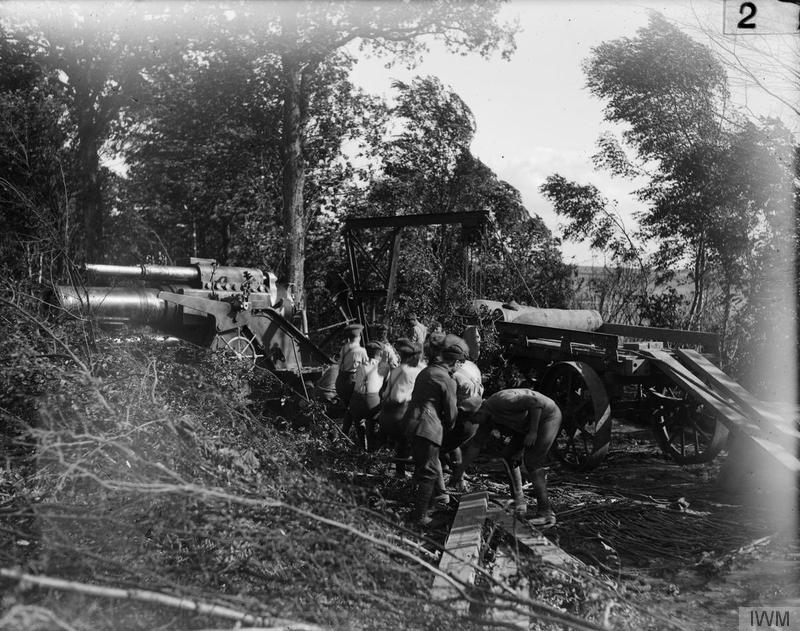
British Howitzers Preparing to Fire, Morning 1 July 1916

Newfoundland Regiment at St. Johns Road Trench Awaiting Movement to Front

Hawthorne Mine Detonated, 0720 Hrs 

34th Division Attacking at La Boisselle

Empty Trench of Departed Scots Guards at Fricourt

Attacking Infatry at Beaumont Hamel

Ration Party of Royal Irish Rifles, 8th Division, Mid-Battle

British Casualties 

German Fatalities in a Captured Trench

German Prisoners Captured During the Day 


Two Fatalities from the Newfoundland Regiment, 29th Division