Now all roads lead to France and heavy is the tread
Of the living; but the dead returning lightly dance.
Edward Thomas, Roads

Monday, January 11, 2016

Was the Meuse-Argonne America's Deadliest Battle?

The Meuse-Argonne Offensive was clearly the worst battle of the Great War in terms of killed in action for the American Expeditionary Force. How does it stand with respect to other comparable U.S. battles, specifically the Normandy Campaign of 1944? 

American Burial Service, 1918

Professor Robert Farrell titled his book on the Meuse-Argonne Offensive, "America's Deadliest Battle." I questioned that assertion when the book came out and eventually got around to doing a little research. The biggest questions involved some assumptions about the most likely competitor for the distinction, the Normandy Campaign of 1944. Some think of Normandy in terms of D-Day and the battle to get off the beaches, while others take it up to the St. Lo breakout of 25 July. However, I concluded the actual end of the campaign is best marked by the official ending date used by the British and Canadians (they were there, too) of 1 September 1944. On that date Patton's Third Army had reached the Meuse River and Montgomery's forces farther north had arrived in front of Arras. Events of that date, to me, indicate clearly that the Battle for Normandy was over and a new phase of the war had started.  

The argument could be made that the figures below are not a fair comparison. For instance, the casualties in the later battle had a much higher proportion of air casualties. There just weren't that many airplanes flying in the Great War. Also, the battles lasted different lengths, the Argonne six weeks, Normandy was twice as long.

Nonetheless, with these qualifications and stipulations,  the conquest of Normandy resulted in more American deaths.  Here are the figures (U.S. dead only are listed)

1. Normandy Campaign, 6 June –1 September 1944
29,000+

2. Meuse-Argonne Offensive, 26 September–11 November 1918
26,000+

Among the First to Perish in the Normandy Campaign: American Dead on Omaha Beach


Sunday, January 10, 2016

Lest We Forget: Gallipoli Was a Turkish Victory

Their duty was to come here and invade, ours was to defend.
Adil Shahin, Turkish veteran of Gallipoli

Turkish Artillery at Gallipoli

The British had expected the Gallipoli operation to conclude quickly and that the Turkish army would be no match for their soldiers. Instead they met a determined and resourceful opponent. At critical moments Turkish and German commanders took quick and decisive action, and at no time did the British Empire forces manage the breakthrough which they so desperately sought.

On Gallipoli men of both sides showed bravery and endurance. After the Turkish counterattack of 19 May, in which the Turks suffered so severely, the Australian and New Zealand soldiers began to regard the Turkish soldier with great respect. Something of the spirit of the Turks on Gallipoli can be seen in the response to an Australian note thrown into a Turkish trench urging its occupants to surrender. The response read, "You think there are no true Turks left. But there are Turks, and Turks' sons!" In this defense of the homeland, in the conflict known here as the Battle of Çanakkale, Turkish authorities have put their casualties at between 250,000 and 300,000, of whom at least 87,000 died.

One of the few officers at Anzac who spoke fluent Turkish was the Englishman Captain Aubrey Herbert. Herbert wrote the following tribute to the bravery of the Turkish soldiers at the Battle of Chunuk Bair:

The day went badly for us. We lost Chunuk Bair, and without it we cannot win the battle. The Turks have fought very finely, and all praise their courage. It was wonderful to see them charging down the hill, through the storm of shrapnel, under the white ghost wreaths of smoke.

Source: Australian Government Website

Saturday, January 9, 2016

100 Years Ago: Allied Evacuation of Gallipoli Ends, 9 January 1916

I hope our poor pals who lie all around us sleep soundly, and do not stir in discontent as we go filing away from them forever.
New Zealand soldier at the evacuation of Gallipoli

Preparations for Evacuation, North Beach, Anzac Sector

After August, the British mounted no further major attacks at Gallipoli. The British Government grew alarmed at the failure to break through to the Dardanelles and there was mounting criticism of the whole venture. In November, when winter arrived, there were men who froze at their posts, and over 16,000 troops suffering from frostbite and exposure had to be evacuated. 

Eventually it was decided that the campaign could not meet its objectives and that the British and Dominion force on Gallipoli should withdraw. Many thought a withdrawal would result in heavy casualties. However, elaborate precautions were taken to deceive the Turks into thinking nothing unusual was happening.

Between 8 and 20 December 1915, 90,000 men were secretly embarked from Suvla and Anzac. On 8 and 9 January 1916 a similar evacuation was conducted at Helles to withdraw the remaining 35,000 Allied troops. Only a handful of casualties was suffered in these well-executed operations.

Source:  Australian  Government

Friday, January 8, 2016

The Kingfish and the Great War


The career of former Louisiana governor Huey Long had some interesting links with the Great War. As a young lawyer, on the verge of launching his spectacular career destined to be shortened by an assassin, Huey Long chose to defend an antiwar state senator named S.J. Harper on a charge of sedition under the Espionage Act. Harper had made statements like "This is a poor man's fight and a rich man's war. President Wilson and Congress ought to be assassinated." Huey and his brother Julius decided to defend their friend, who had helped finance Huey's legal education. Harper—thanks in good part to the Longs' adroitness at jury manipulation—won an an acquittal.  The jury deliberated a full seven minutes.

The Huey Long America Remembers
Biographer William Ivy  Hair thinks this was a key event in Long's rapid political rise. "By defending Senator Harper under such circumstances, during wartime and in a year when Huey was planning to run for office, with his own draft deferment already making him vulnerable to questions about patriotism, Huey Long performed the most courageous and unselfish act of his life."

Oh, about that draft deferment. Know LA: The Encyclopedia of Louisiana summarizes how it followed him ominously for the rest of his life, and even beyond the grave.

Military service did remain a key social marker in Louisiana for a generation or more after the conflict ended. Indeed, Huey Long’s avoidance of wartime service (he received a deferment) and his defense of antiwar state Senator S. J. Harper of Winnfield, who was brought up on sedition charges, provided a point of attack for many of his opponents during the 1920s and 1930s.  Carrie Moore Davidson, a society lady from northeast Louisiana whose only son was killed in action during the war, framed her opposition to Long thus: “When I come to total the final score, I cannot forget that when my boy was fighting in France to make it safe for the Longs they were dodging the draft over here.” Yet the fact that many of his most political bitter rivals had served as officers rather than enlisted men only validated Long’s class-infused criticisms of Louisiana’s upper crust.

In later years, these officers, many of whom were Louisiana State and Tulane University graduates, became influential members of the state’s business and political establishment, almost all in vehement opposition to Long. Many also found their way into the American Legion, a veterans’ organization created after the war that, while disavowing political aims, nonetheless drew men of a more reactionary stripe. Rising from its ranks was Sam Houston Jones, a district attorney and good-government type from DeRidder, who eventually became the figure around whom the conservative forces of the state rallied to defeat Earl Long in the 1940 gubernatorial election. Like his brother, Earl Long missed out on military service during the war. Meanwhile, Jones’s World War I record was featured prominently in his political biography, and Legion posts around the state received him enthusiastically on his campaign tour. 

Huey Long  died from an assassin's bullets on 10 September 1935, 11 days after his 42nd birthday.

Thursday, January 7, 2016

About the Dover Patrol


Admiral Bacon

In late July 1914, with war looming, 12 Tribal-class destroyers arrived at Dover to join the near obsolete destroyers already at anchor in the harbor, most of them built in the late 1800s. These destroyers formed the nucleus of the fledgling Dover Patrol, which, from its early beginnings as a modest and poorly equipped command, became one of the most important Royal Navy commands during both World Wars. At its bases in Dover and Dunkerque, France, the patrol assembled cruisers, monitors, destroyers, armed trawlers and drifters, paddle mine-sweepers, armed yachts, motor launches and coastal motor boats, submarines, seaplanes, aeroplanes, and airships. 

Dover Patrol Memorial
With these resources it performed several duties simultaneously in the southern North Sea and the Dover Straits: carrying out anti-submarine patrols; escorting merchantmen, hospital, and troop ships; laying sea-mines and even constructing mine barrages; sweeping up German mines; bombarding German military positions on the Belgian coast; and sinking the ever-present U-boats.


Admiral R.H. Bacon commanded the Dover Patrol from January 1915 until 31 December 1917. He had been one of the prewar Royal Navy's ablest officers, director of ordnance, an ally of Jackie Fisher, and ironically one of the founders of Britain's submarine service. His open-mindedness and willingness to work with General Haig helped to initiate and almost to pull off one of the most innovative concepts of the Great War. Vice Admiral Roger Keyes replaced Bacon and was charged with the special duty of blockading the German-held Belgian ports and the U-boats based there. This was to culminate in what was the Patrol’s "finest hour", the raid on Zeebrugge and Ostend on 22/23 April 1918.

Source: Dover England Website

Wednesday, January 6, 2016

Disaster at Tavennes Tunnel


Tavennes Tunnel (Probably Just After the War)

Tavennes railway tunnel, located near Fort Vaux, stretched 1.170 meters from the battlefront to the French rear areas and was reached by a narrow cutting. This gave cover to the French troops approaching the front line, a degree of cover to the troops and ,storage for vast amounts of ammunition and fuel. 

It was a dark, utterly fetid existence, not helped by the absence of any sanitary facilities except for the track drainage ditches which ran beside the useless rails and which rapidly became stagnant. It was not a good place to spend time, but at least it was cover from shellfire for some three thousand men.

On 4 September, around 9:15 p.m., a supply train of mules carrying ammunition and supplies, arrived at the tunnel's west side (facing the French). The load carried by one of the mules caught fire for an unknown reason. The frightened animal entered the tunnel, setting fire to gas cans for the generator placed at the entrance. With the draft, the fire reached the ammunition stocks, which exploded. The explosion was felt throughout the region, and the Germans bombarded the entrance to block the French troops inside the tunnel. However, the other exit (facing the German line) was obscured and French soldiers managed to escape in that direction. 

Tavennes Tunnel Today 
Right Tube Added in 1936

The fire burned for days. Of an estimated 3,000 men in the tunnel, about 500 to 700 perished.    Censorship kept the news of the disaster from the public until after the war.

Tuesday, January 5, 2016

Great Battles: Gallipoli
reviewed by David F. Beer


Great Battles: Gallipoli
by Jenny Macleod 
Foreword by Hew Strachan
Oxford University Press, 2015


Those heroes that shed their blood and lost their live are now lying in the soil of a friendly country. Therefore rest in peace. There is no difference between the Johnnies and the Mehmets to us where they lie side by side here in this country of our. . .You, the mothers, who sent their sons from faraway countries, wipe away your tears; your sons are now lying in our bosom and are in peace, after having lost their lives on this land they have become our sons as well. 
  Mustafa Kemal Atatürk 1934

Monument to Atatürk at Cape Helles, Gallipoli

This week, 100 years ago, the Dardanelles/Gallipoli Campaign concluded with the withdrawal of the remaining land troops around Cape Helles. Roads to the Great War is recognizing that event with this review of a work about Gallipoli that is unique. Unlike the many excellent works on Gallipoli such as Alan Morehead's 1956 classic and the recent histories surrounding the campaign's centennial, Jenny Macleod's Gallipoli isn't an analysis of the conflict. Rather, it's a history of the varied and shifting ways in which the campaign has been remembered and commemorated over the past 100 years by those countries whose soldiers fought there.

This includes what is now Turkey. As the opening sentence of Chapter 1 states, "In the early hours of 19 May 1915, 50,000 soldiers from the Ottoman Empire attacked the Australian and New Zealand soldiers who had invaded their country." Thus begins an impressively original and concise account of the campaign followed by a detailed look at how it was thereafter memorialized in Australia, New Zealand, Britain, Ireland, and Turkey. Notably, Anzac Day stands out as the embodiment of the post-Gallipoli "myth" and might be considered, as Macleod claims, Australia's most important export to the world.


Order Now
The author has taken on a difficult task in this book. She argues that no other World War One campaign has been remembered in so many diverse and changing ways. Thus she looks at the countries that were involved — except France, which in spite of losing some 8,000 men at Gallipoli, has maintained no significant cultural memory of the event. The other nations involved have, however, in spite of the campaign representing a shattering defeat for most of them.

Most noticeably, Australia remembers the event with a kind of sorrowful nostalgia mixed with heroic pride. Anzac Day is indeed their day. New Zealand, only slightly less ardent, has followed Australia's lead, while Britain has subsumed "Mr. Churchill's folly" into memory of the war in general. Ireland has slowly moved from a strongly anti-British stance and resentment of those who fought for Britain to a gradual acceptance of those who paid the ultimate price. Much different, of course, is how the victors have remembered and used the victory and the image of Mustafa Kemal to establish ideals within the Turkish nation.

The whole situation is much more complex than this, of course, and Macleod does an excellent job of detailing how in each nation, and in almost every decade since 1915, attitudes have waxed and waned. Hew Strachan points out in his foreword to the book that "The opportunity for invention and reinvention is simply greater the longer the lapse of time since the key event" (pg. x). The extent to which Gallipoli is commemorated and reinvented has always been influenced by religious, military, political, and social concerns within the individual nations, and the author carefully examines these influences, consistently and fully annotating her sources of information.

A School Group from Australia Touring the Gallipoli Battlefields in 2009
(Your Editor Center Rear in Grey Cap)

This is a scholarly yet highly readable study and is Book Two in a new series being published by Oxford University Press under the editorship of Hew Strachan. Several significant battles are examined in the series, including Waterloo, Gettysburg, and El Alamein, with the main focus being on the legacy of these battles in the imaginations of the victors and the defeated. As the author states in her preface, both history and memory are considered, with memory's flexible and selective nature especially being examined in each case. She is well qualified to look at Gallipoli in this light. Besides being an experienced academic, Jenny Macleod is the co-founder of the International Society for First World War Studies and an associate editor of the journal First World War Studies. Anyone interested in the ways the Gallipoli campaign has been evaluated and remembered from 1915 to the present will find this book a most informative and rewarding read.

David F. Beer

Monday, January 4, 2016

Recommended: Sentimental Poilu Postcards

From Bradley Omanson's: 
History & Lore of the Old World War: Artifacts & Odd Bits from 1914–1918


Each country had its own distinctive postcards, of course, including the Germany, but French postcards stand out from all the others and were especially popular. Given the miserable and unrelenting drabness of life at the front, these inexpensive trifles of charm and color, easily available in estaminets and stationary shops behind the lines, may well have seemed irresistible to soldiers just out of the trenches.


It is hardly necessary to point out the immeasurable distance between the fantasized image of the Poilus in these cards— with their scrubbed male models wearing immaculately laundered and pressed uniforms against picturesque battlefield backdrops in pleasing pastels—and the actual mud-encrusted, lice-infested Poilus they supposedly portrayed. These cards were fantasy, pure and simple. . . 

Read the complete article here:


Sunday, January 3, 2016

In Their Own Words: The Pilots of the Lafayette Escadrille


They were the precursors of the mighty awakening of the west—of that gigantic effort of America—unparalleled in history—the greatest of all crusades—where every qualified man was enrolled under the Stars and Stripes, for no selfish aim, for no world-conquest, but for the great ideals upon which civilization depends and for which the entire resources of the nation were unsparingly contributed to assure victory.
Captain George Thenault, Commanding Officer of the Lafayette Escadrille


Kiffin Rockwell
I am paying my part of our debt to Lafayette and Rochambeau.
~ Kiffin Rockwell

Since the formation of the American Escadrille, I have tried to exalt the beauty of the ideal which brought my American comrades to fight for France.
Captain George Thenault, commanding officer of the Lafayette Escadrille 

If I die, wrap me in the French flag, but place the two colors upon my grave to show that I died for two countries.
Edmond Charles Clinton Genet, Lafayette Escadrille pilot—KIA 1916


The first pass convinced me that I was in the presence of a master. This was no laughing matter. Banking my airplane, I saw him about fifty meters below me. He pulled up in order to bait me into making a loop, which would have left him in a good position to fire a volley, but I countered with a half reverse to the right.
Raoul Lufbery, leading Lafayette Escadrille ace—KIA with U.S. Air Service, 1918

Lufbery

I muttered a prayer, yanked back on the stick and hoped. The poor old SPAD groaned, the wires shrieked and every spar bent like an archer’s bow. The agony nearly finished me for a few seconds, but everything hung together somehow. I leveled off and looked back. That damned Hun was still after me, but he didn’t dare yank out as I had done. He had to ease out gradually and was several hundred meters below me before he could consider taking me on again. By that time I had my courage back, and boldly turned to fire a few bursts in his general direction.
Edwin Parsons, Lafayette Escadrille ace

He gave the fullest measure. The old flame of chivalry burned brightly in this boy’s fine and sensitive being. With his death France lost one of her most valuable pilots.
James McConnell remarking upon the death of his squadron mate, Kiffin Rockwell

Captain Thenault (Center) with Four Americans Who Died for France —
James McConnell, Kiffin Rockwell, Norman Prince, and Victor Chapman

The General Commandant-in-Chief, Cited to the Order of the Army, the Escadrille N. 124: 
An Escadrille composed of volunteer Americans who have come to fight for France in the spirit of the purest sacrifice. Under the command of Captain Thenault, it has maintained without ceasing an ardent struggle against our enemies. In exceedingly difficult combats and at the price of severe losses, which far from discouraging it, have exalted its morale, has brought down twenty-eight officially confirmed planes of the enemy. It has excited the profound admiration of the officers who have it under their command, and the French Escadrilles who, fighting by its side, have striven to vie with it in various deeds.
General Philippe Pétain, 1917

Sources: Text from the Lafayette Escadrille Working Group; Images from Tony Langley

Saturday, January 2, 2016

Nexus: The Great War's Grain Crisis and the Coming of Prohibition in America

Anti-Saloon League Wartime Poster

By Keith Muchowski

Food was one of the central crises of the First World War. So many millions faced food insecurity during and after the conflict that the issue became a central preoccupation for the Wilson Administration. Drys, as those who advocated for the prohibition of alcohol were called, understood the significance of the food crisis— how could they not with the price of bread rising so quickly? — and grasped that it could be a way to advance their agenda. The Great War itself did not bring about Prohibition; the temperance movement had been making incremental progress for decades. Activists created the National Woman's Christian Temperance Union (WCTU) in 1874. That same decade First Lady Lucy Hayes became known, with either admiration or derision depending on the individual, as “Lemonade Lucy” due to her strict edict that only non-alcoholic beverages be served at White House receptions. The Anti-Saloon League came into existence in 1893. New York City Police Commissioner Theodore Roosevelt sparked outrage within Gotham’s Irish and German communities a few years later when he began enforcing the city’s strict Sunday blue laws. By the time America entered the war more than a dozen states had gone dry. The grain problem proved to be a convenient means for the drys to advance their initiative.

Herbert Hoover
The food crisis began when the war did in summer 1914. Mining engineer Herbert Hoover proved invaluable throughout the Great War and his first, most immediate task was getting Americans stuck in Europe safely back to the United States. He did this so efficiently—helping nearly 200,000 stranded Yanks find passage home that summer—that he booked his own ticket to come home in late September. The severity and ensuing privations brought on by the German invasion of Belgium soon ended those plans. Belgium was a nation of nearly ten million urban dwellers who soon found themselves running low on foodstuffs of all varieties. Hoover soon found himself in a new, albeit unpaid, position—chief of the Commission for Relief in Belgium. The CRB, a private, non-governmental organization, held its meeting on 22 October 1914, when the war’s first winter was soon to get under way. The commission’s mission was no easy one; it had to feed the millions of Belgians stuck between the German war machine and the British naval blockade. Hoover and his colleagues performed their work with ruthless efficiency, eventually distributing five million tons of four, sugar, cereals, meat, grains, milk, and other provisions worth over 20 billion in 2015 dollars to Belgians trapped at home and in neighboring France over the next five years. The task was complicated by the Germans’ intermittent use of submarine warfare, which sent several thousand tons of additional supplies to the ocean floor.

The plight of the starving Belgians was tragic and yet the food crisis was just beginning. The American declaration of war on 6 April 1917 naturally marked a new phase in the conflict. The war had been good to many Americans until spring 1917, with farmers and Wall Streeters prospering as food went to Europe and the credit to pay for it came to America. Historian David M. Kennedy notes in his seminal book Over Here: The First World War and American Society that wheat selling for less than a dollar a bushel prior to the war was going for $1.25 in 1915, two dollars in 1916, and capped at $2.20 by the Wilson Administration for 1917. Americans would now have to bear the burden at the dinner table. Not only that, they would have to provision their own American Expeditionary Force and the armies of their new allies as well. That burden became more acute when Russia signed a separate peace with Germany and subsequently descended into civil strife and mass starvation. No Russia in the war meant no grain from the east.

No one grasped the need for urgency better than Woodrow Wilson. He requested that Hoover return to the United States and take a U.S. government position. Hoover arrived in the United States in May 1917 and got to work before he officially had a job. That post came three months later after the passage of the Lever Act, sometimes called the Food and Fuel Control Act, on 10 August 1917. Four days later President Wilson created the Food Administration Grain Corporation, part of the wider United States Food Administration, to add teeth to the new law. He put Herbert Hoover in charge with the official title of United States Food Administrator. Others understood the problem as well. In May, as Hoover was returning to America, Progressive reformer and Yale economist Irving Fisher created a Committee of Sixty, who campaigned against using America’s grain supply in the distillation of alcoholic beverages for the duration of the war. The committee’s motto was “Save 11,000,000 loaves of bread a day.”  

Congress got into the act in June when the Senate Agricultural Committee debated whether to ban beer, wine, and spirits. The Anti-Saloon was one of the provision’s strongest supporters. The bill was defeated at this time, but brewers were required to lower the alcohol content and also to use 30 percent less grain in their in their products. That December former president Theodore Roosevelt publicly declared his support for prohibition not just in the army but for civilians working in such war-related tasks as shipping, mining, munitions manufacturing, and military transport.

U.S. Food Administration Poster, 1918

The task was urgent and the problems real. Grain prices were quickly set at $2.26 for the next two crop years. The Grain Corporation’s distribution of food stuffs is staggering to imagine, with the organization selling nearly 30 billion 2015 dollars worth of wheat, grains, cereals, and other perishables over the 33 months course of its existence. America’s principal allies—Belgium, France, Great Britain, and Italy—were the chief beneficiaries. After the Armistice, however, the Food Administration and its successors fed friends and enemies as disparate as Finland, Estonia, Germany, Turkey, Hungary, Austria, and Denmark, to name only a few. The initiative had taken its toll, with Americans forced to observe Wheatless Mondays and Wednesdays among other deprivations. Bakers and consumers alike also chafed that bread prices were increasing while the loaf itself was shrinking. Scientific American published what it thought to be a helpful article in its 23 November 1918 edition on the wonders of “substitute bread,” a concoction using alternative ingredients.

Frances Cleveland Preston
Temperance advocates inserted themselves into this breach with growing boldness. In February 1918 President Wilson received a petition signed by six million women calling for a ban on beer. The measure had serious backing. This support included the usual advocates, such as Anna A. Gordon, President of the National Woman’s Christian Temperance Union, but also the leaders of such groups as the Daughters of the American Revolution, the Federation of Women’s Clubs, the Y.W.C.A., the National Federation of College Women, and many others The petition’s chief signator was Frances Cleveland Preston, the widow of President Grover Cleveland. Hoover and Wilson were against the measure but eventually ceded to the inevitable. Hoover’s Food Administration, with President Wilson’s reluctant imprimatur, mandated in late summer 1918 that American breweries stop manufacturing beer and malt liquors by 1 December of that year. The brewers in a sense were an easy target. German- and Irish-Americans were among the largest producers and consumers of beer and malted beverages in the United States. These hyphenated Americans were suspect in the eyes of some, as many Irish were anti-British and many German-Americans suspected of greater loyalty to Kaiser Wilhelm than Uncle Sam.
An Anti-Saloon League Cartoon Explicitly Linking the Enemy with the Liquor Industry

The grain crisis and the temperance movement came together during the First World War in ways that were mutually reinforcing. Grains are of course a key ingredient in many alcoholic beverages and their shortage during the war, combined with the need to feed Europe’s starving millions, made it increasingly palatable to restrict and even abolish their use in the making of alcoholic beverages. The push for an amendment banning all alcoholic beverages continued even while the war was going on. Congress passed the Eighteenth Amendment on 18 December 1917 and sent it to the 48 states for ratification. Many felt it would never obtain the three-quarter majority required for passage, yet it only took 13 months for it to become reality. Nebraska became the thirty-sixth and deciding state when it ratified the measure on 16 January 1919. President Wilson was in Europe attending the Peace Conference. Twelve months later Prohibition was the law of the land.

Our contributor, Keith Muchowski, previously contributed and article on musical genius and Harlem Hellfighter officer James Reese Europe (view). Visit Keith's Blog, The Strawfoot,  for more interesting insights on the history of the First World War.


Friday, January 1, 2016

What to Expect in 2016 from Worldwar1.com


Here's what you can look for in the coming year from all our publications at Worldwar1.com, including Roads to the Great War, the St. Mihiel Trip-Wire, Over the Top magazine, and our constellation of educational websites.


Paralleling the Centennial Events from 1916


From Top: The Somme, Jutland; Three Key Commanders of 1916: Philippe Pétain,
Aleksei Brusilov, and Franz Conrad von Hötzendorf; Verdun

Following America's Inexorable (But Somewhat Indirect) March to the Battlefields


In 1916 America Would Launch a Punitive Expedition into Mexico
Under the Command of Future AEF Commander John J. Pershing

Battlefield Imagery from Today


Austrian Position Atop Mte Lagazuoi, Dolomite Alps
Site of  Major Mining Operations 

Illustrations and Photographs from the Period


French Soldiers at Verdun Using Coffins at Meal Time

Reviews and Recommendations for Your WWI Bookshelf


Recommended Works on the Battle of the Somme

Thursday, December 31, 2015

New Years Eve 1915


100 years ago today the war was dragging on. German attacks were mounted in the Vosges and north of Loos. The Royal Navy was recovering from the loss of the armored cruiser HMS Natal in a mysterious explosion the previous day. No one was imagining what was to come in 1916 at Verdun or the Somme. Tomorrow we will share some of the topics we will be including in our Centennial coverage of the Great War next year.

About our card: 
The image is a detail from the Panthéon de la Guerre at the National World War I Museum. Thanks to Mike Vietti and Mark Levitch.

Wednesday, December 30, 2015

Kipling and the Imperial War Graves Commission


Today is the anniversary of Rudyard Kipling's birth in 1865.  Kipling wrote much about the Great War and, of course, suffered until the end of his life over the loss of his son John at Loos in 1915. However, his contributions to the Imperial War Graves Commission will live on as long as we remember the fallen of the war.  Here is a summary of his contributions I discovered from the Kipling Journal of the Kipling Society, March 2005 issue.

By Dr. Deborah E. Wiggins


A Contribution of Rudyard Kipling

Membership on the Imperial War Graves Commission was the first office Kipling ever assumed. He did have some involvement with the Boy Scout movement, including allowing Lord Baden-Powell to use the Jungle Book for preparation of The Wolf Cubs' Handbook. But he had refused the laureateship in 1895 and declined the Order of Merit three times on the grounds that whatever services he might perform for empire or king would be most effective out of the public eye.

The Imperial War Graves Commission was born of the need for proper burial for the thousands of dead in France and other theaters of war. In the first months of the war, the dead had been buried in the trenches, but the British stopped this practice by 1915. The British Army created a Graves Registration Unit in 1914. This group took over work that had been done up until that time by the Joint War Committee of the British Red Cross Society and the Order of St. John of Jerusalem. In 1916 this unit was renamed the Directorate of the Graves Registration and Enquiries and worked with the National Committee for the Care of Soldiers Graves (whose president was the Prince of Wales). Eventually there were calls for a larger committee to look after all the graves of the empire, and the Imperial War Graves Commission was created in 1917.

Typical Memorial Panel Found in
Cathedrals in France and Flanders
While the Army recognized the necessity of handling burials, the early view was that the Graves Registration workers were simply a requirement that might detract from more important activities. In a letter from March of 1916, General Sir Douglas Haig discussed the request for more motor transports for use by this unit:

It is fully recognized that the work of this organisation is of purely sentimental value, and that it does not directly contribute to the successful termination of the War. It has, however, an extraordinary moral value to the Troops in the Field as well as to the relatives and friends of the dead, at home. . . Further, it should be borne in mind that on the termination of hostilities the nation will demand an account from the Government as to the steps which have been taken to make and classify the burial places of the dead, steps which can only be effectively taken at, or soon after burial. 

The first members of the commission included the Prince of Wales as president. The chairman was Secretary of State for War Lord Derby, who had recently lost his son-in-law in the war. Other members included the vice-chairman, Fabian Ware, who had spearheaded the British Red Cross involvement with registration of graves; General Sir Nevil Macready; Admiral Poe; Sir William Garstin of the Red Cross; Harry Gosling of the Transport and General Workers' Union; and Rudyard Kipling. Both Garstin and Kipling had lost sons in the war. 

At the start of the commission, the members decided that there would be three general concepts that would guide the development of all the cemeteries. All memorials would be permanent, the headstones would be uniform, and there would be no distinction as to rank. As Frederic Kenyon, Director of the British Museum, noted, "where the sacrifice had been common, the memorial should be common also." This was a departure from past practices, but the members of the commission decided that the task ahead of them required both innovation and precise planning. Seven architects were appointed to plan the cemeteries. Kenyon was also consulted as to design. The Royal Botanical Gardens at Kew were in charge of the horticultural features.

To Kipling went the job of inscriptions for the memorials. It was his feeling that this was not the occasion for the invention of some new form of words, but that the idea which the stone intended to convey could be best expressed by the choice of some familiar phrase from the Bible. 

The commission considered several possibilities, including "You live and die, and die and live," and "All's Well" from J. M. Barrie.  Other suggestions included "To the Brave" and "Peace be with you." One of the architects, Sir Edwin Lutyens, suggested simply "Amen." But the choice was really Kipling's, for as Lutyens complained, "the question is coming to a head and if Kipling says the ukase, the Royal Commission will say yes." Kipling took his choice from the Apocrypha in Ecclesiasticus 44, verse 14, "Their name liveth for evermore."

Kipling was responsible for the composition of most of the inscriptions used in the British memorials located in French cathedrals, including the words placed on the headstones of unmarked graves, "A soldier of the Great War. . . Known unto God." He is also given credit for beginning the evening ceremony of playing of "The Last Post" at the Menin Gate Memorial. Kipling is also mentioned as being one of the originators of the idea of the Unknown British Soldier whose body was interred in Westminster Abbey on 11 November 1920. 

Two Highlanders "Known Unto God"

On one occasion soon after he joined the commission, Kipling was asked to assist in drafting a revision of the letter sent from the King to the bereaved family on the death of a member of the military. Lord Derby felt that the original letter was too brusque. "I cannot myself think of the right words," Derby wrote, "but I am sure in this respect you could very much help me." Kipling wrote back immediately with several suggestions, although as he commented, "It's a bit hard to combine the impression of national thanks with a personal letter from the King." As it turned out, Derby did not use Kipling's suggestions, but basically stayed with his own first draft. 

In September 1920 Kipling urged the commission to establish local enquiry offices in Britain to assist families in their searches. Many family members planned trips to France to visit the graveyards; Thomas Cook was advertising tours to the battlefields. On Kipling's frequent visits to France, he had seen "many bereaved relatives wandering, confused, distressed and helpless." The commission eventually allotted a budget of £4,500 for these local offices. 

Kipling was a determined traveler to the various cemeteries, viewing this oversight as a part of his work for the commission. . .He wrote to his close friend H. Rider Haggard that

One never gets over the shock of this Dead Sea of arrested lives — from V.C.'s and Hospital Nurses to coolies of the Chinese Labour Corps. By one grave of a coolie some pious old Frenchwoman (bet she was an old maid) had deposited a yellow porcelain crucifix!! Somehow that almost drew tears. 

In 1922 King George V made a visit to Belgium and France to tour the cemeteries and meet with the workers of the commission. The coastal cemetery of Terlincthun was the last location visited by this convoy of dignitaries, and here the King spoke to the crowd and the world, but his words were written by Kipling.

In the course of my pilgrimage, I have many times asked myself whether there can be more potent advocates of peace upon earth than this massed multitude of silent witnesses to the desolation of war.

Inscription on the Menin Gate, Ypres

In the last few years of his life Kipling was bothered more and more frequently by recurrent digestive tract illnesses, and his trips for the commission were fewer. However, he was present on 4 August 1930 in an official capacity for the unveiling of a war memorial to commemorate the Battle of Loos. The memorial was designed to honor all those who had fallen in the battle but especially those whose bodies were never found. General Sir Nevil Macready addressed those assembled, and the buglers of the Irish Guards sounded the "Last Post." Kipling was to have spoken at the ceremony, but according to reports, he was "completely overcome by emotion." His work for the Imperial War Graves Commission was a painful labor of love and a public demonstration by a very private man. Above all, it was duty fulfilled.

Sources: Kipling Society, Cyril Mazansky

Tuesday, December 29, 2015

Devil Dogs Chronicle: Voices of the 4th Marine Brigade in World War I
reviewed by Courtland Jindra


Devil Dogs Chronicle: Voices of the 4th Marine Brigade
in World War I
Edited by George B. Clark
University Press of Kansas, 2013

Marine Recruits 1918 – "First to Fight"

The first day at camp I was afraid I was going to die. My next two weeks my sole fear was that I wasn't going to die. And after that I knew I would never die because I had become so hard that nothing could kill me.

And so the main portion of George Clark's narrative begins. Devil Dogs Chronicle is an anthology of letters, remembrances, and diaries, with commentary by Clark thrown in from time to time. The Marines really made their name at Belleau Wood and arguably this unit is one of the most written about in the AEF. Because of the wealth of materials on the brigade, the author obviously thought it was best to let the men speak for themselves. This proved to be an excellent decision by and large, as most of these men were fantastic writers.

After a brief overview of the Marine Brigade's exploits in the Great War, Clark throws us right back into boot camp. Much to my surprise, this section was probably my favorite. There are some truly hilarious descriptions of the raw recruits at Paris Island. We follow new marine officers in their training shortly thereafter. This is where we meet Second Lieutenant James MacBrayer Sellers, who is probably the most described of all the men in the book. As one would expect, the journey to and arrival in France, combat, occupation, homecoming, and then a wrap-up on what happened to everyone after the war are also included.

The chapter on Belleau Wood is by far the longest (at nearly 80 pages), but every battle the Brigade was involved in gets special attention. The descriptions of combat themselves are often riveting. However, I wish Clark had included more commentary in these chapters as I had a hard time with what exactly was happening on the ground. Sometimes books that just focus on what divisions and corps are doing can be incredibly dry, but here I needed more of that to ground me in what was going on. The maps that were included were insufficient to be able to figure out where one regiment was versus the other, what one battalion was doing, or where the companies were spread out on the field.

Marines at Belleau Wood After the Battle

This got to be frustrating — especially in the Belleau Wood chapter. I remember in the 1964 BBC documentary The Great War there is an interview with a veteran of the battle who said “the difficulty with Belleau Wood was you never knew where the front was. Little groups of men, little groups of Americans, little groups of Germans got together to fight each other and while you were fighting in one direction, all of the sudden without any warning, you would find that there were some Germans to the rear of you.” For some readers, this confusion will not be a problem, but I really needed some clarity on how the battlefield was laid out. The chapters on later engagements had similar issues, but I was mostly able to follow the action. The best combat segment was First Lt. Cooke's portion on the opening of Soissons. That was an amazing read.


Order Now
Mr. Clark obviously did a huge amount of research. Not only are the sheer number of accounts he included impressive, but his footnotes are some of the most extensive I have seen. I think nearly everyone who is mentioned by name in the text gets some sort of notation in the back about their awards, citations, or death (often all three). It appears to me that this was a labor of love the author had been thinking about putting together for some time. I do have one related criticism however — for me Clark's commentary in the course of the book ranges from informational and helpful to borderline annoying. That said, I think military historians would for the most part love this book. It's an important piece for posterity, and I am very glad to own it.

Courtland Jindra

Monday, December 28, 2015

Unique AEF Photos from the Imperial War Museum

During an incredibly dismal TV football game (49ers vs. Browns, but I'll spare you any more details) I went exploring on the Internet.  I discovered that the Imperial War Museum has a substantial collection of American photos covering several categories, naval, home front, etc.  I managed to go through their entire "THE US ARMY ON THE WESTERN FRONT, 1917–1918" set and discovered several images I've never seen before.  Here they are:

Troops Arriving at Le Havre, France


Renault FT-17 Tanks Under Camouflage 


An Artillery Unit on the Move


General Pershing's Quarters at Chaumont


Delousing Hut


First American Prisoners of War; Captured at Cambrai, October 1917


American Soldiers Visiting a Belgian Fort Near Antwerp


King George V Decorating 33rd Division Soldiers After the Battle of Hamel


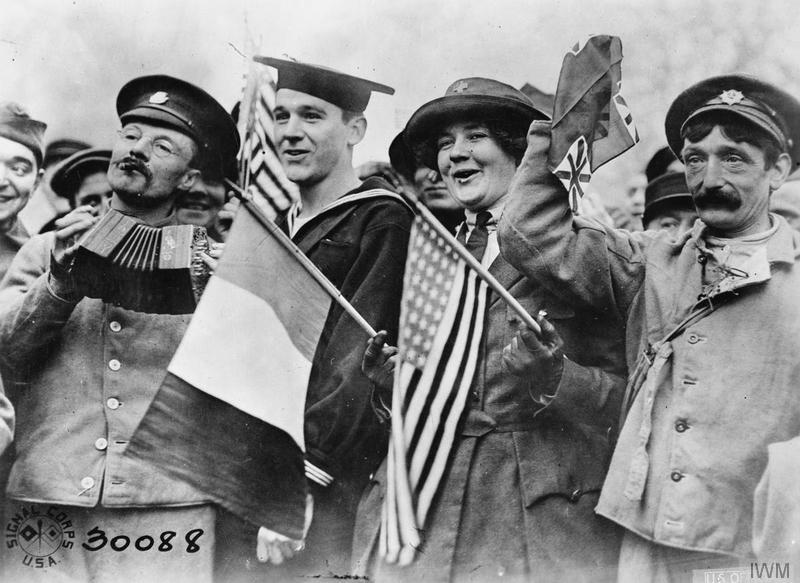
Armistice Day in Paris


Sunday, December 27, 2015

British Military Aviation in 1915, July – December


The Vickers Gunbus Became Operational in July 1915

12 July
Following an inconclusive exchange of fire on 6 July, the monitors HMS Severn and HMS Mersey re-engage the German Navy cruiser Königsberg, which had been trapped in the Rufiji Delta by blockships. A seaplane of the Royal Naval Air Service provided spotting for the monitors until forced to land due to a combination of engine trouble and damage from anti-aircraft shrapnel. The Königsberg was destroyed during the bombardment.

13 July
The British Armstrong Whitworth SS (Submarine Scout) airship with an extra fuel tank successfully completes trials at Kingsnorth in Kent.

24 July
Colonel F.H. Sykes is appointed to command all Royal Naval Air Service (RNAS) air units in the eastern Mediterranean, effectively becoming the air commander for the Dardanelles operation.

25 July
No.11 Squadron, Royal Flying Corps (RFC), the first fighter squadron to be fully equipped with the Vickers Gunbus 2-seat fighter, arrives in St Omer, France.

25 July
The Victoria Cross is awarded to Lieutenant Lanoe G. Hawker of No.6 Squadron, Royal Flying Corps, for his actions during an offensive patrol over France and in recognition of the continuous courage he demonstrated while flying a Bristol Scout 1611, with a hastily fitted cavalry carbine.

31 July
The Victoria Cross is awarded to Captain J.A. Liddell of No.7 Squadron, Royal Flying Corps, for his actions during a reconnaissance patrol over Ostend in Belgium. His observer was Second Lieutenant R.H. Peck and the aircraft a Royal Aircraft Factory RE5, 2457.

August
The first systematic scheme for training observers is introduced.

HMS Ben-My-Chree

12 August
Flight Commander C.H. Edmonds of the Royal Naval Air Service makes the first aerial torpedo attack as he sinks a Turkish supply ship in the Sea of Marmara, Dardenelles, flying a Short 184 seaplane from the seaplane carrier HMS Ben-My-Chree.

17 August
Flight Commander C.H. Edmonds sinks a second Turkish vessel with an aerial torpedo. While a Short 184 seaplane flown by Flight Lieutenant G.B. Dacre of the Royal Navy, sinks a Turkish tug. However, the plane was not airborne at the time and needed to release the torpedo in order to be able to take off from the water.

19 August
Colonel Hugh Trenchard assumes command of the Royal Flying Corps in France in succession to Sir David Henderson. Trenchard was promoted to brigadier general and quickly requested another squadron by the middle of September. He further suggested that one squadron be provided for each army corps for artillery work, photography and close reconnaissance, and one squadron for each army headquarters, for army reconnaissance.

Trenchard also suggested that there should be a headquarters squadron for General Headquarters (GHQ) work and that a further squadron be provided for each army for special work such as bombing raids.

23 August
Captain A.J. Liddell of the Royal Flying Corps is awarded the Victoria Cross for valour while flying a Royal Aircraft Factory RE5.

24 August
Major Lanoe G. Hawker of No.6 Squadron, Royal Flying Corps (RFC) is awarded the Victoria Cross for shooting down three German Albatros biplanes while flying a Bristol Scout C biplane and armed only with a bolt-action rifle mounted beside the cockpit.

September
The Royal Flying Corps Machine-Gun School is formed at Hythe to instruct students in air fighting.

23 September
No.2 and No.3 Wings of the Royal Flying Corps begin the first concentrated interdiction campaign aimed at disrupting German communications, in support of the Allied offensive at Loos. The attacks continued until 16 October. Rail lines were damaged in 16 places, five trains were destroyed, and a signal box and railways sheds at Valenciennes were wrecked.


Maj. General Hugh Trenchard Just After the War
(Corrected from Original Posting)

4 October
In a special order of the day, the commander-in-chief of the British Expeditionary Force Field Marshal Sir John French expresses to Brigadier General H.M. Trenchard and all ranks of the Royal Flying Corps his appreciation of "the valuable work they have performed during the battle of Loos, he desires especially to thank pilots and observers for their plucky work in co-operation with the artillery, in photography and bomb attacks...Throughout these operations the RFC have gallantly maintained the splendid record they have achieved since the commencement of the campaign".

8 October
No.26 Squadron is formed at Netheravon from personnel of the South African Air Corps previously engaged in the campaign in German South-West Africa. The squadron subsequently embarked for East Africa in December 1915 to participate in operations against German forces in Tanganyika.

November
The Royal Flying Corps' 5th Wing, consisting of No.14 and No.17 Squadrons, supported by an Aircraft Park, arrives in the Middle East. The Wing was commander by Lieutenant Colonel W.G.H. Salmond.

3 November
The first land plane to be flown from an aircraft carrier is piloted by Flight Lieutenant H.F. Towler of the Royal Naval Air Service (RNAS), when he flies a Bristol Scout C from the seaplane carrier HMS Vindex during launching experiments.

7 November
Lieutenant G.S.M. Insall of No.11 Squadron, Royal Flying  Corps, is awarded the Victoria Cross for his actions during a fighting patrol across German lines. Air Mechanic T.H. Donald was observer-gunner in a Vickers FB5, 5074.

19 November
The Victoria Cross is awarded to Squadron Commander R. Bell-Davies of No.3 Squadron, Royal Naval Air Service, for rescuing a downed airman (Flight Sub-Lieutenant G.F. Smylie) after completing a bombing attack on Ferejik Junction in Bulgaria in a Nieuport 12, 3172.

Handley Page Bombers Operational Later in the War

18 December
The first British multi-engined aircraft is test flown. The Handley Page O/100 is piloted by Lieutenant Commanders Stedman and Babington.

Source:  RAF Museum