Now all roads lead to France and heavy is the tread
Of the living; but the dead returning lightly dance.
Edward Thomas, Roads

Wednesday, August 17, 2016

America's First Flag to the Western Front, Part I


Part I: The Journey Begins

By Patrick Gregory


On 24 April 1917, less than three weeks after Congress, following President Wilson's war message, declared war on Germany, a crowd gathered around a group of students on San Francisco's Embarcadero waterfront. The young men standing proudly to attention at the Ferry Building that lunchtime were drawn from Stanford University and the University of California, Berkeley. 

Although numbering only 63 in total, the group — one section from Stanford, two from Berkeley — was dwarfed by the entourage accompanying it. Some 3,500 uniformed university cadets thronged around, themselves flanked by detachments from the U.S. Army and Navy. All had come to celebrate the young men's decision to leave imminently for the war in France — volunteers of the "American Ambulance" or "American Field Service", a corps of ambulance drivers already serving on the Western Front. At a given signal, the assembly moved on en masse for the two-mile march from the Ferry Building down to the city's Civic Auditorium, there to take part in an historic leave-taking ceremony, one which would help symbolize America's participation in the Great War. 

The Civic Auditorium Rally

More than 12,000 people crammed inside the auditorium for the occasion, having come to listen to the speeches being made and anthems sung and to witness the presentations which followed. Californian dignitaries sat and stood on the platform, figures drawn from the worlds of politics, the church, and the army. Among them, and from the universities concerned, the dean of the faculties of the University of California David Barrows and the president of Stanford and chairman of the League of California Ray Lyman Wilbur; the French consul-general Julien Neltner; Mrs. Herbert Hoover; and the San Francisco industrialist and entrepreneur W.B. Bourn. The latter was representing the group the "Friends of France". The Friends and the American League of California were to present brassards for the young men to wear during their service in France, and also to hand over four American flags. These flags had been brought beforehand by the Bishop of California for blessing and one of them was soon to take on a special significance — it would become the first official American flag to be brought to the front and flown in service there. 

Mindful that it would be some time before the first contingent of American Expeditionary Force troops would be ready to leave for Europe, the American League of California had approached Secretary of War Newton Baker in Washington for permission to fly this "First Flag" and the other flags as official standards in France. Baker had agreed, and in the San Francisco ceremony that April day, the First Flag was handed over to the detachment of volunteers representing Stanford. The Stanford students would have the responsibility of bringing the flag to France as soon as possible, and once there presenting it to a group already serving on the front — the First Stanford Unit — who had set out from their university two months before. 

Because it was likely that this new "Second Stanford" would take some time to gather itself, however, it was decided to entrust the banner to one member of the unit and to ask him to travel on ahead of the group. That task now fell to 21-year-old Arthur "Clifford" Kimber. 

"Allies Day," New York, May 1917
Childe Hassam
Kimber began his journey four days later, setting out on the first leg of his trip on an overnight train from the Oakland Mole railroad wharf across the bay from San Francisco. His journey across America was to take a week in all as he wound his way doggedly across country: up through California and into Oregon; over into Washington State and Idaho, across Montana and North Dakota into Minnesota, and across the Mid-West and beyond. There were stop-offs on route in Portland, Chicago, and Detroit to try to gain some publicity for the flag, something he had promised his unit he would do. 

A photograph of Kimber posing proudly with the flag duly appeared in a newspaper in Oregon, and before long he found himself touring factories in the big industrial cities of Chicago and Detroit, factories which would soon be gearing up for the demands of the war effort. Reaching New York on Saturday 5 May, Kimber's first port of call was the offices of the American Field Service and the organization's main figurehead in the United States, the Bostonian Henry Sleeper. With his ship scheduled to leave for Europe just ten days later, it had already been planned that the flag would be paraded down Fifth Avenue — the so-called "Avenue of the Allies" — at the head of an American Ambulance parade, something the two men now discussed. Theirs was to be one of several processions and cavalcades New York would see that week, with the Allied representatives Marshal Joseph Joffre of France and British Foreign Secretary Arthur Balfour in town at the head of their countries' respective war delegations. The American Impressionist Frederick Childe Hassam was also there, an artistic witness to these heady days of flag-waving and cheering crowds, days which would later be commemorated in one of his Flag Series, "Allies Day May 1917," now in the National Gallery of Art. 

The parade involving the American Ambulance volunteers, when it came on Thursday 10 May, was a stirring affair. Yet it was one with some comedic overtones. The crowds did indeed gather in strength to see this special Stars and Stripes being carried through the city, and they lined the pavements down the route. But festivities were somewhat marred beforehand by a prank played by some of the ambulance students from University of California, Berkeley, who had come to New York for the parade. As Stanford's senior and larger rival, and seemingly annoyed by the attention being afforded Kimber, some of the University of California students surrounded him. They snatched the flag from his grasp and, succeeding in bundling it into a taxi with one of their unit on board, made off down through Manhattan. What followed owed more to a Keystone Cops sequence than a serious war rally, a rather farcical chase complete with a passing policeman jumping on the running of a second taxi to give pursuit. The offending student party was eventually stopped and the flag returned to allow the ceremony to proceed. 

Note from Former President Roosevelt

The rest of Kimber's time in New York passed off with less excitement, barring a stop-off to visit former President Theodore Roosevelt. The latter was an old acquaintance and sometime ally of Kimber's late clergyman father, but, more specially, he was young Clifford Kimber's political hero. The two talked of Kimber's father and his ministry before moving on to the main subject at hand, the war. Roosevelt, by that time in his late 50s, reflected ruefully on the fact that it appeared unlikely he would be permitted to raise his own corps of troops for the front. If that changed, the former president said, all the younger man had to do was write to him and he would use him in some capacity. But for now, the older man took the notebook proffered and inscribed a message of good luck to the volunteer on his travels. 

Before leaving New York, Kimber went to Trinity Church on Wall Street. There, on Sunday 13 May, with the rector Rev. William Manning presiding, he took part in a service carrying the flag and afterwards placed the flag in the chancel of the church. Many parishioners paused before it with some stopping to touch or kiss the folds of consecrated cloth. The following afternoon, accompanied by his mother, Clara, who had travelled to New York with him, he took a taxi down to Pier 62 on the Hudson river, there to board the steamship St. Louis, bound for Liverpool in England. A reassuring ship to sail for Europe in, the St. Louis — later renamed the USS Louisville and used as a troopship of the A.E.F. — had been the first such American vessel to be armed and to sail the Atlantic in the spring of 1917 after Germany's resumption of unrestricted submarine warfare. 

Book Cover Showing A.C. Kimber
& the Actual First Flag
The nine-day voyage on the St. Louis passed off without incident, life on board gradually settling into a comfortable if humdrum routine, but in the last 24 hours of the crossing, that easygoing mood of passengers suddenly darkened. The ship was entering the coastal waters around the British Isles, the danger zone where most U-boat activity of the war had been concentrated. They passed the area off the Irish coast where the Lusitania had been sunk two years previously and now spotted an empty lifeboat and some floating wreckage in the sea, evidence of more recent activity. After a few hours, a U.S. destroyer came out to guide them and chaperon them the rest of the way to Liverpool. Yet the mist swirling around them kept the approaching land largely hidden from view and that last night, fearful of having to abandon ship in haste, many of the passengers took to sleeping on deck or inside in the saloon, fully clothed. 

Yet make land they did in Liverpool on Wednesday 23 May as the passengers spilled gratefully onto the quayside and docks below. After a few brief hours of sightseeing in the port city, Kimber was on his way again, a train carrying him and others from the ship to London. Overnighting in the capital that evening he next secured passage on a cross-Channel troopship to France, and by dawn on the Friday he was in Paris. Kimber was to spend the next week there, staying at the American Field Service headquarters and getting used to the disciplines of his new quasi-military life. Then, after discussions with the director of the AFS, A. Piatt Andrew, he prepared to make for the front to join the First Stanford Unit. He would finally deliver his precious cargo.

© Patrick Gregory 2015

Adapted from the forthcoming An American on the Western Front: The Letters of Arthur Clifford Kimber, Patrick Gregory & Elizabeth Nurser (The History Press, UK, June 2016)

Tuesday, August 16, 2016

An American on the Western Front
reviewed by Jane Mattisson Ekstam


An American on the Western Front: The First World War Letters of Arthur Clifford Kimber, 1917–1918


by Patrick Gregory and Elizabeth Nurser

The History Press, 2016

An American on the Western Front is more than the story of one soldier: it also describes how America entered the global stage in 1917. The story of Arthur Clifford Kimber (he signed himself "Cliff") had been told before by his mother, in the small volume The Story of the First Flag (1920), which is based on selected letters. Unlike the earlier story, however, An American on the Western Front places Clifford's letters in their historical context. An American on the Western Front is thus not one but two stories: that of Arthur Clifford Kimber and that of America's involvement in World War One.


Order Now
Thanks to Clifford's mother's careful storage and typing of her son's letters (many were also addressed to Clifford's brothers, John and George), the scholarly use of historical sources, Professor Andrew Wiest's short but highly informative introduction, and Elizabeth Nurser's editing skills, An American on the Western Front provides the reader with an unusually rich picture of America's involvement in the last two years of the war. In the words of Andrew Wiest, An American on the Western Front is "an important first step" in filling "the historiographical lacuna of the experience of American soldiers fighting and dying in the trenches of France" (19); it shows that the war was fought by "young men with real lives and dreams" (20). In total, there are 160 letters in the collection; those sent to friends have not survived. Many of the letters are quoted in full in the 35 chapters that make up An American on the Western Front. In one of the earliest letters, Clifford tells his mother that the American army is full of patriotic young men who have "quit their studies" (Clifford was a student at Stanford University in 1917; 56). On his journey to England, he reflects on the dangers of crossing the Atlantic and on the sinking of the Lusitania, a story described to him by a steward who had survived. In France Clifford not only wrote letters but also took photographs. Having observed a confirmation service in the small village of Ligny-en-Barrois, for example, he took an emotive photograph, which is included in An American on the Western Front (126). The innocence of the children (the girls are all dressed in white) is in stark contrast to what is going on around them. Clifford is horrified by the atrocities committed by the Germans and proud of his nation for entering the war. It is in the letter that describes the confirmation service that Clifford begins to reflect on the attractions of being an aviator. He is excited by all that he is learning in the war and particularly impressed by those who wish to become pilots. He says, however, that "I have definitely made up my mind not to consider'"(126) such a step, preferring to drive an ambulance. Nonetheless, he changes his mind, and three chapter later (chapter 15), he describes his very first flight. When in June 1917 he was asked if he would like to be a pilot and agreed to accompany a senior pilot on a 45-minute flight, he became convinced that he would indeed "make an excellent aviator" (158).

Arthur Kimber in Flight Training

As the speed of the airplanes increased and as they became more maneuverable, Clifford realized that it was becoming increasingly dangerous to fly. He describes one accident in which he was involved:

Enclosed is a souvenir. It is a piece from the propeller of the chasse plane I wrecked today, my first smash-up and a mighty good one, take it from me. But I was not hurt, so DON'T WORRY. You may be interested to know what it is like to be in an aeroplane wreck. Got in the plane this afternoon and made three flights with fair landings. These chasse type planes land very fast, 40 to 50 miles per hour and faster, and as I said before are very, very sensitive and quick to respond. In fact sometimes we are too brutal with the controls, as the French moniteurs say. We forget ourselves and handle these highly sensitive machine birds as we handled the lumber wagons we first flew in, planes like the Curtiss, Farmans, and Caudrons; that's what I did today.

I came down pretty fast, a little faster than I thought, like a 'bat out of H.' to use the generally accepted expression over here, and I didn't redress, pull back on the stick, quite soon enough. Result: the plane hit on the wheels and bounced way up in the air; this would have done nothing if I could have kept even, it would have ended in a 'pancake' or three point landing, but I tipped a little to the right. I corrected, but was too brutal, for instead of shoving the stick to the left just a little, I threw it over all the way as I should have done with a C. Up went the right wing; down went the left; and in the twinkling of an eye the left wing hit the ground, crumpled up like paper with a cracking sort of sound and the end strut dug in. The machine hesitated a second and then with a swing and a sudden jerk it reared up on its nose splintering the propeller into bits (only a matter of a couple of hundred dollars or so; thank heaven I don't have to pay a cent; it is on Uncle Sam and you good old taxpayers at home), and burying the revolving motor a foot in the ground
(239).

Meuse-Argonne Cemetery, Romagne
On June 15th 1918, Clifford recorded the death of a fellow aviator. An American on the Western Front contains several letters about exploits in the air, Clifford's own and those of others. His final letter bears no trace of suspicion that it might be his last. Recording a move to a new camp, he explains that he must be up early the following morning to report for duty. It was to be his last night. What happened in Clifford's final flight is related in the following chapter, "Final Flight", chapter 33.

An American on the Western Front is a labor of love and a tribute to the USA's efforts in World War One. It is both scholarly and passionate; Patrick Gregory is an historian and son-in-law of Elizabeth Nurser, the daughter of Clifford's brother, George. The family story is a national as well as a personal one and deserves to be read by all who wish to know more about the USA's involvement in the war. The accessibility of the language, the richness of the illustrations (pictures, photographs, and maps), and the additional information in the copious notes and appendix make An American on the Western Front pleasurable as well as instructive reading.

by Jane Mattisson Ekstam
Østfold University College, Norway


Before he joined the Air Service, Arthur Kimber also made a highly symbolic contribution to America's commitment to join the war "to save civilization." In the next three issues of Roads to the Great War, author Patrick Gregory will share the story of how the "First Flag" of America was transported to the battlefields of the Western Front.

Monday, August 15, 2016

A VC for Shooting His Own Men

This one caught my eye and I thought I should share it with our readers:

George Raymond Dallas Moor, VC, MC & Bar (22 October 1896–3 November 1918) was a recipient of the Victoria Cross. 

Born in Australia and educated at Cheltenham College, following the outbreak of the First World War, Moor was commissioned as a second lieutenant on probation in the 3rd Battalion, The Hampshire Regiment, British 29th Division on 29 October 1914. He was 18 years old when the following deed took place for which he was awarded the VC. The citation in the London Gazette, 23 July 1915 reads: 

On 5 June 1915 south of Krithia, Gallipoli, Turkey, when a detachment of the battalion which had lost all its officers was rapidly retiring before a heavy Turkish attack, Second Lieutenant Moor, realizing the danger to the rest of the line, dashed back some 200 yards, stemmed the retirement, led back the men and recaptured the lost trench. This brave act saved a dangerous situation. The action actually took place early on 6 June during the Turkish counter-attack following the Third Battle of Krithia. 

Moor "stemmed the retirement" by shooting four of his own men. In the words of the 29th Division's commander General Henry de Lisle, Moor shot "the leading four men and the remainder came to their senses." Moor was promoted to lieutenant on 30 October 1916. 

He was later awarded the Military Cross (MC) and bar (second award). The citation for his MC read: 

Lt. George Raymond Dallas Moor, V.C., Hamp. R. For conspicuous gallantry and skill. He carried out a daylight reconnaissance all along the divisional front in face of heavy machine-gun fire at close range, in many places well in front of our foremost posts 

At the time of the second award he was ADC to the General Officer Commanding 30th Division, and an acting General Staff Officer, Grade III. The citation in the London Gazette, 29 July 1919 reads: 

On October 20th, 1918, about Pijpestraatthe  [his] vanguard commander was wounded and unable to carry on. Owing to heavy shelling and machine-gun fire, the vanguard came to a standstill. Lieut. Moor, Acting General Staff Officer, who was reconnoitering the front, noticed this ; he immediately took charge, and by his fearless example and skillful leading continued the advance until the objective was reached. He has a positive contempt for danger, and distinguishes himself on every occasion. (M.C. gazetted 2nd December, 1918.) 

Moor was in poor health as a result of his war experiences, and he died of Spanish Influenza at Mouvaux, France, on 3 November 1918. His Victoria Cross is displayed at The Royal Hampshire Regiment Museum & Memorial Garden, Winchester, England. 

Source: (Cited from: http://www.militarian.com/threads/george-raymond-dallas-moor-vc-mc-bar.8224/)

Sunday, August 14, 2016

A WWI Inspiration for Patton's Most Famous Quote?


Patton after the War
You've seen the movie: with a massive American flag behind him. A medal-bedecked George Patton, played by George C. Scott, mounts the stage and asks his GI audience (and you) to remember:

No bastard ever won a war by dying for his country. He won it by making some other poor dumb bastard die for his country.


According to the highly informative Quote Investigator (QI) Website, the script for the 1970 film sourced a 1958 work by Lt. General James Gavin, that said Patton had made almost that exact statement in a 1943 pep talk to troops in North Africa. QI, though, points out that the sentiment had been expressed in some forms previously, the closest of which comes from the First World War, in which Patton himself fought. We also know from Patton's own writings that he was an avid reader of all the Great War's literature, including poetry.

In 1917 a collection titled “War Poems” was published with the author name “X." Later “X” was revealed to be the British author and journalist Thomas William Hodgson Crosland. The poem “Dying for Your Country” contained a precursor in its fourth stanza.

So, Johnny, keep your barrel bright,
And go where you are told to go,
And when you meet, by day or night,
Our friend the enemy, lay him low;
And you must neither boast nor quake,
Though big guns roar and whizz-bangs whizz—
Don’t die for your dear country’s sake,
But let the other chap die for his.

Patton's version is certainly more "rough and tumble," and I know of no proof that he ever read Crosland's poem, but he certainly captured the same sentiment.


Patton at Fort Meade Where Met
Dwight Eisenhower


Source:  Quote Investigator

Saturday, August 13, 2016

Halifax: A Tragedy with a Unique Dimension

By most measures, the greatest non-nuclear explosion in history occurred in Halifax, Nova Scotia, in December 1917. The approximate casualty estimate was 2,000 killed and 9,000 wounded and blinded. More Nova Scotians died in the Halifax explosion than were killed in World War One. Out of 60,000 inhabitants, 25,000 were left homeless. So many people suffered eye injuries that the science of treating damaged eyes was advanced significantly by the newly established Canadian National Institute for the Blind. Halifax would become known as a center for caring for the blind. That story within a story is one worth recounting.

The Damage at Halifax

“City in danger. Explosion. Conflagration.” The alarm was sent by telegram to areas surrounding Halifax, Nova Scotia, Canada, on the morning of 6 December 1917. Relief expeditions organised from Nova Scotia, Boston, Toronto, and Montreal did not know the cause of the explosion, nor the extent of the damage. Had the Germans invaded? Was the city destroyed? Reports of casualties varied from 50 to 50 000 persons. 

In the fourth year of the First World War, Halifax was a seaport of 47,000 people, a base from which Canadian troops were sent overseas. Warships gathered in the Halifax Harbor to be refitted and supplied before sailing in convoys to Europe. For this reason, Halifax was a prime target for the Germans, and many believed that they had attacked. However, the explosion was caused by an accidental collision between two vessels.

The Mont Blanc Explodes
At 08:48 hrs a French freighter, the Mont Blanc, collided with the Imo, a Belgian relief ship, as a result of navigational error in the Halifax Harbor. The Mont Blanc carried 3121 tons of picric acid, 200 tons of trinitrotoluene, 35 tons of benzol and 10 tons of gun cotton.  The benzol drums ignited, with flames and smoke rising 2000 feet into the sky. Women and men went to their windows, and children walking to school stopped on the street to watch the blazing fire. After 17 minutes the ship blew up with a force that launched the hull over 1000 feet into the air, destroying everything within a 2.5 km radius and shattering every window in the city. The force of the explosion was estimated at three kilotons.  A great number of the spectators — especially those watching what they thought was another ship fire from behind glass windows in their homes on the hill overlooking the harbor — received shards of glass in their eyes. Thus, an extra tragic dimension was added to the disaster —  its huge number of ophthalmic injuries. 

Finding the injured was the initial challenge.  George H Cox, an eye, ear, nose and throat (EENT) specialist from New Glasgow, a town 100 km away, joined the relief expedition.  Eleven Nova Scotian doctors with nurses and volunteers reached Halifax that evening to find the city in ruins. “We had to make our way along streets and tracks blocked and covered with debris of all sorts. . .every here and there dead men on piles of black stuff. The whole area was darkened by smoke or lit up by flames from the burning debris.”

In the ruins Dr. Cox and his colleagues discovered that an inordinate number of penetrating eye injuries occurred. The severity and the overwhelming number of eye injuries sustained that day made it impossible for lengthy eye‐saving procedures to be performed. Enucleation,  the removal of the eye that leaves the eye muscles and remaining orbital contents intact, was often the only option. Twelve ophthalmologists treated 592 people with eye injuries and performed 249 enucleations. Sixteen people had both eyes enucleated. Most of the eye injuries were caused by shards of shattered glass. 

The Halifax explosion sparked an outpouring of community support for survivors who were blind or partially sighted and served as a catalyst for the formation of one of Canada’s oldest charities, the Canadian National Institute for the Blind

Sources: Mostly excerpted from "The Halifax disaster (1917): eye injuries and their care." British Journal of Ophthamology, June 2007; "Halifax: December 6, 1917" by Andrew Melomet, St. Mihiel Trip-Wire, April 2010 .

.

Friday, August 12, 2016

Five Excellent Articles on the AEF


A lot of magazines make the past holdings available online for free. Here are five top-notch articles on the American Expeditionary Force I've come across recently.

Tragedy at Fismette, France, 1918
From: History Net
By Edward G. Lengel
http://www.historynet.com/tragedy-at-fismette-france-1918.htm

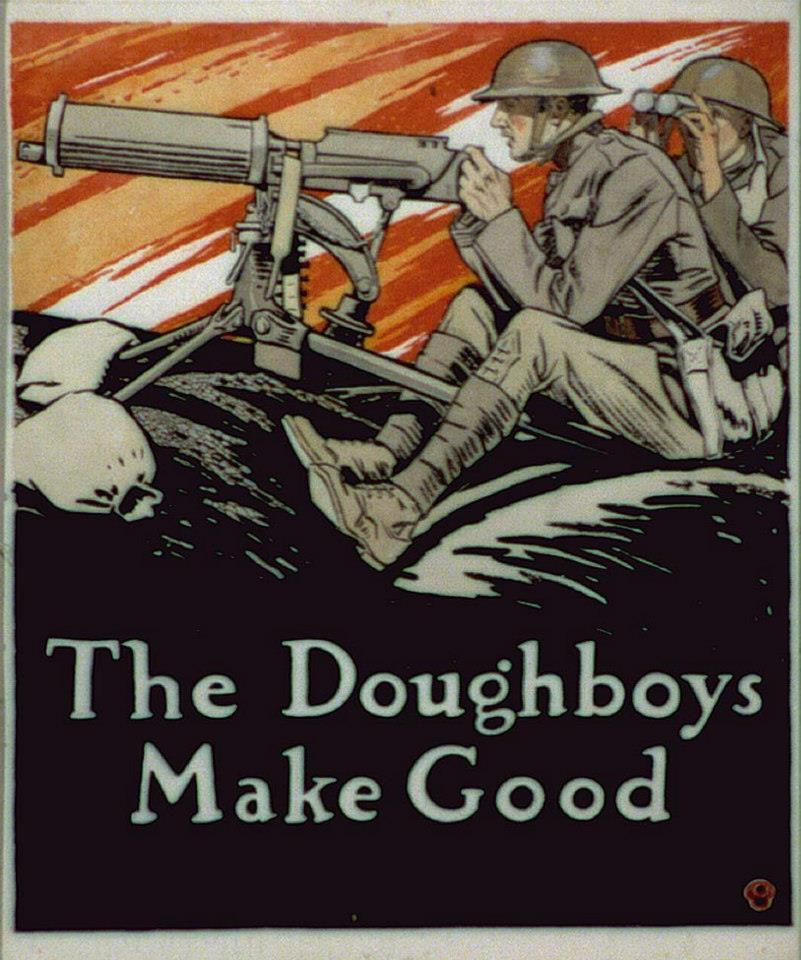
The Doughboys Make Good: American Victories at St. Mihiel and Blanc Mont Ridge (pdf issue)
From: Army History
By Mark E. Grotelueschen
http://www.history.army.mil/armyhistory/AH87(W).pdf

The Battle of the Meuse-Argonne, 1918: Harbinger of American Great Power on the European Continent?
From: Foreign Policy Research Institute
Michael Neiberg
http://www.fpri.org/article/2012/05/the-battle-of-the-meuse-argonne-1918-harbinger-of-american-great-power-on-the-european-continent/

The U.S. Military and the Influenza Pandemic of 1918–1919
From: Public Health Reports
Carol R. Byerly, PhD
http://www.ncbi.nlm.nih.gov/pmc/articles/PMC2862337/

“Representative of a Victorious People”: The Doughboy Watch on the Rhine (pdf issue)
From: Army History
By Alexander F. Barnes
http://www.history.army.mil/armyhistory/AH77(W).pdf


Feel free to add your recommendations for similar articles in our comments section. Be sure to include the title and url.

Thursday, August 11, 2016

By the Way — Let's Not Forget Salonika Either

The Salonika policy. . .was largely vindicated by the extremely practical test of results.
Winston Churchill, The World Crisis


Regular readers might recall that I recently got on my soap box about the Italian Front and the need to keep studying it. I just remembered that I did a similar piece about the Salonika Front a few years ago for our monthly newsletter, the St. Mihiel Trip-Wire.  Here it is.


The Salonika, or Macedonian, Front is mostly neglected today, except by specialists and the British-based Salonika Campaign Society. But consider: almost all the war's combatants sent forces to the theater; three quarters of a million men were deployed along its 170-mile front; even down to the 21st century it remains the greatest focal point of debate between the war's "Easterners" and "Westerners","and in fact,it was the front where the final collapse of the Central Powers began. 

Anglo-French forces began landing at the Greek port of Salonika on 5 October 1915. The troops were sent to provide military assistance to the Serbs, who were threatened by combined German, Austro-Hungarian, and Bulgarian armies. The intervention came too late to save Serbia, and after a brief winter campaign in severe weather conditions on the Serbian frontier, the Anglo-French forces found themselves driven back to a small perimeter around Salonika. At this point the British advised that the troops be withdrawn. 

Greek Memorial at the Battlefield

However, the French, with Russian, Italian, and Serbian backing, still believed something of strategic importance could be gained in the Balkans, and, eventually, the British also bought in to the policy.. After preparing the port of Salonika for defense, the troops moved up-country. During 1916, further Allied contingents of Serbian, Italian, and Russian troops arrived, and offensive operations began. These culminated in the fall of Monastir to Franco-Serbian forces during November. A second offensive during the spring of 1917 made little impression on the Bulgarian defenses. The front line remained more or less static until September 1918, when a third offensive was launched under the command of talented French General Louis Franchet d'Espèrey. With a breakthrough by Serbian forces west of the Vardar river, the Bulgarian Army was forced into a general retreat. The campaign concluded with the surrender of Bulgaria on 30 September 1918. Backdoors to both Austria-Hungary and Turkey were now open.

Wednesday, August 10, 2016

Meet the Golden Eagle of Belleau Wood


Americans should all be proud to know that one of France's eagles guards our Aisne-Marne Cemetery at Belleau Wood. With my 2013 group I was pleased to meet with him one quiet Sunday afternoon. Here he is. I'm sorry, however, to say I've forgotten his name over the years. Nevertheless, he was most impressive, and I did pick up some interesting facts about his duties.


Mr. Eagle was not pleased with the volume of my voice and let me know about it.  I assure you it was a most bracing and memorable encounter.


His area of responsibility covers both the mile-square wood on the plateau above the cemetery and the cemetery itself.  He flies hia patrols here about once per month.


The objective of Mr. Eagle's sorties is to protect the beautiful crosses on each grave.  Bird droppings have a terrible effect on the Carrara marble. (I'll leave those details to your imagination.) The assistant superintendent who accompanied us that day proudly reported that when Mr. Eagle flew one of his missions all the other birds fled the forest, the cemetery, and the entire neighborhood for weeks, apparently spreading the word wide within the avian community of northern France.

The Golden Eagle of Belleau Wood and His Handler

Tuesday, August 9, 2016

Voices from the Front: An Oral History of the Great War
reviewed by Peter Belmonte


Voices from the Front: An Oral History of the Great War
by Peter Hart
Oxford University Press, 2016


Peter Hart is oral historian with the Imperial War Museum (IWM). In that capacity he interviewed 183 British Great War veterans in the 1980s and 1990s, at a time when their numbers were quickly diminishing. Because the interviews took place more than 65 years after the end of the war, it's not surprising that quite a few of the men were under-age enlistees, with a few enlisting as young as 15. In this book, Hart's interviews are augmented by others conducted by fellow oral historians at the IWM and by interviews conducted by the British Broadcasting Corporation in the 1960s.


In his introduction Hart outlines the advantages of oral history. He is not, of course, unmindful of the limitations of oral history. Because of some of these limitations, oral history is often more valuable in learning what it was like to be a soldier in the war, versus presenting an accurate account of events. How did the soldier feel when he enlisted and went through training? What did it feel like to advance to the front and, finally, to go "over the top?" What did the soldiers carry into battle? How was life in the trenches? Oral history can help us answer these questions.

Hart's chronological narrative serves as the framework onto which he hangs the interviews. This arrangement is interspersed with digressions to cover the war in the Middle East ("nightmarish" does not begin to do it justice), the naval war, the air war, life in the trenches (my favorite chapter), and the aftermath of war. This layout serves Hart's purpose well; his proportions of narrative versus oral history are appropriate because he wants to concentrate on the men's experience in the overall context of the war.


Order Now
A sampling of the interviews illustrates events that, more than 60 years later, still left impressions on the veterans.

Of course, most of the men were octogenarians or nonagenarians when they were interviewed. When one considers what Private Alex Thompson of 2nd King's Own Scottish Borderers, experienced at Ypres in 1915, one wonders how any of these men survived at all: "I'd got an explosive bullet in the left arm, it split my left arm…another bullet just above my wrist did for my thumb—it cut the sinews. Then I got another one in this side—a shell burst—shrapnel. I got a hole here in the lefthand side of the stomach and that was running with blood. Shrapnel in the shoulder up here. All in seconds, all in a bunch one after the other. I was knocked right upside down" (p. 70).

Engine Room Artificer Ernest Amis, HMS Kent, described his ship's sinking of the German cruiser Köln: "Our last salvoes fired into her at about 400 yards range. She was on fire. Some of them [German sailors] were jumping into the water on bits of wreckage so as to try and get to us, but the seas were icy cold. The sea was not calm then; it was a choppy sea…We tried to save some, we hauled some aboard, but they were too numb; they eventually died and we simply put them back into the drink again. There was no time for any ceremony. We didn't know whether there would be any other German ship about ..." (p. 164).

Ordinary Seaman Joe Murray, serving ashore near Gallipoli, recalled a young sailor named Horton going to the aid of a fellow sailor who had been wounded: "...a bullet struck him dead centre of the brow, went clean through his head and took a bit out of my knuckle. Poor old Horton. He kept crying for his mother. I can see him now. Hear him at this very moment. He said he was 18, but I don't think he was 16, never mind 18" (p. 99).


Of course there's humor here, too. Private Harold Hayward, 12th Gloucestershire Regiment, was wounded in the scrotum and hospitalized. A well-meaning female visitor persisted in asking Hayward about the nature and location of his wound. Hayward's final answer to her is priceless. And Corporal Donald Price, 20th Royal Fusiliers, developed a bad boil on his inner thigh. His description of a medical officer's examination of him while in muddy, slimy trenches is evidence that funny episodes can happen in horrible circumstances.

There are no photographs, illustrations, or maps in the book and, frankly, they are not needed.

I have some limited experience in oral history (Italian American World War II veterans), and this is the kind of thing that is valuable and important. It is a pity that more historians and institutions did not think to collect interviews with Great War veterans until it was almost too late. Thankfully, Hart and the IWM preserved these voices for us and future generations.

by Peter Belmonte

Monday, August 8, 2016

100 Years Ago: Pozières — The Australian Corps' Gethsemane


A Garden Called Gethsemane, in Picardy It Was

A century ago the Somme Battlefield had been fragmented, the area north of the Albert-Bapaume Road left quiet while the main British effort was focused – with mixed success – to the south, primarily against the horseshoe of woods surrounding Caterpillar Valley.  However, what progress was made exposed  the left flank of the attacking British units and a push was needed, directed down either side (through Mash Valley to the north and Sausage Valley to the south) of the old Roman road. This in-turn necessitated a concurrent attack on the high ground to the north of the Albert-Bapaume Road from which German observers could watch and call in artillery strikes.  

Australian Veteran's Department Map

The first objective, was to take  the village of Pozières located on the road about four miles from the outskirts of Albert.   The First Australian Division captured most of the town quite handily on 23 July.  Then their agony began.  The Diggers were completely in the open and were an easy target for the German artillerymen, who took an awful toll.  In the next four days the Germans also mounted three major efforts to take the village.  The Aussies beat them all off, but took over 5,000 casualties.  By the 27th the First Division needed to be relieved.

The Windmill Before the Battle
The high command felt the push needed to continue down the road and that job was given to the 2nd Australian Division. They had two key positions to take. (See Map.)  Down the road past the village was the local mill, placed on high point.  On either side of the mill was a double trench, the assembly area for all the German counterattacks. This had to be secured first. North on the ridge, commanding Pozières, was the innocuous sounding, but highly fortified, Mouquet Farm.  It's elimination was needed to secure the Australian flank, but also offered promise of turning the German position on Thiepval Ridge further north if the Australians could take the position.

In a well-executed attack on 4 August, the division captured most of the mill site and the trenches. But it was incredibly costly.  The Australian 4th Division had to relieve the 2nd, which had lost 7,000 men in twelve days. From 8 August to 5 September the Australians, with all three of the Corps divisions taking turns, advanced on Mouquet Farm, getting close three times. The Aussies would never secure the farm, though, .  

Aerial View of Mouquet Farm

By 5 September, when 1st Australian Corps was withdrawn and replaced by Canadian troops, the Corps had lost 23,000 men in six weeks. The Canadians would finally take the farm on 26 September, but another tough German defensive line, the Regina Trench, was sitting in readiness. There the Canadian Corps would experience their own Gethsemane.

Historian Charles Bean later wrote that the Pozières ridge "is more densely sown with Australian sacrifice than any other place on earth."

Sunday, August 7, 2016

Francesco Baracca, Enzo Ferrari, and the Prancing Pony


Italian veteran Enzo Ferrari liked to tell the story of how the prancing pony became his emblem. The black horse had been painted on the fuselage of the SPAD fighter flown by Francesco Baracca, Italian ace of aces, killed over the Montello in 1918. After winning a race in Ravenna in 1923 Baracca's father and mother congratulated him. The aviator's mother said, "Ferrari, why don't you put my son's prancing horse on your cars? It will bring you luck." He did, and it did.


Incidentally, Porsche has a similar emblem, but it's not connected to the Great War.  Stuttgart, the company's home base was founded in the 13th century as a horse farm. The company wanted to highlight its connection to the city.

Saturday, August 6, 2016

On the Brink: Some of the Odd Ideas of 1913


It seems that on the eve of the Great War some were already obsessed with change, modernism, and violence.  And they soon got it. All these quotes are from 1913.

I am like a blind man running with a lighted torch among hay stacks. On whichever side I turn I must set fire on something.
                                                                                ~ King Ferdinand of Bulgaria

I have learnt everything the West can give me. Now I am shaking the dust from my feet and leaving the West, my road runs to the source of all art: the East.
                                                                                            ~ Natalia Goncharova,
                                 Stage and Costume Designer for Diaghilev’s Ballet Russes

Wassily Kandinsky's "Composition VII," 1913


The psychology of the unconscious is the philosophy of the revolution...The coming revolution is a revolution for the mother-right [matriarchy]. 
                                                                                         ~ Otto Gross, 1913 

Fear is the beginning of wisdom
                                ~General Joffre, 1913

Each art is isolating itself and limiting itself to its own field. Specialisation is a characteristic of modern life, and pictorial art, like all other manifestations of the human mind, must submit to it.
                                        ~Artist Ferdinand Léger 

Hundreds of millions of people are awakening to life, light and freedom in a movement that will liberate both the peoples of Europe and the peoples of Asia.
                                                                                                     ~ Lenin 

Suffragette Killed by the King's Horse at Epsom Downs, 1913

With the high development of the capitalist countries and their increasing severe competition in acquiring non-capitalist areas, imperialism grows in lawlessness and violence, both in aggression against the non-capitalist world and in ever more serious conflicts among the competing capitalist countries.
                                                                                  ~ Rosa Luxemburg 

Bloodshed is a cleansing and sanctifying thing.
                                                        ~Patrick Henry Pearse, Irish Nationalist

It was fashionable to be pale and drained; Princess Belgiojoso strolled along the boulevards…pale as death in person.”
                                              ~ Composer Camille Saint-Saens

Rose is a rose is a rose is a rose.
                                     ~ Gertrude Stein 

Crew Aboard New Dreadnought HMS Queen Elizabeth, 1913


There is one point when it is permissible to break up the institution of the family: that is the point when it is changing from an institution to a mausoleum.
                                                                                  ~ Rebecca West

The Slavs were not born to rule but to serve, this they must be taught.
                                                                                                  ~ Kaiser Wilhelm 


Friday, August 5, 2016

One Pals Battalion and One Man's Story from 1 July 1916


Pals Battalions were a uniquely British phenomenon. Britain was the only major power not to begin the First World War with a mass conscripted army. After the war broke out, it quickly became clear that the small professional British Army was not large enough for a global conflict.

In a wave of patriotic fervor, thousands of men volunteered for service in Lord Kitchener's New Armies. As part of this, it was realized that local ties could be harnessed for national gain. Many more men would enlist if they could serve alongside their friends, relatives, and workmates. Dozens of the Pals Battalions saw their first action on the first day of the Battle of the Somme.

The Lonsdale Pals Marching Through Nearby Carlisle

The Lonsdale Pals (11th Border Regiment) was a volunteer battalion raised by Lord Lonsdale of Lowther Castle, located near the Lake District of England. The battalion fought with the 32nd Division on the opening day of the Battle of Somme on 1 July 1916 and supported the capture of Leipzig Redoubt on Thiepval Ridge, the sole British Army success north of the Albert-Bapaume road that day. The unit suffered over 500 casualties out of the 800 men who went into action, including 23 out of the 26 officers; the commanding officer, Lt-Col. Machell, was killed.

Private Fred Heslop

Frederick Edward Heslop was the son of Frances Heslop, a Warcop farmer’s daughter. The year after his birth in 1898 his mother married Leonard Coates. He was brought up at Orton in Cumbria but after his stepfather’s death, Frances and her seven children moved to Garnett Plain in Skelsmergh and lived there until she died in 1932. Fred worked at Ellergill Farm at Orton but volunteered at the start of the war and joined the Lonsdale Pals  and then the 32nd Divisional Cyclists Company. 

He died on 1 July 1916 on the first day of the Battle of the Somme. Fred was 18 and has no known grave but is commemorated on the Thiepval Monument quite close to where he must have died.

Fred (Second from Right) with Three of His "Pals"

Sources:  Cumbria Museum of Military Life, The Lonsdale Pals Battalion, and Europeana: 1914–1918

Thursday, August 4, 2016

The Fascinating Champagne Region

Forget about the bubbly stuff, the Champagne holds an endless series of fascinating sites for the history enthusiast. 

Fort de la Pompelle, Defender of Reims


Restored Trenches at Massignes de Main


Memorial to 1917 Battles


U.S. Memorial, 1918 Battle of Blanc Mont Ridge


Navarin Farm Monument to Champagne Battles & Preserved Battlefield


Russian Cemetery & Memorial Chapel, Mourmelon-le-Grand


Soldiers Shot for Example in 1915, Suippes Memorial


Reims Cathedral, One of the World's Greatest Treasures
World War I Veteran