Now all roads lead to France and heavy is the tread
Of the living; but the dead returning lightly dance.
Edward Thomas, Roads

Monday, February 15, 2021

Hemingway Was Wounded Here


Hemingway on the Italian Front


Ernest Hemingway was wounded  by a mortar shell on 8 July 1918  at Fossalta di Piave in a trench on a levee overlooking the Piave River. At the site, located 17 miles northeast of Venice, is a memorial kiosk remembering the event. Also located there is a monument to the “Ragazzi of ’99” (The Boys of ’99) which commemorates the Italian soldiers born in 1899 who were thrown into the Piave defense at a young age in 1917/18.


Hemingway Panel


The Piave River sector is the most forgotten sector of the Italian Front. It was the barrier behind which the retreating Italian Army reorganized after the disaster at Caporetto. In June 1918 it became the sector where the Austro-Hungarian Empire launched the last offensive in its history. That failed, and in October 1918 the Piave line was the launching position for the opening of the Battle of Vittorio Veneto, the last act  of the Great War on the Italian Front.    


Side View of Hemingway & Boys of '99 Memorials


Sunday, February 14, 2021

Remembering a Veteran: Medal of Honor Recipient PFC George Dilboy, 103rd Infantry, 26th Division, AEF


Originally presented at Gregory Pappas's Blog, The Pappas Post; Contributed by Darden Livesay.

George Dilboy (Giorgos Dilbois) was born on 5 February 1896 in the Greek town of Alatsata near Smyrna in Asia Minor (modern-day Turkey).  In his short life, he was destined to serve in the armed forces of both his native and adopted nations, and to be  awarded America's  Medal of Honor, to be interred at last at Arlington Cemetery.

Dilboy and his family immigrated to New Hampshire in the United States in 1908. In 1912, at the age of 16, he returned and fought for Greece in the Balkan Wars of 1912–13. After serving his ethnic homeland, he returned to the U.S, where he joined the New Hampshire National Guard and served in the Mexican Border Campaign. But after World War I broke out—and when the U.S declared war against Germany in 1917—Dilboy's National Guard unit was called up for the U.S Army and joined the 103rd infantry regiment, 26th Division.

In the photo below, Dilboy lies reclined in front with his fellow soldiers at Camp Keyes in Concord, New Hampshire. (Photo/The Story of George Dilboy by Richard Rozakis) Before turning 22 years old, Dilboy had already fought in four wars on three continents. In 1918, the Asia Minor native fought in the Battle of Belleau Wood in France.


George Dilboy Up Front


The following excerpt is from his U.S. Army Medal of Honor citation:

After his platoon had gained its objective along a railroad embankment, Private First Class Dilboy, accompanying his platoon leader to reconnoiter the ground beyond, was suddenly fired upon by an enemy machine gun from 100 yards. From a standing position on the railroad track, fully exposed to view, he opened fire at once, but failing to silence the gun, rushed forward with his bayonet fixed, through a wheat field toward the gun emplacement, falling within 25 yards of the gun with his right leg nearly severed above the knee and with several bullet holes in his body. With undaunted courage he continued to fire into the emplacement from a prone position, killing two of the enemy and dispersing the rest of the crew.

Dilboy died on 18 July 1918 due to his wounds. He was initially buried in the Aisne-Marne American Cemetery in France, but at the request of his father he was later buried at his birthplace of Alatsata in Turkey, where thousands attended his funeral. 

In January 1919 the Commanding General of the Northeastern Department presented his Medal of Honor to his father, Antonios. The distinction made him the first Greek-American to earn America’s highest decoration for valor.

"Under other circumstances I would have shed tears because of my son’s death,” his father said. “But when I learned of the manner in which he died, I was proud that he had given his life with honor the cause of his adopted country, the United States. . . We came to this country from Smyrna, where my boy and other children were born. . . We know and have felt the persecutions of Turkey."

In 1922 when Turkey’s Kemalist army occupied Alatsata, Turkish soldiers broke open Dilboy’s coffin entombed in the Church of the Theotokos, desecrating Dilboy’s remains and the U.S flag.  President Warren G. Harding became outraged and ordered a U.S warship to recover the remains and return them to the U.S. Harding also demanded and received a formal apology from the Turkish government. Following their return, Dilboy's remains were interred at Arlington National Cemetery on 12 November 1923. 

George Dilboy received honors from three U.S presidents: Woodrow Wilson, who signed the authorization awarding him the Medal of Honor; Warren Harding, who brought him back; and Calvin Coolidge, who presided at his final military burial.


Dilboy Memorial, Hines Veterans Hospital


He is remembered at a number of sites in the U.S. A bronze monument of Dilboy was built outside the Somerville City Hall in Massachusetts. The monument consists of a bronze bust standing on a granite base and was created in 1930 by the Boston-based Grenier Studio. The Order of AHEPA presented it to the city. Somerville’s Dilboy Stadium was also named in the fallen soldier’s honor. On 24 May 1942, the George Dilboy Memorial Foundation erected a memorial to Dilboy at the Hines Veterans Administration Hospital in Hines, Illinois, a western suburb of Chicago. In 2009, a U.S. Citizenship and Immigration Services facility in Detroit was named in his honor.

Thanks to Demos Lamprinakis for bringing this article to our attention.


Saturday, February 13, 2021

Sources of Frontline Intelligence: Captured Documents


A Valuable Document for the Enemy
British Trench Map for the Somme Sector

By Terrence J. Finnegan

Captured documents such as maps, aerial photography and written orders were ideal intelligence sources. Sometimes sketches contained within such documents included notes regarding machine guns, Minenwerfer (trench mortars), dummy complexes, and other projects of interest. Captured documents were forwarded to the photographic interpreter for in-depth examination. His initial tactical approach attempted to unlock the key to enemy intentions. This was followed by a broader strategic analysis accomplished by the staff. 


A Valuable Document for the Enemy
German Intelligence Summary, Argonne Sector, Sept. 1918


The interpreter's art required a perfect knowledge of the details of the trench organization, such as that found in the published regulations. French instructional manuals reminded their readers that the commander's responsibilities included reviewing captured documents to provide for every possible phase of attack, studying for successive lines of defense and all enemy lines of approach.

Knowing enemy intentions intimately from these sources best positioned the defense to counterattack and eject the enemy rapidly from any captured territory. Based on captured documents, General Ludendorff adjusted his directives to the forces in final preparation for the March 1918 Michael Offensive in the Somme Sector. 

From "Military Intelligence at the Front," Over the Top, February 2009

Friday, February 12, 2021

Augustus John's Unfinished WWI Mural


Augustus John (1878–1961)


The specimen of celebrated Welsh artist Augustus August John's work that might be most recognizable to our readers is the portrait below of Lawrence of Arabia.  That was probably done about the time of the Paris Peace Conference. During the war, however, John had a brief, but memorable,  tour of duty as a war artist. During his five-month service he had worked mostly around the areas of Lens, LiĆ©vin and Hill 70 near Vimy Ridge, the centre of important Canadian action in France in 1917. His most important war work, though, was unfinished and remained forgotten for almost a century.


Lawrence of Arabia


In 2011, the Duke and Duchess of Cambridge visited the Canadian War Museum to meet veterans and their families and to unveil The Canadians Opposite Lens, a remarkable painting by John (1878–1961). Twelve metres (40 feet) wide and 3.7 metres (12 feet) high, the unfinished First World War canvas depicts Canadian troops, refugees and prisoners of war against the battle-scarred landscape near Vimy Ridge, in the area of the French town of Lens. Although the most significant Canadian-commissioned painting from the conflict, it had never before been on public view.

John was already recognized as one of the great artists of his time. A notoriously difficult character, after a number of rebuffs and through the patronage of newspaper publisher Max Aiken, he managed to gain a commission as a war artist with the Canadian forces, including a waiver that allowed him to keep his flowing beard. He quickly wore out his welcome, however, barely escaping court martial for his participation in a drunken brawl. He completed only one minor painting of three Canadian soldiers titled Fraternity" before his dismissal.  He would continue working on The Canadians Opposite Lens for almost his entire life.


The Canadians Opposite Lens — Canadian War Museum
(Display width=580px, Rt Click for 1,500px version)


Based on drawings he made in this sector, the massive image depicts more than 50 carefully delineated individuals set against a backdrop of trucks, ruins, an observation balloon, bursting shells, and the mining landscape to the west of Vimy Ridge. Although John sketched in all of these elements, about one-third of the work remains unpainted.

The Canadians Opposite Lens was intended to be the centrepiece for a war memorial art gallery in Canada that was never built. Due to a lack of permanent exhibition space, the painting remained in the artist’s studio in London, England, where he worked on it sporadically until a year before his death. In 1962, it was sold at auction and disappeared into a private collection and remained in that status until the Canadian War Museum acquired it.  It's not clear whether the full mural is on permanent display there.  However, the Beaverbrook Gallery in New Brunswick holds an interesting piece that shows in small scale a charcoal cartoon displaying the concept of the 40x12 foot final oil painting.


Cartoon Study — Beaverbrook Museum
(Display width=580px, Rt Click for 1,500px version)


Sources: Canadian War and Beaverbrook Museums, Wiki Commons

Thursday, February 11, 2021

The Story of the Nissen Hut


Hospital at St. Omer Incorporating Nissen Huts


Britain's "New Army" would need  a massive number of buildings for barracks, warehousing, and offices  that could be built quickly. An American-born  Canadian officer serving in the Royal Engineers found the solution. In April 1916, Lt. Col. Peter Nissen of 29 Company, RE, came up with the idea of a prefabricated steel structure made from a half-cylindrical skin of  corrugated steel. The cross-section was not precisely semi-circular, as the bottom of the hut curved in slightly.


Lt. Col. Peter Nissen on Left Before One of His Huts


Two factors influenced the design of the hut. First, the building had to be economical in its use of materials, especially considering wartime shortages of building supplies. Second, the un-assembled building had to be portable. This was particularly important in view of the wartime shortages of shipping space. This led to a simple form that was prefabricated for ease of erection and removal. Eventually, Nissen huts could be constructed in any of three widths: 16, 24, or 30 feet wide, and any length, in multiples of 6 ft. The Nissen hut could be packed in a standard Army wagon and erected by six men in four hours. The world record for erection was one hour 27 minutes.   


Assembly


There were some shortcomings with  the original  designs. The early huts had dirt floors, no electricity, no insulation, and had only a potbelly stove for heating. These problems were addressed in later upgrades. According to some sources, over 100,000 Nissen huts were built in World War I. (I'm suspicious this figure may include those of improved design that were built for the Second World War.)


The U.S. Purchased Nissen Huts When It Entered the War;
Camouflaged Huts at Ourches Airfield


The U.S.-made Quonset hut of the World War II, of course, was inspired by the Nissesn Hut. In the spring of 1941 the U.S. Navy established a Temporary Advance Facilities compound at West Davisville, Rhode Island. It was here that the design and manufacturing concepts for prefabricated Quonset huts was developed by a team from the George A. Fuller Co of New York, led by engineer Peter Dejongh and architect Otto Brandenberger. Before war's end, 153,200 Quonset huts had been produced. Tens of thousands of surplus units were sold after the war for civilian  use. They can still be spotted across America.


Nissen Huts Utilized by the U.S.
North Russia Transportation Corps
(Brooke Anderson Collection)

Sources:  Military Wiki; "Nissen and Quonset Huts" by J. David Rogers, Wiki Commons

Wednesday, February 10, 2021

Two Days in the Rain at the TranchƩe de Calonne


Fighting in the Rain


From Maurice Genevoix's Under Verdun

Saturday, 19 September 1914

Forty hours we pass in a ditch full of water. The improvised roof of branches and straw soon lets all the rain through. Since then we live in the midst of a torrent.

Motionless, and packed tight together in cramped and painful attitudes, we shiver in silence. Our sodden clothes freeze our skin; our saturated caps bear down on our temples with slow and painful pressure. We raise our feet as high as we can before us, but often it occurs that our frozen fingers give way, letting our feet slip down into the muddy torrent rushing along the bottom of the trench. Already our knapsacks have slipped into the water, while the tails of our greatcoats trail in it.

The slightest movement causes pain. I couldn't get up if I wanted to. A short while ago the adjutant attempted to do so; the effort wrung a cry from him, so keen were the pains in his knees and back; and then he sank down on top of us before slipping back into the hole in the mud his body had made, and resuming his former huddled attitude, which had caused his ankles to stiffen.

Nowadays I find it difficult to recall all that befell in the course of those two days; memory is veiled and dim. It is as though I had lived in an atmosphere of numbness in which all light and beauty were but dead things. An intense pain about my heart, never moving, rendered me almost delirious.

I remember that we remained for a long time hidden in a large thicket. My section was stationed near the battalion horses, which had been picketed together. Every time they moved, branches broke and fell. And most certainly it was raining, there could be no doubt of that; for long afterwards the eternal pitter-patter of rain on the leaves remained in my ears. Afterwards, I do not know how long, we set out on the march.


Marching in the Rain


Almost insensibly a depressing evening settled down over fields and woods. Before us were extended the columns of infantry, clinging like ants on the side of the bare slope. Above us, the smoke balls of shrapnel, soft and pale, hung in the air. This shrapnel gave no warning of its approach, and shells burst with an abrupt snap which found no echo over the dull countryside. A deserted farm to the left had been stripped of its reddish tiles, which lay smashed to pieces on the earth. A horseman was moving slowly towards this farm, his head covered by the hood of his cloak; his horse seemed merely to glide onwards, strangely silent. The stillness was portentous, almost tangible.

We passed a night in another trench in reserve, where we are at present. Five or six of us in a bunch hung over a few damp pieces of wood we had collected in the hope of being able to make a fire; the sticks smoked but refused to burst into flame. I recollect that I was obsessed by a feverish and loquacious gaiety; I scorned my own sad condition and laboured tremendously to prevent myself giving way to the fever running riot in my veins. This lasted some time, and so nervous was I, so disordered was my speech, that those about me watched me queerly and significantly. The moment came when my ill-timed jests became an insult to the general depression. I fell silent then, and resignedly delivered myself up to that dumb despair which had been dogging my heels for days, waiting only the opportunity to enter into its kingdom.

The monotonous, incessant tapping of the rain on the leaves of the trees was in itself maddening. The sticks in the brazier hissed and spluttered. There was a single spark, a faint glow among the cinders, which I watched desperately.

In the morning firing was heard in the direction of the outposts. The Captain sent me with two sections to reinforce them. We marched in single file, slipping on the greasy clay, falling every few steps; laboriously climbing on hands and knees a little ascent which, but for the mud, I could have taken in a couple of strides.


Lt. Maurice Genevoix


Arriving at our destination, we were compelled to seek shelter behind the trunks of trees, for all along the edge of the wood bullets were whistling. There were no trenches and the men were lining a ditch, standing in the water with their knapsacks before them.

The rain did not cease. It flooded the vast ploughed lands, where here and there groups of walnut trees seemed to huddle shiveringly together. Two German vedettes posted before a wood facing ours seemed like two stone statues. Shortly afterwards infantry emerged from the wood and advanced over open ground, as dark as the soil itself, and scarcely visible. We killed several of them and they went back hastily, abandoning their dead.

Still the bullets continued to whistle. From time to time a cry burst from one of the men in the ditch, and he would come into the wood towards us, both hands pressed against his chest or staring at the blood dripping from his fingertips with wide, terrified eyes. At last the firing ceased and calmness reigned.

We returned into reserve, carrying one of my corporals who was wounded in the groin by a bullet that had passed right through it. That was a difficult journey over the muddy roads! The wounded man groaned feebly, his arms passed around the necks of two of his comrades, his head swaying, his face livid. Once the men carrying him slipped and fell to their knees, and the agonized cry which broke from the sufferer echoed in my ears long after it had died to silence.

Tuesday, February 9, 2021

No Man's Land: The Trailblazing Women Who Ran Britain’s Most Extraordinary Military Hospital During World War I,


by Wendy Moore
Basic Books, 2020
Ron Drees, Reviewer


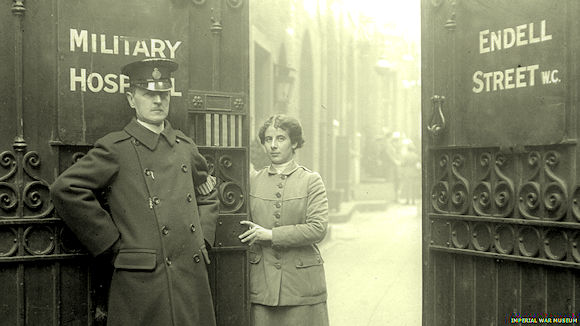
Hospital Entrance


The Endell Street Military Hospital in London had almost no men but was staffed by women who were doctors, nurses, orderlies and in almost every other position, thus “No Man’s Land.” Counting the faces in the 1916 staff photo prior to the text, there are 144 women and 22 men. The primary surgeons—and doctors in charge—were Flora Murray and Louisa Garrett Anderson.

This is an unusual Great War book as the entire narrative takes place behind the lines in either Paris, Boulogne, or London. Gray-green clad troops were not the enemy confronted by female surgeons but chauvinistic social beliefs, sexism and moribund British army regulations prohibiting female doctors were.

Before the War, Murray and Anderson were suffragettes who were striving to get the right to vote for women. This was not a struggle for the faint-hearted as women were arrested, went on hunger strikes and then force-fed with sometimes serious injuries resulting. With the outbreak of war, such considerations were put aside with everyone trying “to do their bit.” Yet English medical practices continued to bar women from mainstream hospitals and major appointments. They were limited to treating women and children.

Murray and Anderson recognized the opportunity the War presented, even though the army barred them from medical practice despite the shortage of everything caused by the war. The pair, along with a team of nurses and support staff, went off to Paris to set up a hospital on their own in what came to be known as Claridge’s, a luxury hotel but a most inappropriate building for a hospital.

The massive numbers of casualties, the inadequate resources and the high explosives used for the first time were far different than the neat bullet holes of the Boer War, and everyone was found to be inadequate for military surgery. Frontline medical treatment and the evacuation of troops to the channel coast during the opening days was ghastly, with many casualties abandoned as medical staff fled just prior to the German advance. Great War medical practice was a continual learning exercise. One lesson learned in 1915 was that steel helmets would better protect troops. Also, BIPP (bismuth, iodoform, and paraffin paste) proved very helpful in treating septic wounds. Some lessons, such as leaving gas gangrene wounds open after surgery, had to be relearned during WWII.

When the war shifted toward the Channel, the staff moved to a sugar warehouse in Boulogne. Then, in February 1915, Murray and Anderson were given a large thousand-bed hospital in London to be commanded and staffed almost entirely by women. The “hospital,” a former workhouse on Endell Street which may have inspired Charles Dickens to write Oliver Twist, was filled with rubbish and had to be thoroughly cleaned before being put to use. Despite their earlier successes, the two doctors continued to endure obstacles and antagonism until the end of the war.


1916 Staff Photograph
(Click on Image to Enlarge)


The description of the Endell Street hospital was so cheerful as to be almost unrealistic. Antibiotics were unknown, x-ray equipment was just coming into use, and the suffering must have been unimaginable considering how many casualties needed to be treated quickly. Thus I found the book’s credibility to be lacking here. I did not see how matters could be so upbeat, considering the number of casualties from the Somme and other major battles. However, about two thirds of the way through the book, the tone definitely changed.

Moore also tells the stories of a doctor from Australia, a patient from Canada, of medical schools opening to female applicants and the struggle of new volunteers to adjust to the grisly and exhausting work. While it became known that suffrage would be offered to women after the Armistice as a reward for their war work, discrimination continued in the form of lower pay, fewer tax benefits and the War Office’s refusal to grant equal rank to women doctors. After the War, Winston Churchill led government objections to various equality measures.

What makes this book particularly worth reading are the ongoing descriptions of the home front: London’s social life and suffering, rationing, feelings of desperation, fatigue, German bombing, the women casualties in France, bacterial infections, and the onslaught of flu which possibly killed six times as many as the Great War did. These are aspects of the Great War rarely discussed in other texts.

Finally, peace returned along with discrimination against women who wanted medical careers. Medical schools began again to deny admission to women. But the war did not end for Endell Street as the wounded kept coming, necessitating operations, laundry service and all the other functions of a hospital. The flu returned, deadlier than ever, probably fueled by troops returning home in cramped ships plus jubilant celebrating crowds. Death could come in three days and was violent and ugly.

The Endell Street Military Hospital was closed in October 1919 and torn down years later to be replaced by public housing. Not until 1975 were medical schools forced to accept women on an equal footing.

Ron Drees

Monday, February 8, 2021

The Last Victoria Crosses of World War I

By James Patton

The last Victoria Cross (VC) of the World War One era was presented to 'The unknown warrior of the United States of America'. On 11 November 1921 it was placed on the grave of The Unknown Soldier in the vault of the Memorial Amphitheater at Arlington National Cemetery by the First Sea Lord, Admiral of the Fleet the Earl Beatty (1871-1936) GCB, OM, GCVO, OM. This VC symbolically honored all of the Americans  who died for the Allied cause during the war. Reciprocally, ‘The Unknown Warrior’ who lies in Westminster Abbey received the U.S. Congressional Medal of Honor. Significantly, the same British Unknown Warrior was never presented with the VC. 


11 November 1921: Internment of the Unknown Soldier
On Behalf of King George V, Admiral David Beatty Presents the Victorial Cross to America's Unknown


Previous articles in Roads have covered the North Russian Intervention, mostly from the American perspective, so here’s some background from the British perspective. The expedition was a British idea and the original force was formed in June 1918, while the war was raging. After intense diplomatic pressure an American contingent was added later. 

When demobilizations began after the Armistice, many of the soldiers in Russia became restive about continuing in service and there was also public pressure in both the U.K. and the U.S. to bring them home, especially since many were conscripts. As a result the American 339th Infantry and its supporting units were withdrawn in July 1919. 

Whitehall wasn’t ready to abandon the mission, though, so a plan was hatched to create a replacement force made up entirely of volunteers. Two battalions were raised: designated as the 45th and 46th Royal Fusiliers (City of London) Regiment. The 45th enrolled over 150 Australians who had been cooped up in the U.K. due to a shortage of transport home. The Australian army allowed these men to transfer to the British Army, who in turn allowed them to keep their distinctive uniforms. 

This new formation was known as the North Russian Relief Force (NRRF) and they began to arrive in the theater in May 1919 to cover the withdrawal of the previous force. Subsequently, a series of Bolshevik victories divided the force into isolated garrisons and made further occupation untenable. The soldiers performed a valorous fighting extraction and all of the units were out of Russia by 27 September 1919.

The last World War One era VC’s awarded to individuals were to Cpl. Arthur Sullivan and Sgt. Samuel Pearse (posthumous), of the 45th Royal Fusiliers (both were Australians), for different actions in North Russia during the withdrawals of August 1919. 


Arthur Sullivan, VC


Arthur Percy Sullivan VC (1896–1937) was a bank employee and Australian Rules footballer from South Australia who didn’t enlist in the Australian Imperial Force (AIF) until April 1918 and thus was still in training in the U.K. at the Armistice. Apparently a good soldier, he was promoted to Corporal in March 1919. After his stint in the NRRF he returned to his bank job and was active in community affairs and sports. He also served as a President of The Returned Soldiers and Sailors League. He died in London in 1937 while serving as a representative of Australia at the coronation of King George VI. Sullivan’s VC is displayed today at the Australian War Memorial in Canberra:

For most conspicuous bravery and devotion to duty on the 10th August, 1919 at the Sheika River, North Russia. The platoon to which he belonged, after fighting a rearguard covering action, had to cross the river by means of a narrow plank, and during the passage an officer and three men fell into a deep swamp. Without hesitation, under intense fire, Corporal Sullivan jumped into the river and rescued all four, bringing them out singly. But for this gallant action his comrades would undoubtedly have been drowned. It was a splendid example of heroism, as all ranks were on the point of exhaustion and the enemy less than 100 yards distant.

— The London Gazette 26 September 1919


Samuel Pearse, VC


Samuel George Pearse VC MM (1897-1919). Born in Penarth, Wales, his family immigrated to Australia in 1911. In 1913, the 16 year old Pearse joined the Australian Militia’s 73rd Infantry (Victorian Rangers). He volunteered for overseas service in July 1915 (still under-age). In his attestation papers his occupation was given as a “rabbit-trapper”. He left for Egypt in September 1915 with the 9th Reinforcement Battalion; he was later assigned as a replacement to the 7th Battalion AIF, which was serving at Gallipoli. He arrived there shortly before the evacuation, spending only two weeks in the line.  Then he went with the 7th Battalion to the Western Front, where he served mostly as a runner. He was wounded in 1916 and 1918 and received a Military Medal for his role in attacking a machine gun post in the Battle of Polygon Wood during Third Ypres. He was promoted to Lance Corporal in 1917 and to Corporal in 1918, in spite of being written up for neglect of duty, absence from guard and disobedience to orders. After he joined the 45th Royal Fusiliers, based on his prior experience he was promoted to Sergeant. He was married in the U.K. in 1919 and left a pregnant wife behind when he shipped out for North Russia. Pearse’s VC is held in a private collection in Australia.

For most conspicuous bravery, devotion to duty and self-sacrifice during the operation against [an] enemy battery position north of Emtsa, North Russia on the 29th August 1919. Sergeant Pearse cut his way through enemy barbed-wire under very heavy machine-gun and rifle fire and cleared a way for the troops to enter an enemy battery position. Seeing that a blockhouse was harassing our advance and causing us casualties, he charged the blockhouse single-handed, killing the occupants with bombs. This gallant non-commissioned officer met his death a minute later and it was due to him that the position was carried with so few casualties. His magnificent bravery and utter disregard for personal danger won for him the admiration of all troops.

— The London Gazette, 21  October 1919


In 2018, after more than ten years of searching, a group of Russians guided only by a 1925 map and a 1919 photograph, found a grave believed to be that of Sgt. Pearse. The remains were exhumed and are currently stored at the Archangelsk morgue. Thus far DNA identification of the remains has not yet been performed, but the skeleton is the same height as Pearse (5'6"), the remains of a slouch hat were found in the grave, the grave location was consistent with the 1925 map, a toe was missing from the right foot, which was noted in Pearse's Australian army medical record and whitewashed stones found during the exhumation are similar to those shown covering the grave in the 1919 photograph. 

On 22 May 1920 King George V signed a Royal Warrant regarding the Victoria Cross, which included the closure of the World War One era. He ordered that henceforth there would be no more VC’s bestowed for actions performed during that conflict. Thus, unlike with the U.S. Congressional Medal of Honor, there have not been nor ever will be any retroactive VC’s for valorous acts during World War One. 


Sunday, February 7, 2021

Souchez: Annihilated by War and Reborn


Before the War: Souchez Schoolhouse and Mairie


In 1915, a little village in northern France strung out  along the Bethune-Arras road named Souchez  found itself on the front line. Earlier in the year, the French Army had secured the heights of Notre Dame de Lorette just to the west, and the sector commander, Ferdinand Foch, was determined to continue on to the next strategic point, Vimy Ridge, just 1.7 miles to the southeast.  Two offenses coordinated with British attacks to the north would be mounted by the French in 1915, one in May, a second in September. Both would fail to gain Vimy Ridge. Souchez was finally captured. But only after the second assault was it so utterly leveled.  


Here are some contemporary descriptions of the trauma suffered by Souchez in the Great War.

From the town website:

The commune of Souchez was particularly affected during the First World War, which earned it to be mentioned to the Order of the Nation in 1920 and to receive in 1924 La Croix de Guerre (which can be seen on the pediment of the town hall).

It must be said that our municipality had well deserved it because as Fleury Cresson says in her book "Souchez through the ages". "Despite all the misfortunes having befallen Souchez during previous centuries, nothing however compares to what happened to him between the years 1914-1918! His martyrdom was so great during these four years that his name was known to the whole universe, and that the same name furnished for months the communiques of the French high command. The sufferings of those who fought there were unspeakable and its population knew a frightening ordeal ".


French Troops in the Sector, Late 1915


In his book A Winter in Souchez (1915-1916), written in 1917, the journalist  Jean Galtier-BoissiĆØre recounted: 

The landscape is so hideous, so out of nature that I wonder if I am not dreaming: it is a vision of an infernal nightmare, the dismal setting of some fantastic tale by Edgar Poe,

They are not ruins: there is no more wall, no more street, no more form. Everything has been pulverized, leveled by the pestle. Souchez is nothing more than a disgusting mush of wood, stones, bones, crushed and kneaded in the mud. (...) A few waves of ruins emerge alone from the mud; nevertheless the enemy shells persisted in ruthlessly searching the bowels of the murdered town ... 


Former Train Station


From Chapter XII of Henri Barbusse's book, Le Feu

The village has disappeared. I have never seen such a disappearance of a village. Ablain-Saint-Nazaire and Carency still keep a form of locality, with their broken up and truncated houses, their courtyards filled with plaster and tiles. Here, within the framework of the slaughtered trees - which surround us, in the middle of the fog, with a specter of scenery - nothing has any shape: there is not even a section of wall, a gate, a gate. , which is erected, and we are astonished to note that through the tangle of beams, stones and scrap, are cobblestones: it was here, a street!

It looks like a wasteland and dirty, swampy, near a city, and on which it would have dumped for years regularly, without leaving empty space, its rubble, rubble, demolition materials and old utensils : a uniform layer of rubbish and debris among which one plunges and one advances with great difficulty, of slowness. The bombardment changed things so much that it diverted the course of the mill stream and the stream runs haphazardly and forms a pond on the remains of the small square where there was the cross. 

Nevertheless, a century later, Souchez is a thriving country village of about 2,500. Its rural economy is supplemented by World War One tourism.

Saturday, February 6, 2021

Sources of Frontline Intelligence: Patrol Reports & Ground Observations


By Terrence J. Finnegan

Patrols and Raids Were Used to Gather Intelligence


Spies and attachĆ©s personified traditional intelligence collection, but the rapidly evolving World War I battlefield of 1914 transcended this. Furthermore, the field commander's traditional favorite force arm for intelligence, mobile cavalry, was rendered impotent with the transition to trench warfare. With each passing autumn day in 1914, demand for relevant and timely information increased as enemy forces converged to a territorial stalemate and commenced a strategy of positional war. At the front the military culture was preoccupied with trying to make sense of what constituted success in a stationary environment. They soon learned that whatever advantage there was to be attained required timely access to accurate information. Within the first year French intelligence visionary Capitaine J. De Lennoy De Bissy portrayed information's contribution in simple terms. Data was needed "to follow the destructive work of our Artillery and to register the victorious advance of our Infantry." 

Patrol Reports

Each belligerent had their own patrol reporting procedures to collect and disseminate information within the sector they were assigned. When information was needed for refining last-minute operations, trench raids were mounted either to capture prisoners for interrogation, to gather evidence from the enemy trenches or both. The raiding party had a priority to note the trench construction, including how the revetments were configured. Any article of equipment or document was a source for intelligence analysis. Captured booty such as helmets, caps, rifles, shoulder straps and identity discs complemented the analysis. Patrols were told to look for the antennae of the enemy's radio intercept device. These usually consisted of two divergent wires coming over the enemy parapet and being earthed at two points close up to the adversary's forward trench. 


An Observer in a Canadian Trench


Ground Observation Reporting

Positional war allowed continual observation of the enemy through a network of stations strategically positioned along both sides of the front line (The French referred to this as the service des renseignements de l'observation du terrain [SROT]). Telescopes, periscopes and field glasses were the tools of the trade, and the number of observers was dependent on the terrain assigned. Panorama photographs, pasted together to form a horizon-line mosaic, provided detail for infantry analysis. The panoramic mosaics were annotated with degrees marked so a bearing to a recognized permanent point could be given for all observations. Ground observation intelligence collection was not shared by all frontline positions like sentries and machine gunners. Their role required total concentration to react effectively against observed activity. Instead, the ground observer was a highly experienced infantryman who could piece together an evolving situation and report in a timely manner back to intelligence elements or artillery units.


Model of a Camouflaged Observation Post


Counter-Measures

Both sides [meantime] conducted a war of deception, trying to defeat the enemy's perception of reality. . . Trench activity emphasized deception wherever possible, using cover of darkness or moving activities underground. What remained above ground was often a mirage created with camouflage netting in vast arrays designed by master artists. Operations in the forward areas, including construction of dummy trenches and batteries as well as feints from diversionary raids and maneuvering artillery, all contributed to this war of illusion. 

From "Military Intelligence at the Front," Over the Top, February 2009

Friday, February 5, 2021

Hiram Maxim and the Story of the Machine Gun—A Roads Classic


Even though, in fact, more men were killed by artillery fire than by bullets in the Great War, the war is remembered and is most strongly held in our collective memory as a machine gun war. The man who gave the world the machine gun was an American inventor named Hiram Maxim.

Click on Image to Expand


Hiram Maxim (Lower Left) with an Early Model of His Gun; Above Is the Model Purchased by the British Army in the 1890s


Hiram Maxim's Story


Born in 1840 in Sangersville, Maine, Maxim was apprenticed at 14 to a carriage maker. While learning that trade, he exhibited a knack for invention, designing a mousetrap that automatically reset and rid local mills of rodents. He obtained the first of his 271 patents at age 26 for a curling iron. By his thirties, Maxim was becoming chief engineer of the United States Electric Lighting Co. in New York, for which he introduced carbon filaments for electric light bulbs. At the 1881 Paris Exhibition, he demonstrated an electric pressure regulator and was awarded the Legion d'Honneur. That same year he arrived in England to reorganize the London offices of the U.S. Electric Lighting Company.

At the Paris Exhibition in 1881, a man told Maxim that if he wanted to make a fortune, he should invent a machine that would help these Europeans kill each other. Maxim would go on to sell his machine guns to European countries on the eve of World War I, changing the nature of combat.

Maxim harnessed a bullet's recoil power to create a portable machine gun that needed only one barrel to fire all of its bullets automatically. In 1884, Hiram Maxim built the first effective machine gun, which revolutionized warfare. Its precursor, the Gatling gun, was a hand-driven, crank-operated gun with first six, later ten, barrels. Maxim's innovation was to harness the recoil power of each bullet, a force strong enough to eject the used cartridge and draw in the next one. Structured in this way, the portable gun needed only one barrel to fire all of its bullets automatically. To maximize the gun's effectiveness, Maxim also developed his own smokeless powder, cordite. In 1884, he founded the Maxim Gun Company in Britain to produce his new weapon. Five years later, he licensed it to the British Army in 1889; the following year the Austrian, German, Italian, Swiss, and Russian armies also incorporated it into their firearm auxiliary.

In 1896, the Maxim Gun Company was bought out by Vickers, Ltd., of which Maxim became a director. The Vickers machine gun would become standard issue of the British Army during World War I.


Click on Image to Expand


Maxim and His Grandson Examine a WWI-Era Maxim Machine Gun; The Diagram Below Shows All 66 Parts of Another Model


Later in life Maxim turned his attention from warfare to flight, building a steam engine-powered airplane that briefly rose from the ground. While he was unable to achieve sustained flight, his amusement ride, the Captive Flying Machine, became a staple of British fairgrounds. Maxim died on 24 November 1916, as the Battle of the Somme, where over one million soldiers fell in four months of machine gun warfare, was winding down.

Sources:  PBS Website; Tony Langley; Royal Artillery Museum

Wednesday, February 3, 2021

Uncle Sam Goes to War


1914—Wilson Urges Sam to Be Calm


1915—The Kaiser Is Starting to Really Annoy Sam


1917—German Snakes Are Everywhere


A Serious Sam Asks Congress to Declare War


Sam Supports Liberty Bonds


A Stern Looking Sam Supports the Sedition Act


Beleaguered Over the League of Nations 


Tuesday, February 2, 2021

A Russian Nurse in War and Revolution: Memoirs 1912–1922


by Tatiana Varnek
Translated & Edited by Kimball Worcester
Blurb Publishing, 2021


Tatiana Aleksandrovna Varnek was born in St. Petersburg, Russia, in 1894 into an affluent upper-class family of some distinction. Her great-grandfather was a noted portrait artist, her grandfather an architect, and her father a navy officer and Arctic explorer. She had a sister and two brothers, and until the start of the war she lived the life of an educated young lady, winters in Petersburg and summers in the Caucasus at the family estate. The seemingly only dark time was the death of her mother in 1908. Varnek starts her memoir in 1912, when she graduates from the gymnasium (high school), the cataclysm yet to come. Four years later she is in the throes of the Southwestern Front of Russia’s war with the Central Powers, her personal fortitude and nursing skills considerably tested. [Bracketed comments in italics are the translator’s notes.]


Unidentified Frontline Nurse with Drozdovite
Volunteer Army Unit, January 1918


Just before Christmas [1916] we two [her colleague Ksenia] and part of the detachment were sent urgently to Romania, to Tecuci. We spent Christmas Eve sitting in a crowded rail car, by the window a little tree we had brought from Kiev. We arrived in Tecuci at the height of the Romanian Army’s retreat. When we left the station for our lodgings, we were met with crowds of soldiers and officers, many of whom were sitting on carts with furniture and belongings, most of which had no military value at all. They shouted at us to flee!

The next day we started helping in a Russian hospital, full to the brim with wounded. It was a long walk away. Mud clogged the streets, and we could get through only thanks to our boots, but the orderlies carried Mara Silven, since she didn’t have any boots.

We worked there for a few days, when a hospital train arrived from the front and we had to board it. It turned out to be a Romanian hospital train—some carriages without heating [There was a wide range of railway cars then, some with heat, some not, e.g., a teplushka is a heated car.], a rustic kitchen car, and two 1st-class cars for the staff, one for long-distance travel but with all the windows shattered and of course no heating, and the other was tiny, rough, with open floors, no washroom, and of course freezing. On the 31st, everything was ready for embarkation: suitcases packed, everyone in their coats, the little Christmas tree on the table. We waited on our feet until midnight, drank a glass of wine, and set off.

A frost descended unexpectedly. The train, having come from the front, was full of wounded, exclusively Russians, who lay right on the floor. Not even an orderly with them!

We got to work with a good attitude. First—separate the dead from the wounded and frostbitten, then we laid out straw and set up stoves and fashioned some bunks. The trip was arduous: it was a very fierce frost, and often the track was covered with snow. We slept with our clothes on in sleeping bags. We heated washing water on a primus stove. There were frequent crashes but nothing big, thank God. The train strained, a carriage rolled down a slope, stopping at the last minute before a ruined bridge, but it all turned out fine. We survived this voyage from Tecuci to Galați to Reni [in Ukraine] and back to Siret along the front line where we were to collect wounded. On the return trip, between Reni and Galați, we came under heavy German artillery fire. The train moved slowly along the embankment, with swamps on both sides. On the left, beyond the river and swamp, were the mountains the Germans were firing from. We were well visible. Whenever the train passed in daylight, they opened fire. A train had been hit the day before, and we saw it lying along the embankment with a dead man alongside, whom we couldn’t get to. Shells burst along both sides of the train. Huge pillars of water and mud flew upward. We three nurses were sitting together. It was terrifying but beautiful! Orderlies, Romanians, everyone ran out along the embankment, and many didn’t return to the train. Our kitchen team, Russians, lay under the stove with pots on their heads! One shell exploded right on the embankment, the shrapnel killing one passenger and wounding another, who had been riding as stowaways. Having passed this dangerous place, we exhaled in relief, but at the Galați station, which was constantly under fire, it was “hot”—a shell had hit a railroad car.

We three nurses were awarded the George Medal. The detachment commander congratulated us and said that in a few days we would receive the notice, but because of the nascent revolution [February 1917] we never received them.

Translator/Editor Kimball Worcester is a member of the editorial team that produces Roads to the Great War.