Now all roads lead to France and heavy is the tread
Of the living; but the dead returning lightly dance.
Edward Thomas, Roads

Wednesday, October 20, 2021

The National WWI Museum and Memorial: An Appreciation


by Asst. Editor Kimball Worcester


Despite having studied the Great War and its legacies for some decades, this was my first trip to the one hundred-year-old museum and memorial in Kansas City, MO. When first built, on a substantial rise, the edifice and tower must have dominated the skyline for some distance. Its presence is now diminished somewhat by surrounding buildings, but when walking the paths and stairs around it on that rise, the visitor is struck by the true aesthetic solemnity of the design and its execution. The commitment of the citizens of Kansas City at the time to commemorate the recent war resulted in a venue and collection that honor and educate, celebrate and mourn. 


 Sculpture on the Main Floor

  
The specific draw for me was the opportunity to see (and measure and photograph) a special recent acquisition: a uniform coat belonging to a female machine gunner in the nascent Red Army, c. 1918/19. The coat is made of cloth (rough, probably linen, striped lining and a cotton-weave outer layer) and retains its machine gunner’s badge and rank stripes on the left sleeve. There are two buttons, one of which is an embossed metal, somewhat corroded, presumably part of the original issue. The other button is possibly wood, not the embossed metal, likely replacing the lost original. The coat is practical—with a gusset down the sleeve for ease of movement and a very wide skirt—as well as stylish; the considerable gathering at the back waist looks fashionable while being unrestrictive. There are deep pockets to accommodate combat accoutrements. The overall condition of the coat is remarkable for its age and circumstances, a wonderful find for the museum. One must wonder where it has been these last hundred years.


 Russian Woman Machine Gunner's Coat, c. 1918/19


My Sketch in Hopes of Replicating


Uniforms abound at the museum: a Russian nurse’s uniform, which I surmise came from a Kaufmann Society nurse, given that the dress is black. The Kaufman Nursing Society was established in 1900 in St. Petersburg by the Dowager Empress Maria Fyodorovna. The schooling was strict and the nurses held to a high standard. Their graduates served with well-recognized diligence, professionalism, and distinction on all fronts in the most difficult of wartime circumstances. 


The tunic below belonged to a member of a Kornilov regiment in the Volunteer Army during the civil war, with its identifying death’s head patch. Various representative uniforms from all fronts and fighting units, air, sea, and land, emphasize the involvement of real women and men and bring the pathos of their fates into high relief.


Kornilov Regiment Patch and a Chevron of the 
Volunteer Army Colors


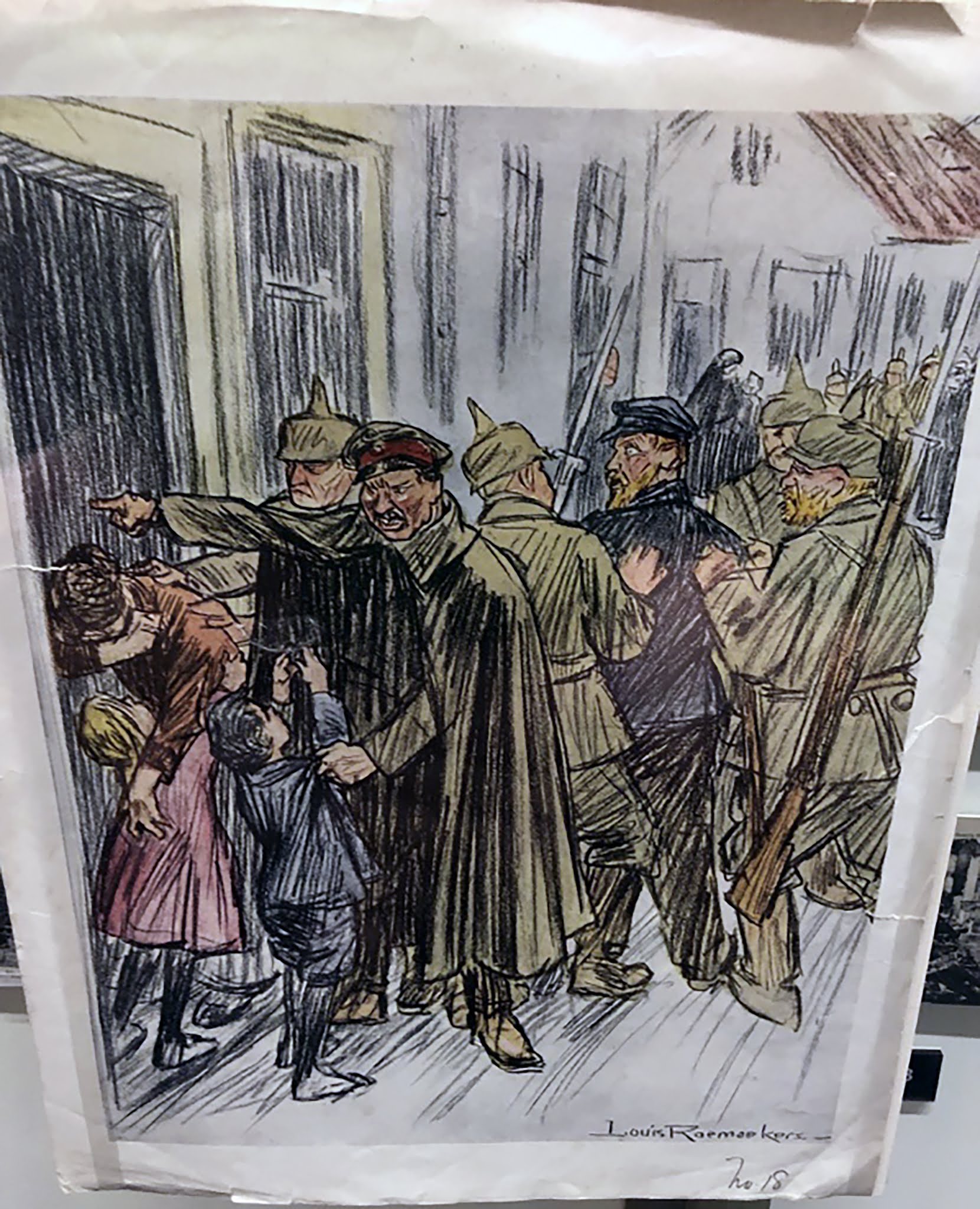
The permanent exhibit manages to include obtrusive items like heavy artillery and an airplane in an unobtrusive way. They fit in well with the cases of objects and information, rounding out the comprehensive experience of a complex war. The more delicate items of art also feature to their advantage, such as a Princess Mary box with its contents and this stunning Louis Raemaekers' drawing of German oppression of the Belgians.


Another work of art presents in the form of a puzzle bearing a beautiful painting of a submarine and two seaplanes. The artistry in the seascape caught my eye, but the clear identification of the U-boat piqued my historian's curiosity. U-72, type UE-1, was built in Hamburg in 1915 and commissioned in Jan 1916. She experienced four different commanders and four patrols between April 1916 and November 1918, based in the Adriatic. U-72 was scuttled on 1 November 1918 at Cattaro, present-day Kotor in Montenegro. How satisfying it is to visit a museum, enjoy anew all the aspects one has studied for years, and to come away with a new bit of knowledge. Thank you, National WWI Museum and Memorial.


Photographs used with the gracious permission of the National WWI Museum and Memorial, Kansas City, MO.
 

Tuesday, October 19, 2021

Trust No One The Secret World of Sidney Reilly


By Richard B. Spence
Feral House, 2002
Burke G Sheppard, Reviewer


The Real Reilly
(Not Sam Neill)


Originally Presented at Strategypage.com 

The man best known to history as Sidney George Reilly has been called the “Ace of Spies”, and even the role model for James Bond. Some biographers have praised him as one of Britain’s most cunning and ruthless intelligence agents, while others have claimed that he actually betrayed British intelligence and spied for the Soviets. He has even been the subject of a TV miniseries called Reilly: Ace of Spies, that aired in the 1980s. Richard Spence, a professor of history, watched that series when it aired and was fascinated. He decided to investigate the facts of Reilly’s life for himself.

Spence has done some very impressive research. Reilly’s previous biographers relied a great deal on what Reilly said about himself, and as Spence demonstrates, very little of that was true. Reilly took pains to obscure the details of his life. Spence has carefully combed the surviving records, and appears to have come closer than anyone to solving the mystery of Reilly’s origins and early life.

He was probably born Salomon Rosenblum somewhere in Russian Poland in 1874. He was illegitimate, and when this came to light in 1890, it precipitated a family crisis. His mother was forced to leave for Odessa, taking young Salomon with her. In 1892 he enrolled in a university there and became involved with some student revolutionaries. This brought him to the attention of the Okhrana, the tsarist secret police, and Rosenblum was forced to flee the country.

He completed his university studies in 1895 somewhere in central Europe. He appears to have studied chemistry. In 1895 he appeared in Paris, where he worked as an informant for the Okhrana, reporting on Russian radicals. (He may well have been recruited by them after his brush with the law in Odessa.) While in Paris, Rosenblum and his Okhrana case officer robbed and murdered two couriers carrying money for a Russian revolutionary group. Rosenblum took his share of the loot and went to England.

It was in England that Rosenblum took the name of Sidney Reilly, one of many aliases he would adopt. He began using what he called “The System.” This amounted to working for all sides, being careful to maintain a good relationship with the strongest, and maximizing his own profit. Reilly called himself “a practical man.” He was really, according to Spence, “a mercenary of a rather specialized sort...a freelance entrepreneur in the business of information and influence.” He had personal stationary made for himself bearing a double-headed eagle with the motto “Mundo Nulla Fides,” which translates as “Put no faith in the world,” or perhaps more simply, “Trust no one.”

His association with British Intelligence began in England as well. He continued, for a time, to spy on Russian radicals for the Okhrana, but eventually made contact with the British and began to work for them also. His work for the Okhrana ended when he was caught distributing counterfeit Russian currency—the counterfeit notes were used to finance the very radicals he was supposed to be reporting on. By that time, the British had come to regard him as a valuable agent, and sent him to the Far East to get him away from Russian agents in England. While there, he nominally worked for the British but seems to have sold information to the Germans and the Japanese as well, and engaged in a variety of lucrative (and frequently shady) private business dealings of his own. The Japanese were apparently dissatisfied with Reilly’s work and put a price on his head.

By carefully tracing Reilly’s movements, Spence uncovers some tantalizing coincidences. For example, in June of 1919, a series of terrorist bombs exploded in the United States. These were blamed on the Communists and triggered a massive Red scare in America. At the time, Reilly was working against the Russian Bolsheviks. Spence points out that Reilly was in America at the time the bombs were mailed and that they were mailed from a post office near an office Reilly used. 

Burke G Sheppard

Monday, October 18, 2021

Map Series #22—The Great War in Asia and the Pacific


Japanese Siege Artillery at Tsingtao


The Asian and Pacific Theatre of World War I in good part involved a conquest of German colonial possession in the Pacific Ocean and China. The most significant military action was the careful and well-executed Siege of Tsingtao in what is now China, but smaller actions were also fought at Bita Paka and Toma in German New Guinea. All other German and Austrian possessions in Asia and the Pacific fell without bloodshed. Naval warfare was common; all of the colonial powers had naval squadrons stationed in the Indian or Pacific Oceans. These fleets operated by supporting the invasions of German-held territories and by destroying the East Asia Squadron.  Troops from Australia, New Zealand, India, Southeast China, and China proper were also sent to support the Allied efforts in the Middle East and Western Front. A nice summary of the the various operations in this theatre can be found at MILITARY WIKI.


Click on Map to Enlarge
(Display Width=580px  Larger Width=1042px)


Source: Cambridge History of the First World War, Vol. I

Sunday, October 17, 2021

Battlefield Innovations: 1915–1917


French Trench in Vosges Mountains, 1915


By David Stevenson

Although the Western Front remained static in 1915–17, it would be wrong to assume that tactical procedures failed to adapt to the new conditions, despite the stereotyped view that attacking forces simply went on repeating the same mistakes. On the contrary, we can see an evolution towards better coordinated combined operations. In September 1915 and April 1917 the British and French armies on the Western Front attempted sequenced offensives, a preliminary blow drawing off the German reserves before the main attack came in a different sector.

 At the Chantilly conferences of December 1915 and November 1916 the Allies adopted even more ambitious plans for synchronized offensives in summer 1916 and spring 1917 respectively. The summer 1916 schedule of attacks (Russia’s Brusilov offensive in June 1916; the Anglo-French Somme offensive starting in July; Romania joining the Allies in August; and Italy’s capture of Gorizia in the same month) placed the Central Powers under great pressure, and the Allies agreed to follow it up with still more powerful synchronized attacks in the following spring, until the March 1917 revolution in Russia disrupted this scheme.

In summer 1917 the British planned to combine an inland advance from the Ypres salient with an ambitious amphibious landing on the Flanders coast in order to  capture the ports of Ostend and Zeebrugge (which the Germans were using as destroyer and submarine bases), although this project failed to get beyond the first phase.

At the tactical level, moreover, the Allies were improving their capacity for all-arms operations. They developed more sophisticated air reconnaissance and photography, and began locating enemy artillery by flash-spotting and sound-ranging. First the French and then the British experimented with the "creeping barrage:" a protective curtain of field-gun fire running just ahead of the attacking infantry, which if correctly timed would force the defenders to keep their heads down until the attackers were virtually upon them.

But the Germans (who by and large were on the defensive on the Western Front) meanwhile evolved new counter-techniques of defensive warfare, particularly  after Paul von Hindenburg and Erich Ludendorff took over the German Army High Command (Oberste Heeresleitung—OHL) in August 1916. These techniques included building ever more elaborate trench fortifications, which by 1917 might comprise five successive defensive systems, each consisting of three principal trench lines plus communication trenches and including deep dugouts—or continuous trenches might be abandoned in favour of mutually supporting and camouflaged concrete strongpoints. But in addition, the Germans concentrated fewer troops in the first line (where they were most vulnerable) and held them further back for prompt counter-attacks, while their artillery lay further back still and mostly survived Allied bombardments. These methods worked well against the French Chemin des Dames offensive in April 1917 and against the British Third Ypres offensive during August.


Mine-Destroyed German Trench on Messines Ridge, 1917


More generally, the German army had a strong tradition of systematic and self-critical learning from experience and regular revision of doctrine. Not only was it developing new defensive tactics but it was also developing new offensive ones: particularly the Bruchmüller artillery system and the "stormtroop" (Stosstruppen) tactics for infantry, which will be discussed further in the next section. These methods can be seen developing from the Battle of Verdun in 1916, via the operations in Galicia (July 1917), at Riga (September 1917), and at Caporetto (October 1917). 

The Battle of Cambrai in November 1917 encapsulated the new developments. The initial British attack there used 476 tanks and a surprise artillery bombardment and air strike, before the infantry broke through the German lines. But a German counterattack two weeks later, delivered by specialized assault troops who also achieved surprise, recaptured much of the lost ground. At this stage the two new systems seemed more or less to cancel each other out. 

From: "Joint or All-Arms Warfare on the Western Front, 1918,"  2014 International Forum on War History: Proceedings


Saturday, October 16, 2021

Recommended: A Tribute to Australia's HMAS Sydney


HMAS Sydney Departing for War, 1914


The name Sydney is one of the most famous ever carried by an Australian warship. The first Sydney was a Town Class light cruiser; one of three ordered in 1910 which were part of the initial Australian fleet unit. Traditionally cruisers were the most versatile element of a naval force. A cruiser’s role was to go anywhere and to do anything and they were to prove particularly useful in the role of trade protection and scouting duties. The Town Class cruisers were really a group of classes, each representing a steady improvement in seakeeping and warfighting capabilities. Sydney (I), Melbourne, and Brisbane belonged to the third group known as the Chathams. These incorporated a side belt of 3-inch armor to improve protection against high explosive shells, while better stability resulted in increased accuracy of their gunnery.

The first cruiser laid down for the RAN was Sydney (I) which was launched in August 1912 by Lady Henderson, wife of Admiral Sir Reginald Henderson. She commissioned at Portsmouth on 26 June 1913 under the command of Captain John CT Glossop, RN. She departed Portsmouth on 25 July 1913 and first arrived on the Australia Station at Albany on 19 September 1913. On 4 October 1913 she formed part of the Australian Fleet Unit that ceremonially entered her namesake harbor to a rapturous welcome from tens of thousands of spectators who turned out on the shores of the harbor to welcome the arrival of ‘their’ fleet.

Following a period spent in eastern Australian waters, Sydney (I) proceeded to Singapore in March 1914 to meet and escort to the two new Royal Australian Navy submarines, AE1 and AE2, which were en route to Australia from England. Sydney (I) spent the remaining months of the prewar period working up in Australian waters.


The days preceding the outbreak of war in August 1914 found Sydney (I) in Queensland waters. On 3 August 1914 she was joined at Townsville by the destroyers HMAS Warrego and Yarra before proceeding north to form a unit of Admiral Patey's Pacific Squadron.

Following the outbreak of war on 4 August 1914, Sydney (I) operated in New Guinea and Pacific waters and in the brief campaign against the German Pacific possessions during which she carried out a series of punitive patrols. Highlights during this period included the capture of Rabaul (9 to 11 September 1914) and the destruction of the Angaur Island Wireless Station on 26 September 1914.


Firing One of Sydney's 6-inch Guns


In October 1914, Sydney (I) and her sister ship Melbourne detached from the Flagship HMAS Australia, and returned to Australia to form part of the escort for the first ANZAC convoy which consisted of some 38 transports. The convoy’s escort comprised Sydney (I), Melbourne, HMS Minotaur and the Japanese cruiser Ibuki. The convoy sailed from Albany on 1 November 1914 and on the morning of 9 November 1914 was steaming some 50 miles east of the Cocos Islands.

At about 06:20 on 9 November, wireless telegraphy (W/T) operators in several transports as well as in the escorting warships received signals in an unknown code followed by a query from the Cocos Island W/T station, 'What is that code'? It was in fact the German cruiser Emden under the command of Captain Karl von Müller, ordering her collier Buresk to join her at Point Refuge to coal. Shortly afterwards, the Cocos Island telegraphists signaled 'Strange warship approaching’ followed later by the same message prefixed by ‘S.O.S.’ — the international distress call.


Emden had by then anchored in Port Refuge and immediately dispatched a landing party, under the command of Lieutenant Commander Von Mücke, with orders to destroy the cable and wireless stations.  As Von Müller patiently awaited the return of his landing party, smoke was sighted on the horizon which was at first assumed to be the Buresk. Soon afterwards the masts of the approaching ship were recognized as those of a warship. The ship Von Müller had spotted was Sydney (I) which, as the nearest warship to the Cocos group, had been ordered by Captain Silver in Melbourne to proceed at full speed to investigate. By 07:00 Sydney (I) was 'away doing twenty knots' and at 09:15 had simultaneously sighted the island and the Emden some seven or eight miles distant. At first Captain Glossop could not tell whether the ship sighted was Emden or the Königsberg, both of which were thought to be at large in the Indian Ocean at that time.

Continue the story of Sydney's pursuit of Emden here:

https://www.navy.gov.au/hmas-sydney-i-part-2


Friday, October 15, 2021

Future U.S. Marine Corps Commandants at Belleau Wood

That four future Marine Corps commandants fought at Belleau Wood might not surprise many of our readers.  The name of one who was not there, however, might surprise you.  Legendary Marine, John Lejeune, was busy with other duties within the AEF at the time.  More on that below, but here are the four that were destined for greater responsibilities after surviving that struggle for the little forest near the Marne River in June 1918.


Now, about General Lejeune's whereabouts:


From May to August 1917, Lejeune helped organize the 5th and 6th Marine Regiments and took command of the new Marine Corps base at Quantico, Virginia. He remained there until May 1918, whereupon the commandant sent him to serve on General John J. Pershing’s (1860–1948) staff, at Chaumont, France. From 19 June to 4 July, Lejeune served with the 35th Division in the Vosges Mountains. He earned promotion to major general on 1 July, and on 5 July he briefly assumed command of the 64th Infantry Brigade of the 32nd Division. Then, on 25 July, he took command of the 4th Brigade (Marines), 2nd Division. Just three days later, Lejeune took over command of the entire 2nd Division. Shortly after his taking command, the 2nd Division participated in the American-commanded St. Mihiel Offensive, the Battle of Blanc Mont Ridge, and the final stage of the Meuse-Argonne Offensive.

Sources:  USMC.edu and Encyclopedia 1914-1918

Thursday, October 14, 2021

"Back to the Stone Age'" or The Flintstones on the Western Front


From War in a Different Light

During the Great War, armies not only dug trenches into the earth but also built large and voluminous underground dugouts, shelters, huts, storage rooms, aid posts, and what not. In certain regions in northern France, most notably around Arras, Soissons, Rheims, the Chemin des Dames, and other regions, thankful use was made of either natural caves or stone quarries. Many of such underground cavities were quite large, allowing shelter for thousands of men at a time, others were more modest in size but perfectly adaptable for use as living quarters, often by the addition of a wall, windows, and door.


The irony of a regression toward a more primitive mode of habitation was not lost on news editors and photographers. Many magazines published photos of such dwellings accompanied by all manner of captions. While scorn might be heaped upon the enemy for living in caves, like cavemen, the own troops might equally well be praised for the adaptive ingenuity of adjusting to difficult circumstances and making the best of things. It was all a matter of perspective.


Most of the images shown here are from the early years of the war and come from news magazines on both sides.


Postscript: The American 26th Division spent some time in the caves near the Chemin des Dames in the spring of 1918.  The Doughboys left a number of inscriptions on walls.  A good collection of them can be viewed HERE.

Thanks to Tony Langley for the article and photos


Wednesday, October 13, 2021

The Execution of Captain Fryatt – A Roads Classic

Before the war was a year old, Captain Charles Fryatt had already had a number of close shaves with German U-boats. After growing up in Harwich, Essex, he followed his father into the merchant navy. In March 1915, captaining the SS Brussels, he attempted to ram a prowling U-boat, actions that won him national acclaim.


But on 25 June 1916, his ship was cornered by five gunboats and Captain Fryatt was imprisoned.  He was tried in Bruges on charges of being franc tireur—a civilian engaged in hostile military activity. Captain Fryatt had earlier told his captors he did his duty to protect his crew but, according to press reports, was not allowed to speak at his trial.

The hearing, sentence and firing squad all took place on the same day, 27 July 1916. When his funeral was held in Harwich, schoolchildren were given the day off and the streets were lined with people. Among the lasting tributes, the local hospital was named after him.

The public reaction to Charles Fryatt's death echoed that of Nurse Edith  Cavell eight months earlier. In both cases, the Germans had intended to show defiance would not be tolerated. In both cases they acted in accordance with their military code and international law. Stephen Badsey, Professor of Conflict Studies at the University of Wolverhampton, explained: "Both were guilty of breaching military law and once the Germany military had determined they had a right to execute them they were going to go ahead and do it, without thinking through the wider impact."

In both cases they failed to consider the propaganda battle. The outcry in both cases was that Germany had "violated civilisation." Newspapers across the world raged at the actions of the German army. Headlines were fat with words like "murder" and "atrocity."

In a letter to Mr Fryatt's widow, King George V called his death an "outrage." Every means of communication—songs, postcards, posters, films, and even stamps—were used to convey such examples of "the Hun" at work.


Both Fryatt and Cavell were initially buried close to where they were shot, but shortly after the war their bodies were exhumed and brought back to England. The same train carriage was used in both cases. Capt Fryatt's funeral was held at St. Paul's Cathedral, but his body was also taken home and buried at All Saints' Church, Upper Dovercourt, Essex.

He was celebrated in two main memorials, but in addition to the hospital, a road and a pub in Harwich also bear his name.

Adapted from a BBC Website article

Tuesday, October 12, 2021

Montfaucon


By Maarten Otte
Pen and Sword, 2018
Peter L. Belmonte, Reviewer


Approach to Montfaucon Today


Disclaimer: Half of this book (Full title: The American Expeditionary Forces in the Great War: Montfaucon) is a travel guide for the Montfaucon area and the Meuse-Argonne battlefield, and although I’ve researched and written about the Meuse-Argonne Offensive, I have never visited the battlefield. PLB


The failure of the 79th Division to take Montfaucon on the first day of the Meuse-Argonne Offensive has been the subject of some historical analysis. This current book, by historian Maarten Otte, is the latest examination of the action at Montfaucon. Otte acknowledges two recent books describing the division’s terrible struggle to advance against the Germans in late September 1918. As Otte says, “there is no comparison to be made between this book, which should not be regarded as a major study, and these large-scale works” (p. xi). Indeed, Otte intends his book to be used as a reference to the battle for readers at home or visiting the battlefield. This is Maarten Otte’s second book in Pen and Sword’s Battleground series. The author lives in the area of the battlefield and makes good use of “his intimate knowledge of the ground” (p. viii).

Otte starts with an overview of the war and some key personalities; he then reviews the Montfaucon terrain as an observation post rather than as a fortified bastion. He also gives a nice overview of the famed observation tower in Montfaucon as well as a description of different types of German dugouts and fortifications in the area.

The meat of Montfaucon is a narration of the advance of the 79th Division, covered chronologically and referencing the left and right “halves” of the division’s attack formation. Otte gives more detail about September 26 and 27, the most important of the days on which the division fought, and less so for September 28 through 30. The author relies on only a few different primary sources in his description of the American attacks; a broader variety would have been helpful but would have lengthened the book and put it at odds with Otte’s primary purpose. Still, his use of these sources allows us to get a good feel for the tenacity of the men as they faced German machine guns and artillery with little food, water, and supplies.


Wounded Men of the 79th Division


The author’s historical scholarship is sound. While critical of some aspects of the American 1st Army, such as the overly ambitious objectives of the first day and the dreadful traffic jams behind the lines, he approaches the topic fairly and is thoughtful in his assessment. Otte makes good use of both American and German primary sources, such as unit histories and diaries. The nature of the book causes Otte to focus narrowly on one area and mostly on one American division; detailed examinations of strategy or operational concerns are absent.

Otte includes two car tours and three walking tours; their descriptions begin on page 159 and run about 70 pages. A numbered and labeled map accompanies each tour. For each walking tour the author gives an approximate duration and a distance. He also includes helpful hints about whether the terrain is difficult for hiking and what type of shoes to wear. Otte includes cautions and warns of places one can visit “at your own risk.” All the tours are accompanied by GPS coordinates of significant points and helpful tips about points of interest to visit along the way. These include places to stay, private museums, etc. Five appendices give orders of battle, statistics relating to the battle, and a list of 20 German observation posts and shelters in the area, accompanied by current photographs.

There are 27 maps and diagrams scattered throughout the text of Montfaucon. Some of these maps are reproductions of the American Battle Monuments Commission maps, and others are geared for each car or walking tour. There are dozens of photographs throughout the book; these are helpful in giving the reader a feel for the men and terrain involved. Especially helpful and interesting are present-day photographs of areas of the battlefield, including some monuments. There are no end notes and only an abbreviated “Selected Bibliography.” While this is not the “final word” on the American fighting at Montfaucon, it is a fine overview of the action of the 79th Division there, and it would be a worthy companion for anyone touring that battlefield. .

Peter L. Belmonte

Monday, October 11, 2021

Saturday, October 9, 2021

Genealogical Help: World War I Burial Case Files

This version contains corrections made 15 October 2021

Temporary Cemetery for the Fallen of the 147th U.S. Infantry


By Lynna Kay Shuffield

When Cpl. William W. Brown, Co. D, 141st Infantry, 36th Division, "went over the top" during the Battle of Blanc Mont Ridge in World War I on 8–9 Oct 1918, he fought as only a Texan should. While courageously advancing under violent artillery and machine gun fire, Brown was killed in action by German shrapnel, which resulted in fractures of the skull and left arm at the elbow.

He was originally buried in an isolated battlefield grave on the Medeah Farm at St. Etienne-a-Arnes (Ardennes). He was posthumously awarded the French Croix de Guerre with a silver star for extraordinary heroism. Brown was disinterred and reburied four times before he reached his final resting place at the Meuse Argonne Cemetery #1232 at Romagne-sous -Montfaucon in Meuse, France in Grave 174, Sec. 85, Plot 4.


Corporal William Brown's Final Resting Place
(While Under Construction)


You are probably wondering how I learned so much about Corporal Brown and his death. There are little-known documents called "burial case files" for most World War I casualties contained in Record Group 92 now located at the National Archives facility in St. Louis, MO. These files are related to servicemen or women who died while in the military during the time period 1915-39; the files were maintained for war casualties as well as for military domestic deaths.  See https://catalog.archives.gov/id/595318 for the NARA catalog description of the burial case files.

The folders are arranged alphabetically and contained documents related to the individual's name, military organization, place of residence, date of death, circumstances of death, places of burial, next of kin, etc.  These files also contain documentation if the mother of the deceased participated in the "World War I Mothers' Pilgrimages" program, which was sponsored by the U.S. government.  This program transported mothers and wives of the deceased to the overseas military cemeteries.

Contact Information:

National Archives at St. Louis (RL-SL)

1 Archives Drive, Room 340

St. Louis, MO 63138

Phone: 314-801-0850

Fax: 314-801-9187

Email: stl.archives@nara.gov


Be sure to include as much information as you know about the solider, i.e., full name, date of birth/death, service number (if known), places of residence, etc.

Thanks to Patrick Osborn of the National Archives for pointing out that the contact information in the original version of this article was out of date.

Friday, October 8, 2021

A Chaplain's View of WWI Combat, the Spanish Flu, and the Impact of War, Part 2 of 2


In Part 1, Chaplain Stewart Robinson described his duties with the 78th "Lightning" Division through the St. Mihiel Offensive until he was struck down with by the Spanish flu. He continues his account:

September 24, 1918, Tuesday, Clear +61; French hospital train evacuation through Burgundy

“Did not stay long in this Base Hospital #45. It is an evacuation hospital now and we were shot out on a French hospital train. I did not feel very well but the experience was novel and I enjoyed it. Towards evening I went to bed on one of the swing litters with the rest of the sick and wounded men. The French attendants took pretty good care of us. They fed us our supper. We reached our destination about 1 a.m. and I had a bath and went to bed.”

September 25, 1918, Wednesday, Clear +62;  Base #26 Hospital,  Allerey-sur-Saone, Cote d’Or, France

“A beautiful day. I did not feel so very lively and kept pretty well down in bed all day. The nurses are very nice to us. This is Base #26. The little village here is quite a center for hospitals. My malady seems to be slowly yielding to the treatment forthcoming. They do not give me much medicine. Perhaps they have only a very little. But I guess it is just as well. Being quiet here has awakened within me a great desire to turn my footsteps homeward.”

September 27, 1918, Friday, Cloudy +60; Allerey hospital

“Still this quiet life here continues and I keep on feeling better all the time. I keep thinking all the time of the chance of getting back home to work over there. I feel that this will doubtless be what will happen, because of the prayers of the dear folks back home. The fact that I can do just as much there as here and the fact that I want and pray for it myself. Things like that have worked out so before. God has a way of doing very wonderful things for those who love Him.”

September 30, 1918, Monday, Clear +59; Ward under quarantine for meningitis. Ready to get out.

“The ward is still under a quarantine for a case of meningitis that was discovered here. I am feeling much better and am anxious to get away from here now. The war is progressing in wonderful shape. I do believe that before so very long we shall see the end of it. How the world and land of France longs for that day when peace shall come again. Perhaps this coming Christmas will see a day spring of a new era of peace in the world, built on a little more secure foundation than it has ever had before.”


A Ward at Base Hospital #26


October 4, 1918, Friday, Cloudy +60; Recovered and released “to leave this place…” Train to Dijon

“Awoke, dressed for breakfast and started to leave this place. I was scheduled to go to Convalescent Camp last night but they did not send for me. Today the camp was writing to pass me through immediately and wrote my orders for me to go to Chateau d’Aux, Louplande. Nobody knew where this place was, so I started for Dijon Cote d’Or, where I plan to spend the night. I will seek after this place in question and hope that it will be on the way homeward. That has become my ardent desire now. The Fall and cold weather bids me fly back to the sunny southland of home sweet home.”

October 8, 1918, Tuesday, Clear +60; Train from Montparnasse to Le Mans, Orders back to 78th Div.

“Arrived by train from the Gare de Montparnasse at Le Mans and thence to La Suze at 4:30am. The local paper carrier took me out to the Chateau d’Aux (aka Villaines) in Louplande in a little donkey cart. The sight of the little village in the first streaks of dawn. When we reached the edge of the estate another pretty sight greeted me in a little stone house from whose chimney the smoke curled and whose door and window gave forth a fresh pink glow. Chaplain Moody came down and said I was to go back to my division (78th). Well, we will hope for the best.”

In Mid-October the 78th Division was transported from the St. Mihiel Sector to the left flank of the American First Army which was in the midst of the Meuse-Argonne Offensive.

October 16, 1918, Wednesday, Rainy +58; Slept in French freight car with thousands of loaves of bread

“Slept in a French freight car on the floor with some thousands of loaves of bread. Morning dawned cold and wet. A company of railway engineers gave me some breakfast and I had my first ride in an American locomotive run by a man who used to run from Kansas City to Chicago. We ran from Clermont to Aubreville. There I caught an ambulance going to the 78th. Late in the evening we reached Lancon, where I met Colonel MacMillian, who took me over to Chatel to P.C. A mine blew up at 1 a.m. and a shell or 2 lit in the edge of village. So goes life.”

October 17, 1918, Rejoins the 78th Division in the Meuse Argonne battle. Close call with artillery shell

“Found my work in a pretty complete state of confusion, thanks to the many changes which had happened in my absence. There have been many changes in the HQ. The prospect is not overly bright for the future. Rode down in the evening with MacDonald. About 45 seconds after he drew his truck out of a barn door where it had been standing a shell sailed in right on the spot.  We reached Les Islettes and found a place to sleep with some of the supply train. They had a nice fire which was very acceptable and brightened up the evening.” 

October 22, 1918, Tuesday, Cloudy +58; Evacuation Hospital #14, “the agony and suffering of this awful war passes all imagination.”

“Did not need to get up this morning. One of the patients in the shock ward died during the wee hours when I arrived. He had lost an arm and his leg had a horrible wound fully three inches deep and nearly a foot long. I held his head on Sunday while his leg was dressed. It was agonizing to see his face written all over with signs of extreme pain. The agony and suffering of this awful thing passes all imagination. I am tired of the thing and I have barely seen the fringe of the thing. We are in the midst of God’s great testing by fire. I trust Him for all things.” 


78th Division Stretcher Bearers in the Argonne Sector


October 26, 1918, Saturday, Cloudy +63; “Shells land 50 yards of me, they were big ones and whistled painfully…I was delivered from great danger.” St. Juvin, France.

“Went out over the hills to the front, visited 115 Brigade reserve, 155 P.C. and went up into St. Juvin. We hold one end of this little village and the Boche is in the other. He was trying to blow up the little bridge by which one had to get into town. It was a pretty strenuous time and I was assured anew that God takes care of us. They (shells) fell inside of 50 yards of me. They were big ones and whistled painfully. The trip was in the line of duty and I was delivered from great danger. God is able to keep me and use me through all the days of my life. I can trust Him. I must dare to do so.”

At the end of the month, Chaplain Robinson is ordered to a Services of Supply Base at Brest on the French Coast.

November 6, 1918, Wednesday, Clear +50; Lambezellec, France, Thousands of graves of those who died of influenza upon landing in Brest… .

“Arose at leisure-Went out to Lambezellec and had a funeral. There are thousands of graves out there of men had influenza and died when they landed here. In p.m. I looked over some of the features of Casemate Fautras where some of my work is to be done. Had supper and went to the movies with Sledge, a very genial Southern Baptist chaplain. The movies were American and one was very funny and I laughed more than I have all summer. The little nascent moon hung in the West. I felt a premonition of home by the week.”

Thanksgiving, November 28, 1918, Thursday, Clear +49.

“Held service at Fort Federes. Had dinner with Co. I 2nd Pioneers. Took bath in the p.m. Went to Officers’ Club in even. and enjoyed a very fine turkey dinner. Met Wm Larimer Jones II of Princeton 1915 on street. He was just in town from the U.S.S. Dekalb and gave the heartening news that she had no chaplain. This may be the slant I have been praying for. I had another feeling today that an advance towards home was about to come to me. Wired GN> regarding matter. Heard that Esther is up at St. Malo a port not such a great distance from here. I pray I may be about to leave for home.

Stewart Robinson spends the next four months hoping for a timely return home. He finally sails on 25 February 1919. 

March 7, 1919, Cloudy, +55; Arrives in New York harbor, train home to Philadelphia

"Went up on deck right after breakfast and sighted land at about nine o’clock. All the moments thereafter were spent in eagerly looking for new things on the shore or in the water. We came along through the Bayand along the buoyed channel to the upper way past the forts and past the Statue of Liberty.

We docked at one o’clock and as soon as we came out of the dock I saw Anne MacGregor and the folks waiting behind the gate. We had a cursory examination for bugs and creeping things and then were able to get out to see the impatient dear ones. It was a very happy sight for there were many little parties like our own.

Caught 5 p.m. train for Philadelphia and spent a thankful and happy evening and went to bed at peace and full of a very great and deep thanksgiving to God."

March 8, 1919, Clear, +57; Home in Philadelphia

"Spent the whole day in the house unpacking and visiting. It was one long happy hour with no thought of time or obligation. I wired for permission to report on Monday at Camp Dix where I am to go to be demobilized. This request was granted and this added to the joy of the day In the evening Anne MacGregor and I walked over to see Grandfather who is sick in the hospital.

There seems to be a few jobs on the horizon into which I may have a chance to insinuate myself. One possibility is the chair of English Bible at Lafayette. This seems like a large thing to be put in my way at this stage of the game but I do believe that I could make a success of this very piece of work. I wonder if God has this bit of work for me. I will wait, work and pray."

Postwar:

After WWI, he pastored Presbyterian congregations in Cleveland, Ohio, Lockport, NY, and Elizabeth NJ, until retirement in 1961. For 12 years he edited, The Presbyterian, an independent journal published in Philadelphia. After WWII, 1951–53, he served as Chairman of the Army-Navy Chaplains Commission, visiting troops during the Korean War. He authored a monograph on the influence of colonial clergy on the American Revolution. His papers are archived at the National Archives, Princeton University and Princeton Theological Seminary.

Thanks to Dave Robinson of McLean, VA, for bringing his grandfather's diary to our attention.