| A Reinforced Concrete Shelter Under Construction |
Now all roads lead to France and heavy is the treadEdward Thomas, Roads
Of the living; but the dead returning lightly dance.
Thursday, January 20, 2022
Why the Hindenburg Line Failed
Wednesday, January 19, 2022
The Great War's Impact on Canada
| Temporary Canadian Graves on the Western Front |
Originally Presented by the Canadian War Museum
Canada emerged from the First World War a proud, victorious nation with newfound standing in the world. It also emerged grieving and divided, forever changed by the war’s unprecedented exertions and horrific costs.
A Country Fundamentally Changed
The war united most Canadians in a common cause even as the extremity of national effort nearly tore the country apart. Few had expected the long struggle or heavy death toll. A war fought supposedly for liberal freedoms against Prussian militarism had exposed uneasy contradictions, including compulsory military service, broken promises to farmers and organized labour, high inflation, deep social and linguistic divisions, and the suspension of many civil liberties. Some women had received the right to vote, but other Canadians—recent immigrants associated with enemy countries—had seen this right rescinded.
Government had intervened in the lives of Canadians to an unprecedented degree, introducing policies that would eventually mature into a fully fledged system of social welfare. But it had not prevented wartime profiteering, strikes, or economic disasters, leading many to question the extent to which rich Canadians had sacrificed at all. A massive and unprecedented voluntary effort had supported the troops overseas and loaned Ottawa the money it needed to fight the war. The resulting post-war debt of some $2 billion was owed mostly to other Canadians, a fact which fundamentally altered the nature of the post-war economy.
| Red Cross Packages for Canada's Soldiers in Europe |
Politically, the war was also a watershed. Borden’s efforts to win the 1917 election and carry the nation to victory succeeded in the short term, but fractured the country along regional, cultural, linguistic, and class lines. English and French relations were never lower, and accusations of French traitors and English militarists were not soon forgotten. Quebec would be a wasteland for federal Conservative politicians for most of the next 40 years. Laurier’s forlorn stand against conscription lost him the election and divided his party, but helped ensure the Liberals’ national credibility, with a firm basis in French Canada, for decades to come.
Labour, newly empowered by its important role in supporting the war effort, pushed for more rights, first through negotiations, and then through strikes. Farmers seethed over agricultural policies and Ottawa’s broken promise on conscription. In the post-war period, both groups would form powerful new political and regional parties.
Autonomy and Foreign Policy
| Celebrating Dominion Day |
The war accelerated the transformation of the British Empire into the British Commonwealth and demonstrated Great Britain’s military and economic reliance on the self-governing dominions. Most of the principal Commonwealth heads of government recognized this, and saw clearly in their wartime contributions the route to greater independence and standing within imperial counsels.
Prime Minister Sir Robert Borden orchestrated a massive national effort in support of the mother country, but also demanded that Great Britain recognize Canada’s wartime sacrifices with greater post-war autonomy. Canada signed independently the Treaty of Versailles (1919) that formally ended the war, and assumed a cautious, non-committal role in the newly established League of Nations. London’s wartime agreement to re-evaluate the constitutional arrangements between Great Britain and its dominions culminated in the Statute of Westminster (1931), which formalized the dominions’ full control over their own foreign policy. Canada’s determination to do so regardless had already been made evident during the 1922 Chanak Crisis, when Ottawa insisted on a Parliamentary debate before considering possible support to Great Britain in a military confrontation with Turkey.
Unprecedented Status
| Victorious Canada: Paris, 14 July 1919 |
Despite the social and political challenges of the post-war, most Canadians also emerged from the struggle believing they had done important and difficult things together. Their primary fighting force at the front, the Canadian Corps, had achieved a first-class reputation as one of the most effective formations on the Western Front. Their generals and politicians had played an obvious role in victory, and the country itself enjoyed an international standing that few observers in 1914 could have predicted.
Tuesday, January 18, 2022
Of Those We Loved: A Great War Narrative Remembered and Illustrated
| Author with His Training Mates at Alsdershot, 1914 Note: All His Friends Were Killed or Wounded in the War (Click on Image to Enlarge) |
A certain mystery hangs over the origin of this fascinating and highly readable memoir. We never learn what the author’s initials I. L. stand for, but we do know he died in 1971. The book was first published in England in 1994 and republished in 2013, copyrighted to "The Estate of I. L. Read." I can only surmise that someone took original notes or a diary, plus pencil sketches by the author, and fashioned this excellent final work—an idea bolstered by the statement inside the book’s cover that the contents have been “refined over the years.”
But I’d rather talk about the book than play literary detective. Dick Read joined the Leicestershire Regiment in 1914 at the outbreak of war. He was an enthusiastic patriot with an extremely positive attitude. This attitude seems to have stayed with him throughout the war no matter what. He sees early combat in northern France and later at the Somme. He is wounded in the leg and recovers. In 1917 he’s commissioned into the Royal Sussex Regiment and is sent to Egypt to join his new battalion. The lengthy trip, by train and then boat, is described in detail and is one of considerable discomfort and fatigue. On arrival in Egypt he is almost immediately ordered back to France, so back he goes, spending some three months on his total travels. He arrives in time for the Second Battle of the Marne, where his valor earns him the Croix de Guerre, is in the Final Advance, and remains in the army after the Armistice, seeing duty with the British Army on the Rhine.
Although we encounter most of the main battles of the war in this memoir, more valuable in my opinion are the personal insights and attitudes we get from the text. Some are quite earthy. Read is told early on by an old salt about the gas masks they used at Ypres: “Them bloody things are no good—If Jerry sends over gas, piss on a spare sock and tie it over your nose and mouth. That’s what we did” (p. 21). There are scenes of devastation and dead soldiers, of course, but Read does not dwell on the ghastliness and horror of combat. He chooses the general rather than the detailed in his descriptions:
Soon after midnight the Nissen hut in the transit camp which we occupied near Mendinghem station had a narrow escape, a bomb dropping nearby which riddled the roof like a sieve, snuffed our candles, and knocked us all over. Upon the road outside lay two American soldiers, unfortunately past aid…It was said that a cook had left his campfire uncovered, and that a passing flight of German Gothas en route for Calais or Boulogne had reminded us of the fact (p. 338).
| Author's Sketch from Arras Sector |
Only once in his narrative does the author express anger. It’s not toward the enemy but toward a group of his own countrymen: conscientious objectors, or "Conchies," as they were called. He sees a group of them at a depot while back in England for a spell:
An old colour sergeant was endeavoring, without success, to form them into two ranks as they stood about, many with hands deep in trouser pockets. They appeared so unusually slovenly that I commented on this to the sergeant of the guard on the main gate. ‘Them? Them there? They’re a bloody lot of Conchies…I’d shoot the bloody lot—look at ‘em!’ I looked, and saw them slouching around the perimeter…as they deliberately flouted authority by studied insolence and nonchalance amounting to open defiance. They had all refused to put on uniform…If hate is the word, I hated these figures of men just then, far more than any Germans. At least the Germans were worthy of respect as fighters (p. 276).
It seems that despite the dangers and discomforts, Read rather enjoyed his war. His "mates" or comrades as an NCO and later as a second lieutenant, mean a great deal to him. They’re all generous and supportive, ready to laugh at anything remotely funny or absurd, and they have plenty of fairly innocent adventures together whenever possible. In fact, I feel this book is an effective counterpoint to the myriad accounts that emphasize the horrors of the Great War and the abject misery of those who fought and died in it.
That Dick Read’s companions meant so much to him shines through the book. This is reflected of course in the title, Of Those We Loved. It’s also expressed at the beginning of Chapter 8, "The Somme," with the subtitle “To Our Comrades of the Somme, 1916,” followed by a quotation from The Rubaiyat of Omar Khayyam:
.
According to information on the dust cover of the book, each year on the anniversary of the Somme until he died, Read had these lines inserted in the Leicester newspapers in memory of his WWI pals.
Not only is this book a splendid read that easily holds our attention, but it also contains many black and white pencil drawings by the narrator plus photos of him as a young soldier. The sketches intrigued me, the stark black and white contrasts evoking an almost haunting response to impressions of soldiers marching, bathing, or relaxing in their temporary billets. Several sketches of maps are included, roughly hand-copied from official maps of locations and battle plans.
I haven’t been able to find out much about I. L. Dick Read other than what he tells us in his narrative. It would be interesting to know who "refined" the text over the years after his death and who made the decision to publish it in 1994. Nevertheless, Of Those We Loved is a highly readable memoir that should be better known than it is. I highly recommend it and feel it deserves the recognition given to the more popularly esteemed publications in this genre.
David F. Beer
Monday, January 17, 2022
New Addition to Our World War I Tattoo Collection: #2 Barbed Wire & Poppies
Collection Number & Title:
#2 Barbed Wire & Poppies
Description: Floral piece with two dramatic blossoming red poppies set atop rolls of barbed wire.
Location: Lower Left Leg
Tattooee: John S. Sproul
Artist: Amanda Pepper, in St Louis MO, website: bemycanvas.com
Background: Details from John and Linda Sproul
I've been entranced by the Great War for about 20 years; when I met my wife, Linda, she got the bug. We've been to the Western front seven times, once a year from 2014 to 2019. Our first trip over was to Sarajevo in 2014; we were on the site of the assassination on the 100th anniversary of the deed. From there we flew to London and then into France. I proposed to Linda at the Lochnagar crater, and we were married on Veteran's/Armistice Day that year, at 11:00 a.m., in Kansas City. We then went to the museum in period clothes and were taken for actors.
| Wedding Day for John and Linda |
Over the next six years, we returned to the front yearly to mark 100th anniversaries of the Somme, Verdun, and other spots; we used what was a great touring company, The War Research Society and were devastated when its leader Ian Alexander passed. We were there in Longueval when his memorial bench was dedicated. Our final trip was in 2019, to the Palace of Versailles, on the anniversary of the signing of the treaty, and were dumbfounded that the French did precisely zero on that spot, on that day. We hope to return after COVID, and in the meantime, we're members and supporters of our World War I Memorial and Museum in Kansas City, and we voraciously read and collect trench art, medals, things that used to go bang, and so forth. . .
When preparing for the tattoo, I described to the artist that what I was wanting: a collage of poppies and barbed wire. She emailed me a photo of a sketch she had drawn, and I loved it. When applying it, she did it freehand, without a stencil... quite the feat.
Here's a picture of the oil painting of the tattoo my wife Linda gave me as a gift after I got the tattoo, painted by the original tattoo artist; she used a piece of wood from an old church pew as her "canvas."
Sunday, January 16, 2022
Sveta Gora: Holy Site Destroyed in the Great War
| Sveta Gora Today |
Along the Soca (formerly Isonzo) River just north of the Slovenian/Italian border city of Gorizia, is a 2,240-ft. peak named Sveta Gora ("Monte Santo" in Italian, "Holy Peak" in English). It is the site of the basilica of the Assumption of the Virgin and an important seat for the Roman Catholic Franciscan Order. For five centuries it has been a sacred destination for Christian pilgrims. Among its most important religious elements is the image of the Madonna of Sveta Gora on the main altar, a work of the painter Palma il Vecchio from the 16th century. Founder of the Franciscan Order, St. Francis of Assisi, is also honored at the site, with an elegant, modern sculpture.
The Madonna of Sveta Gora |
The mountain owes its name to the apparition of the Madonna to the shepherdess Orsola Ferligoi of Gargaro in 1539 . A church was built on the top of the mountain already in the 14th century, which was then destroyed by the Turkish invaders and rebuilt in 1544. In 1786, Emperor Joseph II ordered the demolition of the church, which was later rebuilt.
| St. Francis of Assisi |
In 1917 the holy site of Sveta Gora, like Monte Cassino in World War II, were leveled out of military necessity during heavy fighting between Austrian and Italian armies. After the war, the basilica was rebuilt again, and the sacred artifacts—that could be removed and hidden—returned to the site. Sveta Gora was in similar jeopardy during the Second World War but was spared from bombing by [possibly] miraculous severe weather. In 1992, Pope John Paul II visited the site and blessed the famous painting of the Madonna.
| Aerial View of the Complex Showing How Challenging It Would Be Taken in an Assault from Across the River |
The mountain, in a dominant position on the Gorizia plain, was an important strategic objective since the opening of the Isonzo front hostilities, during the First World War. The sanctuary was in fact damaged by the Italian bombardments of June 1915 . Its importance as a military objective, however, became crucial only after the sixth battle of the Isonzo, when the Italian troops conquered Gorizia and the stronghold of Mte. Sabotino, located on the opposite bank of the river. Sveta Gora, together with the peaks of Vodice, San Gabriele, and San Danieleit formed the new well-armed northern defense line created by the Austro-Hungarians with the aim of stopping the Italian advance towards the Carso and Ljubljana. During the following four offensives, the Italian Army was unable to make the summit of the mountain its own due to the very serious losses. Even in the tenth battle of the Isonzo, which saw the Italian conquest of Kuk and Vodice, Monte Santo remained firmly in Austro-Hungarian hands despite its temporary conquest by the infantry of the Campobasso brigade on 12 May 1917.
| Top: Austrian Defender Atop Sveta Gora Bottom: Typical Italian Assault in the Soca (Isonzo) Sector |
On 22 August of the same year, during the eleventh battle of the Isonzo, the Italian troops finally managed to conquer Sveta Gora and the saddle of Dol below. Despite the successful outcome of the Italian offensive on the Bainsizza plateau, the strategic scope of success was very limited. After the disaster of Caporetto, which occurred only two months after the Italian conquest, Sveta Gora returned to Austrian hands until the end of the war.
| 1917 Damage to the Basilica |
Saturday, January 15, 2022
Remembering a Veteran: Lt. Everett McKinley Dirksen, 19th Balloon Company, 328th Field Artlillery, AEF
| Lt. Everett Dirksen Wearing the Aerial Observer Wing |
Future U.S. Senator from Illinois and Senate Minority leader Everett Dirksen (1896–1969) was born in Pekin, Illinois, where he attended public schools. He would later receive his law degree from the University of Minnesota. During the war he had the extremely hazardous job of observing artillery fire an observation balloon. He did observer duty in both the St. Mihiel and Meuse-Argonne Offensives and later served as an intelligence officer during the occupation of Germany.
When he returned home, he reflected on how he wanted to spend the remainder of his life:
I was not sure that I wanted to return to school and complete my law course, but I did know that I wanted to do something to end the madness of conflict and the insane business of arbitrating the differences of men and nations with poison gas and high explosive shells.
| President Eisenhower with Senator Dirksen in the Oval Office |
By 1933, he was ready to run for office. Here's a summary of his next 36 years of public service:
Everett Dirksen, represented central Illinois in the U.S. House of Representatives, 1933–1949. He later won four elections to the U.S. Senate, beginning in 1950. He rose through the leadership ranks of the Republican party in the Senate as chairman of the National Republican Senatorial Committee (1951–1954), Republican whip (1957–1959), and Senate Minority Leader (1959–1969). Dirksen played key roles in passing the Nuclear Test Ban Treaty (1963), the Civil Rights Act of 1964, the Voting Rights Act of 1965, and the Open Housing Act of 1968.
Sources: The Doughboy Center, Peoria History Center, Dirksencenter.org
Friday, January 14, 2022
Who Was Eric Geddes?
| Sir Eric Campbell Geddes (1875–1937) |
Eric Geddes was the driving force behind the reorganization of the British Expeditionary Force’s (BEF) logistics on the Western Front and the political head of the Admiralty in the final 18 months of the war. Under Lloyd George's premiership, Geddes was the preeminent troubleshooter of the British war effort.
Early Life and Career
Born in India, the son of a Scottish civil engineer, Eric Campbell Geddes (1875–1937) was a directionless youth more interested in rugby football than education. He attended a series of British public schools before gaining employment first in the United States with the B&O Railroad and then in India. Geddes joined the North-Eastern Railway (NER) in England in 1904. By 1914, his drive, energy, and aptitude had seen him promoted to the role of deputy general manager of the NER, and rewarded with the highest salary of any senior executive of a British railway company.
World War One
| Geddes and Admiral Duff Welcome American Admiral William Benson and Secretary of the Navy Josephus Daniels |
In September 1914, Geddes was responsible for the raising of a battalion of men, the 17th (Service) Battalion, Northumberland Fusiliers (NER Pioneers) from among the NER’s employees. It was not until the following June that Geddes was able to take a direct role in the British war effort. As a deputy director of munitions supply at the Ministry of Munitions under David Lloyd George (1863–1945), Geddes helped increase production of rifles and machine guns, before in December 1915 he became responsible for the new national filling factories. His work in this role was rewarded with a knighthood in 1916.
Geddes was sent to France to report on the transport situation facing the British Expeditionary Force (BEF) in August 1916. After a brief tour, Geddes recommended an overhaul of the British logistical organization and the creation of a new staff officer at General Headquarters styled the director-general of transportation. Geddes was asked to head the new directorate by Sir Douglas Haig (1861–1928), and to act as director-general of military railways at the War Office by Lloyd George. In this unique dual role, Geddes’s key achievements were the construction of a 1,000-kilometer light railway network to improve supply to the BEF and the integration of the ports, railways, roads, and canals that served the Western Front. Geddes’s contribution to the “general excellence” of the BEF’s transportation was recognized by Haig in his final dispatch of the war in 1919.
| A WWI Convoy Successfully Crossing the Atlantic |
In May 1917, Geddes became controller of the navy before he was installed as First Lord of the Admiralty by Lloyd George on 6 July. In this role, Geddes assisted in the implementation of a convoy system to combat the German submarine menace, and upgraded the security of the English Channel line of communication to France. He was also instrumental in the dismissal of the First Sea Lord, Admiral Sir John Jellicoe (1859–1935), in December 1917. Following Jellicoe’s removal, Geddes requested a return to transport duties but was denied the opportunity to coordinate the movements of allied manpower and material on the Italian Front. He spent the last year of the war reorganizing the board of the Admiralty and on missions to Italy, north Russia, and the United States.
Postwar Career
Following the war, Geddes remained in government until 1922, first overseeing the demobilization of British troops, then as Britain’s first minister of transport, and finally as chairman of the committee on national expenditure that oversaw a retrenchment in public spending that became known as the “Geddes Axe.” The Geddes Axe was the drive for public economy and retrenchment in UK government expenditure recommended in the 1920s by a Committee on National Expenditure chaired by Sir Eric Geddes and with Lord Inchcape, Lord Faringdon, Sir Joseph Maclay, and Sir Guy Granet also members. Apart from defense where there were widespread reductions, the blade of the Geddes Axe fell primarily on education and social housing. But the effect was not permanent. After cuts in the financial years between 1921 and 1924, expenditure again began to creep back up.
| Geddes at a Post War Imperial Airways Event |
Geddes’s postwar interests included working as chairman of Dunlop Rubber Company and as part-time chairman of Imperial Airways. He died following a long illness in June 1937.
Sources: Encyclopedia, 1914-1918; Wikipedia
Thursday, January 13, 2022
General Pershing, Meet the British High Command
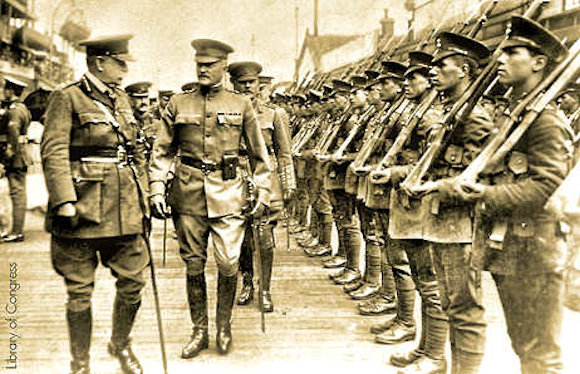
| Arrival in Liverpool, 8 June 1917 |
By Dr. Tyler R. Bamford
For nearly all active U.S. Army personnel, World War I marked the first time they came into contact with their British counterparts. It was also the first time the U.S. Army had ever deployed to Europe. Only once in the two armies’ histories, during the brief Boxer Rebellion of 1900–1901, had they fought side by side. Yet between April 1917 and November 1918, hundreds of thousands of American officers and men would train and fight with their British comrades. . .
Pershing’s stop in London was more than just a formality. It also acquainted him with the leaders of Britain’s Army and the political struggles within Great Britain. Pershing met with General Sir William R. Robertson, the British chief of the Imperial General Staff (CIGS); Field Marshal Viscount French (formerly Sir John French), the commander in chief, Home Forces; Maj. Gen. Sir Francis Lloyd, the general officer commanding the London District; and General Sir John S. Cowans, the quartermaster general of the British Army. These meetings allowed the leaders to get the measure of one another and set the tone for their partnership.
Robertson
| General Sir William R. Robertson |
Perhaps the most important was with the CIGS, Robertson, whom Pershing described as “a rugged, heavy-set, blunt soldier.” Robertson began his career as a private and became the first British soldier to ever rise from that rank to field marshal. In Robertson’s first meeting with Pershing, he explained the advantages of having American soldiers serve with or near British units. Pershing politely replied that it made far more sense to have American units serve near French units since it was French ports, railways, and materiel on which the U.S. Army would rely most heavily. Pershing neglected to mention that he, President Wilson, and Secretary of War Newton D. Baker had already decided that the AEF should have a closer affiliation with French rather than British forces. This decision stemmed both from American public sentiment and from the necessity of relying on French assistance in establishing the AEF. Pershing instead asked Robertson whether extra British shipping could be found to help bring the U.S. Army into the fight sooner. To this request, Robertson and other British leaders revealed the full extent of their enormous shipping losses to German U-boats in recent years, which greatly surprised Pershing.
In many ways, this exchange encapsulated t he relationship between AEF and British Army leaders over the next year: professional and friendly, yet plagued by disagreements. Robertson headed an army that had expended more than 400,000 lives before the Americans entered the war. The CIGS repeatedly had to defend the offensive plans of Field Marshal Douglas Haig, the commander of the British Expeditionary Force (BEF), against criticisms from Prime Minister David Lloyd George, who feared escalating casualty rates. Meanwhile, Robertson asked for more men to be drafted from his already depleted nation. Pershing stepped into this struggle promising help but without a definite timeline for his forces to enter combat. Moreover, his request for shipping above and beyond Great Britain’s previous commitments asked his allies to risk shrinking their food stores in the face of the German submarine peril.
Robertson and other British leaders’ appeals for American troops to serve with the British were perfectly reasonable from their standpoint. Such a proposal had the potential to relieve the British manpower crisis and get American soldiers into battle quickly. Pershing found the suggestion a nonstarter, however, in light of American national sentiment and the U.S. Army’s desire to build an independent field army in France. The problem was that building such an army required British help, and there was no guarantee the AEF would be ready in time to prevent the Allies’ defeat. Pershing’s initial meetings with British commanders resolved none of these issues. Fortunately, these disagreements did not sour the attitudes of all British and American officers even as they repeatedly strained relations between the armies’ commanders.
Haig
| Generals Haig and Pershing |
Haig also took the opportunity to size up Pershing. The BEF commander wrote, “I was much struck with [Pershing’s] quiet gentlemanly bearing—so unusual for an American. Most anxious to learn, and fully realises the greatness of the task before him.” This observation likely reflected Haig and other British officers’ assumptions that American officers would be uniformly arrogant and outspoken.
Over lunch, Pershing enjoyed reminiscing with British Lt. Gen. Sir George H. Fowke, the adjutant general of the British armies, whom Pershing had known in 1905 when they were both observers in the Russo-Japanese War in Manchuria. Meanwhile, Patton chatted with Haig about their shared interests in hunting, polo, and sabers.
That afternoon, Haig and his staff treated Pershing and the other American officers to a tour of the British headquarters. It gave the Americans the opportunity to observe the functioning of Haig’s command structure and ask many questions about the BEF. Harbord thought “the afternoon with the General Staff was most interesting and instructive and left us with a great respect for the splendid organization of the great army our virile imperial cousins have put in the field.”
Pershing also found the visit informative. He recalled in-depth discussions about the organization, recruitment, and records of the British Army. Pershing wrote in his memoirs that “although our military system had been practically copied from the British a century and a half earlier, it was surprising to find so few points of difference after this lapse of time.” These similarities only increased as the war progressed and U.S. Army officers borrowed freely from the British.
The three-day visit accomplished a great deal. It allowed American and British leaders to take stock of one another and express their opinions on the war and how best to prosecute it. Haig and his staff knew the scale of the task Pershing faced in assembling an army, supply organization, and headquarters from scratch. Haig worried it might take years before such a force could join the fight, and he wondered if the American officers had enough experience to handle such an undertaking.
Pershing remained determined to construct the AEF as an independent force, and although he rejected Haig’s suggestion to incorporate American units into British divisions, Pershing saw the U.S. Army could learn much from the British. This meeting marked the start of a strong professional relationship between the two commanders, albeit one that was strained periodically by heated disagreements.
Though Pershing and Haig’s interactions guided relations between their armies, the two met only occasionally during the war. On a daily basis, their liaison officers served as the representatives of the armies to each other. At Haig’s headquarters, Lt. Col. Robert H. Bacon, the former U.S. ambassador to France, represented Pershing. A wartime volunteer, Bacon’s diplomatic experience made him an asset to the American commander in chief, and he quickly gained the trust of British officers. Haig wrote that from the first time he met Bacon, “He struck me as a most honest, upright man, and absolutely to be trusted.” Haig treated Bacon as a member of his own staff and readily informed him about British plans. This personal trust was vital to cooperation between the two armies.
For this reason, Pershing handpicked the men who served as his liaisons. Bacon and other liaisons needed to understand their hosts and maintain their trust while also remaining dedicated to their own commander and his interests.
At AEF headquarters, Col. [later General] Cyril M. Wagstaff acted as Haig’s liaison. Wagstaff was commissioned into the Royal Engineers in 1897 and served with Australian troops on the staff of General William R. Birdwood during the Gallipoli campaign in 1915. Charles à Court Repington, a reporter for The Times of London and a former lieutenant colonel in the British Army, described Wagstaff as “a good practical man and a typical English soldier, who appears to me to carry out his delicate duties with great tact and good sense, and to make himself helpful to all.” Upon visiting AEF headquarters at Chaumont in October 1917, Repington observed, “The American officers are constantly seeking [Wagstaff’s] advice. They come to his room one after another without ceasing.” After the American attack on the Saint-Mihiel salient on 12 September 1918, Wagstaff submitted a detailed report on the operation that praised American planning and the troops’ quick movement.
He noted that although American methods differed from those of the British Army, they successfully caught the Germans off guard and captured large numbers of prisoners. As Repington observed, liaison officers not only relayed messages between their commanders, but they coordinated activities and answered questions about their respective armies. They worked hard to smooth out disagreements, clarify miscommunications, and create favorable impressions in each other’s headquarters—and they largely succeeded.
Still, the most persistent source of discord between the two armies’ leadership was the issue of amalgamation. . .
Note: We presented an extensive discussion of the amalgamation issue on Roads to the Great War HERE.
Source: Excerpted from "United in a Great Cause: U.S. and Allied Military Relations in World War I," by Tyler R. Bamford, Army History, Summer, 2020. The full article can be read online HERE.
Wednesday, January 12, 2022
America's Moms Played a Big Role in World War I
| Eddie Rickenbacker's Mother Welcomes Her Son Home from the War |
By Patri O'Gan and Mallory Warner, National Museum of American History
When people think of World War I, they often think of soldiers fighting in trenches. But soldiers weren't the only ones doing the work of war. In honor of Mother's Day and the centenary of the Great War, we examine some of the roles mothers played in World War I.
Mothers Were Recruiters
Wartime propaganda artists recognized the power of mothers in recruiting soldiers. They used mother figures to remind men of their duty to their country and family, and to assure them of how proud their mothers (and wives) would be when they became soldiers.
Mothers Were Fundraisers
| Hand-spun and hand-woven Navajo blanket with 48-star American flag motif, made by Hosteen Nez Basa for her son, a soldier in World War I, and donated to the Red Cross for a fundraising raffle. |
Mothers who remained at home while their sons and daughters served overseas had much to do to keep the household running, to fill in for soldiers in the workplace and support war production, and to help raise funds for the war effort. One mother, Hosteen Nez Basa, a Navajo woman from New Mexico, donated this blanket to the Red Cross for a fundraising raffle. According to the donor, Ms. Basa originally made this blanket for her son, a soldier serving in Europe during the war. Convinced that her son would die serving, Ms. Basa made this blanket to be used for his burial. When her son returned from the war front alive, she donated the blanket to benefit the local Red Cross, raising close to $1,500 in war relief.
Mothers as Nurses [or Nurses as Mothers?]
According to this Red Cross poster, the nurses of World War I acted as great "mothers" to all of the soldiers fighting in the war. Scholars have noted that the nurse's pose mimics that of another famous mother, the Virgin Mary cradling the body of Jesus in the Pietà . The strength, grace, and purity evoked by Mary were all traits held by the ideal World War I nurse. An American text from 1917 on surgical war nursing listed these "motherly" personal qualifications of a nurse: "patience, kindness of heart and manner, a power of unremitting attention and that indescribable quality called tact."
Mothers as Memory Keepers
| Man-in-Service Flag |
The devastating loss of life in World War I meant that many mothers were left with the heartbreaking task of mourning and memorializing their dead. One way of memorializing those killed in action was the Gold Star. Families hanging a Man-in-Service flag in their window would cover the blue star with gold fabric, symbolizing their loss. Women were encouraged to forgo traditional mourning garb in favor of a simpler black armband with a gold star. Woodrow Wilson referred to these women as gold-star mothers. After the war, in 1928, the organization American Gold Star Mothers was founded. To this day, mothers who have lost a child in military service wear a gold star pin to honor the deceased.
Adapted from "Mothers in World War I," Website of the National Museum of American History
Tuesday, January 11, 2022
United States Army Depot Brigades in World War I
| How the Depot Brigades Were Supposed to Work |
To open this review, which I intend to be of the positive sort, I'm going to do something presumptuous for a reviewer. I'm going to suggest an alternate and more ambitious title for Peter Belmonte and Alexander Barnes' new work—The Hilt of the Sword: How America Built the AEF. In a metaphor used to great effect by wartime Army Chief of Staff Peyton March, the AEF in France was the "Blade" of America's sword and the War Department and the Army's training system was its "Hilt." Both were essential to victory. Central to the functioning of the stateside "Hilt"—and the subject of the title the authors or publisher chose—was a new piece of military organization called the "Depot Brigade." While they thoroughly examine the concepts behind these units and their applications, and shortcomings, Barnes and Belmonte range much wider in their writings, examining many other fascinating aspects of General March's "Hilt" in an almost comprehensive way. Hence, I would have liked a broader title for this work.
Now, don't get me wrong, for anyone who's ever sat through an organizational theory seminar, these depot brigades are fascinating social specimens. In the course of the nation's short 20 months of waging war, they would be conceived, get implemented army-wide on the fly, mutate wildly via mission creep, and, then, like MacArthur's old soldier, fade away with the demobilization of the four million man force it had assembled. But what makes this book especially enjoyable is the style with which the authorial team presents their material. They seem to have collected an amazing number of soldierly anecdotes, biographies, and photos, and they present them in a smooth flowing manner. (They reminded me of Joseph Wambaugh, who must have compiled every cop story and legend in the history of the LAPD and used all of them in his novels.)
First, though, what exactly was a "Depot Brigade?" Initially, the umbrella-like units were charged with all the tasks necessary to turn civilians—by the tens of thousands—into your basic (not yet extremely well trained) American soldier. This included housing, feeding, and clothing them; screening out the unfit: teaching the troops basic military skills from saluting to shooting; fitting them to their best occupations: and then shipping them out for their advanced training post or final assignment. That was the starting concept, anyway, but as we all know, stuff happens.
The "Hilt" soon discovered it needed to provide other types of support for the Pershing's "Blade" in France and much of the new burden would fall on the depot brigades. What about identifying and training the leaders, officers and NCOs for the millions in the new drafts? And, at the other end of the spectrum, what to do about the thousands of marginal or unfit new privates, the "Lame, Halt, and Blind," as the authors titled one of their chapters? Further, all sorts of complications grew from the segregated nature of the army, the need for highly skilled soldiers in certain specialties, the need to promptly replace casualties suffered by divisions deployed to the Western Front, and stateside demands for manpower—things were not calm on the Mexican border, for example, and the country's ports, railroads, and factories needed guarding against saboteurs. The depot brigades found themselves in the middle of these issues, and the two writers provide interesting insights how the problems were solved, although sometimes in a "close enough for government work" way.
| Typical Crowded Barracks in One of the New Camps |
After reading United States Army Depot Brigades in World War I, two things stand out for me. First, the authors have really done overdue justice to the two million or so Doughboys who never made it overseas but had reported in, underwent the indignities of basic training, and were ready to fight in the 1919 campaign, that—thank the Lord—proved unnecessary. Barnes and Belmonte do a fine job of delineating the who, how, what, when, and why of their honorable service.
Second are the little know facts about America's war effort that the authors have uncovered for us. I loved them. I've read a lot about the AEF, but here's a short list from the extravagance of new details I learned.
1. General Leonard Wood, politically unpopular with the Wilson Administration and generally considered to have been kept away from the action Over There, got himself wounded by a trench mortar explosion on a visit to the front line during the early days of the AEF's deployment.
2. The "total war" effort of the U.S. led to the creation of some unusual army specialties and units. For instance, the Hoboken Port of Embarkation hosted army Ship Repair Shop Unit Number 301, made up of soldiers charged with maintaining the navy's transport ships for conveying the troops overseas.
3. An all-Puerto Rico National Army division, the 94th, was planned but was still being organized at the time of the Armistice.
4. The last full AEF combat unit to arrive in France, the 8th Infantry of the 8th Division, would be among the first to arrive back in France in WWII, landing on Utah Beach on 6 June 1944.
5. Some things never change—a number of draftees, who had no wish or intention to see combat, feigned injuries, language difficulties, psychiatric disorders., etc., etc., to gain assignment to "Development Battalions" for special counseling and training. Naturally, the most talented actors held out getting "cured" until after the Armistice.
6. Every AEF Division that saw combat required 10,000 draft animals (horses and mules) for artillery, ammunition, supply, and medical trains. That's a much bigger number than I ever realized.
7. The U.S. built 32 training camps for the newly conscripted troops, with barracks all designed to house 200 man companies. In the meantime, some other part of the War Department decided in the newly configured divisions companies would have 250 men. Widespread and unhealthy crowding (remember the Spanish flu) resulted, of course.
8. Between the 11 November 1918 Armistice and January 1920, the ENTIRE four-million-man force that America had raised for the Great War had been demobilized except for the 130,000 officers and men who remained in the Regular Army.
I recommend United States Army Depot Brigades in World War I for any readers who find the details of America's effort in the Great War utterly fascinating. It's also a very valuable resource for genealogical researchers and family members who wonder what those serving Doughboys, like F. Scott Fitzgerald and Irving Berlin who never quite made it over the pond, might have been up to in the War to End All Wars. It's available in Kindle and paperback formats.
Michael Hanlon, Editor/Publisher
Monday, January 10, 2022
They Did Not Choose Their Burial—A Desecrated Memorial Restored
| Detail from the Original Work |
| Artist Haïm Kern Working on the Replacement |
| New Statue, New Location, Same Battlefield |