Now all roads lead to France and heavy is the tread
Of the living; but the dead returning lightly dance.
Edward Thomas, Roads

Thursday, October 19, 2023

President Wilson Comes to San Francisco to Sell the Versailles Treaty


Wilson on Market Street in San Francisco


After returning from the signing of the Versailles Treaty in June, President Wilson decided to go on the road to convince the American people, and hence the Senate to gain support for the treaty and the League of Nations. Included in the iterinary was a whirlwind visit to the San Francisco Bay Area. He arrived in San Francisco on 17 September 1919 and took part in a procession down Market Street, which was lined with spectators, to the Civic Center Plaza, where 60,000 school children greeted him. President Wilson ascended onto a reviewing stand there to acknowledge the crowd but soon left for the St. Francis Hotel, where he and his wife were staying. 


The President with San Francisco's High Society


His two best-remembered presentations were to a ladies' group representing the upper crust of San Francisco society at the Palace Hotel's lovely Garden Court  and at the city's new Civic Auditorium  when he was introduced by a political enemy, the ever-present Republican Mayor, James "Sunny Jim"  Rolph, who was nevertheless upbeat with his preliminary comments. Newspaper reports indicate that the president, who we now know had begun experiencing some symptoms of his soon-to-strike debilitating illness, was in top form that night, winning over a partly hostile crowd. 


Two Venues: San Francisco's Palace Hotel & Civic Auditorium


The next day the President crossed the bay and spoke at the Greek Theater on the Berkeley campus of the University of California. A transcript from the speech captures what was probably his main appeal for support of the Versailles Treaty in language obviously tailored to an educated audience:

. . . The burden that is upon my heart as I go about on this errand is that men are hesitating to give us the chance. We can not do any effective thinking for the world until we know that there is settled peace. We can not make any long plans for the betterment of mankind until these initial plans are made, and we know that there is going to be a field and an opportunity to make the plans that will last and that will become effective. That is the ground of my impatience with the debate. I admit that there are debatable things, but I do not admit that they need be debated so long. Not only that, but I do insist that they should be debated more fairly. 

A remark was repeated to me that was made after the address I made in San Francisco last night. Some man said that after hearing an exposition of what was really in the treaty he was puzzled; he wondered what the debate was about; it all seemed so simple. That was not, I need not assure you, because I was misleading anybody or telling what was not in the treaty, but because the men he had heard debate it, some of the newspapers he had heard debate it, had not told him what was in the treaty. This great document of human rights, this great settlement of the world, had been represented to him as containing little traps for the United States. Men had been going about dwelling upon this, that, and the other feature and distorting the main features and saying that that was the peace proposed. They are responsible for some of the most serious mistakes that have ever been made in the history of this country; they are responsible for misleading the opinion of the United States; It is a very distressing circumstance to me to find that when I recite the mere facts they are novel to some of my fellow citizens. 

Young gentlemen and young ladies, what we have got to do is to see that that sort of thing can not happen. We have got to know what the truth is and insist that everybody shall know what the truth is, and, above all things else, we must see that the United States is not defeated of its destiny, for its destiny is to lead the world in freedom and in truth.


President Wilson (Seated Lower Center) at the
Greek Theater, University of California


After leaving San Francisco, Wilson continued on his nationwide tour in support of the Treaty.  It came to an abrupt end, however, on 26 September when he suffered a serious stroke in Wichita, KS. By the way, the Palace Hotel—rebuilt after the 1906 earthquake and fire—had been a popular hospitality center for troops during the war and would later be the site of President Warren Harding's death in 1923.

Wednesday, October 18, 2023

The Canadian Corps Takes Courcelette


Fighting at Courcelette by Fortunino Matania


The Canadians, originally in the Ypres sector, missed the first months of the Battle of the Somme, but had relocated there by early September. Their first action on the Somme, the Battle of Courcelette, or the Battle of Flers-Courcelette,  fought from 15 to 22 September 1916. The overall attack was an effort to restar the Somme Offensive which, in two and one-half months of fighting had yielded disappointing results and enormous casualties for the the British Army.  

Capturing the well-defended village of Courcelette and the fortified sugar factory which guarded it's approach were key objectives of the 15 Septemberr attack. Field Marshal Haig’s scheme was to use the assault to break through German defenses between the villages of Flers and Courcelette. Both were well behind German lines at the start of the battle, but a thrust between them parallel with the Albert-Baupame highway meant that a full cavalry corps could seize Bapaume. The village stood immediately astride  the key road  and on the souther flank of the strong Regina Trench position of the German forces.

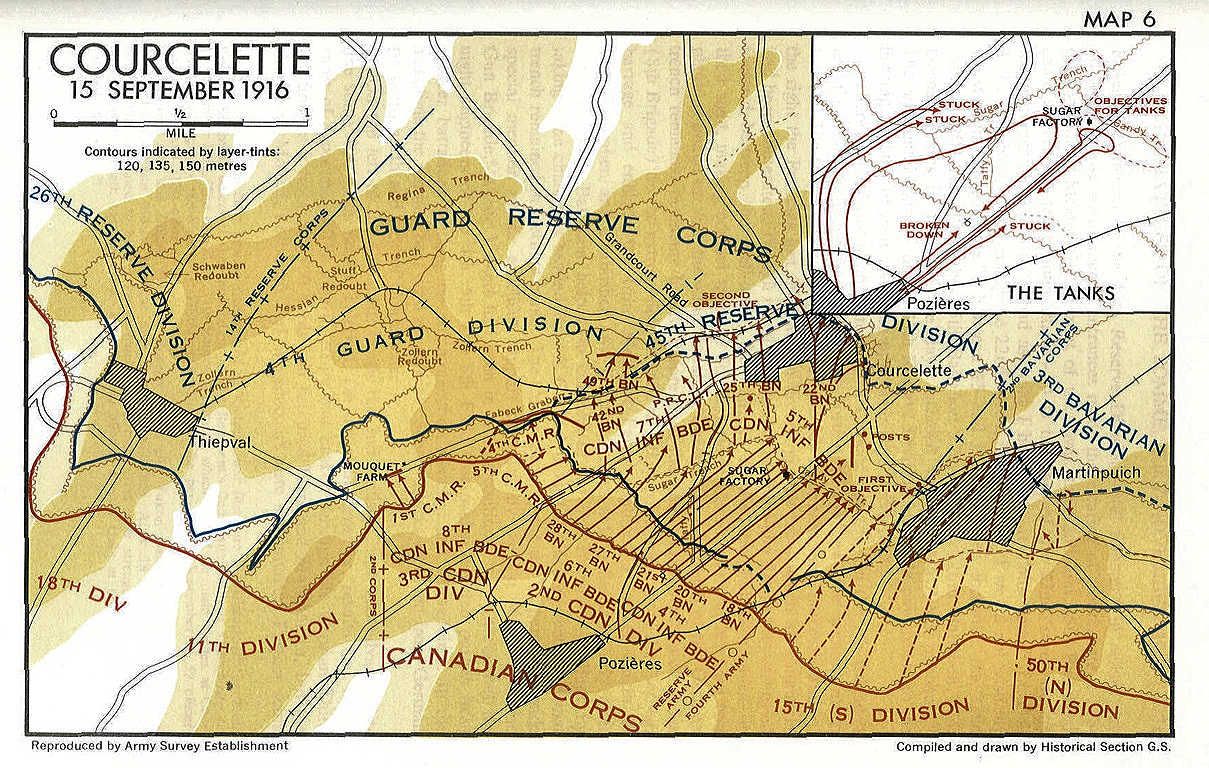
Click on Map to Enlarge


In the fighting to come, the Canadians would benefit from two tactical innovations: a creeping artillery barrage, and the first employment of tanks in combat.

Instead of trying to annihilate the enemy, the new creeping barrage resulted in thousands of shells slowly raking through the enemy lines, advancing 100 yards, or 91 meters, per lift. This barrage was not meant to destroy the enemy trench systems, although this sometimes happened, but to drive defenders into their protective dugouts. The infantry would closely follow the barrage, called "leaning on the barrage," in order to cross No-Man’s-Land before enemy troops could emerge from cover to fire at them.


Fortified Section of the Captured Sugar Factory


To assist with cutting barbed wire and silencing enemy machine-guns, seven tanks, or armored land cruisers, accompanied the Canadians in their first major battle at Courcelette on 15 September. Mechanically unreliable and as slow as a walking person, tanks nonetheless struck fear into the enemy, many of whom surrendered when the tanks first appeared.


Mark I Tank, "Crème de menthe," That Supported
the Canadian Attack


At 6:20 on the morning of 15 September, the 2nd and 3rd Divisions attacked German lines outside of Courcelette. Accompanied by one tank and following behind a creeping artillery barrage, they overtook the German trenches and a sugar refinery by 8 a.m. The successful advance of Canadian units included the capture of the village of Courcelette by Lt. Col. T.L. Tremblay’s 22nd Battalion (French Canadians) and the 25th Battalion (Nova Scotia Rifles) as well as the capture of the  sugar factory  by the 21st Battalion (Eastern Ontario). Elsewhere, the attack stalled, and hopes for a decisive success faded, as the Germans launched strong counterattacks or withdrew to fortified positions. For the Canadian Corps, despite thousands of casualties, it was a tactical victory, one of the few for Allied forces on the Somme. After the war Courcelette was chosen as one of the sites for a Canadian war memorial.


Just Out of the Fight at Courcelette, Canadian Soldiers
Aboard an Autocart
 Celebrate


Further attacks through September and October were just as costly but less successful. Operations against Desire Trench and Regina Trench, to the north of Courcelette, were grinding affairs where soldiers attacked and counterattacked repeatedly over the same ground, and always under heavy enemy fire. In late October, the three battered divisions of the Canadian Corps limped off the Somme having suffered 20,000 casualties. The 4th Canadian Division, fighting with British troops, finally captured Regina Trench in November, as the offensive came to a halt in the mud all along the Somme front.

Source:  Canadian War Museum; Canadian Encyclopedia; Library and Archives

Tuesday, October 17, 2023

Imperial Apocalypse: The Great War and the Destruction of the Russian Empire


By Joshua A. Sanborn
Oxford University Press, 2014
Reviewed by Melissa K. Stockdale, The Journal of Modern History, Vol. 89, #1


News of the Tsar's Abdication Arrives


In 2014, as various nations commemorated the centennial of the outbreak of the Great War, those activities mostly maintained the customary focus on the conflict’s Western Front. Flanders Fields, Verdun and the Somme, the Treaty of Versailles—these remain the iconic names and events of the war, not Tannenberg, Gorlice-Tarnow, and Brest-Litovsk. Though scholars are increasingly exploring the understudied war experience of the Eastern Front—essentially, the territory of the old Polish-Lithuanian Commonwealth—that experience tends to remain off the public radar. One goal of Joshua Sanborn’s terrific new book  Imperial Apocalypse: The Great War and the Destruction of the Russian Empire, is to help raise consciousness of the war in the east and the collapse of empires there. It is his provocative argument that the Great War should be seen as a war of European decolonization, noting that “the fact of decolonization in Eastern and Southeastern Europe was one of the most tangible and significant outcomes of the conflict.”

For a variety of reasons, mass national movements were relatively slow to develop in the multinational Russian empire; as Sanborn notes, although the 1905 revolution revealed high levels of discontent within non-Russian populations in the borderlands, they did not pose a serious threat. And in the aftermath of 1905, the Russian state and economy grew stronger while the imperial project gained in public popularity. It was Russia’s Great War experience in the borderlands that ignited a two-fold imperial challenge—serious critiques of empire on the periphery and in the metropole—as well as initiating the process of state failure.

Chapters 2, 3, and 5, which outline this destructive process, are the most compelling parts of the book. With the outbreak of war, governing power in the war zones was transferred from the civilian to the military authorities, who proved disastrously incapable of wielding it. As Sanborn puts it, “No single act did more to lay the conditions for comprehensive state failure in the borderlands than did the edict of martial law” (40). Competent local authorities were superseded or undercut, creating power vacuums and promoting corruption and crime. Misguided economic policies premised on suspicion of capitalism and Jews devastated local economies, fueling shortages, black markets, and resort to coercion and theft. Spy mania and ethnic and religious hostilities resulted in pogroms, hostage-taking, and outright ethnic cleansing. By March 1915, the imperial state’s ability to maintain law and order in these regions, or even protect conduct of basic economic activity, was seriously impaired and its legitimacy correspondingly weakened.

From spring 1915, the worsening in Russia’s military fortunes imported many of these problems into the interior as the front “migrated”—one of the many strengths of Sanborn’s approach is his insistence on the importance of the war’s military-operational story for understanding larger developments. Retreating armies, deserting soldiers, and millions of dispossessed refugees streamed into the heartland, bringing with them disease, hunger, violence, and crime; social relationships broke under the strain. The scope of the calamity and the government’s apparent inability to handle the crises reanimated political critiques, further undercutting regime legitimacy.


Treaty of Brest-Litovsk Signing


Interestingly, Sanborn begins his chapter on the Russian revolution in summer 1916, with the massive anti-colonial rebellion that rocked Turkestan. Triggered by an ill-conceived decision to conscript noncombat labor from the Muslim population, the rebellion and its savage suppression undermined confidence in the “civilizing” rationale of the Russian imperial project in Central Asia. Sanborn explicitly links the anxiety evoked by this collapse of control, and all the other failures in order in 1915–16, as causal factors in revolution: “The pangs of fear and the visceral sense of chaos and impending doom felt by citizens across the country provided the radical edginess needed to transform disgust and protest into the violent acts of mutiny and rebellion” (175). After revolution toppled the discredited regime (a process in which discontented soldiers played an outsized role), the new Provisional Government and Petrograd Soviet found they were no more able than the tsarist authorities to exercise the state’s monopoly on the legitimate use of violence. Instead, the unraveling of the imperial armies, rapid decentralization of power, and growing anarchy encouraged the long-delayed burgeoning of national movements.

Initially, most of these movements demanded autonomy rather than independence. The Bolsheviks took advantage of the refusal of most Russian elites even to contemplate concessions to non-Russian populations, proclaiming their adherence to “self-determination”—a commitment they soon revised as the post-Brest-Litovsk Russian state devolved into warlordism, civil war, and full-blown social catastrophe. Once again, men with guns—this time, millions of demobilized, brutalized soldiers ready to take whatever they wanted—had a big role to play in the process.

Ultimately, the case for decolonization is not as persuasive as it might be. That is in part because the two chapters on military and societal innovations in response to wartime problems—fascinating though they are—have not been integrated into the overall argument and do little to advance it. More significantly, Sanborn does not define “decolonization,” or review any of the theoretical literature surrounding this crucial concept, a particularly surprising omission for a scholar who has shown himself well versed in and comfortable with theory in his previous work.

Nonetheless, his work Imperial Apocalypse: The Great War and the Destruction of the Russian Empire succeeds powerfully on many levels. Sanborn’s command of his vast primary source base lends his narrative authority, his prose is unfailingly engaging, and his insights numerous. The many personal stories he tells of humble citizens caught up in this imperial “apocalypse” provide moving illustrations of the broad processes he charts. Above all, no previous treatment of Russia’s Great War and revolution makes so palpable the scale of chaos and misery endured by the population as war-induced violence spun out of anyone’s control.

Melissa K. Stockdale

Monday, October 16, 2023

The Art of Tree Camouflage


An Example from the Western Front


Observation posts were highly valuable during the First World War. Troops were locked in trench warfare and needed a solution to help track enemy movements without being seen, while also being protected should they come under enemy attack. Camouflage trees effectively concealed an observation post from which troops could watch enemy movements without being seen. A camouflage tree was an observation post made from a hollow metal cylinder, which was camouflaged to resemble a dead tree. The trees were replicas of battle-damaged trees in no-man's land. 


Extremely Detailed Field Drawing


They were constructed behind the lines using sketches drawn by a camouflage artist on the battlefield. A camouflage team would then cut down the real tree at night and replace it with the replica. The observer could then crawl in and watch the Germans in full view, while protected by the tree's steel core.They were often situated in flat, exposed areas in No-Man's-Land, where there were no natural surveillance points and the need for observation posts was greatest. Producing the sketches and positioning the camouflage trees were both highly dangerous tasks.


An Example Under Construction


Source:  Imperial War Museum


Sunday, October 15, 2023

Notes on the Brusilov Offensive — A Roads Classic


In June 1916 Russian armies on the Southwestern Front under the command of General Aleksei A. Brusilov broke the Austro-Hungarian line in several places and drove them back as much as 160 kilometers in some sectors in what was by most estimates the greatest Russian military achievement of the war. At Habsburg positions deemed impregnable, brigades disintegrated in the face of the meticulously planned and precisely executed Russian assault. 

Brusilov's forces took more than 350,000 Habsburg soldiers prisoner, and an entire Austrian corp—seven divisions—broke before the onslaught. The Russians regained all of the territory lost on the front in 1915 and advanced to the foot of the Carpathian Mountains, where they threatened Hungary itself. Only rapid action by Germany's military leaders held the front together and prevented the collapse of the Habsburg Empire in 1916. 


The Entrenched Defenders Apparently Confident of Their Position

At the start of the attack, Brusilov had available on the Southwest Front:

  • 4 armies (7th, 8th, 9th, and 11th) later augmented with 3rd Army
  • 40 infantry and 15 cavalry divisions 
  • 600,000 men 
  • 1,926 artillery pieces of all sizes


The defence [by the Central Powers], however, had been successful only because 20 German divisions in all had been brought here. . .
General August von Cramon,  German Liaison Officer with the Austrians 

Only the crudest estimates of casualties are available for the Brusilov Offensive. The Austro-Hungarian army suffered a staggering total of 1.5 million men (including 400,000 taken prisoner). Comparable estimates for the Russian Army are something over one million.

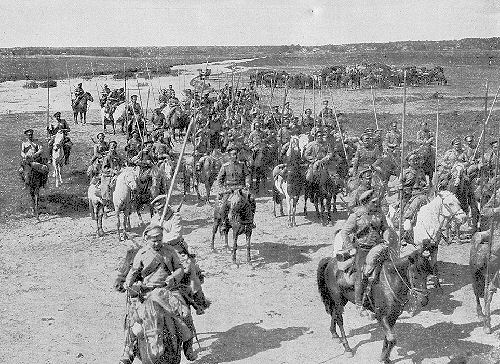
Russian Cavalry on the Move

In the end, the Brusilov Offensive destroyed the military capacity of the Habsburg Empire, brought Romania into the war, forced Vienna to accept Berlin's almost total control in the east, and relieved the fronts in both Italy and France from enemy pressure. 

Sources:  Timothy Dowling and Holger H. Herwig

Saturday, October 14, 2023

Famous Frontline Rations


Manconochie Stew and Hard Bread


1. Anzac Biscuits

Cookies sent to troops in Gallipoli from kitchens back home. Originally called “Soldier's Biscuits” and renamed Anzac for Australian and New Zealand Army Corps after the famous landing at Gallipoli. They contained no butter or eggs and kept well.

2. Corn Willy

A hash made from tinned corned beef fried with potatoes and onions by American mess sergeants.

3. Ersatz Coffee

Small packets of coffee were cut with chicory and distributed to German troops throughout the war after Kaiser Wilhelm's wife (Kaiserin Augusta Viktoria) created "morale boxes " for the soldiers. The amount was enough to make half a mess-tinful.

4. Hard Bread (aka Hardtack)

Bread made as hard and dry as possible that needed to be softened in water or coffee.


5. Slum

Short for slumgullion, a thin stew made by American mess sergeants, consisting of meat, water, tomatoes, onions. Sometimes thickened up with crumbled hardtack.

6. Maconochie

A canned meat stew or a thin soup of sliced turnips and carrots made by Maconochie Brothers in Aberdeen for the British Army. Most soldiers hated it unless they were nearly starving.

7. Monkey Meat and Bully Beef

Monkey meat was a peculiar-tasting canned beef from Madagascar, rumored by Doughboys to be made from monkeys. Bully beef was British canned corned beef. Either of these were often mixed with vegetables to create stew or goulash.


"Old Bill" Examining His Jam 


8. Tommy Tickler's Plum and Apple Jam

"Tickler" was slang for jam but also for handmade grenades made from old jam tins and packed with nails, glass, and explosives.

9. Tommy's Iron Ration

British ration pack, consisting of a tin of beef (bully beef or corned beef), two packs of biscuits (3 ounces each), an ounce of meat extract (Bovril or OXO), a pack of tea (5/8 ounce) , salt, (1/2 ounce), and sugar (2 ounces).

10. Trench Pudding

A Tommy dessert made from crumbled hard bread, tinned condensed milk, jam, and water, cooked and stirred over the fire until it had a glue-like consistency.


These French Officers Seem Pleased with Their Rations

11. Wine, Rum, and Beer

The French soldier's morale was affected by his wine ration, which varied through the war. British soldiers were rationed two ounces of rum or a pint of porter daily. Germans received a pint of beer, half a pint of wine, and a quarter pint of spirits. Canadians got allotments of Jamaican rum.

Friday, October 13, 2023

Canada's Disproportionate Contribution to Victory


Canadians Over the Top at Amiens by Alfred Bastien


On one of my battlefield tours that was focused on the 1917 battles in Flanders, I took the group to a place called Frezenberg Ridge east of Ypres. I was describing an action involving one of the Scottish divisions when I spotted some Canadian flags and military personnel. Naturally, I stopped the bus to discover what was going on, and I found the Canadian Army major who was in charge. I learned that he and his men were there to support the re-dedication of a memorial to their unit, Princess Patricia's Canadian Light Infantry, for an action in 1915. We had a nice chat and parted. Two days later, we ran into the major and his troops again at Vimy Ridge. At that point, I said something like, "You Canadians get all over the place, don't you." He replied that was exactly the way the Canadians were in World War One and they always ended up in the middle of things.

During the last phase of the Great War, miscounted but universally remembered as the "100 Days," the cutting edge—the most effective assault units—of the British Army were its Australian and Canadian Corps. The substantial Australian contribution to victory will be dealt with elsewhere, here in this issue of Roads we are focusing on Canada. By July 1918, the holding of the line at the first gas attack at Ypres, Vimy Ridge, Hill 70, and the capture of Passchendaele Ridge were legendary—all battles that had been impossible to win until the Canadians moved to the front. The Canadian Corps, led post-Vimy by Lt. General Sir Arthur Currie, had proven to be unstoppable. In fact, the enemy had named the Canadians "stormtroopers."


Canadian Operations, 1915-1918


After the war, British prime minister Lloyd George wrote of the Canadians “Whenever the Germans found the Canadian Corps coming into the line, they prepared for the worst.” The Canadian Corps' performance during the 100 Days campaign lived up to their reputation. Alongside the Australian Corps, the Canadians spearheaded the Amiens assault of 8 August, forced the Canal du Nord, took Bourlon Wood, Cambrai, and Valenciennes, and—on the last day of the war—found itself in Mons, where the British Army had started its war over four years before.

From the beginning, the politicians and future generals of the CEF knew they had a major learning curve to follow and that their men needed demanding and repeated exercises before they were ready to deploy. In Europe, they prepared the men for missions like the capture of Vimy Ridge with specific and authentic training exercises before launching an assault.


August 1917: Canadians Occupying a Trench on Hill 70


In the area of leadership, the CEF could not have been luckier than to fall under the command of General Julian Byng, who fostered the best instincts of his Canadians and also spotted the most capable and innovative general of the Canadians, Arthur Currie, and saw to it that Currie succeeded him as leader of the Canadian Corps.

Regarding the undeniable "grit" of the Canadian soldiers, this is a quality that's observable but difficult to analyze. Maybe war correspondent Philip Gibbs had a sense of it when he wrote, “The Canadians fought the Germans with a long, enduring, terrible, skillful patience.”

Searching for Lt. John Kipling, Irish Guards (Video)


Thursday, October 12, 2023

Photo Album: Alabama's Own on the Western Front


During the World War One Centennial commemorations,  Alabama was one of the states that was deeply committed to honoring the efforts and sacrifices of their predecessors during the war.  I was provided with numerous photos of Alabama's war time experience by their Centennial Commission and some of our friends and contributors like Monique Seefried and the late Nimrod Frazer. Here's a selection of photos that I think captures the wartime efforts of Alabama's historic 4th Infantry that served with the 42nd "Rainbow" Division as the 167th Infantry.  I've interspersed the photos with some details on the regiments history and wartime experience. Please keep in mind that thousands of other Alabamians served with other AEF units, the Marine Corps and Navy, and volunteer organizations.


Off to Camp


Pre-Departure Parade


Mobilization of the Alabama National Guard for service on the Mexican border was announced on June 16, 1916. It included five regiments, the largest being the 4th Alabama, and had been created as militia by the Alabama legislature in 1911. Alabamians regarded the 4th Alabama as the descendant of a Confederate unit with the same name and number. There had not been a 4th Alabama between the end of the Civil War in 1865 and 1911. On August 14, 1917 the War Department published an order changing the name of the 4th Alabama Infantry Regiment to the 167th United States Infantry Regiment. William Preston Screws, after having only briefly held the rank of Lieutenant Colonel, was promoted to Colonel and given command of the expanded and newly named regiment. On the next day it was announced that the command would become part of the 42nd “Rainbow” Division and on August 28, 1917 a force of 3,677 officers and men left Montgomery on eight trains for Camp Mills on Long Island to join its new division.


Some of the Men of the Regiment's Company I


A Group of the 167th's Junior Officers Sporting
Their Sam Browne Belts


Upon entering the war on April 6, 1917, the regiment’s authorized strength for rifle companies was increased from 65 men to 150, then to 250. Other Alabama National Guardsmen were integrated into the 4th to bring it to 3,720, including 112 officers. The Guard had a total force of about 5,000 at that time. Many of those not selected to be included in the 4th were sent to Macon, Georgia to become the nucleus of the 31st (Dixie) Division.


A Little Rest Time for the Troops at Neuvilles


In Action at Seringes-et-Nesles


The “Rainbow” Division organized and trained on Long Island for little over a month. In October it started moving by ship to England and France. The Alabama regiment began its movement on November 7, 1917. After reaching France and receiving some specialty training from the French and a few newly established American schools, the 167th (Alabama), like all of the 42nd Division, was twinned with French units in the Lunéville sector of Lorraine in February, 1918.   The Rainbow Division saw heavy fighting in all the major engagements of the war through the Armistice.


Awaiting an Enemy Attack Near Reims


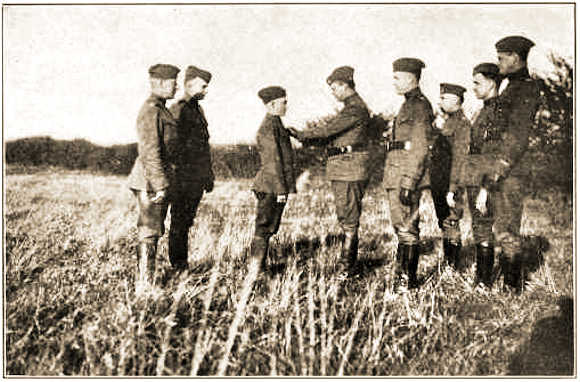
Decorating Corporal Gary Roberts for Heroism in Action


Regimental Aid Station in Champagne


The fiercest fighting the 167th experienced, however, occurred in July 1918 while attacking German strong points at La Croix Blanche Farm and La Croix Rouge Farm, the latter being just east of Beuvardes about midway between Fére-en-Tardenois and Château-Thierry in the Aisne department. The regiment succeeded in forcing a German retreat and were instrumental in securing a crossing over the Ourcq River and assisting Allied troops in routing German troops from their entrenched positions in France. Of the 3,700 members of the regiment, 616 died in service and over 1,000 were wounded. Of the men killed, 282 rest today in American cemeteries in Europe, the remainder, at the request of their families were returned home for burial throughout the state.


Fallen of the 167th After the Croix Rouge Farm Action


In Rifle Pits During the St. Mihiel Offensive


The regiment entered Germany and served in the Army of Occupation in Sinzig. After five months of occupation duty, some training, fraternizing and sightseeing, it traveled by rail to Brest, France and sailed for home on April 25, 1919. Returning to Camp Meritt, New Jersey, the “Rainbow” dispatched all units to home states for discharge. The Alabama troops left for home by train on May 7, 1919 and were honored by triumphal parades in Gadsden, Anniston, Birmingham, Montgomery and Mobile before being discharged at Camp Shelby, Mississippi.


Back Home to Alabama


Welcome in Montgomery


42nd Rainbow Division Memorial Dedication at
Croix Rouge Farm Where the 167th Fought


One of the Sons of Alabama Who Now Rests in
France at the Meuse-Argonne Cemetery


Sources:  Alabama Centennial Commission; ABMC; Alabama Encyclopedia; LovettArtillery.com; Official U.S.  Photographs of the World War; Croix Rouge Farm Foundation


Wednesday, October 11, 2023

Pétain Creates the Voie Sacrée


"They seemed, by the Sacred Way, to ascend, through an offering without example, to the most formidable altar that man had ever erected." Paul Valéry                      
(Painting by Georges Scott)


By Robert B. Bruce

Selected from "To the Last Limits of Their Strength: The French Army and the Logistics of Altrition at the Dattle of Verdun", Army History, Summer 1998


Present Day Marker at the Starting Point in Bar-le-Duc


Click on Map to Enlarge

Road in Red, Rail in Blue


Northern Loop, Where Returning Troops Were Loaded


Bas-Relief from Voie Sacrée Memorial
Note That Rail, Trucks of Different Types, Road Crews, and Loaders Are Commemorated


Tuesday, October 10, 2023

The Ottoman Army and the First World War


By Mesut Uyar
Routledge, 2021
Reviewed by Michael Tyquin
 British Journal for Military History, 7.1 (2021)


Ottoman Artillery Battery Passing Through Constantinople


The Ottoman Army and the First World War is a thorough analysis of the Ottoman Army on all fronts during the Great War. It describes its operational military history and military effectiveness during that war, and it is difficult to disagree with Uyar in his assessment that Western historiography has for too long ignored the so-called peripheral campaigns of the war.

He reminds us that in 1914 it was by no means a foregone conclusion that the Ottomans would join the Central Powers. Once committed, the author contends that the First World War exposed Ottoman unpreparedness, having taken no steps prior to the war to secure stocks of food, fuel or munitions. Another of the book's themes is the constant interference of Germany's High Command and Ottoman acquiescence to both its strategic vision and its demands.

Western scholars have long struggled with access to Turkey's war archives, let alone the translation of both old and modern Turkish. If only for this reason Uyar's book is tremendously important for those interested in the Ottoman contribution to the First World War. The footnotes contain some archival material which sees the light of day for the first time. There is an extensive and up-to-date bibliography providing a handy synthesis of non-English language sources, although the author has not included Klaus Wolf's 2020 in-depth study of the German-Ottoman Alliance.


The Turkish Soldier—Tough, Tenacious, and Enduring

Uyar highlights the problems found in the wake of army reorganization when, in 1911, triangular divisions were established but insufficient attention was given to doctrine and combat services support, which were ignored. He details the vastly over-stretched military resources of the Ottoman Empire in the lead-up to and subsequent prosecution of the First and Second Balkan Wars.

The author examines the genesis of German military advisors and support. Initially the German alliance appeared to provide security against the territorial aspirations of both greater and lesser powers. But the optimism of the German High Command in using pan-Islamism as a force multiplier soon foundered on the reality of regional and tribal politics. In the body of the text, it is refreshing to see that Austro-Hungarian units and armaments deployed to Turkey receive more than a passing footnote. Little-known Ottoman contributions to Macedonia, Galicia, and Romania are also included in this study.

While the Ottoman Army of 1914 was far more representative of the empire's population than that of any other period, it lacked well-trained NCOs. This hindered the effectiveness of mobilization and the sudden appearance of tens of thousands of new recruits. In this the empire was not alone. The British Dominions shared a similar experience. The Ottoman Army was initially hampered by the total absence of aviation assets and any organization to manage line of communications issues. In addition, much heavy equipment and weapons had been lost in the Balkan Wars (1912/13). Unfortunately, the Ottoman High Command made no systematic effort to resolve or at least reduce the impact of these problems. Lack of a good road and rail network did not help matters. In 1914 the Ottoman Army was burdened by the inheritance of a dying empire: rampant corruption; inefficiency, and inadequate lines of communications; and hopelessly inadequate medical and veterinary care.

There was an abysmal lack of understanding in Berlin of not only the cultural and political mores of its Ottoman ally, but the challenges facing a collapsing empire from 1917 onward. We learn too that as early as April 1914, senior German advisors worked actively to deny Ottoman officers positions of influence and kept them uninformed of developments on the Western Front. The author also highlights fundamental tactical flaws in General von Sanders' initial defense plan for the Dardanelles in March-April 1915, where his interference further exacerbated tensions between the Ottoman staff and their German advisors.

Michael Tyquin