Now all roads lead to France and heavy is the tread
Of the living; but the dead returning lightly dance.
Edward Thomas, Roads

Sunday, August 18, 2024

America's Greatest Quack, Charlatan, & Mountebank Served (Briefly) in the Great War


John B. Brinkley at the Top of the World


James Patton

Born in North Carolina, John R. Brinkley Jr. (1885–1942) was a colorful character who called Kansas home from 1917 through 1935. Originally trained as a telegrapher, over the course of his life he was a millionaire, a charlatan, a quack, a fraud, a crackpot, a cheat, a political  ranter, a radio pioneer, a child abductor, a bigamist and, believe it or not, a hero. 

He advertised himself as a doctor although he had a sketchy medical education. At first he worked in medicine shows and sold tonics around the Carolinas. Then, in 1912, he got the chance to buy a medical diploma from a going-bankrupt medical school in Kansas City. 


His Hometown Is Still Proud of Him


On 23 April 1908, Congress had created the Medical Reserve Corps (MRC), and in 1913, on the strength of his dubious degree, Brinkley was accepted for a ten-year hitch. 

He set up shop in Greeneville, SC, with an "electro-medical" doctor, and they developed a lucrative practice treating syphilitics with a shot of colored fluid that they claimed was the German "miracle-drug" Salvarsan. Brinkley fled under a cloud of suspicion, stopping over in Memphis, where he was arrested and, although he was not divorced, married his second wife. Weaseling his way out of all the charges against him, the happy couple fled to Arkansas. He answered a blind advertisement for a doctor in Fulton, KS, a rural community north of Pittsburg. While there, on his own initiative, he organized the first army ambulance company in Kansas.

In April 1917, the entire MRC was called up to active duty. First Lieutenant Brinkley was ordered to report to Ft. Sam Houston in San Antonio, but the army soon moved him to Ft. Bliss in El Paso, where he was assigned to the newly formed 64th Infantry Regiment as its chief medical officer—in sole charge of the health care of over 2,200 new recruits. 


Fort Bliss During the War


According to his official biography: ‘Dr. Brinkley was responsible for the sanitation of the whole regiment—the installation of latrines, sewage systems and garbage disposal. When asked why they had joined the army their invariable reply was that it was to get $30 a month with room and board thrown in. “They had about as much patriotism visible as a horned toad.” [Said Brinkley]

An epidemic of meningitis swept through the ranks; measles and many other infectious diseases began to make inroads among them. Many of his soldier patients were in the hospital, and the overflow was sick in their quarters. And there were many who were crippled and unfit for the army service–dozens of men on the roll who should never have been allowed to enlist. A captain one day who had been drilling a company brought a man into the doctor for examination, troubled because he could not get the man to step correctly in drill. Dr. Brinkley found that the man’s hip had been almost shot away and was completely ankylosed, that is, that bones had unnaturally knit together. Other men had severe heart disease, flat feet, broken arms and legs.

So far this may sound sort of heroic. His official biography concludes: "his military service was a terrible ordeal that he could scarcely endure. He was lucky if he got three or four hours of sleep at night. After a short time he collapsed from exhaustion and spent a month in the hospital, followed by a discharge with a certificate of disability. He continue to serve in the Medical Officers Reserve until August 1922."

The official army records tell a different story, stating that Brinkley served a total of one month and five days. He worked for only two days and then was placed under observation for "nervous exhaustion" at the Ft. Bliss base hospital for the remainder of his service. His reserve officer’s commission wasn’t renewed upon its expiration in 1922.

Back at home in the autumn of 1917, Brinkley answered another advertisement, this time for a doctor in Milford, KS, a small town on the Republican River which, coincidentally, was 16 miles west of the brand-new Camp Funston. 


Doc Brinkley's Finest Moment Would Come During
the Spanish Influenza


Quoting from Pope Brock: "The worldwide Spanish flu pandemic … had struck here too, and Brinkley earned respect and gratitude that winter with his conspicuous efforts to help the victims. 'The doc seemed to have an uncanny knack with the flu,' one of his aides recalled. 'Maybe it was something he learned as a boy in rural North Carolina [his father had practiced traditional healing]? I don’t know. But whatever it was it worked.' When more than a thousand cases broke out at nearby Ft. Riley, Brinkley (in marked contrast to his exaggerated exploits in the army) was on the spot to help treat them. He went from farm to farm, as well, bouncing along mud-rutted roads in a 1914 Ford. His driver, Tom Woodbury, remembered him as 'a wonderful doctor. He lost only one patient during the flu epidemic and he doctored all around.' A local housewife said, 'He saved us. They called him a quack and that just breaks my heart. He was no quack, believe me.' When a coal shortage that winter made the suffering even worse, Brinkley led a petition drive demanding that the governor provide emergency allocations for flu victims. The entire performance, contrasted with the rest of his career, was so aberrant it is hard to credit. Maybe he was buying publicity. Maybe he had no choice. Whatever motivated Brinkley, the help he rendered during those months stand as the finest achievement of his life."


Subsequently Brinkley became known as the "goat-gland doctor" after he achieved international notoriety and considerable wealth by transplanting goat sex organs into humans. Although at first he promoted this procedure as a means of enhancing male virility, over the years he also claimed that it was an effective treatment for a range of conditions.  Although his ideas sound utterly hare-brained today, in his time endocrinology was in its infancy, and various endocrine replacement theories were being pursued, including insulin therapy for diabetes mellitus.

At various times, Brinkley operated clinics in Kansas, Texas, and Arkansas. His clinics offered steady employment and paid good wages. He was also community-minded, financing several public works projects in Milford. His Texas mansion grounds featured a sort of amusement park complex that was open to the community until it was sold by the Brinkley family in 1980.

He performed his treatments for over two decades, despite having his techniques and credentials thoroughly discredited by both the broader medical community and the pharmaceutical industry. His operations might not have been only fraudulent; they could have been dangerous. Forty-two persons are known to have died at his Kansas clinic. 


Brinkley's Goat Farm


In 1923, in order to sell his treatments, his product lines and even his advice, he set up a powerful radio station, KFKB (Kansas First, Kansas Best). Although he was a pioneer in airing traditional American music, his broadcasts consisted mostly of advertising. In 1930, KFKB was deemed not operating in the public interest, and the license wasn’t renewed. He sued and lost in a landmark case regarding regulatory power. 

Undeterred, Brinkley set up shop in Del Rio, Texas, as the Mexican-licensed XER: his 500 kilowatt transmitter and “Sky Wave” antenna array (both were illegal in the U.S.) were located on the southern side of the Rio Grande. He began the era of the "Mexican border blaster" radio stations whose nighttime signals could reach virtually everywhere in the U.S., especially in the rural Midwest. The idea was pure genius and soon copied, until there were 11 on the air, all of which the Mexican government later shut down in compliance with the 1938 Havana Treaty. Some later returned to the air under Mexican ownership. 

Incensed after being stripped of his medical license in Kansas (he was still licensed in seven other states), Brinkley exhorted his many followers to elect him governor. He ran in 1930 and 1932 (governors had two-year terms until 1972) and in the primary of 1934; the first time, he nearly won. He may have lost due to sleazy last-minute ballot disqualifications.  


In Kansas he reportedly took in over $14,000 a week, while the average doctor earned $61 weekly. Texas sources estimate that he amassed $12 million there. He was one of the most successful quacks in history—owning mansions, airplanes, custom-made cars, yachts, and lavish jewelry. 

Brinkley rose to stellar heights of notoriety and wealth, but his eventual fall was precipitous. He died in bankruptcy amid a welter of malpractice, wrongful death, libel, tax fraud, and mail fraud charges against him. There remains no trace of his clinic in Kansas; the old part of the city was flooded by the Milford Reservoir in 1962. His mansion in Del Rio remains but is still privately owned. 


Sources Consulted Include:

Kansapedia, Kansas State Historical Society

Handbook of Texas, Texas State Historical Association

Charlatan, Pope Brock, Crown (2008)

The Bizarre Careers of John Brinkley, R. Alton Lee, University Press of Kentucky (2002)


Saturday, August 17, 2024

Weapons of War: Germany's Maschinengewehr 08


MG 08 in Action


Maschinengewehr 08 (MG08)—The MG08 was a heavy machine gun used by the German Empire during World War I. It was developed from the Maxim gun and was designed to provide sustained and accurate firepower to infantry units. Under optimal conditions the MG08 could fire 450 rounds/min. of 7.92 x 57mm Mauser ammunition over 6,600 ft. The ammunition was fed via a cloth belt on a 250-round strip. The muzzle velocity was 2,900 ft/sec.  The gun weighed 58 lbs, and with the sledge mount (see next photo) the unit came to 140 lbs. The MG08 stayed in service for the German Army through both World Wars.  

The MG08 played a vital role in trench warfare, where its ability to deliver a high volume of fire made it a valuable asset for defending and attacking positions. It was typically crewed by a team of gunners who fed the gun with belts of ammunition and had a water cooling system to prevent overheating. In 1915, work began on a lighter version of the weapon designated the MG08/15. It proved easier to produce and was soon available in more plentiful supply throughout the remainder of the war. However, it had serious accuracy limitations and could be fired only in short bursts.


MG08—Smithsonian Collection


Around 17,000 MG08 machine guns and its variations were being built per month by 1917. This highlights the significant industrial capacity that Germany possessed during the war. The level of production showcased the importance the German military placed on equipping their troops with powerful and reliable firepower. 

However, the  MG08 was heavier and more difficult to repair in the field  than was the British Vickers gun. It was also fired from a heavy four-legged "sledge" mount. This mount frequently proved difficult to use in the trenches, and a wide variety of extemporized "trench mounts" were produced. These mounts put MG08 gunners at a disadvantage, as they precluded the use barrage, indirect, or overhead fire.  


Charles Baskerville—
Improvised Use of MG08 Machine Gun


Sources: Source:  Imperial War Museum; The Military Factory; Smithsonian; U.S. Army Art Collection

Friday, August 16, 2024

Why 1914 but Not Before? RIP, Franz Ferdinand


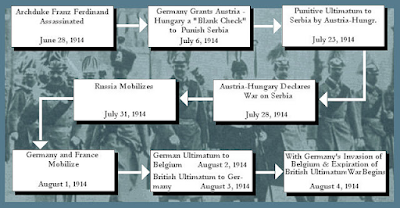
The July Crisis of 1914 Simplified


A Selection from "Why 1914 but Not Before? A Comparative Study of the July Crisis and Its Precursors," by Jack S. Levy and William Mulligan in Security Studies, 2021, Vol. 2

Why did the July 1914 crisis—but not crises in 1905, 1908–9, 1911, and 1912–13—escalate to great-power war despite occurring under similar international and domestic conditions?. . . A more complete answer to the why-1914-but-not-before question, however, requires the incorporation of Franz Ferdinand’s assassination, which went beyond a pretext for war. It eliminated the most powerful and effective proponent for peace in Vienna and fundamentally changed the nature of the decision-making process in Austria-Hungary. . 

One of the most significant differences in the July 1914 crisis was Vienna’s success in securing a “blank check” from Berlin to initiate a war against Serbia.  It removed the primary external constraint on Austro-Hungarian military action, and in doing so made it possible for Berchtold and Conrad to persuade Tisza to abandon his opposition to armed conflict, which was a necessary condition for war.  The question for Austro-Hungarian leaders was: How long would the window of opportunity stay open? After the emotions of the assassination passed, or once the volatile William II changed his mind, as he had frequently done in the past, would Berlin once again revert to the pattern of restraint it exhibited throughout most of the Balkan crises? Could this be the last opportunity for the preventive war for which Conrad had long advocated? This is an interesting case of anticipated decline of relative power, of alliance support, and of internal state capacity combining to magnify incentives for preventive war. . .

Although changes in power and alliance relationships in both the Balkans and in Central Europe provide the core of an explanation for why the 1914 July Crisis, but not the 1912–13 Balkan crises, escalated to great power war, one additional difference in the two sets of crises also played a critical role: the assassination of Archduke Franz Ferdinand. . .


The Assassination of Franz Ferdinand

The Archduke and His Wife Leave Sarajevo's
City Hall, 28 June 1914


The assassination of Archduke Franz Ferdinand contributed to the outbreak of World War I in several ways. It added new reputational concerns to Austria-Hungary’s preexisting motivations for war by requiring a response. Critically, the assassination provided a plausible justification for military action in the eyes of leaders in Vienna and Berlin. The assassination was not simply a “streetcar” that would eventually come by and provide the necessary catalyst for war. The most recent streetcar came by in October 1913, and Serbian leaders helped derail it. The increasing stabilization of Balkan politics following the wars of 1912–13 reduced the likelihood of subsequent sparks.

The assassination provided additional ammunition to Conrad in his longstanding campaign for a preventive war against Serbia. It also removed an important constraint on Austria-Hungary by significantly increasing the probability of German support in several ways. It raised the principle of monarchial solidarity. The assassination also struck an emotional chord in William II, given his growing fondness for the archduke after their meeting only two weeks before, and it invoked his longstanding racial attitudes toward the Slavs. In addition, the Austro-Hungarian ultimatum in response to the assassination triggered strong Russian support of Serbia, including mobilization measures, which helped create a narrative in which Germany and its Austrian ally were on the defensive, a narrative that Moltke, as well as William II and Bethmann-Hollweg, believed to be necessary to mobilizedomestic support for war, especially among the Social Democrats in the Reichstag. These considerations are fairly well known. We focus on another effect of the assassination—on the decision-making process in the Dual Monarchy. The assassination eliminated both the leading advocate for peace in Vienna and the military chancellery that reinforced his influence. As Samuel Williamson argues, Franz Ferdinand’s death was not only “the pretext and occasion for war”; it also “dramatically altered the political structure in Vienna in ways that virtually insured military action against Serbia.”

Franz Ferdinand’s influence on Austro-Hungarian decision making was based on rights and duties associated with his position as heir to the throne, and on the archduke’s personal relationships with the emperor and the foreign minister, which improved significantly after Berchtold replaced Alois Lexa von Aehrenthal in February 1912. The archduke’s influence was reinforced by the informal military chancellery that Franz Joseph created in 1906 for him to lead, and he began 1913 in his new position of inspector general of the armed forces. Franz Ferdinand used the chancellery effectively to access information about military plans and to broaden his political role.  With respect to military (but not political) matters, Franz Ferdinand was now second behind the emperor. He had access to military information and the authority to question the strategies and plans of Conrad and the General Staff and to raise new issues. Scholars debate the extent of Ferdinand’s influence, but the comment of a senior Austrian official is telling: “We not only have two parliaments, we also have two emperors.

The archduke strongly promoted cautious policies throughout most of the Balkan crises, with one brief but notable exception. After advocating restraint and siding with Berchtold against Conrad’s demands for mobilization measures at the beginning of the First Balkan War in October 1912, Franz Ferdinand shifted his position in early November after Serbian forces had routed the Ottomans. Persuaded by the military’s argument that Serbia was now free to act against the Austro-Hungarian Empire, he supported precautionary military measures in Galicia and joined a mission to Berlin that secured German support. In early December he persuaded Franz Joseph to reinstate Conrad as chief of the General Staff. He then tried but failed to persuade Berchtold and the emperor to initiate a military confrontation.

After this “momentary lapse,” Franz Ferdinand suddenly reversed course, embraced Berchtold’s search for a diplomatic solution, and split with Conrad. By the end of January 1913 he was emphasizing the risks of war with Russia and reacting strongly against Conrad’s continuing push for preventive war.  He urged Berchtold to oppose Conrad’s demands for war against Serbia in the May and October 1913 crises over Albania and instead to cooperate with Russia. Franz Ferdinand recognized Russia’s military strength, worried about Russian intervention in a Balkan crisis and about the reliability of Italy, and he feared the risk of nationalist and social revolutionary upheaval for the empire resulting from a general European war. Well aware of Austria-Hungary’s dependence on Germany, he worried any military campaign in the Balkans, regardless of its outcome, would increase that dependence.  Franz Ferdinand was also the leading proponent of internal reform within the Dual Monarchy and feared war would make major reforms impossible. As Williamson argues, “By late 1913 the archduke’s caution and aversion to military action was well established.”

The assassination removed Franz Ferdinand’s restraining hand from deliberations in Vienna, eliminating the one person who might have pressed both Berchtold and Franz Joseph for more cautious policies. It also eliminated an institutional center that provided legitimacy for those with more moderate views to access military information, question the emperor’s own normally bellicose military chancellery, and challenge Conrad himself. Given Franz Ferdinand’s good relationship with William II, the assassination also eliminated a potentially valuable dynastic communication channel with Germany at a time of poor communication between Vienna and Berlin on both diplomatic and military matter.

We [also]  consider the harder case of a failed assassination attempt. It would have triggered a crisis and invoked some reputational concerns and a more limited pretext for some kind of military action, but it would have left Franz Ferdinand involved in decision making. We will never know the outcome with certainty, and a more through and systematic counterfactual analysis necessary, but many leading historians have argued both that Franz Ferdinand would have opposed war and that his views probably would have prevailed in turning Franz Joseph against war. Alexander von Hoyos, a leading proponent of war in Vienna, said of Franz Ferdinand that “through his death, he has helped us to the decision, which he would never have taken, as long as he lived.”. . The removal of Franz Ferdinand from Austro-Hungarian decision making during the July Crisis went beyond creating a pretext. It left Hungarian prime minister Tisza the only top official to press Franz Joseph for caution immediately after the assassination. It also left Berchtold, hawkish but a weak personality and one open to persuasion,  alone to face Conrad and the generals.  [Historians] Samuel Williamson and Russel Van Wyk argue that “Berchtold probably would have remained committed to a policy of military, threatening diplomacy, everything short of actual war, an approach he had used during the Balkan Wars.” With Franz Ferdinand and Tisza urging restraint, and with Conrad and the generals applying the primary pressure for war, there is a very good chance the emperor would not have authorized military action. War would not have occurred, as no other country had incentives to start a war in 1914.

This argument, if correct, raises the complicated question of whether a great-power peace would have endured, and for how long. We leave a more detailed exploration of this question for another time, but make four points here. First, additional personnel changes were both likely to occur and likely to work against war. Most historians agree that in the absence of the assassination, Conrad, whose influence had been waning, would have been dismissed fairly soon, eliminating the leading advocate for war in Vienna.148 Second, assuming Franz Joseph would have still passed away in late 1916, Franz Ferdinand would have ascended to the throne. Third, the durability of Triple Entente was open to question, primarily due to the Anglo-Russian conflict of interests in Central Asia but also due to French concerns about St. Petersburg’s commitment to the alliance as Russia grew stronger.  In addition, Grey was hoping to deepen the Anglo-German detente, and had arranged a clandestine mission to Berlin for his private secretary.  Finally, the more difficult question is what would have happened with the continued growth of Russian power over the next two to three years. Is Lebow correct that German leaders would have been forced to abandon their risky policies and become more conciliatory?  Or would German leaders have gambled on a preventive war to avert impending doom?  If the latter, would they still have needed a pretext, and could they find one?  Would that have been “essentially the same war” or a very different one?

Thursday, August 15, 2024

First Action of a Very Famous World War I Veteran


Site Near Wytschaete South of Ypres Where Our Subject
Fought in 1914 Before These Trenches Were So Elaborate


Letter of 3 November 1914

We swarmed out and chased across the fields to a little farm. To left and right the shrapnel were bursting, and in between the English bullets sang. But we paid no attention. For ten minutes we lay there, and then we were again ordered forward. I was way out in front, ahead of our squad.... The first of our men began to fall. The English had set up machine-guns. We threw ourselves down and crawled slowly forward through a gutter. From time to time a man was hit and couldn't go on, and the whole column was stuck... We ran fifteen or twenty yards, then we came to a big pool of water. One after another we splashed into it, took cover, and caught our breath. But it was no place to lie still. So we dashed out quick, and double-quick, to a forest that lay about a hundred yards ahead of us. There we found each other after a while.... We crawled on our bellies to the edge of the woods. Over us the shells were howling and whistling, splintered tree-trunks and branches flew around us. And then again grenades crashed into the wood, hurling up clouds of stones, earth, and stifling everything in a yellowish-green, stinking, sickening vapour. We couldn't lie there forever, and if we were going to be killed, it was better to be killed outside.

Again we went forward. I jumped up and ran, as fast as I could, across meadows and turnip-fields, jumping over ditches, over wire and living hedges.... A long trench lay before me; a moment later I had jumped into it. Before me, behind me, to the left and right others followed. Beside me were Wurttembergers, under me dead and wounded Englishmen. The Wurttembergers had stormed the trench before us. And now I knew why I had landed so soft when I jumped in. Between 240 and 280 yards to the left of us there were still English trenches; to the right, the road to Leceloire was still in their possession. An unbroken hail of iron was whistling over our trench...

Finally, at ten o'clock, our artillery opened up in the sector. One - two - three - five - and so on. Again and again a shell burst in the English trenches ahead of us. The fellows swarmed out like ants, and then we rushed them. We ran into the fields like lightning, and after bloody hand-to-hand fighting in different places, we threw them out of one trench after another. Many of them raised their hands. Those who wouldn't surrender were knocked down. In this way we cleared trench after trench. For three days we fought on like this, and on the third day the Britishers were finally licked. The fourth evening we marched back to Werwick. Only then did we see what our losses had been. In four days our regiment of thirty-five hundred men had melted away to six hundred. There were only thirty officers left in the whole regiment.

Can you guess the identiy of this notable World War I veteran?  Answer HERE.

Sources: Spartacus-Educational; Wiki Commons

Wednesday, August 14, 2024

Epic Battlefield—Hill 60


The View of Ypres from the Base of Hill 60


Overview

Hill 60 is a former World War I battlefield and now a memorial site  located about three miles southeast from the center of Ypres.  Author Richard Pyves nicely characterized it:

It wasn’t much of a hill. Although located 60 meters above sea level, Hill 60 was just 10 meters high and barely four city blocks in area. It looked more like a knoll than a key observation post that the Germans and Allied forces would contest for four long and gruelling years. It was the graveyard for thousands of soldiers, many just teenagers.

That hill is bisected by the Ypres-Comines railway line to Comines resulting in two distinct areas of raised land separated by the railway line.  The eastern area was known by soldiers as Hill 60 due to its 60 meter ASL elevation, while the western part was called The Caterpillar because of its irregular shape. These heights had been created in the 1850s by dumping the spoils from the rail line construction.  Because of this additional height, the two sections were the only sites on the southern edge of the Ypres Salient not subject to frequent waterlogging.  Fighting here was nearly nonstop from 1914 until the Armistice.


The Rail Cut Looking South


The postwar British Official History described what evolved at the site as: "...a medley of confluent mine and shell craters, strewn with broken timber and wire: and in this rubbish heap it was impossible to dig without disturbing the body of some British or German soldier." The detritus from years of battle lay everywhere. Tunnel and dugout entrances were open, and the stench of death from the many rotting corpses filled the air. Nevertheless—almost immediately—a small café opened up, offering refreshments and guided tours. It also acted as a small museum, displaying objects from the battlefield. Local guides took pilgrims and visitors into the troglodyte world beneath the small hill, enlightening them on the dark landscapes of subterranean warfare. Those early guides and tourists probably never guessed that Hill 60 would be a future battlefield in another war two decades in the future.


Aerial View of the Hill 60 Site Today


Strategic Importance

When the Ypres Salient was formed in late 1914, it was quickly discovered that the heights of Hill 60 gave commanding views of the town of Ypres and the southern half of the full salient. Hill 60 had great strategic importance and was the location of almost non-stop fighting throughout the war. The fact that the German Army held it for the majority of the war probably explains why the town was almost flattened before war's end. Yet, its critical importance is difficult to appreciate today when you stand atop it, not only due to the new growth trees surrounding you, but because receiving four years of concentrated artillery fire and mining has left the crest of Hill 60 13 feet lower than 1914 by one estimate.


German Soldiers at Hill 60, 1916


The Mining

What makes Hill 60 such a fascinating battlefield to study and visit is the relentless struggle that was waged beneath it. From 1915 onward, mining and counter-mining was carried below Hill 60 at a ferocious rate. A secret war raged underneath the hill, during which tunnels collapsed, detonators exploded, and men suffocated. On 17 April 1915, in one of the first tunneling operations by the British Army, six mines were exploded under Hill 60, which was then quickly captured with minimal casualties.

However, a German attack regained the position a month later. Naturally, the Allies simply could not  let this situation prevail. The integrity of the Ypres Salient was at stake. If that ever collapsed the entire British position anchoring the northern leg  of the Western Front was thought untenable. A new solution to the Hill 60 problem—of almost inhuman scale—was started. Not only Hill 60 would be mined, but nearly two dozen mines would be blown simultaneously along the irregular six-mile, north-south ridgeline south of the position. This plan would take a long time and a stupendous effort to bring to fruition.


Trenches, Tunnel Lines, and Detonation Points for 7 June 1917


In August 1915, 175th Tunnelling Company RE began deep-mining beneath Hill 60. The 3rd Canadian Tunnelling Company completed the task, building two deep chambers off of the Berlin Tunnel. One under Hill 60 (Mine 60a) was filled with 53,300 pounds of ammonal explosives; a second branch, under the Caterpillar  (Mine 60b) , was filled with 70,000 pounds of explosives. To try to solve the problems of the wet soil, the mines were dug through blue clay 80 to 120ft below the surface.

In November 1916, the 1st Australian Tunnelling Company commanded by Captain Oliver Woodward took over the tunnels and maintained them through the winter. Eventually there were about 8,000 yards of tunnels in the area. The Germans very nearly discovered the main chambers on more than one occasion.


My 2011 Flanders Tour at the Pillbox Atop Hill 60
Built by Australian engineers on top of a destroyed German bunker after the June 1917 detonation, this pillbox saw later action in WWII. 


At 3:10 a.m. on 7 June 1917, these two mines and 17 others, containing nearly one million pounds of explosives, were detonated as a prelude to the Battle of Messines. The effect was like that of a particularly violent earthquake. There was a mighty roar, and columns of flame shot into the air. Thousands of tons of rubble, debris, and human remains were scattered over a wide area. For almost a year, the biggest threat to the salient would be neutralized. At first, the British effort to break out of the salient in the east would be the local focus of attention. Then, the surprising German Spring offensives in 1918 would lead to the German recapture of Hill 60 and another great threat to the Allied position in Flanders.


Caterpillar Mine (60B) Today

Who Controlled Hill 60: A Chronology

10 December 1914

German troops gain control from French defenders.

17 April 1915

Captured by British 5th Division after the explosion of six mines around the hill

5  May 1915

Recaptured by the German XV Corps with the aid of chlorine gas; underground fight followed for the next two years

7 June 1917

Regained by British forces after the explosion of  two mines under Hill 60 (60A) and the Caterpillar site (60B)


Site of Mine 60A Today
Not as deep as 60B because it blew out the nearby
rail embankment laterally.


April 1918

Retaken by German forces during the Ludendorff Georgette Offensive

28 September 1918 

Final capture by British units fighting under command of  Albert I, King of Belgium


Sources:  Memorial Project–15th Battalion, CEF; Wikipedia Commons; WW1battlefields.UK; Greatwar.co.uk; "Hill 60" Military Times; "World War I: Hill 60", Military History Matters

Tuesday, August 13, 2024

Manipulating the Masses: Woodrow Wilson and the Birth of American Propaganda


Click Here To Order This Book


By John Maxwell Hamilton

 Louisiana State University Press, 2020

Lloyd E. Ambrosius, Reviewer

Originally presented on H-Net, April 2021

In this excellent book, John Maxwell Hamilton examines the darker side of US president Woodrow Wilson’s administration during the First World War. In historical scholarship, the president has been identified with progressivism at home and liberal internationalism abroad. When he led the United States into war against Germany in 1917, he promised to make the world safe for democracy. Yet Wilson authorized and encouraged wartime practices that denied civil liberties to Americans in the name of winning the war in Europe. “This book,” Hamilton writes, “is about the profound and enduring threat to American democracy that rose out of the Great War—the establishment of pervasive, systematic propaganda as an instrument of the state” (p. 4).

A week after the United States entered the war, Wilson established the Committee on Public Information (CPI) under the leadership of progressive journalist George Creel. The CPI and Creel are the central focus of Hamilton’s book, which recognizes their positive contributions but also their negative impact on the nation. “The CPI’s accomplishments are not its whole story, however.” Hamilton emphasizes, “More than anything else, this book is a cautionary lesson about the intoxicating power of propaganda.... The CPI subverted the democratic ideals it espoused. It sanitized news, distorted facts, and was tendentious. It appealed to emotions of home and hearth, which was relatively benign, but aroused fear and hatred, which was not.... Working with federal intelligence agencies eager to sniff out subversives and stifle dissent, the CPI was an accomplice to the Wilson administration’s trampling of civil liberties” (pp. 7-8). Hamilton warns against the long-term consequences of what began during the Great War: “The quest for more effective propaganda—and the danger to democracy—intensifies when a nation is at war. This is the case today” (pp. 13-14).

Hamilton notes a pattern of leadership that characterized Wilson’s presidency. Those who managed the publicity for his 1916 presidential campaign emphasized the “He Kept Us Out of War” slogan. He knew he might be unable to keep that promise of peace because the demands of his policies toward the European belligerents might culminate in America’s entry into the war. Yet he embraced that false promise.

After winning reelection, Wilson issued a peace note to the belligerents but failed to control the public message. Hamilton notes, “The badly plotted peace note added to Wilson’s difficulties achieving his peace goal. The fundamental error was rooted in his disdain for journalists. He wanted them to keep their pens in their pockets until he told them when it was time to write. His efforts to control the message this way produced exactly the opposite of what he wanted. By taking the press into his confidence, even if on background, he could have avoided confusion about his peace proposal.” Hamilton emphasizes, “This episode revealed a fundamental aspect of Wilson’s thinking about the presidency: the great faith he put in leading the public with soaring appeals through diplomatic notes and speeches from behind a lectern. This concept of leadership, which sprang from his thinking about government as a professor, was informed by progressive belief in the need to engineer citizens’ opinions. That reasoning lay behind his creation of the Committee on Public Information when, within the next few weeks, the country went to war” (p. 77).

While Wilson touted pitiless publicity, Hamilton observes, he often remained quite secretive and even uninvolved in his own administration. “Wilson’s weakness warred with—and undermined—his greatness,” writes Hamilton. “He expanded the role of the office and enlarged the scope of the federal government, yet he was detached from crucial aspects of governing” (p. 82). Wilson strongly supported Creel and his aggressive leadership of the wartime CPI, yet he sought to keep his distance from some of its worst abuses.


America's Committee on Public Information
Chairman George Creel on Right


Hamilton provides a detailed account of the CPI’s operations, ranging from propaganda to censorship both at home and abroad. “Wilson’s administration revolutionized press relations like the steam engine revolutionized manufacturing,” he writes. “Theodore Roosevelt had made effective use of press releases, to the point of annoying Congress, but these handouts were largely the products of a few bureaus and amounted to a trickle compared to what gushed from the CPI. Creel mass-produced news and established impersonal routines to reach the press day in and day out. The CPI was not limited to handling the flow of news from government agencies. Because Wilson did not hold press conferences and [his secretary Joseph] Tumulty ceased giving daily press briefings, the CPI was the principal source of White House news” (p. 127). It also stopped alternative sources of information. “Creel and the president were largely shoulder to shoulder with regard to censoring. In May 1918, Creel forwarded an analysis by British correspondent Arthur Willert of the president’s attitudes toward Irish independence. ‘Acting under my blanket instructions, to the effect that censors should not pass matter purporting to give your views,’ Creel wrote, ‘the whole cable was killed with the exception of the opening [para]graph.’ The first [para]graph was one sentence. The portion killed amounted to more than three pages. Creel asked if Wilson approved. Wilson did. He said the reporter ‘had no authority’ to speculate on his thinking. This despite Willert’s close cooperation with the CPI” (p. 245).

Although generally critical, Hamilton credits the CPI with effective public diplomacy abroad. “The CPI’s signal achievement was not individual accomplishments in one country or another. It was,” he explains, “the implementation of Wilson’s New Diplomacy, a progressive idea of international relations. The CPI went over the heads of governments to shape the attitudes of their citizens about the United States, about their own domestic politics, and about creating better ordered world comity” (p. 294). Yet the CPI failed in its propaganda aimed at bolstering the morale of US and Allied soldiers and undermining that of enemy soldiers. “Creel’s mismanagement of field propaganda exceeded the bungling of CPI propaganda in allied and neutral countries. Nothing redeemed the CPI apart from its belief that field propaganda was a good idea. The spare account in Creel’s Complete Report swept the embarrassing episode under the historical carpet. Little has been written about it. The story is worth telling not only because it fills out the history of the CPI. Field propaganda against enemy combatants, which the AEF [American Expeditionary Force] eventually oversaw, marked the advent of a species of psychological warfare deemed essential today but was then, in many military minds, considered a waste of time” (pp. 297-98).

Hamilton regards the Sisson documents, which purported to prove a German-Bolshevik conspiracy that enabled Vladimir I. Lenin and the Bolsheviks to seize power in the Russian Revolution of 1917, as the worst example of the CPI’s operations. Although these documents were forgeries, Edgar Sisson, who headed the CPI’s Office of War Propaganda, vowed for their authenticity. Both Creel and Wilson strongly supported this falsehood, disregarding warnings from other officials about the evident forgery. It served their short-term interests in promoting democracy abroad through propaganda. “The administration badly miscalculated,” Hamilton concludes. “It assumed the great mass of Russians could be induced to throw off the Bolsheviks for a democratic government and enthusiastically fight the Germans. ‘It was perfectly possible to make them have heart in the war,’ Charles Edward Russell told Wilson when the [Elihu] Root mission, of which he was part [in 1917], returned to the United States. An education campaign was needed. ‘If it is addressed to Russian’s passion for democracy, and if it shows him that his beloved Revolution is in peril, he will be ready to fight with all his strength.’ Wilson replied that Russell’s thinking ‘runs along the lines of my own thought.’ If one believed that Russians really wanted to fight, it was an easy next step to believe the Bolsheviks, who took the country out of the war, were an alien political element acting on behalf of the Germans” (pp. 384-85). This falsehood not only contributed to failure abroad but also helped promote the Red Scare at home.

“The Sisson-Creel combination played to both men’s weaknesses, the one being inclined to sensationalism and the other to impetuousness,” Hamilton observes. “Wilson’s reliance on two men with no credentials for pronouncing judgment on a German-Bolshevik conspiracy and his failure to tell the State Department that he approved publication constituted administrative malpractice. Wilson had warned Sisson to stay away from ‘political entanglements’ and then followed him into an adventure that haunted policy toward the Soviet Union for years to come” (p. 390). The United States thus became a victim of its own false propaganda.

Hamilton concludes that the CPI left a negative legacy. Ironically, it helped undermine Wilson’s vision for a new world order. “CPI propaganda had other postwar liabilities besides accentuating partisanship,” he notes. “CPI images of Hun brutality and CPI stories of German-Bolshevik conspiracies worked against the fair treatment that Wilson had promised—a promise that Germans believed when they signed the armistice” (p. 429). Despite the accuracy of Hamilton’s criticism, there were other reasons for the failure of Wilson’s peacemaking. If he had succeeded in convincing the Allies to accept all his ideas for the peace treaty with Germany, it would still not have satisfied the postwar German claims. No propaganda, even more accurate and less harsh than the CPI’s, could have resolved those deep international conflicts.

In Hamilton’s view, Wilson ultimately failed to use propaganda effectively when he most needed it to persuade the American people to support the Versailles Treaty with the League of Nations Covenant. The president’s illness and his abrupt ending of the CPI were contributing factors to his inability to convince the Senate to approve the peace treaty. But his personality and style of leadership also influenced this outcome. “Wilson’s stubbornness and sanctimoniousness and his aversion to courting the press and political opponents were not new. These traits had existed for a long time. Illness only exacerbated them” (p. 450).

CPI Poster


Wilson’s legacy was mixed, as Hamilton convincingly demonstrates in this outstanding book. “Wilson profoundly transformed the communication functions of the American government, but he did not grasp how much. He enlarged the executive branch in his first years in office and expanded it more during the war. This growth required a presidency that was more engaged in persuasion—persuasion of members of his administration, of Congress, of key constituencies, and of citizens... All this, and yet, when the need for propaganda was as great, if not greater, than at any other time, he treated it as a secondary matter” (p. 451).

Hamilton believes that the president’s misguided use of propaganda contributed to his failure at the Paris Peace Conference of 1919 and in the treaty fight over the League of Nations and other parts of the peace treaty with Germany. Wilson failed to understand the proper role of propaganda in democratic governance. “Democracy privileges process. It presupposes that open, vigorous deliberation ensures better outcomes. The CPI subverted this. It did all the things that Creel insisted it did not do. It ignored facts and opinions that spoiled its narrative. Its publicity was tendentious” (p. 458). Hamilton’s book makes a convincing case for this critical conclusion.

Lloyd E. Ambrosius, University of Nebraska

Monday, August 12, 2024

Remembering a Veteran: Sir Arthur Dean, CIE, MC with Bar, ED, late 252 Tunnelling Company, Royal Engineers


Royal Engineers Badge, World War I


Contributed by Adrian Roberts

My great-uncle, Sir Arthur Dean, was one of the few Great War veterans with whom I talked about his experiences. Not that he talked about the war very much; he was as modest as most true veterans are, but he did tell me that he was in a tunnelling company, as he had gained a degree in mining engineering at Imperial College, London, and when the war started, he was working at a gold mine in Russia. He said that although he was a sapper, he had once been asked to lead his men over the top in an infantry attack. I remember him saying, “I wasn’t keen—but I went!” with the massive understatement typical of his generation.

It wasn’t until his funeral in 1976, when I was 17 and he would have been 84, that I learned that he had been awarded the Military Cross, and it was not until I went on the internet nearly 30 years later that I found that he had a bar to his MC. I corresponded in 2005 with a researcher online who said that Arthur Dean had been in 252 Tunnelling Company and was possibly the officer who had detonated the Hawthorn mine at the start of the First Battle of the Somme on 1 July 1916. He sent  me the attached photo that he believed was of Arthur Dean. 


Arthur Dean, Possibly in a Mine Tunnel


Unfortunately, the rest of the correspondence is in a format which I cannot now open. (I wonder how many historical records will be lost due to only being stored digitally). However, around the same time my uncle gave me the address of Arthur’s son by his first wife, who very kindly sent me a handwritten letter and other documents, which I still have, including a CV written by Sir Arthur himself, and copies of the London Gazette with his Military Cross citations.

The son said that he thought it very likely that the photo is of his father. The first MC citation is dated 15 March 1916 (meaning the incident was several months earlier).  Apart from confirming that he was with 252 Tunnelling Company, it says that he “rescued at great personal risk from a wrecked mine an NCO and a man who had been entombed, went further and found another man dead, and within five minutes of his return the whole gallery collapsed.” The bar was gazetted on 10 January 1917 and says “For conspicuous gallantry in action. He blew a mine under the hostile front line, which killed 280 of the enemy, and went at once over to the enemy front line with one servant, bombed a dug-out, and took three officers and forty-six men prisoner.” (Men have been awarded VCs for such single-handed attacks on dugouts).


Hawthorn Mine Explosion, 1 July 1916


This latter citation almost certainly refers to the blowing of the Hawthorn mine at the start of the Battle of the Somme (and was possibly the incident that he told me about). His son included a copy of a letter that he had written the previous year (2004) to the curator of the Territorial Army Museum. He states that he had been in the TA (the UK equivalent of the National Guard) for 23 years, and states with certainly that it was his father who had detonated the mine (confirmed in the Gazette). He mentions the controversy around the fact that the mine was detonated several minutes before the British troops went over the top: this was to avoid them being caught in the explosion, but the delay enabled the enemy to re-group and man the machine guns that caused so many British casualties. He says that his father told him that:

…he was the most junior officer present in the Divisional HQ. The General said that the first requirement was to withdraw all units to the third-line trenches before the mine was blown. My father interrupted and said ‘why are we going to do that Sir?’. The reply was to ensure that none of the men were injured in the explosion. My father said ‘Sir, there are detailed calculations that no soldier would suffer more than minor injuries provided he was wearing a steel helmet. You should therefore keep them in the front-line trenches’. The General’s reply was: ‘Dean, you are a Temporary Captain with little military experience. My advice comes from the Colonel Royal Engineers so we will do what he says’.

The general was presumably Hunter-Weston, which would tie in with his poor reputation. The son points out that no other CRE gave the same advice regarding the other mines. Arthur finished the war as an acting major. His son said that when working in the mines he was only able to wash in cold water, and he only washed in cold water for rest of his life!


Sir Arthur's Trench Art Souvenirs from the War


After the war, he worked for the Indian Public Works Department, eventually becoming chief engineer. He was also commissioned into the Indian Auxiliary Force, eventually commanding the Delhi Contingent as a lt-colonel. He resigned his commission in 1939, presumably as his engineering skills were more important to the war effort, and during WWII, according to his CV, he supervised the design and construction of 78 airfields throughout India, as well as road and drainage works. I assume this was why he was knighted. He returned to his work in Delhi after the war, but in 1948 his “services were dispensed with prematurely due to constitutional changes” (his words!) and he returned to the UK. His first wife died around this time, and he married Marjorie, my great-aunt in 1951. During the 1950s, they were in Libya, where he worked on the postwar reconstruction of that country, before he retired to Worcester Park, Surrey.


Sir Arthur Dean, 1952 (National Portrait Gallery)

Finally, I should say that he was a committed Christian, a member of the Plymouth Brethren, and in the 1960s was on the committee of the British and Foreign Bible Society.

Adrian Roberts, August 2024


Saturday, August 10, 2024

What It Took To Be a World War I Submariner by Captain (Later Admiral) William S. Sims


Officers and Crew of USN Submarine N-7

Letter from Captain William S. Sims to Walter S. Meriwether, Naval Training Association, February 9, 1917


My dear Meriweather:


Referring to you letter of the 17th,  I will try and give you some information  about the qualifications required for submarine work.

I am not able to give you very much, but I can indicate to you where it can be found, and you, in your capacity as a writer, will have the duty of picking out the highlights and putting in the sparkle.

You doubtless know that every man who serves in a submarine must be a highly technical and highly trained man. There are no landsmen there for instruction. Every man must either be a very competent machinist, or an electrician, or a gunner’s mate for gun and torpedo work. They must also be a radio operator in case the boat carries wireless.

In addition to all these technical qualifications the men must have distinctive moral attributes. They should be men who have volunteered for this duty, and not men who have simply been assigned to it on account of their technical knowledge


Officers and Crew of USN Submarine N-3


They must be the kind of men who are willing to take a sporting chance. Men who have not the mental habit of imagining disaster; that is men who have not too much imagination. Moreover, they must be the kind of men who set no store by physical comfort. With all this, they must be men who have been proved by experience to be practically immune from sea-sickness, that is to say, proved in submarine craft, which of all vessels are the most trying on the stomach in sea-way.

In a trip of 2,000 miles made by a certain submarine, all hands were at first totally incapacitated except the commanding officer and one man, though the bulk of them recovered after a certain time. The point is that the crew must be trained by actual experience in rough weather to resist sea-sickness. This is, of course, particularly true of the cook.

I have never heard of any sickness or ailment due to the sense of being confined in a submarine. This is not likely, however, to occur with men of the type indicated above. Members of a submarine crew cannot tell, after the conning tower hatches close, whether the boat remains on the surface or is down 200 feet except by looking at the depth indicator. And therefore if they do not let their imaginations impress them with what might happen in case anything went wrong, they will not be likely to be bothered by their position. 

I don’t know anything about the so-called “periscope eye”. I don’t see any reason why a man who uses a periscope should suffer any more eye strain than a man who uses a gun telescope. In either case, if the eye is used continuously for a certain length of time, eye strain will be felt, but as far as my experience goes, it never amounts to anything more than a temporary tiring of the eye. I have never known of a pointer’s eyes being injured by the use of the telescope.


Admiral Sims Later in the War

As to the relative number of submarine disasters that have occurred in various countries, you will find this in THE SUBMARINE TORPEDO BOAT, written by a Mr. Hoat, and published by D. Van Nostrand Co., New York, N.Y., in 1916. The above book will give you much other valuable information, and is the best book thus far to be published in this country.

If however, you are looking for the human interest element, nothing could be better than Kipling’s “The Fringes of the Fleet”.  I should think that with these two publications, a trained writer like yourself would be able to get up a song and dance that would be interesting to the man on the street.


Very sincerely yours.

Wm. S. Sims


Sources:  Naval History and Heritage Command; The Naval Encycopedia