Now all roads lead to France and heavy is the tread
Of the living; but the dead returning lightly dance.
Edward Thomas, Roads

Wednesday, April 19, 2023

Letter Home from the Loos Battlefield, September 1915


From Richard Gilson, 12 May 1915, France. Born: 20 September 1887, Regiment: 4th Seaforth Highlanders, Regiment number: 2076; 200415, Rank: Acting Colour Sergeant. Died: 1961.

My dear Mother,

Have just come through a particularly nasty period. We went into the trenches on Wednesday night and on Sunday morning at 5am our Artillery commenced bombarding the German trenches and after 20 minutes had elapsed we went over the parapet. My goodness what a reception the Huns had in store for us, they simply swept the ground with machine gun fire and shrapnel. Poor old ‘C’ coy. caught it hot and Neuve Chapelle seemed to be a fleabite compared with this. It was found impossible to make any advance in our quarter, so I dug myself in and awaited events. It was horrible suspense, as I seemed to be the only man untouched, all around me, and being personally acquainted with each man made matters worse, in fact, it’s all wrong to call them men, as they were mostly mere boys.

About early afternoon I was hailed from the trench as to whether it was possible for me to get back. I replied in the affirmative and decided to run the risk of getting potted on the way. So I commenced crawling on my stomach until about a few yards from the parapet, then made a spring and rushed headlong over the top, nearly spoiling the features of a few who happened to be in the trench and were not expecting me. We were relieved that afternoon, but some of the fellows did not get in until nightfall and these experienced another bombardment… Billy Hastings is quite fit and the only pal left.

We have been resting since and getting information about the (illegible) but by all reports we shall be up again soon. No rest for the wicked it is said, and if true we must surely be a bad lot.

What a terrible thing about the Lusitania, and with so many Americans aboard. Should imagine there will be more trouble. Have received box and letter dated 6th and am most thankful for everything you are all doing for me. (censored.)


A Scottish Soldier at Loos


As regards the pads, (masks of cotton pads which served as gas masks), all we were served out with were made ‘on the spot’ and consisted of a piece of gauze and tape and were steeped in a solution of bicarbonate of soda, prior to this charge. I lost all my belongings except the Gillette (razor) so should be glad of a few toilet requisites when next you are sending a parcel. Do not trouble about towel and perhaps Frank would get me a shaving brush. Must now close. 

Much love to all. From your affectionate son,

Dick

Source:  World War One Centennial Commission

Tuesday, April 18, 2023

A Pair of Aces and a Trey, 1st Lieutenants William P. Erwin, Arthur E. Easterbrook, and Byrne V. Baucom, America’s Top Scoring World War I Observation Pilot and Observers


By Alan L. Roesler
Casemate Publishers, 2023
Terrence J. Finnegan, Reviewer

Lietenants. Baucom, Erwin, and Easterbrook,
First Aero Squadron


In my research on World War I aviation over the decades, my priority has been to better understand the role of aerial reconnaissance and how it shaped the battles that forever marked a war remembered as one of the most traumatic and costly in all history. The prevailing aviation history of the era has focused mainly on aerial combat rather than reconnaissance, a focus that has appealed to the majority of readers and made legends out of the outstanding aces: Richthofen, Ball, Guynemer, Voss, and Rickenbacker, to name a few.

What makes this work so interesting is that Roesler takes this prevailing theme of aviation’s relevance for air superiority and yet retains the photographic reconnaissance mentioned in the reports. This better illustrates the aviators’ sorties those last months of 1918 when the American Expeditionary Force played a significant role. It goes without saying that the three aviators, Erwin, Easterbrook, and Baucom, were exemplary in their bravery and commitment to the missions they flew. Of the three Erwin was the most spectacular, flying the best aerial reconnaissance airplane of the war, the Salmson 2A2, in a manner that out-dueled the Luftstreitkräfte adversaries and helped him acquire a very impressive nine “kills” in the short time he flew combat.

The history told here is relevant for the aviation enthusiast of the era. Reports of sorties culled from the First Aero Squadron histories tell a detailed story of those last months. It was especially interesting to learn Byrne Baucom was a newspaper reporter prior to the war and had extensive writing experience of events covered. His “reporting” of the missions flown was extremely detailed and puts the reader on the edge of the seat. 

What is lacking in A Pair of Aces and a Trey is information on what these aviators were required to accomplish on an aerial reconnaissance sortie. It was one of the most demanding assignments of any military function in the entire war. The pilot had to be able to fly a variety of dangerous mission profiles to acquire information close to the battle ground, which included flying straight and level so that the observer could acquire the necessary overlap of aerial photographs for stereo coverage. Mission accomplishment was laid on the aerial observer knowing in detail the area to be covered and the mission parameters, as well as successfully operating a variety of aerial cameras to acquire photographs. These would be used by commanders of the battle, battle hardened veterans of campaigns being fought. Also, intelligence operations needed to know what the adversaries’ intention was.


Pilot Erwin and Observer Easterbrook in Their Salmson 2A2


Roesler lists various missions from the reports but does not explain what they entailed. However my own extensive research over the past years, plus Casemate’s Eyes All Over the Sky by Jim Streckfuss, have addressed what aerial reconnaissance from a unit such as the First Aero Squadron was required to accomplish.

Absent in this volume is the remarkable story of the First Aero Squadron, America’s first combat ready aviation unit—one that was responsible for accomplishing aerial reconnaissance. First Aero Squadron became the U.S. Air Forces’ 1st Reconnaissance Squadron. First Aero Squadron’s subsequent historic legacy over the past century included some of the most famous airplanes of all time such as the U-2 and SR-71.

Today, 1st Reconnaissance Squadron manages global reconnaissance missions with the U-2S Dragon Lady and the RQ-4 Global Hawk drones. Yet amazing stories still abound of the First Aero Squadron’s first operational mission which included Captain Arthur Coyle, America’s first aviator from the National Guard. Coyle flew the first combat sortie recognized for bravery by the French and as this book tells, commanded the squadron when Erwin, Easterbrook and Baucom were members.
Roesler concludes with the flying exploits of Erwin in the years after the war. Sadly, both Erwin and Baucom were victims of aviation. Erwin died trying to achieve everlasting history with a successful flight from the U.S. mainland to Hawaii. Baucom’s DH-4 crashed into a power line when the motor quit. Of the three, Easterbrook remained in the Army Air Corps and was promoted to brigadier general, serving in World War II in the capacity of organizing and maintaining aviation training in the western United States.

Terrence J. Finnegan

Monday, April 17, 2023

The Reparations Story in a Nutshell


By James Patton

The 1919 Versailles Treaty required the payment of reparations to most of the Allied Powers for causing the war.  No payments were to be made to Russia, who wasn’t represented at the conference, and the U.S.  which refused to receive reparations or territorial concessions. The burden fell mostly on Germany, in an amount equivalent to $269 billion today. Cash reparations assessed to Austria, Hungary, and Turkey were zeroed out due to their large territorial losses. Bulgaria paid about $1.4 billion in today’s money before their debt was cancelled in 1932.  


Charles Dawes, on the Right, Was a General in the AEF Before
He Became the Vice President Under Calvin Coolidge


The German economy had been badly damaged by the war, the government had huge debts and pension liabilities and so they quickly defaulted, not meeting the required payments. In 1924 the Dawes Plan was approved whereby the U.S. loaned Germany the funds to pay the Allies who then paid down their debts to the U.S. Federal Reserve. Future Vice President Charles Dawes (1865–1951) was awarded the Nobel Peace Prize for this scheme, but it didn’t work. Next there was the Young Plan in 1928, but it didn’t work either. Ultimately in 1931, U.S. President Herbert Hoover negotiated a one-year moratorium on payments, and a new deal was reached at the Lausanne Conference in 1932. In 1933 the National Socialists came to power in Germany and repudiated the entire debt. You can read more about this here.

In 1949, when the Federal Republic of Germany (“West Germany”) was created from the former American, British, and French Occupation Zones, this new government was required to agree in principle to resume reparation payments but argued for a reduction of the debt based on logic derived from the elimination of the debt of the other losing sides, territorial loss. The 1914 German Empire, which was held responsible for the war at Versailles, had 208,825 sq. mi. of land mass while the new West Germany had only 137,988 sq. mi., so their rightful share of the debt should be reduced accordingly. Subsequently a new deal was made in 1953, and the debt was paid off on 3 October 2010.

Source: Originally presented in Kansas WW1 on 10 August 2019

Sunday, April 16, 2023

A Turkish Historian Answers the Question: What Were the Ottoman's Original War Aims?


Kaiser Wilhelm II on State Visit to Constantinople, 1913
On Sultan's Left, Enver Pasha Looks On

By Mesut Uyar

The Decision for War

The Ottoman decision for war, followed by the Ottoman navy’s fateful naval attack on the Russian Black Sea ports on 29 October 1914 has attracted the attention of politicians and scholars for nearly a century. The political decision-making process, the role of political and military leaders, public opinion, intellectuals and the press have been well covered by recent scholars drawing on newly opened archives and comparative studies. We now know for certain that it was not a foregone conclusion that the Ottomans would join the Central Powers. We also have a better picture of Ottoman leaders’ early dilemma of keeping the empire out of war while securing an alliance with a Great Power. Although we still come across old clichés  repeated in recent books,  most historians no longer believe that the Ottomans were actively seeking war in 1914, and there is no need to describe the background to their decision at length. 

. . . It is important to emphasise that the Ottoman decision to enter the war on the side of Germany was a mixture of band-waggoning and balancing strategies. As regards the first, given that the Entente was regarded in Constantinople as the stronger side, it might have made sense to side with that combination. 

However the short-sightedness of the Entente in refusing an Ottoman alliance offer, its siding with Greece over disputed Aegean islands, the British government’s requisitioning of two Ottoman dreadnoughts – Reşadiye and Sultan Osman – being built in England, the presence on the spot of a German Military Mission and the general effectiveness of German diplomacy changed the attitudes of decision makers. 

Although Ottoman leaders were about equally divided in their sympathies at the beginning of the war, they were all impressed by the power and the advantages of the German military system. Indeed, in their view, Germany had the means and talent to achieve victory well before the Entente could bring the might of its colonial resources into play. Hence, in the short term at least, although they were well aware of the junior role they were likely to play, they still saw the Ottoman Army as capable of tipping the balance and offsetting the longer-term advantages of the Entente.


1915 Poster Celebrating Early Successes of
the Central Powers


Initial War Aims

In comparison to those of the other belligerents Ottoman war aims were initially relatively few—just two—and conservative. The most obvious one was to preserve the integrity and independence of the empire, a constant aim of Ottoman diplomacy and the military since the end of the 18th century. However the series of defeats in the recent Balkan Wars had shaken both the self confidence of the Ottoman military and the Porte’s faith in the international system. The Great Powers had shown their colours by endorsing the territorial gains of the Balkan states in direct violation of their treaties and promises. 

The Great Powers—especially Britain—formally declared at the beginning of the Balkan Wars that they would not accept any changes of the border and status quo. Apparently they were expecting an Ottoman victory. The Balkan Wars changed this perspective. Instead of trying to preserve the integrity of the Ottoman Empire as they had previously done, they had accommodated themselves to the idea that the multinational empire was disintegrating. In this situation, the Ottoman government was anxious to enlist the support of at least some of the Great Powers, even if that meant joining the war.

With the luxury of hindsight Turkish and western scholars have tended to see the Ottoman leadership’s belief in the need to join one of the alliance systems as a fatal blunder. However they are ignoring not only the general psychology of the Ottomans with their ingrained fear of Russia  but also the signs and messages coming from all of the Great Powers. A German alliance seemed to offer security against the territorial aspirations of all the other Powers, great and small. In Ottoman eyes, Germany was the only Power that would respect the integrity and survival of the empire in return for an alliance. At the same time Ottoman leaders were hoping to reinforce their regional security by constructing a Balkan bloc with Rumania and Bulgaria; and here, too, they would need Germany’s support. It was certainly a gamble, but one which offered a chance of winning. .  .

The second Ottoman war aim was the economic independence of the empire and the creation of a modern economic system by radical reforms. War seemed to provide a unique opportunity to get rid of the irksome Capitulations, the dream of several generations. The Ottoman economy had always been in a critical state, but after the Balkan Wars it had got into an acute downward spiral and with the July crisis it collapsed altogether. Most Western-owned businesses completely stopped their activities and foreign-dominated maritime transportation came to a halt. It was only by signing the alliance with Germany that the Ottoman government was able to raise any foreign loans at all. These terrible experiences convinced the leadership that the empire had to do all it could to establish an independent and viable economy and that this could not wait for the end of the war. The Capitulations were unilaterally abrogated just before the empire entered the war. [Editor's note: The term “capitulation” refers to the legal position of foreigners in the Ottoman Empire, as regulated by a series of treaties (and some customary rules) that gave foreign citizens special privileges such as the right to worship, special tax status, and exemption from the jurisdiction of the local courts.]

. . . To sum up: their initial war aims demonstrate clearly that Ottoman decisionmakers were not expecting a momentous outcome in terms of either territory or power; and that their prime motive for entering the Great War was simply to preserve the independence and integrity of the empire as far as possible, and, ideally, to reinforce their position by means of Balkan pact. In short, they considered their options and formulated their war aims rationally, not in terms of making gains but of eliminating threats.

While the General Staff was dealing with the problems of mobilisation, the ruling authorities failed to develop an effective strategy for achieving their political aims. In the first place, they the were divided into two camps in terms of both their attitude towards joining the war and their preferred alliances: Enver Pasha, Cemal Pasha and Talat Bey—the triumvirate of the ruling Committee of Union and Progress (CUP)—managed to win over or outmaneuver the opposition to the German alliance; but their methods aroused ill-feeling and further opposition. 

In the second place, the Grand Vizier Said Halim Pasha and civilian members of the leadership did not fully understand the demands of war. They had only a limited understanding of the basic decisions that would affect the nature, scope, length, and the economic and human costs of the war; and they lacked the courage to tackle such problems. Clearly, these civilian politicians were overruled by the CUP triumvirate.  

In the third place, for Enver and the inner circle of the CUP, who were firm believers in the superiority of German military thinking and in the imminence of victory, the role of the Ottoman military ought to be to tie down as many Entente troops as possible, so as to enable the Germans to win decisive victories on the main fronts. This thinking was, of course, welcomed by the German General Staff, which saw in the Ottoman Army a useful diversionary tool to force the enemy to waste more troops in “Oriental side shows.” But it was a way of thinking that went directly against the need to defend the empire’s territories and it confronted the leadership with a dilemma which they were to prove unable to resolve.


Ottoman Casualties in Mesopotamia, 1917


Evolving War Aims

As regards the strategy to be adopted against the Russian threat in the Caucasus, the Ottoman leadership and General Staff took more time to reach agreement. In the 19th century the Ottomans had twice failed to stop Russian assaults at the border, the tsar’s army managing to penetrate deep into eastern Anatolia and capture Erzurum both in 1829 and in 1877. The feeling was therefore one of skepticism and it was decided to conduct a strategic defense; but no clear decision was reached as to where the main defensive line was to be established. The Third Army commander Hasan İzzet Pasha received conflicting and vague orders, some advising him to use the archaic Erzurum fortress and the high ground around it, while others recommended defensive lines near to the border.

As for the southern provinces of the empire, these were, interestingly enough, virtually ignored at this stage. There was no threat assessment or discussion of Mesopotamia, Yemen and Hejaz and only some speculations about the defense of Palestine, Lebanon, and Syria. Indeed, units that were stationed or mobilized in the south were considered suitable for deployment at the Straits or in Thrace.


Source: "Ottoman Strategy and War Aims during the First World War"; Mesut Uyar; The Purpose of the First World War: War Aims and Military Strategies;  Schriften des Historischen Kollegs; 2012/2013

Thursday, April 13, 2023

Not All the AEF Was Inexperienced


By R.L. Hillman, III 

The U.S. Army's 9th Infantry Regiment would enter the war as one of America's most  experienced and honored formations.  Consistent with its heritage, it fought in France with the 2nd Division in six major victorious battles.  Many of the regiment's senior men—both officer and enlisted—had earlier gained helpful  experience over three intense years at the turn of the century in expeditions far beyond their nation's borders. The regiment  found it itself deployed to Cuba,  the Philippines, China, and back to the Phlippines before returning home.

The 9th was a regular U.S. Army regiment organized on 3 March 1855 at Fort Monroe, VA. It then moved to the northwest coast where it fought a variety of American Indian tribes before and during the Civil War.

Following the Civil War, the 9th was engaged in the Indian Wars, labor disputes, and quiet garrison duty beginning in 1892 when it moved to Madison Barracks outside of Sacketts Harbor, NY. It was indistinguishable from its brother infantry regiments until the Spanish-American War in the "Empire Age." Then, in a short span of three years it became one of the most well known and bloodied regiments in the U.S. Army.

On 1 July 1898, the 9th went up San Juan Hill, Santiago, Cuba, as part of the 1st Division of the Vth Corps. After recovering from the battle casualties and deadly tropical diseases suffered in Cuba, the 9th sailed to the Philippine Islands in March 1899. It went into action against the Filipino Independent Army on Luzon Island.


9th Infantry Guarding the Sacred Gate, Peking


Then history landed on the 9th again when it was ordered to China in June 1900 to become part of the Allied Relief Expedition. The Relief Expedition's objective was to rescue the foreign legations in Peking and Tientsin from the Chinese "Boxer" religious fanatics and the Imperial Chinese Army.

On 13 July 1900, the 9th attacked the old walled city of Tientsin as part of a joint operation with a United States Marine Corps battalion, regular Japanese Army units, and the British Royal Marines. While leading the  regiment, the regimental commander, Colonel Emerson H. Liscum, a battle-scarred Civil War, Indian War, and Spanish-American War veteran, was mortally struck by a Chinese sniper's Mauser round. As he lay dying in a muddy ditch, Liscum issued his final order:

"Keep at them, men! Keep up the fire!" 

"Keep up the fire" is still the motto of the 9th Infantry. 

All to no avail; much of the regiment was pinned down in the canals outside the walled city until rescued that night by one of its battalions. That day the regiment suffered over 90 casualties including the fallen heroic leader Colonel Liscum. The regiment then tended to its wounded, recovered its strength from the brutal summer drought/heat, and joined with the rest of the Allied Relief forces as they advanced to Peking, fighting and winning two skirmishes at Pei-tsang, which fell on 5 August 1900 and at Yang-tsun on 6 August. The 9th was part of the American forces that fought their way into the walled Imperial City in Peking on 14 August. It was this Chinese adventure that earned the regiment its nickname, the "Manchus.” The Chinese service period is represented on its regimental crest with the imperial Chinese dragon centered in the crest. 


9th Infantry During the Philippines Deployment 

The regiment remained in Peking and Tientsin as part of the occupation forces until May 1901, when it sailed back to the Philippines to continue operations against the Filipino insurrectos. Then history struck the 9th again. On Sunday 28 September 1901, Filipino insurrectos ambushed "C" Company in the village of Balangiga, Samar Island. The treacherous Filipinos inflicted over 70 casualties on the Americans including the company commander, the executive officer, and the company surgeon. The regiment finally left the Philippines in 1902, when it returned to Madison Barracks in New York state. 

Then, in 1907, the regiment was transferred to Fort Sam Houston, TX, where it was assigned routine garrison duty. The 9th did not participate in the Mexico Punitive Expedition. It remained stationed at Fort Sam Houston until 1917, when it was ordered to east coast garrisons, primarily Camp Syracuse, NY, to prepare for deployment to France to join the American Expeditionary Force (AEF) as part of the Allied forces in the war against the Imperial German Army. 


1917: The 9th Arrives on the East Coast Prior to
Embarkation for France


Unfortunately, the level of experience among the senior cadre did not negate German firepower.  In its six major operations in France, the 9th suffered 4,571 killed, wounded, and captured, over 100 percent of its manning level. Their story, however, tells much about how the small "constabulary" U.S. Army kept busy before the multi-million-man AEF was needed.

Wednesday, April 12, 2023

Front Line on a Glacier: The Marmolada


North Glacier on the Marmolada


By Richard Galli

The highest mountain in the Dolomite range of the Alps at 3342 meters, the Marmolada (marmalade) Massif or "group" comprises of a vast northern glacier and a soaring, semicircle of cliffs and peaks on the sunny southern side. Three months of summer and nine months of winter make its annual weather cycle. Astride the old, pre-1915 border of the Austro-Hungarian Empire and the Kingdom of Italy, this icy giant became a major battlefield of the First World War's Gebirgskreig or Italian Front. As with Tofane, Monte Piano, and the Tre Cime massifs in other mountainous sectors, Marmolada was vital to the control of its region.


Topside Ice Trench


Marmolada had all characteristics and dangers unique to high mountain warfare, including the thin atmosphere [70 percent of sea-level at 3,000 meters in altitude]; ice, snow, and scree; and frequent blizzards or dense fog banks covering attacks. Avalanches, falling rock and lightning, long-range shooting duels, artillery, and hand to hand fighting; as well as exposure to extremely low temperatures and high winds killed men in equal numbers. Injuries such as frostbite, snow blindness, altitude sickness, and malnutrition caused by the severe climate competed with the usual war wounds, disease, and stress—especially for troops that must stay on position and not let down their guard. Patrols, observation posts and assault units resembled mountaineers as much as soldiers. Supply was carried out by backbreaking corvée [on the backs of men and mules] and téléphérique [both manpowered and motor-driven cable-cars.] Despite being surrounded by frozen water, this vital need of humans was difficult to obtain or store. 

With most of their army in Russia, the Austrians concentrated on defending their empire's lofty southern flank. On Marmolada, between the Italian and Austrian forces, was a vast no-man's-land of glacier crevasse and bergschrund or soaring rock cliffs, needle-like arêtes, and knife-edge ridges with their blocking "gendarmes." All these are great challenges for mountaineers defining war on this Alpine front as somewhere between unique and incredible.


Glacier Combat
Patrolling — Artillery Port — Connecting Tunnel

Combat on this icy amphitheater began in 1915 with a rush for the high points unoccupied in times of peace. In June the first action took place with the Alpini Belluno Battalion capturing the strategic Padon and Ombretta Passes. The word "pass" is a stretch, for only to climbers were these notches on knife-edge ridges considered passes. They did, however, look down onto the great glacier and Austrian positions. While Austro-Hungarian forces controlled the massif's central ridge, the Punta Penia [3342 m.] summit and the cliffs below it, as well as the great northern glacier, the Italians controlled, or one might say "clung" to the southeast and southwestern cliffs. In winter the basic strategy became survival, a mighty undertaking for large groups of men in these high mountains, from the first deep snowstorms in September until the last blizzards of heavy snow in May.

It was beneath the surface of the great glacier that a "city of ice," unseen and untouchable by Italian artillery or gunfire, was constructed. Designed by Lieutenant Leo Handl of the Kaiserjager, a labyrinth of tunnels connected five clusters of buildings or "cities." [see map] Each outpost was composed of barracks, electric generators, supply depots, first aid stations, and kitchens. Some of these buildings were beneath 60 meters of glacial ice. Cable cars brought soldiers and supplies to the last safe [from fire] ridge, where they went beneath the glacier through tunnels bored through rock connecting to ice passages. From rock ridge and cliff poked the snouts of machine gun and cannon, with their hidden ports and interlocking fields of fire.


Conceptual Scheme for an  Ice City


The last full-scale battle on Marmolada was during the last week of September 1917 when Alpini units, a battalion of the 3rd Bersaglieri and a regiment of regular infantry [Alpi Brigade], captured Point 3259, also known as Marmolada d'Ombretta. The victory was short-lived, as in early November of 1917, the Italians abandoned their hard-won gains and positions on Marmolada without a shot, during the great retreat after Caporetto. Total losses by both sides in two years of fighting on and around the Marmolada amounted to over 9,000 dead—one third killed in action, another third dying in avalanches, and the remainder of cold-related injuries. Most of them remain entombed in the mountain's rock and ice.

Tuesday, April 11, 2023

Bloody April 1917: The Birth of Modern Air Power


By James S. Corum
Osprey, 2022
Michael Hanlon, Reviewer


Discussions of the air war over the Western Front during the spring joint French-British Offensive of 1917, like this quote from the Commonwealth War Graves website, usually focus on the British experience. "On 9 April 1917 the British Army launched a major offensive at Arras. During the battle the Royal Flying Corps fought for control of the skies. The losses they suffered were so heavy that the period became known to British aircrews as 'Bloody April'."

Bloody April 1917, however, takes a much broader approach to his subject. Using French, German, and British sources, he looks beyond the fighter battles at the operational and command levels and their connection to the ongoing ground campaign, especially support of artillery. Most important, he shows how the Allies' dreadful losses compelled them to change their methods and gain ascendency in the air by 1918. The author makes his approach clear in his introduction presented here.


Dr James Corum is a retired U.S. Army Reserve lieutenant colonel. He taught military history at Salford University, UK, from 2014 to 2019, and was dean of the Baltic Defence College from 2009 to 2014. From 1991 to 2004, he served as a professor at the U.S. Air Force School of Advanced Air and Space Power Studies. From 2005 to 2008, he was an associate professor at the US Army Command and General Staff College. Dr Corum is the author of several books on military history, including The Roots of Blitzkrieg: Hans von Seeckt and German Military Reform (1992); The Luftwaffe: Creating the Operational Air War, 1918–1940 (1997); Field Marshal Wolfram von Richthofen, Master of the German Air War (2008); The Luftwaffe’s Way of War: German Air Doctrine, 1911–1945, with Richard Muller (1998).

Monday, April 10, 2023

Lonesome Memorials: #2 The Signpost and Boroević's Throne


On the Carso Plateau of the Italian Front on an old military road within the Austro-Hungarian sector stand two monuments side-by-side.  On the left in the photo above is a column erected during the war by the 43rd (Rumanian) Infantry Regiment in honour of the commander to the 7th Austro-Hungarian Corps, Archduke Joseph.  Since it was located at a crossroads, directional arrows and informational panels were mounted on it and it became known as the "Signpost".


Rare to See a Monument Built When the Battle Was Still On


The second, now known as  "Boroevic's Throne," is named after General Svetozar Boroević von Bojna (1856-1920), the commander of the Austro-Hungarian Fifth Army. The current name was adopted in the1970s; before that it was known as Karl's Chair. The chair, carved into the nearby massive stone, was apparently intended for the Emperor Karl I. when he was due to make one of his inspections of the troops on the front. In reality neither he nor General Boroevic probably ever actually sat on this chair. On its right side is carved the surname Pristan, which presumably is that of  the stonemason who carved the chair. On the northern side (back side) is a badly worn inscription, now indecipherable. 


Boroevic von Bojna


Svetozar Boroević  is worthy, however, of having a  monument to his command of this sector. He was an Austro-Hungarian field marshal who was described as one of the finest defensive strategists of the First World War. He commanded Austro-Hungarian forces in the Isonzo front, for which he was nicknamed the "Lion of Isonzo".  For his service during the First World War, Boroević rose to the rank of Feldmarschall before the end of the war in 1918, becoming the first and only Austro-Hungarian field marshal of South Slavic descent.  Sadly, he is most remembered for the failed 1918 offensive along the Piave River—which he did not believe in—and the crumbling of his forces during the Vittorio Veneto campaign.  After the war the commander who was victorious in almost he battle he  led in the war was impugned with a second nickname, "the Croatian Blockhead."  


Red Marks the Spot (Roads Visible at Larger Scale Map)


How to Get There.  Assuming you are in the area of Gorizia, all you need is one of the locally-sold tourist maps. The monuments are one a former military road about three miles directly south of Gorizia. The example shown here is from Google Maps.  Of course, there are many sites to see in the vicinity so a stop here should be folded into a full day's (at least) tour of the surrounding battlefield.


Travelers, naturally, like to pose for a photo on the Throne. 
My apologies to the members of my 2017 Italian Front
Tour for forgetting to stop the bus here for  photos. It was
really hot that day, the "Devil's Heatwave" was underway.


Sunday, April 9, 2023

An Easter Truce, 1916


German troops celebrating Easter in their dugout in
the Champagne, 8 April 1917


Dr. Emma Hanna

As we approach Easter I’m sure I’m not the only person wondering how the festival was celebrated by the troops during the First World War. A fascinating glimpse into French army life can be provided by one of their many trench newspapers, Le PépèreJournal Gai du 359ème Régiment d'Infanterie (Merry Newspaper of the 359th Infantry Regiment). The first issue dates from 21 April 1916, two days before Easter. The front-page feature is "Les Oeufs de Pàques" (Easter Eggs) which lists the regiment's officers next to what each should ideally receive in his oeuf, drawing on a French Easter tradition of exchanging confectionery eggs containing surprise gifts. As with some of the British trench newspapers, such as the Wipers Times, missing letters have been replaced with punctuation marks, perhaps due to a shortage of letters in the print. The Imperial War Museum has a photograph of German troops celebrating Easter in their dugout in the Champagne, 8 April 1917. The phrase "Happy Easter-Frohliche Ostern" can be seen written on the door.

For Russian troops the Easter festival was of greater importance than Christmas. Therefore this is a particularly fitting time to dig out the testimony of someone who witnessed an Easter truce on the Eastern Front in 1916. Friedrich Kohn was serving as a medical officer with a Hungarian regiment in Galicia, where Russian and Austro-Hungarian forces were facing each other in entrenched conditions entirely similar to those on the Western Front. In 1981, in a letter to Malcolm Brown and Shirley Seaton as they were working on material for their book and television program "Peace in No Man’s Land," Kohn recalled the events of Easter Day 1916:

The winter of 1915-16 was very severe and when I joined my regiment at the end of February the country was covered deep in snow. No military action was possible […] The thaw set in and the peace stopped artillery duels between the Austrian and Russian armies started, sometimes by day, but more frequently during darkness.

Then suddenly on Easter Sunday, about 5 o’clock in the morning, about twenty Russians came out of their trenches, waving white flags, carrying no weapons, but baskets and bottles. One of them came quite near and one of our soldiers went out to meet him and asked what he wanted. He asked whether we would not agree to stop the war for a day or two and, in view of Easter, meet between the lines and have a meal together. We told him that first we would have to ask the military authorities whether such a meeting would be possible. The Divisional Commander refused permission. Nevertheless at 12 noon the Russians came out of their trenches and brought with them their military band, who came playing at full strength, and they brought baskets of food and bottle of wine and vodka, and we came out too and had a meal with them. We also had food and wine to offer.

During the meeting both sides seemed to be embarrassed, but both sides were polite to each other and consumed the food and drinks we offered to each other. After a few hours we all went quietly back to our trenches.

I talked with a Colonel who spoke perfect German and he told me that he had lived for several years in Vienna. When I asked him why he was always firing shrapnel at my first aid post- he told me he knew exactly where it was – he promised to leave me alone and he would send a rocket if he had to leave. For the next fourteen days I was left unmolested. Then he sent me a rocket, telling me that his unit were leaving.


Russian Soldiers Celebrating Easter


Kohn survived the ensuing Brusilov offensive of May that year. He survived the First World War as he later survived imprisonment by the Nazis before the Second World War. His letter to Brown and Seaton concluded that

I have seen demonstrated in front of my own eyes that suddenly people who are trying to kill each other, and will try to kill again when the day is over, are still able to sit together and talk to each other.

Friedrich Kohn’s words taken from Malcolm Brown & Shirley Seaton, Peace in No Man’s Land (Pan, 1984)


Source: Gateways to the First World War

Saturday, April 8, 2023

Remembering a Veteran: Pvt. Marcelino Serna, 89th Division, AEF

Marcelino Serna, Home from the War


Private Marcelino Serna (26 April 1896–29 February 1992) was a Mexican who enlisted as an American soldier and settled from El Paso, Texas. He became one of the most decorated soldiers from Texas in World War I. Serna was the first Hispanic to be awarded the Distinguished Service Cross. The citation for that award reads:

The Distinguished Service Cross is presented to Marcelino Serna, Private, U.S. Army, for extraordinary heroism in action near Flirey, France, September 12, 1918. Private Serna displayed exceptional coolness and courage in single handed charging and capturing 24 Germans." General Orders No. 27, W.D., 1919 Home Town: Fort Morgan, CO.

Serna migrated from his home country of Mexico to El Paso, Texas, in 1915, when he was almost 20 years old. After working illegally for two years, Serna was eventually arrested by Federal officials concerning his status as a citizen. While he waited to find out if he was to be deported back to Mexico, Serna decided that he would show his desire to become a U.S. citizen by volunteering for the army. He was deployed to France with the 89th Division, which saw its first major combat on 12 September 1918 in the opening of the St. Mihiel Offensive.  It was on this first day that Serna made his officially honored effort, for which he received the DSC.   

The specifics of his accomplishments, however, have apparently been the subject of conflicting reports and claims over the years. For instance, one account mentions he was wounded during the fighting.  Another claims vaguely that he killed some of the enemy and captured others. A third article I read alleged he "managed to capture 24 soldiers and kill another 26." Also, there seems to be considerable confusion and misinformation about what he accomplished in the St. Mihiel vs the Meuse-Argonne Offensives. All sources I've found, though, seem to agree, in any case, that Pvt. Serna did a remarkable job of fighting for his adopted country during the war. Further, its important to remember that his actions were distinguished enough also to be honored by France with the Croix de Guerre with Palm, and by Italy with the Croce al Merito di Guerra.  My instincts tell me his DSC citation might understate things, but I just can't determine what his actual record was from the sources available to me.


The Old Soldier—Still Proud


Serna was discharged at Camp Bowie, Texas in May 1919. In 1924, Serna became a United States citizen and soon after he married and settled down in El Paso, Texas. He went to work at the Peyton Packing Company. In 1960, he retired as a plumber from William Beaumont Hospital. On 29 February 1992, Marcelino Serna died at the age of 95. He was buried with full military honors at Fort Bliss National Cemetery, of El Paso, Texas.

Sources:  Wikipedia;  World War One Centennial Commission; Various News Articles

Friday, April 7, 2023

America's Biggest Battle: The Meuse-Argonne Offensive—A Roads Collection


Articles


Facts About the Meuse-Argonne Offensive


At Bois de Borrus the Night Before the Meuse-Argonne Opened


Meuse-Argonne Photos from the American Battle Monuments Collection


Question: How Effective Was the American Air Service in the Meuse-Argonne Offensive?


Surprise at Côte Dame Marie


How the 35th Division's Artillery Broke Down in the Argonne


AEF's Greatest Artillery Barrage: 1 November 1918 (Part 1) — the View from First Army


130th Field Artillery Deploys at Varennes


The AEF's Greatest Artillery Barrage: 1 November 1918 (Part 2) — the View from the 2nd Division


Map Series #10: The 5th Division, AEF, Crosses the Meuse


Historian Thomas Fleming Tries to Recapture the Experience of His Father in the Meuse-Argonne Offensive


Dying Time: The Period of the Worst American Casualties in the War


George Marshall Reflects on the Meuse-Argonne Offensive


The Meuse-Argonne Offensive, Victory Commemorated


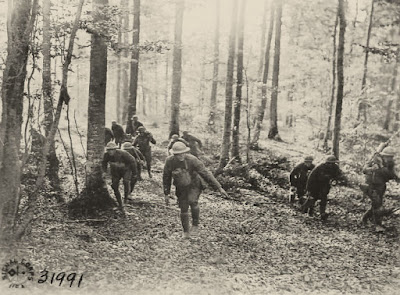
80th "Blue Mountain" Division Advancing
in the Opening of the Battle


Reviews


Forty-Seven Days: How Pershing's Warriors Came of Age to Defeat the German Army in World War I


Meuse-Argonne 1918: Breaking the Line


A Reminder: This is a representative listing, not inclusive of all the articles we have published on this topic in Roads to the Great War.  To search our archives for other articles on this topic, or to explore other World War One interests of yours, take advantage of the site search engine at the top left corner of every article on Roads to the Great War.  MH