Now all roads lead to France and heavy is the tread
Of the living; but the dead returning lightly dance.
Edward Thomas, Roads

Wednesday, December 16, 2015

American Collage

 A Random Selection of Images of the U.S. War Experience

(Thanks to the readers who sent these)


Tuesday, December 15, 2015

The Dust That Falls from Dreams
reviewed by David Beer


The Dust That Falls from Dreams
by Louis de Bernières
Pantheon Books, 2015


If you enjoyed Corelli's Mandolin (1995) or saw the movie, you'll be happy to know that de Bernières has now written another rich saga, this time about three families caught up in the Great War and its aftermath. This is de Bernière's second novel set in 1914–18: his Birds Without Wings (2004) takes place in a Turkish village during the war and the rise of Kemal Atatürk. Like other works by this author, The Dust That Falls from Dreams is a lengthy read of over 500 pages — but don't let that put you off. A flowing and lucid prose plus very short chapters make this an enjoyable and effortless read, and almost every page gives evidence that de Bernières has done his homework by acquiring an intimate knowledge of even some of the most obscure details of the war.  This novel has been selected as one of the ten best pieces of fiction for 2015 by Time Magazine.

British Middle Class Family, Prewar Period

Opening with a brief but touching account of Queen Victoria's final days (her last imperial act was to proclaim the establishment of the Commonwealth of Australia), this historical novel takes us into life in the Edwardian era, the war, the period following the Armistice, and briefly on to what was then still Ceylon. The lives of three well-to-do families, all neighbors living just south of London, are focused on during this tumultuous time. They, like so many others, are steeped in the Victorian era of empire and comfort yet are soon to be cruelly disrupted and tested. Predominant are the McCosh family with four daughters — Christabel, Ottilie, Rosie, and Sophie. Mr Hamilton McCosh loves golf, his London club, and a mistress or two while investing in often precarious enterprises. Mrs McCosh "was always writing to the King, and was the fiercely proud owner of a little pile of polite and non-committal acknowledgements from his secretary."

Next to them live their extremely proper American neighbors, Mr. and Mrs. Pendennis, formerly from Baltimore, with their sons Sidney, Albert, and Ashbridge. These boys must shake their father's hand before breakfast and address him as "Sir." On the other side live an Anglo-French family, the Pitts, with two daredevil brothers, Archie and Daniel. All the children are lively and get along well. By their late teens when war breaks out, they have happily formed a pact as "Pals" and romance is beginning to flourish.


Order Now
This is the setting for what soon becomes a family saga that we find hard to put down. The author presents the thoughts and experiences of all the main characters throughout the book's short chapters, so as the novel progresses we see events from multiple points of view. Without revealing the story line, I can say that the sections of the book dealing with the trenches, aerial combat, and nursing the wounded and dying – all of which one or more of the young people experience — are among the best I have ever read. When the war ends, those who have survived (death has been no stranger to the families) are overwhelmed by the sense of loss and uncertainty that descends upon them. Everything seems to have changed and they must each deal with it in their own ways. One riveting chapter is an internal soliloquy by Daniel Pitt, who has survived the war after recklessly flying a "split-arsed" Camel fighter ("Real heroes don't jump, they just bounce or burn") and who nostalgically recalls to the smallest detail all he is now going to badly miss.

The characters themselves add greatly to both the charm and the intensity of the novel. Some, like Mrs. McCosh, seem to take on an almost Dickensian quality with their eccentricities. Sophie McCosh, less prominent in the story line than her sister Rosie but more fortunate in love, frequently confuses or amuses everyone with her poetic misuse of the language. It's Sophie who supplies the title for the novel on her wedding night, mystically alluding to a poem by Rupert Brooke.

In many ways The Dust That Falls from Dreams reminds me of a Victorian novel combined with a war novel. So many "ingredients" are blended into the story, such as letters and excerpts from diaries, references to well-known poets, emphasis on proper manners, thoughts on God and religion, and a séance with disquieting results. A fascinating chapter deals solely with the autograph book that Rosie gradually fills up with the signatures and sentiments of her wounded patients: "It was bound in soft black leather, and the paper was thick and watermarked. Rosie had wanted a book of high quality in order to demonstrate to the men how much she valued them."

A British Nurse Lights a Cigarette for a Patient

You'll find plenty of words in this book no longer in use but fairly common during the period. They don't hinder the reading of the novel but do serve to put us more fully in the early 1900s. You may be tempted to look up words like whitster, pelmet, or efell, or wonder what a "cats'-meat-man" is (you can google it). Some are self-explanatory on reflection, such as rear admiral – the solder who drew the duty of cleaning out the trench latrine. As mentioned earlier, the author has done his homework and has written yet another rich, authentic, and captivating historical novel.

Author Louis de Bernières was born in London in 1954. After a brief stint in the army he eventually obtained an MA at the University of London. Before becoming a full-time writer he was a landscape gardener, motorcycle messenger, car mechanic, and English teacher in South America. I can strongly recommend his The Dust That Falls from Dreams to anyone who enjoys a novel that is paradoxically both a leisurely read with a Victorian flavor and also a deeply insightful look at the devastating effects the Great War had on the lives of three families.

David Beer

Monday, December 14, 2015

How to Follow the World War I Centennial Month by Month


The very best way to follow the events of 100 years ago is to subscribe to our monthly magazine, OVER THE TOP.  Below, you can see  all twelve of our covers from 2015, and you will see that we presented new, freshly researched feature articles on the major events of 1915 from all the major fronts, plus innovations in aviation, the early cultural responses to the fighting, the sinking of the Lusitania, and the tragic Armenian genocide.  The year of the war's "signature" battles on land and sea — 1916 — we will cover comprehensively.


OVER THE TOP is a full-color magazine delivered to you electronically.  We have been publishing monthly since 2007. All of our previous 108 issues are available on annual CD compilations, always with some extra features for you to enjoy.  Our 2015 CD (pictured below) besides all 12 1915-2015 Centennial issues includes illustrated guides to the two great battlefields of 1916, Verdun and the Somme.  Also, we continue to offer our very popular musical CD of Great War Favorites.


Please sign-up, you won't be disappointed in any of our OVER THE TOP products.


Don't forget to include your email and contact information.

Sunday, December 13, 2015

Remembering a Veteran: Sapper William Hackett, VC


William Hackett, VC

On the morning of 22 June 1916, Sapper William Hackett and four other miners of 254 Tunnelling Company were driving a tunnel toward the enemy lines below the cratered surface of the Givenchy sector of northern France near Vimy Ridge. At about one-quarter of the way toward the German trenches at a depth of about 35 feet, the timbered gallery 4’3” high by 2’6” wide was still in the early stages of development; it was served by a single shaft – the Shaftesbury Shaft. At 2:50 a.m. the explosion of a heavy German mine (the Red Dragon) blew in 25 feet of the tunnel, cutting the five men off from the shaft and safety. On the surface, a rescue party was immediately organized. After two days of digging an escape hole was formed through the fallen earth and broken timbers, and the tunnelers contacted. William Hackett helped three men to safety. 

However, with sanctuary beckoning, and although himself apparently unhurt, he refused to leave until the last man, seriously injured 22-year-old Thomas Collins of the Swansea Pals (14th Battalion, the Welsh Regiment), was rescued. His words were said to be “I am a tunneller, I must look after the others first." The rescuers worked on but were frequently immobilized by German shelling and mortaring of the shaft-head. Conditions above and below ground became more treacherous by the minute. Eventually the gallery collapsed again, entombing the two men. Both still lie beneath the fields of Givenchy today. Figure 1, to the right, shows an overlay of a contemporary aerial photograph and trench map, showing the Givenchy crater field formed by intensive underground warfare, the British and German trenches, the location of the Shaftesbury Shaft that served the tunnel in which William Hackett and his colleagues were working, the German mine crater (Red Dragon) that caused their gallery to fail, and the site of the memorial.


Memorial to William Hackett & WWI Tunnelling Companies at Givenchy
(Dedicated 2010)

For his act of selfless valor William Hackett was awarded a posthumous Victoria Cross — the only such decoration ever to be bestowed upon a Tunneller. He is remembered in perpetuity on Panel 1 of the Ploegsteert Memorial to the Missing near Armentières while Thomas Collins’s name appears on the Thiepval Memorial on the Somme. Why two men who died together and still lie together are not commemorated in the same place is unknown.

Source:  The Tunnellers' Memorial, Givenchy Website

Saturday, December 12, 2015

The 100-Year Debate on the Origins of World War One


Article by: Annika Mombauer at the British Library Website

How could the death of one man, Archduke Franz Ferdinand, who was assassinated on 28 June 1914, lead to the deaths of millions in a war of unprecedented scale and ferocity? This is the question at the heart of the debate on the origins of the First World War. How did Europe get from the assassination of Franz Ferdinand and his wife to the situation at the beginning of August when Germany and Austria-Hungary were at war with Serbia, Russia, France, Belgium, and Britain? Finding the answer to this question has exercised historians for 100 years, and arriving at a convincing consensus has proved impossible. 


"Cupidity" by R.Ferro (1916) [Institute Centrale]


The need to fight a defensive war

Establishing the responsibility for the escalation of the July Crisis into a European war – and ultimately a world war – was paramount even before fighting had begun. The governments of Great Britain, France, Russia, Germany, and Austria-Hungary tried desperately to ensure that they did not appear to be the aggressor in July and August 1914. This was crucial because the vast armies of soldiers that would be needed to fight this war could not be summoned for a war of aggression. Socialists, of whom there were many millions by 1914, would not have supported a belligerent foreign policy and could only be relied upon to fight in a defensive war. Populations would only rally and make sacrifices willingly if the cause was just – and that meant fighting a defensive war.

The French and Belgians, Russians, Serbs, and British were convinced they were indeed involved in a defensive struggle for just aims. Austrians and Hungarians were fighting to avenge the death of Franz Ferdinand. Germans were assured by their Kaiser, Wilhelm II, and their chancellor, Theobald von Bethmann-Hollweg, that Germany’s neighbors had "forced the sword" into its hands. In 1914, Germans were certain that they had not started the war. But if not they (who had after all invaded Belgium and France in the first few weeks of fighting), then who had caused this war?

From the victors’ war guilt ruling to a comfortable interwar consensus

For the victors, this was an easy question to answer, and they agreed at the peace conference in Paris in 1919 that Germany and its allies had been responsible for causing the Great War. Based on this decision, which was embodied in Article 231 of the Treaty of Versailles, vast reparations would be payable. This so-called "war guilt ruling" set the tone for the long debate that followed on the causes of the war. From 1919 onward, governments and historians engaged with this question as revisionists (who wanted to revise the verdict of Versailles) clashed with anti-revisionists who agreed with the victors’ assessment.

Sponsored by postwar governments and with access to vast amounts of documents, revisionist historians (many, but not all, German) set about proving that the victors at Versailles had been wrong. Countless publications and documents were made available to prove Germany’s innocence and the responsibility of others. Arguments were advanced which highlighted Russia’s and France’s responsibility for the outbreak of the war, for example, or which stressed that Britain could have played a more active role in preventing the escalation of the July Crisis.


Scenes from the Signing of the Versailles Treaty

In the interwar years, such views influenced a newly developing consensus that no longer foregrounded Germany’s war guilt but instead identified a failure in the alliance system before 1914. The war had not been deliberately unleashed, but Europe had somehow "slithered over the brink into the boiling cauldron of war", as David Lloyd George famously put it. With such a conciliatory accident theory, Germany was off the hook, and instead of remaining a former troublesome enemy could become a potential future ally against the increasingly threatening-looking Soviet Union. And so a comfortable consensus emerged and lasted all through the Second World War and beyond, by which time the Great War (now known as the First World War) had been overshadowed by an even deadlier conflict. 

The Fischer school challenge to the revisionist consensus

There was little reason to question this comfortable orthodoxy after 1945. The first major challenge to this interpretation was advanced in Germany in the 1960s, when the historian Fritz Fischer published a startling new thesis on the origins of the war which threatened to overthrow the existing consensus. Germany, he argued, bore the main share of responsibility for the outbreak of the war. Moreover, its leaders had deliberately unleashed the war in pursuit of aggressive foreign policy aims which were startlingly similar to those pursued by Hitler in 1939.  Backed up by previously unknown primary evidence, this new interpretation exploded the comfortable postwar view of shared responsibility. It made Germany responsible for unleashing not only the Second World War (of this there was no doubt), but also the First – turning Germany’s recent history into one of aggression and conquest.

The German establishment, which included leading historians and politicians, reacted with outrage to Fischer’s claims. They attempted to discredit him and his followers. The so-called Fischer school was accused of "soiling its own nest", and in the context of the Cold War of the early 1960s, it is not difficult to see that the question of the origins of the First World War was of serious contemporary political significance. Those willing to question Germany’s recent past and those wanting to hide any potential wrong-doings by Germany’s former leaders clashed in a public dispute of unprecedented ferocity.

In time, however, many of Fischer’s ideas became accepted as a new consensus was achieved. Most historians remained unconvinced that war had been decided upon in Germany as early as 1912 (this was one of Fischer’s controversial claims) and then deliberately provoked in 1914. Many did concede, however, that Germany seemed to have made use of the July Crisis to unleash a war. But its government was not the only one to do so. In the wake of the Fischer controversy, historians also focused more closely on the role of Austria-Hungary in the events that led to war and concluded that in Vienna, at least as much as in Berlin, the crisis precipitated by the assassination of Archduke Franz Ferdinand was seen as a golden opportunity to try and defeat a ring of enemies that seemed to threaten the Central Powers.

New questions but no new consensus

In recent years this post-Fischer consensus has in turn been revised. Historians have returned to the arguments of the interwar years, focusing for example on Russia’s and France’s role in the outbreak of war, or asking if Britain’s government really did all it could to try and avert war in 1914. Germany’s and Austria-Hungary’s roles are de-emphasized, and it is stressed that there were decision-makers in all the major capital cities who considered a general European war in August 1914 to be a risk worth taking. After 100 years of debate, every conceivable interpretation seems to have been advanced. In some of the most recent publications, even seeking to attribute responsibility, as had so confidently been done at Versailles, is now eschewed. Is it really the historian’s role to blame the actors of the past or merely to understand how the war could have occurred?

Such doubts did not trouble those who sought to attribute war guilt in 1919 and during much of this long debate, but this question will need to be asked as the controversy continues past the centenary. The current consensus on why it broke out is "that there is no consensus". After 100 years of arguing about the war’s causes, this long debate is set to continue.

Friday, December 11, 2015

Images of Gas Warfare

Haunting, absurd, inhuman, looking like B-movie science fiction, the images of gas warfare still pack a wallop 100 years later.


Photos from Steve Miller and Tony Langley

Wednesday, December 9, 2015

Recommended: Pickelhaube Picks from Anitques Road Show


By Dennis Gaffney


Militaria expert Bruce Herman says that most collectors are drawn to Pickelhaube helmets for one reason. "Their appeal is the spike," Bruce says of the pointy adornment known as a spitze in German. "That feature makes these helmets unique, and they set the tone for helmets through the second half of the 19th century."

But it's not only Americans (their most common collectors) who desire them. "These are universally popular," explains Bruce, who is based in Pasadena, California. "Collectors come from Australia, Sweden, Germany, South America...I've encountered collectors from all over the world." We asked Bruce to educate Antiques Roadshow fans about the history of Pickelhaube helmets and to provide some tips to potential collectors about what to look for. Here's what he told us.

A Prussian Design

The Pickelhaube helmet was introduced in 1842, at a time when King Friedrich Wilhelm IV of Prussia undertook a major modernization of his army. Until then, his soldiers still wore the shako style typical of the Napoleonic Wars. Wilhelm tossed aside this headgear—tall, cylindrical hats now commonly worn by school marching bands—popular among Western armies in the late 18th and early 19th centuries. . ,

Read the complete article here:


Photo from Steve Miller

Tuesday, December 8, 2015

A Kingdom United: Popular Responses to the Outbreak of the First World War in Britain and Ireland
reviewed by Jane Mattisson Ekstam


A Kingdom United: Popular Responses to the Outbreak of the First World War in Britain and Ireland
by Catriona Pennell
Oxford University Press, Oxford, 2014


A Kingdom United gives a new and nuanced picture of the reactions of the British and Irish to the outbreak of war in 1914. They were neither wholly enthusiastic, as has sometimes been stated about Britain, nor were they completely disengaged, as historians have claimed about Ireland. There was, and indeed never could be, any "single, uniform reaction to such a major event as the outbreak of war in Europe" (227). The hitherto accepted idea of collective war enthusiasm is a simplification of popular feelings in a time of grave danger. In reality, there was a wide range of attitudes: excitement, curiosity and adventure, but also insecurity, fear and depression. And such feelings knew no national boundary.

In comparison with France and Germany, volunteerism was more prominent in Britain; indeed, 1914–1916 saw the raising of the largest volunteer army in British history. Britain and Ireland shared the same view of what was at stake: "national honour, liberty, the rights of small nations" (230). They were very different, however, in one important regard — domestic politics. While these were suspended in Britain, war was to become an integral "part of the politics of domestic peace in Ireland" (229).


Order Now
A Kingdom United is the first study to focus on how the British and Irish responded to the war. Concentrating on the first five months, from August to December 1914, Pennell explores a multiplicity of emotions, identifies patterns, and draws new and important conclusions from the evidence. She investigates newspapers, diaries, journals, memoirs, interviews taken retrospectively, photographs, police records, sermons and government records, giving equal weight to national and regional reactions to the outbreak of the war.

In addition to the above sources, Pennell's study incorporates adventure stories by G.A. Henty, H. Rider Haggard, Boy's Own magazine, and best-selling accounts of the South African War, which promoted an image of war as honorable and glorious. Pennell notes that in the years leading up to the First World War, war was increasingly becoming a moral phenomenon in which ethical issues were of critical importance.

The growing feeling that Germany was a threat to Britain is also discussed in A Kingdom United. By 1911, relations between Britain and Germany were deteriorating. Britain was expecting war to break out due to a growth of German imperialism, disputes with France and later with Germany, and the decision to abandon the traditional policy of isolationism. The attempts to improve Anglo-German relations between 1911 and 1914, and Britain and Germany's collaboration during the Balkan crises of 1912–1913, produced a false belief in the idea that the July 1914 crisis could be resolved. As a result, the sense of surprise and shock at the outbreak of war in August was, as Pennell convincingly demonstrates, significantly exacerbated.

Chapter Four, "Encountering Violence: Imagined and Real," is particularly fascinating. It explores people's knowledge of war and violence and how the opening months of the war were characterized by a vacuum of news that fueled "apprehension, rumour, and fear" (124); the possibility of a German invasion seemed to be coming ever closer. As wounded soldiers returned from the front and as people learned of the loss of their loved ones, the pain and grief "literally brought the war home" (142). As a result, the kingdom in 1914 "did not stay united, but paths of division were strongly influenced by the length and nature of the war, matters that were still shrouded in mystery in 1914, and were by no means foreordained" (232).

10th Irish "New Army" Division in Training, 1915

A Kingdom United is a fascinating and convincing study. It is fastidiously researched, contains illuminating illustrations, copious footnotes, excellent short presentations of the 441 characters discussed (Appendix I), and a statistical breakdown of their gender and prewar occupations (Appendix II), the location of the diaries, journals, and memoirs used (Appendix III), and a presentation of anti-German riots and western military events for October 1914 (Appendix IV). The bibliography is extensive and includes old as well as more recent studies. A Kingdom United is personal, engaging, and fresh. It is also written in an eloquent and easy-to-read style — a major achievement given the complexity of its subject. As an important contribution to the history of the British home front during the First World War, it is warmly recommended.

Jane Mattisson Ekstam

Monday, December 7, 2015

Remembering the First World War Veterans of 7 December 1941


Crew and Officers, USS Oklahoma, 1917

Today, on the anniversary of the Day of Infamy, let's look at the ships of the Pacific Fleet that served in the Great War. Of the ships damaged or sunk, three served overseas in Battleship Squadron 6 – the second group of battleships deployed to the war zone. (The other was Squadron 9, deployed with the Grand Fleet.)
The three ships of Squadron 6 at Pearl Harbor were the USS Utah (by then converted to a gunnery ship), the USS Oklahoma, and the USS Nevada. The ships' mission was to escort convoys across the Atlantic. After the Armistice they helped welcome President Wilson to the Paris conference and were present at the surrender of Germany's High Seas Fleet. Here are each of the three ships and a little information about them:


USS Utah (BB-31/AG-16)


USS Utah on Station, Bantry Bay, Ireland, 1918

Utah Being Refloated After the Attack

In the first minutes of the Japanese attack on Pearl Harbor, the ship was hit by two torpedoes, which caused serious flooding. Utah quickly rolled over and sank; the vast majority of her crew were able to escape, but 64 men were killed in the attack. The wreck remains in the harbor, and in 1972 a memorial was erected near the ship.

USS Oklahoma (BB-37)


USS Oklahoma, Berehaven Harbor, Ireland, 1918

Oklahoma Capsized Next to USS Maryland, Which Suffered Minimal Damage
On 7 December 1941, a total of 429 crew died when the USS Oklahoma capsized and sunk on Battleship Row after being struck by several bombs and torpedoes during the Japanese attack. Most of the battleships that were recovered after Pearl Harbor were able to be salvaged and return to duty. But not the USS Oklahoma. She was too damaged and was eventually stripped of her remaining armaments and superstructure before being sold for scrap in 1946 but was lost at sea in transit to the Pacific coast.


USS Nevada (BB-36)


BB-36 in Three Configurations: Original/WWI, 
Interwar Modernization, Post-Pearl Harbor WWII


The Only Battleship to Get Under Way on 7 December, Nevada's Captain Was Ordered
to Run the Ship Aground to Avoid Blocking the Main Channe
l
Of the three veterans of Squadron 6, USS Nevada was the only ship to survive the attack and the only battleship of the Pacific Fleet to attempt to get to sea. Over the course of the morning, Nevada suffered a total of 60 killed and 109 wounded It was repaired within a year. Nevada served as a convoy escort in the Atlantic and as a fire-support ship in four amphibious assaults: the Normandy landings and the invasions of Southern France, Iwo Jima, and Okinawa. After the war, deemed obsolete, the Nevada suffered the indignity of being designated a target ship for atomic bomb tests.  However, after surviving a blast at Bikini Atoll, the ship was more fittingly sunk by naval gunfire.

Engineer Officer Donald Ross, USS Nevada,  Receiving the 
Medal of Honor for His Service on 7 December

Don Ross played a critical role in getting the Nevada's engines working that day. Your editor had the good fortune of chatting with him in the 1980s over a cup off coffee on a Puget Sound ferryboat. As we returned to our cars, I noticed his license plate was a special State of Washington issue with a Medal of Honor designation. I later looked up his citation and this is what it says:

For distinguished conduct in the line of his profession, extraordinary courage and disregard of his own life during the attack on the Fleet in Pearl Harbor, Territory of Hawaii, by Japanese forces on 7 December 1941. When his station in the forward dynamo room of the U.S.S. Nevada became almost untenable due to smoke, steam, and heat, Machinist Ross forced his men to leave that station and performed all the duties himself until blinded and unconscious. Upon being rescued and resuscitated, he returned and secured the forward dynamo room and proceeded to the after dynamo room where he was later again rendered unconscious by exhaustion. Again recovering consciousness he returned to his station where he remained until directed to abandon it.

Sunday, December 6, 2015

Verdun: Total Battle in Total War


"The battle of Verdun is the battle of France."


It's a place of the identity of France, of France-ness, I would say. There was no battle before, and no battle after, which was so important in the French memory. So, you can't understand France without understanding Verdun.

The French troops were unprepared in Verdun. It sounds incredible, but that is the case. Why? Because the French High Command didn't expect any attack on this particular sector of the front. So the German attack was a complete surprise for French troops, and especially for the French High Command.

German troops had the advantage of surprise.

The Verdun Battlefield – 1916

Second, is the huge advantage in artillery that German troops had at the turning point of the war, especially in heavy guns. And the French Army couldn't match the German artillery.

I think the soldiers on the battlefield of Verdun – French soldiers or German soldiers the same – felt completely lost, completely abandoned. And we have to understand why. You have no ordinary trenches in Verdun. There are no trenches anymore because of the heavy bombardments. You have only pieces of trenches, and soldiers are alone or in small groups everywhere with no officers, no tactical links. So they feel completely abandoned on the battlefield. For example, there are no stretcher-bearers. No food. No letters. Nothing at all. So that is a very specific sort of battle.

I think that in the total war, the battle of Verdun was a total battle.

Published in France While the Battle Was Ongoing

I think that French soldiers were perfectly aware of the meaning of the battle. In their eyes, the battle was a defense of their women, their wives, the children, the French religion, the French soil. It looks very strange to us now, but for the French soldiers of 1916, it was very clear to them. The battle had real meaning.

Stephane Audoin-Rouzeau, University of Picardie, Interview

Saturday, December 5, 2015

Images from the Royal Naval Museum, Greenwich

One of the great things about the Centennial is that a lot of institutions are publishing their World War I archives online.  Here are some images from the Royal Naval Museum.

Barrage Balloon

Gun Drill on a Torpedo Boat Destroyer

WWI Q-Ship, Thought to Be HMS Gaelic

HMS Cardiff Leading High Seas Fleet to Surrender

Study for Mark Series Tank
(Admiralty Engineers Contributed to Its Design)

Drawing of a Destroyer Flotilla


Convoy with Dazzle Camouflage

Conning Tower, Royal Navy Submarine

HMS Vindictive at the Zeebrugge Mole

Painting of a Royal Navy Seaplane

Friday, December 4, 2015

Notes on the Brusilov Offensive


In June 1916 Russian armies on the Southwestern Front under the command of General Aleksei A. Brusilov broke the Austro-Hungarian line in several places and drove them back as much as 160 kilometers in some sectors in what was by most estimates the greatest Russian military achievement of the war. At Habsburg positions deemed impregnable, brigades disintegrated in the face of the meticulously planned and precisely executed Russian assault. 

Brusilov's forces took more than 350,000 Habsburg soldiers prisoner, and an entire Austrian corp—seven divisions—broke before the onslaught. The Russians regained all of the territory lost on the front in 1915 and advanced to the foot of the Carpathian Mountains, where they threatened Hungary itself. Only rapid action by Germany's military leaders held the front together and prevented the collapse of the Habsburg Empire in 1916. 

The Entrenched Defenders Apparently Confident of Their Position

At the start of the attack, Brusilov had available on the Southwest Front:

  • 4 armies (7th, 8th, 9th, and 11th) later augmented with 3rd Army
  • 40 infantry and 15 cavalry divisions 
  • 600,000 men 
  • 1,926 artillery pieces of all sizes


The defence [by the Central Powers], however, had been successful only because 20 German divisions in all had been brought here. . .
General August von Cramon,  German Liaison Officer with the Austrians 

Only the crudest estimates of casualties are available for the Brusilov Offensive. The Austro-Hungarian army suffered a staggering total of 1.5 million men (including 400,000 taken prisoner). Comparable estimates for the Russian Army are something over one million.

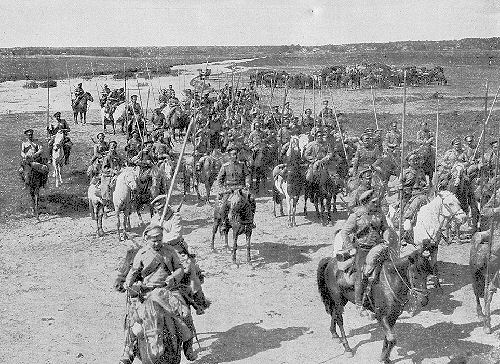
Russian Cavalry on the Move

In the end, the Brusilov Offensive destroyed the military capacity of the Habsburg Empire, brought Romania into the war, forced Vienna to accept Berlin's almost total control in the east, and relieved the fronts in both Italy and France from enemy pressure. 

Sources:  Timothy Dowling and Holger H. Herwig

Thursday, December 3, 2015

The Postwar League of Nations Mandate System for the Middle East


Following WWI, the League of Nations established a system of "mandates." In theory, the mandate system had the benevolent intention of preparing the "natives" of various regions for self-government. Many believed of course that the granting of mandates often represented nothing more than the granting of spoils to the different victorious Allied governments. The basis of the mandate system was Article 22 of the Covenant of the League of Nations, which gave broad authority to the mandate powers regarding preparation for self-rule. The document is reproduced below.

It is noteworthy that the mandate provision allowed the widest possible latitude in execution of individual mandates: "The character of the mandate must differ according to the stage of the development of the people, the geographical situation of the territory, its economic conditions and other similar circumstances." The terms of each mandate were accordingly to be worked out on a per-country basis. 

The Mandate System
Kuwait: Designated “Independent Sheikhdom”
Greater Lebanon: Part of French Mandate


The authority for the Mandate System was Article 22 of the Covenant of the League of Nations, 28 June 1919:

Article 22. To those colonies and territories which as a consequence of the late war have ceased to be under the sovereignty of the States which formerly governed them and which are inhabited by peoples not yet able to stand by themselves under the strenuous conditions of the modern world, there should be applied the principle that the well-being and development of such peoples form a sacred trust of civilization and that securities for the formance of this trust should be embodied in this Covenant.

The best method of giving practical effect to this principle is that the tutelage of such peoples should be entrusted to advanced nations who by reason of their resources, their experience or their geographical position can best undertake this responsibility, and who are willing to accept it, and that this tutelage should be exercised by them as Mandatories on behalf of the League.

The character of the mandate must differ according to the stage of the development of the people, the geographical situation of the territory, its economic conditions and other similar circumstances.

Certain communities formerly belonging to the Turkish empire have reached a stage of development where their existence as independent nations can be provisionally recognized subject to the rendering of administrative advice and assistance by a Mandatory until such time as they are able to stand alone. The wishes of these communities must be a principal consideration in the selection of the Mandatory.

Other peoples, especially those of Central Africa, are at such a stage that the Mandatory must be responsible for the administration of the territory under conditions which will guarantee freedom of conscience and religion, subject only to the maintenance of public order and morals, the prohibition of abuses such as the slave trade, the arms traffic and the liquor traffic, and the prevention of the establishment of fortifications or military and naval bases and of military training of the natives for other than police purposes and the defence of territory, and will also secure equal opportunities for the trade and commerce of other Members of the League.

There are territories, such as South-West Africa and certain of the South Pacific Islands, which, owing to the sparseness of their population, or their small size, or their remoteness from the centres of civilization, or their geographical contiguity to the territory of the Mandatory, and other circumstances, can be best administered under the laws of the Mandatory as integral portions of its territory, subject to the safeguards above-mentioned in the interests of the indigenous population.

In every case of Mandate, the Mandatory shall render to the Council an annual report in reference to the territory committed to its charge.

The degree of authority, control or administration to be exercised by the Mandatory shall, if not previously agreed upon by the Members of the League, be explicitly defined in each case by the Council.

A permanent Commission shall be constituted to receive and examine the annual reports of the Mandatories and to advise the Council on all matters relating to the observance of the mandates.

Wednesday, December 2, 2015

Meet the Red Baron


One of our readers has shared a YouTube video on the Red Baron that is actually quite revealing.  It's clearly something of a propaganda piece, but the attitudes and emotions expressed seem sincere. It was made in September 1917, and he's not showing the nervous, burned-out look of the following spring, just before his death.  The film starts with  the ground crew rolling out the Dr.I triplane,  then von Richthofen greeting the men, getting helped into his flight gear, and interacting with his fellow pilots.  There is also an interesting segment at the end showing the pilots inspecting bullet holes on a damaged aircraft.  You can find the video here: 

Tuesday, December 1, 2015

Days of Perfect Hell: The U.S. 26th Infantry Regiment in the Meuse-Argonne Offensive, October-November 1918
reviewed by Michael P. Kihntopf


Days of Perfect Hell: The U.S. 26th Infantry Regiment in the Meuse-Argonne Offensive, October-November 1918
by Peter L. Belmonte
Schiffer Military History, 2015


The Regiment Arriving in the Argonne Sector, Near Cheppy

For an infantryman, war rarely exists above the plane of his vision at the time of combat. Vaguely, he may be aware of the events that brought him to a field in some nameless place where he experiences things that will change and shape his world forever after, but he seldom sees beyond those occurrences until well after the conflict has been resolved. Peter Belmonte's Days of Perfect Hell clearly shows how the men of the 26th Regiment, 1st Battalion, 1st Division, 1st Army saw their battle in this new work; it was a daily struggle to stay alive. The author spares us the overdone details of the Great War's political start, the formation of the American Expeditionary Force and all the arguments that preceded its entry into the trenches. This is specifically a book about the regiment's part in the Meuse-Argonne Offensive from 26 September through November 1918.

Belmonte begins with a brief but detailed picture of the American Expeditionary Force's organization from the top to the lowly soldier slugging through the mud. Leadership personalities are delved. Then he briefly covers the weapons that the soldier used and would have come into contact with including those used by the other side of the line. To round out what I saw as a basic introduction to the fighting man of the Great War, the author then gives a short history of the regiment's origin, training, and involvement in the war up to their exposure to the Meuse-Argonne Offensive. Covering these areas presents an in-depth profile of the unit that the reader will need as he accompanies the regiment through forests and across rivers and creeks.

Corpsman Axel Lundegard, 26th Infantry, Receives the Distinguished Service Cross
from General Pershing for Service in Action 4 October 1918

Belmonte is meticulous in the next chapters of Days of Perfect Hell, which are divided by dates beginning from 1 - 3 October when the regiment goes into preparation positions for the attack. Battalion, company, and platoon officers and men who will be part of the upcoming assault to begin on 4 October are presented. Through their diaries, after-action reports, and some letters home, the reader gets to know the very essence of the regiment. The author succinctly analyzes archival material to ferret out inconsistencies in some reports and truths in others. Throughout the pages I found the hand-drawn maps done by battalion and company commanders to be excellent references guides, far better than the overused maps of commercial origin which all too often don't indicate the points of the accompanying text. When the 26th Regiment finally goes over the top, I was as much relieved that the fighting was beginning as those soldiers were.

Contrary to what many have thought over the years, the German army was not as demoralized or inept in October 1918 as some have implied. Resistance to the Americans was staunch. The doughboys had to slug their way through a warren of cleverly hidden machine gun nests and other obstacles. I was appalled at the number of casualties incurred by the division and the regiment. From 4 - 12 October the division casualty rate was 196 officers and 7324 men, with the regiment hardest hit with the loss of 41 officers and 1600 men out of a beginning strength of 3300 men and 84 officers. It seemed that the American commanders were repeating some of the same mistakes the British and French made in 1914 which had caused horrendous casualties in the war's opening months.


Order Now
But an answer soon surfaced in the following pages. The Germans had been in the area since 1914. During that time they had conceived of a defense system in which pockets of resistance were so well developed that many machine guns and field artillery pieces supported each other. When one area was taken, the doughboys in a flanking attack designed to reduce casualties often found even stronger resistance on their flanks and in their rear. A front or definite line of resistance never existed. This book is a military historian's treasure chest. It is extremely rare to find orders of battle on any given day down to the company levels, as we do here. Moreover, the author's numerous details gleaned from archival sources are highly effective and make this a book not to be missed. Besides being a retired Air Force officer and author on World War One topics, Peter Belmonte is also a frequent contributor of book reviews on this blog.

Michael P. Kihntopf