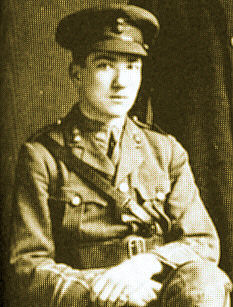
Now all roads lead to France and heavy is the tread
Of the living; but the dead returning lightly dance.
Edward Thomas, Roads

Sunday, July 10, 2016

Keeping the Memory Alive: A Visitor’s Experience at the National World War I Museum

by Cody Northrup


I had the opportunity to visit the National World War I Memorial and Museum in Kansas City this month, and as a history teacher with a particular interest in the First World War, I wanted to share the experience with my fellow World War I aficionados. While the museum itself is fairly new, having just been opened in 2006, the memorial that sits above it has a history dating back nearly a century. In 1919, just months after the battlefields finally grew quiet after four years of combat, citizens of Kansas City felt the urge to pay a lasting tribute to the American participants in the war. They were able to quickly raise several million dollars, and the final product of their activism, completed in the 1920s, is a sight to behold. Describing the numerous statues and symbols that adorn the memorial deserves an article all its own, but the main attraction is the Liberty Memorial Tower, stretching 265 feet in the air. While exploring the memorial, it is difficult not to appreciate its majestic design.


Kansas City may not seem like the most obvious location for what the United States had deemed its official WWI museum, but it is an appropriate area for numerous reasons. The commanding general of the American Expeditionary Force, John J. “Black Jack” Pershing was born and raised just miles outside the city (the museum is actually located on Pershing Street), and an artillery captain in the war named Harry S. Truman, who went on to become President of the United States, came from neighboring Independence. Additionally, only seven states in the nation produced more Doughboys than did Missouri, which enlisted over 128,000 soldiers in all.
            
Onto the museum itself, I feel there are three strengths that should be highlighted. The first of these is the accessibility it provides to all audiences. History buffs will surely feel the greatest sense of awe when exploring the exhibits, but those with little background knowledge of the war can easily catch up on the context with the videos that play throughout the museum. Even children can stay involved by completing a scavenger hunt guide. The second strength is the museum’s ability to establish balance and impartiality. The first half of the exhibits cover the war from 1914–17, while the second half focuses on the United States’ involvement from 1917–18. I did not feel that the material presented any bias for or against any country. It is up to the viewer to make up his or her own mind based on the artifacts displayed. And while the Western Front deservedly receives much attention, lesser known topics such as the role of Asian powers in the war and the AEF Siberia receive some much-appreciated spotlight as well.

A glimpse into life in the trenches 

The final strength is the somber atmosphere the museum is able to create. While the visit was an exciting experience, I feel that the First World War was a tragic event and appreciated the ability to reflect on it in such a way. Upon entering, visitors cross a glass bridge, suspended over a field of 9,000 (artificial) poppies. Each of these poppies represents 1,000 lives that were lost in combat. While I know that 9,000,000 is an enormous number, seeing the sacrifices before me in this visual way allowed me to better understand just how dramatic that number is.
            
While viewing the museum’s first display, featuring artifacts from a peaceful prewar Europe, one can hear the sounds of artillery being fired from a distant part of the building. It creates a sense of the impending doom that quickly struck the people of Europe in the summer of 1914. Other examples are the peepholes that allow one to look in on mannequin soldiers seeking cover in a life-size trench and a ledge that lets viewers look down on soldiers crossing a shell-pocked no-man’s-land. I felt like a voyeur who was able to step back a century into time when observing these exhibits. While I am certainly glad I never had to experience the horrors of trench warfare firsthand, gaining a glimpse of it through these battlefield recreations gave me a new sense of what the combat must have felt like. It wasn’t the new facts that I learned at the museum that I most appreciated; rather, it was this sense of reflection that the displays were able to instill.
            
I should add here, and as the generation born in the late 19th century who had the misfortune of achieving adulthood in a war-torn world can attest to, timing is everything. The atmosphere I described is best achieved on quiet day. A ticket allows visitors two days of admission. The first day I visited, I happened to arrive at the same time as a large middle school class on a field trip. Luckily, the second day I attended saw the museum pretty empty, allowing me to appreciate it without fighting for room to view the exhibits with the other visitors. If you plan on visiting, perhaps give the museum a call beforehand in order to avoid large crowds.

Looking down on the field of poppies upon entering the museum

While there are far too many collections and artifacts on display to begin to mention in this space, I would like to spotlight a temporary exhibit that commemorates the centennial anniversary of the two bloodiest battles of the First World War — Verdun and the Somme. Titled “1916: They Shall Not Pass,” it features a multitude of items used in these now legendary battles, such as a Vickers machine gun, a 340mm mortar shell, and a bullet-pierced helmet. The exhibit will continue to be displayed through March 1917, when it will be replaced by one dedicated to the anniversary of the United States’ entry into the war. It is awe-inspiring to be up close and personal with these objects, knowing that exactly 100 years ago they were being used to permanently change the world as we know it.

Unfortunately the First World War has become largely forgotten in the collective memory of Americans. Because of this, I appreciate efforts — whether it is sites like Roads to the Great War or museums like the one in Kansas City — that use the centennial anniversary of the war to keep its memory and significance alive. If you have any questions about a particular piece of the museum, leave a comment here or contact me at northrup@nmmi.edu. 

Saturday, July 9, 2016

A Dozen Great War Quotes


At first there will be increased slaughter — increased slaughter on so terrible a scale as to render it impossible to get troops to push the battle to a decisive issue. Everybody will be entrenched in the next war. The spade will be as indispensable for a soldier as his rifle. All war will of necessity partake the character of siege operations. Then we shall have a long period of continually increasing strain upon the resources of the combatants. Soldiers may fight as they please; the ultimate decision is in the hands of famine. 

Ivan Bloch, Modern Weapons and Modern War, 
1897 

What minister who declared war in August 1914, would not have recoiled with horror had he known the shape of the world in 1918, not to speak of the present? One who had such an intuition and did so recoil was, of course, the British Foreign Secretary, Lord Grey.

Henry Kissinger, 
A World Restored: Metternich, Castlereagh, and the Problems of Peace 1812–1822

You can be a virgin in horror the same as in sex. How, when I left the Place Clichy, could I have imagined such horror? Who could have suspected, before getting really into the war, all the ingredients that go to make up the rotten, heroic, good-for-nothing soul of man? And there I was, caught up in a mass flight into collective murder, into the fiery furnace. . . Something had come up from the depths. . . Men are the thing to be afraid of, always, men and nothing else. 

Louis-Ferdinand Céline
Journey to the End of Night


. . .thralled and breathless, I was watching the first big infantry charge I had ever seen. It was a glorious and terrible sight, and exultant. The infantry pushed and tore through the village of Sedd el Bahr up to the fort belching fire and death from the cliff beyond. . . A man who lived ten minutes under that Turkish fire seemed to have a charmed life. Most dropping within minutes. But before they dropped they worked — ah, how they worked while they lived! Each did his small vital bit; and when he lurched bleeding into his sea grave, a comrade, newly come, snatched up his job until he, too, died. . . 

Major A. H. Mure, aboard River Clyde, V Beach, Gallipoli, 
25 April 1915

It does not pretend to be impartial. I was fighting for my hand, upon my own midden. Please take it as a personal narrative pieced out of memory. I could not make proper notes: indeed it would been a breach of my duty to the Arabs if I had picked such flowers while they fought. 

T.E. Lawrence
Seven Pillars of Wisdom, Author's Preface

During the last days disorders have taken place in Petrograd, followed by force and assaults on the lives of soldiers and members of the police. I forbid every kind of assembly in the streets. I warn the population of Petrograd that commands have been issued and repeated to the troops to use their arms and not to stop short of anything in order to assure tranquility in the capital.

Lt. Gen. Sergei Semenovich Khabalov, 
Commander Petrograd Military Area, 25 February 1917 


And now I'm drinking wine in France,
The helpless child of circumstance.
Tomorrow will be loud with war,
How will I be accounted for?

Lance Cpl. Francis Ledwidge, Royal Inniskilling Fusiliers (KIA 31 July 1917) 
Soliloquy

You know my system, I stick a bit of plaster here, then another there, then another there. The Boche doesn't advance so fast—hardly advances at all. I stick another bit there, and the Boche is stopped. You can always stop the Boche.

Ferdinand Foch, 26 March 26 1918
Just before he was named Generalissimo

My subject is war, and the pity of war. 
       The poetry is in the pity.
              Wilfred Owen, 
Preface


Richthofen has really been killed in action! I am completely shattered by the news. No words will suffice to do justice to his deeds, or to describe the grief which every German feels at the loss of this national hero; it is just impossible to grasp. . .
Herbert Sulzbach, German Artillery Officer
With the German Guns

There's absolutely nothing so uncanny as to hear a shell approach. It is not comfortable in broad daylight, but at night it is positively bloodcurdling. 

Sgt. John A. Cegner, 141st Infantry, AEF

[It's] another of those pesky half-holidays, with some things open, other things closed and everybody confused and/or uninterested. Now it's called Veterans Day, but when Nov. 11 was Armistice Day, it had meaning and poignancy — parades at slow time, muffled drums, black armbands, gold star flags in front windows of grieving mothers. The Civil War was a horror, but World War I was the real thing, dragging this coltish young nation into the international arena. It was all so innocent that those of our generation cannot hear "My Buddy" or "Over There" without a lump in the throat. I won't say "Happy Veterans Day" because the phrase makes no sense.

Herb Caen,  San Francisco Chronicle
9 Nov 1986 Column

Friday, July 8, 2016

The AEF's M-1917 Helmet


A Doughboy Reenactor in Authentic Gear

By Mark A. Reynosa

The United States entered World War I in April 1917, and at the time the United States Army did not have a helmet for its troops. The adoption of a helmet by the French, British, and German armies convinced the U.S. Army that a helmet was needed as a standard piece of equipment. In June 1917 the Army selected the standard British helmet design for its use. This was the British Mk. I steel helmet. There were three main reasons for the selection of the British Mk. I helmet design:"the immediate availability of 400,000 ready-made helmets from England, the simplicity of manufacture from hard metal, and the superior ballistic properties." When the British Mk. I was selected by the U.S. Army, the U.S. production version was designated and standardized as the Helmet, M-1917. Until U.S. production of the M-1917 could begin, the Army purchased the 400,000 available British Mk. I helmets in England and issued them to the American Expeditionary Forces already in Europe. Production was begun on the M-1917 helmets in the fall of 1917. By the end of November 1917, large quantities of M-1917 helmets became available for the U.S. Army. 

Rear View
The M-1917 helmet was very similar to the British Mk. I helmet, basically an inverted bowl stamped out of a single piece of manganese alloy, which was made up of 13 percent manganese and was .036" thick. This differed from the British helmet, as the Mk. I helmet was made up of 12 percent manganese. Thus, ballistically, the M-1917 helmet increased protection for the wearer by 10 percent over the British Mk. I helmet and could withstand a .45-caliber pistol bullet traveling at 600 feet per second fired at a distance of ten feet. A rim was spot welded to the edge of the steel bowl, with the ends butted, as opposed to lapped, which was done on the British Mk. I helmet. Riveted to the steel bowl were two flexible guiding loops for the chin strap. Here again, the U.S. M-1917 helmet differed from the British Mk. I helmet. On the U.S. helmet the loops were secured by solid machined rivets, whereas the British Mk. I helmet used split rivets. An adjustable leather chin strap was riveted to the steel bowl and consisted of two halves, each joined together by metal loops which were secured to the ends of the leather halves by steel split rivets. Also riveted to the steel bowl was the helmet lining. To make the outside surface of the helmet anti-glare, the helmets were first painted, then fine sawdust was blown on the wet paint, and finally the helmet was painted again. To increase protective properties the helmets were painted in an olive drab shade.

Machine Gunners of the 3rd Division at Château-Thierry

During the fall of 1917 production was begun on the M-1917 helmets. By the end of November 1917, the first deliveries of large quantities of M-1917 helmets were being made to the U.S. Army. On 17 February 1918 approximately 700,000 M-1917 helmets had been produced. As United States involvement in World War I increased, the U.S. Army placed additional orders for the M-1917 helmet. By July 1918 orders for the M-1917 helmet reached 3,000,000, in August 6,000,000, and in September 7,000,000. In November 1918, when hostilities ended and American production was ordered to cease, U.S. manufacturers had produced a total of 2,707,237 M-1917 helmets.

Excerpted from U.S. Combat Helmets of the 20th Century; reprinted with permission.

Thursday, July 7, 2016

Read the July 2016 St. Mihiel Trip-Wire


The July issue of our monthly newsletter, the St. Mihiel Trip-Wire, is now available online at:

http://www.worldwar1.com/tripwire/smtw.htm


Here are the Discover World War I features in this issue

  • Verdun: Not Dead, Not Past
  • Multiple Articles on the Centennial of the Battle of the Somme
  • Report on the WFA-East Coast, USA, Symposium & Memorial Day Events
  • Coming WWI Symposia & Seminars
  • A Great War Poetry Blog
  • Next Issue of  Over the Top
  • The Centennial Ticker
  • Raising Fund for the National Memorial
  • 100 Years Ago: The First Day on the Somme
  • Battlefield Tours: The Somme, Flanders 1917, Caporetto, and the Italian Front
  • WWI News Stories from the 21st Century
  • Japan's Imperial Navy in the Mediterranean
  • Ford (Despite the Peace Ship) Goes to War

Wednesday, July 6, 2016

1916 on the Isonzo, Italy's Most Successful Advance

Overview

If the campaign is protracted, the resources of the State will not be equal to the strain. . . then no man, however wise, will be able to avert the consequences that must ensue.
            Sun Tsu - The Art of War 


When Italy entered the Great War in 1915, it hoped to tilt the balance of force against the Central Powers, ending the war quickly and allowing them to gain some long sought after territorial gains on the cheap. By the start of 1916, however, Italy found it was engaged in a protracted total war, placing undreamed-of social and economic strains on the nation. Italy's government and military had to justify this burden with some successes on the battlefield. Their new allies had also started placing demands on them to continue on the offensive to alleviate pressures on their fronts. Austria-Hungary, likewise, had mobilized its entire empire to support its war effort and needed to keep popular support. Also, to inhibit the disintegration threatened by the growth of ethnocentric nationalism, Austria-Hungary could not afford to surrender any territory. On the Isonzo, all of this meant that in 1916 Italy needed to continue attacking and Austria-Hungary needed to continue defending. The war of attrition would continue growing with both sides blind to the inevitable consequences. 


Fifth Battle of the Isonzo
9–17 March 1916


In February of 1916, on the Western Front the German Army launched a tremendous assault on the city of Verdun and its surrounding fortress zone in northeast France. At a conference at Chantilly, France Marshal Joffre requested that Italy and Russia take the offensive on their respective fronts to reduce pressure on the French forces. Cadorna ordered a broad, but half-hearted, offensive nearly immediately. 

Probes were made at Tolmino, Gorizia, and the Carso. In most cases they were more demonstrations than full assaults. These died out after about a week because of bad weather and some bracing counterattacks staged by the Austrians, most notably at Santa Maria near Tolmino. The Italian Army also still needed more guns and artillery shells. The Allies committed to sending Italy heavy artillery pieces, but further offensives were delayed until the new weapons and sufficient shells could be assembled. 

Meanwhile, in the Trentino, the Austrians were marshaling their own forces for an assault. If they could mount a successful attack down off of the mountains, cross the Asiago Plateau, then occupy the Venetian Plain, they could cut off all the Italian forces in the Carnic and Julian Alps and along the Isonzo. This major operation, called the Battle of Asiago by most and the Straffe [Punishment] Expedition by some began on 15 May 1916. Asiago will be the subject of another major article on La Grande Guerra and will not be discussed here in detail. It did, however, have some dramatic effects on the Isonzo Front, and these need to be outlined briefly. 

At first the Austrian attack in the Trentino looked dramatically successful. Comando Supremo delayed further its plans for offensive operations and moved troops to reduce the threat to their rear. The deployment from the Isonzo to the Asiago Plateau was done fairly quickly since the Italian forces were traveling over shorter, interior lines. By early June the Austrian offensive was grinding to a halt. The Italian situation was further helped by the Russian response to their call for pressure on the Austrian Army on the Eastern Front. The subsequent series of actions known as the Brusilov Offensive were so successful that Austrian Supreme Commander Conrad von Hötzendorf was forced to give up his Trentino Offensive and move troops to distant Galicia. Italy responded in turn by mounting a counteroffensive which ultimately regained part of the Asiago Plateau. 

Back on the Isonzo Front, General Borojevic had decided to strengthen some local positions and the Italian Third Army was directed to mount attacks to discourage the Austrians shifting more men to the Trentino. Italian operations at Monfalcone were fairly low-scale, but the concurrent Austrian attack on the Carso marked a turning point for the Great War on the Italian Front. In their assaults on the Italian IX Corps at Mte San Michele and San Martino they introduced gases of the asphyxiant type leading to some quick local successes with heavy losses casualties among their opponents. The Italian killed, wounded, and gassed totaled 4,600 men in just a few days. 

View from Monte San Michele

As the Italian counteroffensive on the Trentino slowed, the focus of Comando Supremo shifted back to the Isonzo. Now, they decided, the time was at hand to capture strategic Gorizia. Again, they used their shorter interior lines to shift troops, this time back to the Isonzo sector. In August they would be ready to mount what would turn out to be the most successful of their 11 Isonzo Offensives. 

Sixth Battle of the Isonzo 
4–17 August 1916


The Sixth Battle of the Isonzo is also known as the Battle of Gorizia, after Italy's sole objective for the operation. For once, by practicing the principle of mass or concentration and limiting the initial battlefield to an eight-mile-wide front, General Cadorna was able to align ten of his divisions against only two of his enemy's. This was made possible by the secrecy surrounding the preparations and his speed in switching back units from the Asiago sector.

The Isonzo, Where the Italian Army Crossed in Force

The battle began with what was intended to be a diversionary artillery barrage and an infantry feint by units of two corps against Monfalcone to the south. The fighting got out of control, though, resulting in over five days of tough combat. The diversion failed to draw any Austrian units around Gorizia south. 

The main advance began two days later from the towns of Oslavia and Padgora and featured the capture of Mte Sabatino and Mte Padgora despite strong resistance and heavy counterattacks. On 8 August, units of the 12th Italian Division were the first to enter Gorizia. The next day the Isonzo was crossed in force and the city secured. On the southern perimeter, the front broadened, growing to a width of 15 miles. The fierce fighting characteristic of the Carso was once again renewed. Mte San Michele and Mte Sei Busi were finally seized, but at tremendous loss of life. The Italian advance on the Carso continued several miles to the dry river bed of the Vallone.

Typical Brutal Terrain on the Carso Plateau

General Cadorna turned a bit cautious and Borojevic brought up reinforcements who dug in at strong locations, and the operation ended fairly quickly. The advance of three miles depth over the 15-mile front with the capture of several strategic targets was the first major offensive success by the Italian Army during the Great War. Italian morale temporarily soared and on 29 August the government finally declared war on Germany. For their gains, the Italian Army had suffered 50,000 killed and wounded; on the defense, Austria-Hungary lost 42,000. Planning was initiated by Comando Supremo to expand the Gorizia bridgehead as soon as sufficient ordnance could be collected.

Coming in the Fall of 1916: Three More Battles on the Isonzo

Tuesday, July 5, 2016

The Burning of the World: A Memoir of 1914
reviewed by David F. Beer


The Burning of the World: A Memoir of 1914
by Béla Zombory-Moldován. Translated by Peter Zombory-Moldovan
New York Review Books, 2014


This short paperback is an excellent read on a number of levels. First, although labeled as a memoir, it's written in the style of All Quiet on the Western Front and other such memoir/novels and thus makes a captivating narrative. The translation from the original Hungarian (by the grandson of the author) is in a clear and coherent literary style that compares well with other WWI classics of this genre. Some passages reveal sensitivity to color and texture not often found in war recollections, but this isn't surprising since the author (who lived from 1885 to 1967) was an established painter, graphic artist, and illustrator who graduated from the Academy of Fine Arts in Budapest prior to the Great War.


Order Now
We briefly meet several other Austro-Hungarian artists and writers in The Burning of the World, men who, like the author, were drafted into the army as soon as war broke out for them in July 1914. Although we may not be familiar with their names, or with the names of some places and events important to the story and to the opening moves of an infantry regiment of the Royal Hungarian Army, brief notes on each chapter identify and explain all such names. Furthermore, a map of the Balkans and particularly of Hungary and Galicia at the back of the book keeps us informed of where we are. The notes and map are indispensable, as is the informative 14-page introduction to the book by translator Peter Zombory-Moldovan, who lives in London.

A photograph at the front of the book shows Béla Zombory-Moldován as a rather dapper young man in the company of over a dozen friends enjoying a vacation at a resort in Novi Vinodolski on the Adriatic coast. (Warning: you may need a magnifying glass to identify some place names on the map.) Everyone is shocked when the news of war reaches them.

Self-Portrait in Uniform
From there we follow Béla as he returns to Budapest, takes leave of his parents, is mobilized and commissioned as a junior officer, and then travels by train and afoot across Hungary to his first and last battle at Rava Ruska. He takes part in horrific fighting as some 300,000 troops attack the Russians on 6 September 1914 — but find themselves retreating by 11 September. Some 400,000 Austro-Hungarian casualties result from these actions, with 100,000 more taken prisoner by the Russians (who lose 250,000 men).

The chapter on Rava Ruska, titled "Into the Fire," takes us only halfway through Béla's story. We then follow him as he is wounded, agonizingly evacuated "by cart and train, and eventually hospitalized with the crazies" in a military hospital while his wounds heal. Much later he's able to return to quiet resort villages and attempt to paint once more, but not before he contends with unbearable civilian attitudes, a brittle relationship with his father, and dismay bordering on depression. As Peter Zombory-Moldovan aptly states in his introduction, ". . . it is the account of what happens after his return from the front that is, from a psychological point of view, the most revealing and interesting part of the work (xv)."

War in the Balkans inevitably involved numerous peoples with different backgrounds, aims, and languages. The polyglot nature of the Austro-Hungarian Empire created problems of communication that can only be imagined in a more homogenous nation, and these problems reveal themselves in the book. Soldiers who cannot understand their officers are sent into battle ill trained and poorly equipped, knowing that if they are injured they can  expect only the most primitive of help.

1952 Landscape by the Artist

Béla himself survived his wounds and the war, and went on to become the principal of the Budapest School of Applied Arts. He also became a noted landscape artist. His handwritten memoir came to light much later and, as mentioned above, was edited and translated by his grandson. It has so far only appeared in English. That the New York Review of Books chose to publish it in their Classics series is a further indication of its significance. For me it was an enjoyable, moving, and educational read that increased my understanding of some early events in WWI that I had little knowledge of before.

David F. Beer

Monday, July 4, 2016

Remembering a Doughboy on the Fourth of July


Lt. Robert Mitchell from Tennessee was an officer with the machine gun company of the 328th Infantry of the 82nd Division. He wrote the letter below on 6 October 1918, as his unit was preparing to help relieve the Lost Battalion in the Argonne Forest.

Nine days later he was killed in action. Lt Mitchell was buried in the Meuse-Argonne Cemetery where he rests today.

To: Winfred 

Sitting on the head of a cot, map case on knee and head ducked beneath canvas leanto against side of company officer's wagon.  The war news continues to be the best ever. We're licking the tar out of the Germans and I'm a live part of it.  The spirit of the boys is great and they are brimming over with confidence. These are stirring times and regardless of my personal outcome I'm glad to be a part of it.


Robert

Source: War Letters, edited by Andrew Carroll

Sunday, July 3, 2016

Eyewitness: France Marches to War, August 1914

\
Reported by Correspondent Phillip Gibbs


I went down to the East frontier on the first day of mobilization. It was in the evening when I went to take the train from the Gare de l'Est. The station was filled with a seething crowd of civilians and soldiers, struggling to get to the booking-offices, vainly seeking information as to the times of departure to distant towns of France. The railway officials were bewildered and could give no certain information. The line was under military control. Many trains had been suppressed and the others had no fixed time-table. I could only guess at the purpose animating the individuals in these crowds. Many of them, perhaps, were provincials, caught in Paris by the declaration of war and desperately anxious to get back to their homes before the lines were utterly choked by troop trains. Others belonged to neutral countries and were trying to escape across the frontier before the gates were closed. One of the "neutrals" spoke to me—in German, which was a dangerous tongue in Paris. He was a Swiss who had come to Paris on business for a few days, leaving his wife in a village near Basel. It was of his wife that he kept talking.  "Ach, mein armes Weib! Sie hat Angst fur mich."


The platform was now thronged with young men, many of them being officers in a variety of brand-new uniforms, but most of them still in civilian clothes as they had left their workshops or their homes to obey the mobilization orders to join their military depots. The young medical officer who had been speaking to me withdrew himself from his wife's arm to answer some questions addressed to him by an old colonel in his own branch of service. The lady turned to me and spoke in a curiously intimate way, as though we were old friends.

"Have you begun to realize what it means? I feel that I ought to weep because my husband is leaving me. We have two little children. But there are no tears higher than my heart. It seems as though he were just going away for a week-end—and yet he may never come back to us. Perhaps to-morrow I shall weep."


As our train passed through France on its way to Nancy, we heard and saw the tumult of a nation arming itself for war and pouring down to its frontiers to meet the enemy. All through the night, as we passed through towns and villages and under railway bridges, the song of the Marseillaise rose up to the carriage windows and then wailed away  like a sad plaint as our engine shrieked and raced on. At the sound of the national hymn one of the officers in my carriage always opened his eyes and lifted his head, which had been drooping forward on his chest, and listened with a look of puzzled surprise, as though he could not realize even yet that France was at war and that he was on his way to the front. But the other officers slept; and the silent man, whose quiet dignity and sadness had impressed me, smiled a little in his sleep now and then and murmured a word or two, among which I seemed to hear a woman's name.

In the dawn and pallid sunlight of the morning I saw the soldiers of France assembling. They came across the bridges with glinting rifles, and the blue coats and red trousers of the infantry made them look in the distance like tin soldiers from a children's play box. But there were battalions of them close to the railway lines, waiting at level crossings, and with stacked arms on the platforms, so that I could look into their eyes and watch their faces. They were fine young men, with a certain hardness and keenness of profile which promised well for France. There was no shouting among them, no patriotic demonstrations, no excitability. They stood waiting for their trains in a quiet, patient way, chatting among themselves, smiling, smoking cigarettes, like soldiers on their way to sham fights in the ordinary summer maneuvers. The town and village folk, who crowded about them and leaned over the gates at the level crossings to watch our train, were more
demonstrative. They waved hands to us and cried out "Bonne chance!" and the boys and girls chanted the Marseillaise again in shrill voices. At every station where we halted, and we never let one of them go by without a stop, some of the girls came along the platform with baskets of fruit, of which they made free gifts to our trainload of men. Sometimes they took payment in kisses, quite simply and without any bashfulness, lifting their faces to the lips of bronzed young men who thrust their képis back and leaned out of the carriage windows.


"Come back safe and sound, my little one," said a girl. "Fight well for France!"

"I do not hope to come back," said a soldier, "but I shall die fighting."

The fields were swept with the golden light of the sun, and the heavy foliage of the trees sang through every note of green. The white roads of France stretched away straight between the fields and the hills, with endless lines of poplars as their sentinels, and in clouds of grayish dust rising like smoke the regiments marched with a steady tramp. Gun carriages moved slowly down the roads in a glare of sun which sparkled upon the steel tubes of the field artillery and made a silver bar of every wheel-spoke. I heard the creak of the wheels and the rattle of the limber and the shouts of the drivers to their teams; and I thrilled a little every time we passed one of these batteries because I knew that in a day or two these machines, which were being carried along the highways of France, would be wreathed with smoke denser than the dust about them now, while they vomited forth shells at the unseen enemy whose guns would answer with the roar of death.


Guns and men, horses and wagons, interminable convoys of munitions, great armies on the march, trainloads of soldiers on all the branch lines, soldiers bivouacked in the roadways and in market places, long processions of young civilians carrying bundles to military depots where they would change their clothes and all their way of life—these pictures of preparation for war flashed through the carriage windows into my brain, mile after mile, through the country of France, until sometimes I closed my eyes to shut out the glare and glitter of this kaleidoscope, the blood-red color of all those French trousers tramping through the dust, the lurid blue of all those soldiers' overcoats, the sparkle of all those gun-wheels. What does it all mean, this surging tide of armed men? What would it mean in a day or two, when another tide of men had swept up against it, with a roar of conflict, striving to overwhelm this France and to swamp over its barriers in waves of blood? How senseless it seemed that those mild-eyed fellows outside my carriage windows, chatting with the girls while we waited for the signals to fall, should be on their way to kill other mild-eyed men, who perhaps away in Germany were kissing other girls, for gifts of fruit and flowers.


Saturday, July 2, 2016

Ten Almost Random Thoughts on the 100th Anniversary of the Battle of the Somme, Part II


One Hundred Years Ago Today, the Final 140 Days of the Somme Began


6. One mystery about the Somme that I've never seen satisfactorily explained is how the German Army, which had minimal casualties on 1 July, managed to catch up to the grand total for the British Army over the next 140 days. They started out with all the advantageous positions, and they knew the Allies' intentions — didn't the machine gun and massed artillery give the defenders a decisive advantage? Everywhere else they did.

Vigil at Thiepval Memorial, July 2016

7.  The Pals Battalions and, in general, the commitment of the under-trained New Army divisions are part of the tragic dimension of the Somme and elements of its compelling mythic heritage with its soccer balls, the Leaning Virgin, sacred trees, and countless memorials and cemeteries of varied design. The near-annihilation of the experienced 29th Division (eight months continual combat at Gallipoli) in trying to capture the mine site on Hawthorne Ridge and Y-Ravine, however, shows that there were more fundamental flaws in the initial concept that the inexperience of the troops.

Hull Commercial Pals at the Somme, 28 June 1916

8.  The poor bloody infantry suffered the most, of course. But the failure of the campaign was due to the poor performance of the artillery. To begin with, the Royal Artillery simply lacked enough guns, especially larger pieces. None of their major missions — cutting the wire, destroying trenches and redoubts, supporting the advancing infantry, and suppressing enemy artillery — were accomplished to an acceptable level.  Plus, they suffered a high number of duds, many of which came from American suppliers.

9.  The Somme is the Great War's most remembered battle (at least in the English-speaking world). For instance, the U.S. Library of Congress catalog has 289 citations for the "Battle of the Somme" and 161 entries combined for the three biggest American battles of the war, the  2nd  Marne, St. Mihiel, and the Meuse-Argonne Offensive. I'm sure the ratio would be much greater in, say, the British Library. Why the Somme fascination? Some speculations:

a.  It was almost inhuman in scale. Beside the casualties, there is no better symbol of the Somme than the Lochnagar Mine Crater, fired on the first morning of the battle.

b.  Much of what we know about the Great War comes from British sources, and the Somme sent shock waves through the British Empire like no other event in history. It affected every level of their stratified society from the working class Pals of Accrington to the "playing fields of Eton." (Over 1,100 Etonians died on the battlefields.) It touched every corner of the empire — Canadians, Anzacs, South Africans, and even Indian Lancers, served and died at the Somme.

Robert Graves
Alan Seeger

c. The Somme marks a literary fault line. The early war poets, like Rupert Brooke, John McRae, and Alan Seeger, wrote of tradition, duty, and sacrifice. Well, Seeger dutifully met his "Rendezvous with Death" at the Somme on 4 July 1916. About the same time, two junior officers of the 38th Welsh Division named Siegfried Sassoon and Robert Graves were approaching Mametz Wood, where their unit would encounter a brutal fight. They would help initiate what has become the more famous school of war writers, the rejectors of the past, who saw the war as futile and a great betrayal. Graves later wrote, "I found in Mametz Wood a certain cure for lust of blood" and aptly titled his war memoir Goodbye to All That.

10.  Final Irony

After all that happened in 1916, what happened next truly must have seemed to have made the whole effort appear futile. The red area marks all the territory captured by British and French forces in the 1916 battle. The green line marks Operation Alberich, AKA, the retreat to the Hindenburg Line (9 Feb – 20 Mar,1917). The Allies were "gifted" with three times the territory they had bled barrels for, and the German's were manning a shorter and much more defensible front line.


Roads to the Great War
Has Much More on the Battle of the Somme


Just enter "Somme 1916" in the search box at the top of the screen and you will find two dozen articles we have presented earlier on the battle.

Friday, July 1, 2016

Ten Almost Random Thoughts on the 100th Anniversary of the Battle of the Somme: Part I

100 Years Ago Today, the Battle of the Somme Began


Last Sunday I had a wonderful time in Sacramento, CA, making a presentation on the coming centennial of the Battle of the Somme for the city library's World War I Revisited Project. The turn-out was a "full house" and the audience was engaged and knowledgeable about the war. Our host, James Scott, could not have been more hospitable and helpful. I made some notes for my PowerPoint presentation. Here are some of my comments and images I used during the presentation. In the past, Roads to the Great War has published numerous articles on the famous battle; at the bottom you can find some tips on how to quickly access them.

1.  In the English-speaking world the Somme is the war's signature battle. It gave the 20th century its most haunting image (at least before the mushroom cloud), the soldier rising out of a trench mowed down in no-man's-land in his tracks.
Men of the Newfoundland Regiment, 29th Division, 1 July 1916
In a Short Time 90 Percent of These Men Will Be Dead, Dying, or Wounded

2.  The First Day on the Somme is a story told over and over, but the next 140 days of the battle are the more important part of the tale. In the larger British sector, where the original intention was the rupture the German line, the battle seamlessly evolved into a war of attrition.The 60,000 killed and wounded they suffered on 1 July 1916 was multiplied by a factor of seven. Furthermore, in some dance of death, the German Army – despite having all the defensive advantages – managed to closely parallel the British losses.

3. Many authors focus blame for the incredible casualties on either Douglas Haig or 4th Army commander, Henry Rawlinson. Another entry in that discussion should be none other than General Joffre. Recall that France was the dominant member of the 1916 coalition and led (forcefully) the planning for that year's campaign. It was to be a joint French-British attack, originally with 39 French divisions committed. The requirements of dealing with Verdun did not inhibit Joffre's drive for the attack to proceed despite:

a.  An ever diminishing availability of French divisions, and

b.  The skepticism about the whole affair but the northern sector commander, Ferdinand Foch.

Thiepval, Now Site of the Largest Somme Memorial
Close to the Front Line But Not Captured Until September 1916

4.  General Foch was one of the victims of the Somme. After the failure of the five-month battles and losses that accumulated at the same rate as Verdun, he found himself in disfavor and was pushed to the side in favor of the rising star, Robert Nivelle. Luckily, Foch was rehabilitated in time to become the most important Allied general of the 1918 campaign.

5.  The rolling, apparently open country of the Somme looked like the perfect location to attempt a major breakthrough. However, the Germans had been in the sector since October 1914 and converted every village, rise, ridge, and forest into a defensive stronghold. After the failure of the first day's assault, following the sound military principle of reinforcing success, rather than failure, Haig's staff decided to push south of the Albert-Baupame Road where there had been some modest, although incredibly expensive success around Fricourt village, and the singular fully successful operation of the day, the capture of Montauban village.  The valley they chose to move through had a horseshoe of five small forests: Mametz, Bazantin, High, Delville, and Trones Woods. Each was a superb defensive position on a plateau, commanding the gently rising surrounding countryside. Readers know the story of Belleau Wood for the U.S. Marines. The middle phase of the Somme was Belleau Wood times five for the British Army.

Roads to the Great War
Has Much More on the Battle of the Somme

Just enter "Somme 1916" in the search box at the top of the screen and you will find two dozen articles we have presented earlier on the battle.