Now all roads lead to France and heavy is the tread
Of the living; but the dead returning lightly dance.
Edward Thomas, Roads

Sunday, February 11, 2024

Rutland of Jutland: From Heroism to Disgrace


Flt. Lt. Frederick Rutland—Hero


The Battle of Jutland on 31 May 1916 was the great naval battle of World War One. It was also historic as it was the first time that an aircraft was involved in a naval battle. After contact had been made between the British and German cruiser screens, Flight Lieutenant Frederick J Rutland (1886–1949) was ordered to take off at 15:08 hours for reconnaissance in Seaplane No.8359—a Short 184—from HMS Engadine, a seaplane tender. He and his observer, Lt. Gerald Livstock,  reported course changes of one of the enemy cruisers before a carburetor pipe broke and curtailed the sortie. Rutland was awarded the Distinguished Service Cross (DSC) "for his gallantry and persistence in flying within close distance of the enemy light cruisers."

He earned further recognition at Jutland for diving overboard—against orders—to save a wounded sailor who had fallen in the ocean while being evacuated from his damaged ship. For this act of bravery he was awarded the Albert Medal in Gold. His notable war service continued after Jutland. On 28 June 1917, Flight Commander Rutland took off in a Sopwith Pup from a flying-off platform mounted on the roof of one of the gun turrets of the light cruiser HMS Yarmouth, the first such successful launch of an aircraft in history.


Rutland (Left) and Livstock


Rutland had joined the Royal Navy as a boy seaman in 1901. He was graded as flight sub-lieutenant in the Royal Naval Air Service (RNAS) in December 1914,  awarded his aviator's certificate by the Royal Aero Club on 26 January 1915 after training at Eastchurch  and promoted to lieutenant on 7 January 1916. By the end of the war, he had become one of the most admired war heroes of the Royal Navy, but in the next phase of his life, Frederick Rutland would betray his service and his nation. He would be assigned a code name for his new life—Agent Shinkawa.

After an adultery scandal tarnished his reputation in the British military, Rutland saw no future in the service and hoped to leverage his fame elsewhere. That opportunity arose when he was approached by Shiro Takasu, a Japanese naval attaché, in December 1922 with an attractive job offer. Rutland retired from the navy in 1923 and moved to Japan for four years, where he earned a high salary as a consultant for Mitsubishi, teaching pilots how to land on aircraft carriers. He returned to the mundane life of a London businessman in 1928 but could not bear the boredom. Exciting prospects returned when Takasu reconnected with Rutland in London in 1931 and made another tantalizing proposition: How would he like to move to sunny Los Angeles and rub shoulders with movie stars as an emissary for the Japanese Navy?


Rutland's Sopwith Pup Takes Off from the Forward
Turret of HMS Yarmouth, June 1917


Max Everest-Phillips, a former British diplomat to Japan who has written about his exploits, says "Rutland played a significant role in the evolution of Japan's offensive capability that made the attack on Pearl Harbor possible."

The spy helped "facilitate Japan's capacity to develop aircraft carriers, the technology that enabled Japan in 1941 to launch a 'first strike' attack in the US Pacific." The Japanese paid him the equivalent of $600,000 a year—ten times the salary of a Japanese admiral. His paymaster was Japanese Navy official Eisuke Ono, whose daughter Yoko later married John Lennon.

"Rutland fed them details of US troop and fleet movements, military preparedness and warplane production," says author of  a new Rutland biography Ronald Drabkin. "He placed a former IRA member as his spy in a Lockheed plant developing the new P-38 Lightning fighter plane, to obtain specs." He liaised with Japanese agents in Mexico to send secret messages across America's southern border, and fed information to the Japanese embassy in Mexico City. One of Rutland's secret agents was Charlie Chaplin's longtime butler, Toraichi Kono. Rutland used his contacts within Hollywood's British expat community to gain information from former officers, but his time was running out. The FBI had been watching him, tapping his phones, and monitoring his meetings with Japanese agents and forced him to return to England in 1941.


Interesting Later MI-5 Photo of Rutland
Compare to Top Photo


While MI-5 had ample evidence of Rutland's spying against America, they had no proof he had spied against Britain and so he remained a free man. After the Pearl Harbor attack, Rutland was taken into custody in London by MI-5 and was interned in Brixton prison for the duration with Nazi sympathisers including British fascist leader Oswald Mosley.

Disgraced and despondent, on 28 January 1949, Rutland turned on the gas stove in a small hotel in the Welsh village of Beddgelert and lay down to die. In a suicide note addressed to his eldest son, he wrote “My life has been an adventurous one, always full of excitement. I have always told myself that so long as life was worth living, I would live it to the full, and when it no longer held any real interest, it would be time to go."

Sources:  Hollywood Reporter, Wikipedia, Daily Express

Saturday, February 10, 2024

A World War One Sailor Was the First Beneficiary of Plastic Surgery


HMS Warspite, 6-inch Gun Mount Damaged at Jutland


Petty Officer Walter Ernest O'Neil Yeo (1890–1960) of the Royal Navy was the first person to have plastic surgery according to the Guiness Book of World Records. In 1917, skin grafts were transferred by Surgeon Sir Harold Gillies from his chest and shoulder to his face in order to replace facial scar tissue and both upper and lower eyelids that he had lost whilst manning the guns aboard the Dreadnought HMS Warspite in 1916 during the Battle of Jutland.


Original Injury

The process required several procedures and was complicated by post-operative infections. At one point the grafts were reported to be "floating in a sea of pus." Yet, Yeo was eventually declared "Fit for Service" in July 1919 and returned to the ranks. He required a further operation in August 1921, however,  after which he was medically discharged from the Royal Navy.


Early Stage—Note Scar Tissue Around Eyes


Intermediate Stage with Damaged Eye Lids


Later Stage—Work Around Eyes Progressing

Walter Yeo was the son of a sailor who died at sea, who became a career navy man, himself.  He was married with a daughter before his injuries, and after the war he and his wife had another daughter. In his later life he became a publican in Plymouth, England.

[Note: The photos here seem show the progression of the process, but I'm not sure of the exact stage is depicted or their dates. Also, I've not been able to find a definitive post-surgery photo.]

Sources: DevonLive,  Yeo Society, Wikipedia

Friday, February 9, 2024

Battlefield Sanitation Improvements Due to the Great War


British Motorized Bacteriological Laboratory


The First World War caused upheavals in many spheres of life but especially in medicine, where it acted as a giant field trial. A new feature amongst the many problems caused by so great and widespread a conflict was the medical  administration and sanitation of vast armies. This prompted American Fielding Garrison author of the History of Medicine to state that:

Viewed after the lapse of a decade, the medical innovations and inventions of the war period seem clever, respectable, but not particularly brilliant. The administrative achievement was, however, truly remarkable. 

There was a general lack of preparedness (except Germany) for war and following the outbreak of hostilities the medical services of the Allied nations were expanded on an unprecedented scale. The United Kingdom drew 11,000 civilian practitioners, France mobilized the whole of the medical profession, and the United States expanded the medical services 20-fold, enrolling 29,602 doctors as reserve officers. Napoleon is quoted as saying "Three fourths of mankind never do the necessary thing until occasion arises, and then it is just too late." Fortunately, it was not too late, and the medical services responded well and learnt many lessons. 


Interior of one of the bathing compartments of one of
Germany's special bathing trains that traveled behind the firing lines to provide bathing accommodation for the soldiers.


The full version of this article makes the salient point that there was a vast improvement in the percentage of deaths of wounded men from previous wars. "The point we need to realize is that the mortality amongst the wounded of 10%  [in WWI] was very low as compared with previous wars, i.e. 39% in the Crimean, 32% in the Russo-Turkish, and 25% in the Franco-German wars."

[In Britain] sanitation was an area in which the Director General Army Medical Services Lt General Sir John Goodwin could not be accused of falling prey to Napoleon's dictum. In 1904, he read a paper at the Royal United Services Institute" and stated:

The future success of an army in the field must, and will, to an enormous extent, depend on the efficiency with which measures for the prevention of disease can be carried out. 


Field Sterilizer at an American Hospital


Goodwin ascribed the vast improvements in rates of disease to the advances made regarding water purification, disposal of waste and field sanitation generally and to the improved education in hygiene of the Army as a whole, and last but not least to the increase in preventive inoculation. The vaccine department of the Royal Army Medical College made and issued during the war years over 23 million mililitres of typhoid and paratyphoid vaccine. Tetanus was prevented by prophylactic injections so successfully that its incidence immediately fell 90%. An even more successful reduction was achieved with typhoid. 

As late as the last decade of the 19th century, this disease was still causing 5,000 deaths annually, and in the Crimean War, it had caused greater mortality than the war itself. Colonel Sir Almroth Wright began trials using vaccines made from killed typhoid bacilli on himself and the military surgeons at the Royal Victoria Hospital at Netley, which subsequently became a psychiatric center (no connection). The current thinking, developed by Pasteur, was that immunity could be acquired only by infection with living pathogens. Wholesale inoculation of British troops was attempted in the South African War, but due to bitter opposition from influential persons, less than 4% of the soldiers received the vaccine. As a result of this blunder, the Army had some 58,000 cases of typhoid and about 9,000 deaths. During the whole of the Great War there were 7,423 British cases, with 266 deaths, in an average strength of 1,200,000.


French Soldiers Receiving Anti-Typhoid Vaccination


The French figures decreased dramatically with the introduction in their army of compulsory inoculation. In January 1916 records showed a British death rate from typhoid 31 times higher among the unprotected. In June 1916, the ratio had increased to 50 to one, a fact brought home to the public by a popular medical journalist of the time. Goodwin made the point in 1919 that inoculation was still voluntary in the British Army and that in 1914 the efforts made to persuade the men to have it were met by "the production of the page of a certain daily journal which strongly advised against inoculation." He goes on to state "I think it says something for the persuasive powers of our eloquence and for the intelligence of the British soldier that we were able to overcome this most pernicious advice, and that 98% of our Army were inoculated against the disease." Armies were not slow to adapt current technology and modes of transport for the massive sanitation problems found.

Source: Excerpted from "Medical advances consequent to the Great War 1914-1918," Journal of the Royal Society of Medicine, Volume 83

Thursday, February 8, 2024

Map Series #25—America As New Prussia


Click on Image to Enlarge

Display=580px, Large=1060px

Life, 10 February 1916, Front Cover


[Note: Please enlarge this map.  Some of the cleverest humor is in the selection of new names for U.S. cities.]

Germany might pose a future threat, and that a failure to prepare for war might lead to dire consequences. As the map illustrates, Germany and its allies were not the only potential adversaries: there were also concerns regarding Japan’s strength amid increasing tensions in the Pacific. None of these scenarios came to fruition. The United States ended up fighting on the same side as Japan, and while Germany did become an enemy, the chance of it successfully subjugating the United States had always been slim. But the fantastical nature of the map was surely part of its appeal, for this cover image was undoubtedly intended to be humorous, as a glance at some of the place names—including "Kuturplatz," "Hyphenburg," and "Goosestep"—reveals.

What was Life satirizing here, and what were its readers supposed to be laughing at? By using humor, the magazine may have been mocking overblown fears of invasion, and perhaps even undermining the arguments of those who advocated preparedness.

However, when this image is read alongside the magazine’s editorials—which consistently pressed for preparedness—it becomes clear that Life was also making a serious point. Life’s editors, alongside a growing number of other Americans, believed that the United States needed to be able to defend itself against foreign threats. An invasion may have been unlikely, but it was not entirely implausible. If Germany defeated Britain on the Western Front, there was a risk that Canada, a British Dominion, might fall into German hands, which in turn would severely threaten American security.

Life’s arresting cover image reflects how widely the Great War pervaded American culture, even before U.S. intervention in April 1917. From the moment it broke out in Europe in the summer of 1914, the war provoked discussion and debate in American publications, and the nation’s citizens became acutely aware of developments on the other side of the Atlantic.

 Despite this, there have been relatively few works which deal in depth with how the war affected the United States between 1914 and 1917. As the historian Jennifer Keene has recently argued, "too often, discussions of America’s road to war become focused nearly exclusively on Woodrow Wilson’s decision making."

The social and cultural dimensions of the neutrality period—and especially the responses of the American public during these years—remain under-explored, and there is no historical consensus regarding the extent to which the American people supported intervention before April 1917.

Source: "Humour, neutrality, and preparedness: American satirical magazines and the First World War, 1914–1917," by Vincent Trott,  War in History, Vol. 29, 2016

Remembering a Veteran: Samuel Frickleton, VC, New Zealand Rifle Brigade


His brother William served at Gallipoli and in France, where he was wounded; he died in late 1916. James, Herbert, and Thomas Frickleton were all wounded in different battles. All four surviving Frickleton brothers were returned to New Zealand as medically unfit. Samuel was given a hero’s welcome on arrival in June 1918, with large civic receptions in the main cities and on the West Coast.

He was commissioned into the New Zealand Staff Corps in October 1919 and served on the West Coast and in Christchurch and Napier. He married Valeska Gembitsky in 1922, and they had one son. His health problems recurred, and he retired from the army medically unfit in 1927. Later he joined the territorial force, and was promoted to captain in 1934. When the Second World War broke out, he again volunteered for overseas service but was rejected because of his medical history.

After leaving the army, Samuel Frickleton worked as a clerk for the Colonial Motor Company, and spent some time farming at Waikanae. He was always interested in sport, especially golf in later years. Although lung problems (later diagnosed as chronic asthma) continued to trouble him, he lived until he was 80. He died in September 1971 and is buried in the Taita Servicemen’s Cemetery, New Zealand.

Sources:  Flanders Field in the Great War, New Zealand History

Wednesday, February 7, 2024

Survival and Rescue at Sea: The First Mission of Ensign Kenneth R. Smith, USN


Kenneth Smith (R) and Henry Davison with
Their Squadron Mascot


Newly commissioned Kenneth Smith was a 1917 graduate of Yale University and member of the First Yale Aviation Unit.  The story of his first combat mission is an epic one. On 22 November 1917, a French Tellier seaplane flown by him was forced down at sea on his flight out of Naval Air Station Le Croisic at the mouth of the Loire River to investigate a report of German submarines south of Belle Isle. Two days later and minutes before his aircraft sank, he and his crew of two were rescued by a French destroyer. It was U.S. Naval Aviation’s first airplane to crash land while on a combat patrol in Europe in WW I. The communication and air/sea rescue techniques were a far cry from the effective speed of such operations today. His base at the time of the crash was a little fishing village of about 3,000 inhabitants 18 miles from St. Nazaire, called Le Croisic. The United States had established there on the French coast its first Naval Air Station overseas as a part of WW I operations. 


Early 1917—The Yale Aviation Group Joins the War Effort


Background

In extending the American naval air service on the French coast, it was decided to place a station close to the harbor of Brest, the most crowded of all ports in the gigantic disembarkation of troops and supplies. The U.S. Navy began patrol operations from Naval Air Station, Le Croisic, France, in November 1917, utilizing 34 French Tellier flying boats.To Ensign Kenneth Smith was assigned the task of organizing the flight patrols of this new station.  

The first flight from Le Croisic was made on 13 November 1917, and it was  five days later that the first patrol flight  was made and operations officially started. From that date, weather permitting, patrol and convoy flights were made regularly with six French seaplanes of the Tellier type. Communication facilities were inadequate, and since the time and position of passing convoys were uncertain and there were no adjoining air stations to cooperate in escorting convoys along the coast, long flights were necessary.

The Mission

On 20 November, when two German mines were reported off Les Grands Cardinaux, two seaplanes were sent out and the district was patrolled, but the mines were not discovered. On 22 November, submarines were sighted south of Belle Isle and a seaplane was sent out on patrol, piloted by Ensign Kenneth R. Smith with Homer N. Wilkinson, Electrical Mechanic, and T.J. Brady, MM2C.

Trouble

The Tellier, which carried only enough fuel for a four-hour flight, failed to return. The search was begun, but even with some idea of where the aircraft might be, it could not be found. 

Meanwhile, on the Tellier as the hours passed, so did hope. Thinking they faced death, pilot Smith wrote an account of what had happened. The very use of the past tense reflected his sense of finality. His notes are now part of naval history.


Le Croisic Naval Air Station


Thursday, Nov. 22, 1917

Weather conditions were not ideal for flying, clouds being very low and quite a sea running. After leaving Le Croisic, we started south steering course 195. On reaching Ile d’Yeu, found our drift to be considerably to the East. After picking up Point Breton on Ile d’Yeu, we sighted a four-masted bark, in ballast with auxiliary engine, to the N.E. We circled over her a number of times, increasing our radius on each turn until we were nearly out of sight of Ile d’Yeu. We then left the bark and headed for Ile d’Yeu. After searching the shore for mines and submarines, returned to Pt. Breton.

From Pt. Breton we steered course 29 for 45 minutes. We then headed due East for 30 minutes at altitude 50 meters. [The] motor died and we were forced to make a tail-to-wind landing. We found it possible to land the Tellier in rough water. Dispatched at 2:30 P.M. pigeon with following message:

Left Ile d’Yeu at 1:10 P. M., headed 29 for 45 minutes. Then direct East 30 min. had to come down, big sea running. Send all aid. . . .

Could not tell for certain our location. We took watches during the night. One bailed while the other two slept. As we could not get motor started, we thought over all possible things that could happen to it. Wilkinson found left gas tank had not been feeding; but too late to fix it as we could not see. Passed a very uncertain night. We knew they would do all possible things to help us.

Friday, Nov. 23, 1917

Sent pigeon at 7:40 A.M. and message as follows:

Sighted last night two lighthouses on starboard bow which we considered Ile d’Yeu. Send torpedo boats and aeroplanes. Have no food. We are taking in water. We are not positive of our location, but are going to sea. Send help. If you should not find us, say we died game to the end.

Put in a new spark plug, cleaned magneto, shifted gasoline from left to right tank. We were all so seasick that we could not work to best advantage. Bailed water out of boat. Wilkinson finally got motor started at 11:40 A.M. Saw hydroplane and “blimp” to the North of us. Did not give up hope. Beautiful day. Got motor going and started to taxi towards Ile d’Yeu. We were not making much headway on account of the sea. Our left pontoon had filled with water.

Finally decided our only hope was to try and get machine off water. As a result of trying, I broke left wing and got ourselves into a hell of a shape. Things began to  look black.   There was no finding fault with anyone. Could not help marveling at the morale of the men. It was a case of heroic bravery on their part to see their only hope smashed.

We took watches during the night, first lying on wing, then bailing, then sleeping. Wilkinson turned to and got all ready to cast adrift the left wing. We all decided to die game to end . . . .

Wing began to crumble. We all decided to let it stay on as long as possible. Sea began to grow bitter towards evening, and the water began to come in. We all hoped that we would be able to ride out the night. Very uncomfortable night and we were all growing very weak. Very long night. Our hopes were beginning to go very low, but no one showed it. 


Tellier Flying Boat Similar to Smith's Aircraft


Saturday, Nov. 24, 1917

Day finally came. Wing getting near to boat as it crumpled. It was heart-rending. We had to bail and stay out on wing-tip. As waves came over, we began to feel lower and lower. It was finally decided to cast off wing, and let what might come. We tried to get other wing ready to cast off, but we could not get off nuts as we were so weak and tools were very inadequate.

We were going over gradually on starboard side. We were all on port side trying to keep her righted. We then saw that there was no hope of us staying up much longer unless we could get wing off. We had just about given up everything when Wilkinson let out a yell that something was in sight. We were not able to believe our eyes. We thought it was a submarine, but we did not care. If it was a submarine, we hoped it would blow us up and end it all.

IT WAS no U-boat. It was a French destroyer that picked up Smith and his two companions southeast of Rochebonne and took them to La Pallice. Along with patrol boats, motor torpedo boats and destroyers in the area, the French [destroyer] had heard of the missing seaplane via telephoned requests for search all along the coast.

The rescue destroyer had arrived none too soon, The badly damaged plane sank within minutes after the crew was taken off. The men suffered from exposure, but all recovered.


Aftermath

Machinist Wilkinson, in making a report after the rescue, wrote, “[Mr. Smith] was brave and courageous from the first. I never heard a whimper from anyone no matter how close we were to death. The accident was no one’s fault . . . .”

The officer, who had assigned Ken Smith and his crew to the patrol said, “We learned to equip our planes . . . with every possible emergency appliance.” The lesson, “hammered in by experience,” taught the Le Croisic officers that signaling devices, a sea anchor and emergency rations were absolute musts, and that since three men constituted too heavy a load, only two should be sent. “All of which was a darned good thing for the rest of us, but rather tough on Ken. He had to be the goat.” 

Later after promotion to lieutenant, Smith would receive a Navy Cross for his skill in attacking and damaging a German submarine off France in April 1918. After the war, he became a stockbroker on Wall Street.  In World War II, he re‐entered the navy, rose to commander, and was based in Corpus Christi, Texas, and Kodiak, Alaska. He  retired from his business  in 1974 and died in 1976. 

Sources:  Patriots Point Naval & Maritime Museum; New York Times Obituary; The First Yale Unit by Ralph D. Paine; Naval Aviation in World War I

Tuesday, February 6, 2024

Russia’s Last Gasp: The Eastern Front 1916-17


By Prit Buttar
Osprey Publishing, 2016
Reviewed by Lt. Col. Jeffrey L. LaFace, U.S. Army, Ret.


Soldiers of the Tsar


Originally published in Military Review, May 2017

Prit Buttar’s Russia’s Last Gasp is his third book in a series about the war on the Eastern Front in World War I. He has presented a comprehensive study at the strategic, operational, and tactical levels of the events that framed the fighting in 1916 and early 1917 for the Russian, German, and Austro-Hungarian armies and affected the countries of Romania, Bulgaria, and Turkey. The author provides a through description and discussion of the fighting that occurred on the Eastern Front and the political considerations that drove that fighting during this time frame.

As with his previous books on World War I, Germany Ascendant and Collision of Empires, he takes a complex and detailed series of events from this period and explains them in a way that any reader can come away with a clear understanding of what occurred during this very trying time in European history. His discussion of the Brusilov Offensive, the Romanian campaign, and the events that led to the overthrow of the Russian tsar are among the most comprehensive I have read in some time.  


This Title Can Be Ordered HERE

For the military reader, Russia’s Last Gasp is a necessary and relevant source to begin the process of understanding the complexity of modern warfare on a continental scale at all levels of war. It is not a narrative of just the fighting; it is a comprehensive study of policy, strategy, and fighting at a level of detail most books on World War I in particular, or military history in general, do not go into. This detailed discussion will educate and develop leaders to recognize many of the issues present in modern warfare and the need for adaptation to meet the challenges of major combat operations.

Lt. Col. Jeffrey L. LaFace, U.S. Army, Retired


Monday, February 5, 2024

Pershing and the Moros


Pershing


[Editor's Note: The successful career experience that set John J. Pershing apart from his peers as a man capable of taking the largest responsibilities of high command was his service in the Philippines. In a 1963 speech at the Air Force Academy, his biographer Professor Frank E. Vandiver discussed that period in Pershing's life.]

After fighting ended in Cuba, Pershing received orders to report for duty in the office of the Assistant Secretary of War. Victory in Cuba and the acquisition of the Philippines brought problems unexpected by the government. The toughest questions centered around administering new colonial possessions. Since resistance continued in the Philippines, where rebels led by Emiho Aguinaldo fought for independence, the army had to devise a system of military government. Within the War Department a Bureau of Customs and Insular Affairs appeared in March 1899, with Major (temporary) Pershing as Chief. His description of the task facing him has a curiously modern ring:

The problems that arose involved readjustments in government and the determination of policies to be followed in the complicated business of ruling peoples as distant from each other geographically as Porto [sic] Rico and Mindanao and as different in character as West Indian Negroes [sic] are from Mohammedan Asiatics. Over the original code of laws of these peoples Spanish laws and customs had been superimposed. Our application of the rules of military occupation to the different alien groups frequently brought up questions which only the War Department could decide.


Captain Pershing Early in His First Tour
 

Though he could act like one on occasion, Pershing was no bureaucrat. Doing his desk jobs efficiently became a good soldier, but it also became a good soldier to get away from the desk and back to the field. Over loud protests from friend Meiklejohn, Pershing wormed an assignment to the Philippines in September 1899.

Desk duty served him well, though, for few officers had comparable legal and administrative understanding of insular problems. True, initial tasks as adjutant general of the District of Zamboanga and later of the District of Mindanao hardly gave him a chance to display his knowledge. But when he could he offered careful advice, showed interest in the Moro natives, and slowly impressed the brass. A man of his obvious talents could be useful in command capacity and in October 1901 Capt. Pershing (he finally made it in February 1901) took charge of Camp Vicars, an important Mindanao outpost.

For the first time he had a chance to practice some of his ideas of leadership and military government. The main task of Camp Vicars' commander focused on the Moro population. Few American soldiers either knew or cared much about these strange Mohammedan folk who decked themselves in turbans, wildly colorful clothes, practiced polygamy, took slaves, and brandished razor-edged krises, campilans, and barongs.

About all known of them was their warlike nature, their unending desire to kill Christians, and their resistance to all forms of law and order. Many Americans felt about Moros as they did about Indians: the good ones were dead. Standard operating procedure seemed to be shoot first and chat later. Obviously this sort of treatment bred equal enmity, and by the time Pershing took command at Camp Vicars relations between Americans and Moros were about as bad as they had been between Spaniards and Moros—which is to say impossible.

The new Yankee leader acted like none before him. Instead of sending out patrols to round up hostiles, he sent out letters written in Arabic, letters which talked of friendship and mutual assistance. A few Moro dattos and sultans tried the novel ways of peace and grew to trust Pershing. Working with this small nucleus, he tried to win over all the barrios of Mindanao. But this attempt failed. Fierce, proud people, the Moros tended to see weakness in peace talk and most could not forget the Mohammedan duty to rid the world of infidels.

Lake Lanao, landlocked deep in the interior of the Island of Mindanao, served several barrios as fishery, avenue of commerce, route of retreat. Two especially fearless bands of Moros hugged the shores of the lake and made it their own sea—the Lake Lanao and Maciu Moros. Their dattos treated every friendly overture with contempt, and Pershing finally knew he must fight them or lose the respect of the Moros who had accepted him.


1902 Captain John Pershing (third from left, standing)
with the Sultan of Oatu (rightmost chair), the sultan’s son
(one chair over), and Datu Kurang (in front of Pershing)


By the time he led his first expedition into Mindanao's interior he knew much Moro lore. Hard fighting, he understood, conferred religious virtue; those Moros who died well, especially when warring against Christians, went immediately to Mohammedan paradise–noble death, then, formed the threshold of bliss. To an old Indian fighter this warrior philosophy had chilling similarity to the Ghost Dance frenzy which drove the red men to their desperate last stands. [Note: Pershing had been present at the Wounded Knee episode.]

Pershing understood a soldier's desire to die well–this ambition was not, after all, the exclusive property of Moros or Indians. And he respected those who achieved this goal. But he knew that somehow he must soil death for the Moros, somehow rob it of its hallow. This achieved, and discretion might have a chance over valor. Knowledge of the Koran and its teachings offered a simple, if repelling solution: bury dead Moros with dead pigs. This practice, which guaranteed perdition to Mohammedans, reduced the power of the war dattos and fighting slowly subsided. [Note: This anecdote has been disputed, but this what Professor Vandiver spoke at the time.]

But Pershing knew that he must give something valuable in return for such shabby guile: what he gave was mettle for mettle. He treated the Moro soldier as a worthy foreman whose strength demanded both strength and artifice in response. When he fought Moros he stormed their cottas with fury and when he carried their forts he spared the survivors the weakness of mercy.

Slowly but inexorably the Lake Lanao and Maciu Moros, then the fearsome Job and Sulu bands, yielded to this strange Yankee–this noble warrior who talked so softly.  When at last they came to know he meant to help rather than humiliate them they, too, trusted. And when they did, they gave him their hearts. He became the first American soldier admitted to the exalted station of Moro datto in a mystic ceremony reminiscent of the Arabian Nights. Other Americans less sensitive to humanity, less understanding, less learned, might have spurned the strange rites and ridiculed the honor. Not Pershing. And the important thing is that none of the Moros expected he would. . .  

[In 1903 Pershing was recalled to Washington for service with the new general staff. He met and married the daughter of  Wyoming Senator Francis War, served as an observer to the Russo-Japanense War, and earned a promotion to Brigadier General. In 1906,] the new brigadier at last received the assignment he most wanted: back to the Philippines as Commander of the Department of Mindanao and Governor of the Moro Province. This dual military and civil role had all kinds of possibilities. As military commander of the Department of Mindanao, he had charge of U.S. forces in the area and responsibility for operations–this meant, of course, he had power to enforce his decisions as civil governor of the province.


Governor General Pershing with Moro Leaders, 1910


Had he been less experienced, less sympathetic with the Moros, power might have corrupted his administration into the petty tyranny known in other parts of the Philippines. But power he used to dignify his friends and chastise his foes; so justly did he use it that the Moro Province became a model of American military government. Civic advances could be glimpsed from Zamboanga to Iligan, from Tawi Tawi throughout the Sulu Archipelago. And at last leave-taking in 1914 both Pershings and Moros mourned the parting.

[Note: Before his final departure, Pershing faced a crisis that could have led to one of the most brutal battles in the American experience in the Philippines. Eight hundred Moro warriors, who refused to disarm, turned an extinct volcano, Bud Dajo, into a fort. A bloody, one-sided battle that resulted in hundreds of Moro deaths had been fought there in 1906. Pershing assembled an overwhelming force to deal with the challenge. However, through negotiations, he succeeded in persuading the majority of the assembled Moros to return home.]

Source:  Excerpted from Professor Vandiver's 1963 Harmon Lecture at the United States Air Force Academy, "John J. Pershing and the Anatomy of Leadership."


Sunday, February 4, 2024

The Wartime Cartoons of J.M. Staniforth


Call to Arms


Joseph Morewood Staniforth was born at Gloucester on 16 May 1863 to a saw repairer/cutler and his wife. Staniforth grew up in Cardiff and left school at 15 to become a printer’s apprentice with the Western Mail.  His emerging talent as an illustrator led to his transfer to the paper’s editorial team and his employment as an occasional and then a regular cartoonist, both for the Western Mail and its sister paper, the Evening Express, and, from 1893 onward, for the News of the World


J.M. Staniforth (1863–1921)


Although occasionally interrupted by illness (he suffered from tuberculosis and heart problems), Staniforth’s work appeared very regularly for both the Cardiff Daily and the British Sunday until his death on 17 December 1921.


Gas—'Last Resort of Cowardice'


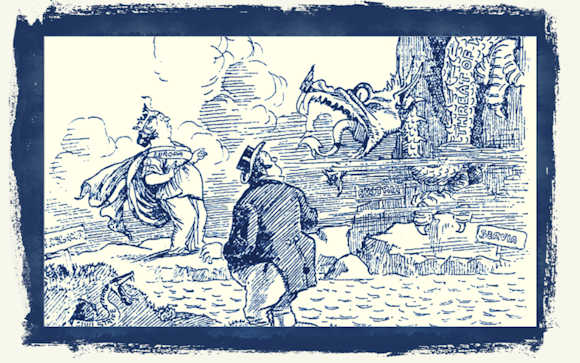
Threat of War Over Serbia


Stock Character "Pepper" Victorious at the Somme
(Inspiration for Sgt. Pepper?)

His cartoons during the war are uniformly patriotic and supportive of the war, unforgivingly anti-German, and explicitly encouraging of Welsh support of the Allies. Few seem to be explicitly tragic, and many of them have a humorous aspect ranging from caustic and sarcastic to  a  Bairnsfather-like sympathy for the Tommies' plight. In this article I've included but a few specimens of his work I've found online.


After the Dardanelles—Churchill's Career Set Adrift


The Kaiser as a Gutter Artist

Staniforth created over 1300 cartoons for the Western Mail from 1914 to 1918, providing a unique and fascinating insight into how the war unfolded on the Welsh Home Front. Over 400 of his wartime cartoons have been archived with additional commentary at Cartooning the First World War HERE. 


The Russian's Have an Early Success in Galicia


Sources: Passports to Oblivion: J.M. Staniforth’s Political Cartoons for the News of the World, 1893–1921; Imperial War Museum; People's Collection of Wales


Saturday, February 3, 2024

D.W. Griffith in the Trenches


Hearts of the World (also known as Love's Struggle) was a 1918 American silent World War I propaganda film written, produced and directed by D. W. Griffith. In an effort to change the American public's neutral stance regarding the war, the British government contacted Griffith due to his stature and reputation for dramatic film making. 

Hearts of the World stars Lillian and Dorothy Gish and Robert Harron. The film, produced by D.W. Griffith Productions, Famous Players–Lasky Corporation, and the War Office Committee, was distributed by Paramount Pictures under the Artcraft Pictures Corporation banner.

The British Government gave D.W. Griffith unprecedented access to film in locations that were otherwise forbidden to journalists. After being presented to George V and Queen Mary, Griffith was introduced to members of London's aristocracy who agreed to appear in the film. Among them were Lady Lavery, Elizabeth Asquith (later Princess Bibesco), Lady Diana Manners. Playwright Noël Coward also appeared as an extra.


Griffith (Bow Tie) in a Recently Damaged Trench


Exterior shots were largely filmed throughout England from May to October 1917. Griffith made two trips to France where he filmed footage of the trenches. In one instance Griffith and his film crew were forced to take cover when their location came under German artillery fire; he escaped unscathed.


The full movie can be viewed here:


Sources:  Wikipedia and YouTube

Friday, February 2, 2024

Étretat—Seaside Resort and Military Hospital Center


Étretat Today


Étretat is a beautiful seaside French village on the northern edge of Normandy that is believed to have been first settled by the Vikings. Famous for the brilliant white cliffs that bracket the small inlet where it sits, Étretat saw service in  World War I as a hospital center for the British and American Armies, and for the French Army in the Second. Most significantly, in the Great War the community served as the site of British No.1 General Hospital from December 1914 until December 1918. Later, one of the first U.S. medical units to reach France in 1917, Base Hospital No. 2, staffed by New York's Presbyterian Hospital and Columbia University, was stationed at Étretat. In the Second World War, French medical units were stationed in the area until the surrender to German forces.


By Claude Monet


Long mainly a  fishing village, pre-WWI Étretat became a magnet for the creative set. Eugène Delacroix, Claude Monet, and Henri Matisse painted the pebble beach and cliffs, drawing numerous fellow artists to the area.  Author Guy de Maupassant spent most of his childhood in Étretat and later set some of his stories there. Composer Jacques Offenbach escaped Paris at his “Villa d'Orphée.” As word and images of Étretat's beauty spread, a tourism trade started growing. Hotels and  a rail extension to the shore were added to support the new industry. It was this tourism infrastructure that made Étretat an attractive site for a military hospital.


One of the Hotels Used for Hospital Wards


Ambulances Passing through the Town Center


Temporary YMCA Hut

It's probably inaccurate to say there was a hospital "located at Étretat" during the First World War. It's more like  the town became a hospital. Facilities were placed in the resort's various hotels, public buildings, and temporary structures. For such an important asset, there's surprisingly little in the way of documentation on how this was planned and executed. I've found, however, secondary sources referencing at least two major hotels that served as the wards for British officers and enlisted men,  a third hotel used as a hospital by the Yanks when they arrived, a huge bathing complex, housing for the doctors, nurses, and support staff, messes and club houses, an ambulance depot, and so forth. There's little in the way of statistics for either the patients or the staffing and support manpower, though. Prewar and in the present day, Étretat's permanent population historically hovers between 1,200 and 1,600. That number, of course, swells during tourism season, and probably did to a much greater level during World War I with all the military personnel assigned there or passing through. In any case, Ã‰tretat was a crowded, bustling place in wartime. Nothing like the quaint vacationing site it was before or after the wars of the 20th century.


The war service of the village is well remembered today locally.  A commemorative plaque is mounted in Place Maréchal Foch. Further inland in the Étretat churchyard are two Commonwealth War Graves cemeteries, built after the Great War. They hold 546 Commonwealth burials from the First World War, four from the Second World War, and 13 German graves.


Sources: Bulletin of the Western Front Association, August 1914; Edith Elizabeth Appleton O.B.E. R.R.C. — A Nurse at the Front, The Wartime Memories Project, Scarletfinders, and various tourism sites


Thursday, February 1, 2024