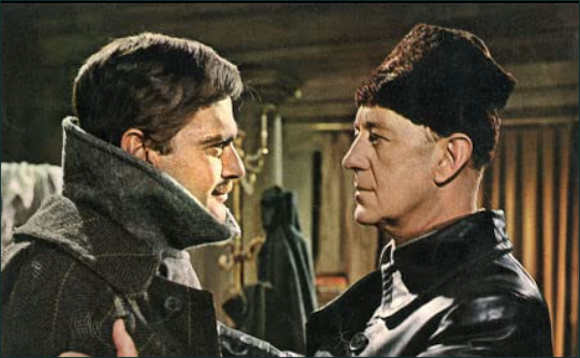
Now all roads lead to France and heavy is the tread
Of the living; but the dead returning lightly dance.
Edward Thomas, Roads

Monday, December 9, 2024

The Square Division—Basic Fighting Unit of the AEF


President Wilson and General Pershing Review the  Assembled 26th Yankee Division, Christmas Day 1918

The U.S. Army first used divisions during the Revolutionary War as administrative commands and only much later did they evolve into semipermanent tactical organizations. Divisions used during the War of 1812 tended to be ad hoc formations. In the mid–nineteenth century the division began to mature as an organizational concept and significant operational and strategic instrument. Being greatly influenced by the Napoleonic hallmark of dividing armies into divisions—the first modern independent field maneuver units—General Winfield Scott first organized American troops into divisions for the purpose of flanking operations during the Mexican War in the 1840s.

Divisions were later used prominently in the American Civil War, but peacetime divisions would not come into existence until early in the next century. The U.S. Army then followed the examples of the large European armies, which had adopted permanent division designs by the 1890s.


Officers of the 34th "Red Bull" Division

The first U.S. Army division of the 20th century was conceived not necessarily with combat power in mind, but primarily as an administrative formation used to aid mobilization. Its roots lie in an effort to improve training procedures and the speed of assembly. America’s experience in its war with Spain in 1898 spurred a rethinking among the Army’s bolder leaders of its organization for fighting.

Secretary of War Henry Stimson and Army Chief of Staff General Leonard Wood also wished to eliminate the many small posts inherited from the constabulary and Indian fighting days and reorganize the Army into larger garrisons. At the very least, Wood and Stimson believed that they should form temporary troop concentrations on paper that would aid mobilization purposes. The so-called “Maneuver Division” was formed at San Antonio, Texas, in March 1911. This grouping gave officers experience handling large bodies of men and permitted testing and experimentation with new Signal Corps equipment, such as telegraph and wireless telegraph sets (radios) and airplanes. The shortcomings of the resulting undermanned and unprepared Maneuver Division later gave Army leaders the ammunition to call for an improved organization of the Army as a whole. Stimson subsequently called on the U.S. Army War College to plan for the tactical reorganization of the Army into a permanent, division - based organization.

In early 1913, Stimson persuaded the Army’s general officers of the merits of the divisional plan, and the reorganization of the Army into four divisions soon followed. These divisions consisted of three infantry brigades, a cavalry regiment, an engineer battalion, a signal company, and four field hospitals. The wisdom of the new plan soon became evident as the Mexican Revolution threatened to spill over the Rio Grande. What once required scores of orders now required only one, and with that the 2nd Division commanded by Brigadier General Frederick Funston at Texas City and Galveston was mobilized.

The Army’s first permanent division was organized on 8 June 1917, as the 1st Expeditionary Division. During the mobilization for American involvement in World War I, U.S. Army leaders noted the Allies’ experiences and reorganized the division design with a new approach to two traditional Army hallmarks, mobility and firepower.

The Americans did not want to get bogged down as the French and British had and designed and trained their forces to break the stalemates prevalent on the Western Front. Maintaining the momentum of attacks through sustained firepower was placed at a premium. While the Americans retained an open warfare style that had been abandoned by their allies, mobility was not a key consideration for organizing.

In Maneuver and Firepower, Wilson states that Chief of Staff Major General Hugh L. Scott originally leaned toward a smaller square division of about 13,000 men to facilitate mobility and the exchange of men on the line. Following British and French recommendations, a subsequent study conducted at the War College led to a division of nearly 19,000 men (including more than 10,000 infantrymen) that resembled the French square division, enlarging the regiments by reducing their number from nine to four, and slashing the amount of cavalry significantly. The Allies felt that cavalry had little utility in trench warfare, while horses and fodder would take up too much valuable shipping space. General John J. Pershing and Colonel Chauncey Baker later altered the underlying assumptions of division organization: instead of facilitating the movement in and out of the trenches, the division should be organized and sized to fight prolonged battles. They felt that the Allies would have increased the size of their divisions had they the luxury of abundant manpower. An infantry company was restored to each battalion, bringing the total to four in each, while augmentations to machine gun assets brought the U.S. Army square division to more than 27,000 men.


Single Infantry Company of the 36th Texas-Oklahoma Division

Pershing was also an unabashed fan of the American soldier, believing that with innate American initiative and more divisional combat power, he could succeed where the Allies had failed. In his book Fast Tanks and Heavy Bombers (Ithaca, NY: Cornell University, 1998), David E. Johnson notes that Pershing felt American officers and infantrymen were superior to those of the tired Allies. Johnson adds that, unlike the Allies, the Americans still believed in the inherent power of the infantry charge with fixed bayonet, and they were successful with this “open warfare” doctrine—contrary to the British, French, and German experiences—only because of prevailing conditions on the Western Front that were conducive to such an approach. Meanwhile, infantry-artillery coordination was not yet smooth enough to engender effective maneuver: communications between infantry and artillery were still rudimentary, and artillery itself was not yet mobile enough to keep up with infantry advances.

Traditional American tactical inclinations toward mobility and open warfare were made moot because of certain technological aspects of the battlefield in World War I, notably the machine gun and the limitations on effective artillery due to poor self-mobility and archaic methods of communication. The Army may have had a predilection for a more mobile style of warfare, but without effective artillery fire to support maneuver, the infantry was constrained to move slowly

The pre-World War I triangular design was deemed insufficient, lacking enough flexibility, control, and sustainable combat power. De-emphasizing mobility and maneuver, the division was to be bulked up and reorganized to fight prolonged battles in sustained frontal attacks.11 While not totally abandoning mobility, this cornerstone of U.S. Army warfare was sacrificed somewhat in the interest of firepower needed to penetrate German defenses and exploit breakthroughs. The commander of the American Expeditionary Force, General John J. Pershing, fixed the division at 979 officers, 27,082 men (about 40,000 all told, including support personnel).

Pershing created this division—which was more than twice the size of its European counterpart—to “achieve a capacity for sustained battle which would ensure that American divisions would not falter short of their objectives as British and French divisions so often had done.” A division with fewer but larger regiments would facilitate a more reasonable span of control and battle momentum. Similar to—albeit larger than—early European “square” designs, the American square division consisted of two infantry brigades of two regiments each, one field artillery brigade (two 75mm regiments, one 155mm regiment), an engineer regiment, a machine gun battalion, a signal battalion, and division supply, and sanitary trains. Each infantry regiment had a strength of 112 officers and 3,720 men formed into three battalions and one machine-gun company. Each battalion consisted of four companies of six officers and 250 men each.


First Artillery Brigade of the 1st Division, 1919

Although it possessed tremendous firepower, this division could not fully capitalize on its assets and was also hindered by insufficient numbers of combat service support troops and equipment. Coordination between infantry and artillery was poor, hampered by unreliable communications equipment and the inability to keep track of the movement of infantry units in the offensive. Successful offensives were thereby slowed tremendously. A shortage of personnel and equipment specifically reserved for general logistical requirements, medical evacuation, and transporting rations and the dead further slowed the advance. In short, the square division lacked coordination and was unwieldy and difficult to support logistically.

The interwar period would prove to be important for incorporating lessons learned from World War I into the division design. Chief among them was the fact that greater coordination among the combat arms and support was required to enhance combat effectiveness. Advances in weapons, communications, and transportation technology were needed to improve the division’s lethality, while properly integrating the advances into Army formations and operations was equally important.

Immediately after the war, many veteran officers recommended that the Army retain the square divisional structure. General Pershing objected, believing that these evaluations came too soon after the conflict and were heavily influenced by the special circumstances of the Western Front. He favored a division that was much more mobile and flexible and proposed a design possessing a single infantry brigade of three infantry regiments, an artillery regiment, a cavalry squadron, and combat support and combat service units. Time and distance factors were paramount: “The division should be small enough to permit its being deployed from . . . a single road in a few hours and, when moving by rail, to permit all of its elements to be assembled on a single railroad line within twenty-four hours; this means that the division must not exceed 20,000 as a maximum.”

The debate over the divisional structure was framed by the assumption that North America would be the theater in which it would most likely be deployed. The static battlefield, characteristic of World War I in Western Europe, was viewed as a thing of the past as “technological advances in artillery, machine guns, and aviation made obsolete stabilized and highly organized defensive lines whose flanks rested on impassable obstacles, such as those encountered on the Western Front.”


The Decks of the Returning USS Agamemnon Holding
Only a Portion of the 26th Yankee Division


However, despite Pershing’s preference for a much smaller and flexible division of three regiments, two prominent redesign efforts, the Superior Board (1919) and Lassiter Committee (1920), recommended square designs. In answering the call to increase mobility, the division was cut in size by reducing from four to three both the number of platoons in infantry companies and the number of companies in battalions; 155mm howitzers and some support troops were also eliminated. It is interesting to note that the Lassiter Committee wished to retain the brigade-based square division in part because a triangular design would have eliminated the brigade command billets filled by brigadier generals. The reduced square division was tentatively approved by Army Chief of Staff General Peyton March in August 1920 at 19,385 men and grew to 19,997 men a year later. Pershing, who was to become chief of staff soon after, may have ultimately acceded to a smaller square design because he wished to avoid embarrassment: many of his own officers had recommended the square design while serving on the Superior Board. At the same time, following much criticism for the bloated and unwieldy 1917 design, the postwar cavalry division was radically reduced from approximately 18,000 men to 7,463.

Sources: Excerpted from Chapters 2 & 3 of Evolution and Endurance: The U.S. Army Division in the Twentieth Century, Richard W. Kedzior at the Rand Corporation Website.


Sunday, December 8, 2024

December 1918: Woodrow Wilson's Feverish Welcome in Europe


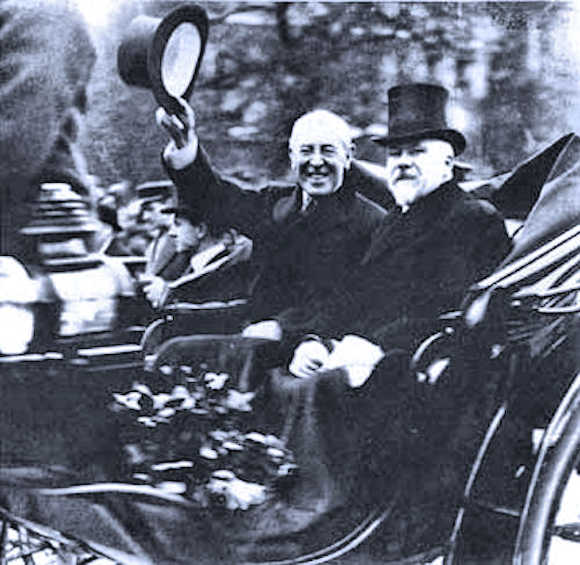
President Wilson and French President Poincaré, Paris
14 December 1918

On 4 December 1918, President Woodrow Wilson departed from Washington to embark on the first European trip by an American chief executive. After nine days at sea aboard the S.S. George Washington, a German-built passenger liner interned in New York at the start of World War I, Wilson arrived in Brest, France, and traveled to Paris.

The German magazine Der Spiegel described the reception he received in Paris:

As a man who was promising freedom, self-determination and eternal peace, it was no surprise that he was welcomed and celebrated as a savior in Europe. Herbert Hoover, who would later become president and managed food exports to Europe under Wilson, wrote: "Woodrow Wilson had reached the zenith of intellectual and spiritual leadership of the whole world, never hitherto known in history."

His first stop was Paris. Edith Wilson, who was at her husband's side, as always, could hardly believe what she saw, noting: "Paris was wild with celebration. Every inch was covered with cheering, shouting humanity. The sidewalks, the buildings, even the stately horse-chestnut trees were peopled with men and boys perched like sparrows in their very tops. Roofs were filled, windows overflowed until one grew giddy trying to greet the bursts of welcome that came like the surging of untamed waters."

The loyal Hoover was equally enthusiastic, writing: "No such man of moral and political power and no such an evangel of peace had appeared since Christ preached the Sermon on the Mount. It was the star of Bethlehem rising again."


The Lord Mayor of London Escorts the President on
His Official Welcome to the City

Christmas day he traveled to AEF General Headquarters at Chaumont for his only official contact with the troops during his time in Europe. He was greeted by General Pershing on his arrival, visited the soldiers in their quarters, and was treated to a Presidential Review of the 26th Yankee Division, which was quartered nearby.

After his initial visit and meetings in France, the President visited the other major Allies' homelands. He visited with Prime Minister Lloyd George and King George V and toured Great Britain between the holidays, returned to Paris for the New Year, and then left for a week in Italy, where he received another stunning welcome. During this time Wilson met with King Vittorio Emanuele III and Prime Minister Orlando and had an audience with Pope Benedict XV at the Vatican.


President Wilson with King Vittorio Emanuele III in Rome

From Der Spiegel:

The Wilsons' second stop was London. They had been warned that the British would undoubtedly behave with more reserve during the first official visit of an American president. Prime Minister Lloyd George viewed Wilson with some mistrust, rightfully assuming that this new power posed a greater threat to the future of the British Empire than the German Empire had ever done. Nevertheless, Wilson was greeted with as much applause in London as on the streets in Paris. Shortly after they had arrived in their rooms in Buckingham Palace, King George V and Queen Mary sent a message to the presidential couple that the crowd outside the palace had grown so large that they would have to make a joint appearance on the balcony.

Rome, stop three, was the apotheosis. The Wilsons were showered with white roses. Wilson's bodyguard, Secret Service agent Edmund Starling, wrote: "The reception in Rome exceeded anything I have ever seen in all my years of witnessing public demonstrations. The people literally hailed the President as a god – the God of Peace."

Afterward, President Wilson returned to Paris for the start of the peace conference, little realizing that his popularity, influence, and reputation had crested and were soon to decline dramatically.

Sources: "WWI and America's Rise as a Superpower," Der Spiegel Online, 24 January 2014; the National Archives


Saturday, December 7, 2024

It Was the Elites That Brought On the Great War (and Some Recent Great Disasters That Followed)—A Roads Classic

Found on Wikileaks

Failing elites threaten our future. Leaders richly rewarded for mediocrity cannot be relied upon when things go wrong. MW


The Congress of Vienna 1815
Gathering of Elites to Deal With Napoleon


By Martin Wolf, the Financial Times

In 2014, Europeans commemorate[d] the 100th anniversary of the start of the First World War. This calamity launched three decades of savagery and stupidity, destroying most of what was good in the European civilisation of the beginning of the 20th century. In the end, as Churchill foretold in June 1940, “the New World, with all its power and might,” had to step “forth to the rescue and the liberation of the old.”

The failures of Europe’s political, economic and intellectual elites created the disaster that befell their peoples between 1914 and 1945. It was their ignorance and prejudices that allowed catastrophe: false ideas and bad values were at work. These included the atavistic belief,  not just that empires were magnificent and profitable, but that war was glorious and controllable. It was as if a will to collective suicide seized the leaders of great nations.

Complex societies rely on their elites to get things, if not right, at least not grotesquely wrong. When elites fail, the political order is likely to collapse, as happened to the defeated powers after First World War. The Russian, German, and Austrian empires vanished, bequeathing weak successors succeeded by despotism. The First World War also destroyed the foundations of the 19th-century economy: free trade and the gold standard. Attempts to restore it produced more elite failures, this time of Americans as much as Europeans. The Great Depression did much to create the political conditions for the Second World War. The Cold War, a conflict of democracies with a dictatorship sired by the First World War, followed.

The dire results of elite failures are not surprising. An implicit deal exists between elites and the people: the former obtain the privileges and perquisites of power and property; the latter, in return,obtain security and, in modern times, a measure of prosperity. If  elites fail, they risk being replaced. The replacement of failed economic, bureaucratic, and intellectual elites is always fraught. But, in a democracy, replacement of political elites at least is swift and clean. In a despotism, it will usually be slow and almost always bloody.

This is not just history. It remains true today. If one looks for direct lessons from the First World War for our world, we see them not in contemporary Europe but in the Middle East, on the borders of India and Pakistan and in the vexed relationships between a rising China and its neighbours. The possibilities of lethal miscalculation exist in all these cases, though the ideologies of militarism and imperialism are, happily, far less prevalent than a century ago. Today, powerful states accept the idea that peace is more conducive to prosperity than the illusory spoils of war. Yet this does not, alas, mean the West is immune to elite failures. On the contrary, it is living with them. But its failures are of mismanaged peace, not war.

Here are three visible failures [in the 21st century].

First, the economic, financial, intellectual, and political elites mostly misunderstood the consequences of headlong financial liberalisation. Lulled by fantasies of self-stabilising financial markets, they not only permitted but encouraged a huge and, for the financial sector, profitable bet on the expansion of debt. The policy-making elite failed to appreciate the incentives at work and, above all, the risks of a systemic breakdown. When it came, the fruits of that breakdown were disastrous on several dimensions: economies collapsed; unemployment jumped; and public debt exploded. The policy-making elite was discredited by its failure to prevent disaster. The financial elite was discredited by needing to be rescued. The political elite was discredited by willingness to finance the rescue. The intellectual elite—the economists—was discredited by its failure to anticipate a crisis or agree on what to do after it had struck. The rescue was necessary. But the belief that the powerful sacrificed taxpayers to the interests of the guilty is correct.

Second, in the past three decades we have seen the emergence of a globalised economic and financial elite. Its members have become ever more detached from the countries that produced them. In the process, the glue that binds any democracy—the notion of citizenship—has weakened. The narrow distribution of the gains of economic growth greatly enhances this development. This, then, is ever more a plutocracy. A degree of plutocracy is inevitable in democracies built, as they must be, on market economies. But it is always a matter of degree. If the mass of the people view their economic elite as richly rewarded for mediocre performance and interested only in themselves, yet expecting rescue when things go badly, the bonds snap. We may be just at the beginning of this long-term decay.

Third, in creating the euro, the Europeans took their project beyond the practical into something far more important to people: the fate of their money. Nothing was more likely than frictions among Europeans over how their money was being managed or mismanaged.  The probably inevitable financial crisis has now spawned a host of still unresolved difficulties. The economic difficulties of crisis-hit economies are evident: huge recessions, extraordinarily high unemployment, mass emigration, and heavy debt overhangs. This is all well known. Yet it is the constitutional disorder of the eurozone that is least emphasised. Within the eurozone, power is now concentrated in the hands of the governments of the creditor countries, principally Germany, and a trio of un-elected bureaucracies—the European Commission, the European Central Bank, and the International Monetary Fund. The peoples of adversely affected countries have no influence upon them. The politicians who are accountable to them are powerless. This divorce between accountability and power strikes at the heart of any notion of democratic governance. The eurozone crisis is not just economic. It is also constitutional.

None of these failures matches in any way the follies of 1914. But they are big enough to cause doubts about our elites...

Friday, December 6, 2024

March 1913–A Time of Foreboding in the Balkans


Serbian poster, depicting King Alexander I
beating the losing Bulgarian ruler, Tsar Ferdinand I


March 1913 saw the end of fighting in the First Balkan War. But this did not lead immediately to peace and stability in the region. It required pressure from the Great Powers towards Greece and Serbia, who had postponed signing in order to fortify their defensive positions, the signing of the Treaty of London took place on 30 May 1913. With this treaty, the war between the Balkan Allies and the Ottoman Empire came to an end.  One of the victors—Bulgaria—would be unhappy with its share of the spoils and would soon precipitate a second regional war. As one astute war correspondent (the name Leon Trotsky should ring a bell) observed, "The Balkan war has not only destroyed the old frontiers in the Balkans, it has also lastingly disturbed the equilibrium between the capitalist states of Europe." The soon-to-be successful revolutionary was spot on. 

The successes and subsequent expressions of independence by the victorious Balkan states should have alarmed their sponsors, who had taken for granted that they were positioned to manipulate events in the region to their own advantage. As further events would show, their ability to control their proxies in the Balkans had declined much more than they realized.


George I of Greece

The ominous assassination of much-admired King George I of Greece on 18 March at the hand of a derelict socialist during a visit to recently liberated Salonika was an alarm bell in the night, as well. It would prove detrimental to Greek politics, and it certainly reminded would-be regicides of the vulnerability of royals and heads of governments while traveling. Mr. Princip and his Black Hand sponsors were surely watching.

Thursday, December 5, 2024

A Dozen World War One Cartoons from the Library of Congress Collection


Click on Images to Enlarge


Mexican Friendship
William A. Rogers


Marne, the Club Blow
Félix Lacaille


Henry Ford's Peace Ship
Kenneth Russell Chamberlain


Remember the Little Lost Children of the Lusitania
William Allen Rogers


The Zimmerman Telegram
Cifford K. Berryman


Rising Food Prices
Cifford K. Berryman


[Anti-] Conscription
Henry Glintenkamp


This [Espionage &Sedition Acts] Must Not Be!
Winsor McCay


Two Winters:
Washington 1917, Valley Forge 1777

Oscar Cesare


The Girth of a Nation [Governmental Growth]
Nelson Harding


Putting It Across
Everett Lowry


Postwar Unemployment
American Legion Cover, 1922


Wednesday, December 4, 2024

Remembering a Veteran: Colonel Richard Meinertzhagen, Royal Fusiliers


Richard Meinertzhagen


Col. Richard Meinertzhagen CBE DSO (1878-1967) was a Harrovian, like Winston Churchill, and one of the swashbuckling characters Churchill admired. A soldier, intelligence officer and ornithologist, he had a prominent military career in Africa and the Middle East. Meinertzhagen has come in for criticism over the years, most recently by revisionist historians. 


The Soldier

Early in the Great War, Meinertzhagen was posted to the intelligence staff of the British Indian Expeditionary Force. His map-making skills were much valued and recognized, though his assessments of the strength of the German Schutztruppe and other contributions to the conduct of the Battle of Tanga and the Battle of Kilimanjaro were a complete miss.  From January 1915 through August 1916, Meinertzhagen served as chief of British military intelligence for the East Africa theatre at Nairobi. He was awarded the Distinguished Service Order in February 1916.  In November of that year General J.C. Smuts ordered him invalided to England.

After recovering, in 1917, he was transferred to Gaza and later  credited himself with the famous “Haversack Ruse.” [Article Here.] During the Sinai and Palestine Campaign, according him, he let a haversack containing false British battle plans fall into Ottoman military hands, resulting in a British victory in the Battle of Beersheba and Gaza. As an intelligence officer and advisor to Allenby, Meinertzhagen played a key role in the capture of Jerusalem in December 1917.

From the spring of 1918 until August, he commuted between England and France, delivering lectures on intelligence to groups of officers – then was assigned full-time to France at GHQ. After the armistice, he attended the Paris Peace Conference in 1919 and was Edmund Allenby's chief political officer, involved in the creation of the Palestine Mandate, which eventually led to the creation of the state of Israel.

Some biographers trumpeted his achievements; later ones call him a fraud and a charlatan and accused him of lying to enhance his reputation, especially in his multi-volume diary.

Erroneously presumed to be Jewish because of his staunch pro-Zionist views, Meinertzhagen in 1921 was appointed by Churchill as military adviser to the Middle East Department, which Churchill organized to administer British occupied areas of the former Ottoman Empire. He took a diffident attitude toward his fellow Harrow Old Boy, saying Churchill fancied himself the Duke of Marlborough and “had to be managed,” which he claimed he knew how to do. He would sometimes shoot from the hip, drawing a rebuke from his boss:

Please caution Colonel Meinertzhagen that he is not to express to the War Office opinions in regard to military matters contrary to my policy. Yesterday the Secretary of State for War told me that Colonel Meinertzhagen was quite agreeable to the removal of the armoured cars from Trans-Jordania. I have definitely forbidden this, and it is wrong for any officer in the department to give to other departments opinions contrary to my decisions. 


The Serious Ornithologist Somewhere in Africa, 1915


​Advisor and supporter

The pro-Zionist Meinertzhagen nursed a mutual dislike for the pro-Arab Lawrence, but the two were alike in making enemies by challenging the status quo among the military and officialdom. He was a brave and valiant officer who often gave Churchill sound advice, such as avoiding support for the post-World War I Greek invasion of Smyrna (modern-day Izmir), Turkey in May 1919:

In reviewing our position in Mesopotamia it is impossible to blind ourselves to the whole political and military problem in the Near East. The solution seems to lie in the following proposal: Mustafa​ [Kemal, the Turkish leader]​ knows our difficulties at home, in Mesopotamia and in Constantinople. He is more than alive to Greek political ferment and military impotence. It is of no use attempting to throw dust in his eyes on thes​e​ accounts. I submit that we, hand in hand with the French, should at once get into touch with him and entirely repudiate the Greek occupation ​of Smyrna.


​Palestine and Trans-Jordan

Meinertzhagen was solidly behind Churchill on the concept of a Jewish National Home in Palestine. There Britain ran a League of Nations mandate following the collapse of the Ottoman Empire. Norman Rose offers an accurate summary of the little-recognized “first partition of Palestine.” This was undertaken by Churchill, with the support of Meinertzhagen, in 1921:

[Prime Minister] Lloyd George, however, was in no mood to relinquish any British gains from the war. And once it became clear that Britain was in Palestine (and Iraq) to stay, Churchill applied himself to the consolidation of British rule in those areas with all the energy and vision of which he was capable. At the time, he was under tremendous pressure to revise Britain’s Zionist commitment. An anti-Zionist campaign, laced with strong doses of anti-semitism, was underway in the press, Parliament, and government. Richard Meinertzhagen detected a distinct “hebrewphobe” atmosphere emanating from the Colonial Office, while Churchill admitted to his friend, Chaim Weizmann, the Zionist leader, that nine-tenths of the British officials in Palestine were anti-Zionist.

Churchill’s axe fell as heavily upon Palestine as elsewhere. At Cairo, he set up the emirate of Transjordan. As he later elaborated, “the Emir Abdullah is in Trans-jordan where I put him one Sunday afternoon.” This was the first partition of mandatory Palestine. But Churchill was faithful to Britain’s Zionist obligation, anchored in the vague phrases of Balfour’s declaration. To the Arabs, he defended Britain’s Zionist oriented policy. He made it abundantly clear that “we cannot abandon to Arab fanaticism Jewish efforts.”

In the Second World War, Meinertzhagen, was recalled to the colors, serving mainly as what is known as a "public affairs" officer.

[In researching this article, I've found that Richard Meinertzhagen, created a lot of enemies in his life. There is a flood of published accusations that he was a liar, scientific fraudster, fantasist, glory-seeker, bully, forger, and murderer.  I don't have time to research all the accusations and, as far as I can tell, what's included in this article is well-supported. MH]


Sources: The Churchill Project of Hillsdale College, December 2015; WikiCommons

Tuesday, December 3, 2024

Attacked by Flamethrowers


German Flamethrower Team

I don't know of a better, or more terrifying, description of what it was like to be attacked by flamethrowers than that contained in Generals Die in Bed. The novel, written by Canadian veteran Charles Yale Harrison, was published in 1930. Critics at the time considered it one of the finest of the war's semi-autobiographical antiwar treatments.

They are coming! We look behind us. They have laid down a barrage to cut us off. We are doomed. Anderson jumps from his gun and lies groveling in the bottom of the shallow trench. I tell Renaud to keep firing his rifle from the corner of the bay. Broadbent takes the gun and I stand by feeding him with what ammunition we have left. They are close to us now.

They are hurling hand grenades. Broadbent sweeps his gun but still they come. The field in front is smothered with grey smoke. I hear a long-drawn-out hiss. Ssss-s-sss!

I look to my right from where the sound comes. A stream of flame is shooting into the trench. Flamenwerfer! Flame-throwers! In the front rank of the attackers a man is carrying a square tank strapped to his back. A jet of flame comes from a nozzle which he holds in his hand. There is an odor of chemicals. Broadbent shrieks in my ear: "Get that bastard with the flame." I take my rifle and start to fire. Broadbent sweeps the gun in the direction of the flame-thrower also. Anderson looks nervously to the rear. "Grenades," I shout to him. He starts to hurl bombs into the ranks of the storm troops.

Odor of burning flesh. It does not smell unpleasant. I hear a shriek to my right but I cannot turn to see who it is. We continue to fire towards the flame-thrower. Broadbent puts a fresh pan on the gun. He pulls the trigger. The gun spurts flame. He sprays the flame-thrower. A bullet strikes the tank on his back. There is a hissing explosion. The man disappears in a cloud of flame and smoke.

To my right the shrieking becomes louder. It is Renaud. He has been hit by the flame-thrower. Flame sputters on his clothing. Out of one of his eyes tongues of blue flame flicker. His shrieks are unbearable. He throws himself into the bottom of the trench and rolls around trying to extinguish the fire. As I look at him his clothing bursts into a sheet of flame. Out of the hissing ball of fire we still hear him screaming. Broadbent looks at me and then draws his revolver and fires three shots into the flaming head of the recruit. The advance is held up for a while. The attackers are lying down taking advantage of whatever cover they can find. They are firing at us with machine guns.

Click Here to Order This Book


Monday, December 2, 2024

Memorable Dialog from WWI Movies — A Roads Classic


From All Quiet on the Western Front


Tjaden: Well, how do they start a war?

Soldier #1: Well, one country offends another.

Tjaden: How could one country offend another? You mean there's a mountain over in Germany gets mad at a field over in France?

Soldier #1: Well, stupid. One people offends another.

Tjaden: Oh, that's it. I shouldn't be here at all. I don't feel offended.


From La Grande Illusion


Capt. von Rauffenstein: A 'Maréchal' and 'Rosenthal,' officers?

Capt. de Boeldieu: They're fine soldiers..

Capt. von Rauffenstein: Charming legacy of the French Revolution

Capt. de Boeldieu: Neither you nor I can stop the march of time.

Capt. von Rauffenstein: Boldieu, I don't know who will win this war, but whatever the outcome, it will mean the end of the Rauffensteins and the Boeldieus.

Capt. de Boeldieu: We're no longer needed.

Capt. von Rauffenstein: Isn't that a pity?

Capt. de Boeldieu: Perhaps.


From Sergeant York


Alvin York: Well I'm as much agin' killin' as ever, sir. But it was this way, Colonel. When I started out, I felt just like you said, but when I hear them machine guns a-goin', and all them fellas are droppin' around me... I figured them guns was killin' hundreds, maybe thousands, and there weren't nothin' anybody could do, but to stop them guns. And that's what I done.


From Doctor Zhivago


Yevgraf Zhivago: In bourgeois terms it was a war between the Allies and Germany. In Bolshevik terms it was a war between the Allied and German upper classes—and which of them won was a matter of indifference. . . They [the warring powers] were shouting for victory all over Europe—praying for victory to the same God. My task—the Party's task—was to organize defeat. From defeat would spring the Revolution...and the Revolution would be victory for us.


From The Blue Max


Von Klugermann: Well, aren't you coming [to the enemy pilot's funeral]? It's an order.

Stachel: Why?

Von Klugermann: Because our commanding officer has made it one. He believes in chivalry, Stachel..

Stachel: Chivalry? To kill a man, then make a ritual out of saluting him—that's hypocrisy. They kill me, I don't want anyone to salute

Von Klugermann: They probably won't..


From Lawrence of Arabia


Prince Feisal: The English have a great hunger for desolate places. I fear they hunger for Arabia..

Lawrence: Then you must deny it to them.

Prince Feisal: You are an Englishman. Are you not loyal to England?.

Lawrence: To England and to other things. 

Prince Feisal: To England and Arabia both? And is that possible? I think you are another of these desert-loving English.


Sunday, December 1, 2024

Today I found in Mametz Wood a certain cure for lust of blood—The Brutality of War Well Documented


Mametz Wood Today, Welsh Dragon Memorial in Foreground
Click on Image to Enlarge


Background

The 38th (Welsh) Division was recruited from battalions of the Welsh Regiment, South Wales Borderers, and Royal Welsh Fusiliers in 1914. Lloyd George had a heavy hand in the raising of the formation, one of his sons being an officer in the division. It crossed to France in late 1915 and came down to fight on the Somme in July 1916. The first attack on Mametz Wood was on 7 July, when the division lost heavily in "Death Valley" during the advance on the "Hammer Head." The next attack went in on the 10th, and by 14 July the wood was cleared—but at the cost of over 4,000 casualties in the 38th (Welsh) Division: 565 were killed, 585 reported as missing, and 2,893 wounded.

A famous memorial was placed in Mametz Church in the 1920s, but this Red Dragon monument was relocated to a site overlooking the woods in the late 1980s per the wishes of a number of Mametz Wood veterans. It one of the "places of pilgrimage" on the old Somme battlefield.

The action at Mametz was a grim one, but not singularly so by the standards of the Great War.  It is, however, especially well remembered because the Welsh division contained a remarkable number of soldiers with literary (and artistic) gifts.  Its ranks contained numerous diarists, letter writers, memoirists, and poets, who were deeply affected by their experience. Furthermore, other formations fighting in same zone at the same time contained some of the best-known writers of the war.  

A collection of  the reflections these soldiers, who were either members of the 38th Division or who served in proximity to Mametz Wood  make up the substance of this article. I've tried to find some similar selections from the German defenders but have drawn a blank, even from Jack Shelton's valuable The German Army on the Somme.   

Most interesting to me about this selection is their uniformity. Collectively, they make one of the most powerful statement about the brutality of war, I've come across. I think the quote in the title from Robert Graves's 1917 poem "Dead Boche" nicely introduces these memories of the fighting at Mametz Wood.


Soldier-Poet-Artist David Jones's Vision of Mametz Wood


The Battle Proper

When questioned about how he felt in the middle of the terrible bombardment the young lieutenant, who is only 21 years of age, said: It has a most peculiar effect on you. You can’t describe adequately your feelings at hearing the continued deafening roar of the guns and the continuous rain of shells. . . Two days before the British took Mametz Wood the Boches peppered Mametz with ‘weeping’ shells [tear gas], and we had to put our goggles on. These shells give off a rather sweet smell, but they make tears come to the eyes, and eventually, if you don’t use your goggles, you get so bad that you cannot see.

News Article, Lieutenant W.R.M Gwynne, wounded at Mametz on 11 July


Friday evening, July 7, 1916 It continued to rain and in the dull atmosphere, Mametz Wood, which had already cost dearly, took on a more sinister appearance. It is known as the largest and thickest wood in the Somme area, and it has withstood repeated attacks. During the day its huge dark mass appeared impenetrable, while by night it lit up with shrapnel and heavy artillery and it seemed impossible that anyone could live there. 

Early Monday morning, July 10, 1916 Shortly after midnight the troops for the front line of the attack began to pass down to White Trench. Then the barrage dropped on Mametz Wood. The 16th Royal Welsh Fusiliers were in position in the sunken road about 3 am and whiled away the trying hour before the attack with banter and snatches of song. Someone had struck up Aberystwyth as the moment of going over drew near. When the singing finished Colonel Carden called for silence. He said: “Boys, make your peace with God. We are going to take that position and some of us won’t come back, but we are going to take it”.

News Article, Unidentified soldier of the 38th Division


From Epic Poem, In Parenthesis, Pvt. David Jones, wounded at Mametz


Hand-to-hand fighting and bombing took place throughout the wood. The wood was extraordinarily thick. The Germans had tied the branches of the trees together and it was extremely difficult to force a path through. Machine-guns were also hidden in the woodland on either side of the front of the wood. 

News Article, Unidentified officer of the Welsh Regiment


Equipment, ammunition, rolls of barbed wire, tins of food, gas-helmets and rifles were lying about everywhere. There were more corpses than men, but there were worst sights than corpses. Limbs and mutilated trunks, here and there a detached head, forming splashes of red against the green leaves, and, as in advertisement of the horror of our way of life and death, and of our crucifixion of youth, one tree held in its branches a leg, with its torn flesh hanging down over a spray of leaf. . . Even now, after all these years, this round ring of man-made hell bursts into my vision. Blue sky above, a band of green trees, and a ploughed graveyard in which living men moved worm-like in and out of sight; three men digging a trench, thigh-deep in the red soil, digging their own graves. A bursting shell turned their shelter into a tomb; two signallers crouched in a large shell hole, waiting for an order to move, but showing in their patient and tired inactivity the look of dead men ready to rise at the trump of a Last Judgement. 

Up to Mametz and Beyond, Captain Llewelyn Wyn Griffiths (Griffiths fought at Mametz and his brother was killed in the same battle.)


2015 Archeological Finds at Mametz Wood


After Action

The next two days we spent in bivouacs outside Mametz Wood.  We were in fighting kit and felt cold at night, so I went into the wood to find German overcoats to use as blankets.  It was full of dead Prussian Guards Reserves, big men, and dead Royal Welch and South Wales Borderers of the New Army battalions, little men.  Not a single tree in the wood remained unbroken.  I collected my overcoats, and came away as quickly as I could, climbing through the wreckage of green branches.  Going and coming, I passed by the bloated and stinking corpse of a German with his back propped against a tree.  He had a green face, spectacles, close-shaven hair; black blood was dripping from the nose and beard.  I came across two other unforgettable corpses: a man of the South Wales Borderers and one of the Lehr Regiment had succeeded in bayoneting each other simultaneously.  A survivor of the fighting told me later that he had seen a young soldier of the Fourteenth Royal Welch bayoneting a German in parade-ground style, automatically exclaiming" "In, out, on guard!"

Memoir, Goodbye to All That by Captain Robert Graves, Royal Welch Fusiliers, (Wounded shortly after this visit to Mametz)


Today, a Shell from the Battle Still Trapped 


The long-stretched agony of the week had scoured something out of every man in the column. [The soldiers' eyes are] dull and slow-moving, coated with a film that turned their opacity into a revelation of all the anguish that lay behind them. .  . Equipment, ammunition, rolls of barbed wire, tins of food, gas-helmets and rifles were lying about every where. There were more corpses than men, but there were worse sights than corpses. Limbs and mutilated trunks, here and there a detached head, forming splashes of red against the green leaves, and, as in advertisement of the horror of our way of life and death, and of our crucifixion of youth, one tree held in its branches a leg, with its torn flesh hanging down over a spray of leaf.

Up to Mametz and Beyond, Captain Llewelyn Wyn Griffiths 


As we went up the lane towards Mametz I felt that I was leaving all my previous war experience behind me. For the first time I was among the dĂ©bris of an attack. After going a very short distance we made the first of many halts, and I saw, arranged by the roadside, about fifty of the British dead. 

Memoirs of an Infantry Officer,  Capt. Siegfried Sassoon, 38th Division 


1917 Poem, Captain Robert Graves, Royal Welch Fusiliers


Other Sources: Archaeological Excavation Report, Mametz Wood, Somme. 2015; BBC; Cambrian Daily Leader; The First World War Education Project The National Library of Wales; Paul Reed's Somme Battlefield Website