Now all roads lead to France and heavy is the tread
Of the living; but the dead returning lightly dance.
Edward Thomas, Roads

Thursday, January 18, 2024

Recommended: Everything You Ever Wanted to Know About the Hawthorn Ridge Mines


Post-Exposion Plume of the 1 July 1916 Mine


A new study, published in the Journal of Conflict Archaeology, has been made available online titled "A multidisciplinary scientific investigation of the 1916 Hawthorn Mine Crater, Beaumont Hamel, Somme, Northern France."

While it is brimming with historical detail, this paper will be a delight for any of our readers with a scientific/technical bent. A few years ago, the site of two explosions at Hawthorn Ridge that marked the (premature) start of the Battle of the Somme (1 July 1916) and its conclusion (13 November 1916) came into ownership of the Hawthorn Crater Association. The new group quickly commissioned a multi-year study of the site. The study team pulled out all the stops, employing remote sensing, drones, ground-based-LiDAR and surface surveys, geophysics and archaeological investigations. Best of all, their final report makes a smashing read.


Their Map Show the Location of All the Mines
Detonated on 1 July 1916
(Note: Hawthorn Ridge Had a Second Explosion on 13 November 1916)


Some of their  findings include:

  • The Germans successfully incorporated the crater rim into their front line after the blast.
  • The location of an unknown tunnel dug out from  the crater by German forces to provide an advanced position in no- man’s-land
  • The second mine explosion at the ridge on 13 November 1916 was much more successful that the 1 July blast, allowing the 51st Highland Division to capture the ridge and nearby village of Beaumont Hamel.
  • Post-1 July, the site was subject to persistent artillery fire—some of which was ineffective due to failed detonations
  • The precise location and depth of the two explosions


The Crater Today


Team member Professor Peter Doyle, a military historian at Goldsmiths, University of London, said: “The Germans had quickly mastered the art of capturing craters and used this to their advantage. . . Our study has provided new evidence of the strongpoint the Germans built from the captured crater in the middle of No Man’s Land that doomed the British attack to failure. This reinforces the idea that blowing the mine ten minutes early, to give the earth time to settle, was a very bad idea."

The full report can be read or downloaded as a PDF document: HERE


Wednesday, January 17, 2024

A Hungarian Officer Describes the Meuse-Argonne Fighting


Hungarian Troops on the Western Front


During the Meuse-Argonne Offensive, the 1st  and 106th Austro-Hungarian divisions were involved in the fighting. They were deployed on the east bank of the Meuse when the battle opened. This is an excerpt from an unidentified Hungarian lieutenant's diary that was later translated by U.S. Army intelligence. His unit was heavily bombarded from the opening of the battle on 26 September 1918 but did not experience an infantry assault until 8 October when Pershing's First Army forced a crossing of the river and also pushed north along its east bank. Two American divisions and a French division assigned to First Army were involved in the attack that led to the capture of our lieutenant, who seems to have had a lot of responsibility for a junior officer. If you have difficulty reading the text, just click on the section, and you will get an enlarged text.


Source: "Candid Comment on the American Soldier of 1917-1918 and Kindred Comments by the Germans," Intelligence Section (Enemy Order of Battle Subsection), Chaumont, France, 1919, pgs. 16-17.

Tuesday, January 16, 2024

The Nature of WWI Aircraft: Collected Essays by Javier Arango


Photographs by Philip Makanna
Reviewed by Steve Suddaby


Aviator Javier Arango at the Controls


Even though this reviewer has been studying WWI aviation for over 50 years, this fascinating book contains much information and many observations that are new to him. The Nature of World War I Aircraft: Collected Essays by Javier Arango is a memorial tribute to him in the wake of his untimely 2017 death in a crash while piloting one of his WWI airplanes. Over the years, Javier had built one of the world’s largest collections of flying WWI airplane replicas, many of which were powered by original engines. Notably, he had built multiple types from two aircraft designers (Fokker and Sopwith) so he could study how each designer’s type evolved during the course of the war. 

Javier’s essays are the backbone of this book. These had been published widely in a number of magazines and journals (including Over the Top), and it’s enlightening to be able to read all of them together. It also includes some of his correspondence with other aircraft builders and historians, plus some of his published research articles. For years, Phil Makanna chronicled Javier's planes in exceptional photographs, both under restoration or re-creation and in subsequent flight. This book features 21 of those photos (four of which are shown here) with Javier delighting in the experiences that inspired and supported his thoughts and conclusions in the essays.


The VanDersarl BlĂ©riot


One of Javier’s observations was due to his experience with flying multiple examples of the same plane.  It was clear to him how much the same airplane type varied from one individual plane to another even in the same production run. In Europe, engines and planes were not constructed on assembly lines but were built by hand with a small team of individuals working on each one. Javier points out that these differences from one plane or engine to another were overcome by how the plane was rigged and by the individual attention given to the same engine over and over by the mechanics assigned to one pilot/aircraft. The pilot adjusting to the eccentricities of his individual plane was also a factor in dealing with this wide variation in how a particular plane flew. In other words, the ground crew and pilot were indispensable parts of the WWI aircraft production process in ways that no longer exist.


Sopwith Camel


Javier argues convincingly that pilots’ descriptions of their planes’ performance were different then, back at the dawn of aviation, than they are now. Statements by WWI pilots on performance simply don’t match “reality” as we currently define even the simplest of terms. British ace Albert Ball famously said that his (beloved) Nieuport 17 was much “faster” than his S.E.5. If you measure the level speeds of both, however, it is clearly not true as we understand the term. Something about the Nieuport made it feel faster under some no-longer-understood conditions.  

This memorial to Javier is full of many other insights—how Anthony Fokker and Tom Sopwith outmaneuvered the bureaucracies of their military customers and the established aircraft production competitors; why biplanes with higher drag were nevertheless more successful than monoplanes; the role of unskilled labor in manufacturing airplanes and how it affected their designs; the rapid and continuous innovations that made Fokker and Sopwith so successful. This reviewer was particularly intrigued by Javier’s comparison of the Fokker D.VII and D.VIII and the factors that made one plane better than the other. 


Fokker D.VII


The Nature of World War I Aircraft can be obtained through GHOSTS.COM.

Full disclosure—this reviewer did research with Javier Arango for several years and, along with Kimball Worcester, published a 2016 article that won a Hooper Award for Excellence in Aviation History from the League of WWI Aviation Historians and Over the Front magazine.

Steve Suddaby, Past President, World War One Historical Association

Monday, January 15, 2024

Morals and the AEF Officer Corps


By Richard S. Faulkner

Excerpted from "'Gone Blooey'—Pershing's  System for Addressing Officer Incompetence and Inefficiency"

Historian Richard Faulkner has written extensively about the American Expeditionary Force sent to Europe in the First World War. [See our review of his award-winning School of Hard Knocks HERE.]   In an article he contributed to Army History in 2015,  he has much interesting to say about how the army dealt with those of the 82,000 officers under Pershing's command who did not cut the mustard and were reassigned, disciplined, or discharged. "To address the worst of these problems, Pershing established standing reclassification and efficiency boards as part of the Casual Officers’ Depot at Blois, France, in March 1918. The stigma of Blois was hard to shake. In fact, the reputation of Blois grew so fearsome that the terms 'blooeyed' or 'gone blooey' entered the American lexicon as slang for a failure or a colossal malfunction."

The number of officers of all ranks and sources of commission "boarded" to Blois and later sites totaled roughly 1,870 including a dozen generals. Of course, there are countless ways an officer can foul up, but I thought the most interesting category of complaint against the men Faulkner describers was for “personal moral failings,” when their commanders found their behavior at odds with the army’s expectations of gentility, morality, temperance, or standards of behavior.

The Blois case files also disclose much about the AEF and the times in which it served. For example, the officers ordered to Blois for their personal moral failings illustrate the code of conduct that the AEF expected of its officers and the taboos or morays that it was unwilling to have transgressed. 

In some cases, the officer’s transgressions attacked the social contract between the leaders and the led as well as the barrier between officers and their men. Capt. Augustine P. DeZavala was sacked for lending money to his soldiers while charging “usurious” interests rates. The board viewed 2d Lt. Ewart G. Abner as unfit for holding a commission for having bought 32 pounds of chewing tobacco from the Quartermaster Sales Commissary with the intent of reselling the item to his soldiers for profit. The senior officers involved in these cases rightly saw the actions of these officers as detrimental to the discipline and morale of the units.

Other moral failings dealt more with the temptations of sex and demon rum. Despite the moral standards of Progressive Era America, the army was not quite as puritanical in its outlook as the larger society. Drinking was fine, as long as it was not allowed to influence a soldier’s performance or harm the image of the army or its officer corps. The officers who could not live within these limits quickly made themselves unwelcome in their units. Second Lt. Thomas Hazzard was sent to Blois after twice exhibiting conduct unbecoming an officer and a gentleman. He was involved in a drunken brawl with another officer after he “goosed” the lady the other man was escorting.

The AEF’s view of cases involving sexual misconduct generally reflected similar attitudes as alcohol. The U.S. Army in the Great War instituted the first widespread efforts to provide sex education in the nation’s history. While the Army encouraged the Young Men’s Christian Association representatives to pass out booklets pushing sexual abstinence, it also established a large system of prophylaxis stations across France. However, if a soldier still contracted a venereal disease (VD), the AEF’s judicial and reclassification systems showed him little compassion. As 2d Lt. Earnest W. Chase found out, this was doubly true for officers. By contracting VD, Chase had basically “damaged government property” by rendering himself unable to carry out his duties. Upon ordering him to Blois, his commander moralistically announced that he hoped that Chase’s replacement would be “an officer whose mind is on his work and whose determination is to render adequate service to his country without selfish concern for himself.” 

When it came to an officer needing to satisfy his sexual desires, the Army tended to turn a blind eye unless the man’s conduct interfered with his duty or brought the service’s image and standing, or that of its officer corps, into question. The case of 2d Lt. Arthur Fortinberry provides an illustration. Just before leaving the United States, Fortinberry met and married a woman whom he had known only a short time. Shortly afterward, some of the soldiers in his unit informed him that his new wife had been working as a prostitute when he met her. An investigation by Fortinberry’s commander verified the suspicions about the officer’s wife and that the young officer had become an object of ridicule within the unit. The board concluded that due to this fact, Fortinberry’s “influence and usefulness as an officer is at an end.”

The one sexual matter that the AEF had absolutely no tolerance for was instances of homosexuality. The Blois files contain at least two cases where officers were accused of homosexual conduct. Second Lt. John W. Royer of the 29th Division’s 111th Machine Gun Battalion was sent before a general court-martial in August 1918 for violations of the 96th Article of War. Royer was accused of making “advances and invitations of an unnatural and immoral nature” to three of his soldiers while on board the ship to France and of committing sodomy on one of his privates on numerous occasions in June and July. Although the court-martial found him not guilty of the charges, his commander had no further use of his services and hurriedly sent him to Blois.The other case involved Maj. L. H. English, a doctor assigned to the 60th Coast Artillery. After his “inappropriate” actions, the board gave English the option of resigning for the “good of the service” or face court-martial.

The board’s treatment of officers sent for reclassification due to physical and mental breakdown, including those suffering from shell shock or combat fatigue, was much more sympathetic and enlightened. Second Lt. Morris Oppenheim was a case in point. Oppenheim enlisted in the Pennsylvania National Guard in 1916 and had served on the Mexican border. His sterling record as an enlisted man, solid performance in combat during the Second Battle of the Marne in July 1918, and demonstrated skill with machine guns had led his previous commander to send him to the AEF’s officer candidate school. Upon his commissioning in September, the Army assigned him as a machine gun platoon leader in the 30th Division. He seemed to have all of the best characteristics the Army sought in its junior leaders. In fact, during his hearing one of his squad leaders noted that “in the advance he had acted so bravely that I thought, well we have a Liut. [sic] that will stick to us no matter what happened.” But despite this courage, he broke under the strain of shell fire during his unit’s attack in the Argonne on 17 October 1918, straggled from the lines, and was apprehended by military police in Paris seven days later. Although Oppenheim could easily have been charged with desertion or even misconduct in the face of the enemy, his commander and the board members appreciated the strain that combat had put on him and agreed that both he and the Army would be best served by finding him a suitable noncombat billet. 

Source: "'Gone Blooey'—Pershing's  System for Addressing Officer Incompetence and Inefficiency," Army History, Spring 2015

Sunday, January 14, 2024

American Women in the Great War Banner

This striking banner was produced by our friend Dana Lombardy for San Francisco's World War One Centennial and was displayed at the city's War Memorial during 2018. The high resolution image is displayed at 580px width and 2000px when enlarged.


Click on Image to Enlarge


Friday, January 12, 2024

A Doughboy Visits the Site of the Murder of the Tsar and His Family


Jesse Anderson Guarded a Similar Train


Aboard American Red Cross Train #15, 10 July 1919:

Things are better at the front so we got started for Ekaterinburg with our cars and one car of medical supplies. We soon got into the Ural Mountains. They are beautiful; covered with pine, fir, and birch timber, and all kinds of wild flowers and ferns. [We saw] about 80 Cossacks on their horses, practicing on the drill field. They were galloping and swinging their sabers. We are held up for six hours, just 25 versts (approximately 10 miles) from Ekaterinburg, then got to the junction 4 versts from Ekaterinburg by the morning of 11 July.

We saw miles of refugees leaving Ekaterinberg [sic]. The [White] Army is retreating. The Bolsheviks are only 40 miles away. The American Vice Consul Mr. Gilman got on our train. I saw one group of 500 Bolsheviki prisoners, and several groups of 15–20 marched off to their destiny (execution). The Siberian Army of 40,000 is retreating before an army of 37,000 Bolsheviks. 


Ipatiev House—Site of the Murders


I went uptown and saw the home of Professor Ipatiev which was the prison of Tsar Nicholas and his family, where the tsar, his wife Alexandra and son and daughters were murdered. All the stores are closed and houses vacated. Over 400,000 people have been made refugees and fled. This has happened in two days. We saw a carload of rotten horse meat and people were picking it over.

By the efforts of General Jack (of the Canadian Army) we got our cars attached to the refugee train of the Russian Army staff and left Ekaterinburg at 1 pm, 12 July. We went 13 versts and stopped. The train ahead of us ran into the train ahead of it. One was a sanitary [hospital] train and the other a train of prisoners and refugees. It was an awful sight—about 30 cars were total wrecks. It took 5 hours to clear the track. We got started again at 7 o'clock.

Source: The Diary of Jesse A. Anderson, AEF Siberia

Thursday, January 11, 2024

D.H. Lawrence Attacks the War, Conscription, and Christianity


D.H. Lawrence
(National Portrait Gallery)


Due to his poor health, D. H. Lawrence was declared unfit for service in World War I. In this letter, Lawrence writes to his friend and future biographer Catherine Carswell.


Higher Tregerthen, Zennor, 

St. Ives, Cornwall.

9th July, 1916


My dear Catherine,—

I never wrote to tell you that they gave me a complete exemption from all military service, thanks be to God. That was a week ago last Thursday. I had to join the Colours in Penzance, be conveyed to Bodmin (60 miles), spend a night in barracks with all the other men, and then be examined. It was experience enough for me, of soldiering. I am sure I should die in a week, if they kept me. It is the annulling of all one stands for, this militarism, the nipping of the very germ of one’s being. I was very much upset. The sense of spiritual disaster everywhere was quite terrifying. One was not sure whether one survived or not. Things are very bad.

Yet I liked the men. They all seemed so decent. And yet they all seemed as if they had chosen wrong. It was the underlying sense of disaster that overwhelmed me. They are all so brave, to suffer, but none of them brave enough, to reject suffering. They are all so noble, to accept sorrow and hurt, but they can none of them demand happiness. Their manliness all lies in accepting calmly this death, this loss of their integrity. They must stand by their fellow man: that is the motto.

This is what Christ’s weeping over Jerusalem has brought us to, a whole Jerusalem offering itself to the Cross. To me, this is infinitely more terrifying than Pharisees and Publicans and Sinners, taking their way to death. This is what the love of our neighbour has brought us to, that, because one man dies, we all die.

This is the most terrible madness. And the worst of it all is that it is a madness of righteousness. These Cornish are most, most unwarlike, soft, peaceable, ancient. No men could suffer more than they, at being conscripted—at any rate, those that were with me. Yet they accepted it all: they accepted it, as one of them said to me, with one wonderful purity of spirit—I could howl my eyes out over him—because “they believed first of all in their duty to their fellow man.” There is no falsity about it: they believe in their duty to their fellow man. And what duty is this, which makes us forfeit everything, because Germany invaded Belgium? Is there nothing beyond my fellow man? If not, then there is nothing beyond myself, beyond my own throat, which may be cut, and my own purse, which may be slit: because I am the fellow-man of all the world, my neighbour is but myself in a mirror. So we toil in a circle of pure egoism…

If they had compelled me to go in, I should have died, I am sure. One is too raw, one fights too hard already, for the real integrity of one’s being. That last straw of compulsion would have been too much, I think.

Christianity is based on the love of self, the love of property, one degree removed. Why should I care for my neighbour’s property, or my neighbour’s life, if I do not care for my own? If the truth of my spirit is all that matters to me, in the last issue, then on behalf of my neighbour, all I care for is the truth of his spirit. And if his truth is his love of property, I refuse to stand by him, whether he be a poor man robbed of his wife and children, or a rich man robbed of his merchandise. I have nothing to do with him, in that wise, and I don’t care whether he keep or lose his throat, on behalf of his property. Property, and power—which is the same—is not the criterion. The criterion is the truth of my own intrinsic desire, clear of ulterior contamination.

I hope you aren’t bored. Something makes me state my position, when I write to you…

I have finished my novel, and am going to try to type it. It will be a labour—but we have got no money. But I am asking Pinker for some. And if it bores me to type the novel, I shan’t do it. There is a last chapter to write, some time, when one’s heart is not so contracted…

Greiffenhagen seems to be slipping back and back. I suppose it has to be. Let the dead bury their dead. Let the past smoulder out. One shouldn’t look back, like Lot’s wife: though why salt, I could never understand.

Have you got a copy of Twilight in Italy? If not, I have got one to give you. So just send me word, a p.c.

Frieda sends many greetings.

Yours,


D. H. Lawrence

Sources:  This Day in Lettres, Theamericanreader.com

Wednesday, January 10, 2024

Recommended: A Soldier's Journey Nears Completion

Click on Image

Artist's Rendering of the Completed A Soldier's Journey


By Jim Beckerman

Excerpted from Original Presented at NorthJersey.com


They won't come back till it's over Over There

"Over there" is the UK, where the last of 38 World War I figures that sculptor Sabin Howard fashioned in his Englewood studio are about to be shipped. Probably, the week of the 15th.

Those remaining five figures mark the completion—essentially—of the American World War I monument. What remains now is for the clay figures to be cast in bronze, in a foundry in Gloucestershire, and then brought back to the U.S. to be assembled at the site. It's an epic project that has taken four years to finish—as long as the war it commemorates.


Sculptor Sabin Howard

"It's a great feeling," said Howard, with whom we caught up recently at his South Van Brunt Street studio during a lunch break. A Soldier's Journey, as the artist calls his 58-foot-long, 10-foot-high bronze tableau, will be unveiled in Washington, DC, on 13 September—Gen. John J. Pershing's birthday.

"I've given so much to my work," Howard said. "It's my passion. So, now all of a sudden, it's like I've done something that is being recognized by a lot of people of actual importance. The biggest thing I've always wanted to do is make art for 'We the People.' An art that everyone would understand no matter what their education. And that's actually happening."


A Team Is Needed to Assemble the Larger-Than-Life Pieces


The five figures that Howard is about to ship represent the climax, and resolution, of a colossal story he's telling in bronze. Following his frieze from left to right, the viewer will see a departing father being handed a helmet by his little daughter.

The ensuing tableaux show him one soldier among many, as bayonets thrust and bombs explode, and the wounded, in the care of nurses, scream in agony. Then, in the final episode—the one that's just been completed—the soldier returns a civilian, handing the helmet back to his daughter. "The most important figure of the last grouping is the daughter," Howard said. "She is the alpha and omega of the whole relief. He hands the helmet to her. She is the next generation. World War II."

He used his own daughter Madeleine—11 at the time—as the model for the little girl. His wife, novelist and filmmaker Traci Slatton, modeled for one of the nurses. His daughter Julia modeled for another. And he used actual veterans of Iraq and Afghanistan as models for many of his soldiers—a hands-across-the-generations gesture that speaks to the inter-connectedness of all soldiers, all times, all wars. "This sculpture was made specifically to honor those veterans of 100 years ago and those veterans of today," he said. "Because there's nothing more honorable than to sacrifice oneself for one's country. That's a sacred act."


The Final Section Nears Completion

Of those five final figures, one is based on a ranger who fought in Iraq. Another is modeled on a Marine who served in Afghanistan. He has Asian features. Not, says Howard, by accident. "One hundred years ago when there was a Welcome Home parade in New York City, there was a Chinese man who carried the flag down Fifth Avenue," he said. "So we've returned to that historical concept."

It was in 2019 that Howard transformed a derelict 5,000-square-foot printing plant on South Van Brunt street into a studio, specifically for this project.  Most days, there have been a half-dozen or more people in the place—his assistant, Charlie Mostow, his various models, visiting sculptors, and his wife, Traci, who has been documenting the whole process on video. It's a painstaking business: covering a Styrofoam "maquette" with clay to create the figures, then transferring them through a silicon mold to wax, which in turn becomes the ceramic shell—into which hot bronze will be poured.

Not the least of the challenges is getting the finished figures to England in one piece. "They're cut and disassembled and packed very carefully," Slatton said. "The arms get chopped so they don't crumble. If you ship them in summer, you have to use a refrigerated shipping container. Because if it gets hot, the surface melts and the work is gone."

It's work that makes Howard very proud—and perhaps a little defensive. As a sculptor, he's a realist in the mold of Michelangelo, Donatello, Rodin. His figures have arms and legs, a torso, and a face. And in all the customary places. That hasn't been the fashion since—not coincidentally—World War I, when the shock of global cataclysm blew those Renaissance ideals of man's heroism and nobility to smithereens. Since then, art has been all irony, alienation, abstraction. It's been a while since we proclaimed, with Shakespeare, "What a piece of work is a man!"

Howard wants to rekindle that feeling. And he hopes the public will respond—whether the critics do or not.


Blinded and Wounded Doughboys

"I'm going back to sacred values with this memorial," said Howard, who trained in Italy and at the Philadelphia College of Art (now the University of the Arts). "These values of heroism and family and rising to the occasion. This goes back to this heritage we have, this figurative tradition that goes back to the Greeks and the Romans."

Editor's Note:  On the website for NorthJersey.com a 24-image slideshow is included, which I was not able to include here (four are shown above).  I recommend taking a look at it HERE. MH


Thanks to Paul Albright for bringing this article to my attention.

Tuesday, January 9, 2024

Asleep in the Deep: Nursing Sister Anna Stamers and the First World War


By Dianne Kelly
Goose Lane Editions,  2021
Reviewed by Jim Gallen


This Titled Can Be Ordered HERE

Roads To the Great War sheds light on all facets of the Great War: the famous and heroic, the overlooked but crucial.  Asleep in the Deep is the story of the Canadian Army Medical Corps (CAMC), loosely told through the experience of Nursing Sister Anna Stamers of St. John, New Brunswick.  Two years after graduation from Saint John School of Nursing, Stamers was one of 50 CAMC nurses to sail from Montreal on 4 June 1915, arriving at Plymouth, England, on 13 June after an uneventful crossing.  

On 2 July 1915, Anna began eight months at her first assignment at Moore Barracks near Folkestone, Kent. However, as Canadian troops became committed to battle in France, CAMC established two Canadian Casualty Clearing Stations (CCCS): Canadian Stationary Hospital (CSH) No. 1 and Canadian General Hospital (CGH) in France.  Anna was one of nine Canadian nursing sisters arriving at CGH near Etaples on 19 February 1916.  

Though ostensibly protected by the Hague Convention, medical corps were targets.  On 25/26 April 1916, a zeppelin attack dropped two bombs directly on No. 1 CGH. Anna was not involved in this bombing, but since she had spent over a year treating Canadian casualties from Mount Sorrel outside Ypres, the Somme, and Vimy Ridge, she was granted leave, departing from Liverpool for Canada on 9 June 1917. This was a worrisome voyage, as the threat from U-boats was much greater than it had been in 1915. While in Canada, returning nursing sisters like Anna were called on to give speeches on conditions in France and to attend patriotic events.

Returning to England, Anna was posted to No. 16 CGH in Orpington by 12 October 1917.  Many of her patients had already received treatment in France, and many would be sent back to Canada on hospital ships. Perhaps as a natural sequence in her service, Anna was transferred to the Canadian hospital ship Llandovery Castle, in March 1918. Despite special protection under the 1907 Hague Convention, to which Germany, Britain, and all the naval powers were signatories, observance of this protection varied over time and among officers.  

Article 1 of the Convention stipulated that hospital ships were not to be used for any other purpose. Claims that they were used for transportation of troops or war materials and for observation menaced vessels of both sides. After sinking a half-flotilla of German minelayers on 17 October 1914, the British captured the German hospital ship Ophelia on the claim, upheld by the Prize Court, that it was acting as a signaling ship and had never attempted to act as a hospital ship. The Ophelia precedent would be cited by Germany to justify actions against British hospital ships for the rest of the war.  


Two "Blue Birds" As Canadian Nurses Were Called

After 4 February 1915, all ships in the war zone around Britain and Ireland were declared subject to German attack, although hospital ships were to be spared; they were only to be attacked when they were obviously used for the transport of troops from England to France.  On 1 February 1915, a German torpedo narrowly missed the British hospital ship Asturias. In 1916, the Russian hospital ship Portugal was torpedoed by U-33 in the Black Sea as was Portugal’s replacement, Vpered. British hospital ships torpedoed included HMHS Gloucester Castle, HMHS Asturias, HMHS Lanfranc, HMHS Donegal, and HMHS Britannic.

Given the precedent, Anna knew she was undertaking hazardous duty when she boarded Llandovery Castle.  On 27 June, after seven nights at sea, a torpedo from U-86 struck the ship at 9:30 p.m., sinking her in ten minutes. The explosion destroyed the wireless room and prevented the crew from sending a distress call. Witnesses claimed that seven lifeboats made it safely into the sea. One was sucked into the whirlpool created by the sinking ship, and two others capsized. The captain’s lifeboat was rescued after 36 hours at sea. A British sloop and four American destroyers continued the search, yielding only one lifeboat.

Many massacres have survivors. Major Thomas Lyon, a Canadian surgeon, testified the U-boat commander took him and Captain Sylvester of Llandovery Castle aboard for questioning.  Then the U-boat went on “a smashing up cruise among the survivors and by hurling it hither and thither he succeeded in ramming and sinking all the boats and rafts except one…which escaped.  The survivors in this boat heard the sound of gunfire behind them for some time.”

The sinking of the Llandovery Castle became part of the Allies’ propaganda war and forced a change in hospital ship practice. After the sinking, hospital ships proceeded as ordinary transports, with no distinguishing markings, armed, and with naval escorts. A trial for war crimes was held in 1920 against Helmut Patzig, commander of U-86. His conviction was quashed in a general amnesty in 1931, and he served as a U-boat commander from 1943 to 1945.


Anna Stammers was killed in the sinking and
is commemorated in her home province of
New Brunswick.


Roads readers will appreciate this 222-page book for its insights into the Canadian Army Medical Corps in the Great War and for the shocking details of the perils of hospital ships.  As Nurse Stamers left neither diary nor first person narratives, author Dianne Kelly was forced to rely on newspaper articles, military records, or writings of others from which Stamers’ location and actions could be determined or inferred. The focus of this book is the nurses of the CAMC, with Nurse Stamers serving to provide a connection to qualify the book for The New Brunswick Military History Series, of which it is a part.  Asleep in the Deep has earned its niche in the medical history of the Great War.

Jim Gallen


Monday, January 8, 2024

Poland's Tadeusz Kościuszko Mound: Connecting the American Revolution, Poland, and the Great War


General Tadeusz Kościuszko

Thaddeus KoĹ›ciuszko (1746–1817), was a Polish general, military engineer, and revolutionary. He fought in the American Revolutionary War, as well as an uprising in his home country. He was known for his bravery, kindness, patriotism, likeability, and unwavering strength of character.

Late in August 1776, Thaddeus KoĹ›ciuszko stepped off a ship and onto the docks in Philadelphia, Pennsylvania. After making the acquaintance of Benjamin Franklin and proving his worth by designing blockades and fortresses along the Delaware River, KoĹ›ciuszko was given the rank of colonel by Congress in October 1776. In December, he designed Fort Mercer in Red Bank, New Jersey. In the summer of 1777, he ordered the troops retreating from Ticonderoga to delay the British by felling trees and moving boulders onto the path, as well as diverting and damming streams to turn the woodland path into a swamp. In the autumn of 1777, KoĹ›ciuszko’s structures and use of topography contributed to the American victory at Saratoga.

Reaching Fort West Point in New York in March 1778, Kościuszko heavily fortified the base, as well as the section of the Hudson River that it overlooked. It was here that he met the witty and charismatic Agrippa Hull, a black New-Englander who would accompany Kościuszko for the rest of the war as his servant, assistant, and companion.

Finally leaving West Point late in the summer of 1780, the engineer traveled south to meet up with his friend and mentor, General Horatio Gates. Gates, however, was soon replaced by General Nathanael Greene, whom KoĹ›ciuszko would serve for the rest of the war. As the British general Lord Cornwallis chased Greene’s forces around the Carolinas, KoĹ›ciuszko proved himself invaluable by leading the troops through shortcuts and building a fleet of small boats which could be used to transport supplies and soldiers across rivers.


The Tadeusz Kościuszko Mound, Krakow, Poland


In June 1781, while attempting to burrow closer to an enemy fort known as “Ninety-Six,” KoĹ›ciuszko was bayoneted in the buttocks while inspecting his trench. He soon recovered from the criticism of his failed plan, as well as the embarrassment from his wound. In early autumn 1782, as the war was drawing to a close, KoĹ›ciuszko was made a field commander. On November 14, KoĹ›ciuszko led a skirmish outside Charleston, South Carolina, one of the last military skirmishes of the American Revolutionary War. After nine years away from his homeland, Thaddeus KoĹ›ciuszko returned to Poland in September 1784.

For a few years, he lived simply and alone on his remote farm while Poland and other parts of Europe underwent significant political changes. Weary of Russian domination, and inspired by the American Revolution, Poland began to strengthen its army, and on 3 May 1791, it passed a new constitution. It is generally considered the second national constitution in history, the first being that of the United States.

Tensions eventually broke with the Russians, and Kościuszko, who had been given the title of major general in 1789, fought a year-long war for Poland's freedom. However, the Russian army was too strong, and in late July 1792, the Polish King Stanislaw surrendered to Tsaritsa Catherine the Great. Kościuszko left Poland, as did many other leaders who fought against the Russians.
 
After spending over a year in western Europe, planning and gathering support, the revolutionaries re-entered Poland in March 1794, prepared to set off a fiery rebellion. KoĹ›ciuszko was proclaimed commander in chief of Poland and chosen to lead the uprising. Leading his patchwork army—soldiers armed with guns and peasants armed with farming tools—the Polish army waged a battle with a Russian force near the village of Raclawice. The Polish army overpowered the unprepared Russian forces. The scythe-bearing peasants also brought an element of psychological warfare to the Polish army: with their long scythes and fierce war cries, they reminded the Czarina’s troops of the mythical grim reaper from folktales. Soon, people in cities all over Poland rose up to force out the occupying Russian soldiers, pledging their allegiance to KoĹ›ciuszko.

However, Poland’s triumph was short-lived. An unexpected collaboration between the Russian and the Prussian armies defeated and demoralized the Polish army at the Battle of Szczekociny in June 1794. On 15 June, Krakow fell to the Prussians. All efforts turned to defending Warsaw. A combined Russian and Prussian army lay siege to the capital city throughout the summer, but the Polish forces and the city’s inhabitants managed to stave them off until they retreated in September.

Click to Enlarge
Inside the Complex

On 10 October 1794 the Polish army engaged the tsaritsa' soldiers. Massively outnumbered, the Polish forces lost the battle. Kościuszko himself was badly wounded and captured. He was taken to St. Petersburg, where he was imprisoned in the Peter and Paul Fortress on 10 December 1794. After his release he returned to America for two years, and spent the rest of his life in Europe. He notably put in an appearance at the Congress of Vienna to advocate Polish independence, but his efforts came to nought. The beloved hero of both America and Poland died in Switzerland in 1817.

Upon his passing, Polish authorities demanded his body be sent from Switzerland to be interred in the Wawel Royal Crypts. Such was the love for KoĹ›ciuszko that the people proposed to honor him with a monument in the tradition of the prehistoric mounds of King Krak and Wanda—and to make it the grandest in KrakĂłw. With the approval of the Norbertine Sisters, who granted the land, city authorities began developing an artificial burial mound to be constructed atop BronisĹ‚awa Hill in Zwierzyniec. When construction began there was no lack of pomp and ceremony. First mass was held, followed by speeches; documents, heirlooms and artifacts from KoĹ›ciuszko’s illustrious life were placed—as well as soil from his many battlefields, including those in America—before friends, statesmen and foreign dignitaries dumped the first wheelbarrows of dirt. For the next three years people of all ages from all over Poland brought soil from their villages to add to the mound. Though a committee was formed for its oversight, the work was all done voluntarily. Officially completed in November 1823, KoĹ›ciuszko Mound stands 34 meters high, 326 meters above sea level, and on a clear day the Tatra Mountains can be seen from the top.

In the 1850s, the occupying Austrian military authorities built a brick fortress around the mound, which they used as a strategic lookout point. Demolishing a chapel of St. Bronisława at the site, the thoughtful Austrians actually built a new chapel, incorporating it into the stronghold. In 1860, a granite boulder with the inscription: "Kościuszko" was placed on the top.


Warsaw—Atop the Mound in Krakow—Washington, DC


WWI: The Battles of Krakow, November–December 1914

At the outbreak of World War I, the Austro-Hungarian Army removed the memorial stone and set up an observation point on the top of the mound. The mound served this valuable role during the fall 1914 battles just east of Krakow.  Never placed under direct fire of the enemy, it proved and ideal site for launching observation balloons. The result of the fighting was to halt the early successful southern Russian advance to the west and drive their forces out of Galicia permanently.

The Germans later threatened to entirely level the mound and surrounding fortifications during their WWII occupation as they set about destroying all Polish monuments and national symbols (along with three million Polish Jews). Though parts of the fortress were destroyed, the complex has been restored and significant engineering improvements have been made to the Kościuszko Mound to ensure its longevity.


Sources: Krakow City Guide; Malopolska: The First World War Eastern Front Trail; National Park Service Publications.


Sunday, January 7, 2024

What Ever Happened to Alexander von Kluck?


General  Alexander von Kluck (1846–1934)  held the most important field command of the German Army in the opening days of World War I. Known to be a very arrogant and unapproachable general officer, he was also the only German commander during war who had never served on the Great General Staff or attended the Prussian War Academy. 

When war came, though, it was von Kluck's First Army that was designated to spearhead the German invasion of France and Belgium on the extreme right of the great sweeping movement.  In doing so, he showed tremendous vigor for a man of 68 years.  While his efforts were thwarted strategically by the inherent flaws of the Schlieffen Plan, and tactically by the caution and pessimism of the Second Army commander on his left flank, General Karl von Bulow,  his decision-making as the Battle of the Marne unfolded has been consistently criticized by most historians.  Nevertheless, he retained his field command afterward.

Yet, by the middle of the war, he was nowhere in sight.  As it turns out, he was a casualty of the war. In  late March1915, he  received a severe shrapnel wound in his leg  while inspecting his front lines. He received the order of the Pour le MĂ©rite  from the Kaiser himself as he lay on his sickbed. Von Kluck retired from military service in early 1916. His postwar memoirs, The March on Paris and the Battle of the Marne, were published in 1920. The general died on 19 October 1934 in Berlin. He is buried at the SĂĽdwestkirchhof in Stahnsdorf.

Sometime during the war, von Kluck, gained a bit of immortality when his name was incorporated into a bawdy British soldiers' song:

"Kaiser Bill is feeling ill,

The Crown Prince he's gone barmy.

We don't give a fuck for old von Kluck

And all his bleedin' army."

Sources:  Who's Who in World War One; Prussianmachine.com; Library  of Congress

Saturday, January 6, 2024

The Battle of Armageddon, Part II


Part I of The Battle of Armageddon was presented yesterday on Roads to the Great War

Diorama of the Battle of Samakh on the Shore of the Sea of Galilee That Opened the Road to Damascus
(Australian War Memorial)


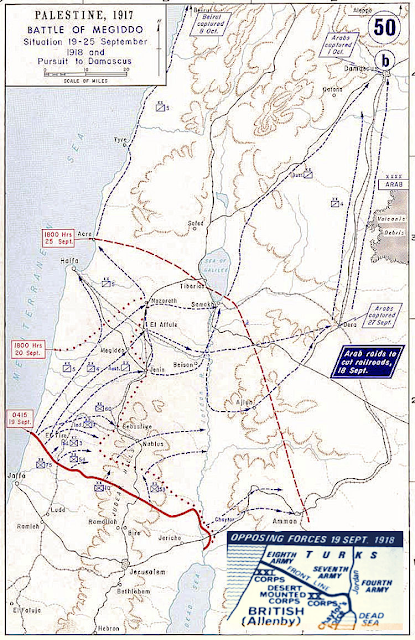
Allenby's plan for the offensive was both daring and creative, in stark contrast to the unimaginative attacks that characterized much of British operations on the Western Front. Noting the single railroad supplying the Turkish armies, Allenby correctly assessed that the seizure of El Affula and Samakh would sever Turkish lines of communications. Threatened with encirclement, the Turkish Eighth and Seventh Armies would be reduced to a single line of retreat through the Jordan Valley, a region already noted for its paucity of roads. Under attack from all his forces, Allenby believed that the Turkish forces would not be able to handle the strain and could be destroyed. Events would prove his assessment correct.

The keys to success in the coming battle would be speed, mass, and surprise. The DMC was placed right behind XXI Corps, thanks in large part to lessons learned on the Western Front. As Chauvel's biographer noted, "Operations in France had shown how important it was to position cavalry well forward to move through a gap as soon as it was cleared." Insistent on speed and mobility, Allenby directed that the cavalry not get bogged down in local actions but instead stay massed for a decisive blow against the enemy's main body. Paralyzing the Turkish forces would assist the DMC in achieving its objectives. The EEF's deception plan was consequently an elaborate design, including dummy horses and empty tents lining the Jordan Valley. On the eve of battle–set to launch on 19 September–Allenby was confident that he had confounded von Sanders. "That the enemy expected an offensive on my part about this date is probable. That he remained in ignorance of my intention to attack in the coastal [sector] with overwhelming numbers is certain."

Integral to the entire campaign plan would be the RAF's accomplishments. With one squadron attached to each corps, Allenby depended on his air assets to accomplish a number of diverse missions–strategic and tactical reconnaissance, artillery cooperation, protection from hostile aircraft, and aerial bombing. Prior to the attack's start, 400 square miles of country were photographed and mapped, while fighters ran security missions to allow for the secret concentration of forces building up on the coastal plains. Thus, not only had Allenby planned for an operation in-depth, he had also fully integrated the air piece to ensure the battle was truly three-dimensional. Correctly assessing that the Turkish centers of gravity lay in their rail transport and command and communications sites, the EEF commander was about to exploit the full spectrum of combat multipliers against a demoralized enemy. As Allenby's biographer, Archibald Wavell, contended, the battle had "been practically won before a shot was fired."


Click on Map to Enlarge


The Opening

The first shots of the Megiddo battle would not be fired by Allenby's ground forces but instead by the Arab Northern Army operating on the eastern flank. Supported by a flight of British airplanes and an armored car squad, the Arabs attacked railway lines and station buildings at Dera beginning on 16 September. RAF bombing runs affected Turkish morale as much as railway traffic, while Arab raids, led by the energetic Col T. E. Lawrence, created havoc along enemy communication lines. Lawrence would later note that the "Turks' hopeless lack of initiative made their army a "directed" one so that by destroying the telegraphs, we went far towards turning them into a leaderless mob." Von Sanders reacted as expected, sending reinforcements from the coastal city of Haifa east toward Dera. Then, with the enemy command center distracted and soon to be completely cut off from the front lines, Allenby unleashed his modern-day version of Armageddon.

At 0430 on 19 September, 435 artillery guns and trench mortars–approximately one gun every 50 yards– opened up a 15-minute bombardment on Turkish positions along the coastal flank. Along this critical 15- mile sector, the EEF had massed 35,000 infantry and 9,000 cavalry troops against 8,000 Yilderim infantrymen. The night before, XX Corps launched its diversionary attack toward the Jordan River Valley, while just after midnight a Handley-Page bomber dropped 1,200 pounds of bombs on the El Affula aerodrome, railway station, and telephone exchange. Von Sanders later noted that all "telephonic and telegraphic communication between the Army Group and the armies was completely broken from the beginning of the attack." As Bulfin's infantry swept forward 15 minutes after the start of the artillery barrage, the Turkish command was unaware of the main attack's weight and scope.


Retreating Turkish Column Utterly Destroyed in the Advance


With the main line quickly broken by the combined shock of artillery and machine gun fire, the Desert Mounted Corps rushed through the breach. One squadron commander from the 19th Lancers described the elation at the cavalry's exploitation. "As we cleared the Turkish trenches and rode unopposed through the debris of defeat, we all felt that the 'G' in 'GAP' for which we had waited patiently [in France] for years had at last been reached." By midday, the Turkish Eighth Army was in shambles, and Chauvel's DMC had captured Tul Karm.

All this was unknown to von Sanders, for the RAF had paralyzed Turkish nerve centers through a well-executed bombing plan. By 20 September cavalry forces supported by armored cars had cleared Megiddo, 44 miles from the jump-off line, as XX and XXI Corps kept constant pressure on the retreating Turkish armies. By nightfall on the 20th, the escape routes at El Affula, Beisan, and Dera, across the Jordan were shut down by Allenby's ground forces and the Arab Northern Army.

On the morning of the third day, an Australian Bristol bomber found the Turkish Seventh Army attempting to retreat northward through the Wadi Fara near Nablus. A steep gorge, the wadi formed a natural canal in which thousands of infantry, cavalry, and transport troops became trapped. Knocking out front and rear vehicles and thus sealing the gorge, Bristols and DH-9s and SE-5a aircraft began strafing and bombing runs that lasted throughout the day. The account of one Australian squadron described the scene of destruction.

"The long, winding, hopeless column of traffic was so broken and wrecked, so utterly unable to escape from the barriers of hill and precipice, that the bombing machines gave up all attempt to estimate the losses under the attack and were sickened at the slaughter."


Chaytor's Force Occupies Es Salt, East of the Jordan River


By the end of 21 September, the Turkish Seventh Army ceased to exist as a capable fighting force. Within 36 hours of the start of the offensive, the major British objectives had been attained. The Turkish Eighth and Seventh Armies were threatened with envelopment and destruction by strong mobile forces to their rear. With few available reserves and his communication net crumbling, von Sanders had little opportunity to influence the battle. He attempted to order his forces to retreat, but only the Fourth Army could even be contacted. It was too late to save all but a corporal's guard of the Seventh and Eighth Armies, as these two formations disintegrated under the strain.

Despite the utter devastation created by his air and ground forces, Allenby continued to press. Chauvel forwarded orders to the 5th Cavalry Division to seize Haifa, which it did on 23 September after heavy fighting in rough terrain during which Indian troops of the 15th Cavalry Brigade distinguished themselves. Two days later Chaytor's force fought its way into Amman. Meanwhile, the combination of Chaytor's Force and the Arab Army had severely damaged the Fourth Army. In six days Allenby had brought about the complete collapse of the Ottoman forces. He chose the name of Megiddo to signify this victory, as the nearby ancient fortress of Tel Megid appears in the Bible as Armageddon, the location of the final battle between the forces of good and evil.

Victory Exploited


RAF Aircraft Over the Sea of Galilee Heading to Damascus (Sidney W. Carline, 1919)


Despite the defeat of the 7th and 8th Ottoman Armies, elements of the Ottoman 4th Army were deployed away from the destruction at Sharon and Nablus and still posed a risk. Learning of the losses at those battles, they retreated northward. Allied aircraft again caused heavy losses on the retreating troops.

The continued pursuit northward was aided by Lawrence and the Arabs, who, after capturing Dera, cut the lines of retreat of the Turkish 4th Army. Cavalry divisions from the DMC were thus able to sustain the chase while the Arabs secured the flanks. Air-ground cooperation continued during the pursuit Damascus, with RAF motorcars accompanying lead units of the DMC. Lorries carrying fuel and stores followed closely behind, allowing air assets to keep pace with the fast-moving cavalry.

As the last desperate elements of the 4th Army reached Ziza they found their path blocked by the ANZAC Mounted Division. Pursued by Arab irregulars embittered by years of occupation, they surrendered en masse to the Anzacs rather than face slaughter at Arab hands. In the entire battle, the Allies had inflicted losses on the Ottomans of over 25,000 killed, wounded, or captured, effectively ending their ability to continue the war.

To the west at the south end of the Sea of Galilee, just before dawn on 25 September, mounted troops approached the rail junction of Samarkh. (See illustration at top of the page.) The advance units received heavy fire. Reforming, the 11th Light Horse Regiment attacked the eastern end of the town and two squadrons of the 12th Light Horse attacked the western end. Samarkh was secured by 0500 with 365 prisoners taken—half of them German. Once the 4th Australian Light Horse Brigade occupied Samakh, the last Turkish stronghold and communications center west of the Jordan was eliminated. For Allenby's forces the way to Damascus, Beirut, and Aleppo now lay open. The remaining Turks were now in headlong retreat, and Chauvel's telegraphic orders on 26 September disclosed that Allenby had revised his battle plans beyond the enemy's annihilation. "Seventh and Eighth Turkish Armies have been destroyed. Fourth Army is retreating on Damascus via Dera. Desert Mounted Corps will move on Damascus."

Ottoman stragglers who had escaped the destruction at Megiddo continued to filter north in the hope of regrouping. What followed was one of the most remarkable military pursuits in history. Chauvel led the DMC northward, covering over 100 miles (160 km) in three days and crossing the Golan Heights.


Desert Mounted Corps Crossing the Golan Heights


One subaltern with the 18th Lancers noted the swath of destruction created by the far-reaching cavalry and aircraft. "We had covered 80 miles in 34 hours. What a sight the roads were! Abandoned lorries and cars, cut off in their attempt to escape, stood every few yards on the road. . . El Affula was a shambles. Engines and trains full of army winter clothing and kits stood in the stations, just as they were surprised that morning."

On the morning of 1 October, the most advanced unit, the 3rd Australian Light Horse Brigade, entered Damascus in pursuit of fleeing Ottoman troops. They accepted the city's formal surrender, much to the annoyance of Lieutenant-Colonel T.E. Lawrence, who had planned a grand ceremony in support of the Arab insurgents' claim to self-rule.

With Damascus occupied in force, Allenby was yet again able to set his sights northward—this time to Aleppo, 200 miles north of Damascus. Meanwhile, the 3rd Indian Division headed to Beirut and the 7th Indian Division towards Baalbek. Homs was also captured, on 16 October.

As an illustration of the depth of the EEF's striking power, the 5th Cavalry Division had marched approximately 550 miles in just under 40 days. Though the final pursuit depleted the strength of the cavalry's men and horses, by the end of October the final shots of the war in the Middle East were fired at Haritan, just outside the limits of Aleppo. Five days later the Turks signed an armistice and the 600-year-old Ottoman Empire was subsequently partitioned.


Indian Lancers Entering Damascus


From the opening of the Megiddo battle to the armistice, the EEF captured 75,000 prisoners, 360 artillery pieces, and 800 machine guns. For its efforts, the EEF suffered 5,666 casualties, though of those only 853 were killed in action. As Matthew Hughes contended, the "completeness of the victory at the battle of Megiddo surprised [even] Allenby." In a letter to his wife, Allenby wrote that he was "almost aghast at the extent of the victory." Indeed, it had been one of the most decisive battles fought in World War I, causing the ruination of three Turkish armies and the capitulation of an empire.

Sources: Our articles on Allenby's 1918 campaign have quoted extensively from two studies, "Deep Battle in World War One: The British 1918 Offensive in Palestine," by Lt. Cmdr. Paul A. Povlock of the Naval War College, and "Armageddon’s Lost Lessons: Combined Arms Operations in Allenby’s Palestine Campaign," by Lt. Col. Gregory Daddis of the U.S. Military Academy. Maps from the West Point Atlas and the British Army Museum.