
 |
| Armored Artillery Train, Probably in Siberia |

The strategy known as "railway" or "echelon" was built around armored trains with artillery on flat rail cars and is distinctive of the skirmishes and battles of 1917–1918 between the Bolsheviks and the Volunteer Army. The latter army was a combination of varied anti-Bolshevik forces drawn primarily from elements of the former Imperial Russian Army (which had fought in the Great War) that coalesced in the south and east of the country in the hope of overturning the more radical political aspects of the revolution or, indeed, an actual return to the monarchy. Disparate generals and regiments comprised the army, and political factions hobbled it to some degree, although it enjoyed a brief ascendance in 1919, before being swept southward to either destruction or evacuation and emigration. It is often described as the “White” Army, not always by those participating. They were the “Volunteers.”
In this style of combat, the train and the forces it carries (together an "echelon") are assigned a range of combat missions. This use of the French term échelon for a naval or aviation combat formation appears to have been adapted for specifically Russian needs in their civil war. Echelons could also be combined under a single command for larger operations. During the Great War on the Eastern Front, unlike the legendary static trenches of the Western Front, the Russians and their foes had manned a much longer front and regularly advanced and retreated large distances. The trains of the Russian Empire successfully supported this front, which was both long (N to S 1600 km) and deep (W to E 500 km). Consequently, a working rail transportation infrastructure was well in place to continue into the civil war and the consolidation of Soviet power.
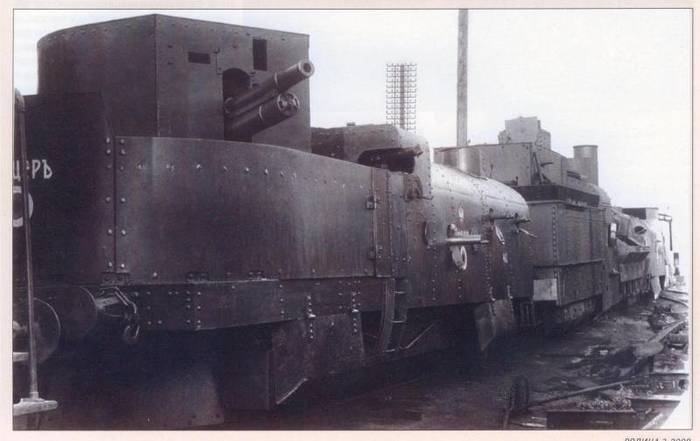 |
| Artillery and Machine Guns Protrude from Turrets |
Here is a succinct description of echelon war, made possible by the existing rail lines and rolling stock of the empire: "[The] most characteristic features of an echelon war [are]…the absence of continuous fronts; relatively small forces and assets involved in hostilities, operations mainly along railways with minimal removal of the battle area from the railway; and the use of rail echelons to attack and pursue the enemy, or to retreat when meeting with superior enemy forces.” [Russia’s Railway Forces, N.V. Starostenkov, 2001]
Echelon warfare gave way eventually to larger-scale operations by late 1918. As Russia's Railway Forces comments: “With the increase in the number of armies and the scale of the armed struggle, the troops are gradually switching to unpaved routes, and the methods of echelon warfare begin to acquire a secondary and then auxiliary character. In the second half of 1918, the echelon war loses its significance.”
 |
| The Volunteer Army armored train On to Moscow, 1919, before its capture by the Reds in 1920 in Novorossiisk |
~ Kimball Worcester
Source: translator's introduction to A Russian Nurse in War and Revolution, Memoirs 1912–1922 by Tatiana Varnek, translation from the Russian, 2021; Wikimedia Commons; Wikipedia; https://pikabu.ru/story/ikh_zvyozdnyiy_chas_bronepoezda_na_grazhdanskoy_voyne_v_rossii_6719677;
No comments:
Post a Comment