Now all roads lead to France and heavy is the tread
Of the living; but the dead returning lightly dance.
Edward Thomas, Roads
Showing posts sorted by date for query Ernst Jünger. Sort by relevance Show all posts

Thursday, December 4, 2025

The Kaiser's Badge for the Wounded


By 1918 there were so many wounded men still  in the ranks and disabled back in Germany—by the end of the war there were an estimated 4.2 million—that the army decided that a decoration was needed for the troops' uniforms to recognize and honor their sacrifice.  Approved by the Kaiser on 3 March 1918, the metal alloy Imperial Wound Badge displayed a German helmet with crossed swords surrounded by a wreath. They were each 1.5 x 1.75 inches and  came in three versions: (Note: I cannot find a source for the actual number of awards during WWI.)

  • Black (3rd class, representing Iron), for those wounded once or twice by hostile action (including air raids).
  • Silver (2nd class) for being wounded three or four times.
  • Gold (1st class, which could be awarded posthumously) for being wounded five or more times.


Ernst Jünger, Wounded
14 Times During WWI,
Displaying the Wound Badge
(Presumably 1st Class)

The "progression" could be waived in the event of loss of a limb or eyesight; when such a severe wound occurred, the silver badge was awarded. Badges were made of pressed steel, brass and zinc. All versions of the Wound Badge were worn on the lower left breast of the uniform or tunic.

The badges, of course, made a comeback for the Second World War, with a swastika added to the helmet. An estimated 5 million were awarded. Civilians wounded in Allied bomb raids were also eligible for the badge. There was even a special version  awarded to survivors of the 20 July 1944 unsuccessful attempt to assassinate Hitler. The Führer, himself, did not accept one since he had received a Wound Badge for his First World War wounds.

Sources: For Führer and Fatherland: Military Awards of the Third Reich; Wikipedia; the Smithsonian Air and Space Museum.

Friday, June 27, 2025

Deeds Still Remembered for Good or Ill: Ten WWI Recipients of the Pour le Mérite


The Pour le Mérite, known informally during World War I as the Blue Max, was the Kingdom of Prussia's highest military order until the end of World War I. The original regulations called for the capture or successful defense of a fortification, or victory in a battle. By World War I, the oak leaves often indicated a second or higher award of the Pour le Mérite. Although it could be awarded to any military officer, many of its most famous recipients were the pilots of the German Army Air Service (Luftstreitkräfte), whose exploits were celebrated in wartime propaganda. It was awarded 1,687 times in the First World War. This included 122 awards with the additional oak leaves.


  • Lothar von Arnauld de la Perière, German U-boat commander for sinking 194 ships, totaling 453,716 tons of Allied shipping, the most by any submarine commander in history. 

  • Oswald Boelcke is important as a pioneering figure in the history of aerial warfare, particularly for his contributions to the development of fighter tactics during World War.  "Dicta Boelcke" is the foundational set of rules for aerial combat. (Photo: Bottom Right)

  • Hermann Göring, was decorated as an ace pilot in June 1918, later Reichsmarschall, head of the Luftwaffe, and second in command of Germany's Third Reich. War criminal. (Photo: Bottom Left)
  • Ernst Jünger, novelist and the last living holder of the Pour le Mérite at the time of his death in 1998.  Wounded 14 times during the war.
  • Paul von Lettow-Vorbeck, who led German forces in the guerrilla campaign in German East Africa. One of Germany's greatest postwar heroes.  (Photo: Top Left)
  • Erich Ludendorff, German general of World War I; awarded the Pour le Mérite in August 1914, one of the earliest World War I awards, for the siege of Liège.  (Photo: Top Right)

  • Manfred von Richthofen,  the top-scoring ace of World War I.   As the "Red Baron" has posthumously received mythic status throughout the world.

  • Erwin Rommel, the future "Desert Fox" distinguished himself on multiple fronts of the war, especially at Caporetto in 1917.

  • Hans von Seeckt, brilliant staff officer in World War I; awarded the Pour le Mérite in May 1915 and the oak leaves in November 1915 for contributions on the Eastern Front. After the war, he was instrumental in surreptitiously rebuilding the postwar German army.


Monday, September 23, 2024

A New Collection of Eleven World War One Quotes


If there is a war between France and Germany, it will be very difficult for us to keep out of it. . .On the other hand the prospect of a European war and of our being involved in it is horrible. 

Sir Edward Grey, 1906


The Tsar thinks I'm Christ incarnate. The Tsar and Tsarina bow down to me, kneel to me, kiss my hands.   

Rasputin


I recommend that you and the Minister of War leave for your vacation so as to keep up the appearance that nothing is going on.

Von Berchtold to Conrad von Hötzendorff, 8 July 1914


When the English started advancing we were very concerned: they looked as though they must soon occupy our trenches. We were amazed to see them walking, we had never seen that before. . .The officers were at the front. I noticed one of them was strolling calmly, carrying a walking stick. When we started firing we just had to load and reload. They went down in their hundreds. We didn't have to aim, we just fired into them. 

Karl Blenk, German Machine Gunner on the First Day of the Somme


Can the Army win the war before the Navy loses it?  

Admiral Lord Fisher, Spring 1917


The notion that a soldier becomes hardier and bolder as war proceeds is mistaken. What he gains in the science and art of attacking his enemy he loses in strength of nerve. The only dam against this loss is a sense of honour so resolute that few attain to it. For this reason I consider that troops composed of boys of twenty under experienced leadership are the most formidable. 
Ernst Jünger


I don't know whether war is an interlude during peace, or peace an interlude during war. 
Georges Clemenceau


I stood by myself for a minute, saying, "Dear God, I'm going into great danger. Would you please guard me and help me to act like a man. Please bring me back safe". . . I used to go out there without a fear, and here I am. I didn't say it out loud. My pals got to know, and they did all sorts of daft stuff to get drunk. Well, I didn't need it because I trusted, you know, in my prayers.  
Arthur Barraclough, the Duke of Wellington's Regiment, passed away 30 August 2004, age 106.


What's the use of worrying?  
Popular Song Lyric


All these talks and speeches and theories of Wilson's are most dangerous, and more dangerous to England than anyone else and are also dangerous to France. This 'League of Nations'. What folly! 
Ex-Empress Eugénie, Widow of Napoleon III


I am obliged to report that, at the present moment, the Russian Empire is run by lunatics.   
Ambassador Paleologue, 14 January 1917


Saturday, June 15, 2024

Great Quotes & Great Photos — A Roads Classics


1.  War had been declared, and the following Sunday I went with a friend of mine to Shepherd's Bush Empire to see the film show. At the end they showed the Fleet sailing the high seas and played "Britons Never Shall Be Slaves" and "Hearts of Oak". And you know one feels that little shiver run up the back and you know you have got to do something. I had just turned seventeen at that time and on the Monday I went up to Whitehall—Old Scotland Yard—and enlisted in the 16th Lancers.
Pvt. William Dove, 16th Lancers


2.  I don't know what is to be done. This isn't war.
Horatio Kitchener
Quoted in J.F.C. Fuller's, The Conduct of War


3. I am obliged to report that, at the present moment, the Russian Empire is run by lunatics.
Ambassador Paleologue, 14 January 14 1917


4.  Like the planet Neptune, the discovery of the dreadnought was inevitable, but luckily we saw her in the heavens before the other chaps and got our unparalleled lead! Thank God!
Admiral Jacky Fisher, 1910


5.  The Christmas truce was the last twitch of the 19th century. By that, I mean it was the last public moment in which it was assumed that people were nice, and that the Dickens view of the world was a credible view...A wonderful ironic moment. And, they were exchanging cigarettes and addresses and exchanging insignias, treating each other like friends. It was a high emotional moment I would say. It's the last gesture of the 19th-century idea that human beings are getting better the longer the human race goes on. Nobody could believe that after the First World War, and certainly not after the Second.
Paul Fussell


6.  I don't know whether war is an interlude during peace, or peace an interlude during war.
Georges Clemenceau


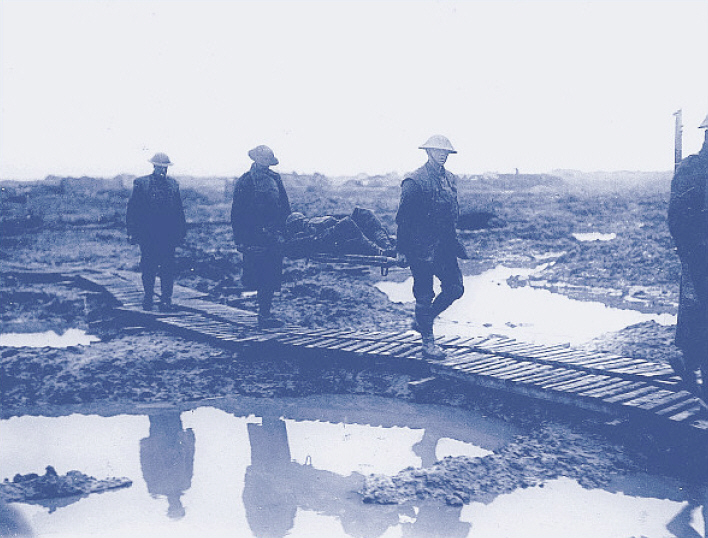
7. The vast field of shell-holes had been turned into a sea of mud by the heavy rain…Its depths were particularly dangerous in the low-lying ground of the Paddebeek. On my zigzag course I passed many a lonely and forgotten corpse. Often only a head or a hand projected from the shell-hole whose circle of dirty water reflected them. Thousands sleep like that, without one token of
love to mark the unknown grave.
Lt. Ernst Jünger, 73rd Hanoverian Fusiliers
Describing Passchendaele


8. Tread softly here—Go reverently and slow,—Yea, let your soul go down upon its knees,—And with bowed head and heart abased—Strive hard to grasp the future gain in this sore loss.  For not one foot of this dank sod—But drank its surfeit of the blood of gallant men—Who for their Faith, their Hope, for Life and Liberty—Here made the sacrifice. Here gave their lives, and right willingly for you and me.
Inscription
Newfoundland Park, Somme Battlefield


9. A mixture of contradictories which never were—perhaps could never have been—harmonised.
John Buchan on T.E. Lawrence


10. When I took a decision or adopted an alternative, it was after studying every relevant—and many irrelevant—factor. Geography, tribal structure, religion, social customs, language, appetites, standards—all were at my finger-ends. The enemy I knew almost like my own side.
T.E. Lawrence
Intelligence Preparation of the Battlefield


11. Our nerves are ruined by mistreatment. If anyone should say that he was not haunted by visions of burning airships, then he would be a braggart. But nobody makes this assertion; everyone has the courage to confess his dreams and thoughts.
Pitt Klein, Crew Member German Navy Airship L31


12. Our story takes you down this shadowed path to a remote and guarded building in the English Midlands, Melbridge County Asylum. Grimly proud of its new military wing, which barely suffices in this autumn of 1918 to house the shattered minds of the war that was to end war.
Opening Line, Random Harvest, James Hilton

Thanks to our pal in France, Olivier Pierrard, for the images.


Friday, March 15, 2024

13 Memorable Quotes from Ernst Jünger's Storm of Steel


[Editor's Note:  I have drawn on Ernst Jünger's biography and writings a number of times over the years.  Click HERE to see a selection of those articles. MH]


1. We had come from lecture halls, school desks and factory workbenches, and over the brief weeks of training, we had bonded together into one large and enthusiastic group. Grown up in an age of security, we shared a yearning for danger, for the experience of the extraordinary. We were enraptured by war.


2. Books and bullets have their own destinies.


3.  Throughout the war, it was always my endeavour to view my opponent without animus, and to form an opinion of him as a man on the basis of the courage he showed. I would always try and seek him out in combat and kill him, and I expected nothing else from him. But never did I entertain mean thoughts of him. When prisoners fell into my hands, later on, I felt responsible for their safety, and would always do everything in my power for them.


4. This was the home of the great god Pain, and for the first time I looked through a devilish chink into the depths of his realm. And fresh shells came down all the time.


5.  Even if ten out of twelve men had fallen, the two survivors would surely meet over a glass on their first evening off, and drink a silent toast to their comrades, and jestingly talk over their shared experiences. There was in these men a quality that both emphasized the savagery of war and transfigured it at the same time: an objective relish for danger, the chevaleresque urge to prevail in battle.


6. In war you learn your lessons, and they stay learned, but the tuition fees are high.


7.  These moments of nocturnal prowling leave an indelible impression. Eyes and ears are tensed to the maximum, the rustling approach of strange feet in the tall grass in an unutterably menacing thing. Your breath comes in shallow bursts; you have to force yourself to stifle any panting or wheezing. There is a little mechanical click as the safety-catch of your pistol is taken off; the sound cuts straight through your nerves. Your teeth are grinding on the fuse-pin of the hand-grenade. The encounter will be short and murderous. You tremble with two contradictory impulses: the heightened awareness of the huntsmen, and the terror of the quarry. You are a world to yourself, saturated with the appalling aura of the savage landscape.


8.  Trench fighting is the bloodiest, wildest, most brutal of all. … Of all the war’s exciting moments none is so powerful as the meeting of two storm troop leaders between narrow trench walls. There’s no mercy there, no going back, the blood speaks from a shrill cry of recognition that tears itself from one’s breast like a nightmare.


9.   Leaving out trifles such as ricochets and grazes, I was hit at least fourteen times, these being five bullets, two shell splinters, one shrapnel ball, four hand-grenade splinters and two bullet splinters, which, with entry and exit wounds, left me an even twenty scars.


10.  What a beautiful country [Germany] was, and eminently worth our blood and our lives. Never before had I felt its charm so clearly. I had good and serious thoughts, and for the first time I sensed that this war was more than just a great adventure.


11.  We stand in the memory of the dead who are holy to us, and we believe ourselves entrusted with the true and spiritual welfare of our people. We stand for what will be and for what has been. Though force without and barbarity within conglomerate in sombre clouds, yet so long as the blade of a sword will strike a spark in the night may it be said: Germany lives and Germany shall never go under!


12.  A bloody scene with no witnesses was about to happen. It was a relief to me, finally, to have the foe in front of me and within reach. I set the mouth of the pistol at the man’s temple — he was too frightened to move—while my other fist grabbed hold of his tunic, feeling medals and badges of rank. An officer; he must have held some command post in these trenches. With a plaintive sound, he reached into his pocket, not to pull out a weapon, but a photograph which he held up to me. I saw him on it, surrounded by numerous family, all standing on a terrace. It was a plea from another world. Later, I thought it was blind chance that I let him go and plunged onward. That one man of all often appeared in my dreams. I hope that meant he got to see his homeland again.


13.  When once it is no longer possible to understand how a man gives his life for his country—and the time will come–then all is over with that faith also, and the idea of the Fatherland is dead; and then, perhaps, we shall be envied, as we envy the saints their inward and irresistible strength.


Thursday, July 6, 2023

The Ludendorff Offensives of 1918: Part I—The Decision for a Last Gamble


The Attack by Felix Schwormstadt


In the fall of 1917, General Erich Ludendorff, the de facto operational commander of the German Army, began planning his 1918 campaign. Despite his successes in the past year—in particular, effectively taking the Russian Army off the board—long-term prospects were not good. The Central Powers were looking increasingly shaky and the Kaiser's army was bleeding away with forecasts for potential replacements trending sharply downward. The other principal enemies since the war's outbreak, France and Britain, of course, were facing the same pattern of losses and declining manpower. They, however, were about to tap into a nearly fathomless reservoir of new soldiers. Since April, the United States of America had been raising and training a huge army across the Atlantic, and it would be arriving in great numbers by mid-1918. 

Ludendorff—blind both to the declining situation on the German home front and to the massive casualties that would certainly ensue from aggressive operations —chose to mount a major offensive campaign, gambling that he could force the Allies to the peace table before the Americans became a factor. His calculations showed he would have a short-term slight advantage in the spring. Russia's revolution and collapsing war effort would free up German units in the east. Forty-eight divisions could be transferred to the Western Front, increasing German strength to 191 against 178 Allied divisions. On this small margin would the good general risk the fate of the German Empire.

We know now that Ludendorff's gambit came up short. He chose to slug it out with Field Marshal Douglas Haig's British Army (at least in his original formulation). What unfolded was a series of five loosely connected offensives that were neither mutually reinforcing nor based on sufficient logistical support. Furthermore, they would draw in larger French forces and an earlier-than-anticipated American infusion of Doughboys and Marines. At their end, with a sixth—and hoped-for decisive—operation cancelled, the Ludendorff Offensives would leave Germany with a more exposed army in the field and fewer cards to play in the diplomatic game. The great gamble had failed. 

But before proceeding with a discussion of how that came about, let's look at Ludendorff's decision to mount the springtime assaults from another angle.

Did Ludendorff Squander a Diplomatic Opportunity?

By late 1917, the war of attrition was succeeding—but in an equal-opportunity manner. All the countries in the war since 1914 were simply running out of bodies.


Consequently, the anticipated flood of American troops projected to arrive in 1918 and 1919 exercised a hypnotic power over both sides. The French, still recovering from the army discontent following its failed Nivelle Offensive, were going to wait for the Americans. And, late in the year, even General Haig decided it would be imprudent to restart the Flanders offensive before the Yanks arrived.

On the other side, Hindenburg and Ludendorff faced a dilemma, after what seemed to them to be a pretty successful 1917—Russia and Romania were out of the war, Italy very nearly the same after the Caporetto disaster, and the U-boat war still appeared promising. Also, their armies had savaged the French in the 1917 spring offensive and, despite their own heavy casualties, had held off the British attacks in Flanders.

However, they faced the same demographic issues as their longtime opponents and saw no way to counter the millions of Americans about to start arriving.

Eventually, despite the infusion of troops made possible by the ending of the war on the Eastern Front, they were inevitably going to be badly outnumbered on the Western Front. They faced three options:

1. Use the troops available from Russia (about one million men) to DIG IN and wait for the Allies to attack them. This they viewed as just postponing the inevitable.

2. NEGOTIATE A SETTLEMENT. This option meant they would likely have to give up much of their occupied territory in Western Europe, but possibly not as much as in the east. In hindsight, it's clear their “worst case” outcome of a settlement in January 1918 would have been nothing as severe as what the Treaty of Versailles yielded. The royals who commanded armies, Crown Princes Wilhelm and Rupprecht and Duke Albrecht, supported this approach—they had more finely tuned political sensibilities than the career military. The generals, though, found it unpalatable to turn things over to the diplomats, and they had lost touch with their home front, where politicians were losing their ability to maintain order and the citizens were going hungry.

3. GO ON THE OFFENSIVE and try to force a request for terms from the French and British before the Americans arrived in force. This was the choice they made, and what resulted was the series of offensives known collectively as the Kaiserschlacht.


Targeting the British

The next big decision was whom to target. Given his finite resources, Ludendorff recognized that he could not attack everywhere at once on the Western Front. One obvious line of thinking is that to defeat a coalition one should focus on one  member and defeat it before turning on the second, now lacking any support from its ally. But whom to attack? At a war conference in Mons on 11 November 1917, Ludendorff explained his answer:

The situation in Russia and Italy will make it possible to deliver a blow on the Western Front in the New Year. . . about thirty-five divisions and one thousand heavy guns can be made available for one offensive. . . Our general situation requires that we should strike at the earliest moment...before the Americans can throw strong forces into the scale. We must beat the British.

But why the British rather than the French? First, it was the numerically smaller of the two main allies. Also, as historian General David Zabecki points out, an added advantage to attacking the BEF was the lack of rear area depth in the sector, with the British front lines averaging only 90 kilometers from the Channel coast. On the other hand, France had proven in the 1914 Marne campaign that it could retreat deep into the nation's heartland if it was pressured.


Where to Attack?

In preparation for the great German offensive of 1918, Ludendorff met at Mons on 11 November 1917 with the chiefs of staff and the principal operations planners from the army groups and the German High Command (OHL). They identified several potential attack scenarios but could not decide on one. Ludendorff ordered the planners to develop fully the plans for several different courses of action, with the final decision to be made at a later date. The two most viable options at that point were Operation GEORG, to be executed in Flanders by the army group of Crown Prince Rupprecht of Bavaria, and Operation MICHAEL, to be executed against the British southern wing in the Somme.

Almost from the start, Ludendorff leaned toward the southern option. In describing the deliberations at the Mons Conference, he later wrote:

It would seem that an attack near St. Quentin. . . offers promising prospects. After reaching the line of the Somme between Péronne and Ham it might be possible, by resting the left flank on the Somme, to advance the attack still farther in a northwestern direction, and thus eventually roll up the British front. For the success of this operation it would be especially necessary to render useless the various rail centers by means of long range artillery and bombing squadrons.  That would create difficulties for the timely arrival of the enemy's strategic reserves. 

The final decision came at a planning meeting at the Aresens field headquarters on 21 January 1918. It was to be MICHAEL, but GEORG, the Flanders assault, was kept on the back burner as a deception for the time being but also as a contingency for a future initiative.


German Artillery—Critical for the Attacks


The Promise of New Methods

Underlying Ludendorff's thinking was his belief that the German Army had developed a tactical package that would create a major breach in the enemy front and allow following troops to wage a decisive campaign of maneuver—“Roll[ing] up the British front"—in his words.

The German infiltration tactics of 1918 can be summarized under four headings: innovative artillery preparation; the combined-arms assault or storm battalion; rejection of the linear advance in favor of bypassing enemy centers of resistance; and attacks to disorganize the enemy rear area.

The key was artillery. Col. Georg Bruchmüller, an obscure officer retired for nervous problems in 1913 but recalled to duty for the war, developed German artillery techniques to a fine art by the time of the Ludendorff spring offensives of 1918. The essence of the Bruchmüller artillery preparation was a carefully orchestrated, short but intense bombardment designed to isolate, demoralize, and disorganize enemy defenders. Georg Bruchmüller avoided area targets, concentrating on such key points as artillery observation posts, command posts, radio and telephone centers, rearward troop concentrations, bridges, and major approach routes. He carefully pinpointed all these targets on aerial photographs. The result was to knock out enemy communications and isolate forward units.


At the Receiving End—A British Dressing Station,
Spring 1918 by Henry Tonks

The huge number of guns available to Ludendorff allowed for a short bombardment of incredible ferocity, which it was hoped would also provide a degree of surprise to the battle. Rear areas, headquarters, and the enemy artillery would first be deluged with shells in an attempt to disrupt the command and communication system and to eliminate the main weapon of response. Then the guns would be turned on the zone defenses of the defenders in an attempt to stun them just in advance of the main infantry assault.

The effect was increased by surprise. At the start of the German offensive on 21 March 1918, Bruchmüller began his bombardment with ten minutes of gas shells to force the British to mask, followed by four hours and 25 minutes of mixed gas and high explosives. The preparatory fires shifted back and forth so that the British did not know when the artillery was actually lifting for the infantry advance. Meanwhile, automatic rifle teams moved as close as possible to the British positions during the bombardment. When the Germans did advance, they moved behind a rolling barrage further enhanced by intense fog. The combination of surprise, brevity, intensity, and carefully selected targets was unique.

The new methods worked for the most part. On successive occasions, Ludendorff's artillery blasted a hole in the British or French line and employing stormtrooper tactics broke out into open country, occasionally securing advances of 40 or 50 miles. All this confirmed the value of the stormtroop method in the opening phase of battle. Slowdowns, however, would occur in the later stages of all the spring offensives. German infantry losses, especially among the specially trained assault forces, were massive.

French reinforcements—a bit slow with MICHAEL, more promptly with GEORG—were decisive. With the battlefront constantly moving targets for the artillery were much harder to locate and Bruchmüller's sophisticated methods proved less effective and relevant. Supply columns were outrun, and—as is well documented—discipline broke down with the infantry.

How order broke down within the German ranks is one of the revealing "human" stories of Ludendorff's offensives. Elite stomtrooper Ernst Jünger described how this started to come about in his battlefield classic Storm of Steel

We strode down to the valley, which was still taking a pounding from our artillery, and began by inspecting a dugout that had apparently only recently been abandoned by British officers. On a table sat a huge gramophone, which Haller straight away set going. The cheery melody that purred off the roll had a ghostly effect on both of us. I threw the box on the ground where it scraped on a little longer, and then fell silent.

The dugout was the height of luxury, even down to a little open fireplace with a mantelpiece with pipes and tobacco on it, and armchairs pulled round in a circle. Merry old England! Of course we didn't stint ourselves, but helped ourselves to whatever we fancied. I took a haversack, undergarments, a little flask full of whisky, a map case and some exquisite little items from Roger & Gallet, no doubt keepsakes from some romantic leave in Paris. We could see that the inhabitants had left here in a hurry.

An adjacent space harboured the kitchen, whose supplies we stared at in wonder. There was a whole crate of eggs, which we sucked on the spot, as eggs were little more than a word to us at this stage. On shelves along the walls were stacks of canned meat, tins of delicious English jam, and bottles of Camp coffee, tomatoes and onions; everything to delight an epicure's heart.

Such episodes recurred up and down the great advances in March and April for the German Army. Troops, having suffered months of low rations, unselfconsciously stopped to gorge themselves when they came across the plentiful British stocks. When alcohol was also available, the air of festiveness that inevitably broke out soon shifted in spirit as the soldiers grew surly and unwilling to resume their duties. Sergeants and junior officers like Jünger reported hundreds of cases of such indiscipline. The breakdown was shocking to the generals, who realized the effect of all these episodes on the advance would be cumulative and serious.

Ludendorff, of course, was not thinking of such breakdowns in his plan when he set the date to launch MICHAEL as 21 March 1918—the day trench warfare would end on the Western Front.

This Sunday we present Part II in this series on the Ludendorff Offensives, Operation MICHAEL, The Shock

Sources:   A complete list of the sources I drew upon for this series will be presented at the end of its final part. MH

Monday, October 31, 2022

Why Was the Passchendaele Battlefield Such a Nightmare ?— A Roads Classic


Click on Image to Expand


Storm Clouds Gather Over Flanders


How the Participants Described Passchendaele


Had I a descriptive pen I could picture to you the squalor and wretchedness of it all and through it the wonder of the men who carry on. . .A desolate wilderness of water filled with shell craters, and crater after crater whose lips form narrow peninsulas along which one can at best pick a slow and precarious way. Here a shattered tree trunk, there a wrecked 'pill-box', sole remaining evidence that this was once a human and inhabited land. 
Maj. C.E.L. Lyne, Royal Field Artillery

The vast field of shell-holes had been turned into a sea of mud by the heavy rain…Its depths were particularly dangerous in the low-lying ground of the Paddebeek. On my zigzag course I passed many a lonely and forgotten corpse. Often only a head or a hand projected from the shell-hole whose circle of dirty water reflected them. Thousands sleep like that, without one token of love to mark the unknown grave.
Lt. Ernst Jünger, 73th Hanoverian Füsiliers


The shapeless Ridge had lost every tree; . . .flayed and clawed up, (it) was traversed by no (known) likeness. . . Waiting there in the gashed hillside we looked over the befouled fragments of Ypres, the solitary sheet of water, Zillebeke Lake, the completed hopelessness.

Lt. Edmund Blunden, 11th R. Sussex Regiment


Click on Image to Expand


The Source of the Nightmare


The most important factor in turning the campaign into a paradigm of the horrors of war was the unusual weather. That 1917 was unusual is beyond doubt, but it was not so outlandishly strange as to be impossible to contemplate in advance. It was coupled with the particular geology of the region, which was certainly known long before the war, but that again had to be coupled with the new brutality of the artillery barrage. Both in terms of quality and quantity, artillery had been revolutionized since the outbreak of the war, and the combination of these factors produced the fearful conditions on the ground that caused so much hardship and loss.
Martin Marix Evans, Passchendaele: The Hollow Victory


Wednesday, April 20, 2022

Recommended: Ernst Jünger's Second World War

From: "Ernst Jünger: Our Prophet of Anarchy"
Originally Presented in Unherd of The Post
By Aris Roussubis


Ernst Jünger in Paris, 1941


It sounds like Jünger's second World War may have been as dangerous for him as his first when he was wounded 14 times. MH

With its modern themes of detachment and alienation, the recent revival of Ernst Jünger’s early work by the internet dissident Right is an understandable urge. When I was a younger man, Jünger’s Storm of Steel, his hallucinatory account of his experiences as a stormtrooper commander in the trenches, was, like Malaparte’s Kaputt and Graves’s Goodbye to All That, a major formative experience in my desire to experience war and, callow though it now sounds, prove myself in it. 

Perhaps it’s natural, then, that in later life, the sombre reflections of the middle-aged Jünger as expressed in his recently translated wartime diaries, a husband and father disenchanted with the modern world around him, now seem so compelling.

The diaries open in 1941, with the 46-year-old Jünger serving in an administrative capacity on the general staff of the German army occupying Paris. Initially feted by the Nazi party for the proto-Fascist tone of his early works, Jünger publicly rejected the regime’s advances and came under suspicion as a result, his house searched by the Gestapo and the threat of persecution always hanging over him. A central figure in Germany’s interwar conservative revolution, Jünger, who stated he “hated democracy like the plague,” had come to despise the Nazi regime at least as much. Ultimately, he was far too rightwing to accept Nazism.

Jünger’s intellectual circle had aimed to transcend liberal democracy through fusing Soviet Bolshevism with Prussian militarism, yet the illiberal regime that actually came to power was wholly repugnant to him. “The Munich version—the shallowest of them all—has now succeeded,” he wrote, “and it has done so in the shoddiest possible way,” filling him with dread that Hitler would drive Germany and Europe toward disaster and discredit radical alternatives to liberalism for generations to come.

Jünger’s two closest friends, the National Bolshevik Ernst Nieckish and the philosopher of law Carl Schmitt, each met different fates under the new Nazi order: Nieckish jailed as a dissident until his liberation by the Red Army in 1945 and Schmitt as the regime’s foremost legal theorist. Jünger remained friends with both. For Jünger, the internal exile, dissidence would come in the veiled form of his dreamlike novella On the Marble Cliffs, published on the cusp of war in 1939, in which he predicted the disaster and bloodshed the Nazis would bring in their train. Carefully monitored and shunted off to a desk job in France, Jünger spent his war as a flâneur along the quais of Paris, buying antiquarian books, conducting numerous love affairs, and recording his impressions of the city he loved.


 Ernst Jünger at 100


A feted intellectual, and a lifelong Francophile, he befriended the city’s cultural elite, socialising with Cocteau and Picasso as well as the collaborationist French leadership and literary figures such as the anti-Semitic novelist Céline, a monster who “spoke of his consternation, his astonishment, at the fact that we soldiers were not shooting, hanging, and exterminating the Jews—astonishment that anyone who had a bayonet was not making unrestrained use of it”. For Jünger, Céline represented the very worst type of radical intellectual: “People with such natures could be recognised earlier, in eras when faith could still be tested. Nowadays they hide under the cloak of ideas.” 

While listening to Céline’s ravings about Jews with polite horror, Jünger was embroiled in an affair with Sophie Ravoux, a German-Jewish doctor, and helping to conceal other Jews in hiding, as well as warning the French resistance about imminent deportations. He records the first reports of mass executions in the east, shared among the army leadership, initially with disbelief and then with horror, disgust, and shame. Generals back from the east recount meetings with figures like “a horrifying young man, formerly an art teacher, who boasted about commanding a death squad in Lithuania… where they butchered untold numbers of people,” or share third-hand rumors about “men who have single-handedly slain enough people to populate a midsize city. Such reports extinguish the colours of the day. You want to close your eyes to them, but it is important to view them like a physician examining a wound.” 

Continue reading the article HERE.


Sunday, February 6, 2022

Artists and Authors Tell Us About War — A Roads Classic

Otto Dix, Self Portrait, 1915

We gingerly crossed the valley of Paddebeek through a hail of bullets, hiding behind the foliage of black poplar trees felled in the bombardment, and using their trunks as bridges. From time to time one of us disappeared up to their waist in the mud, and if our comrades had not come to their rescue, holding out their rifle butt, they would certainly have gone under. We ran along the rims of the shell-holes as if we were on the thin edge of a honeycomb. Traces of blood on the surface of some heavy shell-holes told us that several men had already been swallowed up. 
Ernst Jünger, Storm of Steel

I climbed up to the top of the gully I am in. Behind me was Fleury, and in front of me Vaux and Douaumont. I could see out over an area of ten square kilometres that had been turned into a uniform desert of brown earth. The men were all so tiny and lost in it that I could hardly see them. A shell fell in the midst of these little things, which moved for a moment, carrying off the wounded - the dead, as unimportant as so many ants, were left behind. They were no bigger than ants down there. The artillery dominates everything. A formidable, intelligent weapon, striking everywhere with such desperate consistency.
Fernand Léger, Verdun, 7 November 1916

The rumbling of the artillery became more and more frequent and ended up forming a single rumbling of the whole earth. From all sides, outgoing bursts and explosions threw forth their flashing beams which lit up the dark sky over our heads with strips of light in all directions. Then the bombing grew so heavy that the flashes became continuous. In the midst of the uninterrupted chain of thunder claps we could see each other directly, helmets streaming like the bodies of fish, gleaming black iron shovels, and the whitish drops of the endless rain, truly it was like moonlight created by cannon fire.
Henri Barbusse, Artois front in 1915


The plain, which stretched as far as the eye could see, seemed to have been churned up by a mad plough. The entanglement of trenches formed in the grass a huge white net with much of the mesh gnawed away. In the middle, there was a pile of stones and beams from which emerged, here and there, a house and a tree with all its leaves: La Targette. Further on, some charred tree trunks and a few white stones: Neuville-Saint-Vaast (...) There were thousands of men on this plain and I could only see one of them. He was lying face down with his nose in the grass; he was dead
Jean Hugo, Le regard de la mémoire 1914–1945 (The Look of Memory)

A great movement of earth and sky through our burning eyelids, wet and cold; things you find in the pale dawn, one after another and all of them; nobody killed in the darkness, nobody even buried despite the relentless shell attack, the same earth and the same corpses, all this flesh that trembles as if from internal spasms, which dances, deep and hot, and hurts; no more pictures even, just this burning fatigue frozen skin-deep by the rain; another day dawning over the ridge while the Boche's batteries carry on firing on it and on what remains of us up there, mixed with the mud, the bodies, with the once fertile field, now polluted with poison, dead flesh, incurably affected by our hellish torture. 
Maurice Genevoix, Ceux de 14 (The Men of 1914)


Otto Dix, Flanders, 1934–36

Tuesday, February 23, 2021

Historian Michael Neiberg Recommends Some WWI Fiction

Editor's Comment: Back when I was the editor for the Journal of the World War One Historical Association, I asked prolific military historian Michael Neiberg to contribute an article on the long-term impact of the war. He included some thoughts on the literature of the war.  Here are his comments and a list of his favorites. MH


French Author Henri Barbusse


We all know about the poets of the First World War, but for some odd reason the novelists and memoirists of the war have, with the exception of Ernst Jünger and Erich Maria Remarque, faded into relative obscurity. There are, however, a number of wonderful novels, many of them based on personal experience, that are well worth the time. The best of the group is probably Frederick Manning’s Her Privates We (published in the U.S. under the title The Middle Parts of Fortune), a Cockney slang-filled story of British soldiers on the Somme. Henri Barbusse’s Le Feu, now in a new English translation with the title Under Firewas a sensational bestseller when published in 1916 and remains poignant today. Liam O’Flaherty’s The Return of the Brute deals with Irish soldiers stuck in an impossible situation. One of my favorites remains Jaroslav Hašek’s hilarious take on the ineptitude of the Austro-Hungarian Empire in The Good Soldier Švejk

The Books Can Be Ordered Here


Wednesday, November 13, 2019

Artists and Authors Describe War
(A Roads Classic)

Otto Dix, Self Portrait, 1915

We gingerly crossed the valley of Paddebeek through a hail of bullets, hiding behind the foliage of black poplar trees felled in the bombardment, and using their trunks as bridges. From time to time one of us disappeared up to their waist in the mud, and if our comrades had not come to their rescue, holding out their rifle butt, they would certainly have gone under. We ran along the rims of the shell-holes as if we were on the thin edge of a honeycomb. Traces of blood on the surface of some heavy shell-holes told us that several men had already been swallowed up. 
Ernst Jünger, Storm of Steel

I climbed up to the top of the gully I am in. Behind me was Fleury, and in front of me Vaux and Douaumont. I could see out over an area of ten square kilometres that had been turned into a uniform desert of brown earth. The men were all so tiny and lost in it that I could hardly see them. A shell fell in the midst of these little things, which moved for a moment, carrying off the wounded - the dead, as unimportant as so many ants, were left behind. They were no bigger than ants down there. The artillery dominates everything. A formidable, intelligent weapon, striking everywhere with such desperate consistency.
Fernand Léger, Verdun, 7 November 1916

The rumbling of the artillery became more and more frequent and ended up forming a single rumbling of the whole earth. From all sides, outgoing bursts and explosions threw forth their flashing beams which lit up the dark sky over our heads with strips of light in all directions. Then the bombing grew so heavy that the flashes became continuous. In the midst of the uninterrupted chain of thunder claps we could see each other directly, helmets streaming like the bodies of fish, gleaming black iron shovels, and the whitish drops of the endless rain, truly it was like moonlight created by cannon fire.
Henri Barbusse, Artois Front in 1915


The plain, which stretched as far as the eye could see, seemed to have been churned up by a mad plough. The entanglement of trenches formed in the grass a huge white net with much of the mesh gnawed away. In the middle, there was a pile of stones and beams from which emerged, here and there, a house and a tree with all its leaves: La Targette. Further on, some charred tree trunks and a few white stones: Neuville-Saint-Vaast (...) There were thousands of men on this plain and I could only see one of them. He was lying face down with his nose in the grass; he was dead
Jean Hugo, Le regard de la mémoire 1914–1945 (The Look of Memory)

A great movement of earth and sky through our burning eyelids, wet and cold; things you find in the pale dawn, one after another and all of them; nobody killed in the darkness, nobody even buried despite the relentless shell attack, the same earth and the same corpses, all this flesh that trembles as if from internal spasms, which dances, deep and hot, and hurts; no more pictures even, just this burning fatigue frozen skin-deep by the rain; another day dawning over the ridge while the Boche's batteries carry on firing on it and on what remains of us up there, mixed with the mud, the bodies, with the once fertile field, now polluted with poison, dead flesh, incurably affected by our hellish torture. 
Maurice Genevoix, Ceux de 14 (The Men of 1914)


Otto Dix, Flanders, 1934–36

Saturday, March 30, 2019

A Dozen Random Quotes from the Great War


French Troops Heading for the Front

On or about December 1910, human character changed. I am not saying that one went out, as one might into a garden, and there saw that a rose had flowered, or that a hen had laid an egg. The change was not sudden and definite like that. But a change there was, nevertheless; and, since one must be arbitrary, let us date it about the year 1910.
Virginia Woolf, 1924 Essay "Mr. Bennett and Mrs. Brown"

We left the schoolrooms, the school desks and benches, and the few short weeks of instruction had bonded us into one great body burning with enthusiasm. Having grown up in an age of security, we all had a nostalgia for the unusual great perils. The war thus seized hold of us like strong liquor. It was under a hail of flowers that we left, drunk on roses and blood. Without a doubt, the war offered us grandeur, strength and gravity. It seemed to us like a virile exploit: the joyous combats of infantrymen in the meadows where blood fell like dew on the flowers. 
Ernst Jünger, Storm of Steel

The Europeans, "torch bearers of civilization," are eating at each other, trampling down civilization, ruining Europe; and who will be the better? It is like an avalanche, growing ever more ravaging, as it falls sweeping away trees, woods, homesteads, farms. The catastrophe gets greater and greater. All know the avalanche will consume the valley but no force can stop it . . . European civilization has failed—it was rotten to the core
Future Nobel Laureate Fridtjof Nansen of Norway, 1916

(a) Combat power, with a rapid advance, becomes weaker and, on reaching the combat-power change-about point [where the balance shifts to favor the opponent], comes to a standstill.
(b) Confusion produced by the first impact of attack calms down with the passage of time, and the terror effect decreases with the passage of time. 
(c) The fighting spirit of the attacker is heightened by the intensity of power, being highest at the time of initial impact, and gradually weakens from enemy resistance. 
From an Imperial Japanese Army Critique of the Schlieffen Plan

When we tumbled in, I fell on top of some of the enemy, and one put his teeth in my cheek and held on. I was dragged close to him, but my arms were free, and I tried to get my thumbs into his eyes and push out his eyes, but found his throat instead, and squeezed his windpipe. I felt my cheek being released, and my enemy struggled no more. Immediately I grabbed my rifle and clubbed him with the butt. 
R.M. Luther, RFA, 20th Division, Memoir, The Poppies Are Blood Red

The Price of Glory

    Then in the lull of midnight, gentle arms
      Lifted him slowly down the slopes of death,
        Lest he should hear again the mad alarms.
          Of battle, dying moans, and painful breath
From "A Soldier's Grave" by Francis Ledwidge

A. E. F.
There will be a rusty gun on the wall, sweetheart,
The rifle grooves curling with flakes of rust.
A spider will make a silver string nest in the darkest, warmest corner of it.
The trigger and the range-finder, they too will be rusty.
And so hands will polish the gun, and it will hang on the wall.
Forefingers and thumbs will point absently and casually toward it.
It will be spoken among half-forgotten, wished-to-be-forgotten things.
They will tell the spider: Go on, you're doing good work. 
 Carl Sandburg, Smoke and Steel

A mixture of contradictories which never were—perhaps could never have been—harmonized. 
John Buchan on T.E. Lawrence


Our troops are more or less finished.
Quartermaster General Erich von Ludendorff, After the Amiens Offensive of 8 August 1918


Paris Victory Parade, 14 July 1919

At the Paris Victory Parade: 14 July 1919
Bitterness! Disgust! I have recognized the crowd. . . It is the brutish elemental crowd which does not change, which slavishly acclaims Caesar or Boulanger, which yells at the vanquished, which chooses indifferently its heroes among boxers, gladiators and captains. 
Marcel Cachin, Editor, L'Humanité

The War Summarized
It is enough, if not too much, to say that there was a great and dreadful war in Europe, and that nightmare and chaos and the abomination of desolation held sway for four horrid years. . . Men and Women acted blindly, according to their kind. . . They went to the war, they stayed home. . . they got rich, they got poor, they died, were maimed, medaled, frost-bitten, tortured, imprisoned, bored, embittered, enthusiastic, cheerful, hopeless, patient, or matter-of-fact, according to circumstances and temperament. 
Rose Macaulay, Told by an Idiot, 1923

Looking Back
We have discovered that the scheme of 'outlawing war' has made war more like an outlaw without making it less frequent and that to banish the knight does not alleviate the suffering of the peasant.
C. S. Lewis, 3rd Battalion, Somerset Light Infantry