Now all roads lead to France and heavy is the tread
Of the living; but the dead returning lightly dance.
Edward Thomas, Roads

Thursday, August 3, 2017

A Great War Gourmet Delight: Oysters à la Foch


Marshal Foch in New Orleans

By Donna G. Wagner

On 8 December 1921, the local Knights of Columbus chapter held a dinner at renowned Antoine's restaurant in New Orleans to celebrate a visit by Marshal Ferdinand Foch. Jules Alciatore, one of the sons of the original Antoine, created a dish in his honor called Oysters à la Foch.

Most of the world-famous dishes at Antoine's were conceived by Jules, who also invented Oysters Rockefeller in 1899. Oysters Foch consists of slices of toast spread with pâté de foie gras (or another
liver pâté) and topped with fried oysters and Colbert sauce. The pâté on the toast represents the mud on Foch's soldiers' boots, the Colbert sauce their spilled blood. 

Oysters à la Foch

Jules had studied in Strasbourg, Paris, and Marseilles before taking over his father's restaurant in 1887. Having served as a chef in Strasbourg during the German annexation gave him a special reason to honor the Marshal. Foch's November 1918 triumphal procession marked the return of Alsace and Lorraine to French governance.

Foch Arrives in Strasbourg, November 1918

Now here's the recipe which I have prepared for Mr. Hanlon, editor of Roads to the Great War.  He reports that the dish passed with "Red, White, and Blue Flying Colors."


PS:  I plan to prepare Oysters à la Foch again for Mr. Hanlon when he returns from his latest battlefield tour, but please don't mention this to him.  DGW

Wednesday, August 2, 2017

World War One and Trieste


Today is the last day of my battlefield tour of the Italian Front and we are looking at the sites in Trieste associated with the Great War.  Recall that  acquiring Trieste was one of the principal reasons Italy joined the war. Italy fought 11 bloody battles to capture Trieste that all failed. Then, when the Central Powers collapsed, Italy almost fell into possession of it. 


Trieste's Tram Was Used to Transport Wounded Soldiers from the Nearby Carso Plateau

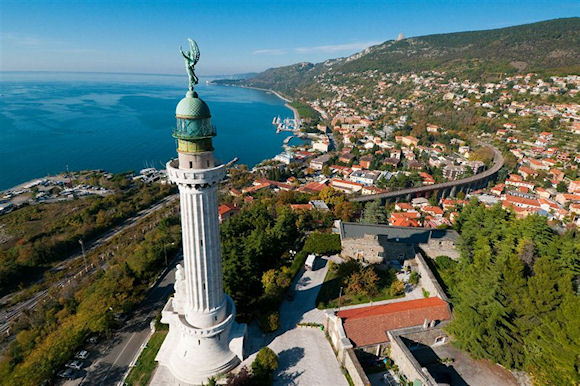
1.  Victory Lighthouse
The Victory Lighthouse (Faro della Vittoria) overlooking Trieste was built in 1927, to honor the fallen at sea during World War I. With its height of 223 feet (68 m), it is one of the tallest lighthouses in the world.


2.   Mole Audace
Our first stop on Trieste's waterfront will be at the place where Italian forces and officials arrived on a naval flotilla led by the destroyer Audace on 3 November 1918 (a day before the Armistice) to claim the city for the Kingdom of Italy.  It provides a beautiful vista of the city, which since 1955 has  once again been part of Italy.


3.  Piazza Unità d'Italia
Naturally we will walk to the nearby and highly photogenic main square of Trieste for a photo opportunity. It's said to be the largest seaside plaza in Europe.


4.  Memorial to the Fallen
Like almost every city of every combatant of the Great War, Trieste has its own monument to the fallen, which is located adjacent to the city's Remembrance Park,  Miramare Castle.


5. Miramare Castle
Before departing on our drive back to Vienna, we are stopping at a non-WWI site:  the pride and joy of the ill-fated Maximilian, brother of Emperor Franz Josef and briefly, Emperor of Mexico. Nonetheless, his castle is considered a masterpiece of 19th-century architecture, and I just didn't want to miss it.


Tuesday, August 1, 2017

Stories of World War One
Reviewed by Jane M. Ekstam


French Children at Play During the War


Stories of World War One

Edited by Tony Bradmans
Published by Orchard Books, 2014

The twelve children's stories that feature in Stories of WW1 are written by well-known authors of novels, short stories, and screen plays. The editor provides a brief but informative introduction to the collection in which he points to the importance of his school literature classes in London, and more particularly, the poetry of Wilfred Owen. It was Owen's poems that made him determined to find out more about the war. In recent years, Bradman has written a number of books with his son, including Titanic: Death in the Water, which won a Young Quills Award from the Historical Association in 2012.

Stories of WW1 covers a wide range of subjects, including life in the trenches, the people left behind, and "what happened to them and their families because of their experiences" (10). The stories address the impact of the war on children in Britain, France, Belgium, and Germany. The soldiers featuring in the stories also come from the Empire, including India and Australia. In his introduction Bradman tells his reader that "[t]here is sadness and pain and suffering in these stories, but there is hope too, and I have a feeling that if Wilfred Owen himself could read them, he would approve" (10).

At the beginning of each story the author provides a short "editor's note" by way of background. These notes are extremely helpful in understanding the writer's perspective and his/her motivation for writing the story. I have selected two stories that I find particularly poignant. The first is Ian Beck's "Propping up the Line"; the second is Tim Bowler's "The men who wouldn't sleep".

Beck introduces his story with the following lines:

'Popping up the Line' is partly based on the experiences of my maternal grandfather, Alfred Gauntlett. He was gassed in the First World War - he survived the attack, but eventually died in middle age. His lungs were so badly damaged that he would only work in the summer. He said very little to any of his family about his experiences in France. When the call came to write something about the First World War, I realised that I had a chance to write about Alfred and, mostly through invention, I have done my best to honour his story and his sacrifice (41).

There are some frightening images in the story, but these are described in terms that children will understand and with images that are familiar. A case in point is when the narrator describes soldiers hanging from the barbed wire in No Man's Land:

Whole portions of them . . . were miraculously left behind like tea leaves caught in a strainer - bits of men hooked up and hanging there for all to see, like the display in an awful butcher's window; or if there were enough shreds and rags of uniform still attached to the lumps and limbs, then it was more like the washing flapping on a Monday morning at home (44).

When Alfred returns from the front after having been gassed, he recognizes that people want to know what it is like to be in the trenches. Alfred does what so many soldiers did in real life: he keeps quiet, "he couldn't tell them anything not now or ever. He just wanted indoors, calm and a cup of tea" (54). The burden of the truth inside him must be "kept cold like the joint of a half leg of lamb in the meat safe" (55). The story concludes with his daughter Nell remembering how she used to joke with her father–and the realization that the time has passed for this. The game is over forever.

German Children at Play During the War

Tim Bowler's "The men who wouldn't sleep" is dedicated to the generation who survived World War One as well as those who suffered traumas during World War Two. Bowler acknowledges that writing "The men who wouldn't sleep" was a poignant experience. It is a story of comradeship. Jimmy has been broken by the sound of shells and become silent. His fellow soldier, Bert, who has shrapnel in his leg, returns to England with Jimmy. Bert refuses to leave his mate but cannot make him talk. It falls to Robbie, the young son of one of the nurses as well as the narrator of the story, to comfort Jimmy. It is not until Robbie tells Jimmy that his mother has received a telegram in which Robbie's father is stated as 'missing' that Jimmy reacts to Robbie's presence. While he does not verbalize his thoughts and feelings, he reaches out for Robbie's hand, and holds it tightly. He continues to hold it until he dies. The story ends with the reminder that although the suffering is over for Jimmy, Bert's pain is now more intense than ever: there will be no sleep for him. The fate of Robbie's father remains unknown; the war, however, continues relentlessly. The final, poignant line reads: "As we [Robbie and his mother] walked away [from the hospital], I heard the thunder start again across the sea" (112). Its reverberations can—and do—reach far beyond the battleground itself.

For young children who know little about the war, Bradman includes a short "editor's note" in which he describes important features of the conflict, famous writers who have commemorated the war in their fiction and poetry, and several informative websites. While Stories of WW1 is a book for children, it can also be read by adults. Ideally, it should be read by adults to young children. Each story can act as a starting point for discussing the war; in this way, the story becomes a tribute to as well as a commemoration of the deeply human side of war.

Jane M. Ekstam, Østfold University College, Norway

Monday, July 31, 2017

100 Years Ago Today: The Battle of Passchendaele Opens (A Roads Classic)


The name Passchendaele has become synonymous for waste of life and pointless orders to continue the attack irrespective of the ground conditions.
Tony Noyes, Battlefield Guide Par Excellence and Friend


Royal Mail: Lest We Forget Passchendaele

Click on Image to Expand


The horrendous losses to the French in their part of the Allied offensive of April 1917 had led to widespread mutinies during the summer. As a result, the burden of continuing the attack on the Germans in the fall of 1917 fell to the British forces. Sir Douglas Haig, the British commander-in-chief, chose the Ypres salient as the site for his new offensive. He believed this area offered the greatest scope for a breakthrough, and the Royal Navy supported him, hoping that the army could capture the ports on the Belgian coast that the Germans were using as bases for their submarine offensive against Britain's seaborne trade.

The offensive began on 31 July 1917, but made disappointingly small gains. The British artillery bombardment, which was needed to shatter the enemy's defensive trench system, also wrecked the low-lying region's drainage system, and unusually rainy weather turned the ground into a wasteland of mud and water-filled craters. For three months, British troops suffered heavy casualties for limited gains.

Inside the Menin Gate: Partial View

Click on Image to Expand


On 16 August the attack was resumed, to little effect. Stalemate reigned for another month until an improvement in the weather prompted another attack on 20 September. The Battle of Menin Road Ridge, along with the Battle of Polygon Wood fought by the Australians on 26 September and the Battle of Broodseinde on 4 October, established British possession of the ridge east of Ypres.

In October, the Canadian Corps, now commanded by Lieutenant General Sir Arthur Currie, took its place in the front lines. On 26 October the 3rd and 4th Divisions launched the first Canadian assault, in rain that made the mud worse than ever. Three days of fighting resulted in over 2,500 casualties, for a gain of only a thousand or so yards (1 km). A second attack went in on 30 October. In a single day, there were another 2,300 casualties—and only another thousand yards (1 km) gained. On 6 November, the 1st and 2nd Divisions launched a third attack that captured the village of Passchendaele, despite some troops having to advance through waist-deep water. A final assault on 10 November secured the rest of the high ground overlooking Ypres and held it despite heavy German shelling. This marked the end of the Passchendaele offensive.


After the Battle: Polygon Wood (Passchendaele Museum) 


Click on Image to Expand


Passchendaele was one of the war's most futile battles. The unspeakable conditions led to terrible losses—nearly 260,000 British casualties, including over 15,000 Canadians killed and wounded. This suffering had produced no significant gains (though it did help wear down the German Army). Passchendaele has come, perhaps more than any other battle, to symbolize the horrors of the First World War.

Sources: Imperial War Museum, Library and Archives of Canada and BBC Website

Sunday, July 30, 2017

T.E. Lawrence on the Ethical in War

From:  The Evolution of a Revolt by T. E. Lawrence (Late Lt. Col., General Staff, EEF)


T.E. Lawrence

It was the ethical in war, and the process on which we mainly depended for victory on the Arab front. The printing press is the greatest weapon in the armory of the modern commander, and we, being amateurs in the art of command, began our war in the atmosphere of the twentieth century, and thought of our weapons without prejudice, not distinguishing one from another socially. The regular officer has the tradition of forty generations of serving soldiers behind him, and to him the old weapons are the most honored. We had seldom to concern ourselves with what our men did, but much with what they thought, and to us the diathetic was more than half command. In Europe it was set a little aside and entrusted to men outside the General Staff.

In Asia we were so weak physically that we could not let the metaphysical weapon rust unused. We had won a province when we had taught the civilians in it to die for our ideal of freedom: the presence or absence of the enemy was a secondary matter.

These reasonings showed me that the idea of assaulting Medina, or even of starving it quickly into surrender was not in accord with our best strategy. We wanted the enemy to stay in Medina, and in every other harmless place, in the largest numbers. The factor of food would eventually confine him to the railways, but he was welcome to the Hejaz railway, and the Trans-Jordan railway, and the Palestine and Damascus and Aleppo railways for the duration of the war, so long as he gave us the other nine hundred and ninety-nine thousandths of the Arab world. If he showed a disposition to evacuate too soon, as a step to concentrating in the small area which his numbers could dominate effectively, then we would have to try and restore his confidence, not harshly, but by reducing our enterprises against him.  Our ideal was to keep his railway just working, but only just, with the maximum of loss and discomfort to him.

Turkish Guard Detail at a Hejaz Railroad Station

Accordingly, I put in a few damages to the line, enough to annoy the enemy without making him fear its final destruction, and then rode back to Wejh, to explain to my chiefs that the Arab war was geographical, and the Turkish Army for us an accident, not a target. Our aim was to seek its weakest link, and bear only on that till time made the mass of it fall. Our largest available resources were the tribesmen, men quite unused to formal warfare, whose assets were movement, endurance, individual intelligence, knowledge of the country, courage.  We must impose the longest possible passive defense on the Turks (this being the most materially expensive form of war) by extending our own front to its maximum. Tactically we must develop a highly mobile, highly e of army, of the smallest size, and use it successively at  distributed points of the Turkish line, to make the Turks reinforce their occupying posts beyond the economic minimum of twenty men. The power of this striking force of ours would not be reckoned merely by its strength. The ratio between number and area determined the character of the war, and by having five times the mobility of the Turks we could be on terms with them with one-fifth their number.

Our success was certain, to be proved by paper and pencil as soon as the proportion of space and number had been learned. The contest was not physical, but mineral, and so battles were a mistake. All  we won in a battle was the ammunition the enemy fired off. Our victory lay not in battles, but in occupying square miles of country.  Napoleon had said it was rare to find generals willing to fight battles.  The curse of this war was that so few could do anything else.  Napoleon had spoken in angry reaction against the excessive finesse of the eighteenth century, when men almost forgot that war gave licence to murder. We had been swinging out on his dictum for a hundred years, and it was time to go back a bit again. Battles are impositions on the side which believes itself weaker, made unavoidable either by lack of land-room, or by the need to defend a material property dearer than the lives of soldiers. We had nothing material to lose, so we were to defend nothing and to shoot nothing.  The precious element of our forces were the Bedouin irregulars, and not the regulars whose role would only be to occupy places to which the irregulars had already given access. Our cards were speed and time, not hitting power, and these gave us strategical rather than tactical strength. Range is more to strategy than force. The invention of bully-beef has modified land-war more profoundly than the invention of gunpowder.

Friday, July 28, 2017

Thursday, July 27, 2017

Remembering a Veteran: Lt. Jimmy Higgs, DSC, 7th Balloon Company


Possibly this is Lt. Higgs on the Right Side in the Balloon

No one had a better view of the battlefields of France during the First World War than NC State civil engineering alum Jimmy Higgs.  And few people survived the danger he faced, as the leader of one of 17 U.S. balloon observation companies that served on the Western front.

James Allen Higgs Jr., a native of Raleigh and a two-time graduate of the North Carolina College for Agriculture and Mechanic Arts (1906, ’10), signed up for duty at the mature age of 29, intent on going to war, just like his slightly younger classmate Frank Martin Thompson (1910).

Higgs was a slight fellow of 5 feet, 5 1/2 inches, weighing 120 pounds in a cold sweat. His greatest ambition, he said just before his graduation, was “to grow.” He knew that if he signed up as an infantryman, he likely would not survive more than a few days in the trenches that bisected the open fields of France, Belgium and Germany.

“I was a little guy, and I couldn’t fancy myself swapping bayonet thrusts with those big Germans,” Higgs told the Atlanta Journal-Constitution in 1968 in celebration of the 50th anniversary of the end of the First World War. “When the call went out to be balloon observers, I volunteered.

“They took us to Washington and put us in a machine and spun us around until we were thoroughly dizzy, then measured the time it took to regain our equilibrium. I was one of the winners.”

Being a “balloon spy,” as he was often called, was a position unique to the Civil War and World War I. Every day, from sunrise to sunset, it was Higgs’s assignment to crawl into a two-man basket tethered by cable to the front of a truck. Armed with binoculars, topographical maps and a telephone, he would fly high (up to 5,000 feet) over the battlefield and report troop activity to his commanders on the ground. Usually, he was with a French observer who was relaying similar information to his superiors.

As if flying unprotected over the battlefield wasn’t dangerous enough, the sausage-shaped gasbags were filled with highly flammable hydrogen, making them susceptible to fires started by the hot rounds coming from guns below. They were also sitting-duck targets for the biplanes that attacked from behind the clouds overhead.  Four times over the course of four months, Higgs was shot down, jumping out of the basket and praying that the parachute stuffed on the outside of the balloon basket and harnessed to his back automatically deployed after he cleared 300 feet.

Each time, he went right back up.

Once, he was trying to coerce his partner to escape for his life and was met only with a blank stare from a non-English speaking partner. He quickly ran through his memory banks to find the French word for “jump.”

Jimmy Higgs Did This Four Times!

“We were supposed to stay in the balloon until our telephone man on the ground told us to jump,” Higgs told the AJC. “Noise carries upward much louder than along the surface. The guns were making such a racket I couldn’t hear over the phone.

“Finally, I made out the words ‘Jump! Jump!’”

When he relayed the order to the French sergeant, he got no response.

“I realized he didn’t understand English, and hollered, ‘Sautez! Sautez!’ and pointed the way he was to go. He went over the side and I followed him.”

It was anything but a peaceful trip to the ground.

“We were each wearing parachute harnesses with a rope attached to the ‘chute that was stuffed into a bag hanging outside the basket. Our weight would pull the ‘chutes out of the bags. They were supposed to open when we dropped 300 feet. It takes nearly five seconds to fall 300 feet from a standing start, and that is a long time to wonder whether you are going to live or die.

“The parachute opened with a considerable jolt, but it was a very pleasant feeling. I closed my eyes until the parachute popped, but I kept them open on subsequent jumps.”

Higgs’s only compensation for jumping out of a falling balloon on four occasions? Each time, he was awarded 48 hours of leave in Paris to “settle his nerves and get ready to go back up again.”

Which he did until 11 November 1918, when the bells of Paris signaled the pre-arranged armistice between the warring forces. Weather did not allow Higgs to go up at the time of the ceasefire, but the following day he did up to 5,000 feet—the limit of his balloon’s steel cable—to make sure German forces were pulling out as promised.

“The end was an amazing thing,” he said. “I had been hearing guns roaring around and under me, and sometimes, enemy shells and bombs bursting in our camp, for almost a year,” Higgs said. “Sharp at the stroke of 11, they all stopped. There were no birds or animals in the war zones to make the usual noises, and no machines moved.

“I found myself listening for just any sound, but there was none.”

Higgs chronicled his balloon exploits in detailed letters to his mother, Mattie A. Higgs, who lived on Raleigh’s North Blount Street from 1889 to 1964. They were retold many times through the years to his NC State brethren during his visits from Atlanta, where Higgs settled after the war, to Raleigh, where his family remained.

Jimmy Higgs in 1968
Higgs was a loyal and devoted NC State alum and served as the president of the Alumni Association in 1938. A vice president and regional manager of the Massey Concrete Products Corp., Higgs never missed an Atlanta-area alumni meeting.

He was awarded the Distinguished Service Cross, the second-highest honor given by the U.S. Army, for extreme gallantry and risk of life during his daily work as a balloon observer. His citation reads:

1st Lieutenant James A. Higgs, Jr.–Distinguished Service Cross
Date of Action: July 31, August 21 and October 29, 1918

The Distinguished Service Cross is presented to James Allen Higgs, Jr., First Lieutenant (Air Service), U.S. Army, for extraordinary heroism in action near Pont-a-Mousson, France, July 31, 1918. Lieutenant Higgs was carrying on a general surveillance of his sector from his balloon with a French soldier, when an enemy plane dived from a cloud and opened fire on the balloon. In imminent danger he remained in basket until he had helped his French comrade, after whom he himself jumped. On August 21, in the same sector, Lieutenant Higgs was performing an important mission regulating artillery fire. Enemy planes attacked, and with great gallantry Lieutenant Higgs remained in the basket until his assistant had jumped. On October 29, near Gesnes, Lieutenant Higgs was conducting a réglage from the basket with a student observer.  Attacked by enemy planes, after his balloon was burning, Lieutenant Higgs would not quit his post until he had assisted his companion to escape. In each of the foregoing instances, Lieutenant Higgs at once re-ascended in a new balloon.
General Orders No. 126, W.D., 1919 

While Higgs survived his 18-month service, unlike so many who are celebrated annually on Memorial Day, he did know the tragedy of war. His father and three uncles were part of the 3rd North Carolina Cavalry in the Civil War.

And he and wife Mary Marbury—a descendant of North Carolina’s first governor, Richard Caswell—were the proud parents of two sons, James Allen Higgs III and Caswell Marbury Higgs. The younger son followed his father’s footsteps as a military hero, enlisting in the U.S. Army in 1942 as a second lieutenant, shortly after completely his sophomore year at the Citadel in Charleston.

A machine-gun platoon leader, Caswell Higgs was shipped overseas in 1944 and landed on Normandy’s Utah Beach two months after D-Day. Serving in the Army under Gen. George S. Patton, the younger Higgs was killed in action five months later, leading his men across the Rhine River. He was posthumously awarded the Silver Star for bravery on the battlefield, making him a second-generation war hero.

Higgs’s grandson, James Allen Higgs IV, was an Army Ranger in Vietnam.

Higgs died on 30 June 1971, at the age of 83 and was buried in a private cemetery in Atlanta. He never forgot his Raleigh roots, his NC State education, or his fallen comrades.

In March 1919, just weeks after returning from France, Higgs was among the first alumni to donate to the proposed Memorial Tower to honor the NC State soldiers who perished in Europe’s Great War, by sending a check for $5 to director E.B. Owen in the Alumni Office.

This post was originally published in the NC State News.  Thanks to Jerry Hester for sharing it.

Wednesday, July 26, 2017

Italy's Most Successful Advance on the Isonzo (A Roads Classic)

Today with my tour group, I'm starting a visit to the battlefields around Gorizia described here. In the grim campaign of attrition that were the 11 battles fought along the Isonzo River, the Sixth Battle of the Iszono was the greatest accomplishment of the Italian Army. MH

Overview

If the campaign is protracted, the resources of the State will not be equal to the strain. . . then no man, however wise, will be able to avert the consequences that must ensue.
            Sun Tsu—The Art of War 

Action on the Rocky, Barren Carso Plateau

When Italy entered the Great War in 1915, it hoped to tilt the balance of force against the Central Powers, ending the war quickly and allowing them to gain some long sought after territorial gains on the cheap. By the start of 1916, however, Italy found it was engaged in a protracted total war, placing undreamed-of social and economic strains on the nation. Italy's government and military had to justify this burden with some successes on the battlefield. Their new allies had also started placing demands on them to continue on the offensive to alleviate pressures on their fronts. Austria-Hungary, likewise, had mobilized its entire empire to support its war effort and needed to keep popular support. Also, to inhibit the disintegration threatened by the growth of ethnocentric nationalism, Austria-Hungary could not afford to surrender any territory. On the Isonzo, all of this meant that in 1916 Italy needed to continue attacking and Austria-Hungary needed to continue defending. The war of attrition would continue growing with both sides blind to the inevitable consequences. 


Fifth Battle of the Isonzo
9–17 March 1916


In February of 1916, on the Western Front the German Army launched a tremendous assault on the city of Verdun and its surrounding fortress zone in northeast France. At a conference at Chantilly, France Marshal Joffre requested that Italy and Russia take the offensive on their respective fronts to reduce pressure on the French forces. Cadorna ordered a broad, but half-hearted, offensive nearly immediately. 

Probes were made at Tolmino, Gorizia, and the Carso. In most cases they were more demonstrations than full assaults. These died out after about a week because of bad weather and some bracing counterattacks staged by the Austrians, most notably at Santa Maria near Tolmino. The Italian Army also still needed more guns and artillery shells. The Allies committed to sending Italy heavy artillery pieces, but further offensives were delayed until the new weapons and sufficient shells could be assembled. 

Meanwhile, in the Trentino, the Austrians were marshaling their own forces for an assault. If they could mount a successful attack down off of the mountains, cross the Asiago Plateau, then occupy the Venetian Plain, they could cut off all the Italian forces in the Carnic and Julian Alps and along the Isonzo. This major operation, called the Battle of Asiago by most and the Straffe [Punishment] Expedition by some began on 15 May 1916.

At first the Austrian attack in the Trentino looked dramatically successful. Comando Supremo delayed further its plans for offensive operations and moved troops to reduce the threat to their rear. The deployment from the Isonzo to the Asiago Plateau was done fairly quickly since the Italian forces were traveling over shorter, interior lines. By early June the Austrian offensive was grinding to a halt. The Italian situation was further helped by the Russian response to their call for pressure on the Austrian Army on the Eastern Front. The subsequent series of actions known as the Brusilov Offensive were so successful that Austrian Supreme Commander Conrad von Hötzendorf was forced to give up his Trentino Offensive and move troops to distant Galicia. Italy responded in turn by mounting a counteroffensive which ultimately regained part of the Asiago Plateau. 

Back on the Isonzo Front, Austro-Hungarian Fiftthe Army Commander General Borojevic had decided to strengthen some local positions, while the Italian Third Army was directed to mount attacks to discourage the Austrians shifting more men to the Trentino. Italian operations at Monfalcone were fairly low-scale, but the concurrent Austrian attack on the Carso marked a turning point for the Great War on the Italian Front. In their assaults on the Italian IX Corps at Mte San Michele and San Martino they introduced gases of the asphyxiant type leading to some quick local successes with heavy losses casualties among their opponents. The Italian killed, wounded, and gassed totaled 4,600 men in just a few days. 

Gorizia Castle Looking North
The Approaches to Gorizia Are Guarded by Mountains to Both the North and West

As the Italian counteroffensive on the Trentino slowed, the focus of Comando Supremo shifted back to the Isonzo. Now, they decided, the time was at hand to capture strategic Gorizia. Again, they used their shorter interior lines to shift troops, this time back to the Isonzo sector. In August they would be ready to mount what would turn out to be the most successful of their 11 Isonzo Offensives. 

Sixth Battle of the Isonzo 
4–17 August 1916


The Sixth Battle of the Isonzo is also known as the Battle of Gorizia, after Italy's sole objective for the operation. For once, by practicing the principle of mass or concentration and limiting the initial battlefield to an eight-mile-wide front, General Cadorna was able to align ten of his divisions against only two of his enemy's. This was made possible by the secrecy surrounding the preparations and his speed in switching back units from the Asiago sector.

The Isonzo, Where the Italian Army Crossed in Force

The battle began with what was intended to be a diversionary artillery barrage and an infantry feint by units of two corps against Monfalcone to the south. The fighting got out of control, though, resulting in over five days of tough combat. The diversion failed to draw any Austrian units around Gorizia south. 

The main advance began two days later from the towns of Oslavia and Padgora and featured the capture of Mte Sabatino and Mte Padgora despite strong resistance and heavy counterattacks. On 8 August, units of the 12th Italian Division were the first to enter Gorizia. The next day the Isonzo was crossed in force and the city secured. On the southern perimeter, the front broadened, growing to a width of 15 miles. The fierce fighting characteristic of the Carso was once again renewed. Mte San Michele and Mte Sei Busi were finally seized, but at tremendous loss of life. The Italian advance on the Carso continued several miles to the dry river bed of the Vallone.

Typical Brutal Terrain on the Carso Plateau, Just South of Gorizia

General Cadorna turned a bit cautious and Borojevic brought up reinforcements who dug in at strong locations, and the operation ended fairly quickly. The advance of three miles depth over the 15-mile front with the capture of several strategic targets was the first major offensive success by the Italian Army during the Great War. Italian morale temporarily soared and on 29 August the government finally declared war on Germany. For their gains, the Italian Army had suffered 50,000 killed and wounded; on the defense, Austria-Hungary lost 42,000. Planning was initiated by Comando Supremo to expand the Gorizia bridgehead as soon as sufficient ordnance could be collected.

Tuesday, July 25, 2017

General Fox Conner: Pershing's Chief of Operations and Eisenhower's Mentor
Reviewed by Ron Drees


General Fox Conner: Pershing's Chief of Operations and Eisenhower's Mentor

by Steven Rabalais
Published by Casemate, 2016

Major General Fox Conner
This biography of Fox Conner brings to life a forgotten soldier who, albeit behind the scenes, was the most influential American officer of the first half of the 20th century. While Conner held few commands and no combat positions, he designed armies and trained leaders who had enormous impact beyond his own service.

Conner was born in Mississippi, the son of a Confederate soldier blinded in the war. Yet his father presided over an academy that gave Fox not only the rudiments of an education but a lifelong love of learning. His parents did have the influence to wangle an appointment to West Point, but he needed two attempts to pass the entrance exams before he was admitted. Once there, he earned more than his share of demerits for smoking and for crossing with a disciplinarian, John Pershing. The smoking would contribute to serious health issues and eventually his death, but Pershing would be a mentor and impetus to his career. Conner also became fluent in French, which, along with his War College background, made him an ideal staff officer for Pershing when America entered the Great War.

U.S. preparedness for war was laughable. Joffre requested that the U.S. send a division immediately. The U.S. did not have a division, only a few regiments. Secretary of War Baker wanted Pershing to depart quickly with a staff. There was no staff and only a few officers had received staff officer training. Eventually a few officers were rounded up, shipped to Paris and went to work. One thing Conner did was to design a division—four regiments, two brigades.


While initial forces were assigned to the French, Pershing and Conner eventually pried them loose to become the American Army. Conner as chief of ops directed their use in the war, where they would be deployed and attack. He also received a political education as some recommendations were refused. Along the way, Major Conner became BG Conner.

Intertwined in Conner's story are the tales of other future luminaries: Marshall, MacArthur, Patton, and the tanker Eisenhower. Due to the AEF's rush to ship thousands of troops to France, tanks and tankers remained stateside, much to the future regret of the war planners. Eisenhower sat out WWI, training tankers.

The decisive battles of 1918—and Conner's decisions—are described with numerous maps. I would have appreciated a book with a larger format so that the maps could be more easily read. There were controversial decisions regarding the race to Sedan and the relentless combat of 11 November, that Conner would have to defend to a dubious Congress in 1920.

No mention is made of Pershing relinquishing command of the First Army when the Second Army was formed nor of the Black Day of the German Army.

Conner During the Interwar Period
There were additional postwar assignments for Conner; plans to restructure the Army and its divisions, Patton's dinner introducing him to Dwight Eisenhower, planning for a future major war, and then assignment to the Panama Canal Zone with his invitation to Major Eisenhower to join him. Prior to that transfer, General Conner used his connections with Marshall to bail Eisenhower out of a potential court martial for claiming an unjustified financial housing reimbursement. If that court martial had progressed, Ike's career would have been over and American history from 1942–1960 would have been much different. Instead, the two would serve together in the Panama Canal Zone from 1921–1924, not only as commanding officer/subordinate but also as mentor/student.

Conner, with his extensive personal library, would tutor Eisenhower in military history, discussing what was done, why, and the results. He would also instruct the major in army procedures, preparing him for the advanced school at Leavenworth, where he received very high marks.

Conner went on to fight more battles with budgets and bureaucracies, mostly on the losing side, to better prepare the army for the next war. When given a command, he trained troops vigorously, but with bouts of ill health and a freakish accident, he was forced to retire early and did not serve during WWII, dying in 1951 asking for cigarettes. Obviously, his student Eisenhower did serve with a phenomenal record, which he attributed several times to Fox Conner.

Conner was a tactician, an intense student, instructor, theoretician, mentor, and far-reaching planner. He deserves more prominence than he has received and deserves attention from every Great War student.

Ron Drees

Monday, July 24, 2017

Ace Maker: The SE-5A


SE-5A at the USAF Museum

While flyers of the Sopwith Camel are credited in aggregate with the most victories associated with one aircraft design, the later arriving SE-5a (Scout Experimental 5, model A) of the Royal Aircraft Factory is considered by most experts, including our friend the late Javier Arango, to be a superior—certainly vastly more stable—fighter plane. Some of the greatest British ace of the war flew the aircraft and compile huge victory totals late in the war. Here are three legendary aces who flew the SE-5a.

 Capt. Albert Ball (1896–1917 [KIA])
• 44 victories
• Was reluctant to give up his Nieuport 17 in favor of the new SE 5a
• Within the period of three months over the Somme he accomplished his first 30 victories


Major Edward (Mick) Mannock (1887–1918 [KIA])
• 61 victories
• Trained under McCudden
• Scored 46 victories in the SE 5a
• Won the Victoria Cross eight days before his death


Major James McCudden (1895–1918 [KIFA])
• 57 victories
• By early April 1918 was the most decorated pilot in the RAF
• Brother John (2nd Lt., MC; 8 victories; KIA, March 1918) also flew the SE 5a

Sunday, July 23, 2017

An Earlier Contribution of the AEF: Doctors and Nurses for the Allies


 There was an unexpected windfall for the Allies when America joined the war—help with the enormous load of casualties in the 1917 campaign. The first American military installation in France during World War I was Base Hospital No.4 (Cleveland), which arrived to cheering French crowds on 25 May 1917, 19 days ahead of General Pershing and the nucleus of his American Expeditionary Force staff. Also known as the Lakeside Unit, the Cleveland unit served at Rouen throughout the war. American physicians, nurses, and enlisted men such as these would be the earliest AEF participants to face the possibility of death and destruction—actually months before the first American soldiers would see combat. 

The British relied heavily on these American units. By 1917 their Medical Department was having trouble handling the massive numbers of casualties. The numbers of casualties treated by the American base hospitals with the British demonstrates the heavy load of patients.


Base Hospital No.4 treated 82,179; No. 10 treated 47,811; and No. 21 treated about 60,000. These numbers do not include the numbers of patients the Americans treated at the Casualty Clearing Stations or while working with British units. Overall, a daily average of approximately 800 officers, 600 nurses, and 1,100 soldiers was serving with the British. 

One of the hazards they faced was German night bomber raids, which attacked hospitals despite the Red Cross markings. Tragedy struck 4 September 1917, when the Germans bombed Base Hospital No. 5 at Camiers, killing Lieutenant William T. Fitzsimmons and Privates Oscar C. Tugo, Rudolph Rubino, Jr., and Leslie G. Woods, who became the first AEF casualties by enemy action..

Sources: U.S. Army Surgeon General Reports and Official History

Saturday, July 22, 2017

Chinese Labor Battalions on the Western Front

The Chinese Labor Corps (CLC) was a force of workers recruited by the British government in World War I to free troops for frontline duty by performing support work and manual labor. The French government also recruited a significant number of Chinese laborers, and although those laborers working for the French were recruited separately and not part of the CLC, they are often considered to be so. In all, some 140,000 men served for both British and French forces before the war ended, and most of the men were repatriated to China between 1918 and 1920. Below is an example of how an unnamed British war correspondent described his first encounter with these men.

CLC Workers on the Boulogne Docks


From: War Illustrated, 27 July 1918


Oh, East is East, and West is West, and never the twain shall meet

The thought embodied in this hackneyed line of Kipling is but one of many accepted conventions which the Great War has challenged. They who talked rather vaguely at first about a "world war" have long since been able to talk definitely. In a way which they could not dimly have visioned, during the earlier months of the struggle, it has truly developed into a world war, wherein East and West have been fated to "meet."

On my first war-time crossing of the Channel, among the ships of the convoy were two steamers from whose upper decks multitudes of strange folk looked across at us. They were all dressed alike in long, loose-fitting cloaks of ruddy brown material, and they wore little caps with cat-flaps not unlike those donned by our airmen when aloft. Their hair was jet black, their strange, expressionless' faces berry brown. They were Manchurians nearing the land of war to give their labor to the cause of Britain – for a sound, commercial consideration be it premised. Figure what it means to sign a contract for three years' work at a place over six thousand miles away from your home! And those Chinamen, when I first saw them at a Channel port, might have been on a day's outing, if one could have judged by the unruffled calm of their faces.

CLC Workers at a Tank Repair Yard

At that time one had heard vaguely about "Chinese labor," but here was its embodiment in these two shiploads of grinning Orientals, who looked so curiously alike that one seemed to see the same man a hundred times over.  It is a success – one of our real war successes. These Chinamen can and do, work well, and thus augmenting the labor power behind the lines, release men for the fighting-front. They are not all mere unskilled laborers. Many of them are craftsmen, and these are carefully sorted out and put to superior work, receiving special pay. Most of all these Chinamen interested me. I felt that East and West had met, and, working as they were to a common end, though differently impelled, there would be some interfusion of thought which would in a future day help towards a kinship of humanity where Kipling saw only a cleavage.

Source: Wikipedia, Relevance

Friday, July 21, 2017

The Great War's 101 Defining Events: Numbers 81–90


81–90

(click on image to enlarge)

This series will run every Friday on Roads to the Great War through its completion.

Thursday, July 20, 2017

Tolkien's Unique View of the War

We recently re-watched the Lord of the Rings trilogy at home thanks to Netflix. It was a most rewarding experience and it reminded me of a piece that O'Brien Browne contributed to the journal Relevance when I was editing it back then. Here is the pertinent section:

The popular image of WWI "war literature" is exemplified by the sarcastic irony of writers like Siegfried Sassoon, or the tragic compassion of Wilfred Owen. Paul Fussell's powerful and immensely influential, brilliantly crystallized these themes. Fussell's subtle, multi-layered arguments have been grossly misconstrued by academics, modern novelists, and even film makers, but his ultimate point is that the romantic epic suffered a fatal wound in the "stupid" and "senseless" First World War.

J.R.R. Tolkien During the War
Tolkien, however, shows us that this is a misconception. In stark contrast to the disillusionment and anti-war sentiment of the post-war period, Tolkien unabashedly kept alive the tradition of war as a noble and romantic ideal. He not only rejected modernism but also revived the heroic epic along with concepts of Faërie and pastoral romanticism in English literature. In so doing, Tolkien—one of the most interesting and influential writers of the 20th century—has sold millions of copies of his books around the world, and he is easily the most widely read writer to emerge from the inferno of WWI. Despite what the poets and academics tell us, the romantic epic lives on with vigor and dash in Tolkien's cavalry charges, beautiful princesses, lush green vistas, and shimmering enchanted forests.

But creativity has its costs. Like many ex-soldiers, Tolkien downplayed, suppressed, ignored, and even outright denied the effects of the war on him. "One War is enough for any man," he told his son. Yet its affects stayed with him all his long life. In 1940, writing to his son Michael, who had volunteered to fight in WWII, Tolkien hinted at the things he had lost in the First War, "I was pitched into it all, just when I was full of stuff to write, and of things to learn; and never picked it all up again." There is no real happy ending in Tolkien. His characters are put to great ordeals from which they emerge transformed. Frodo, for instance, is physically and mentally scarred, his life forever altered by what he has gone through, the things he has lost. 

He is one of the walking wounded. By not killing off Frodo, ex-soldier Tolkien is telling us that the pain of death is momentary, but the pain of life is long-lasting and cuts deep. The trick is not merely survival, then, but how one survives. Tolkien had experienced pain all his life—the early deaths of his parents, financial hardships, the war; his memories must have been awful at times. Thus, like many of us, he retreated into his mind and found there a land of heroes, beauty and great deeds. And when war came to his four Hobbit heroes, Frodo, Sam, Merry, and Pippin, Tolkien could not bring himself to let them die; he had lost friends in a real war and he wasn't about to lose any more in a fictional one. But still, the memories remained. "I can see clearly now in my mind's eye," Tolkien recalled as an old man, "the old trenches and the squalid houses and the long roads of Artois, and I would visit them again if I could…" He never did, except in his books.

The war changed Tolkien. It injected loss and sadness and pain into his writing. It made his descriptions more poignant, more real. Mordor could not have existed had Tolkien not experienced it firsthand on the Somme. But the war taught him to value positive things as well, such as pity, heroism, loyalty, and the meaning of friendship—themes which run throughout all of his works. "May God bless you, my dear John Ronald," Rob Gilson had written Tolkien from the trenches shortly before he was killed, "and may you say the things I have tried to say long after I am not there to say them." Tolkien said them, and through his memories and through his words he paid homage to his little group of dreamy, ambitious friends who had gone off to fight in the Great War of their times. And his books have enriched all of our lives.

Source:  Relevance, Fall 2009

Wednesday, July 19, 2017

A Raptor Pilot on the 21st-Century Relevance of Boelcke's Dicta

Today at Langley AFB, Virginia, the 1st Fighter Wing of the U.S. Air Force operates and maintains the F-22A Raptor and F-15 Eagle. The wing is organized into two groups: an Operations Group and a Maintenance Group. Of three fighter squadrons in the Operations Group, the two that fly the state-of-the-art F-22 Raptor both distinguished themselves in the Great War: the 27th Fighter Squadron (FS), now known as the Fightin' Eagles, and the 94th FS, now known as the Hat-in-the-Ring Gang.

The Wing is a direct descendant of the famed 1st Pursuit Group from the war with both Raptor squadrons sharing that lineage. In World War I, when it was originally known as the 1st Pursuit Organization and Training Center, the Wing scored the first aerial victories of the U.S. Air Service in France by Lts. Alan Winslow (over an Albatros D.V) and Douglas Campbell (Pfalz D.III) from the 94th Aero Squadron. By the time the war ended, the unit's name had been changed to the 1st Pursuit Group and it had earned 202 confirmed kills. Its roster of pilots included Medal of Honor recipients Frank Luke and Eddie Rickenbacker.


In 2010 I had the opportunity to interview Major David "Zeke" Skalicky who then flew the Raptor demonstration missions for the Wing.  I was curious if modern fighter pilots, flying 5th generation aircraft consider Oswald Boelcke's rules of aerial combat–Boelcke's Dicta–still relevant. His answer's were surprising and interesting.

MH: The German aviator Oswald Boelcke developed a set of rules for fighter pilots known as Dicta Boelcke. Richthofen, for instance, swore by them. Are they still valid? Are there new rules for 21st-century fighter pilots?

DS: F-22 tactics are written in classified manuals known as TTP (tactics, techniques, and procedures). They provide general and specific guidance for how to effectively employ the aircraft in a wide variety of scenarios. While I can't discuss any Raptor specific details in this forum, I can comment on Boelcke's principles in general. Most of Boelcke's principles are still valid in modern
aerial combat. Let's step through them:

1: Try to secure advantages before attacking. If possible keep the sun behind you.

Absolutely! For the Raptor, stealth helps secure the advantage of surprise before attacking. Putting the sun at your back can make it hard for an enemy to find you with his eyes or infrared sensors.

2: Always carry through an attack when you started it.

At close range, in general, I'd say that's true. Aborting an attack at close range can potentially leave you defenseless to the enemy's weapons. Most attacks nowadays. however, start at very long range with beyond-visual-range (BVR) weapons. You may start an attack on an enemy who appears to be making a run at your territory but abort it if he turns around or doesn't show hostile intent (such as a defector).

3: Fire only at close range and only when your opponent is properly in your sights.

Caveat: The gun was the only aerial weapon when Boelcke was flying. Shot range depends on an infinite number of variables; the type of adversary, his capabilities, your weapons available, number of follow-on enemies, proximity to friendly forces, etc. Only taking valid missiles and/or gun shots, however, is universally a good idea.

4: Always keep your eye on your opponent and never let yourself be deceived by ruses.

There isn't a single fighter pilot alive today that hasn't heard, "…can't fight what you can't see" and "…lose sight, lose the fight". They remain as true today as they were back then. Stealth gives the Raptor a huge advantage in this area.

5: In any form of attack it is essential to assail your opponent from behind.

Agreed, the most stable gun shot is from the opponent's six o'clock. However, modern aerial weapons mean it is not always essential you attack from behind your opponent.

6: If your opponent dives on you, do not try to evade his onslaught but fly to meet him.

In a visual engagement, absolutely! Meet him head on and may the best man win. Turning to run will most likely leave you defensive from a diving opponent with more energy.

7: When over the enemy's line never forget your own line of retreat.

Always leave yourself an out. Getting outflanked or putting yourself into a situation where your only option is to continue attacking in one direction makes you very predictable and an easier target.

8: For the Squadron: Attack on principle in groups of four or six. When the fight breaks up into a series of single combats take care that several do not go for one opponent.

To me, this addresses the concept of proportionality. Proportionality is a key concept for an aerial mission commander to consider. In Richthofen's era, a single attacker was proportional and effective against a single enemy. Today a single attacker may be effective against one, two, or ten enemies, depending on the type of adversary and capabilities of the weapons system. A mission commander must consider that sending four attackers against a single enemy is probably not an efficient use of his resources. He must also consider that dividing his forces into "raging singletons" may reduce their mutual support for one another and decrease survivability and effectiveness. An updated wording may be "commit forces in a proportional manner to the threat posed by your opponent."

MH:  Thank you, Major Skalicky