Now all roads lead to France and heavy is the tread
Of the living; but the dead returning lightly dance.
Edward Thomas, Roads

Tuesday, March 17, 2020

From Marne to Verdun: The War Diary of Captain Charles Delvert


by Charles Delvert
Translated by Ian Sumner
Pen & Sword, 2016
Michael Kihntopf, Reviewer


Charles Laurent Delvert (1879–1940) entered the French Army in 1899 as a one-year volunteer in an effort to complete his military obligation early and decrease the time spent in the army from three years. After the year, he was released to the reserves for a period of 12 years followed by seven years in the territorials. He maintained his association, rising through the reserve ranks and receiving a commission in 1912. Between 1900 and 1914 he attended two autumn maneuvers, one in 1902 the other in 1912. When the war started, Delvert was called to command the 2nd Platoon, 4th Company, 101 Infantry Regiment, 7th Division. He began his diary on the train platform as his regiment left Paris and kept it until demobilization in March 1919. The diaries are extensive and produced three books of his authorship and a number of books by others whom Delvert accused of adding dramatization when none existed. This work covers 7 August 1914 to June 1916.

From Marne to Verdun is an infantry soldier's diary arranged in daily fashion. There are descriptions of duties and the problems in dealing with the men, but most illuminating are the personal notations. Those notations are highlighted by footnotes written after the war which go into detail about the event or persons and offers scathing criticism in a spirit of anti-war. First encounters with the Germans in Belgium are of interest. The entries show how the attitude of à outrance resulted in needlessly high casualties. Of note was an incident where two battalions of the 130th Infantry Regiment were nearly annihilated in just a few minutes. One battalion was caught eating a midday meal while the other was ordered to charge entrenched machine guns without artillery preparation.

Delvert lamented the fact that the battalions had no idea of whom or what they were facing. In his early entries he complained about the lack of reconnaissance and heavy artillery, noting that the Germans were far better prepared for war. Cavalry, the source of information, was nowhere to be found, hence the unpreparedness of one battalion, while heavy artillery had been eschewed in favor of the more mobile 75mms during the previous years. The 75s had a flat trajectory which made them nearly useless for indirect fire or in dealing with fortifications. The Germans could stand off hidden behind hills with their howitzers and pound both soldiers and artillery without risk to themselves.

There are also comments about morale. French Army regulations required that territorial and reserve units had to be commanded by line officers. Those line officers looked down on their reserve fellow officers as inferior (Delvert also mentions that his peacetime training was totally inadequate) lacking a clear sense of any military situation and telling them numerous times just how inferior they were. Consequently, decisions were reached not by consensus but by the will of the commander.

Additionally, reserve officers were not considered for decorations or promotions until the line officers received theirs. The attitude was that the war would be short and line officers would have a career after. This attitude did not change as the war progressed and the line officers were killed off. Delvert also states that the soldier was considered merely as a means to an end. Line officers very rarely consider their needs. These themes repeat themselves throughout the diary. Verdun, where Delvert commanded a company on the west of Fort Vaux, is a real eye-opener.

Capt. Delvert
French artillery shooting was blind. The artillery commanders refused to send forward observers to direct shots, and the areas occupied by French forces were unknown because of the constant attacks and counterattacks. The result was that French artillery was more deadly to Delvert's men than were the German cannons. He was constantly shooting up green flares to tell the artillery to lengthen their range. Within a day he ran out of green flares. Delvert had had no idea just how precarious his company's existence had been until he reported to the battalion after relief where he found out that he and his men had been written off. The commander hugged him and treated him like a long-lost son, marveling at his survival.

From Marne to Verdun is an excellent book. We have very few translated French experience books available and this is one of the best, as evidenced by the many works which used Delvert's entries to their own purposes. I can find little fault in his entries, although those which are made while not under fire do get a little flowery. One of the things I found most interesting was his description of the men commanding him and the men he commanded. A reader could almost draw composites of the soldiers, it is so complete with heights, physical stature, eye and hair colors, and foibles. I cannot list all the things that I found so interesting.

Michael Kihntopf

Monday, March 16, 2020

Behind the Lines: Belfort and Its Lion at War


The View of Belfort from Atop the Citadel

The Citadel of Belfort, France, and the surrounding system of forts, formed the first line of defense in the Séré de Rivières system of fortifications in the Belfort Gap. Located in northeastern France between Épinal and Besançon, the primary line was built in the late 19th century to deal with advances in artillery that had made older defensive systems obsolete. 

The Lion of Belfort is a monumental statue by Auguste Bartholdi, sculptor of the Statue of Liberty, that is situated against the cliff underneath the castle of Belfort. Completed in 1880, it symbolizes the heroic resistance of the French army besieged in Belfort during the French-Prussian War (1870–71). Prussian forces assailed the city of Belfort for 103 days. The invading force numbered around 40,000 strong against the mere 17,000 French forces, but the Prussian siege was defeated. The defenders were eventually ordered by French authorities to cease their defensive efforts. All of France, nevertheless, considered the defense  a lone victory in an otherwise disastrous war. 

The Lion of Belfort

The statue is made entirely of red sandstone from the Vosges and evokes the sphinxes from ancient Egypt. The lion is 70 feet long, 37 feet high, and watches over the old town with a combative look on its face. It was initially planned to face toward Germany until the sculpture was finally set westward after German protests in the 1870s.

Because of its heroic status, and possibly because of the fame of the statue, Belfort was considered an option to Verdun as the site of an attritional battle that the French nation and army could never abandon.

The Lion Up Close

Smaller copies in bronze stands in the center of Place Denfert-Rochereau in Paris and in Dorchester Square, Montreal, Quebec.

Belfort was the anchor for Joffre's opening diversionary attack as part of Plan XVII, known as the Battle of Mulhouse.  Afterward, despite the setback, Belfort remained in French hands for the entire war. In 1918 American intelligence officers, assisted by the French, planted disinformation documents in a Belfort hotel indicating U.S. forces were planning to attack through the Belfort Gap to capture Mulhouse, rather than against the St. Mihiel Salient as was actually the impending offensive. The effort was later called the "Belfort Ruse." Long after the Armistice, it was discovered the ruse had been successful and had allowed Pershing's First Army to achieve tactical success in the opening of the St. Mihiel Offensive on 12 September 1918.

Sources: France's Monuments, Atlas Obscura, and Wiki Commons

Sunday, March 15, 2020

The Doughboys' Grenades


Described by Sgt. Donald D. Kyler,
16th Infantry, 1st Division

Grenades Used by the AEF

[During our training at Domremy-la-Pucelle] we were given instruction in the use of grenades. At first it was by French non-commissioned officers, using their grenades, which were of several types. The first was a training grenade, made of sheet metal, and could be thrown about ten yards away and left to explode with little danger of fragments harming the thrower. But they were not to be closer than that. We had a few cases of men being injured by not throwing quickly enough or far enough. The second type was a fragmentation grenade, made of iron, and with much more explosive power. It was for longer range use, or to be thrown around or behind something, or in a hole or dugout. It would be dangerous to be thrower if it exploded anywhere near him. Another type, heavier and with more explosive power, was for throwing into the openings of caves or fortifications, etc. Immediate cover had to be taken by the thrower to escape the resulting blast.

Those devices were all pear shaped, with a pin sticking out of the small end about half an inch. That end had a metal cap covering the pin, secured with sealing wax. When ready to use the grenade, the cap was twisted off and the pin pushed in, which ignited a time fuse. Five to seven seconds after the pin was pushed in the blast would occur. So there was no time to be lost in throwing the grenade. The short time fuse was necessary so that the enemy would not have time to throw the grenade away from him. However, they have been known to do so. Ideally, the timing should be such that the grenade would explode just as it reached the target.

The grenades came to us packed tightly in wooden boxes and were well protected. In taking them into the field or trenches, it was our practice to carry them in bags. Rough handling sometimes loosened the protecting cap over the firing pin. I heard of an accident when grenades in a hag exploded, causing causalities.

Another type of grenade was the rifle grenade, which was fired from a grenade launcher. The grenade launcher was shaped like a beer bottle with the bottom removed. The neck of the launcher was placed over the muzzle of the rifle and locked in position by a twisting motion. They were issued one to each squad. The grenade had a hole through its center the same size as the rifle barrel, and was placed in the open end of the launcher and let slide down until it came to rest on the decreasing inside diameter of the neck part of the launcher. The butt of the rifle was placed on the ground and was ready for firing. When fired, after the bullet had passed through the grenade, there was an area of high pressure still in the rifle as the bullet left it, which gave the grenade a considerable boost into an arched trajectory. The maximum range could be achieved by holding the axis of the launcher at slightly more than 45 degrees from the horizontal. At a [greater] angle than that the range would decrease, until by holding it straight up, theoretically the grenade would come down on the launcher. From the maximum range of perhaps two hundred yards the range could also be decreased by holding the launcher at an angle less than 45 degrees from the horizontal, until at the horizontal the range would be only a few yards, which was impractical for a number of reasons.

A Member of the 369th Infantry [Harlem Hellfighters]
Firing a Rifle Grenade

The grenade had a time fuse which was ignited when the bullet struck a projection as it passed through the hole in the grenade. To depress the muzzle toward the target would flatten the trajectory and decrease the range and lessen the time of the grenade in flight. The grenade, when striking the ground, would not explode promptly and would thus give the enemy time to take evasive action.

It was necessary to have the butt of the rifle against the ground or some solid object, because of the recoil. In no case should it be rested against any part of the body. Some of our rifle's stocks were broken by the force of the recoil when using the launchers.

The rifle grenade, like the fragmentation hand grenade, had a powerful explosive charge. It filled the need for a plunging type projectile beyond the range of the hand grenade and less than the range of the light mortar. It could be fired over the tops of embankments, walls, buildings, or trees. Like the light and heavy mortars, howitzers, and certain high angle guns of the artillery, its fire was of the plunging kind. It was designed to fire at a high angle into the air, and the angle of arrival of the projectile at the target at a steeper angle than that at which it was fired. Therefore, that type of fire power was very useful in getting into ravines, behind buildings, and in thick woods.

The disadvantages of rifle grenades were that they lacked accuracy, and the difficulty of supply of grenades at the right place at the right time. Their weight made it impractical for a soldier to carry them on his person, so special means of supply had to be adopted when they were to be used.

Men of 83rd Division in Grenade Training

The rifle grenade was operationally an extension of the hand grenade, and like it, no aiming devices were used when firing. By much practice with it we became able to place the grenade in its effective explosive zone. Like a hand grenade, its fuse was ignited when fired or thrown and would explode in a few seconds. A hand grenade was not to be thrown like a baseball. It was much too heavy for that. The throwers arm should be kept extended, and the grenade heaved high into the air with the arc of the throw at an angle of about forty or fifty degrees from the horizontal. Otherwise, the throwers arm would soon be strained and the ability to throw gone.

I had great respect for the value of hand and rifle grenades, hut regarded them as secondary in importance to the rifle and bayonet. If the infantry is to be very mobile, and not loaded down with excessive weight, then their use was of necessity limited to defensive positions or to selected and well supplied periods of attack. Like the ammunition for machine rifles, a carried supply was soon exhausted when going forward in an attack. And going forward to attack was necessary if we were to be successful in war.

Grenades of other types were also supplied. For example: smoke grenades for laying a smoke screen, toxic gas grenades, and incendiary grenades. Rocket type grenades for signaling, for use in the grenade launcher will be described later.

We used the French grenades until the summer of 1918, when grenades of our own were supplied to us. They did not have a pin to be pushed in, hut instead had a small handle to be held down while a cotter pin with a ring on the end was pulled out and discarded, which allowed the spring loaded handle to rise when released. When throwing the grenade, the handle was released when leaving the hand which ignited the fuse, which was timed for five seconds. Those grenades were much safer in use and in handling than the others had been.

Sources and thanks: Thanks to Martin Marix Evans and Hanna Lundstedt of Taylor & Francis for making possible this selection from American Voices of World War I: Primary Source Documents, 1917–1920. Illustrations are courtesy of Bruce Canfield and Tony Langley. 

Saturday, March 14, 2020

Recommended: France's 50th Anniversary Battle of Verdun Documentary

This mesmerizing documentary on the Battle of Verdun has some unique features. On its 50th Anniversary, Verdun still had a large number of survivors of the battle alive. Dozens of them are interviewed in the presentation. Members of the present-day French Army explain some of the finer points of the battle. The battlefield film footage is not perfectly restored—none of the tricks Peter Jackson has mastered—were available at the time. However, the battlefield and the soldiers are captured very well and the overall effect of the images is powerful. 

One thing to be aware of. On YouTube, the film is divided into five pieces and is intended to move from one segment to the next with a single click. Sometimes this worked for me, sometimes not. Consequently, I've presented links to all five parts below. In any case, this is a must-see presentation for anyone who has an interest in the Battle of Verdun. 

Part 1
 

Part 2


Part 3


Part 4


Part 5

Friday, March 13, 2020

3 October 1918: Germany Asks for Peace


Prince Max of Baden

Berlin, October 3, 1918

The German government requests that the President of the United States of America take the initiative in bringing about peace, that he inform all the belligerent states of this request, and that he invite them to send plenipotentiaries for purposes of beginning negotiations. The German government accepts as the basis for peace negotiations the program stated by the President of the United States in his speech to Congress of January 8, 1918 (1), and in his subsequent
pronouncements, particularly in his speech of September 27 (2).

In order to avoid further bloodshed, the German government requests the immediate conclusion of an armistice on land, at sea, and in the air.

Signed:
Max, Prince of Baden
Chancellor
___________________

Notes:
(1) The well-known  Fourteen Points

(2)  Less remembered is Wilson's speech in New York on this date.

___________________

These, then, are some of the particulars, and I state them with the greater confidence because I can state them authoritatively as representing this Government's interpretation of its own duty with regard to peace;

First, the impartial justice meted out must involve no discrimination between those to whom we wish to be just and those to whom we do not wish to be just. It must be a justice that plays no favorites and knows no standard bu the equal rights of the several peoples concerned;

Second, no special or separate interest of any single nation or any group of nations can be made on the basis of any part of the settlement which is not consistent with the common interest of all;

Third, there can be no leagues or alliances or special covenants and understandings within the general and common family of the League of Nations;

Fourth, and more specifically, there can be no special, selfish economic combinations within the league and no employment or any form of economic boycott or exclusion except as the power of economic penalty by exclusion from the markets of the world may be vested in the League of Nations itself as a means of discipline and control;

Fifth, all international agreements and treaties of every kind must be made known in their entirety to the rest of the world.

Special alliances and economic rivalries and hostilities have been the prolific source in the modern world of the plans and passions that produce war. It would be an insincere as well as an insecure peace that did not exclude them in definite and binding terms.

Thursday, March 12, 2020

What Was the Shell Crisis?


Today Marks Our 2,500th Article

I'll bet that we have posted some articles on your favorite Great War topic. Try the site search box at the upper left corner of the site to see if this is the case.  Let me know in the comments section if you don't find anything and research a new entry for you.  
Mike Hanlon, Editor/Publisher

British Gunners in Flanders


Prelude

In the last decade of the 19th century, artillery firepower was revolutionized. Steel field guns of larger calibers could range up to seven kilometers. Smokeless powder meant gunners could see to identify their targets. The remaining problem was that of recoil: the discharge of the shell caused the whole gun to move, and it had to be relaid for each round. The solution was for the barrel to move while the gun’s carriage remained stationary. Brakes checked the recoil and springs forced the barrel back to its original position. Crews could now stay close to the gun’s breech, sheltering behind its shield. In 1897, the French army adopted the war’s most effective quick-firing field gun, the 75mm, capable of firing 20 rounds a minute. In the following decade, the other European armies raced to match it. 

They recognized that previous calculations of shell consumption were now outdated, revising their expectations on the basis of the wars fought after 1899. By 1914, most had doubled their stocks, holding between 1,000 and 1,500 rounds per gun, thought to be enough for about six months’ fighting. Larger quantities in peacetime created the danger of obsolescence. Crucial now was the speed at which munitions industries could be converted to wartime production. In 1914, shell shortages emerged more quickly than anticipated for all the combatants—for France within six weeks, during the battle of the Marne, and for other armies, including the British and German, by November. The shortening of the day and the worsening of the weather as winter approached then provided some respite. Shortages, however, became critical as the spring campaigns of 1915 unfolded.

The British Experience

During their first offensive operation of 1915 at Neuve Chapelle, it became evident that the British Army would fast run out of shells for its artillery. The British Army in France had enough guns but, due to slow manufacturing of ammunition, not enough shells to fire. By mid-1915 British guns were restricted to firing only four or five shells a day. This "Great Shell Scandal" led to the collapse of Herbert Henry Asquith's government, forcing him to form a new, coalition government in 1916 which eventually led to his replacement by David Lloyd George.

A Well-Supplied British Howitzer on the Somme, 1916

The key ingredient of all ammunition for both shells and small arms at the time was cordite. Before the war the key ingredient of cordite—acetone—had been purchased from Germany. By 1916 it was discovered that conkers [horse chestnuts] fallen from trees could be boiled down to make acetone. A new Ministry of Munitions, headed by Lloyd George, was set up, and improvements to production and new factories and techniques were put in place. This eventually alleviated the crisis and enabled the manufacturing of up to 50 million shells a year, allowing the large offensives such as the Battle of the Somme to be mounted. 

Sources: Canadian Journal of History (1983, #1), 1914-1918 Online 

Wednesday, March 11, 2020

Recruiting the Armies: Volunteers & Conscripts


By: Alexander Watson
Published: 29 Jan 2014 on the Website of the British Library

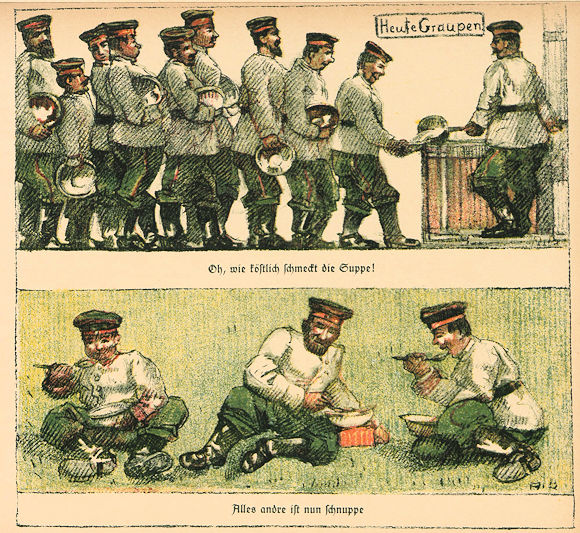
A Full Belly: A German Cartoon Showing a  Benefit of Military Service
(3 Slops and a Flop Each Day in American Lingo)

The origins of conscription and the "citizen soldier"
The First World War was fought predominantly by conscript armies fielding millions of "citizen soldiers." The origins of this type of military lay in the levée en masse (mass mobilization) organized by the French revolutionary regime at the end of the 18th century, the first modern force built on the idea that all male citizens had a duty to bear arms in defense of their nation. However, it was France’s rival Prussia which improved and systematized the military model, developing a new form of universal short-service peacetime conscription. After spectacular victories over Austria and France in 1866 and 1871, this provided the organizational template for other continental European armies. Austria-Hungary imitated it in 1868, France in 1872, and Russia in 1874. Britain and the United States, which relied primarily on their navies for security, were alone among the major powers in remaining with small professional armies.

How conscription worked
Short-service systems of conscription obliged healthy male citizens to undergo a relatively brief period of military training in their youth and then made them subject for much of the rest of their adult lives to call up for refresher courses or for service in an emergency. The exact terms of service varied from country to country, but Germany’s system provides a good example. There men were drafted at age 20 for two or three years of peacetime training in the active army. While all had an obligation to serve, financial limitations meant in practice that only a little over half of each male year group was conscripted. After training, men were released into civilian life but could be called back to the army until they reached the age of 45. In between, men passed through various reserve categories. Those who had most recently completed their training belonged to the first-line reserve for five years, where they could expect to be redrafted early in the event of crisis. Later, they were allocated for a decade to the second-line Landwehr. The third-line Landsturm was the oldest band of reservists, intended mainly for rear-line duties in a major war. The short-service conscript system offered two major advantages. First, it created a large pool of trained manpower that could quickly augment the standing army in an emergency. In August 1914, the German army needed just 12 days to expand from 808,280 to 3,502,700 soldiers. Second, in a long conflict, the system offered an organizational framework capable of deploying nearly the entire manpower of a state as soldiers. Conscript forces became true "nations in arms" in 1914–18. Fifty-five percent of male Italians and Bulgarians aged 18 to 50 were called to military service. Elsewhere the proportions were even higher: 63% of military-aged men in Serbia, 78% in Austria-Hungary, and 81% of military-aged men in France and Germany served.

War volunteers and enlistment motivations
While conscript armies proved indispensable, and even the British in 1916 and the Americans in 1917 began to draft men, significant numbers of volunteers also served in the First World War. Most famously, in Britain 2,675,149 men volunteered, the vast majority in the first half of hostilities. However, even countries with long traditions of conscription also had large volunteering movements. In Germany, around half a million men came forward. The great rush was at the start of the war: in the first ten days 143,922 men enlisted in Prussian units alone. France’s voluntary enlistments were smaller but steadier, reaching 187,905 men by the end of hostilities. In multinational Austria-Hungary, men appear to have been less willing to volunteer for the emperor’s army, although they promptly obeyed call-up orders. Some nationalist movements did recruit successfully, however. The Polish Legionaries, the largest of these forces, had 21,000 volunteers by 1917. While volunteers tended to be disproportionately middle-class, their motives for joining the army may not have been so different from those of conscripts. Patriotic duty appears to have been a prime motivation for both groups, although coercion was also influential. Volunteers were not subject to the legal sanctions faced by conscripts who disobeyed drafting orders, but they might be exposed to considerable social pressure to enlist. For small minorities, economic factors or lust for action and adventure were important. These recruits, whether conscripts or volunteers, were citizen soldiers, whose attachment to their societies and stake in their states’ existence go far to explain the tremendous resilience of the armies of 1914–18.

Tuesday, March 10, 2020

ANZAC Girls (Video Review)


Acorn Media, 2014
James Patton, Reviewer


The Cast of ANZAC Girls As New Recruits

For those of you who subscribe to ACORN TV, the mini-series ANZAC Girls became available on 3 February. The DVD is available at Amazon.com and other sources. This six-part production was shown on Australian Broadcasting's Channel 1 in the fall of 2014. It features an all-Australian cast and was filmed entirely in South Australia, which is surprising, considering the variety of landscapes depicted.

The series is taken from the historical record, as related in the letters, diaries, memoirs, and recollections of five remarkable nurses: Grace Wilson, Alice Ross-King, Hilda Steele, Elsie Shepherd-Cook, and Olive Haynes. All of these women volunteered for the Australian Army Nursing Service (AANS) in August 1914. Hilda Steele was from New Zealand but served with the Aussies throughout the war. All of them went on to have distinguished careers—some even served with the Royal AANS in World War II.

This is the first important aspect of this series: historical accuracy. No battles, other military events or locations are fictitious. All of the hospitals and casualty clearing stations where these nurses served were real.

Second, ANZAC Girls is based on real people. In addition to the five principals, several other main characters are also based on real persons. Although written and directed for dramatic effect, many of the scenes are based on the nurses' accounts.

Real ANZAC Girls Grace Wilson & Alice Ross-King

Third, the human interest story lines are not told or conducted in a modern way. Since the writers didn't live a hundred years ago, the dialogues and actions may not be historically perfect, but the romantic relationships are stilted and dignified, and the stoic approach to circumstances seems believable as well. National loyalty and dedication to duty are stressed throughout, as they were in the day, unlike modern times where these values are questioned routinely.

A small but enjoyable detail: there is an emphasis on singing. In this time parlor or porch singing was the main source of entertainment in middle class homes, particularly in small towns. That these characters can all sing, and do so on many occasions, is very believable.

Finally, this series depicts the big picture as seen from the bottom. Except for a brief speech given by Gen. Birdwood at an awards ceremony, the highest ranking officers featured are doctors at the general hospitals. All of what the nurses know is from rumor, uncensored letters or out-of-date newspapers. Mail service is erratic and it takes a long time to see casualty lists; in fact, all of the logistics are a terrible muddle and no one higher up seems to care.

Policy does occasionally rear up. At one point during the Somme the triage nurses are told to prioritize men with the highest likelihood of returning to the front, rather than the seriously wounded. On another occasion the nurses discover that medical care has been withheld from German POWs. The nurses are stymied by other restrictive dicta as well.

Two big picture undertones do subtly emerge: unequal and unfair treatment of women and the growing Australian disdain for the British high command. Both of these would manifest themselves in the postwar period.

As an insignia wonk I thoroughly enjoyed tracing all of the Australian Imperial Force shoulder flashes. I kept a book at my side the whole time.

The main characters' timeline is compressed at the end. The story skips from the aftermath of Bullecourt in May 1917 to the March 1918 offensives. Although there is nothing wrong with leaving out a stretch of time, this one included the controversial Third Ypres (Passchendaele) Offensive, where the ANZACs were heavily involved. Moreover, in the segue to Episode 6 the written narrative incorrectly states that the Germans were attacking in late 1917!

You will quickly notice that all of the five main characters have the same "BBC English" accent. I suppose that we can't know the Australian or New Zealand accents of a hundred years ago, but even today they are distinctly different.

Although I enjoyed watching the similar BBC One series about British nurses and VADs called The Crimson Field, which debuted in April 2014, ANZAC Girls is hands-down better. It's much more historically accurate, there are no fictitious units or sites, and there is no attempt to include 21st-century opinions, issues, or values.

James Patton

Monday, March 9, 2020

U.S.-Built Naval Aircraft in Action

Recently, we presented an announcement on the exciting news of the first flight this coming May of the restored DH-4 combat aircraft at Bowling Green, Kentucky. ARTICLE It has been pointed out to me that our announcement included a teensy-weensy overstatement when we wrote that the DH-4 Liberty “was the only US-produced aircraft to fight in WWI.”

Naval Air Station, Brest with Curtiss HS-1

It turns out that statement was only true for the U.S. Army.  The U.S. Navy also flew combat missions during the Great War flying US-built Curtiss Flying Boats.  WWI Centennial Commissioner Jack Monahan reminded us  that not only did the Navy fly anti-submarine and rescue missions out of European bases in Ireland, England and Brest, but it also defended our homeland  against the only attack that resulted in enemy detonations on American soil. Jack sent the following report on the action, remembered as the Attack on Orleans, Massachusetts.

On the morning of July 21, 1918, German submarine U-156 surfaced three miles off Orleans, captained by Richard Feldt, and fired its two deck guns at the town and at the passing tugboat Perth Amboy, which had four barges in tow. Perth Amboy was heavily damaged, and the four barges were sunk.[1] Some shells landed harmlessly in a deserted marsh and on Nauset Beach, giving the township of Orleans the distinction of being the only spot in the United States that received enemy fire during World War I, but there is no evidence that these were deliberately aimed at the shore. There were no targets of value in the area other than the vessels. There were no fatalities.


Nearby Station No. 40 of the United States Life-Saving Service launched a surfboat under heavy enemy shellfire and rowed out to rescue the 32 sailors trapped aboard the tug and barges. US Navy Curtiss HS flying boats and Curtiss Model R bombers responded from Naval Air Station Chatham, and they bombed U-156 without success.

(Sources: Wikipedia, AttackonOrleans.com)


Sunday, March 8, 2020

Remembering a Veteran: Lt. Max Ritter von Mulzer, German Air Service


 Fokker Eindecker


Albatros D.I


Leutnant Max Ritter von Mulzer was a German ace fighter pilot who scored ten confirmed victories during World War I flying the Fokker Eindecker. He is also known for being the first Bavarian to become an ace and to receive the Pour le Mérite. Like many WWI aviators, he started as a cavalryman but transferred to the air service. Von Mulzer was 23 years old when killed flight testing a new Albatros D.I  on 26 September 1916. He is buried in his home town of Memmingen, Bavaria.

Sources: Century Flow, the Aerodrome, Wikipedia

Saturday, March 7, 2020

Field Punishment No. 1 in the British Army


Click on Image to Enlarge

Field punishment was introduced into the British Army in 1881 following the abolition of flogging. It was a common punishment during World War I when commanders could impose what were called Field Punishments No. 1 and 2. Field Punishment No. 1, nicknamed “crucifixion” by the soldiers, entailed labor duties and attachment to a fixed object such as a post or wheel for two hours a day. Soldiers viewed Field Punishment No. 1 as particularly degrading. Rendered immobile by their restraints, soldiers could not move or scratch against common irritants such as flies or lice. Field Punishment No. 2 differed only in that the soldier was not bound to a fixed object. During World War I, Field Punishment No. 1 was issued by the British Army on 60,210 occasions. Field Punishment No. 1 was abolished in 1923 when an amendment to the Army Act which specifically forbade attachment to a fixed object was passed by the House of Lords.

Sources: Canadian War Museum, Wikipedia

Friday, March 6, 2020

Wow! The Outstanding WWI Online Exhibition of the American Numismatic Association


The American Numismatic Association is a nonprofit organization dedicated to educating and encouraging people to study and collect coins, paper money, and related items. We serve coin collectors, the academic community, and the general public with an interest in numismatics.

The association operates the Money Museum in Colorado Springs, Colorado, which hosted a major World War One exhibition, "Trenches to Treaties," through 2018. I've only recently discovered that they have kept much of the exhibits and documentation of the event available online. Go here to access the material, and be sure to explore the "Virtual Exhibit."


Here's a sampler of what you can access online. For most of the images you will need to click on them to expand them so you can fully appreciate the object.


Thursday, March 5, 2020

Recommended: Indy Neidell and the Creators of the Game "Verdun" Visit Fort Douaumont

In an episode of the online video series The Great War, a boots-on-the-ground visit to Fort Douaumont, I learned things I had never absorbed in almost 20 visits there.


Wednesday, March 4, 2020

Remembering Snoopy vs. the Red Baron


Some readers might be too young to remember this, but there was a time in America when the only reference you ever heard to World War I was in Charlie Schulz's Peanuts.


This one gave me a big laugh during basic training.


Postscript

Our regular contributor Steve Miller, sent this contribution:


Tuesday, March 3, 2020

Inside World War One? The First World War and Its Witnesses


Edited by Richard Bessel and Dorothee Wierling
German Historical Institute London, 
Oxford University Press, 2018
David F. Beer, Reviewer


An Italian Alpini Officer Writing a Letter

In the course of the First World War, billions of letters were exchanged between the various fronts and the home fronts; millions of soldiers of all ranks, as well as doctors and nurses, wrote diaries at least over a period of their war and front activities; men and women living under occupation did the same. Afterwards, thousands of those who had lived through the war published their memories in newspaper articles, journals, and (sometimes self-published) books. What kinds of sources are these texts offering for a better understanding of the First World War? (p. 9).

This collection of essays looks at the enormous amount of "ego documents'" that have become available over the years to historians of the Great War. We may not be familiar with the term since it tends to be used more in European scholarship than in American, but ego documents are simply documents such as diaries, memoirs, autobiographies, travelogues, and military reports in which "the personal views of the author play a central role: that is, texts which provide accounts of or testimonies to the 'self' which produced them… and which relate in various ways the experiences of their authors…" (p. 8)

These documents are studied in order to find out precisely how their authors experienced and perceived the war and how they reported the information either to themselves or to others. This might seem pretty obvious to most of us, but there are many questions to be asked when studying such texts. In the case of diaries, for example, were they written on a daily basis or intermittently when time allowed? Did events described actually take place on the day they were recorded? Were they sometimes written with more reflection and hindsight than usual? Were they written with an audience in mind, such as friends or relatives? Relevant questions must also be asked of letters and memoirs. In the case of the former, for example, to what extent did censorship determine content? Memoirs and autobiographies invite even more intensive analysis since they might be written years after the fact. Thus, they could include personal interpretations and uncertain memories or even be clouded by the current situation of the author.

Hungarian Officers on the Eastern Front

The 15 scholarly essays comprising Inside World War One? examine a wide variety of ego documents, primarily from non-Western Front sources. Both provenance and content are examined. From these materials we learn, for example, of how Slovenian soldiers saw themselves as sacrificial victims, how the German occupation of Warsaw was seen by its residents (including the claim that Jews were protected from bombing by an ointment they smeared on themselves), how some Belgians felt ambivalent about being occupied, and how brutal the tsarist army was during its brief takeover of East Prussia at the beginning of the war.

Particularly interesting is the study of documents from the Alpine war, specifically the Tyrolean front: As expected, "diaries and memoirs provide invaluable insights into Austrian soldiers' perceptions of nature, mountaineering, and technological warfare in this extremely harsh environment. For the men it was a struggle as much against nature as against the enemy." (p. 125) One soldier relates how they were expected to attack a peak in broad daylight and without rifles! Rich material also comes from nurses who served in the war in Austro-Hungarian hospitals, while another essay, entitled "Front Experience and Psychological Problems: The Voices of Doctors and Patients in Case Studies and Patient Files," speaks for itself regarding its subject matter and sources.

While over a thousand published first-hand accounts by Ottoman soldiers and officers have been found, two memoirs stand out in a different way. These are accounts by two Armenians in the Ottoman Army, Kalusd Surmenyan and Yervant Alexanian. In spite of all we might expect in light of the genocide, these two men both served until the end of the war and eventually became officers. Their memoirs dramatically reveal their experiences, perceptions, and retrospection and give light on how they physically and psychologically existed in such anomalous conditions.

Other essays in the book deal with how ego documents were sometimes used as propaganda, how Italian biographies can be examined for their war story, and how one Serbian veteran's autobiography describes war life in "Yugoslav Siberia"—a derogatory term for what was then the southern region of the South Slav state. Another study deals with colonial encounters and cultures during the war, particularly with Maori, West Indian, South African, West African, and Chinese participants. "The Black Soldier's Lament" well articulates the colonial grievances felt in the war:

Stripped to the waist and sweated chest
Mid-day's reprieve much needed rest.
We dug and hauled and lifted high
From trenches deep toward the sky-
Non-fighting troops and yet we die.
(p. 223)

The book's penultimate article looks at "Writing of the Great War in Russia" and at how high illiteracy among soldiers resulted in most of our information coming from the officer class. Finally, the diaries and narrative accounts of Henri Barbusse and Marc Bloch are shown to reveal the many-faceted ways in which such documents can provide us with personal views of the war.

Inside World War One? is an academic project, an anthology that deeply analyzes the various structures, purposes, and effects of those genres known as ego literature. If you approach the book with this in mind you will find it a highly rewarding volume.

David F. Beer

Monday, March 2, 2020

Before Messines: The New Zealanders at Hyde Park Corner


Approaching Hyde Park Corner from Ypres

Eight miles south of Ypres and sheltered somewhat behind Hill 63  is Hyde Park Corner a junction on the Messines-Ploegsteert Road. Ploegsteert (or Plugstreet, as the British called it) is also the name of the wood surrounding the intersection. Messine, must to the northeast, would be the main objective in thefirst major battle for the New Zealand Division in 1917. The road continues south from Hyde through the village of Ploegsteert to the industrial center of Armentières which is just across the border in France.

Apart from during the New Zealand involvement in the Battle of the Somme this general area was the New Zealanders’ home for all of 1916 and most of 1917. New Zealand was a new division and this was regarded as a nursery sector. It was where new divisions were blooded and learnt the rules of trench warfare on the Western Front. The ground was low-lying and prone to flooding, and so trenches were built up above ground with huge piles of sandbags.

It was a static war—of sniping, artillery, and mortar fire. All the work was done at night, including trench improvements, wiring parties in no-man’s-land and raids by observation and fighting patrols from both sides. The aim of a raid was to take prisoners, and to establish the identities and plans of the enemy. It was also an effective method to destabilize the enemy, and to maintain an aggressive mood among the troops.

In this area the term trench was somewhat of a misnomer; it was impossible to dig very far before encountering water, and the result was that for the most part both parapet and parados consisted of walls built up of sandbags.
Charles Marsack

A British Sergeant Demonstrating the Flooding at Plugstreet

This was a very different war from Gallipoli. When the New Zealand Division first occupied Armentières, there was a large civilian population. When they were in reserve, the New Zealanders were billeted in the town—in disused factories—and could go to the estaminets or cafes in the town and buy egg and chips, and beer and wine. There were shops that sold souvenirs such as lace postcards that the soldiers sent home.

Beer plus wines are exceedingly cheap — deuxsou — penny per glass plus champagne four, five, six, francs a bottle plus you may be sure that the troops consume, enormous quantities, firstly, on account of the cheapness, secondly on account of the weakness plus thirdly on account of the bad drinking water.
Robert Shepherd

Armentières was not an easy initiation for the New Zealanders. They were the new boys, and they found out that the German snipers and machine gunners were masters at their trade. The New Zealanders made many mistakes and this cost lives. It was a hard school, and raids by both sides were common. Lieutenant-General Godley’s 2nd ANZAC Corps, along with the rest of the British Army in the northern sector—were ordered to increase patrols and raids so as to stop the German armies sending reinforcements south to the Somme. The New Zealanders came back to this sector after the Somme. From early 1917 through to June of that year, they used this area as a base and assembly area for the attack on Messines.

The Messines-Wytschaete Ridge had been held by the Germans since 1914 and it gave good observation for German artillery to fire on the roads leading into Ypres from the west. Haig wanted to break out of the Ypres Salient and needed to take the Messines Ridge as the first step. Preparations included large-scale mining operations both to drive tunnels under the German defenses on the ridge but also to dig accommodation areas into the sides of hills on higher ground.

Entrance to the Catacombs at Hill 63

Hyde Park Corner was under German artillery and gas shell fire every night, and this was a very dangerous spot. For safety, the New Zealand “Diggers” as they were called, lived underground, and this was the New Zealand Division’s home for seven months in 1917. The 1st Australian Tunneling Company had dug an underground complex inside the backside of Hill 63. It was known as the “Catacombs,” and could accommodate up to 1,200 men. The entire hillside was covered in dugouts that could accommodate some 4,500 men, both above and below ground. This is where the reserve brigade was based—while the other New Zealand brigades occupied the front line and support trenches. 

The New Zealand Diggers were crammed into an underground city of 19 streets, each with barrack rooms with multi-tiered wooden bunks. There was only chicken wire for a mattress, and the soldiers lay there fully clothed, with boots on, with all their kit piled up on the bunk. There were kitchens, toilets, first aid stations, officers quarters, even electric lighting, all under there—and it was stinking, dark, cold and constantly wet, with the water pumps working all the time. 

To stop gas creeping in underground, particularly mustard gas, they used to have double-layer canvas entrances, acting like doors. And even though there was air circulation, the fact is, it stank to high heaven of unwashed bodies, dirty socks, and the results of a diet of beef stew. Men bathed every eight to 12 days, and got clean clothes at the same time. Every soldier was lousy and spent his spare time cracking lice and their eggs in the seams of his clothing. Rats were everywhere, and rat hunts were great sport.

The brutes are in hundreds and as big as cats with tails like kangaroos. Our little cookshop was swarming with mice but one does not mind them so much.
Robert Brebner

A soldier could never be alone. He lived side by side with the men in his platoon. You ate, slept, and bathed together, you worked, fought, and died together. There was no escape.

Anzac Corps Memorial at Hyde Park Corner
Note the Aussie Slouch Hat and New Zealand's Lemon-Squeezer

This was the New Zealanders’ base for operations against Messines. And the attack from 7 to 14 June 1917 was a major victory for General Sir Herbert “Daddy” Plumer’s 2nd Army.  After the success of Messines, the major operation undertaken by the New Zealand Division—as part of the 2nd ANZAC Corps—was advancing up to the river Lys, as the Germans pulled back from the Messines sector. Both the Australian and New Zealand divisions followed the Germans as they retreated.

Source: Ngā Tapuwae Trails

Sunday, March 1, 2020

March 1912: The Serbian—Bulgarian Alliance Stirs Up the Balkans


Tsar Ferdinand of Bulgaria and King Peter of Serbia

The heavy-handed policies in Macedonia of the Young Turks regime (which had come to dominate the declining Ottoman Empire in 1908) and the outbreak of the Turko-Italian War in September 1911 energized—in all the Balkan countries simultaneously—an impulse toward joint action against Turkey. In late 1911, secret negotiations started among Bulgaria, Serbia, Greece, and Montenegro with the objective of expelling the Ottomans from European territory. The most important connection was between Bulgaria and Serbia. A treaty of alliance signed by the ministers and monarchs of both kingdoms was executed on 12 March 1912. There were two parts to the Bulgar-Serbian treaty. One part created a defensive alliance between the contracting parties, in which they pledged themselves to "succor one another with their entire forces in the event of one of them being attacked by one or more States." The other part is the "secret annex," in which they provided for possible war against Turkey, in the event of internal or external troubles of Turkey which might endanger the national interests of either of the contracting parties or threaten the maintenance of the status quo in the Balkan peninsula. 

This alliance led to military conventions and the formation of a "Balkan Alliance." The first of two Balkan Wars was launched by the Alliance in October and succeeded in expelling the Turks from all Europe except the Constantinople region. The two Balkan Wars of 1912–1913 placed enormous stress on the diplomatic system of the great powers, gave great impetus to Serbia's annexation ambitions, and alarmed Austria-Hungary.

View the treaty and and its secret appendix HERE