Now all roads lead to France and heavy is the tread
Of the living; but the dead returning lightly dance.
Edward Thomas, Roads

Thursday, February 10, 2022

The AEF's Greatest Artillery Barrage: 1 November 1918 (Part 2) — the View from the 2nd Division


Open Fire


The barrage plan was so constructed that throughout the advance, the entire corps front of more than eight kilometers would be covered by a sheet of shell, shrapnel, and bullets to a depth of twelve hundred meters.

MG Charles Summerall, Commander V Corps

[Editor's note: Seven divisions of the First Army attacked on the morning of 1 November 1918.  I've selected the 2nd Division, recall they were a hybrid Doughboy-Marine formation, for a detailed look. The division was in the center of the action, shared responsibility for the most important first-day objectives, and—because its 4th (Marine) Brigade was the lead formation in the attack—Marine historians have done an excellent job in researching the event and I've drawn heavily on their work here.  Also, if you haven't read it yet, I would suggest reading yesterday's entry on Roads to the Great War before proceeding. MH]

Plan of Attack for the 2nd Division

Shortly after 2100 on 31 October, 2nd Division units received orders affirming that the attack would begin at 0530 on 1 November.  At H-hour (0530), the plan called for Marines of the 4th Brigade to attack on the left. On the right, soldiers of the 23rd Infantry, 3rd Brigade, were to clear the enemy positions in/around Landres Saint-Georges and Bois l'Epasse. When that was done, the 23rd Infantry was to reform with the 3rd Brigade in reserve. On reaching Objective 1, the 4th Brigade was to extend to the right and take over the entire 2nd Division front.

The field artillery brigades of the 1st, 2nd, and 42nd Divisions were to fire a two-hour preparation starting at 0330, followed by a rolling barrage beginning at H-hour. A special concentration of MG fire was to be provided by MG battalions of 2nd and 42nd Divisions. When advancing troops masked their fire, MG units were to revert to control of their parent units. Company D, 1st Gas Regiment, and a light tank detachment from 1st Tank Brigade also supported the attack. 2nd Engineers provided wire cutting details with the attacking infantry.

The 80th Division would attack on the 2nd Division’s left, the 89th Division on the right.


Before H-Hour


Prior to the opening bombardment, Corporal Vincent B. Grube of the 23rd Machine Gun Company, 6th Machine Gun Battalion, moved forward with his machine gun crew. Grube had arrived in France in August with the 1st Separate Machine Gun Replacement Battalion and had joined the 23rd Machine Gun Company on 23 October. In pitch dark, he and his crew trudged single file through forests carrying their heavy equipment. After traversing banks and “rough places where wire, mud, limbs, etc., would trip you,” they came to a field, where they dug in to set up their machine gun post. When Grube and his men began firing their gun, expecting that they would use up to 3,000 rounds during the pre-attack bombardment. When the barrage began, to Grube, it seemed as though the gates of hell had been opened, and all its fury had launched at the enemy. 

All through this my gunner showed the greatest coolness and bravery. The Germans tried to neutralize our fire. Shells landed nearer and nearer. The earth shook as though there was an earthquake. Now and then I could hear a wounded man calling for first aid, and could see the Red Cross men hurrying here and there to give first aid to the injured. Litter bearers hurried them to the rear, and all the time the firing continued. I tried to keep cool, and all the time I prayed for God’s protection. Thoughts of home came to my mind, and I asked God to have mercy and spare my life. It certainly was hell on earth.

When a shell hit 20 feet away, Grube saw “a piece of shrapnel hit my section sergeant right in the forehead, and split his head in half as though an ax had done it.” After Grube went “over the top,” he saw a captain blown to pieces by a shell, and he heard machine guns bullets zip by, “making a funny peeping noise like a sparrow. That’s just what they sounded to me—a sparrow chirping.” 

At 0330 on 1 November, Marines hunkered  down in their holes while the immediate preattack bombardment began. East Tennessee native Private Clarence L. Richmond served as a stretcher-bearer in the 43rd Company, 2nd Battalion, 5th Regiment. He would later receive a Distinguished Service Cross for service at Blanc Mont because he “unhesitatingly went through the heaviest machine-gun and artillery fire dressing and carrying wounded. Disregarding his own safety, he refused to take rest or food while there were wounded needing attention.”

Richmond’s war diary described events the night of 1 November. He remarked that several American batteries of 75mm cannon fired nearby, and that the Germans replied with a counter-barrage, but “not near in proportion to ours. The noise was so great that I could only hear a few enemy shells which fell right near us.” Unable to sleep, Richmond “watched the horizon, which was a continuous flash of fire from the hundreds of guns taking part in the barrage.”


Impact


Captain James McBrayer Sellers, commanding officer of the 78th Company, 2nd Battalion, 6th Regiment, had already been wounded and received the Distinguished Service and the Navy Cross for his actions on 6 June at Bouresches in the Battle of Belleau Wood as a first lieutenant. As he recalled the bombardment on the night of 31 October/1 November, Sellers noted that “the artillery was brought up very close to us. It was the only time I ever felt nervous. The artillery was just a few yards behind us, firing all night, and I could not sleep very well. I did not relish the situation and really felt uneasy.

The artillery bombardment also included gas shells: “Summerall was in full agreement with Liggett that the fire plan drench the enemy with various kinds of gas, especially on the enemy’s artillery batteries and most powerful strong points.”  The task of setting up the gas attack fell to the 1st Gas Regiment’s 2nd Battalion, which supported V Corps. In the week prior to the final attack, the battalion’s Company D supporting the Marines installed 160 gas projectors 1.5 km south of Saint-Georges and 40 gas projectors a similar distance southwest of Landres-et-Saint-Georges. 

The gas projectors were tubes eight inches in diameter and closed at one end, resting on a 28-pound steel base plate. They came in three lengths—30, 33, and 48 inches—and weighed 65, 105, and 150 pounds, respectively. They were set up in groups of 20 in a 9.75m-long trench perpendicular to the line of attack. Covered with dirt so only a small amount of the tube stuck out of the ground, they were easy to camouflage. They fired cylindrical drums weighing 65 pounds and carrying 30 pounds of gas or high explosives for a maximum range of 1,850 yards. When the attack came, Company D shot 80 canisters of phosgene gas on enemy targets south of Saint-Georges. The 1st Gas Regiment’s chaplain, Army first lieutenant James Thayer Addison, recalled that “since the wind was south and carried through the village and down the ravine northward, enemy casualties were heavy. Prisoners later reported some 300 gas cases, and more than 20 bodies of men killed by gas were found on the position.” One minute before H-hour, “a group of 40 projectors discharged high explosive bombs upon the same targets, and still another launched the same number upon machine-gun nests southeast of Landres-et St. Georges.” 

Stokes mortars joined the barrage, firing 50 rounds of thermite bombs.  Stokes mortars were four inches in diameter and 48 inches long, firing a 25-pound cylindrical drum holding seven pounds of gas, high explosive, thermite, or phosphorus, for a maximum distance of 1,150 yards. Chaplain Addison concluded that “the weapons described can produce a far more concentrated cloud of gas than it is possible to produce with artillery. Hence the Special Gas Troops have a field which it is impossible for the artillery to fill. The artillery, of course, have a tremendous advantage in range.


H-hour+
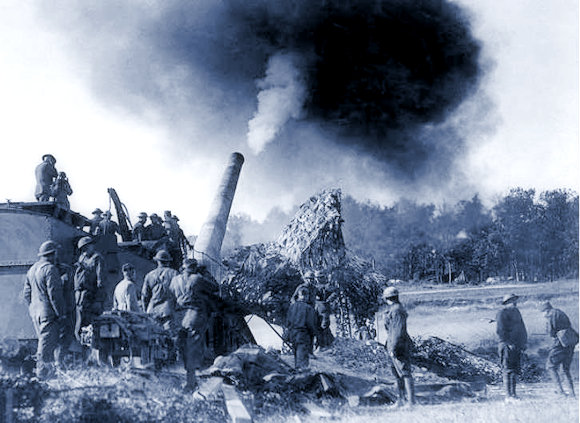

A Rolling Barrage Supported the Advance


At H-hour, officers blew their whistles and the Marines moved quickly into a dense fog, behind a rolling barrage designed to fall roughly 100 yards ahead of them. Lighter guns would fire rounds to land just ahead of the advancing men while heavier weapons fired a few hundred meters farther on. In previous attacks, the Germans had rushed machine guns into the gap in no-man’s-land to mow down the first line of advancing troops. To counter this maneuver, John Lejeune’s chief of staff, Army Colonel James C. Rhea, devised yet another plan: the Marines would pull back 300 hundred yards just before the planned artillery bombardment began. The rolling barrage would then be calibrated to fall into the no-man’s-land, wiping out the enemy machine guns before the Marines advanced.  All this supporting fire was to be perfectly timed at so many meters per minute, depending on the terrain. To move the artillery forward, strict timetables, transportation paths, and new locations were planned.

A complement of nearly 100 troops from 2nd Engineers also charged forward with the Marines to blaze a path through the barbed wire. In addition, 15 light French tanks manned by Americans went forward; five tanks accompanied each of the 5th and 6th Regiments, with the other five serving initially to support the Army’s 23rd Infantry on the right, before falling back into reserve.


Mobile Divisional Artillery Supporting the Advance


The Marines moved forward through intense smoke caused by the rolling barrage. In dispatches at 0800 and 0900, Major Hamilton’s 1st Battalion, 5th Regiment, intelligence officer, Second Lieutenant Leonard E. Rea, notified Colonel Feland’s headquarters that the battalion had met its first objective, just south of Landreville. They had suffered five officer and “few” enlisted casualties. The battalion had captured a battery of 77mm cannon, but “few prisoners and no material.

The division's artillery, 75s and 155s moved forward with the infantry to support the advance. Captain Pell W. Foster’s Battery B of the 12th Field Artillery fired for six hours to support the 6th Marines in the attack. He remembered that, even though the artillery batteries were situated in plain view, the Germans failed to launch counter-battery attacks. To keep up with the rapid advance of the Marines, his battery moved forward to the Landres and Landres-et-Saint-Georges road to continue their rolling barrage just ahead of the Marines.

At the end of the day on 1 November, the 4th Brigade had captured its objectives and, in some places, had pressed slightly beyond to a line of exploitation. The brigade then dug in, anticipating that the 3rd Brigade’s 23rd Infantry Regiment would pass through their lines the next day as planned and lead the 2nd Division’s advance north toward the town of Fosse. 


Breakthrough: Advancing to Sedan


The Big Lesson of  1 November

Unassailable in its logic, however, was one conclusion of a key participant in the attack on November 1. If we are to be economical with our men, we  must be prodigal with guns and ammunition.

MG Charles Summerall, Commander V Corps


Source: Heroic Deeds, Heroic Men: The U.S. Marine Corps and the Final Phase of the Meuse-Argonne Offensive 1–11 November 1918, David J. Bettez, PhD; Maps from the American Battle Monuments Commission


Wednesday, February 9, 2022

AEF's Greatest Artillery Barrage: 1 November 1918 (Part 1) — the View from First Army


Earlier in the Meuse-Argonne Offensive


[On 1 November 1918] the artillery acquitted itself magnificently, the barrages being so well coordinated and so dense that the enemy was overwhelmed and quickly submerged by the rapid onslaught of the infantry.

General John J. Pershing


The Meuse-Argonne Offensive, launched on 26 September 1918, was the largest battle ever fought by American arms. The initial advance through the sector's well-fortified, densely forested, and hilly terrain went slowly. By mid-October the U.S. First Army was bogged down along a 25-mile front still facing strong German positions. The offensive's strategic objective, the rail center of Sedan, was still unthreatened. Other dynamics, however, were in play. General Pershing, to his credit, accepted he had reached a limit to his "span of control." He had too many responsibilities to focus solely on consummating the Argonne campaign. He chose wisely in selecting Hunter Liggett to replace him as commander of the First Army.

Additionally, senior officers who had distinguished themselves at the divisional level—men who had learned the weaknesses of the official AEF doctrine and were determined to find new solutions—were raised to critical posts. Most notable were three future army chiefs of staff: Major Generals Charles Summerall and John Hines, named to command the V and III Corps, respectively, and Colonel George Marshall, operations chief (G-3) for the First Army.


This new team came together just after Liggett assumed First Army command on 15 October 1918. In two weeks—while still mounting local attacks throughout the Argonne region—they would conceive, plan and mount on 1 November the most successful American attack of the Great War. Within a week, a victorious First Army would find itself on the heights dominating Sedan, shifting its attention to the east for its next push through the Metz corridor toward the Rhine.

The attack of 1 November was the most important and influential operation of the war for the American military. It convinced the future leaders, thinkers, and commanders of the army that the best way to take objectives and keep casualties to a minimum was to overwhelm the enemy with firepower. The legacy of the 1 November attack lived on to and after the Second World War, helping define a new and unique "American Way of War." 


En Route


Three major artillery employment problems plagued the first phases of the campaign. The first was that plans called for the infantry to continue its initial attack all the way to distant objectives that were surely going to be beyond the range of the supporting artillery. Pershing and his staff were clearly counting on their infantry, some of whom were seeing their first combat, being able to successfully carry those distant objectives with little or no artillery support.

The second problem was that the attacking corps and divisions attempted to make such a quick, deep penetration without using one of the most tactically decisive weapons of the German Army's spring offensives—gas. Smothering the defending forces with tons of gases of all types was an integral part of each one of Germany's initially successful spring offensives in 1918. Pershing had included a massive gas bombardment in his initial plan for the 26 September attack. Unfortunately, the AEF could not secure all the gas shells that it needed to carry out the plan.


Additionally, the decision as to when, where and how to use the gas that was available was rightfully left to the corps and division commanders, and they, due to unfamiliarity with the weapon, an almost inexplicable fear of retaliation and an inflated expectation of what the infantry could accomplish on its own, did not carry through on Pershing's plan for using gas.

The third problem was that the army and corps artillery groups were not used to maximum effect in either  counter-battery against the German guns or in direct support of the infantry advance with an additional rolling barrage. Due to the expectations of many high-ranking AEF officers that aggressive infantrymen would be able to make successful attacks without the support of heavy artillery and to the fear that the use of heavy guns in an infantry support role would lead to a rash of friendly-fire incidents, the corps and army guns were prohibited from firing on positions close enough to the advancing infantry to be of any practical use to them.

These errors, combined with the inexperience of the combat divisions, their unfamiliarity with the Argonne's harsh terrain and the lack of suitable roads, led to the horrific losses and small gains of the first weeks of the offensive. 

Upon taking his new command, General Liggett began immediately to make changes tailored to solve the problems that had plagued the earlier phases of the offensive. Soon after, on 19 October, Allied Generalissimo Marshal Foch issued general instructions for the continuation of the offensive west of the Meuse.


In Position


Two days later Pershing directed that First Army prepare to carry out its portion of the attack. After some coordination with the French commander in the Champagne on the left flank, D-Day was set for 1 November. In his official report, General Liggett  summarized the operation:

The primary purpose of the attack of the First Army and the French Fourth Army was, to cut the great Carignan-Sedan-Mezieres railroad that supported all the German forces to the west. The first, most important immediate objective of the First Army the heights of Barricourt, whose capture would force the German Army in the sector to withdraw behind the Meuse. The American subsequent advance would then both threatened Sedan and allow a redirected axis of attack across the Meuse River into the Metz corridor for the First Army for launching future operations.


Ready to Open Fire


This opening success stemmed from the most comprehensive firepower  employment plan that the AEF had ever seen. Each of the three attacking Corps were supported by unprecedented massed artillery.  In the V Corps sector alone, the 2nd Division had 236 divisional guns, the 89th Division had 208 guns, and they shared 152 corps guns, including the dedicated army groups that were put under corps direction. This was spread on an eight-kilometer front, giving the corps an artillery density of one 75mm gun for every 29 meters, a 155mm or 8-inch howitzer for every 39 meters, and a 105mm or 155mm gun for every 69 meters of front. The division also had a battery (12) of 6-inch Newton mortars and a number of gas projectors. Although the 1st and 42nd Divisions were in reserve, V Corps commander, MG Charles Summerall ordered their artillery brigades to join that of the 2nd Division to support its attack and the brigades of other reserve divisions to support the 89th. When the dedicated corps and army batteries are included, each V Corps division advanced with the support of more than 300 guns and howitzers.


Note Position of 2nd Division, V Corps for Tomorrow's Article

Everything was in place well in advance of the jump-off time of 0530 hrs. During the artillery preparation that  began promptly at 0330 hrs, all the guns opened up on their German targets, namely, batteries and those infantry positions that were able to deliver fire upon American infantry at their starting positions. Eighty gas projectors also fired lethal chemicals on known machine gun nests, observation posts, and organized shell holes. Ten minutes before H-Hour, the standing barrage was put down in front of the German forward positions, as was a thick smoke screen to hide the American infantry moving up to the barrage. At 0530 hrs. the barrage rolled forward, and the attacking infantry battalions began their advance, assisted by tanks.

The first day's attack was an unequivocal success; in the central V Corps sector the 2nd Division had broken through the enemy's main line of resistance, advanced nine kilometers, and had suffered light casualties Tomorrow,  to see exactly how the barrage affected the attack, we will examine how the opening barrage of 1 November was viewed by the 2nd Division men and commanders.

Go to Part 2 of this story on Roads to the Great War presented 10 February 2022.

Source:  Over the Top, November 2008

Tuesday, February 8, 2022

Gallipoli Diary 1915


By Alec Riley (Author); Michael Crane and Bernard de Broglio (Editors)
Little Gully Publishing, 2021
David F. Beer, Reviewer


Frontline Trench at Cape Helles, Gallipoli


I don’t think there’s a Pulitzer or Academy Award for literary archaeology, but if one existed, I would nominate this book. Its two editors have uncovered materials written by Alec Riley, a soldier who spent time in a Divisional Signal Company on Gallipoli before being medically evacuated. Some 20 years after the war, Riley wrote a book based on his notes and a 1930 return trip to the battlefield but, sadly, was unable to find a publisher in a world tired of war literature. Eventually, he left the materials to the IWM, marked “For the Imperial War Museum (if it is of any interest)” and they sat in the Imperial War Museum’s archives for more than 60 years (p. 242).

Although Riley and his pals arrive on Helles on 6 May 1915, 11 days after the main landings had taken place, they see plenty of evidence of the earlier activities as their boat delivers them ashore:

On one of the decks there was a giant heap of torn and bloody clothing taken from the Anzac casualties after their landing. The strong sun made it smell so it was sorted out, and most of it was thrown overboard. (p. 14)

Despite this, he and his small group of fellow signalers are intrigued and excited about what’s going on. Two interesting aspects soon emerge in the text. First, as signalers they are a small and relatively independent group who are not tied down to the life that the PBI (Poor Bloody Infantry) lead in the front trenches. Drills and inspections are rare for them as they busy themselves with their signaling equipment and communications, broken wires being their biggest nightmare. Yet they still have freedom when not on telephone shifts to wander around and explore their surroundings—which Riley certainly does.


Signalers at Work


For their communication tasks the signalers use only wire; even the most primitive forms of radio are not mentioned. We get interesting glimpses of their work with their equipment and the frustrations of poor communication. They are not above occasionally playing tricks on those on the other end of the line, but the constant problem of broken wire keeps them busy:

In its simplest form our work was to lay wires, repair them when broken, send and receive messages. Sometimes the messages were full of interest, and sometimes there was excitement in getting them through. Repairing breaks was even more exciting at times [an understatement!] (p.114).

The other aspect of life on Helles is the lack of knowledge of a war that was going on elsewhere and of how the Gallipoli operation was part of it. “We did not know much about what was happening on the larger scale…We knew quite a lot about what happened on the small scale” (p. 178). Inevitably the initial interest and excitement Riley described fades away, innocence is replaced by experience, and life becomes grim and focused. Although the signalers can get away from it all sometimes and go walking or bathing in the nullahs (creeks), they inevitably see and suffer the life surrounding them:

Day after day, we watched the PBI [Poor Bloody Infantry] going up and down the nullah, to and from the trenches. Some of them looked like old, tottering men, bowed, stooping, and most of their faces were colourless, except that they were grey or dirty. Now and then we heard some odd remark, but there was very little talking, and less laughing. There was so little to laugh about, now. Even when a smile was raised, it was very soon cancelled. (p. 127)


Riley Back at Helles, 1930


One Saturday afternoon Riley has to go up to a frontline trench:

The trenches were crowded with dirty, ragged, worn-out officers and men. They sprawled everywhere, many of them asleep, and we trod carefully so as not to disturb them. It is impossible to describe how these men were living. Tall men slouched, thin, round-shouldered, bandaged over their septic sores dirty, unshaved, unwashed. Men were living like swine, or worse than swine. About these crowded trenches there hung the smell of latrines and the dead. Flies and lice tormented men who had hardly enough strength to scratch or fan the flies off for a few seconds. (p. 149)


As the months go by, conditions on Helles gradually wear Riley and all his signal section down. They squabble about food portions and how much shade or groundsheet each should get. Telephone duties get on their nerves. Flies and lice torture them, and their sores become septic. More backbiting takes place. They care less and less about the ragged and dirty nature of their clothes. They even become inured to pilfering what they need from the dead. Intestinal disease plagues them, and they pray for a “gadget-wound” (the equivalent of a minor Blighty), which would take them away from the hellhole to a hospital ship blinking out in the bay and a bed to rest in (p. 138).

By the end of August, Riley is constantly unwell. On the 28th, he is “feeling wrong again" (p. 185). The next day he goes to the MO (Medical Officer), who gives him a pill and tells him he is unfit for duty and must rest in his dug-out, where he finds “the lice seem to multiply themselves by themselves. They prevented us from resting…. The heat was great.” The next day he stumbles to the MO again and is “awarded half an ounce of castor oil, and ordered to do as before (p. 187). In spite of this, he manages to help out with signaling duties for a few days—with very frequent trips to the latrine. He is finally evacuated from Helles to Mudros on 10 September.

On his final visit to his MO, who puts him on a milk diet this time, he describes himself thus: 

I had a septic place on my right hand and was walking with the back of my boot doubled in and the boot tied on. I was not wearing my tunic, my shorts were ragged, my helmet battered and dirty—for it had been my pillow for weeks, and with the top bashed in, it made a good one—my hands, legs and foot bandaged. (p.194)

Of course, he’s happy to leave Helles, but he also leaves memories of good friends and interesting explorations of the peninsula, some of which he photographed and are included in the book. We occasionally find subtle humor in his writing, too. In addition to the memoir itself, the editors give us plenty of supplemental information, including Riley’s short articles that started them on their search and biographies of him and other men who appear in the memoir. Call signs for the various signal stations are listed and the book concludes with additional notes and a geographical description of the Dardanelles and the peninsula. An intense and informative read indeed. I highly recommend it.

David F. Beer

Monday, February 7, 2022

Weapons of War: The Škoda 305


Now a Museum Piece: the 30.5cm M-11 Belagerungsmorser


James Patton

No doubt about it, WW1 was a gunner’s war, especially a big gun war. Before the war Krupp had produced the first of their 42cm Minenwerfer-Gerät, nicknamed "Big Bertha." During the war the French and later the Americans dismounted large rifled naval cannon from the main turrets of obsolescent ships and installed them on railway carriages. And, of course, in 1918 the Germans built the super-long-range Paris guns. 

However, even the backward Austro-Hungarian Empire had its own big gun, which was likely the most effective one deployed in the war.

Established in 1859 as an engineering works, the future Škodawerke was based in Plzeň, in today’s Czech Republic. Emil Škoda (1839–1900) expanded the enterprise into the largest industrial firm in Austria-Hungary. During WW1 Škoda produced a variety of artillery, especially mountain guns and mortars, as well as small arms and machine guns, for the Dual Monarchy’s armies. 


Emil Škoda 


The 30.5cm M-11 Belagerungsmorser, familiarly known as the Schlanke Emma, was first proposed by Škoda in 1906, and production started in 1911. Between 72 and 79 (sources differ) of these were produced up to the Armistice, including the lighter and longer-range M-16 models that were effective against trench systems using the Granatschrapnell round. 

The gun was quite modern in design, with safety devices on the breech, a recoil brake and a hydraulic recuperator. The barrel elevation range was 40 to 70 degrees, and it could deliver a shell weighing 380 kg up to 9.6 km away with a ballistic force capable of penetrating two meters of reinforced concrete. The gun also came with its own transportable steel base box which usually made preparation of the firing site simple—no concrete pad was necessary. The gun crew was 15 to 17 men, and the gun could fire 10 to 12 times per hour.

Perhaps the most important feature of the Škoda 30.5 was its transportability. The entire unit was contained on three carriages, one carriage each for the body, the barrel and the base box. The whole unit could be assembled or disassembled in less than an hour by the gun crew using jacks and hoists. The train of the three carriages was pulled by one or two 100-hp Škoda-Daimler M-12 15-ton tractors, depending on the terrain. Due to the slow speed of the tractors rail transport was necessary for long distance deployments, but the battery could move itself to the firing site. 


Ready for Movement


In 1914, the Germans borrowed eight of the Škoda 30.5s for the reduction of the Belgian and French border forts, including the defenses of Antwerp, and later against Russian border forts like Osowiec. In the course of the war the Škoda 30.5s were deployed in over thirty battles against Russian, Italian, French, Serb, and Belgian fortifications. 

After the war, Romania and the new nations of Czechoslovakia and Yugoslavia incorporated leftover Škoda 30.5s into their armies. In the WWII era, many of these passed into the hands of the German Wehrmacht, who employed them in Russia against Sevastopol, Leningrad, and other sites. There are four examples of Škoda 30.5s still extant: one is in Italy, one is in Serbia, and two are in Romania. Three of these are M-11s and one is an M-16.  


On the Eastern Front


Today the name Škoda is still familiar, appearing on automobiles, railway vehicles, and electrical generating equipment. 

Sources include:

http://www.landships.info/landships/artillery_articles/30_5cm_morser_m11.html


Sunday, February 6, 2022

Artists and Authors Tell Us About War — A Roads Classic

Otto Dix, Self Portrait, 1915

We gingerly crossed the valley of Paddebeek through a hail of bullets, hiding behind the foliage of black poplar trees felled in the bombardment, and using their trunks as bridges. From time to time one of us disappeared up to their waist in the mud, and if our comrades had not come to their rescue, holding out their rifle butt, they would certainly have gone under. We ran along the rims of the shell-holes as if we were on the thin edge of a honeycomb. Traces of blood on the surface of some heavy shell-holes told us that several men had already been swallowed up. 
Ernst Jünger, Storm of Steel

I climbed up to the top of the gully I am in. Behind me was Fleury, and in front of me Vaux and Douaumont. I could see out over an area of ten square kilometres that had been turned into a uniform desert of brown earth. The men were all so tiny and lost in it that I could hardly see them. A shell fell in the midst of these little things, which moved for a moment, carrying off the wounded - the dead, as unimportant as so many ants, were left behind. They were no bigger than ants down there. The artillery dominates everything. A formidable, intelligent weapon, striking everywhere with such desperate consistency.
Fernand Léger, Verdun, 7 November 1916

The rumbling of the artillery became more and more frequent and ended up forming a single rumbling of the whole earth. From all sides, outgoing bursts and explosions threw forth their flashing beams which lit up the dark sky over our heads with strips of light in all directions. Then the bombing grew so heavy that the flashes became continuous. In the midst of the uninterrupted chain of thunder claps we could see each other directly, helmets streaming like the bodies of fish, gleaming black iron shovels, and the whitish drops of the endless rain, truly it was like moonlight created by cannon fire.
Henri Barbusse, Artois front in 1915


The plain, which stretched as far as the eye could see, seemed to have been churned up by a mad plough. The entanglement of trenches formed in the grass a huge white net with much of the mesh gnawed away. In the middle, there was a pile of stones and beams from which emerged, here and there, a house and a tree with all its leaves: La Targette. Further on, some charred tree trunks and a few white stones: Neuville-Saint-Vaast (...) There were thousands of men on this plain and I could only see one of them. He was lying face down with his nose in the grass; he was dead. 
Jean Hugo, Le regard de la mémoire 1914–1945 (The Look of Memory)

A great movement of earth and sky through our burning eyelids, wet and cold; things you find in the pale dawn, one after another and all of them; nobody killed in the darkness, nobody even buried despite the relentless shell attack, the same earth and the same corpses, all this flesh that trembles as if from internal spasms, which dances, deep and hot, and hurts; no more pictures even, just this burning fatigue frozen skin-deep by the rain; another day dawning over the ridge while the Boche's batteries carry on firing on it and on what remains of us up there, mixed with the mud, the bodies, with the once fertile field, now polluted with poison, dead flesh, incurably affected by our hellish torture. 
Maurice Genevoix, Ceux de 14 (The Men of 1914)


Otto Dix, Flanders, 1934–36

Saturday, February 5, 2022

About an Infantry Company


From "Reflections on C Company"
Captain Page Smith
C Company, 85th Mountain Infantry, 10th Mountain Division

[Editor's Note.   When I decided to get serious about my study of the First World War,  I tried to interview every historian of the war in the Northern California area I could track down.  One who responded positively to my request, and provided the best interview of all, was retired history professor and author Page Smith, most recently based  in Santa Cruz at the University of California campus there.  He had recently published the latest volume in his "Peoples History" of the U.S., America Enters the World, that covered both the Progressive Era and the nation's effort in the First World War.  

His 1042-page book contained only 27 pages on the fighting by the AEF, but  I had found it very insightful on the homefront, Wilson's war management and diplomacy, and the overall impact of entering the war on American life.  I found it much superior, and by miles more readable, to David Kennedy's similar and better known Over Here.  In September 1988, Professor Smith invited me down to Santa Cruz for a chat and we spent an enjoyable afternoon in his barn/office. (He had become a chicken farmer in retirement years so it was a mixed-use space.)  Professor Smith turned out to be a great story teller and needed minimal prodding from his interviewer. Over five or so hours he got off on a lot of tangents, of course, some barely connected to the events of 1914-1918.  One of these involved his WWII service of which he had fond and proud memories.  He had commanded an infantry company with the 10th Mountain Division in Italy.  His war was ended by a German mine that injured both his legs during the division's most famous exploit, the capture of Mte Belvedere, north of Florence, in early 1945.  

All-in-all it was enjoyable and fruitful day at the end of which the professor and his wife Eloise invited me to stay for dinner. For some damn reason, to my lasting regret, I declined.  Now to the point.  I recently ran across my notes from that day and am planning to do an article on that interview. In checking some details online, I discovered that Page Smith had written about his service in the Second World War and part of it appeared in a history of his company.  When I read it, I could hear his voice again. 

Below are his thoughts on commanding a combat infantry company, that seem to me apply to any war in history. I thought the readers of Roads to the Great War ought to be able to read them. MH]


The Professor About the Time I Met Him


I had never commanded an infantry company before. All I had to go on was my brief experience in the CCC and in Camp William James (which, limited as it was, proved invaluable). I suppose that at the Infantry School we must have gotten the rudiments of leadership as it related to an infantry company: "Follow me!" But all the subtler points were, I suspect, more or less ill-suited to be "taught." So we had whatever advantages accrue to innocence.

Next to the first sergeant in a company, the most important individual is the mess sergeant-more important, certainly, than the captain. Captains come and go, are promoted or shot and succeeded by other captains, but mess sergeants go on forever. Or should. There is no doubt in my mind that the food that Sergeant Wargo fed us was a vital ingredient in the formation of the esprit that came to characterize C Company. That being the case, my principal contribution to C Company may have been to defend Sergeant Wargo against [the battalion commander] Colonel Woolley.

There is something unique about the infantry. There are certainly many honorable branches of the service in which men (and now, women) may serve their respective countries honorably and well. Each has its own ethos: the navy, where men go down to the sea in ships, has its glories and legends, heroes and patron saints; and, more recently, the air force, flung through the skies in exultant flight; the cavalry, once full of dash and romance, now gone; the artillery, the engineers, and so on, all useful and important. But, in the last analysis, when all is said and done, there is the infantryman, ancient and essential, the man on the ground, the occupier, a man of the elemental element, the earth, the man to whom the earth is friend and shelter and final resting place. The veteran infantryman reads the terrain as his ally; the earth is his refuge and shelter. He hides in the earth; he gets earth in his shoes, under his fingernails, in his hair. Everything is auxiliary to him. Every other military activity is subordinate, exists finally to enable the infantryman to carry out his mission: to occupy a specific piece of earth.

So there are, of course, innumerable companies that are good or bad, competent or incompetent, as the case may be--companies of medics, of engineers, of missile operators and communications experts, supply depots, intelligence units, headquarters companies, personnel companies, sanitation companies, transportation companies, heavens knows how many or in what varieties as demanded by the exigencies of modern wars-but, we can only say again, they are all auxiliary to, supportive of, the infantry.


A Wounded Member of C Company at Mte Belvedere
(I Don't Know If This Could Be Capt. Smith)


So a company, made up typically of young men as yet relatively unmarked by life, innocent and beautiful in youth, is called upon to form a unity, perhaps the most basic unity the race has known, a unity whose task it is to form such a union of souls that it will be unflinching in the face of the most terrible testing that the race knows, the test of death experienced in anticipation not once or twice but day after day, week after week. So to say that C Company was a "good company" is, in the last analysis, to say that, like all brave and trustworthy companies, it was the best company that could be. It can claim a rightful place in the long line stretching from Caesar's legionnaires through Cromwell's Ironsides, Wellington's Invincibles, and the companies that made up the Continental armies that fought for freedom from Great Britain.

Read Capt. Smith's full account of his WWII service HERE.

Sources:  Good Times and Bad Times: A History of the C Company, 10th Mountain Division

Friday, February 4, 2022

Remembering the Great War: Mostly It Is Its Barbarity


Danger Was Always Close


By  Annette Becker

The Great War was globalized and totalized  by the inclusion of colonial and newly independent people from all over the world and of civilians, old people, women, and children. The European war became a laboratory for all the suffering of the century, from the extermination of the Armenians to the refugee crisis, the internments, and the unending modernization of warfare.  For the first time in history, the whole world waged war—a war that devoured men, resources and energy; that split loyalties, reignited old fervors and generated new horrors. What began in Europe, and might have been only the “Third Balkan War,” was turned into a global catastrophe upon the whim of the great imperial powers.

Generals Hindenburg and Ludendorff coined the term “battle of materials” (Materialschlacht) to describe the battle of the Somme. Their soldiers, however, described it as Verwüstungschlacht: devastation or butchery. Officers of the General Staff and soldiers in the field were both right. Between 1914 and 1918, the various armies were engaged in battles of materials and battles of utter carnage. The more than 70 million soldiers fighting the war were trapped in a new kind of deadly violence. Even if they came out of the war in one piece, over half of those that survived developed psychological disorders, minor and major.

From 1914, the battlefield became a place that was radically different and more terrifying than anything that had gone before. War had been transformed. Where previously soldiers had fought shoulder to shoulder, they were now isolated, spread out across the terrain, hiding wherever a shell had made a crater. While all battlefields had been frightening in the past, nothing had come close to the total dehumanization of this war. The difference between the means of protecting oneself and killing others was massive: machine guns, artillery, flamethrowers, and poison gas turned the terrain into killing fields. Men were not even safe in their bunkers underground.


Disablement Always a Possibility


The intense fighting lasted, on and off, for weeks, then months. But after the outbreak of hostilities in 1914, the initial period of battles that were brutal but brief was over. Battles on the Western Front, on the Eastern Front and in the Middle East would last for months. They became a series of sieges that laid waste to everything around them—without, however, preventing in the least the besieged from bringing in new supplies and reinforcements, or rebuilding their defenses. Rear lines of trenches extended so far, sometimes dozens of kilometers, that defending forces could repel almost all the enemy’s attempts to break through. But how many were killed or wounded? How many were made prisoners of war? How many were declared missing or used as human shields?

As a result, what is most remembered about the war is the mass slaughter of combatants: over 10 million dead in four and a half years. Unlike in previous wars, very few died of disease; almost all were killed in the fighting. The survivors did not fare much better. Nearly 50 percent of all those who fought were wounded, whether seriously or not, and often more than once. Shells were the main cause; poison gas, though a new terror, caused far fewer casualties.

The new violence got under the skin and into the flesh of those who were both agents and patients. However, few would later be able to say “I survived, and I killed”—like Blaise Cendrars, the Swiss writer who volunteered to fight in the French army:

All at once everything breaks, cracks, booms. General commotion. A thousand blasts. Infernos, fires, explosions. It’s an avalanche of cannon. The thunder rolls. Barricades. The firing pin. In light of the looming departure, oblique, ambiguous men, the index of a signboard, a crazy horse. The batting of an eyelid. The flash of magnesium. A quick snapshot. Everything disappears.

“Everything,” it seems, including bodies:

[H]e was blown up by a shell and I saw, with my own eyes I saw, this handsome legionary sucked up into the air, violated, crumpled, blasted in mid-air by an invisible ghoul in a yellow cloud, and his blood-stained trousers fall to the ground empty, while the frightful scream of pain emitted by the murdered man rang out louder than the explosion of the shell itself, and I heard it ringing still for a long moment after the [vaporized] body had ceased to exist.

It was because there was so often no identifiable trace of killed men that governments started to commemorate the Unknown Soldier.


Sometimes Death Was Inescapable


The war began with many expressing their determination and willingness to take part, but these attitudes shifted to rejection and outright pacifism after the conflict. As Freud said as early as 1915, modern warfare had produced extraordinarily traumatizing situations that nobody was prepared for: the mutilated bodies, the death of so many young people—an entire generation lost—and the massive destruction of homes and of hope. A 19th-century vision of progress and civilization had left behind nothing but barbarity—cruelty, brutality, internalized violence expressed as visceral patriotism—which whether it was accepted or rejected, fought or given into, would be reflected and refracted in the postwar period, in the private sphere and in the political, literary, and artistic worlds

(The views expressed here do not necessarily reflect those of the Editors.)

Source: "The Great War: World War, Total War,"  International Review of the Red Cross, 2015

Thursday, February 3, 2022

"We Know This War by Heart" — Portugal Remembers the Great War


The Republic Off to War


Belligerence is a matter of life or death for the Republic. 

Machado Santos (1875–1921), military serviceman


Initially neutral, and formally belligerent after 1916, Portugal participated in the Great War by mobilizing more than 100,000 men. Among these, about 8000 lost their lives in the trenches of Flanders or on the battlefields of Africa. The war erupted shortly after the transition of political regimes that had placed Portugal alongside France and Switzerland as the only republics in Europe, and it had great influence in the outcome of that political experience. Its impact was pervasive and brutal, with persistent effects in the history and in the heritage of the Country; it gave rise to intense social, cultural and artistic reactions and became an essential part of the history of those who lived it directly or indirectly.

The role that Portugal occupied during the Great War, peripheral within the European context, assumed a certain centrality due to its geo-strategic position. The Portuguese territory, spreading through several countries, included the colonies of Macao, Timor, Angola, Mozambique, Guinea, Cape Vert, São Tomé e Príncipe, and the state of India. In addition the location of the colonies in Africa, the Azores, where an American naval base it was established, were relevant positions in world connections and in particular in the context of the war in the Atlantic.  


If we go to war, we will show the world that we are ready to die for the fatherland, that we live because we want to live.

Teixeira de Pascoais, A Águia, 1914

On 4 August 1914, the news of the declaration of war by England to Germany arrived in Portugal. Soon after, on 7 August, Bernardino Machado, prime minister, submitted to Congress, which had met extraordinarily, a statement of principles on the conduction of Portuguese foreign policy. Portugal would not fail to comply with its international obligations, in particular those imposed by its alliance with Britain. Under pressure from the Foreign Office, Portugal could plead neither belligerent nor neutral regarding the war in Europe. 

In 1914, with the exception of Ethiopia, Liberia, and the South African Union, which were independent, and of Libya and Morocco, which had not yet been “formally conquered”, the rest of the African continent was occupied and divided among the United Kingdom, France, Portugal, Germany, Spain, Italy and Belgium. Britain had the largest empire in Africa, controlling approximately four fifths of the trade in the regions to the south of the Sahara.  Germany, in turn, giving continuity to the policy initiated by Bismarck in the late 19th century, held a small, though strategically positioned Empire, stretching from Madagascar to the entrance of the Red Sea. Both empires bordered territories under Portuguese administration, and disputed those domains at the international level.

Portuguese Soldiers Deployed to Africa 


On 21 August 1914, Prime Minister Bernardino Machado decided to organize and ship away two mixed military units (mountain artillery, cavalry, infantry, and machine guns) to Angola and Mozambique. Between 1914 and 1918 Portugal mobilized about 30000 men to fight in Angola and in Mozambique. Days later, it was decided that two mixed units (mountain artillery, cavalry, infantry and machine guns) would be sent to Angola and Mozambique. The first Portuguese troops left for Africa one month later. A significant part of the military contingent that integrated these expeditions arrived in Africa sick, as they were unable to resist the terrible hygienic conditions experienced during the trip.

The division between interventionists and non-interventionists would soon become installed in Portugal, even within the Government itself. Desired and sought after by a few, avoided or rejected and criticized by others, the participation of Portugal in the war and the specific involvement of military forces on the European front triggered intense, truculent and generalized debate, opposing different ideas, arguments and extreme political positions, and raising growing unrest within a significant part of the Portuguese society. 

Although neutrality would remain until March 1916, the impacts of a world conflict extending over a period far beyond that which was originally imagined, were very intense, resulting in the scarcity of essential goods to the sustenance of the population, which grew progressively more restless.

Following Britain’s declaration of war on Germany, 734 German ships took refuge in neutral waters; of these, about 70 (approximately 242,000 tons) were in Portuguese ports. Portugal’s geographic location made the country a mandatory stopping point to all routes between the North Atlantic and the Mediterranean. German submarines knew it, and did not hesitate in approaching the Portuguese coast where they became an easy prey, in addition to large cargo steam ships, and to fishing and coastal sailing. In all, 100 Portuguese vessels were sunk, not only in territorial waters but also in such places as the Azores, Madeira, the Atlantic, the Mediterranean, the Bay of Biscay, the English Channel or the North Sea.

Since 1915, Britain had been trying to force the Portuguese government to commandeer them, making the point that they ought to be placed at the Alliance’s service. On 23 February 1916, a Portuguese Armada platoon climbed aboard the German and Austrian ships anchored at the Tagus estuary and, with military honors, hoisted the Portuguese flag.


Announcement of Germany's Declaration of War
on Portugal


Two weeks later, on 9 March 1916, Germany declared war on Portugal. The Portuguese Expeditionary Corps (CEP) and the Independent Heavy artillery Corps (C.A.P. I) were then created. Germany’s Declaration of war on Portugal brought about the Portuguese intervention in the European front, giving way to the agreement between the Democratic and Evolutionist Parties in for the formation of the Government of Sacred Union. The Constitution of a Portuguese Expeditionary Corps became an absolute priority, thus beginning the so-called “miracle of Tancos”. The country's mobilization for war, gathering all possible human and material resources, was far from consensual, and there was much outcry against the Government of Sacred Union and the shipment of troops to France, as internal divisions grew at all levels, including within the armed forces.


Portuguese Troops Departing for the Western Front


The trenches were a paradigmatic and striking element in the history of World War I—front line, conquered territory, space to defend, confrontational zone, and refuge zone. They were a place of common living, imposed residence, both surprising and dull, always prolonged… They were a stronghold of conviviality and sharing for thousands of soldiers, on both sides of a sometimes blurry line, dividing a disputed, inaccurate and insecure area. The living conditions were precarious; sometimes worsened by the rain and snow that rushed into the trenches, filling them with mud, hindering the soldiers’ movements even more. The trench routine prevailed over everything else, only interrupted by gunfire, bombings and night raids. The soldiers dug, cleaned and took care of communications. The sentinels watched out for the enemy. The days were always similar, filled with repetitive and exhausting chores. The nights were long, and spent permanently on hold, in a watchful and fearful state.


Heavy Artillery Unit


Then came the German offensives of 1918. Throughout 1917 and 1918, the CEP had participated in several skirmishes. Its intervention was indelibly associated to the battle of La Lys, on 9 April 1918, which was the date set for the replacement of the Portuguese military. The CEP was shattered, taking 500 dead and losing 6,500 wounded, prisoners and MIA. Since that day, 9 April has been a day of remembrance in Portugal.


Massive Prisoner Column After the April Attack

It is not the cruelty related to all those killed and wounded, the sacrifice of all those who die fighting, or that are killed without ever even taking part in any fighting, which weighs heavily on the soul: it is the stupidity of the sacrifice of lives and possessions to anything that is ultimately useless. All ideals and all ambitions are the wicked chimera of male old hags.

Bernardo Soares (Fernando Pessoa), Livro do Desassossego (Book of Disquiet)


Source: "We know this war by heart, 1918;" Original Source: Instituto de História Contemporânea - Faculdade de Ciências Sociais e Humanas


Wednesday, February 2, 2022

Remembering a Veteran: Lt. Giordano Ottolini, 71st Infantry Regiment, Italian Army


Memorial to Lt Ottolini in Milan
(By Enrico Saroldi, 1923)


Giordano Ottolini (1893–1916), born in Milan, was a second lieutenant in the 71st Infantry Regiment and fought along the Italian Front until 1916 when he gave his life during close quarters combat in the Austro-Hungarian lines near Mte Pasubio. In 1915, before Italy entered the war, he had suffered a serious case of typhus which would have disqualified him from the army. However, he volunteered for service when war was declared and was accepted for officer cadet training.  He was later wounded during the Fourth Battle of the Isonzo and near Mte. Pasubio. For  his leadership and refusing to abandon his men in the second action, he was awarded Italy's Silver Medal for Valor.


Lt. Ottolini


Twenty days later on Mte. Spil, he was back with his men defending the line held by the 71st Infantry.  While leading an attack to eliminate an Austrian machine gun, he found himself surrounded, with his rifle broken, and grabbed a pick axe.  He fought his way out, killing an officer and scattering the other defenders. However, when he returned to his own line, he discovered the enemy machine gun was still firing. Ottolini then bandaged his own wound and volunteered to lead another attack to knock out the machine gun. This time, however, he was hit in the forehead by a bullet and died immediately.


Depiction of the Pick Axe Episode

For his sacrifice, he received the Medaglia d’Oro (Gold Medal for Valor), the highest honor in the Italian military.  The award reads:

With few men he rushed to the assault of an enemy machine gun close to his position. Remaining isolated and surrounded, he courageously defended himself, inflicting heavy losses to the enemy. Having been ordered by an enemy officer to surrender, he killed him with a blow of a pickaxe. As the fight was rekindled more fiercely, with his pickaxe blows left and right, he managed to escape the attackers and returned to his lines, passing through the enemy’s. Wounded, he healed himself and then returned to fight, immediately afterward being shot dead.


Tuesday, February 1, 2022

The Starvation Blockades: Naval Blockades of WWI


By Nigel Hawkins;
Pen & Sword Military, 2002
Clarke Shilling, Reviewer


British Blockade Ships on Station in the North Sea


While their armies tried to break the stalemate in the trenches in France, the navies of Britain and Germany were locked in a struggle to win the war by destroying each other's commerce and starving their opponent into submission. Britain was quickly able to sweep Germany's cruisers from the world's oceans and thwart her plans to conduct a surface campaign against British shipping.

In turn, Britain clamped an ever-tightening blockade on Germany. Britain was able to effectively stop Germany's trade outside of Europe using the traditional methods of search and seizure. The British blockade slowly but surely took its toll on the German economy and war effort, inflicting privation on her people and severely affecting their health and morale.

The many elements covered in The Starvation Blockades include the torpedoing of the Lusitania, German plots detected by British intelligence, Q-ships, armed freighters, and air ships.

Germany turned to the new technology of the submarine to attempt a retaliatory blockade of Britain. Germany's final gamble on unrestricted submarine warfare in 1917 quickly took a desperate toll on British shipping and appeared capable of inflicting defeat on the Allies even after the U.S. entered the war. But the U.S. Navy quickly reinforced the British fleet, providing needed vessels for convoy escort and the strengthening of the blockade.

The convoy system defeated the U-boat and allowed the AEF to arrive in Europe. In The Starvation Blockades, Nigel Hawkins recounts the broad naval war, focusing on how the strategy of blockade was an overriding concern guiding the policies of both Britain and Germany. Mr. Hawkins presents a very clear and readable account of the bravery, cleverness, and sometimes foolishness of both sides in this struggle. .

Source: Originally  presented in the Winter 2009 issue of Relevance: Journal of the Great War Society

Clarke Shilling