Now all roads lead to France and heavy is the tread
Of the living; but the dead returning lightly dance.
Edward Thomas, Roads

Wednesday, December 18, 2024

Recommended: The Legend of What Actually Lived in “No-Man’s-Land” Between World War I’s Trenches


No Man's Land (Douai Plain) by Maurice Galbraith Cullen

By James Deutsch
Originally presented in Smithsonian magazine,  8 September 2014

During World War I, no-man’s-land was both an actual and a metaphorical space. It separated the front lines of the opposing armies and was perhaps the only location where enemy troops could meet without hostility. It was in no-man’s-land that the spontaneous Christmas truce of December 1914 took place and where opposing troops might unofficially agree to safely remove their wounded comrades or even sunbathe on the first days of spring.

It could also be the most terrifying of places; one that held the greatest danger for combatants. “Men drowning in shell-holes already filled with decaying flesh, wounded men, beyond help from behind the wire, dying over a number of days, their cries audible, and often unbearable to those in the trenches; sappers buried alive beneath its surface," wrote scholar Fran Brearton in her 2000 history The Great War in Irish Poetry: W.B. Yeats to Michael Longley. No-man’s-land, said poet Wilfred Owen, was “like the face of the moon, chaotic, crater-ridden, uninhabitable, awful, the abode of madness.”

In the Oxford English Dictionary, Nomanneslond, c. 1350, comes from the Middle English, and was “a piece of ground outside the north wall of London, formerly used as a place of execution.” The phrase took on a military connotation as early as 1864, but it became an especially prevalent term during the First World War. The German equivalent was Niemandsland, while the French used the English term le no man’s land.


Gunner Officers Correcting Their Battery Fire by Field Telephone from a Disused Trench in No Man's Land
by Colin Gill


It was during the Great War that a legend arose out of the real-life horrors that occurred in this wartime hellhole. Part Night of the Living Dead and part War Horse, like all oft-told tales, it had several variants, but the basic kernel warned of scar-faced and fearless deserters banding together from nearly all sides—Australian, Austrian, British, Canadian, French, German, and Italian (though none from the United States)—and living deep beneath the abandoned trenches and dugouts. According to some versions, the deserters scavenged corpses for clothing, food and weapons. In at least one version, the deserters emerged nightly as ghoulish beasts, to feast upon the dead and dying, waging epic battles over the choicest portions.

Historian Paul Fussell called the tale the “finest legend of the war, the most brilliant in literary invention and execution as well as the richest in symbolic suggestion” in his prize-winning 1975 book, The Great War and Modern Memory. Fussell, a professor of English at the University of Pennsylvania who had served as a lieutenant during World War II, knew well the horrors of combat, which he vividly described in his 1989 memoir, Wartime.

One of the earliest published versions of the “wild deserters” legend appeared in the 1920 memoir The Squadroon by Ardern Arthur Hulme Beaman, a lieutenant colonel in the British cavalry. No other telling of the legend—at least in print—is as horrifying as Beaman’s. Written just two years after the war’s end, Beaman's tale begins in early 1918 on the marshes of the Somme in northern France. This is where some of the bloodiest battles of the war were fought, and Beaman is convinced that he witnessed two dozen or so German prisoners of war vanish into the ground. He wants to send a search party into the maze of abandoned trenches but is advised against it because the area “was peopled with wild men, British, French, Australian, German deserters, who lived there underground, like ghouls among the mouldering dead, and who came out at nights to plunder and to kill. In the night, an officer told him, mingled with the snarling of carrion dogs, they often heard inhuman cries and rifle shots coming from that awful wilderness as though the bestial denizens were fighting among themselves.”

One poet described the horrors of the no-man’s-land between the encamped armies as an "abode of madness." 


Wire by Paul Nash

Artist and writer Deanna Petherbridge describes Wire in these terms:

Great bomb craters filled with sullen waters, possibly concealing rotten corpses; the pitiful paths up and down dunes that speak of some hidden human presence; the pall of smoke partly filling the sky; the imagined stench. We assume that it is winter from the degraded palette, but it could just be the winter of the soul – war allows no other season than that of desolation. What makes this painful watercolour so memorable is the blasted tree, a great ripped phallic symbol enmeshed with barbed wire. There is a long tradition in Western landscape art of decaying tree stumps as symbols of destroyed civilisations. In sixteenth and seventeenth-century landscapes such signs of decay signify renewal, but in this modern work about the horrors of war, rebirth has been suspended.

"Paul Nash and World War One . . ." at Gerry in Art

__________________________________________


In the 1930 novel Behind the Lines (or The Strange Case of Gunner Rawley, its title in the U.S.) by Walter Frederick Morris, who served in the war as a battalion commander. The protagonist, Peter Rawley, a second lieutenant, deserts his Royal Field Artillery unit after killing his company commander. Somewhere on the battlefields of France, Rawley meets up with Alf, another deserter, who leads him underground. “Rawley squeezed through the hole, feet first. He found himself in a low and narrow tunnel, revetted with rotting timbers and half-blocked with falls of earth. . . . The whole place was indescribably dirty and had a musty, earthy, garlicky smell, like the lair of a wild beast. . . . ‘Where do you draw your rations?’ asked Rawley. . . . ‘Scrounge it, [Alf] answered, . . . We live like perishin’ fightin’ cocks sometimes, I give you my word. . . . There’s several of us livin’ round ’ere in these old trenches, mostly working in pairs.”

Continue reading the article HERE


Tuesday, December 17, 2024

Highlights from "Any Soldier to His Son"


Parts of what seems like a long, (nearly) epic poem by a British Tommy shows up online in pieces at numerous sites online. Sometimes they are attributed to Anonymous and sometimes to a chap named George Willis, about whom there are never any details.  Here are some of my favorite parts.


What did I do, sonny, in the Great World War?

Well, I learned to peel potatoes and to scrub the barrack floor.

I learned to push a barrow and I learned to swing a pick,

I learned to turn my toes out, and to make my eyeballs click.

I learned the road to Folkestone, and I watched the English shore,

Go down behind the skyline, as I thought, for evermore. . . 


I learned to wash in shell holes and to shave myself in tea,

While the fragments of a mirror did a balance on my knee.

I learned to dodge the whizz-bangs and the flying lumps of lead,

And to keep a foot of earth between the sniper and my head.

I learned to keep my haversack well filled with buckshee food,

To take the Army issue and to pinch what else I could.

I learned to cook Maconochie with candle-ends and string,

With "four-by-two" and sardine-oil and any God-dam thing.

I learned to use my bayonet according as you please

For a breadknife or a chopper or a prong for toasting cheese. . .


I learned to sleep by snatches on the firestep of a trench,

And to eat my breakfast mixed with mud and Fritz's heavy stench.

I learned to pray for Blighty ones and lie and squirm with fear,

When Jerry started strafing and the Blighty ones were near.

I learned to write home cheerful with my heart a lump of lead

With the thought of you and mother, when she heard that I was dead.

And the only thing like pleasure over there I ever knew,

Was to hear my pal come shouting, "There's a parcel, mate, for you" . . .


So much for what I did do - now for what I have not done:

Well, I never kissed a French girl and I never killed a Hun,

I never missed an issue of tobacco, pay, or rum,

I never made a friend and yet I never lacked a chum.

I never borrowed money, and I never lent - but once

(I can learn some sorts of lessons though I may be borne a dunce).

I never used to grumble after breakfast in the Line

That the eggs were cooked too lightly or the bacon cut too fine.

I never told a sergeant just exactly what I thought,

I never did a pack-drill, for I never quite got caught.

I never punched a Red-Cap's nose (be prudent like your Dad),

But I'd like as many sovereigns as the times I've wished I had.

I never stopped a whizz-bang, though I've stopped a lot of mud,

But the one that Fritz sent over with my name on was a dud.  . .


You'd like to be a soldier and go to France some day?

By all the dead in Delville Wood, by all the nights I lay

Between our lines and Fritz's before they brought me in;

By this old wood-and-leather stump, that once was flesh and skin;

By all the lads who crossed with me but never crossed again,

By all the prayers their mothers and their sweethearts prayed in vain,

Before the things that were that day should ever more befall

May God in common pity destroy us one and all!


The most complete version of this verse I've found can be located HERE.


Monday, December 16, 2024

A Son, Who Is About to Die, Writes His Family

The Letter Of Second Lieutenant Adolfo Ferrero, 3rd Alpini Val Dora Battalion, Written During the Battle of Ortigara 

[in English via Google Translate]


Lt. Ferrero


[19 June 1917]

Dear parents, 

I am writing this in the hope that there will be no need to send it to you. I cannot help it, the danger is grave, imminent. I would be remorseful if I did not dedicate these moments of freedom to you, to give you a last farewell.

You know I hate rhetoric... No, no, it is not rhetoric that I am doing. I feel life in me that claims its share of the sun; I feel my hours are numbered, I foresee a glorious but horrendous death.

In five hours it will be hell here. The earth will tremble, the sky will darken, a thick fog will cover everything and rumblings and thunder will resound among these mountains, dark as the explosions that I hear in the distance at this very moment.

The sky has become cloudy; it is raining. I would like to tell you so many things... so many.... but you can imagine. I love you all, all of you.... I would give a treasure to see you again... But I cannot... My blind destiny does not want it. In these last hours of apparent calm, I think of you, Papa, of you, Mama, who occupy the first place in my heart; of you, Beppe, innocent child, of you, Nina... Goodbye.

What should I say? I am speechless: a clash of ideas, a jumble of happy and sad ghosts, an atrocious premonition takes away my expression... No, no, it is not fear. I am not afraid! I feel moved, thinking of you, of what I am leaving, but I know  how to show myself in front of my soldiers, calm and smiling. After all, they too have very high morale. When you receive this letter, delivered to you by a good soul, do not cry. Be strong, as I have known how to be.

A son who dies in war is never dead. May my name remain engraved in the souls of my brothers; may my military uniform and my trusty pistol (if it is delivered to you), jealously preserved, bear witness to my glorious end.

And if by chance I have earned a medal, let that remain for Giuseppe. Oh parents, speak, speak, in a few years, when they will be able to understand you, to my little brothers, about me, who died at twenty for the Fatherland. Speak to them about me; try to reawaken in them the memory of me... It is painful to think of being forgotten by them... In ten, twenty years, perhaps they will no longer even know that they had me as a brother.

Now I turn to you. Forgiveness  I ask of you, if I have if I have given you sorrows. Believe me, it was not out of malice, if my inexperienced youth has made you endure troubles: I beg you to forgive me... Stripped of this earthly life,  I hope to enjoy that good that I believe I have deserved.To you, Papa and Mama, a kiss, just one kiss that says all my affection.

To Beppe and to Nina another [kiss?] and a warning: remember your brother. Sacred is the religion of the dead. Be good. My spirit will always be with you.

I leave all my substance to you. It is little. However, I want it to be jealously preserved by you. To Mama, to Papa, I leave...my immense affection. It is the most estimable memory that I can leave them. To aunt Eugenia, the silver crucifix; to my uncle Giulio, my golden Madonna. He will certainly wear it. My uniform to Beppe, as well as my weapons and my belongings. I leave my billfold with 100 L. to my orderly. Greetings to aunt Amalia and Adele and to all the relatives.

A burning kiss of affection from your most affectionate Adolfo


The original letter from Adolfo Ferrero is now exhibited in the Museum of the Great War, at the Military Shrine of Asiago. It was originally discovered in 1958 on the exhumed body of Lt. Ferrero's orderly, who was also killed in the fighting. They are both buried at the Asiago Military Shrine. 

For details about the Battle of Ortigara, read our article HERE.

Sources: Federazione Nazionale Ordini dei Medici Chirurghi e Odontoiatri d'Itali; Archivio Storico Dal Molin

Sunday, December 15, 2024

Remembering a Veteran: Lieut. William Slim, 9th Royal Warwicks: Gallipoli hero and WWII leader


Bill Slim, A Soldier's Soldier, in World War II

By James Patton

Field Marshal the Right Honorable William J. Slim, 1st Viscount Slim, (1891–1970), KG GCB GCMG GCVO GBE DSO MC PC, who much preferred to be known simply as "Bill" Slim, was a British and Indian Army soldier and the 13th Governor-General of Australia (1953–60). His military career spanned 36 years, including both World Wars. He was wounded in action three times, in 1915, 1917, and 1940. In 1948 he was called out of a brief retirement to succeed Viscount Montgomery as the Chief of the Imperial General Staff (1948–52), becoming the first British officer with Indian Army service to be so appointed.

In the beginning, Bill Slim was born to a middle-class family and educated at fee-based schools, finishing at Birmingham’s King Edward’s School (J.R.R. Tolkien was a fellow student).

Due to family business reverses, university was well beyond his means. Between 1910 and 1914 he taught in a primary school and worked as a foreman in a testing gang at an engineering works. 

Although he was never a student at Birmingham University,  in 1912 he was allowed to join their Officers Training Corps, which was affiliated with the 5th (Territorial) Battalion, Royal Warwickshire Regiment. Due to his completing this course, he would ultimately be commissioned as a temporary 2nd Lieutenant in the 9th (Service) Battalion of the same regiment, a "K-1 New Army" formation, upon its creation on 22 August 1914.


Cap Badge of Slim's WWI Regiment


The Great War — Gallipoli

Some have disputed this story, but in 1945 Slim told a reporter that he “began at the bottom of the ladder” as a private in the 5th. On 4 August 1914,  the 5th was at summer camp, and Slim with a lance-corporal stripe. A few days later, however, he was busted for allowing his section to take a drink on a long, hot and dusty march. A few weeks later, however, his commission and the transfer to the 9th came through. 

In his book The Story of the Royal Warwickshire Regiment, C.L. Kingsford tells what happened next:

On June 17, the 9th Royal Warwickshire, under Lieut.-Colonel C. H. Palmer, embarked at Avonmouth, and reached Mudros, in the island of Lemnos, on July 9. Four days later they landed on Beach V, near Cape Helles, where the ship 'River Clyde', from which a part of the immortal 29th Division had disembarked, still lay. For a fortnight they served off and on in the trenches, losing their colonel, who was shot by a sniper on July 25. Colonel Palmer had raised and trained the battalion, which owed much of its fighting spirit and efficiency to his unselfish enthusiasm and ability. A few days previously Lieut. Grundy had been killed, and Lieut. J. Cattanach (the doctor) mortally wounded. Of other ranks 9 were killed and 28 wounded. On July 29 the battalion returned to Lemnos, and on August 3 embarked again for Anzac Cove, where they were to take part in the impending great attack.

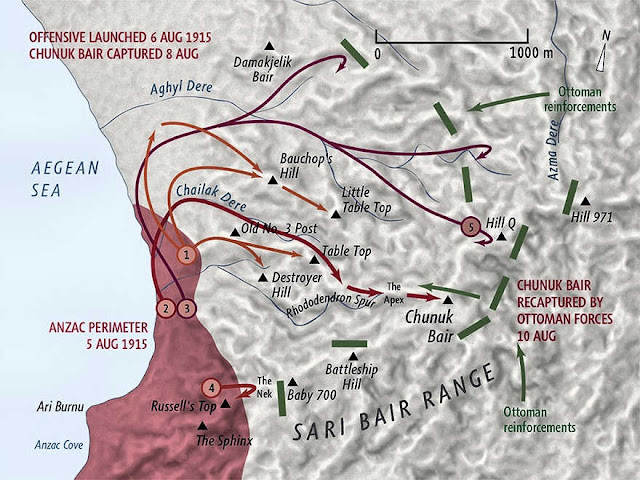
Sir lan Hamilton's plan was to endeavour to gain the heights of Koja Chemen (or Hill 971) and the seaward ridges by an advance from Anzac Cove, simultaneously with a new landing to be made further north at Suvla Bay. The whole ridge, of which Koja Chemen is the highest point, is called Sari Bair. Underneath it on the north lies a long spur known as Rhododendron Ridge, below which a wide water course, split into two forks, both called Aghyl Dere, leads up to Koja Chemen. The 9th Royal Warwickshire, under Major W. A. Gordon, landed in the early morning of August 4. During the first two days (August 6-7) of the attack they were in divisional reserve, but advanced up Aghyl Dere. On August 8 they crossed Bauchop's Hill to the ridge beyond, part going to relieve the 9th Worcester at the head of Aghyl Dere. The New Zealanders had captured Rhododendron Ridge on the previous day…

The main attack came on August 9 with the assault of Koja Chemen. Elements of three battalions- the 9th Royal Warwickshire, the 6th South Lancashire, and the 1/6th Gurkhas- reached the crest, whence they could look down on the waters of the Dardanelles and seemed to have victory in their grasp. 


 Click on Map to Enlarge

Note Location of Hills Q and 971

This capture of heights at Sari Bair would mark the furthest point of Allied advance during the campaign. As part of the force detailed to capture Hill Q (Koja Chemen), 2nd Lieut. Slim, leading around 50 men, was attached to the command of Lieut. Col. Cecil Allanson DSO (1877–1943), of the 1/ 6th Gurkha Rifles, who was himself wounded in the assault. Slim was shot through the chest, suffering serious injury which would affect him for the rest of his life.

But the [Australians] on the right, through no fault of their own, were running late, and when the Turks counterattacked [led by Col. Mustafa Kamal], the assault battalions were forced back to the lower slope trenches. One company of the 9th Royal Warwickshire held on, till they were surrounded, and, as it is supposed, all perished. [This account doesn’t mention the friendly fire incident that required Allanson to move his men away from the downward slope of the ridge].

When at night the 9th Royal Warwickshire was withdrawn to reserve, no officers and only 248 men were left. Major Gordon had been wounded on 8 August, and Major A. G. Sharpe, who succeeded him, was killed two days after. During the four days five officers were killed, 9 wounded and one missing; of other ranks, 57 were killed, 227 wounded, and 117 missing. For their service on these days Majors Gordon and C. C. R. Nevill received the DSO.

The fact that the battalion had lost all its officers, [including 2nd Lieut. Slim], probably helps explain why at the time its share in reaching the crest of Sari Bair was not recorded. As for Bill Slim, he was successfully evacuated and ended up on a hospital ship bound for England and a long recuperation.


The Great War — Mesopotamia

The 9th was transferred to the trenches at Suvla Bay until 19 December, when they were withdrawn to Mudros. On 6 January 1916, they were rushed to Cape Helles to fend off the last Turkish attack, then evacuated three days later straight to Port Said, where they remained until dispatched to Mesopotamia on 12 February 1916 to join the Tigris Corps. 

While convalescing in England, Slim accepted a proffered regular commission as a second lieutenant in the under-strength West India Regiment, the 2nd battalion of which was then serving in East Africa. Eventually, however, he cleared his medical boards in September 1916 and instead got himself named a replacement to the 9th in Mesopotamia.


Key sites of the Mesopotamian Campaign

As a part of Lieut. Gen. Stanley Maude’s (1864–1917) column late in that year, Slim and the 9th served in the capture of the Hai Salient, the capture of Dahra Bend and the Passage of the Diyala. On 4 March 1917, Slim was promoted to lieutenant, then made a temporary captain.  The 9th was one of the first British units into Baghdad on 11 March 1917. They then joined Lieut. Gen Sir W.R. Marshall’s column and pushed north across modern-day Iraq, fighting at Delli’Abbas and Nahr Khalis. Crossing the ‘Adhaim and the fight at Shatt al ‘Adheim, Slim was wounded in the arm in late 1917 and evacuated to a hospital in Shimla, India. He was awarded the Military Cross on 7 February 1918 for his actions in Mesopotamia. Subsequent to his departure, the 9th was in action in the Second and Third Battles of Jabal Hamrin and then at Tuz Khurmathl in April 1918.  In May 1918, they were attached to the North Persia Force, which found itself in Transcaspia (modern-day Turkmenistan) at the Armistice.  Meanwhile, Slim was still in Shimla. For pay reasons, he had been provisionally transferred to the Indian Army, and he was made a temporary major in the 6th Gurkha Rifles on 2 November 1918. On 22 May 1919, he was permanently transferred to the Indian Army and made a permanent captain. 


The Second World War — Southeast Asia

During the Second World War, Slim would lead the British 14th Army, the so-called "forgotten army" in the Southeast Asia Theater. With a peak fighting strength of 606,149 men (87 percent of whom were Indian soldiers), this juggernaut was the largest single Army (an Army is a group of more than one Corps) in British history. They fought in the jungles of Burma, kept the Ledo Road lifeline to China open and stopped the last Japanese offensive of the war at Kohima and Imphal in 1944. 

Some have considered Slim to be the greatest British general of WWII, or even since the Duke of Marlborough. Historian and journalist Max Hastings has written of Slim: “In contrast to almost every other outstanding commander of the war, Slim was a disarmingly normal human being, … without pretension, devoted to his … family and the Indian Army. His calm, robust style of leadership and concern for the interests of his men, ... his blunt honesty, lack of bombast and unwillingness to play courtier did him few favours in the corridors of power.”

In the 1930s, in order pay for his children’s education, Slim wrote novels, short stories, and other publications under the pen name Anthony Mills, an activity which was proscribed by Indian Army rules.  Later, he wrote a personal narrative entitled Defeat into Victory. First published in 1956, it has never been out of print. The prolific author John Lee Masters, an ex-Gurkha officer who had served under Slim in Burmese jungles, said that it proved that Slim was “an expert soldier and an expert writer.”


After Slim’s own autobiography, the next work about Slim was Ronald Lewin’s Slim: The Standardbearer (1977). Following Robert Lyman’s Bill Slim: Leadership, Strategy, Conflict (2011) there has been an outpouring of works on the subject including F.A.  Baillergeon’s Field Marshal William Slim and the Power of Leadership (2012), Edward Egan’s Field Marshal William Slim: the Great General and the Breaking of the Glass Ceiling (2015), John Douglas’s Slim: Unofficial History (2016), and Russell Miller’s Uncle Bill. The Authorised Biography of Field Marshal Viscount Slim (2016). All of these works are available today.

Today there stands a life-size statue of Slim erected in 1990 in Whitehall, opposite the Ministry of Defense.


Slim was a good source of quotable remarks. Here are two examples:

I have commanded every kind of formation from a section upwards to this army, which happens to be the largest single one in the world. I tell you this simply that you shall realize I know what I am talking about. I understand the British soldier because I have been one.

The fighting capacity of every unit is based upon the faith of soldiers in their leaders; that discipline begins with the officer and spreads downward from him to the soldier; that genuine comradeship in arms is achieved when all ranks do more than is required of them. “There are no bad soldiers, only bad officers,” is what Napoleon said, and though that great man uttered some foolish phrases, this is not one.

Sources include The Burma Star Memorial, the War Time Memories Project and Rootsweb.com


Saturday, December 14, 2024

Lonesome Memorial #9: Samogneux's Verdun Poilu


Tiny Samogneux, France, located below the heights of the Verdun battlefield and close to the Meuse River, was captured early in the 1916 fighting after French defenders in the area had been decimated by friendly fire. It subsequently became a strong defensive position for the German Army and was not liberated until the French counteroffensive of 1917.  

Samogneux gained literary fame and considerable sympathy in the last years of the war with the Paris publication of  the plight of an imaginary character created in 1917 by Henri Frémont, editor-in-chief of the Bulletin meusien. Père Barnabé was a peasant from Samogneux, forced to leave his village in February 1916. He would become the symbol of all French refugees driven from their homes during the Great War. The 30 serialized adventures of Père Barnabé were eventually collected in a best-selling French volume titled Réfugiés Meusiens, which was later translated into English and sold in America as Refugees of the Meuse.


The Original Père Barnabé Statue and the
Work That Made Him Famou
s


The American sales enabled a benefactress, Mrs. Jane Matthews Gray of Cincinnati, who had served in France with the Red Cross, to raise 230,000 francs for the rebuilding of the commune's roads and bridge, its church, and war memorials. The last category included a statue depicting the fictional Père Barnabé (since supplemented with a second rendition) and a beautifully executed French Poilu.


Mrs. Gray


The Poilu sculpture is our "Lonesome Memorial" since it is very difficult to see from the adjacent road. I've driven past it at least 30 times and only recently learned of its existence.  He was sculpted by Gaston Broquet (1880–1947)  and is shown pulling on a gas mask during an attack. Broquet trained at the Ecole des Beaux Arts in Paris and served 32 months as a stretcher-bearer at the front in WW1. During the interwar period, he produced a number of remarkable war memorials including the well-known Andre Maginot sculpture near Fort Souville at Verdun.


Getting There

Samogneux is located 13.5 km north of Verdun on highway D964. The older version of Père Barnabé  (shown above) is at the main crossroad of the village. The newer version is on the road about 200 feet farther north, and the Poilu is about 50 feet up the slope from there at the site of the former village cemetery. This stop is at coordinates: 49.25629, 5.33742. Note:  Parking on the D964 is somewhat precarious.  If visiting, find a parking place on a side road or in the village.

Friday, December 13, 2024

A Tale of Two Treaties: From Sèvres to Lausanne


September 1920 Greek Celebration of the Treaty of Sèvres
(The Joy Would Not Last)


The Treaty of Sèvres 

This postwar peace treaty was  signed by Sultan  Mehmet VI on 20 August 1920 between the Allied Powers and the Ottoman Empire. It was, however, never ratified—primarily because of intense internal, nationalist opposition. The treaty abolished the Ottoman Empire and obliged Turkey to renounce all rights over Arab Asia and North Africa. The pact also provided for an independent Armenia, for an autonomous Kurdistan, and for a Greek presence in eastern Thrace and on the Anatolian west coast, as well as Greek control over the Aegean islands commanding the Dardanelles. 


Click on Map to Enlarge


Rejection

Opposition to the treaty was widespread and coalesced around Turkey's most successful commander of the war, Mustafa Kemal, who quickly repudiated it. Many prominent Turks escaped from Istanbul to Ankara—center of opposition—including Turkish Army Chief of Staff İsmet İnönü and, after him, Fevzi (Çakmak), the sultan’s war minister. Fevzi became Mustafa Kemal’s chief of the general staff. New elections were held, and a parliament, called the Grand National Assembly (GNA), met in Ankara on 23 April 1920. The assembly elected Mustafa Kemal as its president.

Having received military aid from the Soviet Union, Kemal successfully drove the Greeks from Anatolia and Thrace and subdued the new Armenian state. The Soviet Union became the first nation to recognize the nationalist government in Ankara. 


Mustafa Kemal in Ankara, 1921


With Anatolia rid of most of the Allies, the GNA, at the behest of Mustafa Kemal, voted on 1 November 1922, to abolish the sultanate. This was soon followed by the flight into exile of Sultan Mehmed VI on 17 November. The Allies then invited the Ankara government to discussions that resulted in the signing of the Treaty of Lausanne on 24 July 1923. The nationalists occupied Istanbul on 2 October. Ankara was named the capital, and on 29 October the Turkish republic was proclaimed. Turkey was now in complete control of its territory and sovereignty.


At Lausanne


Turkish Delegation at Lausanne


The Treaty of Lausanne was signed by representatives of Turkey (successor to the Ottoman Empire) on one side and by Britain, France, Italy, Japan, Greece, Romania, and the Kingdom of Serbs, Croats, and Slovenes (Yugoslavia) on the other. The treaty was signed at Lausanne, Switzerland, on 24 July 1923, after a seven-month conference.

The treaty recognized the boundaries of the modern state of Turkey. Turkey made no claim to its former Arab provinces and recognized British possession of Cyprus and Italian possession of the Dodecanese. The Allies dropped their demands of autonomy for Turkish Kurdistan and Turkish cession of territory to Armenia, abandoned claims to spheres of influence in Turkey, and imposed no controls over Turkey’s finances or armed forces. The Turkish straits between the Aegean Sea and the Black Sea were declared open to all shipping.


Click on Map to Enlarge


Sources: Britannica Online; WikiCommons


Thursday, December 12, 2024

Too Late to See Combat: The Packard LePere LUSAC 11


Click on Images to Enlarge

At Wright-Patterson AFB, Ohio


Designed in 1917 by Capt. Georges LePere, a French aeronautics engineer working for the U.S. Army Air Service, the LUSAC 11 was the result of efforts to get an American-built fighter into combat as soon as possible. The acronym LUSAC stood for "LePere United States Army Combat." LePere designed the LUSAC 11 to be a combination fighter, light bomber, and reconnaissance aircraft that carried a pilot and an observer/gunner. 

Capt. LePere, along with several other French aviation engineers, worked on the design at the Packard Motor Car Co. of Detroit, MI. Packard provided design and fabrication space and additional engineers, and the first prototype was completed in April 1918. After the three prototypes received generally favorable reviews from test pilots at Wilbur Wright Field, OH, the Bureau of Aircraft Production planned to order as many as 3,525 LUSAC 11s. 


Cockpit


At war's end in November 1918, however, the Bureau cancelled its contracts, and only 28 production aircraft were built (with only seven of these built before the Armistice; none saw combat). The aircraft continued to fly in the Air Service, and a specially modified LUSAC 11 became famous by setting a number of altitude records at Wright Field in the early 1920s. Various sources claim it was the first powered aircraft to exceed 10,000 meters altitude.

The aircraft on display at the USAF National Museum (top photo), the only LUSAC 11 in existence, originally went to France just before the end of the war. In 1989 the museum acquired it from the Musée de l'Air in Paris, France. After extensive restoration by museum personnel, it went on display in 1992. It is marked as it appeared while at the Allied test facility in Orly, France, in late 1918.


One of the Few Produced before War's End


TECHNICAL NOTES:

Armament: Two .30-cal. Marlin and two .30-cal. Lewis machine guns

Engine: Liberty 12 of 400 hp

Maximum speed: 136 mph

Cruising speed: 118 mph

Range: 320 miles

Ceiling: 20,200 ft. (modified LUSAC 11 up to 39,700 ft. with turbo-supercharger)

Span: 41 ft. 7 in.

Length: 25 ft. 3 in.

Height: 10 ft. 7 in.

Weight: 3,746 lbs. loaded

Serial number: SC 42133


Sources:  The Aerodrome; USAF National Museum

Wednesday, December 11, 2024

The Drawings of Wyoming's Doughboy Artist: Sgt. George Ostrom, 148th Field Artillery


Bucking Bronco Insignia, designed by George Ostrom


On 18 June 1916, the Wyoming National Guard was activated for service on the Mexican Border. George Ostrom, then 28 years old, was a staff sergeant and the bugler for Company D, from Sheridan, WY. George Ostrom left his beloved colt, Redwing—“a very beautiful sorrel, two white stockings and silver mane and tail and a blazed face,” he remembered years later—in a pasture at the family homestead 20 miles east of Sheridan. He trained at Camp Kendrick in Cheyenne from June to September 1916 and then served at Camp Deming in Deming, NM, from 30 Sept. 1916, through 1 March 1917, before the guard unit was sent home.


Peeling Spuds on the Mexican Border


Road Mine Exploded by an Ambulance near Nantilos, France


Three weeks later, he was back in federal service for World War I, and his guard unit was absorbed into the 148th Field Artillery regiment. In France between July and November 1918, the regiment took part in every major campaign of the American Expeditionary Force (AEF).


Field Dressing station above Chateau-Thierry  (Detail)


Planning the Next Offensive  (Detail)


Staff Sgt. Ostrom was also an artist. During his wartime service with Battery E, Ostrom created the first rendition of the now-familiar silhouette of a bucking bronc. He had managed to smuggle Redwing with him to France and based the image on his colt. Ostrom’s iconic emblem, used on 148th Field Artillery guns and vehicles during the Great War, as World War I was called at the time, eventually became our state’s symbol.


Soldiers of the 168th Infantry Advance past a Town in France


Camouflaged 155mm


Throughout his military service on the Mexican border and in France, Ostrom prepared nearly 20 drawings showing both combat and camp life in precise detail. George generally made these sketches in pencil and then finished them in ink after the war. Today, his sketches are considered to be a national treasure of soldier art. He is one of Wyoming’s leading artists.


Sgt. Adams and Sgt. Ostrom Cracking a Boch [sic] Plane (Detail)


A Crazy Clock, a Bad Road, a Shell, and Two Men with Rifles


Following his discharge, George returned home to Sheridan. He painted highway billboards and signs for the city of Sheridan as well as creating a considerable amount of Wyoming and wildlife artwork. George remained active in veterans’ organizations and bands. He died in Sheridan in 1982 at the age of 97. His relatives still live in Sheridan.


The Marne Defensive, July 14, 1918


The Opening of the Argonne. Battery E 148th F.A. Firing over Dead Man’s Hill


Sources: WYOHistory.org; Wyoming State Library; Wyoming Veterans Memorial Museum, Casper, WY


Tuesday, December 10, 2024

Gotha Terror: The Forgotten Blitz, 1917–1918


By Ian Castle

Frontline Books, 2024

Reviewed by Ron Drees


Loading a Gotha's Bomb Rack


Ian Castle, a prolific English WWI historian, has written his third book on Germany’s WWI blitz of England. Gotha Terror is a bomb-by-bomb description of how German bombs dropped on 32 raids by 86 sorties killed 893 while injuring another 2,125 from March 1917 to May 1918. This blitz has been overshadowed by the 1940 blitz, but there were lessons learned that were later of considerable usefulness.

Early in the book, the purpose of the bombing raids is stated: to unsettle Britain and to distract the military from the actual conflict. As a result of the raids, over 17,000 men in uniform were not deployed to the Western Front or elsewhere but stayed in England. There is no corresponding discussion as to the German forces and resources diverted from combat areas and whether these military resources would have been of greater benefit if employed directly in combat instead of bombing England.

The text is a string of detailed descriptions of the various sorties: the route, flying officers, bombs dropped, and destruction and names of individuals killed in individual raids, opposition by British aircraft and anti-aircraft guns, and the difficulties of the raiders’ return flights. The details of each attack are much the same, becoming somewhat repetitive.  

While the German officers were aggressive in their attacks, the British were slow to respond, finally realizing that they had to do more to protect the home island. Yet in pre-radar days, it was difficult to spot black-painted zeppelins at night and planes overhead, especially when zeppelins could climb higher and faster than the second-rate pursuit planes Britain originally deployed. When England finally realized the seriousness of the Gotha terror there was a significant response with additional searchlights, antiaircraft guns, and more up-to-date fighters.  However, even these weapons were insufficient to significantly stem the Gotha tide.


Click HERE  to Order

The most successful military attack was on the Drill Hall of the Royal Naval Barracks in Chatham, on a bay south of the Thames.  The roof was glazed, so when the bombs fell through, the glass roof became shrapnel, killing 130 sailors and injuring 86. Rescue parties had to deal with numerous body parts.

The raiders had to cope with engine failures, winds blowing the bombers off course, navigational difficulties—including a frequent inability to pinpoint locations—dud bombs, weather, antiaircraft fire, and defending RFC/RAF fighters.  Perhaps this explains why the primary targets were usually population centers instead of military installations, the former being easier to find.

The book is well illustrated with maps showing the routes of the raiders and photographs of the various aircraft, personnel, bombs, and damage.  While the wingspan of the Gothas and Giants were larger than that of the B-29 of WWII, it would have made the size of the WWI airplanes more comprehensible if dimensioned drawings of all three planes and zeppelins had been included. Also, there were references to numerous British planes with which few readers would be familiar. Photos of those planes would have been useful.

The German air assault did sidetrack resources from various fronts of the war while also reducing war production during air raids, but they were not that meaningful. No panic was caused by these raids. Air raids do not greatly impact civilian morale, as was learned during the 1940 London blitz, American raids of Vietnam, and the Gulf Wars. However, the minor destruction of the 1917-18 air raids was a harbinger of things to come in future wars.  Perhaps the significant result of the WWI blitz was the realization of the need for an efficient warning system which was re-instituted during the blitz of 1940, albeit enhanced by radar.


Caption: German Heavy Bomber with Bombs,
Ready for Take-Off

While the author enumerates the houses destroyed or damaged, he does not describe the social impact, how these houses were repaired or replaced or what the damage and disruption meant to communities. This was part of the Gotha Terror and needs elaboration. An unusual aspect of this book is Appendix III, “Individuals Killed in Air Raids 1917–1918,” with a list that includes Date of Death, Name, Age, and Place. The deaths are in two groups depending upon the airship that delivered the lethal ordinance: Zeppelin or Airplane: Gotha or Giant. The author seems on a mission to determine the names of all the fatalities and did identify 797 of those killed.

For readers who are very familiar with the events of WWI and yet wish to discover little-known aspects of the conflict, this book is quite useful.  Gotha Terror documents events of a relatively small impact since they did not influence the outcome of battles, impact political situations or otherwise materially change matters, except, of course, for the victims.

Ron Drees