Now all roads lead to France and heavy is the tread
Of the living; but the dead returning lightly dance.
Edward Thomas, Roads

Sunday, August 16, 2015

D'Annunzio's Vittoriale


Entrance Facing Lake Garda

Gabriele D'Annunzio [1863–1938] was one of the most colorful and controversial personalities of the Great War. The Pescara-born literary innovator moved to Rome in 1881 and quickly became distinguished as a poet, novelist, dramatist, and librettist. In 1914 he became a vocal activist for Italy's entrance on the Entente side. After war was declared, he was active as foot soldier, sailor, and aviator all over the Italian Front. His daring missions to Trieste, Pola, and especially his August 1918 propaganda flight over Vienna, became part of the Italian war heritage. Afterward he would lead an illegal occupation of the Dalmatian port of Fiume and would be an early proponent of fascism. 

His career, especially his participation in the First World War, is commemorated at a museum he planned in detail called the Vittoriale, adjacent to his home at Gardone Riviera on the southwest corner of Lake Garda. The only site I have visited that is comparable to this in location and grandiosity of design is Hearst Castle in San Simeon, California.  Here is a selection of images from the compound.  I've focused on World War I images and avoided some of the many, many depictions of D'Annunzio that are scattered around the grounds, except for his mausoleum, which – I believe – says a lot about the man.

The Airplane That Took D'Annunzio Over Vienna

Cruiser Puglia (Do You Have a Full-Sized Warship in Your Back Yard?)

Or a Torpedo Boat in Your King-Sized Garage?

Monument to the Italian Victory of 1918 on the Piave
from Original Pylons of Bridges over the River

Mausoleum: RIP, D'Annunzio. You Wanted to Leave Your Mark


Photos from the Fondazione Vittoriale Website and Wiki Commons

Saturday, August 15, 2015

French Housewife, British Heroine


Trooper Fowler
During the August 1914 Battle of Le Cateau, Trooper Patrick Fowler of the 11th Hussars, Prince Albert's Own, was cut off from his regiment behind German lines. After hiding in the woods for months, the hungry, exhausted cavalryman was found by Louis Basquin and taken to the home of his mother-in-law, Madame Belmont-Gobert, in the village of Bertry. For the next four years, she successfully hid him, usually in her cupboard, despite being compelled to billet German troops.  Fowler had to spend nearly all his daylight hours sitting in the shelfless half of the cupboard with his knees tucked up. Only at night was he able to emerge with confidence. Madame's ingenuity led her to fill the shelves in the right-hand half of the cupboard with various articles of everyday use and to leave that door slightly open. This averted suspicion and allowed some air to get to the hidden man, as she had cut out a semicircular portion of the vertical partition. As Fowler himself said, "I was often in the wardrobe for four or five hours at a stretch, with the Germans sitting round the fire a few feet from me. If I had even coughed it would have been all up!" Corporal Hull of the same regiment was concealed in another house, but he was discovered in October 1915 and shot. Fowler's presence in the village was at the same time betrayed to the Germans, but an intensified search failed to discover him for he was hidden for a month in a hole in the floor of a barn. 


Madame Belmont-Gobert (center) with Patrick Fowler in London, 1927

At times German soldiers sat, ate, talked, and smoked just a few feet from where Fowler was hiding. Once Madame had a premonition that the cupboard would be searched, so she hid the hussar under a mattress. Indeed, the German inspectors that day — for the only time — opened the cupboard. Trooper Fowler was rescued by advancing British forces in October 1918, although he needed his former commander's testimony to avoid desertion charges. Madame was awarded the Order of the British Empire for her courage. The cupboard is now in the collection of the Imperial War Museum.
Details from British Newspapers and the Imperial War Museum

Friday, August 14, 2015

Harry Lauder's Keep Right on to the End of the Road


Music hall star Harry Lauder composed this shortly after his son John was killed at Pozières in December 1916. During the Second World War Winston Churchill liked to listen to it when things were going badly.


Ev'ry road thro' life is a long, 
    long road,
Fill'd with joys and sorrows too,
As you journey on how your heart 
    will yearn,
For the things most dear to you.
With wealth and love 'tis so
But onward we must go-

Chorus

Keep right on to the end of the road, 
    keep right on to the end,
Tho' the way be long, let 
    your heart be strong, 
Keep right on round the bend.
Tho' you're tired and weary still journey on, 
    till you come to your happy abode,
Where all you love you've been dreaming of 
   will be there at the end of the road.

After his son's death, Harry became something of the Bob Hope of the First World War, entertaining the troops and recruiting for the forces including in America. Listen to a 1926 version of Harry singing the song at YouTube:  https://www.youtube.com/watch?v=vbM86eiczAg


Thursday, August 13, 2015

Who Was "Blinker" Hall?

Captain (later Admiral) William Reginald “Blinker” Hall KCMG CB RN (1870–1943) was the British Director of Naval Intelligence from 1914 to 1919. When Hall was appointed – his health had forced him to give up the captaincy of the battlecruiser Queen Mary – the decrypting operation that would become famous as "Room 40" had already been set up by Sir Alfred Ewing. Relations between the two men, who both reported to the chief of staff, remained difficult until Ewing left the Admiralty in September 1916. Throughout the Great War, Hall was at the center of diplomatic and political intelligence; he became Whitehall's de facto intelligence coordinator, with direct access to prime ministers and senior government members. His activities included interrogation (he questioned both Mata Hari and Sir Roger Casement), running his own intelligence networks (like those in Spain and Latin America), and inspiring disinformation campaigns.

Best-Known Photo of Blinker Hall

Hall was a charismatic man and brilliant intelligence operator and politician. Author Thomas Boghardt wrote that Hall earned his nickname because “when excited…his piercing eyes took to frequent blinking.” Hall also had false teeth that clicked as he spoke, and he used these tics to overcome opponents in Whitehall debates: “When making a point, he clicked his false teeth horridly, and his icy stare and wiggling eyebrows were said to work wonders in negotiations.”

Hall and Room 40 are best known to Americans because of the "Zimmerman Telegram" episode. The British had cut the German undersea cables at the start of the war, leading Berlin to send diplomatic traffic to North America by handing encrypted messages to the U.S. embassy for transmission to Washington on U.S. cables. The cables passed through London, and Hall intercepted and decrypted the State Department’s messages; thus he found and decrypted the Zimmermann telegram, which was embedded within the U.S. traffic. To cap this achievement, Hall staged an elaborate deception so he could pass the telegram to Page without revealing that he was reading U.S. cables. Indeed, it would not be until the 1930s that the United States realized that the British had been reading its traffic (and not until World War II that the UK stopped the practice altogether).

Keeping Track of Germany's High Seas Fleet Was, Of Course,
a Major Mission of Room 40

Under Hall’s firm hand Room 40 operated with virtually no supervision from above, something that would be almost inconceivable today, when intelligence services are bureaucratized and seek to integrate their operations. Ironically, though, Hall’s success contributed to the creation of the modern intelligence bureaucracy. After the war, the British realized how valuable Room 40 had been and took steps to place it on a firm institutional footing, creating what is now GCHQ, the Government Communications Headquarters, which—along with NSA—is one of the world’s leading signal intelligence agencies.

Sources: CIA and World War I Technology

Wednesday, August 12, 2015

Recommended: Medicine in the First World War by the Kansas University Medical Center


The Kansas University Medical Center has made an outstanding start on their effort to tell the story of medicine in the First World War. If you have any interest in the medical side of the war, their site is one you should visit and make a favorite.  Their home page is at: http://www.kumc.edu/wwi.html

University physicians helped the Kansas City area organize its own base hospital during the war and they present its full (and fascinating) history on their site. They have given us permission to share the opening chapter of the story of Base Hospital #28 with our readers.

Part 1: Forming Base Hospital #28


Train to Camp McPherson
Kansas City Star and Times Newspaper Clipping

By March 1917 the people of America were ready to go to war with Germany. In this spirit Dr. John Binnie, Professor of Surgery, and Dr. Lindsey Milne, Professor of Medicine, of the University of Kansas School of Medicine, were instrumental in convening a group of Kansas City doctors at the new Christian Church Hospital on 1 April 1917, to discuss formation of a large general military hospital to be sent from Kansas City to France. Enthusiasm was high and many physicians and surgeons were ready to join the staff of this new and unique hospital. Binnie, already in his fifties and a world-renowned surgeon, was the obvious choice to be the senior officer of the new hospital. Milne, a physician younger by 20 years, and also of considerable eminence as a researcher, naturally assumed the position as Binnie's second in command. By curious coincidence both were born in Scotland and had emigrated to Kansas City in the early years of the 20th century.

Some of the Nursing Staff of the Hospital 

Recruitment to the staff of the now-designated Base Hospital #28 started immediately and proceeded smoothly. Doctors from the Kansas City medical community were enlisted but allowed to continue with their private practices until the actual mobilization of the hospital in the spring of 1918. Enlisted men, who would serve in supporting roles, were recruited from the greater Kansas City area. Recruitment of nurses, at both qualified and assistant levels, was largely handled by the American Red Cross and not specifically identified with Base Hospital #28, though, ultimately, most of the hospital's nurses were from Kansas and Missouri. The city and its citizens were deeply involved in the development of the hospital. News stories, photographs, and even cartoons emanated almost daily from the hospital's temporary headquarters in the recently completed Union Station as the illustrations show.  Training sessions were conducted at Union Station and, by the standards of the U.S. Army and the American Red Cross, uniforms and equipment were issued to some of the hospital's personnel.

On 22 February 1918 six officers and 149 enlisted men departed from Kansas City on a special train bound for Fort McPherson, Georgia, to join Base Hospital #6 in medical and military training for overseas service. Colonel Donald Bannister, a regular army physician and veteran of the Boxer Rebellion, was in command and remained so until the hospital was situated in Limoges, France. Herbert Ridgway was named sergeant-in-charge of the Registrar's Office, a position and service that would remain crucial to the smooth operation of the hospital until its demobilization a year later. In addition to military exercises of various sorts, classes and training sessions were conducted in treatment of shock, injuries from poison gas, limb amputation, identification and removal of shell fragments, and reconstructive surgery.


On 2 June 1918 the hospital staff, now numbering 34 officers and 201 enlisted men, left Fort McPherson for Camp Merrit, New Jersey, and embarkation on the SS Megantic, a White Star Liner, now the troop ship that would take them to England on their way to Limoges, France. Escorted in a convoy of troop ships by the naval cruiser, USS San Diego, the trip was marked by a diversion around Ireland to avoid a flotilla of German torpedo boats. Finally landing at Liverpool the hospital staff went by train to Southampton where an old Irish Channel boat, the Antrim, took them across the English Channel to Cherbourg in France and the Hommes 40 train that would take them on to their final destination, Limoges. The hospital's nurses, 100 young women, traveled separately.

Continue Reading the Story of Base Hospital #28 at:  http://www.kumc.edu/wwi/base-hospital-28/setting-up-in-france.html

Credits: Thanks to Fred Holmes of the KU Medical Center and the National WWI Museum for the images.

Tuesday, August 11, 2015

Behind the Lines
Reviewed by Ron Drees


Behind the Lines: WWI's little-known story of German occupation, Belgian resistance, and the band of Yanks who helped save millions from starvation
by Jeffrey B. Miller
Milbrown Press, 2014


First of a trilogy, Behind the Lines also could be considered a companion piece and sequel to Jeff Lipkes's Rehearsals: The German Army in Belgium, which described holocaust-like behavior by German troops invading Belgium. Jeffrey Miller, a descendent of the victims, describes the invasion and occupation by German troops and their administrative mindset, the impact upon the Belgian psyche, work force, and economy, but most of all upon their ability to feed themselves — total devastation. For those of us who are WWI students, this book will enhance our education on what happened outside of the combat zone.

The Band of Yanks: the American Commission for the Relief in Belgium

The Wehrmacht marched into Antwerp in a gray river that flowed for three days. Spooked troops had murdered civilians and burned several towns to the ground. Centuries-old structures and priceless documents were destroyed. Perhaps this was retribution for this very small country with the audacity to oppose the self-righteous nation who stomped on their neutrality. The cliché, beaten but unbowed, applied here as individuals helped English soldiers and others flee to neutral Holland. An underground newspaper sprung up and mocked the conquerors, all at the risk of torture and death for the perpetrators. Cardinal Mercier wrote a letter that shamed Germany to the world. Miller should have included the letter in this book, even in an appendix.

There was one vital task that the nation ceased to be able to do — feed itself. Nine million faced starvation because the conquerors held no obligation to assist. Yet one small group of people from several nations, particularly the United States, led by a mining engineer, Herbert Hoover, moved national governments, friend and foe, to raise money and organize the monthly collection, shipment and distribution of 80,000 tons of various grains to prevent what could have become the biggest holocaust in world history. How this was done despite internal politics, an ongoing war, personal enmity, logistical nightmares, a devastated countryside, foreign occupation, and naïve college students, makes this book a gripping story.


Order Now
The author uses archives from Hoover's presidential library and Stanford, plus records from his own ancestors who worked to feed their countrymen and oppose the Germans, and is able to describe events at almost an hourly pace. Hoover emerges as a man who wanted total control, partially out of ego but also because he was emotionally concerned about the starvation of a nation. Others risked their lives (and sometimes lost them) to fight back as best they could by collecting intelligence and smuggling troops over the border.

Two more volumes are forthcoming at unmentioned intervals. While this is a story of quiet heroism by many people, there is tragedy in what happened in August and the remainder of 1914 as people suffered grievously, not just from hunger but from the destruction of homes prior to a bitter winter. A heavy loss of self-respect descended as the nation could no longer sustain itself and as cultural treasures were thoughtlessly destroyed by supposedly one of the most cultured countries in the world. Remember Belgium's predicament when the Versailles reparations are discussed again.

Ron Drees

Monday, August 10, 2015

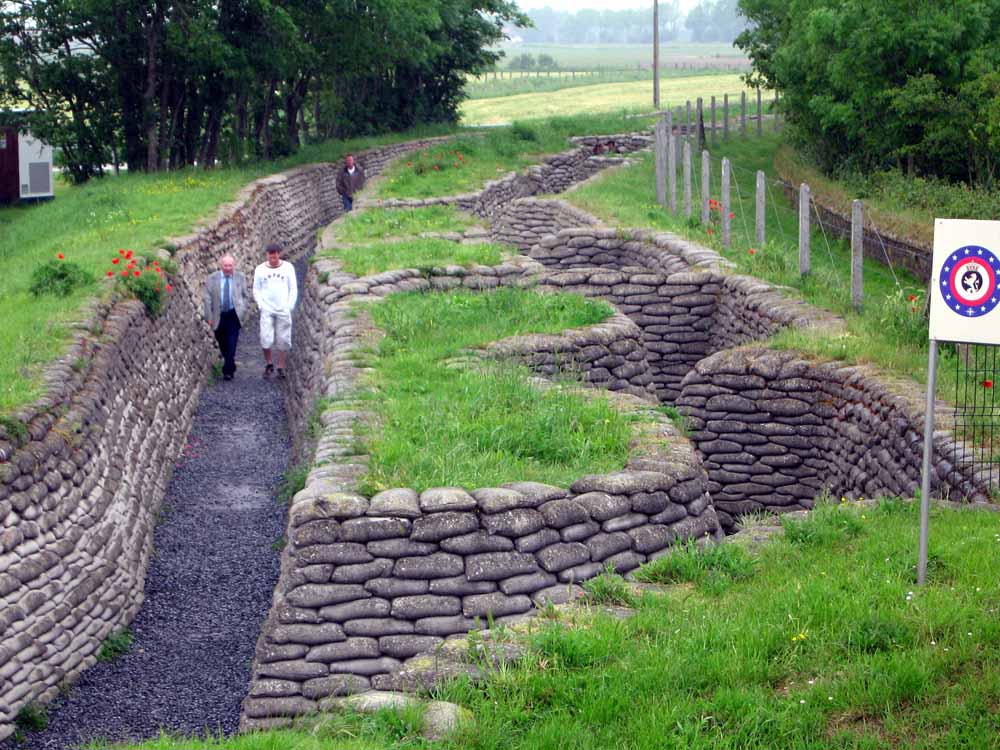
The Trench of Death at Diksmuide


Trench of Death Past the Marker; Yser River to Right

On Belgian section of the Western Front at the southern end of the vast inundated area between Nieuport and Diksmuide that secured the northern-most portion of the front for the Allies was a critical series of field fortifications known as "The Trench of Death." Between 1914 and 1918, regiment after regiment of the Belgian Army struggled under unbearably harsh conditions to prevent the German advance into France. This was a point of extreme vulnerability; a penetration at this location would enable the German Army to outflank the Ypres salient and perhaps roll up the entire Allied position in the west. By the end of 1914 the Germans had established a strong redoubt along the river.

Belgian Troops at Rest Before a "Mouse Trap"


The Trench Extends Along the River Over a Kilometer

In 1915, under heavy fire, Belgian engineers had started digging trenches along the west bank of the Yser River to try to retake the base. Through the use of saps (the extension of a trench to a point below the enemy fortifications) both sides got closer to each other until they were yards apart. The attacks were incessant, the trenches narrow, the soldiers sitting ducks for mortar attacks. Finally, in 1917 the Belgians built a big concrete shelters with lookout holes called the "Mouse Traps" to stop the Germans from infiltrating the Belgian trenches at the ends of the saps.


Two View of the Trenches from Above and Inside

Life was rigorous in the trenches. Belgian soldiers manned the trenches for three days straight, then got three days rest in a cantonment in the rear combat zone. The Trench of Death near Diksmuide remained the heart of the Belgian resistance until the successful Anglo-Belgian offensive called the Battle of Flanders began on 28 September 1918. Today the Trench of Death can be visited and is among the more impressive memorials on the Western Front.

Contemporary photos from Steve Miller, text from Belgium Travel

Sunday, August 9, 2015

Remembering a Veteran: George Gallie Nasmith, CEF

George Gallie Nasmith would never have qualified to be a soldier. A condition called achondroplasia had stunted his growth and he stood just four-foot-six. But as a sanitation expert with the City of Toronto’s medical department of health, he believed he could help the Canadian Army. Minister of Militia Sam Hughes agreed and appointed him to organize a mobile laboratory in the field to test and supply safe drinking water for the soldiers. The plan was to attach him to the medical corps, but because Nasmith wasn’t a doctor, Hughes created a new unit to accommodate him — “Canadian Army Hydrological Corps and Advisers on Sanitation.” Nasmith joined the unit in September 1914 with the rank of lieutenant-colonel.

Lt. Col George Gallie Nasmith

Nasmith was in Ypres with a colleague on 22 April 1915, when the Germans first unleashed chlorine gas on the Allied lines. With his expertise in water purification, he was well acquainted with chlorine. “Looking towards the French line we saw this yellowish green cloud rising on a front of at least three miles and drifting at a height of perhaps a hundred feet towards us,” Nasmith wrote in his memoir of the war. “The gas rose in great clouds as if it had been poured from nozzles, expanding as it ascended; here and there brown clouds seemed to be mixed with the general yellowish green ones. ‘It looks like chlorine,’ I said, ‘and I bet it is.’ ”

Later in the day, he saw victims of the attack at a Canadian field ambulance: “Lying on the floors were scores of soldiers with faces blue or ghastly green in colour, choking, vomiting and gasping for air, in their struggles with death, while a faint odour of chlorine hung about the place.” Nasmith reported directly to headquarters with his diagnosis that the mysterious gas was chlorine, possibly mixed with bromine. He recommended a mask soaked in hyposulphite of soda to protect soldiers. The Canadians adopted it as their first rudimentary gas mask.

On 24 April British commander Gen. Henry Rawlinson summoned Nasmith to explain what he thought happened at Ypres. “The General smiled a smile of appreciation as he thanked me for the assistance that our laboratory had given in helping to diagnose and combat this new mode of warfare, and I left his office feeling that we had been of some real use in the war even if we never did anything else.”

Military officials turned to Nasmith’s lab for help with several experiments and tests aimed at protecting soldiers from gas attacks. For his contributions to the Allies, Nasmith was named to the British Order of St. Michael and St. George.

— Stephanie MacLellan

Sources: The Toronto Star WWI Encyclopedia; On the Fringe of the Great Fight, by Col. George G. Nasmith; No Place to Run, by Tim Cook; War Story of the Canadian Army Medical Corps, Vol. I, by J. George Adami

Saturday, August 8, 2015

August 1915: Warsaw Falls

The main Battle for Warsaw (Poland) took place in August of 1915. After Germany’s victory at Gorlice-Tarnów in June of 1915, General August von Mackensen led his troops over the San River to capture Przemysl. On 22 June the Russian troops left Lvov, the Galician capital. A few days later, the German troops crossed over the Dniester. During the early part of July, Mackensen’s troops were stopped because of attacks by the Russians.

Peasants and German Prisoners Digging Trenches Around Warsaw

Troops of the Central Powers


On 13 July the Central Powers (armies from the Ottoman Empire, Austro-Hungarian Empire, German Empire, and Bulgaria) started a new offensive that went across the whole front line. About one week later, the German troops had arrived at Narev.

When the Russians saw this, they started to retreat very quickly to the Ivangorod-Lublin-Chelm line. The Russian troops were vastly outnumbered because of their earlier losses. The Russian army grew weaker each day as a result of chronic supply shortages, which also caused a decline in morale.


Evacuating Poland


During this period, the Russians ordered the civilians to evacuate Poland. This resulted in many hardships for the Polish people. Their evacuations caused problems for the Russian troops, too, because the people blocked the roads. On 22 July the armies of the Central Powers crossed over the Vistula River.


Russian Troops Are Surrounded


Germany’s Tenth and Niemen troops went to the northern end of the front to help surround the Russians. During the last part of July, these troops arrived at the Novo-Georgievsk (Russian fortress), north of Warsaw. The Russians chose to defend their Novo-Georgievsk fortress, which cost them approximately 90,000 casualties.

Russian Forces Withdrawing from Warsaw

Then Russia’s southern army had to retreat about 100 miles, near the Bug River. This left the Russians with only a very small part of Congress Poland, basically just the Ivangorod fortress and Warsaw.

Russian Troops Leave Warsaw


In early August, Russia’s Fourth Army abandoned the Ivangorod fortress. Russia’s Grand Duke Nicholas Nicholaevich then made the decision to evacuate his army from Warsaw. On 5 August the Russians left Warsaw. Germany’s 12th Army (commanded by General von Gallwitz) was able to easily capture Warsaw. On 21 August Tsar Nicholas II dismissed the Nicholaevich and took charge of the Russian Army.

This ended Russia’s control of the city they had ruled for close to 100 years. Germany’s Twelfth, Tenth, and Eighth Armies continued attacks as they moved south and out of Prussia. The Germans captured Vilna, Grodno, Bialystok, Brest-Litovsk, Ivangorod, and Kovno.

German Troops Entering Warsaw

Effects on Russian Forces


This caused the collapse of the front and sent the northern part of the Russian lines moving south out of Prussia. This resulted in Russia’s northern lines to fall back even further, ultimately to the eastern border areas of Prussia before the war.

During the last part of September just about all of the Russian troops were completely pushed out of Galicia and Poland. At this moment in World War I, the struggling Russian Army was no longer considered a threat on the Eastern Front. This freed the German troops so they could focus their attentions on their war efforts on the Western Front.

Source:  Totallyhistory.com

Friday, August 7, 2015

A War Poem Inspired by the Suvla Bay Operation


Francis Ledwidge, the Irish war poet whom we remembered in our 3 August 2013 posting (link) was killed in the battle of Passchendaele. He had, however, also served in the Suvla operation at Gallipoli and recalled that experience in perhaps his most moving work.


Thursday, August 6, 2015

100 Years Ago: Third Failure at Gallipoli

By June 1915 everyone knew the land assault at Gallipoli had failed as dismally as the great battleship attack of 18 March. A breakout plan had been advanced earlier, based on expanding the Anzac sector, by landing additional divisions just to the north at the beaches around Suvla Bay. Suvla, however, had some interesting physical features. Just behind the beaches is a huge salt lake that initially prevented the new units from deploying shoulder to shoulder. Five to eight kilometers inland, a horseshoe of low hills isolates the area. The new troops were expected to land north and south of the lake, get organized, and immediately seize the ring of hills as a launch pad to attack the higher Chunuk Bair from multiple directions. In any case, the Dardanelles Committee of the British government approved this scheme in June.

The Suvla Plain in the Distance from Sari Bair
Landing Beaches, Salt Lake, Low Hills Are All Visible

There was also to be a concurrent attack out of the Anzac sector against Chunuk Bair, as well as assaults on the south end of Anzac to tie down Turkish forces and a diversionary operation out of the now almost irrelevant Helles sector. Once atop Chunuk Bair the unified Allied force was then expected to march overland to the straits, seize the forts, and allow the passage of the battleships. But the Suvla operation never got to that point to see if the straits could be reached.

All indications going into the operation, scheduled to start 6 August, were that the mistakes of April were not going to be repeated. Sufficient forces — IX Corps with two divisions landing on day one and two more available for quick reinforcement — were available. Even better, the intelligence branch had determined the surrounding ring of hills were lightly held. They just had to be captured before the Turks could send reinforcements to occupy them. That eventuality, of course, would replicate the situation at Helles and Anzac. It was the one thing the British commanders could not allow.

Lt. General Stopford
Simply One of the Worst Appointments of the War

The greatest problem for the British came at the command level.  On the day of the landing and for most of the next day, IX Corps Commander Lieutenant-General Sir Frederick Stopford allowed his soldiers to sit. There were big problems with the water supply and organizing the artillery, and probably a host of other difficulties. Stopford's caution, however, had undermined the basic assumptions behind the Suvla expedition; his troops did not beat the Turkish reinforcements to the hills. The Turks got their first, however,  and — bad luck for the Allies — were placed under the command of that man of destiny, Mustafa Kemal. There was still some possibility of success for the British divisions, but not after Kemal on consecutive days personally directed  actions above Suvla Bay and on Chunuk Bair that drove the enemy almost back to the invasion beach. Stopford was fired after a week, and a major effort to break out was made on 21 August, but it was too late. The August Offensive had failed, and with that failure the whole Gallipoli campaign had failed. It would take the rest of the year to liquidate the operation. In what was a great historical irony the most successful (arguably only) achievement of the Allies at Gallipoli was their withdrawal from the battlefield. It proceeded flawlessly.

Wednesday, August 5, 2015

Gallipoli: The August 1915 Offensive


What Seems to Be an Overwhelming Force Landing at Suvla Bay

The battleship assault of 18 March had failed.  The landings of 25 April at Cape Helles and Anzac Cove had simply created two miniature Western Fronts on the Gallipoli Peninsula.  Something had to be done to retrieve the vast investment in resources.

A new Dardanelles Committee was set up. It included Churchill, but not in a senior role. The original Gallipoli land campaign was under-resourced and had not been properly planned. The pre-invasion reconnaissance had been woefully inadequate.  This was all to be corrected.

The committee approved reinforcements which would arrive for an offensive that was eventually launched in August and is thus known as the August Offensive. It's more often referred to as the Suvla Bay Operation, but that's somewhat misleading. Although Suvla Bay was the site of the main reinforcements landing, there was also a major attack out of the original Anzac position, as well as efforts to pin down Turkish forces at Lone Pine on the right flank at Anzac and on the Helles peninsula.

Fighting took place throughout the month into September, but as the chronology below shows, the effort was decisively defeated within five days and the Gallipoli Campaign was doomed. The stalemate that followed was the worse period at Gallipoli, with the survivors of both sides plagued by heat, insects, disease, and even a murderous flash flooding of the trenches.


The August (Suvla) Offensive: Major Events: 6 – 10 August 1915


6 August 1915
August Offensive begins at Anzac, aimed at capturing the heights of the Sari Bair Range.

Attacks at Helles and Lone Pine aimed at holding down Turkish reinforcements from the main thrust of the August Offensive.

At 10:30 p.m. British troops began landing at Suvla Bay.

7 August 1915
Attacks at the Nek are annihilated. British forces make little headway at Suvla while the forces in the Sari Bair range also failed to seize their objectives.

8 August 1915
New Zealanders, backed up by British units, capture Chunuk Bair and fight off fierce Turkish counterattacks.

British forces made little progress at Suvla against reinforced Turkish forces personally directed by Mustafa Kemal.

9 August 1915
6th Gurkha Rifles, take Hill Q to the north of Chunuk Bair but are forced to retire when a supporting force fails to reach them.

Turkish reinforcements begin massing behind Chunuk Bair and at Suvla.

General Sir Ian Hamilton personally visits Suvla in an attempt to get the stalled British advance moving forward.

Turkish reinforcements, under the command of Mustafa Kemal, beat back the British from key positions in front of Tekke Tepe, Hill 60, and Scimitar Hill.

Mustafa Kemal, Turkish Area Commander During August

10 August 1915

Lieutenant-Colonel Mustafa Kemal — again in command — leads Turkish soldiers in a successful counterattack against British troops on the peak of Chunuk Bair.

A second attack on Scimitar Hill also was defeated. The British had failed to gain the heights and the August Offensive was a failure.

Chronology adapted from the Australian Department of Veterans' Affairs Website

Tuesday, August 4, 2015

Gallipoli
Reviewed by Jim Gallen


Gallipoli
by Alan Moorehead
Ballantine Books, 1956. Reprint: Aurum Press Ltd., 2015

For many seasoned students of World War I, Gallipoli is little more than a name, a symbol of failure, and the place where the Australia/ New Zealand Army Corps got its baptism of fire. Some have heard that it was Winston Churchill's great failure that he tried to redeem by his "soft underbelly" strategy against the Axis in World War II. This reprint of the 1956 classic Gallipoli by Alan Moorehead reveals the Gallipoli campaign to be a complex operation, commenced with potential and concluded in controversy and with proficiency.


Order Now
When the Western Front had stagnated, the Gallipoli campaign provided an opportunity to tip the balance, draw Ottoman forces from the Caucasus Front opposing the Russians, knock the Ottoman Empire out of the war, and open the Dardanelles to the shifting flows of Russian grain and Western aid.

The first plan was for old ships of the Royal Navy to force the Dardanelles. When that failed the initiative shifted to land. The courage displayed at Anzac Cove is an important but not the only tale in this saga. British forces landed at Suvla Bay and Cape Helles while French forces landed a few miles away, in Asia, at Kum Kale. This battle included some features unprecedented in military history. It was the largest amphibious operation to its time and the first in which submarine interdiction of supplies, by both sides, played a significant role. In an era before sonar and depth charges, anti-submarine warfare consisted of firing on subs when they surfaced to attack or recharge their batteries. Allied defeat resulted from a combination of dogged defense, poor decisions, failure to seize opportunities, and limitations of commitment to a secondary theatre of the war.

The superficial view that Churchill was responsible for the disaster is too simplistic. It is true that he promoted the campaign, but the British government, navy, and army cooperated, albeit over Admiral Jackie Fisher's objections, and the French also agreed to participate, even when the only troops available would have weakened the Western Front in France. Even at the end the alternatives of a second naval rush, land reinforcements, and withdrawal were all seriously considered and hotly debated. The operation's greatest success was the evacuation. After setting up guns to shoot randomly and fires to burn and destroy equipment, Allied troops were able to withdraw in groups with minimal casualties, despite earlier estimates of 25,000–40,000 Allied troops, killed, wounded, or captured during the evacuation.

Due to my limited familiarity with British military personnel during the Great War there were times when I had difficulty following the dramatis personae. In spite of this limitation on my part, author Alan Moorehead was able to tell his story in language that recaptures the reader's attention and stimulates the mind's eye to see the scenes described. A tantalizing taste of the writing is found in a description of the evacuation:

August 2015 Is the 100th Anniversary of the Failure of the Suvla Bay
Attempt to Rejuvenate the Gallipoli Campaign
"Both Anzac and Suvla now were honeycombs of silent, half-deserted trenches, and the men that remained in them were utterly exposed to enemy attack. 'It's getting terribly lonely at night' one of the English soldiers wrote in his diary. 'Not a soul about. Only the excitement keeps us from getting tired.'"

It is the sign of a skilled writer that he can present facts that lead to conclusions without having to tell the reader what the conclusion is. Glimpses of humanity amidst death and destruction, as when the Australian and Turkish troops traded courtesies and gifts, remind the reader of the Christmas Truce on the Western Front of a few months before. The goal of taking pressure off the Russians prefigured the call for a second front some 30 years later. The amphibious landings were precursors of those to follow, including Torch, Sicily, Italy, and Normandy, to say nothing of many across the Pacific.

Readers are left with a sense of loss, of lives spent for no gain, and all the "what might have beens?" At a little more risk and with commitment of available resources, perhaps the invasion would have reached its goals, the separate German-Russian peace prevented, a revolution avoided, and the history of the balance of the twentieth century immeasurably altered. We will never know how things might have turned out, but Gallipoli challenges us to appreciate, to analyze, and to ponder. It is an essential step on the road to an understanding of the Great War.

Jim Gallen

Monday, August 3, 2015

The Story Behind a Famous British Recruiting Poster

There's a good reason why this Tommy showed a happy-go-lucky attitude.


Recruiting poster after W H Caffyn, published by Parliamentary Recruiting Committee, as Poster No 22, printed by Haycock-Cadle Company, 1915. This poster depicts a marching British soldier smoking a pipe and is captioned: "The moment the order came to go forward, there were smiling faces everywhere. (Extract from letter written in the trenches of the Aisne by General Sir Horace Smith-Dorrien).” By the end of 1915 the number of new recruits was falling. Stories of the horrors soldiers were facing discouraged men from enlisting. Recruiters therefore made a last effort to avoid instituting conscription. Posters like this attempted to put a positive spin on life at the front. The demand was still not met, and the Military Services Act was passed in January 1916 to introduce conscription. Associated with World War One, Home Front (1914–1918).

Source: The British Army Museum

Sunday, August 2, 2015

The Centennial at the Grass Roots: Tennessee Remembers Its Most Famous Doughboy


In the Footsteps of Alvin York

Customs House Museum & Cultural Center
Clarksville, Tennessee
9 July 2015 Through 27 September 2015


Alvin York was one of the most decorated World War I soldiers from Tennessee. This exhibit celebrating his life is brought to us by the Museum of the American Military Experience.

In October 1918, under heavy fire and casualties, command fell to Sergeant York as he led seven men to take out a German machine gun nest. Against all odds, York and his men took the guns as 132 German soldiers and four officers surrendered. This remarkable feat earned him the Medal of Honor.

His eventual popularity and fame began in 1919, when the April issue of the Saturday Evening Post published an article detailing the raid. His Tennessee upbringing, his shooting ability, and his modest personality all contributed to the legend that became Sergeant York.


The exhibit was created between 2006 and 2009 by filmmaker and designer David Currey with the help of a group of historians in the state. Three scientific expeditions by an international team of geographers, historians, and archeologists were conducted in the Argonne Forest of eastern France to pinpoint the location of where the Tennessee native earned his Medal of Honor. It comes to the Customs House from the Museum of Military Experience. “In the Footsteps of Alvin York” examines York’s background in Pall Mall, Tennessee, and his induction into the Army, as well as taking visitors through a blow-by-blow account of 8 October. The display includes uniforms and decorations, an 82nd Division flag, a short film, and weapons and other era artifacts.

“It’s over; let’s just forget about it.”
York’s modesty about the event that brought him the Medal of Honor

Source:  Customs House Website

Saturday, August 1, 2015

Nellie Bly, War Correspondent


Nelly Bly! Nellie Bly! Bring the broom along,
We'll sweep the kitchen clean, my dear, and have a little song.
"Nellie Bly" by Stephen Foster


Nellie Bly, Correspondent

Pioneer reporter Nellie Bly, unlike her namesake, never stayed in the kitchen. Long after she had spent ten days in an asylum and have traveled around the world in record time, Nellie sent this report back from the Great War's Eastern Front.

[By] Miss Nellie Bly, special correspondent for the Evening Journal, on the firing line at Przemysl, Austria: Przemsyl, Nov. 1 — After the hospital feast all the officers and Prince posed for photographs. Colonel John was very anxious that no journalists should be in the group. The prince then bade us good-bye and disappeared over the hill, followed by two officers. We returned to our wagons. 

Our drivers were roasting potatoes among burning branches. They grabbed the hot potatoes and put them in the pockets of their sheepskin coats. Lieutenant Pichl and Acting Captain Arthur Nichl – the only black-eyed man among the thousands – asked me to stop at the Red Cross hospital. They both belong to the Tyrol and have been stationed here since the beginning of the war. They mounted their really fine horses. and rode along, one on each side of my wagon.

In the valley between us and the Russians is a village — the name I must not tell you. A fierce battle was fought there, and firing is kept on the village constantly. The land is covered with dead soldiers and officers of both armies. Perhaps the living among them. The dead cannot be buried, the living cannot be aided until the rain of hellish fire ceases. 

HOW RED CROSS CARES FOR WOUNDED SOLDIERS.

Dr. Johann Hand, the commander of the second Red Cross section, was delighted to see us. He proudly led me around to see all points of interest.

His "palace," as he called his cave, was just being finished. It was constructed just like all others except that a pane of glass, from a destroyed house, furnished him with one window. He insisted on my having a cup of tea — with rum — and drank a toast to America as I drank one to Austria. Dr. Hand has forty ambulances. They carry four men lying, or two men lying and four sitting, or eight sitting. He has eighty well-fed, good-looking strong horses. Splendid covered shelters have been built for them. Well-made, strong tents warmly lined with straw are provided for all the soldiers, and larger ones, with good-looking bunks, are ready for patients.

Splendid kitchens are under shelter, and small kitchens, which can be carried by a man, set down anywhere and used, are kept for emergencies. The man who made the tea had a broad smile all the while. Finally, when we were inspecting the different places, he touched me on the elbow.

NEW YORK BARBER ANXIOUS TO RETURN.

"Please put in the Journal," he said, "that I am Henry Cross. I come from Lemberg. I had a barber shop on Fourth Avenue for many years. I came home to visit friends, and here I am. I want to go back to America. I will be an American citizen and stay there.”

Dr. Hand insisted on having me pose with him for a photograph. Beside us stood his assistant surgeon, his chaplain, George Kiener, of Salsburg, and others of his staff. The doctor held a bottle of medicine. It was iodine, the one remedy here for cholera. 

RUSS SOLDIERS DYING OF CHOLERA IN TRENCHES.

Between us and the Russians is a distance of 1,500 feet. In the valley between us and the Russians is a village. The name I must not tell you. A fierce battle was fought there, and firing is kept on the village constantly. The land is covered with dead soldiers and officers of both armies. Perhaps the living are among them. They have been there for ten days. The dead cannot be buried, the living cannot be aided until the rain of hellish fire ceases. Meanwhile the air is purified.

There can be no doubt but that at this point the Russian condition must be frightful. Dead and dying of cholera, the Russian soldiers are found along the line of battle or left behind in the trenches, where they are found by the advancing Austrians. Several times at night Russians have returned to the trenches to recover straw, and abandoned arms and knapsacks show with what desperation they seized the remnants of straw.

At one point a river or stream divides the two enemies. In the morning the soldiers of Francis Joseph and the Czar have met on the banks, each in quest of water. They take their water, and even barter with each other for cigarettes. Then they return to their different positions to open deadly fire upon each other.

The day is done. We enter our wagons for our return. I glance sadly at the dark, cold trenches. I say farewell to those I know. And the terrible booming and slaughter keep on ceaselessly.

A 2002 Issue Stamp Worthy of an American Legend

Nellie Bly was born Elizabeth Cochran in Cochran's Mills, Pennsylvania, May 1864. Her adventures came about due to her work for the New York World newspaper. This was the age of "stunt" journalism, and Bly’s first report was to be an exposé of a women’s lunatic asylum. Pretending to be demented, Bly was admitted and experienced the lot of the patients confined on the island. The food was rancid, the nurses brutal, and the asylum hardly fit for humans. The article she wrote was a breakthrough in investigative journalism and led to reform for mental hospitals. Her next adventure was one that brought her worldwide fame. Bly undertook a challenge to make a trip around the world in a time faster than Phileas Fogg’s 80 days. She set out with a special passport signed by the Secretary of State, on 14 November 1889. Her voyage started in seasickness but would end in triumph. In France, she met Jules Verne, who thought she might manage the trip in 79 days but never the 75 she hoped. Having steamed across seas, gone through the Suez Canal, seen Colombo and Aden, visited a Chinese leper colony, and bought a monkey, Bly made it back to New York in a time of 72 days, 6 hours, and 11 minutes.

Many adventures later filled with family and business conflicts and fleeing a warrant, she found herself in Vienna when war broke out. She began sending articles to the Evening Journal. She visited the battlefields, even trying out the trenches, and promoted U.S. aid and involvement to save Austria from the Bolsheviks.

In 1919, she returned to New York, where she successfully sued her mother and brother for return of her house and what remained of the business she had inherited from her husband. She returned to the New York Evening Journal, this time writing an advice column. She also worked to help place orphans into adoptive homes, and adopted a child herself at age 57.

Nellie Bly was still writing for the Journal when she died of heart disease and pneumonia in 1922. In a column published the day after she died, famous reporter Arthur Brisbane called her "the best reporter in America."

Sources:  Various Nellie Bly Websites for the material and Donna G. for the inspiration.

Friday, July 31, 2015

Report from Verdun: July 1916

Advancing to the Front at Verdun

July 7th - Under a terrible bombardment I arrive at my command post in the bois Fumin at 2 am, followed by my battalion. We left at 22:30 and had only 3 kilometers to go. We marched for 3 and a half hours without stopping, except at the end of the route, when pesky Very lights obliged us to wait for a few seconds. We marched so hard and even ran at times, that we are literally exhausted.

At the Front
The earth in front of my shelter has been shattered and tossed about. Entering, I see a cadaverous-looking infantryman crawling out from the mixture of earth, stones and rubble.   But after a few hours he's no longer the same; he's gone away and a tiralleur in khaki lies in his place.   Then other cadavers and uniforms replace him.  The  shell that buries one seems to unearth another; and yet one gets used to these sights; you ignore the indescribable stench of the slaughter-house in which we live, but any joy  in life will certainly be poisoned forever when the war is over.

As far as you can see, and that is long way indeed, for I have a splendid panoramic view of fort Douaumont and the surrounding heights, everything has been burnt, shattered, mixed up pell-mell with earth, rocks, debris and bodies.

Exposed and Under Fire
Can you imagine the heavy artillery concentration the Germans had to build up around Verdun before they could so thoroughly grind up the terrain occupied by the French, by  day and by night; every ridge, every ravine, every fort, every strong-point, every trench, every shelter a target for their special ordnance.

French Major - later Colonel - Roman , 358th Infantry Regiment 

Thanks to Christina Holstein for this.

Thursday, July 30, 2015

Richthofen and Boelcke Get Acquainted

Richthofen's first posting as a pilot of single-seaters was to the Eastern Front. There, the German ace Oswald Boelcke—the first German pilot (along with fellow ace Max Immelmann) to receive the Orden Pour le Mérite, Germany's premier award for bravery—chose Richthofen and another young pilot, Erwin Böhme, to join his new fighter unit. Less than three months later, while chasing a British fighter, Boelcke's and Böhme's planes collided. Böhme landed safely, but Boelcke's plane lost a wing and, as Richthofen later described it, he "rushed into the abyss." At his death, Boelcke had 40 victories to his name. Here, the green Richthofen describes first meeting the great Boelcke.

Richthofen

The Champagne battle was raging. The French flying men were coming to the fore. We were to be combined in a Fighting Squadron and took the train on the 1st of October, 1915.

In the dining car, at the table next to me, was sitting a young and insignificant-looking lieutenant. There was no reason to take any note of him except for the fact that he was the only man who had succeeded in shooting down a hostile flying-man, not once but four times. His name had been mentioned in the dispatches. I thought a great deal of him because of his experience. Although I had taken the greatest trouble, I had not brought an enemy down up to that time. At least I had not been credited with a success.

I would have liked so much to find out how Lieutenant Boelcke managed his business. So I asked him: "Tell me, how do you manage it?" He seemed very amused and laughed, although I had asked him quite seriously. Then he replied: "Well, it is quite simple. I fly close to my man, aim well, and then of course he falls down." I shook my head and told him that I did the same thing but my opponents unfortunately did not come down. The difference between him and I was that he flew a Fokker and I my big fighting machine.

I took great trouble to get more closely acquainted with that nice, modest fellow whom I badly wanted to teach me his business. We often played cards together, went for walks, and I asked him questions. At last I formed a resolution that I also would learn to fly a Fokker. Perhaps then my chances would improve.

Boelcke

My whole aim and ambition became now concentrated upon learning how to manipulate the stick myself. Hitherto I had been nothing but an observer. Happily I soon found an opportunity to learn piloting on an old machine in the Champagne. I threw myself into the work with body and soul, and after 25 training flights I stood before the examination in flying alone.

Source:  Inside the Red Baron's Mind, by Peter Tyson, presented on Nova