Now all roads lead to France and heavy is the tread
Of the living; but the dead returning lightly dance.
Edward Thomas, Roads

Thursday, January 12, 2017

Remembering a Veteran: Lt. Ralph Vaughan Williams


By James Patton

Soldier of the King
Ralph Vaughan Williams, OM (1872–1958) was one of the most prolific composers in the history of English music, certainly the most important of the 20th century even though he only lived for about half of it. He composed symphonies, operas, ballets, concerti, chamber music, film scores, radio scores, rhapsodies, and sonatas, as well as works for organ, band, chorus, piano, organ, and individual vocalists—over 180 distinct works plus dozens of adaptations. He is particularly known for his hymns written in the C of E choral style, mostly in his early period. The current hymnal of the Episcopal Church in the USA contains 24 of his works, more than any other composer, and his 1906 composition “For All the Saints” is found in most Christian hymnals regardless of denomination. Listen to this performance by the world famous Choir of King’s College, Cambridge (skip the ad):

His family was wealthy due to his mother’s inheritance from the Wedgewood potteries fortune. His father was a well-born vicar with the double surname Vaughan Williams, in that unusual English tradition, and Ralph enjoyed a living from his family for his entire life, which then paid over to The Ralph Vaughan Williams Trust which still assists young musicians in their training. He married Virginia Woolf’s cousin, the cellist Adeline Fisher, in 1897. There were no children.

Vaughn Williams Conducting After the War

Ralph was educated at the Royal College of Music in London and Trinity College, Cambridge, where he was awarded a doctorate in 1899. Throughout his life he the only honorific that he wanted was to be called "Dr.”, and he turned down all honors offered to him that carried a title, accepting only the Order of Merit in 1935, which is perhaps the most prestigious honor because there can be only 24 living holders at any time. The only wage-paying jobs that he ever held were as the organist at St. Barnabas Church in Lambeth, South London, from 1895 to 1899 and as a soldier of the King from 1915 until 1919.

Williams (Highlighted) in Formation

His First World War service has been described as one of the two watershed experiences in his career, which changed the flavor and volume of his musical ouevre. In the years after the war he produced a large number of his operas and symphonies. The other watershed was his tempestuous love affair with Ursula Wood, an aspiring poet he met in 1938. Both were married to others, he was 39 years older than she, and this went on until they married in 1953, after both of their spouses had finally died. If you’re curious, you can read more about this here: 

Shortly after completing what would be his most famous romantic piece, titled "A Lark Ascending," Vaughan Williams enlisted on 31 December 1914 for a four-year term of service as a private in the Royal Army Medical Corps (Territorial Force), in the 2/4th London Field Ambulance, part of the 179th Brigade within the 60th (2/2nd London) Division. The most likely reason he chose the Field Ambulance was his age—he was 42 years old. His first service was at the Duke of York’s HQ in Chelsea, a barracks that was very close to his residence, where he underwent training in squad drill, stretcher drill, first aid, and lectures on military practice. The drill was rigorous for Vaughan Williams, who had flat feet. There was, however, still enough time to form a band, with Vaughan Williams as the conductor, as there were many musicians who were serving in the unit. The "2" in 2/4th meant second line, which would normally not be sent on active service, but would repopulate the first line as needed. Thus it was reasonable for him to assume that he might never leave England.

Vaughn Williams (Right) with His Ambulance Section

But needs must, and second line notwithstanding, mobilization orders were received on 15 June 1916 and the battalion left for France on 22 June. Vaughan Williams went to Ecoivres, a few miles north-west of Arras, on the slopes of Vimy Ridge. The British had taken over this sector of the front line in March. Conditions were terrible. Their task was evacuating the wounded from the Neuville St. Vaast area. The terrain was largely flattened—nothing was more than five feet tall. The soldiers were surrounded by dead bodies and rats by the million. The men worked in two-hour shifts. It was dangerous work, the roads almost impassable from shelling. A biographer, Alain Frogley, writes of this period that, since Vaughan Williams was considerably older than most of his comrades, "the back-breaking labor of dangerous night-time journeys through mud and rain must have been more than usually punishing". The war left its emotional mark on Vaughan Williams, who lost many comrades and friends, including the young composer and protégé George Butterworth. “Never such innocence again,” another biographer, Philip Larkin, would later write.

Vaughn Williams (Right Rear) Military Bandmaster

In mid-November the 60th Division received orders to go to Salonika. For Vaughan Williams, the nightmare of the trenches was over, although circumstances in Macedonia weren’t all that great. He left that front in 1917 to take a commission in the Royal Garrison Artillery, serving as a band conductor. Once again, however, needs must, and the German March 1918 offensive required that he take command of a battery and he served on the Western Front for several months before becoming the conductor of General Henry Horne’s First Army HQ Band. As a result of his artillery service, his hearing was impaired. 

Sources include The Ralph Vaughan Williams Society and The Ralph Vaughan Williams Trust


Wednesday, January 11, 2017

America and the War in 1917

Here is a slide show I gave a few years ago to the Cloverdale, CA, History Society.  Please feel free to borrow these images for any educational programs you might participate in.  MH


Tuesday, January 10, 2017

Remembering a WWI Historian: George B. Clark, USMC


A friend of ours, Marine and historian George B. Clark, 90, died in his sleep on 23 December 2016 in Lebanon, NH.

George Clark (rt.) with Roads Reader Mark Mortenson
George is survived by his wife of 63 years, Jeanne; four children; four great-grandchildren; and one great-great-grandchild. George was the son of James B. and Alice L. Clark of Providence, RI. He joined the U.S. Marines during WWII just out of high school and served in the U.S. Army during the Korean War. For many years he administered grants, contracts, and patents for Brown University and the University of Massachusetts Medical School in Worcester. After retiring, he wrote history prolifically,  mainly on U.S. Marine history. 

George's books on the Marines in the Great War are the most thoroughly researched and readable that are available. A selection of three of his works that focus on the Marine Corps experience in the war are displayed below. (Click on the links to learn about the books in detail.) His works are at times very critical of the 2nd Division's high command as well as AEF GHQ, for repeatedly assigning the Marine Brigade's parent 2nd Division to predictably high-casualty-producing operations like Belleau Wood, Soissons, and Blanc Mont. George loved the Corps and all Marines, though.


Monday, January 9, 2017

Stretcher Bearers

As a graduate of a USAF one-day stretcher carrying course at Sheppard AFB, TX, I have a place in my heart for the stretcher bearers of the Great War.


Bearer Private C. Young described his typical night's work on the Western Front in 1916:


Slowly we worked our way along the trenches, our only guide our feet, forcing ourselves through the black wall of night and helped occasionally by the flash of the torch in front. Soon our arms begin to grow tired, the whole weight is thrown onto the slings, which begin to bite into our shoulders; our shoulders sag forward, the sling finds its way into the back of our necks; we feel half suffocated, and with a gasp at one another the stretcher is slowly lowered to the duckboards. A twelve-stone man rolled up in several blankets on a stretcher is no mean load to carry when every step has to be carefully chosen and is merely a shuffle forward of a few inches only.


One fondly remembered poet, Robert Service, had close contact with stretcher bearers and chose to honor them:


The Stretcher Bearer

My stretcher is one scarlet stain,
And as I tries to scrape it clean,
I tell you wot — I'm sick with pain
For all I've 'eard, for all I've seen;
Around me is the 'ellish night,
And as the war's red rim I trace,
I wonder if in 'Eaven's height,
Our God don't turn away 'Is Face.

I don't care 'oose the Crime may be;
I 'olds no brief for kin or clan;
I 'ymns no 'ate: I only see
As man destroys his brother man;
I waves no flag: I only know,
As 'ere beside the dead I wait,
A million 'earts is weighed with woe,
A million 'omes is desolate.

In drippin' darkness, far and near,
All night I've sought them woeful ones.
Dawn shudders up and still I 'ear
The crimson chorus of the guns.
Look! like a ball of blood the sun
'Angs o'er the scene of wrath and wrong. . . .
"Quick! Stretcher-bearers on the run!"
O Prince of Peace! 'ow long, 'ow long?


Flanders: Where Service's Brother Fell

Long after he had gained fame as the poet of the Yukon ("The Shooting of Dan McGrew"), Robert Service (1874–1958) made his way to the Western Front as a Red Cross ambulance driver. During his service he continued to write poems, which were collected in the volume from which "The Stretcher-Bearer" was selected, titled "Rhymes of a Red Cross Man". He dedicated the work to his brother, Lt. Albert Service, who was killed in Flanders in August 1916.

Sunday, January 8, 2017

Gertrude Vanderbilt Whitney and the Great War


Society Matron

Gertrude Vanderbilt Whitney (1875–1942) was a sculptor, art patron, philanthropist, and founder of the Whitney Museum of American Art. During and after the Great War she made memorable contributions to the war effort and its remembrance.

Whitney was born in 1875 to Cornelius Vanderbilt, II. In 1896 she married Harry Payne Whitney, son of William C. Whitney, secretary of the navy, 1885–1889. She studied sculpture under Henry Anderson, James Fraser, and Andrew O'Connor. In 1907 she opened a studio in Greenwich Village's MacDougal Alley. 

The Juilly Hospital

During the First World War, Whitney was involved with numerous war relief activities, most notably establishing and supporting a second American Ambulance Hospital (the first was just outside Paris) in Juilly, France, 30 miles east of Paris in 1916.  She personally financed the conversion of a wing of the Jesuit College of Juilly to a 200-bed hospital in time to care for French soldiers wounded at Verdun and the Somme. The hospital was staffed by American volunteers and eventually was absorbed into the Red Cross system as Hospital 6.


Typical Ward at Juilly

Gertrude made several trips to France during the war, keeping a journal and eventually publishing a piece on the hospital in several newspapers. Her sculpture during this period was largely focused on war themes. In 1919 she exhibited some of these works at the Whitney Studio in a show called "Impressions of War."

The Artist Working on a War Piece
(Quite a Change from the Society Lady, No?)

In the years after the war, she was also commissioned to do several war memorials, including the Washington Heights War Memorial (1922) and the St. Nazaire Memorial (1926) commemorating the landing of the American Expeditionary Force in France in 1917.

St. Nazaire Monument Remembering the First Doughboys to Arrive in France

A Soldier Struggles to Aid His Comrades: Washington Heights, NYC


While continuing her work as a sculptor in New York and France, she also supported young artists and formed the group Friends of the Young Artists, and in 1930 organized the Whitney Museum of American Art, which officially opened in November1931 in New York City.

Sources: American Field Service, New York City Archives, St. Nazaire, France website

Saturday, January 7, 2017

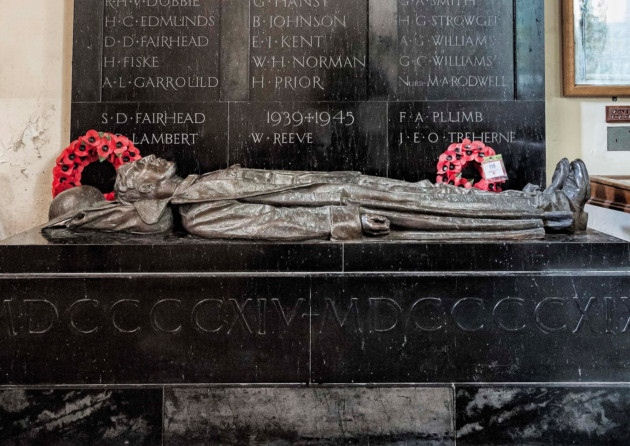
The Stunning War Memorial of Ditchingham, UK


Ditchingham is a little village about 80 miles northeast of London, just off the English Channel. St. Mary's Church there has a most remarkable war memorial. Dedicated after the war to honor the community's fallen in the Great War, World War II was subsequently added to its listing.


It is a stunning object, made of black marble and bronze and is one of very few that include the figure of a fallen soldier. It was created by the artist Francis Derwent Wood, who also create the much better known Machine Gun Corp Memorial that features a statue of Biblical David located at Hyde Park Corner.


Too old to be sent to the trenches, Wood served as a sculptor of ceramic masks for facially disfigured soldiers during the war, before turning to working on the memorials. 

Source:  Western Front Association

Friday, January 6, 2017

H.G. Wells on America, American Tourists, & the War (1916)


H.G. Wells
I found the excerpts below in the 1916 work A Forecast of Things after the War by H.G. Wells. The big points Wells got exactly right in this mid-war extended essay were that the war was becoming test of national energy and will, and that, inevitably, the Central Powers would drop exhausted by the wayside one-by-one, with Germany, finally and decisively,  succumbing.  

It's kind of a ponderous read, with lots of socialist Utopianism mixed in with some astute observations. The first section reads like something from The Innocents Abroad and catches somewhat amusingly and accurately important things about the American character of 100 years ago (and maybe still today). In the second, nonetheless, Wells sees recent movement by the U.S. toward a greater involvement in the world, something of a veiled, but accurate, prediction that the Americans might just get involved in the war after all.

At the beginning of this war, the United States were still possessed by the glorious illusion that they were aloof from general international politics, that they needed no allies and need fear no enemies, that they constituted a sort of asylum from war and all the bitter stresses and hostilities of the old world. Themselves secure, they could intervene with grim resolution to protect their citizens all over the world. Had they not bombarded Algiers? [The reference here, is apparently to the Barbary pirates.]

I remember that soon after the outbreak of the war I lunched at the Savoy Hotel in London when it was crammed with Americans suddenly swept out of Europe by the storm. My host happened to be a man of some diplomatic standing, and several of them came and talked to him. They were full of these old-world ideas of American immunity. Their indignation was comical even at the time. Some of them had been hustled; some had lost their luggage in Germany. When, they asked, was it to be returned to them? Some seemed to be under the impression that, war or no war, an American tourist had a perfect right to travel about in the Vosges or up and down the Rhine just as he thought fit. They thought he had just to wave a little American flag, and the referee would blow a whistle and hold up the battle until he had got by safely. One family had actually been careering about in a cart—their automobile seized—between the closing lines of French and Germans, brightly unaware of the disrespect of bursting shells for American nationality. . . 

An American Tourist Meets Some Local Soldiery

Since those days the American nation has lived politically a hundred years...The people of the United States have shed their delusion that there is an Eastern and a Western hemisphere, and that nothing can ever pass between them but immigrants and tourists and trade, and realised that this world is one round globe that gets smaller and smaller every decade if you measure it by day's journeys. They are only going over the lesson the British have learnt in the last score or so of years. This is one world and bayonets are a crop that spreads. Let them gather and seed, it matters not how far from you, and a time will come when they will be sticking up under your nose. 

There is no real peace but the peace of the whole world, and that is only to be kept by the whole world resisting and suppressing aggression wherever it arises. To anyone who watches the American Press, this realisation has been more and more manifest. From dreams of aloofness and ineffable superiority, America comes round very rapidly to a conception of an active participation in the difficult business of statecraft. She is thinking of alliances, of throwing her weight and influence upon the side of law and security. No longer a political Thoreau in the woods, a sort of vegetarian recluse among nations, a being of negative virtues and unpremeditated superiorities, she girds herself for a manly part in the toilsome world of men.

Thursday, January 5, 2017

Unique WWI Photos from the National Museum of Health & Medicine


A French Double Amputee Re-learns How to Write


U.S. Army Field Dental Station


Amputee Learning Gardening As Part of His Therapy


U.S. Troops at a German De-lousing Center (Probably During Occupation Duty)


Nurses Mess Hall at an American Base Hospital


A Volunteer Gives Water to a Wounded Doughboy


An Ambulance That Had an Accident on a Nighttime Run


Trolley for Moving Casualties Through a Trench


Concert for the Patients and Staff at U.S. Base Hospital #1


An Unfortunate Soldier Who Has Lost Both Feet

Wednesday, January 4, 2017

American Battleship at War: USS New York


By Keith Muchowski

The United States went on a naval building spree in the decade prior to the Great War. By no means did the build-up reach the levels of the concurrent maritime arms race between Germany and Great Britain, but it was significant nonetheless. President Theodore Roosevelt, a former assistant secretary of the Navy, set forth the Great White Fleet in December 1907, the commander-in-chief challenging a recalcitrant Congress to fund the return of the convoy once he had sent it halfway around the world. The 16 battleships returned in February 1909 in the waning weeks of Roosevelt’s administration. The Great White Fleet was a political and diplomatic triumph, but it also exposed weaknesses in America’s naval capabilities.


USS New York Launched with President Taft Present


Roosevelt’s successor, William Howard Taft, understood the importance of a stronger naval presence as much as anyone. For one thing, American ships would be integral to enforcing the Roosevelt Corollary to the Monroe Doctrine. Compounding that, construction of the Panama Canal was proceeding, and when the new locks were operational they would be essential for protecting American interests in the Caribbean and the once remote Hawaiian and Philippine Islands. From the laying of the keel of the USS South Carolina in December 1906 through the end of the Great War, the United States averaged two new ships annually, most of these in the new dreadnought classes. Begun in an era when veterans of the Indian Campaigns were still in the ranks, these craft eventually served in Wilson’s blockade of Mexico, against the Kaiser’s High Seas Fleet, in the Caribbean occupations of the 1920s and 1930s, and against Hitler and Imperial Japan until those that remained were decommissioned in the new Atomic Age.


New York Dockside


With her sister ship the Texas, the USS New York comprised the U.S. Navy’s fifth dreadnought class. Her keel was laid down at the Brooklyn Navy Yard on 11 September 1911. On 30 October 1912—one week before the presidential election pitting the incumbent Taft against Democrat Woodrow Wilson, Progressive Theodore Roosevelt, and Socialist Eugene Debs—President Taft, Secretary of the Navy George von Lengerke Meyer, Governor John A. Dix, Mayor William J. Gaynor, and 40,000 others attended the New York’s launch. She was commissioned on 15 April 1914, just in time to be sent to Veracruz as part of the Atlantic Fleet that July. Events in Europe were reaching the breaking point at this same time, and once back from Mexico the New York, along with the other dreadnoughts of her era, were destined to play major roles in the Great War. The New York arrived at Scapa Flow, headquarters of the British Grand Fleet in Scotland’s Orkney Islands, on 7 December 1917. The New York was the flagship of Battleship Division 9, Rear Admiral Hugh Rodman commanding. Rodman’s division was put under the command of the British Grand Fleet as the Sixth Battle Squadron and would remain thus attached until 1 December 1918.

Like their Doughboy counterparts in the trenches, American sailors had a steep learning curve; the ships of the squadron scored poorly in shooting in the initial months after their arrival, though the New York with her 14-inch guns seems to have performed at least proportionally better. Eventually the Americans found their rhythm and effectively performed their primary task of containing the German High Seas Fleet. Despite the occasional run-in with a U-boat or two, life aboard the New York was fairly routine. To levy the boredom the men played sports and held boxing tournaments, complete with weight categories and championships, contested between the British and American sailors.


Forward Main Batteries with Turret Covers Off


As the flagship of the Sixth Battle Squadron the New York became a natural locus of diplomatic activity. King Albert and Queen Elizabeth of Belgium inspected the sailors on deck. Crown Prince Hirohito, then an admiral in the Imperial Japanese Navy and his country’s heir apparent, inspected the dreadnought on 3 November 1918. After the men of the New York witnessed the surrender of the German High Seas Fleet on 21 November, King George V came aboard to shake Rodman’s hand and thank the men. Admiral Sir David Beatty, commander-in-chief of the Grand Fleet, appeared on 1 December, the last day of the dreadnought’s service in the Grand Fleet. Admiral Beatty beamed that "apparently the Sixth Battle Squadron was the straw that broke the camel’s back” against the Germans and invited the Americans to return whenever they wanted. Before going home the USS New York had one final task—escorting Woodrow Wilson to the Paris Peace talks. On 13 December President Wilson was aboard the George Washington as that ship was escorted by the New York and other craft to the French port city of Brest. Her Great War over, the New York turned around and sailed for home with the other ships of the Atlantic Fleet.


Visitors Day on the USS New York

Admiral Hugh Rodman and the 5,000 men of the Atlantic Fleet received a naval review from grateful New Yorkers on 26 December 1918. Secretary of War Newton Baker and Navy Secretary Josephus Daniels were present. Also there was Assistant Secretary of the Navy Franklin Delano Roosevelt. Nineteen years later Commander-in-Chief Roosevelt would send the now-retired Admiral Rodman to England as an American representative to the coronation of King George VI, whose father had thanked Rodman aboard his flagship after the German High Seas Fleet surrender. On 20 May 1937 Rodman and the New York took part in George VI’s Coronation Fleet Review. Emperor Hirohito’s forces struck at Pearl Harbor on 7 December 1941, 24 years to the day after the New York had arrived at Scapa Flow. In the Second World War the New York saw long service with the Atlantic Fleet and and later helped defeat the Imperial Navy of the onetime crown prince at Iwo Jima and Okinawa among other places.

The New York was back in Brooklyn briefly after the Japanese surrender but soon returned to the Pacific. In July 1946 she was part of Operation Crossroads, the atomic bomb testings on the Bikini Atoll in the Marshall Islands. She suffered some damage but did not sink. In July 1948, spent after 30 years of service in the Great War and beyond, the USS New York was dragged 40 miles southwest of Pearl Harbor to be used for target practice. In a poignant gesture the U.S. Navy invited some of the New York’s old crew dating back to her days at Scapa Flow and elsewhere to attend. Several hours of naval and aerial bombardment later, she rested on the ocean floor.

Our contributor, Keith Muchowski, produces an outstanding blog that looks at American history from a New Yorker's viewpoint. Visit Keith's Blog, The Strawfoot, for more interesting insights on the history of the First World War.


Tuesday, January 3, 2017

Oswald Boelcke
reviewed by Terrence Finnegan


Oswald Boelcke: Germany's First Fighter Ace and Father of Air Combat

by R. G. Head, Brigadier General, USAF
Grub Street, 2016

Oswald Boelcke and His Eindecker Group

General Head's background in aviation serves as the impetus for understanding the contribution of Hauptmann Oswald Boelcke's important legacy for World War I aviation. Head's distinguished U.S. Air Force career involved flying several combat aircraft and included several assignments in Vietnam. His work on Boelcke reflects insight on the challenges of aviation of the era and how aerial combat assumed a definitive role thanks to Boelcke's leadership and legacy.

The book is a leisure read. Insights on aviators from the Western Front help describe the environment that Boelcke was in, including training, the physical environment endured while flying, impact on health and well-being, and the rewards associated with combat aviation.

The formation of Germany's air service is also addressed. The author interweaves Boelcke's life throughout the book. Information on aeroplanes is covered in detail, particularly the Albatros series of fighter airplanes

Most important in this work is discussion of Boelcke's Dicta, the foundation of German fighter tactics that still apply in the present day. Boelcke's concept of grouping pursuit into squadrons and employing them in squadron formation flying reflected higher effectiveness and protection when flying together under the lead of an expert squadron commander.

Display at the Museum of Flight

Terrence Finnegan

Monday, January 2, 2017

A Poem from 1917 to Launch Our Coverage of That Year's Centennial


Rose Macaulay

This 1917 poem by a noted English novelist starts with some friends at a picnic in Surrey in a peaceful wood, but soon the sound of artillery from the Western Front intrudes.  At first the group is detached and matter-of-fact about the noise. Gradually, though, the significance of the explosions sinks in.

Dame Emilie Rose Macaulay DBE (18811958) is most remembered for her award-winning novel The Towers of Trebizondthe final work of her long literary careerabout a small Anglo-Catholic group crossing Turkey by camel.  During the First World War, she worked in the British Propaganda Department, also serving as a volunteer nurse and a Land Girl. Later, she became a civil servant in the War Office. After the war, Rose Macaulay concentrated on prose and wrote a series of satirical comic novels emphasizing on the irrationalities of those times. In 1920, her first best seller, Potterism, was published, followed by Dangerous Ages in 1921.


Picnic (1917)

Rose Macaulay


July 1917

We lay and ate sweet hurt-berries
In the bracken of Hurt Wood.
Like a quire of singers singing low
The dark pines stood.

Behind us climbed the Surrey hills,
Wild, wild in greenery;
At our feet the downs of Sussex broke
To an unseen sea.

And life was bound in a still ring,
Drowsy, and quiet and sweet…
When heavily up the south-east wind
The great guns beat.

We did not wince, we did not weep,
We did not curse or pray;
We drowsily heard, and someone said,
‘They sound clear today’.

We did not shake with pity and pain,
Or sicken and blanch white.
We said, ’If the wind’s from over there
There’ll be rain tonight’.

.                .                 .

Once pity we knew, and rage we knew,
And pain we knew, too well,
As we stared and peered dizzily
Through the gates of hell.

But now hell’s gates are an old tale;
Remote the anguish seems;
The guns are muffled and far away,
Dreams within dreams.

And far and far are Flanders mud,
And the pain of Picardy;
And the blood that runs there runs beyond
The wide waste sea.

We are shut about by guarding walls:
(We have built them lest we run
Mad from dreaming of naked fear
And of black things done).

We are ringed all round by guarding walls,
So high, they shut the view.
Not all the guns that shatter the world
Can quite break through.

.                 .                   .

Oh, guns of France, oh, guns of France,
Be still, you crash in vain…
Heavily up the south wind throb
Dull dreams of pain,…

Be still, be still, south wind, lest your
Blowing should bring the rain…
We’ll lie very quiet on Hurt Hill,
And sleep once again.

Oh, we’ll lie quite still, nor listen nor look,
While the earth’s bounds reel and shake,
Lest, battered too long, our walls and we
Should break…should break…

Sunday, January 1, 2017

What to Expect in 2017 from Worldwar1.com


Happy 2017!

Here's what you can look for in the coming year from all our publications at Worldwar1.com, including Roads to the Great War, the St. Mihiel Trip-Wire, Over the Top magazine, and our constellation of educational websites.


Paralleling the Centennial Events from 1917


From the Top: Unrestricted U-boat Warfare, The Battle of Passchendaele;
Revolution in Russia
Caporetto: The Village and Nearby Austrian Troops;
Three War Leaders Emerge: Lloyd George, Clemenceau, and Wilson

     
Following America's Inexorable March to the Battlefields


The Yanks Are Coming!


Centennial News and Imagery


Stained Glass Window at the American Memorial Church 
at Château-Thierry
The Church Will Be Restored in 2017. Click HERE If You Would 

Like to Help


Illustrations and Photographs from the Period


French Flamethrower Team in Action


Reviews and Recommendations for Your WWI Bookshelf


Recommended for Learning About the Events of 1917
These Can Be Ordered Through Amazon.com at the Right Sidebar