Now all roads lead to France and heavy is the tread
Of the living; but the dead returning lightly dance.
Edward Thomas, Roads

Wednesday, November 25, 2020

Lessons the U.S. Army Learned from Their WWI Experience in Northern Russia


Excerpted from: The Polar Bear Expedition: "The U.S. Intervention in Northern Russia, 1918–1919," Army Sustainment, Mar-Apr, 2012

by Alexander F. Barnes and Cassandra J. Rhodes 


The 339th Infantry on Their Way to Russia


Overview of the Mission

The U.S. Army was present in Russia at the end of World War I for several reasons. One was that the massive amounts of military supplies and equipment stockpiled at the Siberian port of Vladivostok and the northern Russian ports of Murmansk and Archangel had to be recovered for retrograde to their countries of origin or distribution to the anti-Bolshevik "White Russian" forces fighting the Bolshevik "Red" army in the Russian Civil War.

These supplies, including 110,000 rifles in the northern Russian warehouses alone, had been provided to the tsar's forces by France, Great Britain, and the United States in a vain attempt to keep them fighting against the Germans. But that had not worked. The Russian leaders had been incapable of distributing the war materiĆ©l to their forces, and most of what they received still sat in the warehouses where it had been initially offloaded from Allied ships. Some wishful politicians subsequently hoped that a small Allied military force could stabilize the area long enough for the Russians to create a democratic government and field a viable army.  [This original mission failed, and the 5,000 Doughboys deployed to Northern Russian, along with other Allied contingents, ended up confronting Bolshevik forces.] The  soldiers sent to northern Russia in August 1918 were mainly draftees from the Midwest. The force consisted of the 339th Infantry Regiment (also known as "Detroit's Own"), a battalion of the 310th Engineer Regiment, the 337th Ambulance Company, and the 337th Field Hospital.

The mission to protect and redistribute the stockpiles of military equipment in Archangel was nearly a failure before the 339th Infantry Regiment even set foot in Russia. Pro-Bolshevik forces had seized the port and were loading supplies onto rail cars when a small force of British and French soldiers, accompanied by 50 American sailors from the USS Olympia, managed to retake the town. This mixed force was able to stop the passage of some of the trains and recover some supplies; however, a large amount had already been "liberated" by the Bolsheviks.

With more enthusiasm than common sense, the Allied force then set out after the fleeing Reds and soon became trapped, requiring rescue from the just-landed, and flu-ridden, 339th Infantry Regiment. The newly arrived Americans, under British command, hurriedly scrambled a battalion of soldiers onto a Russian train and sent them south to rescue their Allied comrades. Although successful in their rescue mission, the Americans were now spread across the countryside in small detached units. Just like their fellow soldiers in Siberia, the Doughboys soon found themselves fighting from blockhouses and guarding isolated rail heads and small villages. By the time the real winter weather arrived, the Americans and their allies were stranded at remote sites that could not easily support each other. The Red forces that had given ground rather than contest each Allied advance now returned with a vengeance and began a series of hit-and-run raids. Countering these raids was complicated by temperatures that at night dropped to 50 degrees below zero, freezing the oil in machine guns. Wounded soldiers who were not retrieved and brought under cover quickly froze to death.  Click HERE to read the story of the 339th biggest operation, the Battle of Toulgas.

By April 1919, when a new U.S. commander arrived in Archangel with orders to evacuate the American force as soon as practicable, the Allies had been forced to evacuate many of their distant outposts.  By this time, however, it was obvious to the U.S. government and to the American public that it was time to bring the 339th Infantry Regiment home. While preparing for their withdrawal from Russia, the Americans awarded themselves the nickname of the "Polar Bears" as a testament to surviving the arctic winter.


The Polar Bears Earning Their Nickname


Lessons Learned

Trust your people on the scene. When the British requested U.S. support for the Northern Russia expedition, they stated, "The dispatch of additional French or British reinforcements is impossible and it is therefore essential that America should help by sending a brigade . . ." Then they added, "It is not necessary that the troops sent should be completely trained, as we anticipate that military operations in this region will only be of irregular character."

The U.S. consul in Archangel at the time, Felix Cole, strongly opposed American participation. Cole replied in June 1918, with some foresight, "Intervention will begin on a small scale but . . . will grow in scope and in its demands for ships, men, money and materiels. . . . It means establishing and maintaining telegraph, telephone, wireless, railroad, river, White Sea water, sledge, automobile and horse communication with repair shops, hospitals, food warehouses, munitions trains, etc." He also predicted that the Russians would not prove to be effective allies against the Reds: "They work for themselves neither willingly nor effectively. Still less so will they work for others."

The U.S. government ignored Cole's warnings and deployed the 339th Infantry Regiment to Russia anyway. As a result, out of a force of 5,500 soldiers, the Polar Bears suffered 244 deaths from action or accidents, 305 wounded, over 100 dead from influenza, and one suicide.

Rank is important. When operating in a coalition, the leaders of an expeditionary force must have rank commensurate with their responsibility. If this is not possible, ensure that they understand that they maintain the ultimate authority in how U.S. forces are employed. In far too many cases in northern Russia, the senior American officer on the scene was only a captain or a lieutenant and therefore was outranked by an attached British or French officer. Though they commanded fighting forces, the American junior officers were obliged to take orders from senior foreign officers who were completely unfamiliar with U.S. goals, tactics, and capabilities.

Because of some of the complications arising from this problem, General John J. Pershing, the overall U.S. commander in Europe, would later insist on keeping a major general, Henry T. Allen, as the commander of the U.S. forces during the occupation of Germany. Though the size of that command was more suited for a lower-ranking officer, Pershing insisted that the commander be of the higher rank so he could deal on an equal footing with the other Allied occupation commanders from Great Britain, France, and Belgium.

Understand the weather, terrain, and distances, and send a large-enough force for those conditions. This is pretty much the same lesson learned by the U.S. forces in Siberia. Even today, with advanced communications and transportation technology, no commander would attempt to defend and police an area the size of Texas and Oklahoma with 5,500 soldiers. By comparison, in November 1918, to occupy the American zone in Germany, which was a much smaller area than northern Russia, the U.S. Army deployed 250,000 Soldiers and maintained another 50,000 in nearby Luxembourg.

Adding to the problem was the fact that much of the area was impassable swamp or nearly impenetrable forest, which increased reliance on rail and riverine transportation.

The U.S. soldiers sent into this region soon found their cold-weather gear, suitable for the trenches in France, to be inadequate for what was waiting for them in the Russian winter. They also had little knowledge of the type of issues this weather would bring them during the defense of their bases and supplies.

Coalition operations are hard, and coalition logistics are even harder. Many of the same problems that confronted coalition operations in Siberia were also present in northern Russia, but they were magnified by the isolation and weather constraints. As difficult as it was for U.S. forces to receive their supplies in Siberia, it was even harder in northern Russia. Making matters worse, most of the supplies they did receive came from British sources and, particularly in the case of rations and clothing, were not well received by the American soldiers. Other than lumber for building facilities and fortifications, very few resources were available in the Archangel area.


USS Des Moines Cutting Through Ice


When the White Sea froze around Archangel, the only way to get supplies to the Allied forces there and to the remote outposts in the surrounding region was by the rail line from the port of Murmansk. Attempts to build up the White Russian forces also proved frustrating to the Americans when they recognized several of the Bolsheviks they had captured only weeks before when they appeared, apparently rehabilitated, as part of the British-trained White forces.

What can be concluded about the American efforts to protect and recover the mountains of military supplies in Russia during 1918 to 1920? It was a tough mission. That can be said about many military operations, but certainly the two American expeditions into Russia after World War I were unique in their concept, execution, and difficulty. While the rest of the world celebrated the end of the bloodiest war in history up to that time, two relatively small groups of American soldiers were fighting for their lives at opposite ends of a country that was undergoing a violent revolution.

For their part, the soldiers were only partially successful in their Siberian and northern Russian missions. Most of the supplies they were sent to preserve and protect were lost to the Reds or were misused by the Whites. However, the Czech Legion was aided in its successful withdrawal from Siberia and transported to its new homeland. Obviously, such small forces as the Americans provided could not stabilize revolutionary Russia in time to prevent the ultimate victory of the Bolsheviks, especially when it became apparent that the White forces were ineffective and suffering from poor leadership.

On the other hand, the U.S. soldiers did prove themselves capable of operating and sustaining combat forces in an extremely austere and harsh environment. In that environment, where the greatest measure of success often was survival, the American soldiers served bravely and remained loyal to their country and to their Allies. That they did so in spite of overwhelming odds and an ever-increasing sense of isolation is evidence of their courage and perseverance.


When the infantrymen and logisticians of the two expeditions to Russia finally returned to the United States, they found that few people knew or cared about their sacrifices. Ninety years later, fewer people are aware that U.S. forces had even been there. Nonetheless, in the vast wilderness of Siberia and hidden in the deep forests near Archangel, the remains of some of their comrades are still buried. As one U.S. Army veteran of northern Russia wrote in 1920, "Why if the job had been worth doing at all had it not been worth while for our country to do it wholeheartedly with adequate force and with determination to see it through to the desired end . . . Why had we come at all?" It would not be the last time American service members would ask that question in the 20th century.

Tuesday, November 24, 2020

War Football: World War I and the Birth of the NFL

By Chris Serb  
Rowman & Littlefield Publishers, 2019 
Joe Unger, Reviewer


The Rock Island Independents Would Become a Charter Member of
the National Football League in 1920


"In the history of American Football, 1919 will always stand out as a memorable year, one of remarkable achievements and of splendid promise for the future..." This opening quote of the prologue to War Football: World War I and the Birth of the NFL begins the explanation of how football became a part of the national conscience.

Obviously, the Great War had many influences on our modern life, from the geopolitical to the arts, from literature to the military, and everything in between, but football was never previously regarded by me as a product of the Great War, except for my local professional team, the Ironton (Ohio) Tanks, founded by veterans in 1919. (Article)

Author Chris Serb does a great job, however, of explaining early football and making it an exciting read. The chapters are very digestible, and they lead into each other easily, so you can lay the book down and pick it up, right where you left off. Serb discusses early players in depth, without getting bogged down.  The players motives, strategies, achievements, and failures are all presented. This is important because readers would have heard of many of these great football figures before, men like Jim Thorpe, Red Grange, George Halas, etc.  There are, however,  other personalities discussed who played football and who are probably more interesting to readers of Roads to the Great War because they were men who shaped America and the entire world. These individuals, according to Serb, learned much of their leadership skills, teamwork, and offensive strategy on the gridiron. These men became better known in different stadia—George Patton, Omar Bradley, Dwight Eisenhower, Harry Truman, and Woodrow Wilson, who was not a player himself but had many football associations.

The author also shows the dramatically changing role of the rules of the game, from a forward pass to a drop-kick and evolving penalties. He  has even described some engaging play-by-play during the championship games. Likewise, college football is a major topic in the book, especially since football was known at the time of the war mostly as a college sport, attracting sizable crowds. When these college men enlisted, or were drafted, they joined or formed their own football teams at each Army camp or Navy base. In this manner, "All-Star" teams were formed, as men from many different college clubs ended up at the same camp or base. Rosters were manned, leagues were formed, and games were played. Many times the military teams played well-known college clubs, while at other times they pitted themselves against semi-pro teams but mostly against other base teams.

Serb claims that professional football would never have taken flight without World War One, and he does a good job of presenting his case. I believe, though, that the postwar teams, those semi-pro local town and city teams, the teams from the shoe factories, the steel mills, and the packing houses, had a larger part to play in the forming of the NFL. These were the teams that brought the sport right into your own neighborhood.

If you are a fan of entertaining sports history like me (I enjoyed reading biographies of Johnny Unitas and Vince Lombardi in the early 1970s),  or if you are interested in studying  the U.S. home front in WWI, then this book belongs on your shelf.

Joe Unger

Monday, November 23, 2020

What Was an "Old Contemptible"? — A Roads Classic

Memorial at Westminster Abbey, London


To qualify as an "Old Contemptible" a British Army soldier would have to have seen active service actually in France and Flanders between 5 August and 22 November 1914. For this he would qualify for the medal known as the 1914 Star. This medal was introduced in 1917. In 1919 a clasp bearing the qualifying dates was authorized and given to soldiers who had actually been under fire between those dates. It was also known as the "Mons Star."


The Mons Star


It is widely believed that the "Old Contemptibles" derived their honorable title from the famous "Order of the Day" given by the Kaiser at his headquarters, Aix-la-Chappelle, on 19 August 1914:

"It is my Royal and Imperial Command that you concentrate your energies, for the immediate present upon one single purpose, and that is that you address all your skill and all the valour of my soldiers, to exterminate first, the treacherous English, walk over General French's contemptible little Army."

There can be no question that the most successful slogan for recruiting purposes issued during the whole course of the war was the phrase "contemptible little army," said to have been used by the Kaiser in reference to the British Expeditionary Force. It very naturally created a passionate feeling of resentment throughout the country.
 

Detailed information on the order of battle of the original BEF can be found at the website Britishbattles.com:


Memorial photo from Steve Miller; details from the Old Contemptibles Association

Sunday, November 22, 2020

America and the Great War in 1917

In 2014 I was invited by the Cloverdale (California) Historical Society to give a presentation on the American effort in the first year of the war.  Below are the slides I used in the presentation.  These show the main points I covered, and I think that, collectively, they provide a concise summary of the background behind the decision by President Wilson to request a war declaration and the early U.S. involvement in the war.

Readers are invited to download these images for any educational use you might wish to put them to.  The slides are displayed at 580 pixels width, but the originals are 980 pixels when you download them.  MH


Thursday, November 19, 2020

Images from the New National Museum of the U.S. Army

On Veterans/Armistice Day the new National Museum of the U.S. Army opened at Fort Belvoir, VA.  From the photos and reports I've seen the nation's 30 million members  of the Army who served and sacrificed from Valley Forge until today. From the photos, it appears the displays incorporate dramatic dioramas, artifacts, and commemorations. As you will see, the planners did a wonderful job of making sure the Doughboys of the Great War are well remembered.


Part of the Opening Ceremony


Entrance Hall


The American Soldier's Creed


Wars of the Twentieth Century


Into the Higgins Boats on D-Day


First World War Diorama


Another View of the WWI Diorama


Individual Soldiers Remembered


Sgt. York's Helmet


Exterior of the Museum


Wednesday, November 18, 2020

Don't Miss Your November ST. MIHIEL TRIP-WIRE!


Our November 2020 18th Anniversary Issue St. Mihiel Trip-Wire focuses on the important lessons I learned from visiting the Great War's battlefields for a quarter century.

http://www.worldwar1.com/tripwire/smtw.htm


Main Focus: 

  • From Your Editor: 18 Years of the Trip-Wire
  • Grasping the Marne
  • Fathoming Gallipoli
  • Appreciating Caporetto

Welsh Memorial, Mametz Wood, Somme Battlefield


  • Why Visit the Old Battlefields?
  • Conan Doyle Visits Wipers
  • Some Facts About America at the Time of the War
  • Recommended Videos of Battlefield Touring

Your Editor with My 2018 Group at the Sgt. York Site


Other Topics:

  • 100 Years Ago: America Votes for Harding and a "Return to Normalcy"
  • A Spectacular World War One Memorial Rediscovered
  • The National Museum of the U.S. Army to Open
  • WWI Film Classic: J'accuse! (1938)
  • Plus all our regular updates and features


Next Month:  The Winter Wars


Have a great Thanksgiving,

Mike and the Editorial Team

Tuesday, November 17, 2020

Treat 'em Rough: Letters From Jack the Kaiser Killer


by Ring Lardner
Bobbs Merrill, 1918
Michael Hanlon, Reviewer

This book includes part of a series of short stories by Ring Lardner in which his most famous character, baseball pitcher Jack "Busher" Keefe, joins the U.S. Army and describes, in letters, his experiences to his hometown pal, Al. Here's Jack's first letter to Al from Camp Grant, IL. (By the way, the spellings are all Jack's)
 

Jack Keefe Writing to Al


Camp Grant, Sept. 23.

FRIEND AL: Well Al I am writeing this in the recreation room at our barracks and they's about 20 other of the boys writeing letters and I will bet some of the letters is rich because half of the boys can't talk english to say nothing about writeing letters and etc. We got a fine bunch in my Co. Al and its a cinch I won't never die in the trenchs because I will be murdered in my bed before we ever get out of here only they don't call it bed in the army.

They call it bunk and no wonder.

Well Al I have been here since Wed. night and now it is Sunday and this is the first time I have not felt sick since we got here and even at that my left arm is so sore it is pretty near killing me where I got vacinated. Its a good thing I am not a left hander Al or I couldn't get a ball up to the plate but of course I don't have to think of that now because I am out of baseball now and in the big game but at that I guess a left hander could get along just as good with a sore arm because I never seen one of them yet that could break a pain of glass with their fast ball and if they didn't have all the luck in the world they would be rideing around the country in a side door Pullman with all their baggage on.

Speaking about baseball Al I suppose you seen where the White Sox have cinched the penant and they will be splitting the world serious money while I am drawing $30.00 per mo. from the Govmt. but 50 yrs. from now the kids will all stop me on the st. and make me tell them what hotel we stayed at in Berlin and when Cicotte and Faber and Russell begins to talk about what they done to the Giants everybody will have themself paged and walk out.

Well Al a lot of things come off since the last time I wrote to you. We left Chi Wed. noon and you ought to seen the crowd down to the Union station to bid us good by. Everybodys wifes and sisters and mothers was there and they was all crying in 40 different languages and the women wasn't allowed through the gates so farewell kisses was swapped between the iron spokes in the gates and some of the boys was still getting smacked yet when the train started to pull out and it looked like a bunch of them would get left and if they had I'll say their wifes would of been in tough luck.


Army Recruits Playing Baseball


Of course wife Florrie and little son Al was there and Florrie was all dressed up like a horse and I bet a lot of them other birds wished they was in my shoes when the kissing battle begun. Well Al we both blubbered a little but Florrie says she mustn't cry to hard or she would have to paternize her own beauty parlors because crying makes a girl look like she had pitched a double header in St. Louis or something. But I don't know if you will believe it or not but little Al didn't even wimper. How is that for a game bird and only 3 yrs. old? 

Well Al some alderman or somebody had got a lot of arm bandages made for us with the words Kaiser Killers printed on them and they was also signs stuck on the different cars on the train like Berlin or Bust and etc. and the Stars and Strips was flying from the back platforms so we certainly looked like regular soldiers even without no uniforms and I guess if Van Hindburg and them could of seen us you wouldn't of needed a close line no more to take their chest measure. 

Well all our bunch come from the south side and of course some of them was fans and the first thing you know they had me spotted and they all wanted to shake hands and I had a smile for all of them because I have got it doped out that we are all fighting for Uncle Sam and a man ought to forget who you are and what you are and be on friendly turns with everybody till after the war. 

Well Al they had told us to not bring much baggage and some of the boys come without even their tooth brush but they hadn't some of them forgot to fetch a qt. bottle and by the time we got outside of the city limits the engineer didn't have to blow his whistle to leave people know we were comeing. Somebody had a cornet and another fellow had a trombone and a couple of them had mouth organs and we all sung along with them and we sung patriotic songs like Jonah Vark and Over There and when they started on the Star Spangled Banner the guy I was setting along side of him hollered for them to not play that one and I thought he was a pro German or something and I was going to bust him but somebody asked him why shouldn't they play it and he says because he couldn't stand up and he wasn't the only one either Al. 


Original Book Cover (Order HERE)

The train stopped at a burg called Aurora and a bunch of the boys needed air so they got off, some of them head first and one bird layed down on the station platform and says he had changed his mind about going to war and he was going to sleep there a while and catch the first train back to Chi so we picked him up and throwed him back on our train and told him we would have the engineer back up to Chi and drop him off and he says O.K. and of course the train started ahead again but he didn't know if we was going or comeing or looping the loop. 

Well the trombone blower finely blowed himself to a nap and while he was asleep a little guy snuck the trombone away from him and says "Look here boys I am willing to give my life for Uncle Sam but I am not going to die to no trombone music." So he throwed the trombone out of the window without opening the window and the guy woke up that owned it and the next thing you know the Kaiser Killers was in their first battle. 

Well Al by the time we got to Camp Grant some of the boys looked like they was just comeing from the war instead of just going and I guess I was about the only one that was O.K. because I know how to handle it but I had eat some sandwiches that a wop give me on the train and they must of been poisoned or something because when I got off everything looked kind of blured.


We was met by a bunch of officers in uniform. The guy that had throwed the trombone away had both eyes swelled shut and a officer had to lead him to the head quarters and I heard the officer ask him if he was bringing any liquor into the camp and he says yes all he could carry, but the officer meant did he have a bottle of it and he says No he had one but a big swede stuck his head in front of it and it broke.

Over to the head quarters they give us a couple of blankets a peace and then they split us up into Cos. and showed us our barracks and they said we looked like we needed sleep and we better go to bed right after supper because we would have to get down to hard work the next a.m. and I was willing to go to bed without no supper after eating them dam sandwichs and the next time them wops trys to slip me something to eat or drink I will hang one on their jaw.

Well Al the buggle has blowed for mess which is what they call the meals and you would know why if you eat some of them so I will close for this time and save the rest for the next time and my address is Co. C. 399th. Infantry, Camp Grant, Ill.

Your Pal, Jack

Monday, November 16, 2020

Caudry's Brutal Deportation


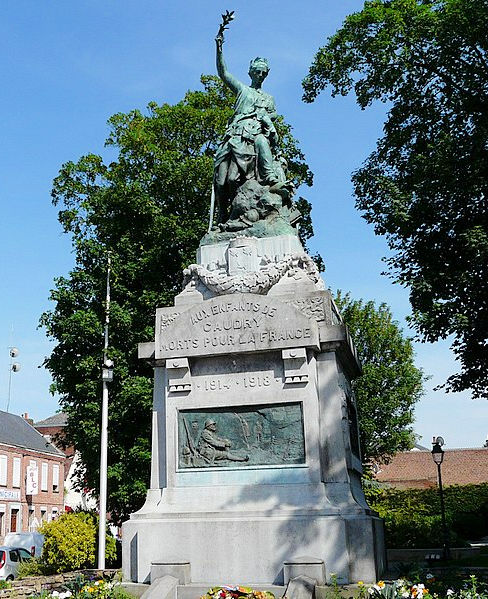
Caudry War Memorial


On 26 August 1914, Caudry, a  northern French town with a population of about 14,000, found itself on the periphery of the Battle of Le Cateau. It suffered a day of heavy shelling which destroyed hundreds of houses. The following day the German Army entered the town  and occupied it until 10 October 1918. Almost immediately after taking the town, the Germans stripped the local factories of their equipment, mostly lace-making machines, and sent the scrap steel and copper to Germany. The Kommandatur (German Command) set up its headquarters in the Town Hall and imposed its will on the people of Caudry: men were requisitioned to build a military hospital and, to quell any unrest, hostages were taken and prominent townspeople were deported, including the mayor, Ernest Plet.


Occupying German Troops in Caudry


After four years of occupation, in September 1918 the Kommandatur, under pressure from the advancing Allies, gave the order to evacuate Caudry. Ten thousand people, mostly women, children, and the elderly, were forced out of the town. After a long and desperate trudge, in which some 200 people died, the refugees finally reached Binche in Belgium. When they liberated Caudry on 10 October 1918, the illustrious 37th Division of the British Army (conquerors of Monchy-le-Preux during the battle of Arras in April 1917) were welcomed by a mere 2,500 people of a once-populous town.

The powerful war memorial shown above in the main square is the work of artist Paul Theunissen and depicts some evocative scenes from the Occupation. Unveiled in 1922, the statue of Humanity gathering up a dying French soldier is a touching tribute to the men of Caudry who died for their homeland. In the four panels shown below that are mounted around the base, the experience of the town during and after the war is portrayed.


Sources: Remembrance Trails and Wikipedia


Sunday, November 15, 2020

Day One: 4 August 1914 in Detail

 (Translated from French Sources.)


Brussels Headline, 4 August 1914

Preparatory actions for the implementation of the Schlieffen Plan are undertaken by the German Army: it enters Belgian territory to seize the bridges over the Meuse. England issues an ultimatum to Germany and then decides to mobilize on the night of 4–5 August.

France

-  At 8.45 a.m., the Minister of War  telegraphs to the general-in-chief, to the generals commanding the covering corps, and to General Sordet, stipulating the prohibition of entering Belgian territory.

-  Joffre ordered the 7th CA to occupy the Alsace balloon, without going down into the plain.

-  The Chamber of Deputies meets. Viviani denies that any French aviator has committed an act of hostility. The laws necessary for national defense are passed unanimously.

-  A detachment of German cavalry enters BlĆ¢mont and FrĆ©monville, a company of infantry crosses the French border at HomĆ©court.

-  As the intervention of the English is probable, Messimy sends instructions to the commanders of Boulogne, Rouen and Le Havre, in anticipation of landings in these ports.

-  Dubail, commander of the 1st Army, receives the order to prepare an offensive in Haute-Alsace, to be executed by the 7th CA and the 8th DC, on the Thann-Mulhouse front.


Kaiser Wilhelm II Addresses the Reichstag, 4 August 1914


Germany

Sir Edward Goschen, Ambassador of England, gives von Jagow the text of the ultimatum, which is rejected.

An exceptional Reichstag session is held in the White Room of the Berlin Palace. Kaiser Wilhelm II reads a speech that all deputies listen to while respectfully standing silent. Its most famous part is:

You have read what I said to my people the other day from the balcony of my castle. I repeat now that I no longer know any parties. I know only Germans. And in order to testify that you are firmly resolved without distinction of party to stand by my side through danger and death, I call upon the leaders of the different parties in this House to come forward and lay their hands in mine as a pledge. 

England

England sends a formal notice to Germany regarding Belgian neutrality. State Secretary for Foreign Affairs von Jagow replies that the violation of Belgian territory is a fait accompli.

As a result, the mobilization of the metropolitan forces was ordered on the night of 4 to 5 August  (two days after France).

Russia

The supreme command of the Russian armies is entrusted to the Grand Duke Nicholas Nicholaevich.

Africa

The French colony of Algeria is bombarded: at 4 a.m., at BƓne by SMS Breslau, as is Philippeville at 5 a.m. by SMS Goeben.


Belgium

From 4–20 August, the Belgian Army was isolated against the 1st and 2nd German armies. Too weak to fight them, she tries to delay them as long as possible by avoiding being run over.

-  At around 8 a.m., two German DCs (2nd and 4th divisions) and the 34th Infantry Brigade crossed the Belgian border. They avoid the fortified position of LiĆØge, pushing toward. the Meuse at VisĆ©. They find the bridge destroyed and the crossings  of the Meuse guarded by the 2nd battalion of the 12th line regiment, which stands up to the attacks. These divisions are the vanguard of an army drawn from the CAs of Aix-la-Chapelle and the Eupen camp, under the command of General von Emmich.

-  At 9 a.m., the House of Representatives acclaims King Albert.

-  Around 10:30 a.m., the first Belgian soldier is killed, in Thimister, on the road from LiĆØge to Aix-la-Chapelle: it is the cavalryman Antoine Adolphe Fonck.

-  The Belgian minister of war asks the French military attachĆ© to immediately prepare the collaboration and contact of the French troops with the Belgian army.

-  The 3rd and 4th Divisions are ordered to destroy all bridges, tunnels, and structures in the Meuse and beyond.


Bridge at Huy Demolished

-  The 9th battalion of German infantry threatens to cross the Meuse at the ford of Lixhe, located 600 m south of the Dutch border, and guarded by companies of the 25th RI.

-  In VisĆ©, the German infantrymen equipped with machine guns opened an intense fire on the defenders of the western outlet of the bridge. The fort of Pontisse pulls to the east side of the VisĆ© bridge and farther north toward Navagne where large gatherings are reported. The Belgian forces were threatened with being turned to their left at Lixhe and had to fall back around 5 p.m. on Milmort, behind the line of forts at LiĆØge. The Germans, annoyed by the fire from Fort Pontisse, stayed the night on the right bank, the two DCs near Mouland and the 34th brigade at Berneau.

-  The other German brigades reached farther south the front of Berneau - Herve - LouveignĆ© - Stoumont. The 9th DC stops at Poulseur.

At 6 p.m., the 12th of the line withdrew from the VisƩ bridge and two regiments of Uhlans crossed the Meuse, followed by two regiments of hussars. A German column enters through Gemmenich into Belgian territory.


First German Troops to Enter Belgium

Following these violations of the territory, King Albert I launched an appeal to the powers guaranteeing the treaty of 1839, France, England, and Russia:

The Belgian government regrets having to announce to Your Excellency that this morning the armed forces of Germany have entered Belgian territory in violation of the commitments which have been made by treaty. . . The King's Government is firmly resolved to resist by all means in its power.. . . Belgium calls on England, France and Russia to cooperate, as guarantors, in the defense of its territory. . . There would be concerted and joint action aimed at resisting the forceful measures employed by Germany against Belgium and, at the same time, guaranteeing the maintenance of the independence and integrity of Belgium in the country. 'to come up. . . Belgium is happy to be able to declare that it will ensure the defense of its strongholds.

The same day, England let it be known that she would help Belgium with all her might.

France and Russia in turn make known their willingness to respond to the call and to cooperate with England in the defense of Belgian territory.

Source: Sambre-Marne-Yser Website

Friday, November 13, 2020

Hagia Sophia and Atatürk's Legacy


Hagia Sophia, Istanbul


by Aykan Erdemir

The re-designation of this iconic building as a mosque was not just a sop to the Turkish president’s Islamist fans but another blow at the memory of the statesman whose legacy haunts and frustrates him.

Turkish president Recep Tayyip Erdoğan held the first Muslim prayers since 1934 in Istanbul’s sixth-century former Byzantine church, Hagia Sophia, on 24 July, marking the building’s re-conversion into a mosque.

As recently as March 2019, Turkey’s Islamist leader publicly opposed demands from his supporters to alter the status of this World Heritage Site, which Turkey’s founding father, Mustafa Kemal Atatürk, had transformed into a museum in 1934.

Erdoğan's U-turn on Hagia Sophia results in part from his need for a political stunt to boost his party’s waning popularity. More important, it reflects his ongoing struggle with Atatürk’s legacy, which exerts surprising influence despite Erdoğan’s consolidation of power and continues to inspire calls for a more secular and pluralistic democracy.

It is ironic that in a country of 84 million citizens, the biggest obstacle to Erdoğan’s Islamist ambitions continues to come from a man who died in 1938. The enduring legacy of Atatürk, the architect of the modern, secular Republic of Turkey, has so far proven unbeatable.

So much so that Erdoğan, who once insulted Atatürk as a “drunk,” has since then felt the need to pay respects, albeit tactically. The ongoing battle between Turkey’s two longest-serving presidents, separated by more than seven decades, will impact not only on the prospects for secular democracy in Turkey but also in other majority Muslim polities.


For over four decades, first as a youth wing member of an Islamist party in the 1970s, then as the mayor of Istanbul from 1994 to 1998, then as prime minister between 2003 and 2014, and finally as president since then, Erdoğan has pursued his dream of dismantling Atatürk’s secular republican legacy.

On the one hand, Erdoğan has overseen an ambitious social engineering project, using all instruments of the state, namely the 140,000-strong Directorate of Religious Affairs, compulsory religious education in schools, and sectarian indoctrination in state-run media, to mould what he has described as a “pious generation.”

On the other hand, he has worked meticulously to erase Atatürk’s legacy, whether it is secular reforms or institutions. Erdoğan has gone so far as to tear down dozens of public structures around the country, from stadiums to airports, that monumentalized Atatürk’s name.

By 2015, Erdoğan’s increasing consolidation of power emboldened one of his lawmakers to declare the end of a “90-year commercial break with the 600-year [Ottoman] empire.” This was a reference to Turkey’s republican era as an interval in the Ottoman caliphate that Erdoğan would presumably restore.

To the president’s disappointment, however, under his rule, the young have grown less religious and more anti-government, inflicting an embarrassing defeat on him in the 2019 municipal elections. Atatürk’s secular legacy has proven more resilient than the Islamists expected.


Hagia Sophia, Interior


The transformation of Hagia Sophia into a museum in 1934 was one of the cornerstones of Atatürk’s cognitive revolution. Ottoman Sultan Mehmet II had converted what was then the world’s greatest church into a mosque after his conquest of Constantinople in 1453, as a symbol of Muslim domination of his empire.

By reversing this highly symbolic act and by turning Hagia Sophia into a museum for all citizens to cherish, regardless of their faith, Atatürk challenged the sectarian hierarchies of the Ottoman era. It was also a gesture of peace and goodwill not only toward neighbouring Greece but also to other Christian nations that the Ottomans had fought for centuries. . .

From: "Erdogan’s Target in Hagia Sophia Stunt was Atatürk’s Legacy,"  Balkan Insight, 4 August 2020

Full article at: 

https://balkaninsight.com/2020/08/04/erdogans-target-in-hagia-sophia-stunt-was-ataturks-legacy/