Now all roads lead to France and heavy is the tread
Of the living; but the dead returning lightly dance.
Edward Thomas, Roads

Monday, September 13, 2021

France and the Armistice of 1918 (Part II)

By Brig. Gen. Robert A. Doughty

Harmon Memorial Lecture, U.S. Air Force Academy, 17 March 2009


Marshal Foch Would Be the Key Figure for
the Allies in the War's End Game

Part II

(Part I Presented on Yesterday's Posting)


Though the French sensed the end of the war was near, a wealth of information did not reveal what the Germans actually would do or how long the war would last. As late as November 7, intelligence reports emphasized preparations in Germany “for a supreme struggle of unknown duration” but noted the lack of German national unity or agreement on waging such a struggle.

This ambiguity created great concern among French leaders. In  February 1919 Clemenceau told a parliamentary commission, “If we had been better informed, we would have imposed much harsher conditions.”  In reality, better information would have made little difference since the Germans themselves did not know what they were going to do.

Given the desire of the French people for peace, fatigue of the French army, specter of a massively destructive final campaign, and possibility of the other Allies sabotaging France’s victory, what could France do to accomplish its goals? Several strategic alternatives came from the collapse of Austria-Hungary in late October. This collapse not only left Germany virtually alone in the war against the Allies but also increased Germany’s vulnerability. First, there was the possibility of an attack into southern Germany. On November 5, the day after Austria-Hungary accepted an armistice, the Allied Supreme War Council, led by Marshal Foch, approved the launching of an operation into southern Germany with about thirty Italian and five French and British divisions. Planners foresaw a two-pronged invasion through regions of Austria heavily populated by ethnic Germans, one across the Alps from Innsbruck and the other along the Danube River from Linz.

Whatever the strategic opportunities may have been, it was clear an Italian-dominated drive across Austria into Bavaria would be neither simple nor easy, especially with winter approaching. An intelligence summary on November 4 noted Germany’s efforts to encourage rebellion in Austria-Hungary or even to send troops to maintain order in Austria.  Moreover, the Italians demonstrated little enthusiasm for the campaign, and the French Premier, Georges Clemenceau, had to intervene personally “numerous” times to gain their cooperation. A frank assessment came from General Buat, Pétain’s chief of staff, in a conversation with an American liaison officer. The American recorded Buat’s words and facial expression: “Do you think the Italians would go to Bavaria? (Smiling knowingly), not on your life—never—.So what have you left? The French and British. Yes they’ll go but there are not very many of them [only five divisions] and so practically the threat is not so serious as it sounds. It is a menace, an important menace, the idea of attacking Germany from the south, but it’s a moral—a mental menace—more than a physical menace.”

German military leaders recognized the difficulty of an attack across Austria, and in a meeting with the German chancellor on October 17 General Ludendorff downplayed the danger from an attack into  southern Germany. Ironically, the threat of such an invasion ultimately had a greater effect on the morale of German civilians and the outbreak of revolution in Bavaria than it did on the strategic thinking of German military leaders.


The French also considered the possibility of strategic bombing. Throughout the war the French had been reluctant to bomb German cities because their own cities were close to the front lines and German cities more distant. Additionally, French commanders were unwilling to consider an independent role for heavy bombers; they wanted aircraft to support their sorely pressed troops.  In the final months of the war most French bombs fell beyond the Western Front in a triangular area bounded by Amiens, Metz, and Mézières, but some fell on German cities  along the Rhine River (Mannheim, Mainz,  Koblenz, etc.) in attacks on factories and in reprisal raids.  With the collapse of the Austrians, new opportunities for strategic bombing emerged. The French recognized heavy bombers could fly one-way from France to Prague and by reducing cities in southern Germany to “ashes” could reveal the “horrors of war” to the German people. The French also recognized heavy bombers could fly out of Prague and inflict significant damage on Berlin.  In the final days of the war, the French began preparing for such a campaign. Although they had sufficient aircraft to damage some German cities, they knew they did not have enough aircraft for a war-winning campaign. Building the air fleet for such a campaign would take at least a year and would consume an enormous amount of resources. Thus, neither strategic bombing nor an offensive into southern Germany offered realistic possibilities for ending the war quickly.

Even though the news was filled with reports about a possible armistice, the French had no choice but to prepare for a massively destructive final campaign, should the threatened “supreme struggle of unknown duration” occur. They made a special effort to gain even greater output from their hard-pressed factories, especially artillery, tanks, and aircraft. 

Additionally, they looked to their colonies for new sources of  manpower for an offensive into Germany. Soldiers from Indochina and Africa already had reinforced the French army. Many of these colonial subjects had performed superbly, a fact not overlooked by French leaders who cringed at the prospect of running out of soldiers from metropolitan France. Clemenceau optimistically talked about adding 100,000 Senegalese soldiers to the French army. Strong resistance in France’s colonies, however, demonstrated the colonial subjects’ reluctance to become part of a “supreme struggle.”

Practically speaking, the only realistic alternative for continuing an offensive into Germany came from the Western Front. French political and military leaders recognized the enormous challenges of a drive into Germany, across the Rhine, and toward Berlin. Yet, the Allies had no plans for crossing the Rhine River, even though—as Foch later asserted—“Once this barrier was conquered, Germany was at the mercy of the Allies....”

In fact, they had no significant bridging capability and their planning involved little more than maps with arrows drawn across them. When one considers the enormously detailed planning completed in World War II for crossing the Rhine River, one can only conclude that the Allies expected to seize intact bridges across the Rhine, much as American forces did at Remagen in World War II. One does not have to be an accomplished strategist to realize that crossing the Rhine could have become one of the most difficult and costly operations of the war, especially if the Germans had fought a final battle of annihilation. For obvious reasons, the French preferred to do something other than fight their way across the Rhine.


One alternative was to destroy the German army with a massive thrust from Lorraine into its rear. Initial planning for such an offensive began in early September 1918 and foresaw thirty divisions attacking across a front of sixty kilometers. Final plans anticipated the offensive beginning on November 14 or, in other words, three days after what became the day of the armistice. Though planning proceeded, many practical problems appeared in an operation that looked good on paper but tough on the ground. The region had few railways and roads, and the French encountered formidable challenges in getting units and supplies assembled for the offensive. In the aftermath of the Meuse-Argonne offensive, they also had trouble getting as much  American participation as they desired.  Despite the Germans’ vulnerability, the French did not accelerate preparations and launch the incompletely prepared offensive. As Foch later observed, an offensive in Lorraine could have succeeded only if German resistance collapsed in front of it. In his memoirs he noted the offensive initially would encounter only small enemy forces and have a “brilliant start and a rapid advance of several dozen kilometers.” After this, however, “[I]t would undoubtedly encounter the devastation that was already slowing the march of the other armies. It would add its efforts to theirs, it would enlarge, reinforce them without changing their nature.”

The offensive also ran the risk of failing and thereby reviving the Germans’ will to fight. Instead of a relatively narrow thrust into the German rear, Marshal Foch preferred converging attacks along the Western Front by the French, British, and Americans. In essence, he sought a series of blows to keep the Germans off balance, prevent them from shifting reserves from one part of the front to another, and keep them from reviving or reconstituting their forces. He illustrated this strategy by punching with his right fist, then his left, and then again with right, followed by a powerful kick.

Recognize that this campaign strategy took advantage of American power on the right and British success on the left. It also kept the increasingly fatigued French army in the fight and gave the enemy no respite. In essence Foch wanted to maintain relentless pressure on the Western Front and expected the Germans eventually to collapse under this relentless pressure. Whether the collapse came from the German people leaving their army in the “lurch” or from the German army losing its cohesion and discipline was important to Foch but not enough for him to oppose an armistice.

As Foch kept pressure on the Germans, Allied leaders met to discuss armistice terms. What was the purpose of this armistice? Clemenceau answered this question in discussions with other Allied leaders on October 31. He said, “One should not confuse the terms of an armistice with the conditions of peace. The armistice has the objective of assuring the victorious armies such a situation that their superiority is clearly established.”

In private discussions with the President of the Third Republic, Raymond Poincaré, however, he had insisted the while terms of an armistice should be “prudent and moderate,” the terms of a peace would not be.  In short, Clemenceau wanted an armistice that would ensure the Germans could not resume fighting but would leave the Allies free to dictate harsh terms in a subsequent peace treaty. Such an armistice, he thought, would ensure termination of the conflict, enable France to achieve its war aims, and create a situation in which the conflict could be resolved.

The terms for an armistice with Germany came together in a relatively hasty manner at the end of October. Though the process ostensibly was an Allied one, Clemenceau and Foch played important roles and ensured France’s victory was not “sabotaged.” Foch first proposed armistice terms on October 8 and then discussed them behind closed doors with Clemenceau and Pétain. With Clemenceau’s concurrence, Foch convened a meeting of the other Allied military leaders on October 25 and then, acting on his own as supreme commander, modified the list. The modified terms were discussed and approved by Allied political leaders from October 29 through November 4. British and Italian representatives at these meetings expressed concerns that Foch was asking too much and thereby risked delaying or torpedoing any chances of a halt to hostilities.  Although the final list of terms differed somewhat from Foch’s initial proposal, the terms ensured the Germans could not resume hostilities after accepting an armistice. That is, the Germans had to agree to evacuate the territories they had seized (including Alsace and Lorraine); leave their heavy weapons and equipment behind; permit the Allies to occupy bridgeheads across the Rhine River; and relinquish control of the Rhineland (the left bank of the Rhine) as a guarantee for reparations.


Among those privy to the private thoughts of Clemenceau, Foch, and Pétain was General Henri Mordacq, Clemenceau’s military assistant. He notes that on November 11, he heard no one, including military leaders, express regrets about not continuing the war.  As Pierre Renouvin has noted, a few French leaders expressed reservations about ending the war too quickly but, in the actual discussion of terms, none of them objected to the armistice. Renouvin also notes that the best known critic of the armistice, Poincaré, primarily feared “false negotiations” by the Germans and did not call for an invasion of Germany and a signing of the armistice in Berlin. 

As the terms of the armistice were being crafted, the main objection to an armistice came from General Pershing. Though Pershing had concurred on October 25 with the main terms of the armistice, he later had doubts and on October 30 he wrote: “I believe the complete victory can only be obtained by continuing the war until we force unconditional surrender from Germany....”  In that same letter he expressed support for an armistice with terms “so rigid that under no circumstances could Germany again take up arms.”

When an American colonel delivered Pershing’s letter to Foch, the French marshal was leaving shortly for a  meeting of the Supreme War Council and could spend only a few minutes with him. After reading the letter quickly, Foch instructed the American to “tell General Pershing that I am in agreement with his views, and he need not be anxious regarding this matter; what I am demanding of the Germans is the equivalent of what he wants and when I have finished with them they will be quite powerless to do any further damage.”

 Foch clearly had no desire to derail the armistice. A few days before the armistice, Clemenceau and Foch met to discuss the terms, and the Tiger asked the Marshal if he had any reservations about signing the armistice. Foch responded that rejecting the armistice and continuing the war would be “gambling for high stakes.” He foresaw another fifty to a hundred thousand French soldiers being killed for “very questionable results,” and he saw no need for any further bloodshed.  Foch said the same thing to Colonel Edward M. House, Wilson’s personal envoy in the final days of the war. He said, “Fighting means struggling for certain results. If the Germans now sign an armistice under the general conditions we have just determined, those results are in our possession. This being achieved, no man has the right to cause another drop of blood to be shed.” When queried by the British Prime Minister, David Lloyd George, on how long it would take to drive the Germans across the Rhine if they refused to sign the armistice, Foch responded: “Maybe three, maybe four or five months. Who knows?”

In none of these discussions did Foch suggest delaying the armistice. Foch met with the German delegates on the morning of November 8 near Rethendes northeast of Paris. After receiving the armistice terms offered by Foch, the Germans complained strongly about their severity. Much to the surprise—and pleasure—of the French, however, they—after getting permission from Berlin—accepted the tough terms. On November 11, they signed the armistice and the fighting ended. By yielding bridgeheads across the Rhine to the Allies and by abandoning much of their heavy equipment, the Germans gave up any capability they may have had to continue the war; they also opened the way for Clemenceau to seek harsh terms in the Treaty of Versailles.

In retrospect, the armistice terminated the conflict but it did not resolve it or prevent a future conflict. It also did not ensure France’s security in the post-war period. One powerful myth that came out of the armistice was the famous “stab in the back” myth. German critics of the armistice (people such as Adolf Hitler) insisted the German army had not been defeated but instead had been stabbed in the back by German politicians. To use another phrase, German politicians had left the army in a “lurch.” On the other side of the hill French critics of the armistice insisted the armistice had ended the war prematurely.

Within days after the signing of the armistice, critics charged Foch with having accepted a “premature” peace and complained about France’s not launching an offensive in Lorraine. They watched with regret as German forces returned to Germany,  sometimes as cohesive units without the stigma of defeat. At the end of November the American liaison officer to Pétain’s headquarters participated in a discussion that included Pétain's chief of staff (General Buat) and his operations officer (General Duval); he reported “their great regret that the war had not continued for almost two weeks.” In that same report the American liaison officer reported the assessment of a French colonel in Pétain’s headquarters: “Viewed in the light of history, it is quite possible that it will appear that the war terminated a little prematurely and thus left the seed for further difficulties, difficulties which might have been entirely obviated by a crushing military defeat of the German Army.”

 As the colonel predicted, the French official history of the events of 1918 lamented the suspension of hostilities which had enabled the Germans to avoid a “certain and irremediable disaster.” After the war Pétain reinforced criticisms of the supposedly “premature” peace by saying he had asked Foch to delay the armistice. He insisted—long after the opportunity for action had passed—that he had asked Foch to delay the armistice and launch the Lorraine offensive. Seeking to enhance his own reputation, Pétain disingenuously, I believe, highlighted Foch’s having missed an opportunity to end the war decisively, not his own inability to make such an ending possible. Some of France’s leading historians of the Great War (Pierre Renouvin, JeanBaptiste Duroselle, Guy Pedroncini) have examined Pétain’s claim and found no evidence of his having urged Foch to delay the armistice.  While Pétain may have met privately with Foch and urged him to launch the Lorraine offensive before completing an armistice, he did not do so in writing or in meetings with other people present or with minutes being taken. He also did not convey his reservations to key members of his staff. In the dining room of Pétain’s headquarters, officers openly criticized Foch and Pétain for not unleashing the Lorraine attack and crushing the German army. An American liaison officer, who witnessed the discussions, observed an officer, Colonel Node Langlois, object to the criticisms. The French colonel insisted every effort had been made to organize the attack but roads and railways had proved inadequate. He likened the situation to driving a horse until it had spent its last ounce of strength and dropped in its tracks.

In reality, France’s willingness (and Foch’s willingness) to accept an armistice in November 1918 rested on the weakened condition of French forces, as well as the uncertain support of its allies. By late September the cumulative effect of four years of war and the extraordinary demands of halting the Germans’ spring offensive and launching a counteroffensive had drained the French of much of their combat power and effectiveness. The French army, the “horse,” had been pushed to its limit; not even an opportunity to deliver a death blow to the German army could breathe new life into it.

As French forces struggled to advance, Marshal Foch  recognized that General Pétain could not charge forward in Lorraine and would advance only when given additional resources at the expense of the Americans in the Meuse-Argonne and the French on other portions of the front. He also did not expect the British or Americans to assume the main burden of a massive offensive given British doubts about French motives and given Pershing’s difficulties in marshaling and employing his forces. And he saw little chance of Allied forces, composed primarily of Italian troops, advancing into southern Germany. By maintaining pressure on the Germans on a broad front along the Western Front, he expected the Germans eventually to yield. And by demanding and getting bridgeheads across the Rhine River, he ensured the Allies would not have to fight their way across the Rhine. In essence, Foch chose the option that ensured victory for the allies while minimizing the cost in soldiers’ lives. His option, however, allowed the German army to remain together and for reactionaries later to claim it had been stabbed in the back. In the end his option had a profound effect on the remainder of the twentieth century.


Graphic Depiction of the Armistice Terms


What does all this mean to us today?  First, it suggests the complexities of ending a conflict. Under the most optimum circumstances, the Allies and the French could have continued the war, destroyed the German army, and avoided any possibility of a myth of a “stab in the back.” Yet, the French did not have the confidence in their own forces, or in those of their allies, to risk the cost and failure of a march to Berlin. Instead, French leaders favored placing continued pressure on the Germans and waiting for the German government or military to yield. Though a few political and military leaders expressed doubts privately about the armistice, none argued publicly for rejecting an armistice and seeking a complete victory. U.S. leaders may face similar difficult choices in the future and, even if they prefer a complete victory, may have to accept an armistice, truce, or cease fire.

Second, it reminds us that options during wartime are shaped by the capabilities of a country’s or an alliance’s forces, not just the weaknesses or failures of opponents. The French had performed magnificently against the German spring offensive of 1918, but by October they had reached the limits of their endurance. Continuing the advance against the Germans would have required significant rest and refitting, as well as the clearing of significant obstacles and the building of important roads and railways. France’s options thus were limited by the capabilities of its forces, not by the absence of grand ideas. Such limitations will undoubtedly influence American options at some point in the future.

Third, it suggests the difficulty of drawing a line between political and military domains in the making of peace. Marshal Foch saw controlling the Rhine as an essential part of any armistice or peace. His desire for bridgeheads across the Rhine and guarantees from the Germans, however, raised questions about the political future of the Rhineland and brought sharp clashes among Allied political leaders and between Clemenceau and Foch. Separating political issues from  military issues is always complex in a war but it can be even more difficult in the crafting of an armistice or a peace. And adding religious extremism to the process can only complicate the process.

Fourth, it shows us the limits of intelligence. The French had remarkably good intelligence about the internal situation of the Germans, but this intelligence did not paint a complete picture of the enemy and left political and military leaders with significant concerns about the eventual outcome of the war. It was relatively easy to measure the Germans’ military capability but it was difficult if not impossible to predict what the Germans actually would do. Intelligence is never perfect and can never erase ambiguity completely. Political and military leaders in the future will be fortunate to have as much information about opponents as the French had.

Finally, it reminds us that hope is always part of an armistice: hope that the killing will stop; hope that the destruction will end; hope that peace will endure. All of you know that the hopes of 1918 and 1919 were eventually smashed in 1939 when an even more destructive war began. In France’s case, its most important war aim, security, did not come from the armistice of November 11 or the Treaty of Versailles. Instead came disillusionment, distrust, anger, and eventually another war. Over the decades historians have pondered whether a different ending in 1918 may have produced a more enduring peace.


Let us hope that historians will not have as many doubts about the termination of future American conflicts. In conclusion, while the prospect of Germany’s unconditional surrender appealed to French leaders such as Clemenceau and Foch, obtaining one—to use a phrase from World War II—seemed a “bridge too far.” The exhaustion of French soldiers, the specter of greater casualties, and doubts about France’s allies compelled French leaders to seek an end other than unconditional surrender. What they got was a temporary victory, one that seemed permanent at the time but one that later proved illusory at best. They achieved conflict termination but they did not achieve conflict resolution.

Sunday, September 12, 2021

France and the Armistice of 1918 (Part I)

By Brig. Gen. Robert A. Doughty

Harmon Memorial Lecture, U.S. Air Force Academy, 17 March 2009


Part I

As future militarily professionals, it is important for you to study not only the waging of war but also the making of peace. All too often military professionals become enamored with putting “steel on a target” or seizing an objective and fail to think through the challenges of terminating a conflict or shaping the “outcome” of that conflict. As our recent experience in Iraq suggests, terminating a conflict sometimes can be more difficult and costly than accomplishing a mission. Our experience also has reminded us that the manner in which a conflict is terminated can shape its long-term outcome.

By itself the phrase “conflict termination” is a cold, technical term that implies a simple and direct process. Most political and military leaders, who are on the victorious side, obviously prefer an ending similar to that of World War II when the Germans and the Japanese surrendered. In reality, conflict terminations can assume many forms, including surrenders, cease fires, truces, and armistices, all of which can end a conflict locally, temporarily, or permanently. None of these methods of conflict termination, however, guarantees or even ensures conflict resolution. In some cases the manner in which a conflict is terminated can increase chances of the conflict not being resolved.

To gain insights into the challenges of terminating a war, I would like to talk tonight about France and the armistice of 11 November 1918. As I begin, note there were two major events associated with ending the war with Germany, the armistice of November 1918 and the Treaty of Versailles of June 1919. I will talk tonight about France’s role in ending the fighting, not in its role in crafting the Treaty of Versailles. I will consider why France accepted the armistice of 11 November and chose not to continue fighting and force Germany to surrender unconditionally.

To give my presentation better focus, I am not going to deal with the separate armistices with Austria-Hungary, the Ottoman Empire, and Bulgaria. To begin, recall how World War I ended. The initial pressure for an armistice came from German military leaders, generals Paul von Hindenburg and Erich Ludendorff, who appealed to German political leaders on 29 September for peace. The request of the two military leaders came in the wake of the Germans having failed to break through Allied lines with the spring offensive that began in March 1918 and the Allies having seized the initiative in Marshal Ferdinand Foch’s counteroffensive of July 1918. In subsequent operations, the Allies drove the Germans out of the territory seized in their spring offensive and launched a massive offensive on September. Adding to Germany’s woes, its allies began falling away.


Marshal Foch's Intentions As of October 1918


Between 30 September 30 and 5 November, Bulgaria, the Ottoman Empire, and Austria-Hungary signed armistices with the Allies and left the war. In the face of the Allied offensive on the Western Front in late September, the Germans could do little to support their allies or keep them in the war. On the Allied side, however, the arrival of American forces on the battlefield, especially in the Meuse-Argonne offensive, ensured an ever-increasing margin in favor of the Allies. As the strategic balance shifted, Germany saw its hopes for victory disappearing under the weight of Allied personnel and matériel.

Despite the negative turn of events, the Germans conducted a surprisingly effective defense on the Western Front. In the face of mounting losses and increasing Allied combat power, the Germans withdrew, thereby reducing the length of their front line. At the same time they consolidated their combat power by reducing the number of their divisions and filling the remaining units by diverting workers from factories (who previously had escaped conscription), returning wounded soldiers to the front line, sending recently released prisoners of the Russians to the Western Front, and incorporating conscripts from the Class of 1920.  They also pushed more divisions into the front line and deployed frontline units in three echelons. This left few reserves for tactical or operational counterattacks but maintained significant resistance against the Allies. 

As the Germans withdrew, French intelligence officers noted their deteriorating discipline but also observed their building bridges across the Meuse River, moving weapons and matériel from Belgium toward Germany, and placing explosives on bridges across the Rhine. They identified five different defensive lines between the Franco-Belgian frontier and the Rhine River. While they knew the subsequent defensive lines were not as well prepared as the forward ones, they reported significant efforts in the German rear to strengthen subsequent positions, and they anticipated a massively destructive defense in depth. By 11 November, the Germans had reduced their front line some 190 kilometers and the number of divisions in the West, said French intelligence, from 207 to 184. Meanwhile, the number of divisions available behind the front line went from 68 on 24 September to 17 on 11 November. Although German defenses resembled, as one German officer said, a “spider’s web of fighters,”  key French planners believed the enemy somehow would assemble two or three “great maneuver masses” to meet the Allied attack.

As for the armistice, the German government sent a note to President Woodrow Wilson on 3 October asking for a peace based on the Fourteen Points. This diplomatic move occurred, as I mentioned, after generals Hindenburg and Ludendorff had urged the German government on 29 September to ask for an armistice. While fighting continued, Berlin and Washington exchanged notes over the next several weeks. Between 29 October and 4 November, Allied political and military leaders met to discuss terms of an armistice with Germany. On 5 November, President Wilson, who initially had not consulted other Allied leaders but finally had done so, sent the Germans a note accepting the Fourteen Points as the basis for peace but maintaining reservations about reparations for damages and freedom of the seas. At about the same time revolution broke out in most major German cities.


Finally, on 11 November, the Germans signed the armistice and the fighting ended. Returning to the question of France and the armistice of 11 November, French political and military leaders did not lose sight of their war aims in the final month of the war. France had not entered the war with clearly articulated goals, but over time political and military leaders had accepted three basic goals: regaining the provinces of Alsace and Lorraine that Germany had taken from France in 1871; establishing international conditions that would ensure the post-war security of France; and acquiring reparations from Germany for damages inflicted on France. In the final month of the war, however, France’s premier, Georges Clemenceau, had to confront the fatigue of the French people. He told his military assistant on the morning of 30 October, “All the people are so tired of this long and terrible war that they would not comprehend or want to comprehend [why] we continue hostilities when the Germans themselves want them ended.”

France had come perilously close to collapsing in mid-to-late 1917 and even the sweet scent of victory did not guarantee public support for continuing the war until its goals were accomplished. Additionally, Clemenceau feared the British and Americans would seek a compromise peace with Germany, one that would end the fighting but not guarantee France's security in the future. He feared, as he told his military assistant, that the other Allies could sabotage France's victory.  British political and military leaders had made it very clear that Great Britain had its own goals and had doubts about France's motives. Clemenceau knew, as Field Marshal Sir Douglas Haig wrote in his diary, “[T]he British Army would not fight keenly for what is really not its own affair.”

Similarly, the United States had designated itself an "associated power" and refused to be bound to the demands of France or Great Britain. Additional concerns came from the battlefield performance of the Americans. On his visit to the Meuse-Argonne area on 28-29 September, Clemenceau was appalled by the chaos in American rear and deeply feared the mistakes of General John J. Pershing and the Doughboys could cost the French "much blood."  When General Philippe Pétain submitted a damning report on 6 October about the performance of the Americans in the offensive and warned of a possible disaster, the specter of an American failure allowing the Germans to repair their desperate situation was more than he could bear. Whatever the shortcomings of the Americans may have been, four years of terrible fighting had demonstrated that France could not defeat Germany on its own. Clemenceau had to devise a way to keep the support of France's allies, place realistic demands on the Americans, and achieve its war aims.

As the French contemplated the possibility of an armistice, they recognized the decline in their own forces. No one understood this decline better than Marshal Foch, who was appointed supreme commander of Allied forces in March 1918, and General Pétain, the commander of French forces in northeastern France. They knew French soldiers had performed magnificently during the German spring offensive of 1918, but they also knew French combat power had ebbed slowly in the heavy fighting that year. Out of a population of about 38,000,000 France lost about 300,000 soldiers killed or “disappeared” from March through November 1918. The 74,000 soldiers lost in June represented the highest monthly loss in the war since 1914. Heavy losses forced the French to dissolve some divisions and face the horrible prospect of running out of men.


Transferring weapons and equipment to the Americans hampered efforts to increase French combat power. The French and British tried to convince the Americans to amalgamate small units (companies, battalions, and regiments) into Allied divisions and corps, but the Americans wanted to build an army of their own and agreed to amalgamation only on a temporary basis. In exchange for the Americans giving priority to the transportation to Europe of soldiers, not equipment, the Allies—especially France—assumed the responsibility of providing heavy equipment to the Americans. By the end of the war the French had supplied more than three quarters of the artillery, tanks, and aircraft used by the Americans.  Much of the transfer of equipment occurred when French soldiers desperately needed additional support to sustain their momentum and keep them moving forward.

In the final weeks of the war, the French offensive gradually lost momentum. Heavy casualties and mental and physical exhaustion reduced their combat power. Poor roads and communications interrupted the delivery of food and supplies, and unusually heavy rains soaked the soldiers, many of whom suffered from the flu. General Émile Fayolle, commander of the Reserve Army Group, which consisted of General Eugène Debeney’s First Army and General Charles Mangin’s Tenth Army, noted in his diary the difficulty of continuing the advance. Fayolle’s concerns are notable because in the final weeks of the war the French had only four armies between the British north of St. Quentin and the Americans in the Argonne Forest, and he commanded two of those armies. In early October he noted the seizing of St.-Quentin and Laon and the unfavorable German situation. The Germans, he wrote, “will be obliged to withdraw before winter to the Meuse [River].” Yet, as the French pushed forward over the next two weeks their attacks made only small gains. On October 17, Fayolle noted, “The attack of Debeney has yielded little.” Two days later he noted Mangin’s attack had made “little progress.”

The advance slowed further in subsequent days. On 24 October Fayolle wrote, “The attack of Debeney is not moving....” and the following day that Mangin’s  attack was “not very useful.” On 30 October he noted Debeney’s attack had “yielded few results” and the following day he added, “And still nothing. It’s messed up.” On 1 November he complained, “I fear that we are attacking on too large a front with insufficient means. Better to concentrate our efforts on a limited number of points.” The next day he noted, “The Boches are still holding in front of us.”

Fayolle feared the Germans would not stop fighting until they had no other choice. The combat log of Fayolle’s Reserve Army Group recorded heavy fighting but only small advances in the final days of October and first days of November. Not until 5 November did the Germans resume their withdrawal and the pace of the French advance increase. The French launched their last attack on the night of 9–10 November . After crossing the Meuse River just west of Sedan, soldiers of the 163rd Division (part of the Central Army Group) gained a precarious foothold on the northern bank of the river. The intensity of the fighting clearly demonstrated that German resistance had not ended. Yet, the 163rd Division was about 100 kilometers from the German frontier, 200 from the Rhine River, and 500 from Berlin.

As diplomatic messages about an armistice flooded the world’s capitals in late October, French soldiers sensed the approaching end of the war and became more cautious. On 20 October, a French general officer told Colonel Émile Herbillon,  he liaison officer between the French government and military, “The poilu is pleased to see that a victorious peace is close, but he also says to himself, ‘This is not the moment for me to have my face smashed.’” As German resistance continued, rumors circulated through French ranks that German women had been chained to machine guns and forced to fight to their death.


Formal reports on soldiers’ morale, which were derived from reading letters written by soldiers, reflected their desire for an end to the four years of fighting. After receiving news of the Germans having sent their first note to Wilson about an armistice, French soldiers wrote many letters home about the prospect of peace, and as the possibility of peace became more likely, their comments became more numerous. Morale reports from individual divisions documented the soldiers’ anxiety. In many French divisions the number favoring an immediate peace tripled or quadrupled those favoring a “complete victory.”

The difference between an immediate peace and a complete victory, of course, pertained to whether Allied forces halted their advance along the German frontier or fought their way into Germany. In some divisions the number of soldiers favoring a complete victory was small. On November 8 staff officers from the 71st Division reported the results of reading 2,360 letters: “The correspondents expect the signature very soon of Germany on the armistice.... Three soldiers desire to continue [the war] until its destruction.”

Like American soldiers in World War II who dreaded the possibility of invading Japan and who welcomed the dropping of the atomic bomb, French soldiers dreaded the possibility of having to fight their way into Germany and preferred an armistice that would end the fighting and give the Allies significant advantages. Whatever steps France took to  terminate the conflict, those steps had to take into account the will and capability of French forces.

But what did French leaders know about developments in Germany? As the end of the war approached, French intelligence provided political and military leaders an enormous amount of information. Consider the main channels of information. The French had established intelligence gathering stations in Annemasse and Belfort, France, both of which were near the border of Switzerland. They also had military attachés in Switzerland and the Netherlands, two neutral countries that occupied key positions around Germany. And they used radio listening sites (including at least one in a Belgian enclave in the Netherlands) to monitor official and unofficial communications inside Germany Among other activities, military attachés collected newspapers from most major German cities, and they talked to businessmen, military officials, and tourists who traveled through Germany.

Officers at the intelligence gathering sites (especially Annemasse) interviewed numerous “repatriated” soldiers from Alsace and Lorraine who had deserted from the German army. Officers at the sites and military attachés also managed a variety of “agents” who operated in Germany, as well as in neutral countries. One extensive study of French intelligence, for example, credits the French with having about 200 agents in the Netherlands. Additionally, the French had access to British intelligence, especially in the sharing of important information at Folkestone. The French and British had agreed in October 1914 on the general function and structure of Folkestone, and not long after Foch’s appointment as supreme commander, he attempted to centralize Allied intelligence more and strengthen the role of intelligence specialists at Folkestone.  Important information from French and British sources thus flowed through huge openings (Switzerland and the Netherlands) on the German frontier.

What did the French learn? Perhaps the most important piece of information pertained to the deteriorating morale and discipline of German soldiers. Although German morale appeared to rise in May 1918 (with the German offensive on the Chemin des Dames), it deteriorated thereafter, especially after the Allied counteroffensive on 18 July. Intelligence reports painted a picture of soldiers losing trust in their officers and hope for victory. Numerous reports from German prisoners (those who were captured on the battlefield or deserted) described the “very bad” morale of German soldiers. Those who had been prisoners of the Russians and then sent to the Western Front or those who had been wounded and then hastily returned to the front line seemed to have especially bad morale. Many of those losing all hope deserted. Some found their way into Allied lines; others bought forged papers and tried to enter neutral countries.  The French also received reports of mutinies and refusals to attack.


According to one report, two German infantry regiments mutinied in Köln in late October, refused to leave the city, and sang the Marseillaise.  Additional reports catalogued increasingly poor relations between Bavarian and Prussian soldiers. One report described the mutiny of a Bavarian regiment and a subsequent bayonet fight between the regiment and a Prussian unit. Clearly, cohesion in the German army was cracking. Despite the decline in morale, German defenses did not collapse. In mid-October the French general officer who was Pétain’s director of operations told an American liaison officer, “A few days ago it was to be hoped that the German Army would crack and be routed. They have been put in difficult positions, but they have shown great skill in extricating themselves and there has not been any route [sic] or even disorder, but rather a well-conceived, orderly retirement everywhere they have retired and their rear guards have functioned excellently. The machine gun groups they have invariably left behind have acted with great skill and greatly hampered our following of the Germans. Of course the newspapers are full of a different sort [of information], but you must remember [that information] is for the consumption of the crowd.... The German Army has had some serious situations to meet and up to now they have met them well. A great reduction of moral[e] in their army is not apparent. The rear guards act with good judgment and yield us very few prisoners.” On 1 November, General Edmond Buat, Pétain’s chief of staff, told an American liaison officer, “The Boche army is far from licked. He is going to retire to a shorter line.” 

As the Germans withdrew but kept fighting, the French carefully tracked the increasingly dire situation and poor morale of German civilians. Unlike the French and Belgians, German civilians had not suffered widespread destruction of their homes and communities, but they had suffered from the effects of the Allied blockade and aerial bombing and by the enormous consumption of resources by fighting forces. Regular reading of numerous German newspapers revealed increasing anxiety and desperation in Germany, as well as strikes and public demonstrations. Using a variety of sources, the French tracked the Germans’ rationing of bread, potatoes, and meat. They tracked the increasing death toll from the effects of poor nutrition, tuberculosis, and Spanish flu. They tracked the Germans’ shortage of munitions and resources for the war. 

They also tracked subtle but important changes in the public’s attitude. A Swiss doctor who spent three months in Germany examining the internment of Allied soldiers had refused earlier in the war to provide information to French  intelligence, but in late 1918 he finally spoke to French agents. He said Germany had changed more in the previous three months than it had in the previous three years. He noted the many shortages and the closing of many businesses. “Theft,” he observed, “has become a public calamity.” The intelligence summary noted that if the situation worsened, the German people would revolt.

An intelligence summary on 30 October concluded that the outcome of the war was “no longer in doubt.”  Two days later another intelligence summary said one could expect the “combat spirit” of German soldiers to increase as they defended their “own soil,” but this final effort could be “only of short duration.”  General Buat, Pétain’s chief of staff, believed on November 1 that the end of the war was near. He said, “Yes we are likely to have an armistice with Germany very soon—a matter of days. But it is not because the German Army is defeated or likely to be defeated in the near future. The reason lies within; the reason is the internal situation of Germany.”

In an early, eerie articulation of the “stab in the back” theory, an intelligence summary said, “Alone among the elements that have collapsed, the German army remains standing, but to its rear is an exhausted nation that no longer supports it, and to its front are adversaries stronger than ever. Nothing can save it.”  Some of those in French intelligence believed, as a colonel in Pétain’s headquarters observed, that the “once proud, haughty [German] people” could “leave their army in the lurch.”

French leaders nonetheless had grave concerns about the Germans fighting to the bitter end. As the Allied offensive slowed in early October and Allied leaders revealed aspects of their demands on Germany, General Ludendorff, who had suffered a momentary collapse in late September, regained his composure and advised the German government to continue fighting. He advocated a battle of annihilation or an Endkampf that involved a massive mobilization of the German people and an enormously destructive final battle.  Given the wide-open windows in Switzerland and the Netherlands through which the French viewed internal German developments, information about the possibility of a final battle of annihilation quickly reached France. Intelligence came from newspapers, as well as diplomatic and military sources, some of which emphasized Germany’s having organized itself as an  “impregnable fortress.”  Information about the possibility of a final destructive battle also came from prisoners. One German sergeant, a prisoner, laughed when questioned about the Allies penetrating into German territory. He said, “Never, they will not cross the Rhine, the dear Rhine, because the German people will never accept such a disgrace. The day when [they are] pushed to the end, they will rise in mass, they will be invincible.”

[Continued tomorrow on Roads to the Great War.]


Saturday, September 11, 2021

Alfred Bastien's Panorama de l'Yser — A Roads Classic

Alfred Bastien's Panorama de l'Yser

Contributed by Tony Langley

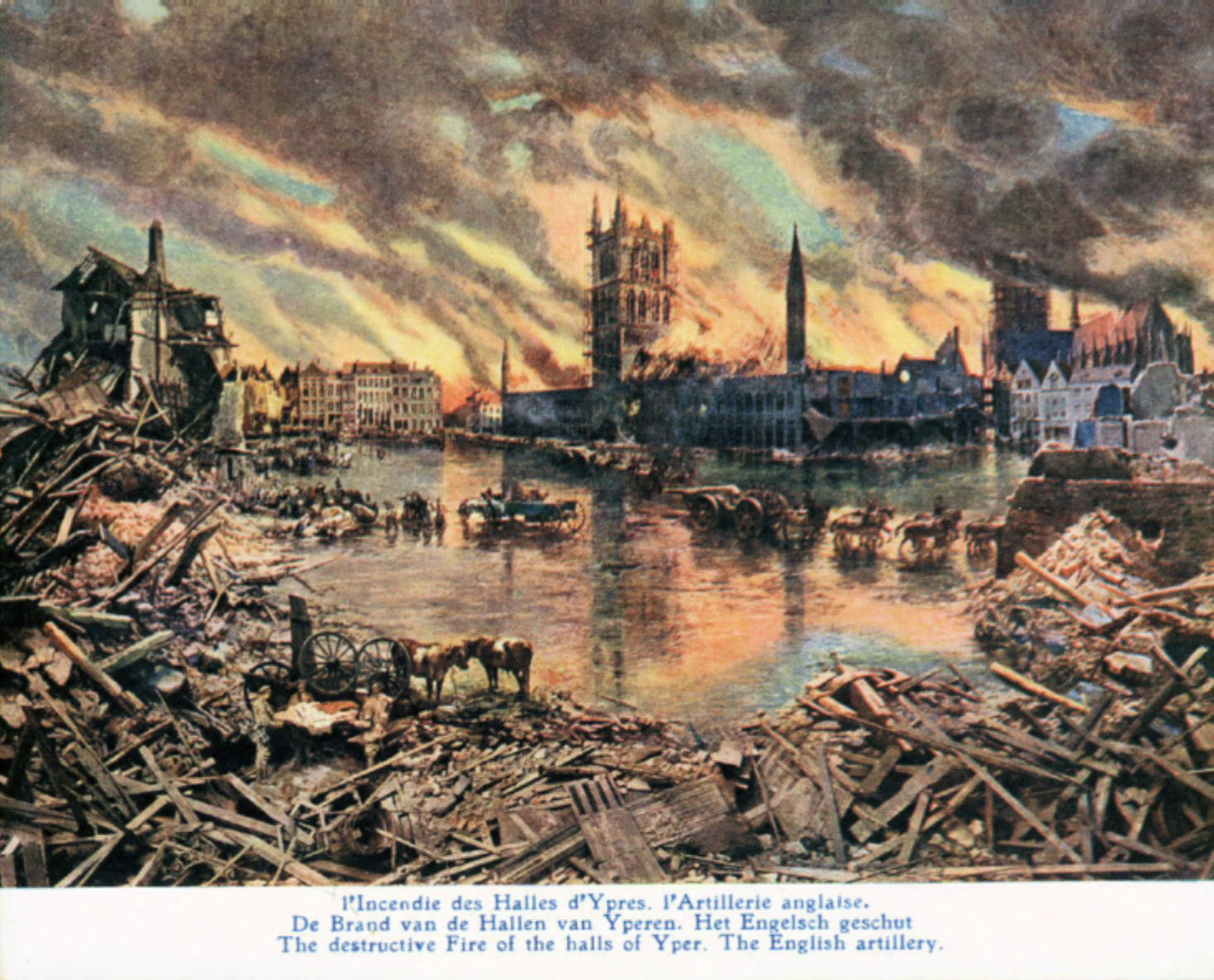
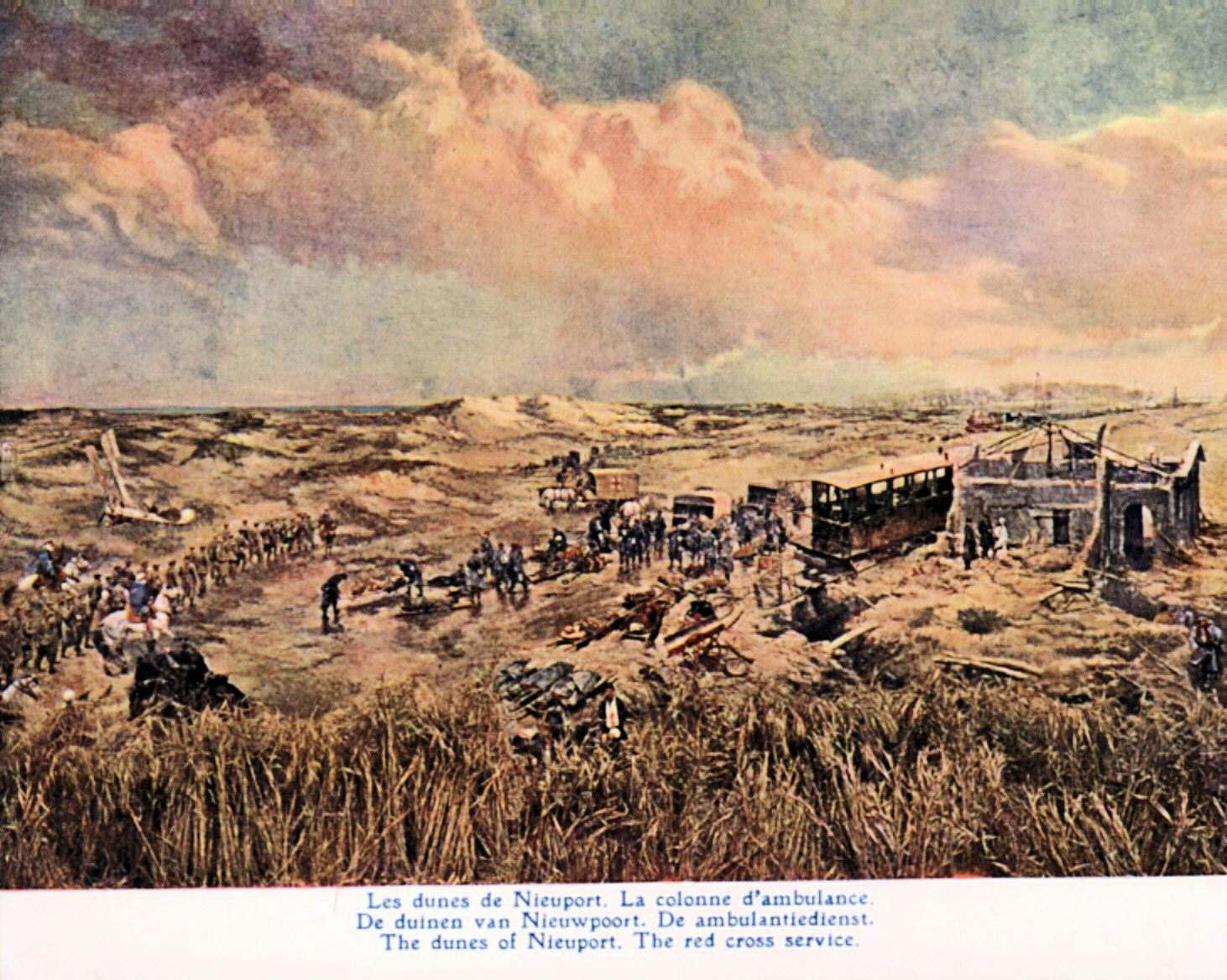
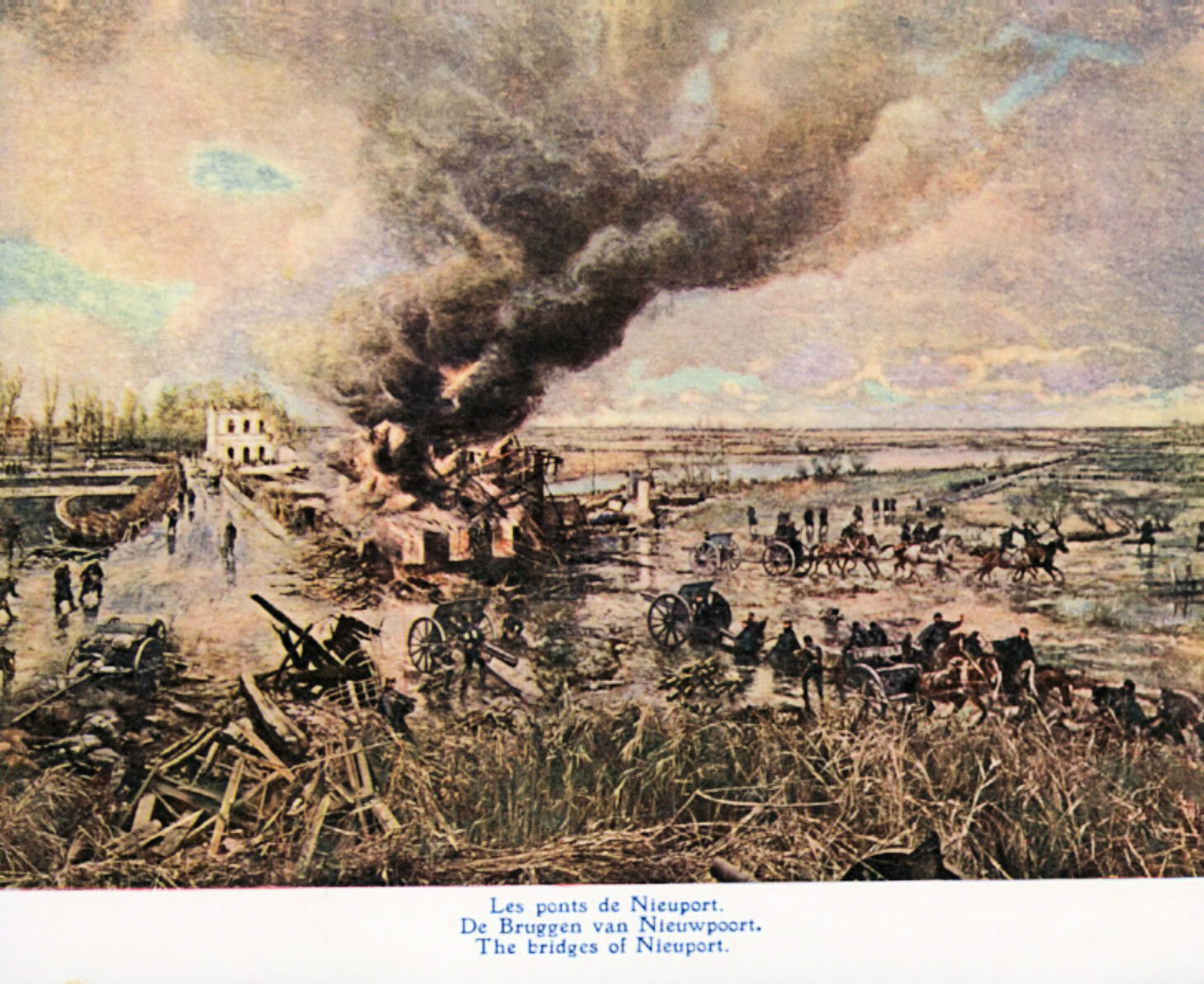
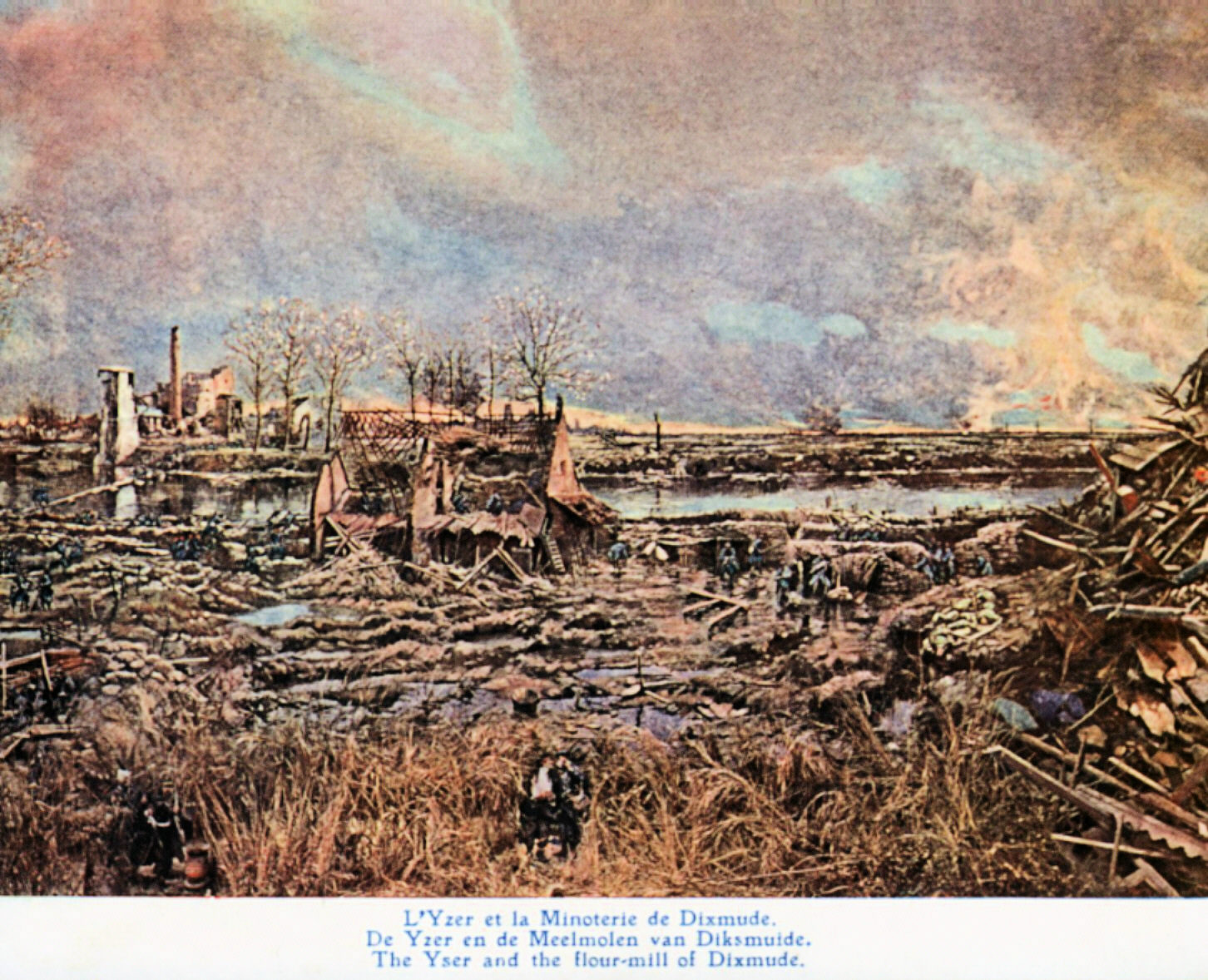
Alfred Bastien was a well known and successful Belgian artist prior to the Great War. He helped complete the successful Panorama du Congo, exhibited at the 1913 Ghent World Fair, which was a prequel of sorts to his grand postwar Panorama de l'Yser, undoubtedly his most famous and acclaimed work, if not the most artistically accomplished.

Click on Image to Expand


After serving in the Garde Civique like many other Belgians, Bastien fled to Great Britain after the fall of Antwerp in October 1914 and despite his age (43) volunteered for the Belgian Army. He was eventually transferred to the Section Artistique in Nieuwpoort along with many of his prewar artist friends and acquaintances. From 1915 onward, he made many drawings and sketches of the situation on and behind the Belgian lines on the Yser river. The British wartime magazine Illustrated War News, among others, regularly published his work, quite often in distinctive and semi-panoramic, multi-color two-page spreads, of which several are shown above. In 1917, on personal request by Lord Beaverbrook, who owned several of Bastien's prewar paintings, he was seconded to the Canadian Army until September 1918, during which time he produced many works of art specifically related to the Canadian war experience.

After the war, Alfred Bastien painted a grand panorama of the Yser Front in 19th-century tradition, a project he had been planning since 1914 and which, according to his own telling, had been suggested to him by King Albert in 1914. During his wartime service in the Belgian Army Bastien made many sketches, drawings, and photos that were later either incorporated into the Panorama itself or were useful studies in technique and effects. Several of such drawings are shown above. The Panorama de l'Yser painting itself measured 115 meters in length and 14 meters in height and was initially exhibited in Brussels. In the mid 1920s, a permanent building was constructed in Ostend to house the Panorama along with a multitude of props and decor. The intention of moving the Panorama to Ostend was to capture a share of British "war-tourism," since most British coming to visit relatives' war graves arrived by steamer in Ostend before proceeding to the area of the Ypres Salient. The Panorama opened at Ostend in 1926. Here are four details from the mural.


Click on Image to Expand

Detail 1


While the intent was to provide spectators with a sense of "being there" on the Yser Front in person, the depiction of the landscape, while extremely realistic in terms of style and detail, was not an actual view that could have been seen at any time during the war. The Panorama not only depicted various battles and incidents from the Yser Front in Belgium in 1914 and 1915, but the central viewpoint from which spectators viewed the battlefield was also an imaginary place. For nowhere in all of Belgium could all the landscapes and towns and villages and rivers have been seen in real life. Just as cyber artists nowadays create "virtual realities" that appear to be highly realistic, back in 1920 Belgian artist Alfred Bastien created a virtual reality scene in which he tried to portray all the drama and heroism of the Yser Front in Belgium.


Click on Image to Expand

Detail 2


Financially the Panorama was great success, for Bastien, who received a tremendous fee for the painting; for the consortium of businessmen and banks that provided funds and capital; and for the city of Ostend, which provided real estate and a newly constructed building to house the Panorama. The initial investment was repaid many times over, from entrance fees and from (by modern standards) modest merchandising of postcards and prints. To give a relative idea of the finances involved, the actual cost of the painting materials (oil paint, linen, brushes etc.) was estimated at around 40,000 BF, the cost to construct the new building at Ostend was 550,000 BF, and Bastien's fee itself was set at 350,000 BF. Entrance fees for customers was 3 BF. While on exhibition in Brussels until 1925 it is estimated that more than 800,000 customers visited the Panorama, amongst them many of the crowned heads of Europe, presidents and foreign emperors alike, all to great acclaim by the news media.


Click on Image to Expand

Detail 3


Of course in completing a work of such dimensions it is obvious that Bastien could not do all the painting himself. Several of his wartime friends and fellow artists from the Section Artistique participated in this grand project. The initial sketching in of the broad outline in charcoal of the Panorama took about a week's time to complete, while the actual painting and varnishing took one year's time. The Panorama was set up in a circle, with paying spectators having a viewing place in the center. Careful attention was given to the lighting effects and the placement of objects in the foreground, in order to create a more believable optical illusion. Many postcards and quality prints in all sizes and colors were made of this early 20th-century artistic extravaganza. The scans in this section are from a series of large-sized color postcards.

Aside from his, famous Panorama de l'Yser, exhibited in Brussels, Bastien also created a smaller sized Panorama de la Bataille de la Meuse in 1937 which showed an amalgam of scenes from the fighting in Namur and the Citadel of Dinant during August 1914. Part of this panorama, which depicted the massacre of Belgian civilians in Dinant in August 1914, was deliberately destroyed by German authorities during the 1940–44 occupation.


Click on Image to Expand

Detail 4


The Panorama de l'Yser was heavily damaged in 1940 during a bombing raid by British aircraft. The museum was closed during the war years and the painting was exposed to all manner of adverse weather conditions. In 1951 the work was moved into the Royal Army Museum in Brussels where a preliminary restoration was undertaken. Afterward it was exhibited in the Army Museum until 1980. Subsequently budgetary constraints and different prevailing artistic tastes have prevented any work being done on the weathered and aged Panorama de l'Yser. the painting has remained in storage, awaiting further restoration and a definitive destination. 

Revised: 8 September 2021

Editor's Note:  There are news stories to be found on the Internet that a philanthropist has offered to purchase the panorama for the town of Walcourt, and that plans for restoration and preparing a site are underway.  I have not been able to fully confirm this, however.  MH

Friday, September 10, 2021

Naval Gunfire Support at Gallipoli


HMS Queen Elizabeth Points Her Main Batteries
at the Gallipoli Peninsula


James A. Smith, Norwich University

The Allied amphibious assault on the Gallipoli Peninsula on 25 April 25 1915 was the first major amphibious assault of the modern era. It was not an auspicious beginning. On two of the five assault beaches, Turkish infantrymen and machine-gunners, unfazed by inadequate and ineffectual pre-invasion shore bombardments, poured fire on disembarking assault troops, causing heavy casualties. On all five assault beaches, the difficult terrain of the Peninsula, coupled with fierce Turkish resistance, made it impossible to expand the initial beachheads, and left the Allied positions exposed to Turkish counterattacks. After a major Allied effort in August 1915 featuring attacks from ANZAC Beach on Sari Bair and a landing at Suvla Bay failed to break the deadlock, the Allies abandoned the campaign.

As the world’s armed forces sought to absorb the lessons of World War I, Gallipoli was the natural starting point for those interested in the study of amphibious operations. While it was clear that the naval gunfire support which the Allies had provided their assault troops had been poorly planned and executed in a number of respects, a more rounded view of the role of naval gunfire was now possible, based on information from “the other side of the hill” revealing how effective that fire had been at certain times in the course of the campaign. . .

25 April 1915

In order to preserve pre-dawn tactical surprise, no preliminary bombardment was planned for the Anzac landing at “Z” beach  Moreover, although the assault on “Y” beach was scheduled for daylight, the British believed (correctly) that the Turks would not be expecting a landing at this location; therefore, no preparatory naval bombardment was provided for it, either. Thus, the British were called upon to provide pre-invasion gunfire support for four beach heads, “S,” “V,”“W” and “X.”  At each of these locations, the pre-invasion bombardment was scheduled to last for half an hour. As the troops approached the shores, the bombardment was to lift onto ‘the first  objective of naval fire,’ the Turkish artillery located some miles from the beach.  Because of ammunition conservation concerns, the heaviest calibers were limited to 20 rounds per gun. 


Location of the Cape Helles Landing Beaches


Precise details concerning the manner in which the British planned to conduct the pre-invasion bombardment are difficult to come by and must therefore be inferred from the actual events. It is, however, known is that prior to the departure of the invasion force, Admiral Weymess  had circulated an order directing fire to be concentrated on the beaches, but that shortly  before the invasion itself, in a conference on board Weymess’ flagship,  Euryalus, Weymess’ own chief of staff called this order into question, stating “You will never be able to pick up the ranges quick enough.” Weymess then left the matter to the judgment of his individual captains, a fact which goes far to explain the great disparity in technique and result between the preparatory fires at the various beaches during the actual landings.

The landings took place early on Sunday 25 April 1915. At all four Cape Helles beaches, the bombardment commenced at 5:00 a.m.  That may have been the only uniform thing about the landings. For each landing point, the nature of the beach, the Turkish defenses, the weight and conduct of the bombardment, and the amphibious assault results must be assessed separately. . .


Click on Image to Enlarge

Naval Assets and Landing Scheme at W Beach


From the naval gunfire support perspective, each of the Gallipoli beaches had a different lesson to teach. “S” beach demonstrated the salutary effect of a bombardment supported with ample force. “V” beach demonstrated the penalty to be paid for an entirely inadequate  bombardment. “W” beach demonstrated that naval intervention could make a difference in whether an assault succeeded or failed. Finally, “X” beach demonstrated the power of close-in bombardment.

[Most instructive for future amphibious operations was the failure at "V" beach. ]


HMS Albion Was the Sole Battleship Supporting
the V Beach Landing


The force assaulting “V” beach, two and a half battalions, was the largest of any at Cape Helles. Under Hamilton’s invasion plan, as modified by [29th Division Commander] Hunter-Weston, this was to be the main British thrust. The naval support for this thrust, however, was the weakest provided to any of the Cape Helles beaches that morning, consisting solely of the battleship Albion, mounting four 12-inch guns and six 6-inch guns. Circumstances conspired to make a bombardment weak on paper even weaker in practice. A haze veiled the shore, presenting targets from being seen distinctly, and when, at dawn, the order to fire was given, the sunrise directly behind the hills through the shore into shadows, so that picking a target or accurate spotting was impossible. The actual bombardment lasted only 40 minutes, and was not continuous; the initial effort was from 5:04 a.m.to 5:20 a.m., ten minutes before the landing force was supposed to arrive. The landing force, however, was late, so fire was resumed at 6:00 a.m., only to be suspended at 6:25 a.m. upon receipt of news that some of the fire was falling among British troops at “Y” beach.


V Beach from the Defender's Position


Moreover, this bombardment was conducted at long range, and there was no close-in fire support as the assault force approached the beach.

The assault on "V" beach was a disastrous failure. One battalion of the assault force (1st  Battalion, Royal Dublin Fusiliers) was transported to the beach in open boats, as at the other beaches; a second battalion (1st  Battalion, Royal Munster Fusiliers) and two companies of the 2nd  Battalion, Hampshire Regiment, were embarked aboard a converted collier, the  River Clyde, which was to be grounded on the beach. Turkish fire discipline was excellent. Not a shot was heard until the  River Clyde grounded at 6:22 a.m. At that point, "hell was let loose.”  The Dubliners, in their open boats, were wiped out by rifle and machine gun fire. Moreover, the  River Clyde grounded too far from the beach for the soldiers on board to reach it directly. A bridge of lighters at first went adrift; restored through heroic action by the Navy officers present, it proved to be a passage only to death. Turkish gunners slaughtered infantrymen trying to get across it.  The situation remained no better for the entire duration of the day. Only under cover of darkness that evening were the remaining 1,000 troops aboard the  River Clyde disembarked without loss. The main initial assault had failed, and with it, arguably, the campaign.

In the succeeding days of the campaign, [naval] gunfire played an important role, especially against troops in the open. Naval gunfire was effective against the Turkish flanks, and instrumental in hindering the movement of reinforcements. Turkish counterattacks had to be staged at night rather than during the day because of the effectiveness of the  Navy’s guns. The German commander, Liman von Sanders, testified that “the artillery effect of the hostile battleships constituted a support of extraordinary power for the landing army. . .  The most beneficial aspect of that support at Gallipoli had been the continuing support rendered to the invading troops well after the initial assault.


Cruiser HMS Talbot Lending Effective Fire Support
Later in the Campaign


Lessons

Naval gunfire at Gallipoli also exhibited a number of technical weaknesses. The flat trajectory of naval guns made it difficult to search out the reverse slopes and deep valleys which characterized the Gallipoli battlefield.

Moreover, naval armor-piercing ammunition intended to sink ships in sea battles was poorly suited to dealing with land targets where a higher explosive content was desirable. Often, messages from forward observers took too long to reach the ships.

Further, the big ships, when tied to the support of the beachheads, themselves became targets. On 18 May a Turkish destroyer, making good use of a fog bank, sank battleship Goliath.  On 25 May German submarine U-21 sank battleship Triumph; two days later, she claimed a second victim, battleship Majestic. After this, the big ships were withdrawn. Their withdrawal was not as significant an event as might first appear. It had not been their main batteries which had performed the yeoman work of the bombardment, but rather, their secondary and tertiary armaments. Operating close to the beaches, light cruisers and destroyers were able to provide adequate support; on 28 June fire from light cruiser Talbot and four destroyers destroyed the Turkish front-line trenches in support of the Allied assault on the Turkish right, allowing them to be easily overrun and the second-line trenches occupied. That night, a Turkish counterattack was detected by the searchlights of two destroyers and swept away by their guns. Thus, the utility of destroyers to provide ongoing support to forces once ashore was also a lesson of Gallipoli.

Source: Excerpted from "Naval Gunfire Support from Gallipoli to Tarawa" by James A. Smith.  Download the full paper HERE

Thanks to Andrew Melomet for bringing this article to our attention

Thursday, September 9, 2021

Kiwis at the Somme Remembered


An Ammunition Train of the New Zealand Division
Passing Through Longueval Village, September 1916

By James Patton

In 1916, New Zealand troops endured 23 days of unbroken fighting—the longest of any division on the Somme. As a result, there are two notable monuments to their sacrifice in the area.  Near the extreme point of their advance is the New Zealand Division Memorial about a mile from their 15 September jumping off position around Longueval village. It stands on the site of the German defense line, known as the Switch Trench. From the memorial, looking to the south, the line of the New Zealand attack can be seen from Caterpillar Valley cemetery and the open slope up which they advanced.


New Zealand Memorial

Lying squarely in the middle of the 1916 Somme Battlefield, Caterpillar Valley was the name given by the army to the long swale which rises eastwards, past Mametz and Caterpillar Woods, to the high ground at Guillemont. Longueval village is on the northern edge of the feature and 500 meters west of the village, on the south side of the road, is the Commonwealth War Graves Commission (CWGC) Memorial to the Missing and Cemetery.

Caterpillar Valley was captured during a successful night assault by the British 3rd, 7th and 9th Divisions on Bazentin Ridge on 14 July 1916. It was lost in the German advance of March 1918 and recovered by the 38th (Welsh) Division on 28 August 1918, at which time the cemetery was started (now Plot 1 of this cemetery) containing 25 graves of the 38th Division and the 6th Dragoon Guards. Post-Armistice, the cemetery was expanded when remains were recovered from other burial sites on the battlefields of the Somme. The great majority of these soldiers died in the autumn of 1916 and almost all the rest in August or September 1918.

The cemetery now contains 4,358 Commonwealth burials, 3,796 of which unidentified; there are special memorials to 32 men known or believed to be buried somewhere on the site and to three men buried in the closed McCormick’s Post Cemetery whose graves were destroyed by shell fire.


Eastside Terrace with Panels Listing the Missing


On a terrace on the east side of the cemetery is the Caterpillar Valley (New Zealand) Memorial, commemorating the men of the New Zealand Division who died in the Battles of the Somme in 1916, and whose graves are not known. This is one of seven memorials in France and Belgium to New Zealand‘s missing soldiers. These are all in CWGC cemeteries chosen as appropriate to the fighting in which the men died.

The monument is on the eastern wall of the cemetery and was designed by Sir Herbert Baker (1862–1946), one of the four principal architects employed by the CWGC and the designer of the memorials at Tyne Cot, Loos, Neuve Chapelle and VC Corner plus ten other cemeteries. Baker also created many important buildings in India and Africa.

This structure is quite like a small version of the Tyne Cot Memorial without the faux-chapels and wing walls at the ends.  It consists of a straight wall of natural pebble-dash stone masonry on which ten large white Portland stone panels bear the names of 1,205 missing New Zealand soldiers. These men fell between August and October 1916 during the Battles of the Somme, and due to the conditions of the battle ground it was a long time until remains could be located and recovered for burial.

Dedication Panel


In 1914 the Dominion of New Zealand raised the "New Zealand Expeditionary Force’ (NZEF) from its militia, which during the Gallipoli campaign was two brigades strong and served  with the Australian 4th Brigade to complete the ANZAC division. After arrival in France, reinforcements enabled the New Zealanders to form a third brigade, and so the NZEF became the NZ Division, which was assigned to the British XV Corps. By mid-1917, the NZ Division was one of the largest in the British Expeditionary Force, having grown to four brigades, and was serving in the Australian Corps.

The NZ Division entered the fight at the Somme on 11 September 1916, taking over the tenuous line between Delville Wood and High Wood. They were a part of the British 4th Army’s attack on15 September, the objective of which was to penetrate north and then east to capture the occupied city of Bapaume. The first part of this offensive became known as the Battle of Flers-Courcelette, and lasted from 15 to  22 September. On the first day the NZ and British 41st Divisions captured the village of Flers, and the Germans were slowly pushed back for several more days. After resting and regrouping the attack was renewed 25 September in the Battle of Morval, and the New Zealand Division captured Factory Corner, on the road between Gueudecourt and Eaucourt-l’Abbaye. By 1 October, they had captured and held Gird Trench, Circus Trench and Gird Support Trench as well. They were withdrawn from the battle on 4 October, and on the 10th they were sent north to the Pas-de-Calais to regroup, although their artillery remained on the Somme for the rest of the month.

In these battles of 1916, the NZ Division had fought for 23 consecutive days, advanced more than two miles deep along five miles of enemy front line. They captured nearly 1,000 prisoners and many machine guns; they lost none of their Vickers and Lewis guns, and less than 20 prisoners. Their casualties were about 7,000, and of these 2,111 were killed in action or died of wounds, just 168 less than New Zealand lost at Gallipoli.


Field Marshal HRH The Prince Charles Lays a Wreath
at the Memorial to the Missing


NZ government records list the dominion’s population in 1914 at 1,089,825 persons, of which 220,089 were males of military age. Further detail lists 135,184 of these as ‘mobilized’, 117,175 found fit for service and 98,950 persons sent overseas, including 550 nurses. Conscription was introduced in August 1916 and 19,548 conscripts served overseas. 2,688 Maoris and Polynesians also served, and at least 3,370 New Zealanders served with other armies, 2,533 of them with the Australians. NZEF overseas casualties for the war were 16,697 killed or died and 41,317 wounded. Another 507 died in New Zealand and an estimated 1,000 died from wounds after the war.

If you’ve been doing the arithmetic here you now know that nearly ten percent of the population of New Zealand served overseas and well over half of the eligible male population was mobilized. This was a significant commitment for such a small nation, and the ratios of loss against size of force are also high: 17 percent killed or died and 58 percent total casualties. Thus it is not surprising that WWI is still a big deal in New Zealand. Every year there are remembrance events at the memorial sites, including Caterpillar Valley. Shown here is Prince Charles, Prince of Wales, in attendance at the 100th anniversary of the Battle of Flers-Courcelette which was held at Caterpillar Valley in 2016. Note in the photo above that HRH exercised his sovereign right to "lead" the NZ Forces and so was kitted out as a NZ Field Marshal, outranking the actual commander of the NZ Defence Force, Lt. General Timothy Keating, who was also present.

An earlier version of this article was presented on the Kansas University, Kansas WW1 Website in August 2018.

Wednesday, September 8, 2021

Recommended: Eight Rules of Leadership from T.E. Lawrence


T.E. Lawrence


By Richard Feloni
Originally Published in Business Insider, 17 August 2017

T. E. Lawrence, forever known to history as "Lawrence of Arabia" and immortalized in film, surpassed the expectations of both his superiors and allies by helping the British and Arabs defeat the Ottomans in World War I. Lawrence may have been much younger and less experienced than other British officers working with Arab forces, but Lawrence's respect for and understanding of his allies' culture proved crucial to his success. He also demonstrated a natural propensity for leadership.

In 1917, he was commissioned by the British military to write a pamphlet about his insights on working alongside Bedouin forces. Lawrence notes that the resulting principles, named "27 Articles" and recently republished for their 100th anniversary, "apply only to the Bedu," but among these guidelines are universal truths about effective leadership. These insights may have been born from a military alliance for a specific period of history, but below, we have summarized and adapted the eight points that are applicable to leaders of any kind — even today.


  • Do not aggressively implement your plans as soon as you are put in charge. "Go easy for the first few weeks. A bad start is difficult to atone for," Lawrence wrote.


  • Learn about your team members as individuals. Learn their personal interests and aspirations.


  • Lead your people to favorable decisions rather than demanding them. It is better to increase another's prestige at the expense of your own.


  • Maintain a constant dialogue instead of confining check-ins to infrequent, structured meetings. "Formal visits to give advice are not so good as the constant dropping of ideas in casual talk," 


  • Have a healthy relationship with your team members without growing too close to them. You can harm your integrity if friendships compromise difficult but necessary decisions.


  • Keep your profile as low as you can. "Your ideal position is when you are present and not noticed," Lawrence wrote. Again, do not let ego distract you from your role of inspiring action.


  • Maintain control of your emotions, even when chastising team members. Lawrence noted that criticism topped with a smile is better "than the most violent speech," and "the less you lose your temper the greater your advantage" when influencing others.


  • Do as little of your team's work as possible. It is better to have your subordinates do an assignment "tolerably than that you do it perfectly." This keeps you focused on big picture decision-making and gives ownership to each person over their work.

In the introduction to the new edition of "27 Articles," foreign policy expert John Hulsman noted that Lawrence achieved what his superiors could not because he realized that effective leadership does not come from heavy-handedness, and that the best way to influence others is to earn their respect rather than demand it.

Lawrence, Hulsman said, realized that "this restrained, secondary role for himself is the key to exercising power."

Tuesday, September 7, 2021

German Prisoners of the Great War: Life in a Yorkshire Camp


Anne Buckley, editor
Pen & Sword Military, 2021
Peter L. Belmonte


German Officer Prisoners at Skipton


In 1920 in Munich, repatriated German prisoners of war published Kriegsgefangen in Skipton (Prisoners of War in Skipton). The book recounts the experiences of German prisoners of war at the camp near Skipton in North Yorkshire, England. It is an account of what the men did, how the camp functioned, how the prisoners felt about their incarceration, and their attitudes toward the British and to the war in general. German Prisoners of the Great War: Life in a Yorkshire Camp, the English translation of the original work, edited by Anne Buckley, helps to make it accessible to a wider audience. Buckley, a lecturer in German and Translation Studies at the University of Leeds, rediscovered the German work in 2014 and set about creating a translation for publication. Thirty students at the University of Leeds translated the original German book, and Buckley, along with Caroline Summers, Alison Abbey, and Ada Whitaker, edited the translated text.

Fritz Sachsse and Willy Cossmann were the compilers and editors of the original book. Sachsse, a captain in the German navy and the senior ranking German officer in the camp, had the unusual distinction of being a prisoner of both the Japanese and the British during the war. After their release, the men gathered the diaries and other written accounts that comprise this book. They wanted the book to describe daily life in the prison and to demonstrate the resilience and continued patriotism of the prisoners. The nature of the book, and the way it was compiled, means that it is not a smooth chronology or history of the prison and prisoners. Rather it is a series of “snippets” written by various authors and assembled to tell various stories of camp events. Some of the men’s poetry is included, and wonderful sketches and drawings made by prisoners are sprinkled throughout.

The initial sentence of the discussion of the camp orchestra serves to illustrate the general tone of the narrative and is worth quoting:

If the attentive reader of the pieces collected in this book has gained an awareness of the crushing mental depression which is the inevitable fate of a prisoner of war, then he will also have come to understand the fervent longing, born of this, to plant a seed of the atmosphere of home amidst the bleak monotony of life behind a barbed-wire fence, a reflection of German scholarship, German art, and German humour. [p. 177]

Indeed, the difficulties experienced by POWs in general, such as shame, helplessness, and “emasculation,” are evident in the accounts. Also prevalent are hope and a sense of humor—those feelings which no doubt have helped prisoners survive throughout history.


Enlisted Prisoner Barracks at Eastcote Prisoner of
War Camp, Northamptonshire


Complaints about food quantity and quality were universal among POWs, and, indeed, among soldiers in general, and are prevalent here. Dissatisfaction with the British is a strong theme throughout the book; many of the Germans felt their captors treated them disrespectfully and harshly. Indeed, the book includes favorable mention of only a few British soldiers.

To show how the men wanted to improve themselves while in captivity, the book describes the efforts of men to obtain study material for various subjects. Men studied foreign languages, science, mathematics, law, business, and other subjects. Officer cadets whose studies were interrupted by the war sought to have a course of study that would enable them to attend university upon their return to Germany. Accordingly, teacher-captives petitioned Germany and were allowed to develop such a course, within certain parameters, that fit their needs. The final exam, shown in the book, would no doubt stump many modern-day college graduates.

The book is replete with information sure to please Great War students. There are entries from the garden administrator, the shower officer, a postal clerk, and others. Other sections discuss escape attempts, sports, efforts to cook in the barracks, the rationing and use of food and tobacco, etc. There are discussions concerning camp finance, musical, theatrical, and choir groups, and religious services (Lutheran and Catholic). All these accounts serve to illuminate one aspect or another of the German POW experience at the camp.

Influenza largely missed the camp in autumn 1918, but it struck with a vengeance in February 1919 when many German prisoners became ill and 47 died. The narrative at this point reflects disgust and anger at what the Germans felt was the indifference and incompetence of British medical staff. Germany signed the peace treaty in June 1919, but the prisoners remained incarcerated. This caused a deep bitterness among the men who couldn’t see why they were not freed. Particularly poignant are the accounts of several prisoners who slipped into insanity during this time. The men were finally repatriated on 27 October 1919, almost one year after the Armistice.

The camp inmate population seems to have averaged about 500 officers and 130 enlisted men. The enlisted men served as orderlies to the officers, and they cleaned the barracks and grounds and supplied labor for the various camp shops. Red Cross records allow researchers to identify 916 Germans as having been imprisoned at Skipton from 1917 to 1919, and a good number of them are listed by name, rank, military unit, and date of birth, in an appendix. In addition to the original German sketches and illustrations, 32 added photographs and illustrations enhance the text. This book is an important contribution to the historiography of World War I. Those with a general interest in prisoners of war will enjoy it. Those who have previously read accounts of British or American Great War prisoners will still be quite interested in the book, giving, as it does, another perspective.

Peter Belmonte