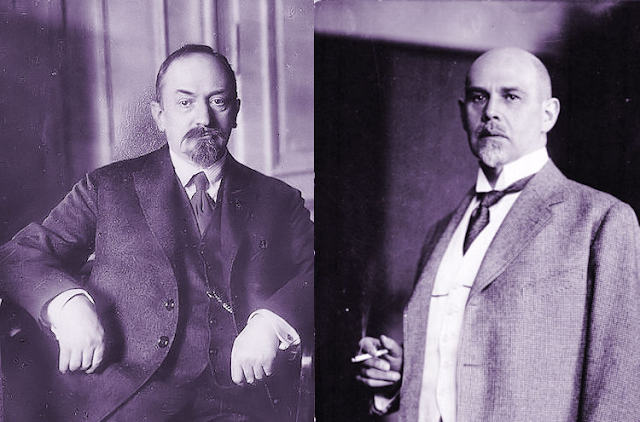
| Foreign Ministers Georgy Chicherin and Walter Rathenau |
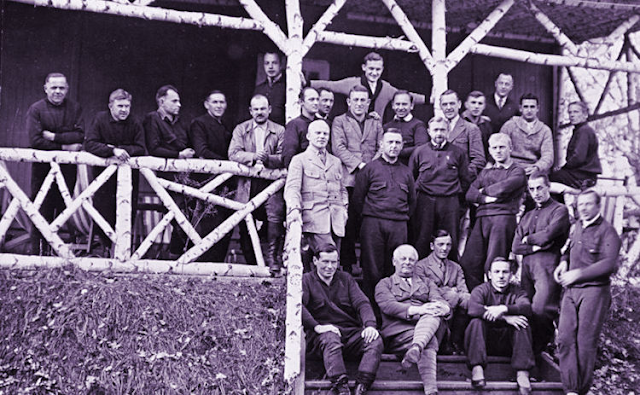
| 1928 Photo of German Staff at a Chemical Weapons Facility at Tomka, Soviet Union |
Now all roads lead to France and heavy is the treadEdward Thomas, Roads
Of the living; but the dead returning lightly dance.
| Foreign Ministers Georgy Chicherin and Walter Rathenau |
| 1928 Photo of German Staff at a Chemical Weapons Facility at Tomka, Soviet Union |
![]() |
| Night Action |
Patrick Beesly, Harcourt Brace Jovanovich, 1982. An indispensible history of how Room 40 broke the German naval codes and engineered the revelation of the Zimmermann Telegram.
H.W. Fawcett & G.W.W. Hooper, Naval Institute Press, 2001. Originally published in 1920, this book brings provides a vivid account of the greatest battle between dreadnought fleets by stitching together Royal Navy eyewitness accounts.
Andrew Gordon, Naval Institute Press, 1996. A fascinating, lively, and massive investigation into British naval command both at Jutland and in the two decades that preceded the battle. Required reading for all students of the Great War at sea
Paul G. Halpern, Naval Institute Press, 1994. Undoubtedly the best one-volume history of the war at sea, covering the activities of all the navies in all the theaters.
Paul G. Halpern, Naval Institute Press, 1987. There was far more to the naval war in the Mediterranean than the chase of the and the disaster of the Dardanelles, and Halpern covers every aspect of it, including Japan's effort.
Holger H. Herwig, Allen & Unwin, 1980. An overview of the German Navy by a leading scholar of Imperial Germany.
R.D. Layman, Naval Institute Press, 1996. The final work of the late Great War Society member, this is a probing examination of the role and impact of aviation in the war at sea.
Arthur J. Marder, Oxford University Press, 1961-1970. Still a brilliant history of the Royal Navy in all theaters, encompassing both policy and operations; its account of Jutland is one the most balanced and incisive.
Evan Mawdsley, Barnes and Noble Books, 1978. An investigation into the causes underlying the collapse of the Russian Navy and its last battles.
Dwight R. Messimer, Naval Institute Press, 2001. An intriguing look at the U-boat war, focusing on anti-submarine measures; the author reaches the conclusion that the most effective weapon against the U-boat was diplomacy.
Lawrence Sondhaus, Purdue University Press, 1994. A groundbreaking study of one of the most overlooked navies of the Great War.
Nigel Hawkins, Naval Institute Press, 2003. While their armies tried to break the stalemate in the trenches in France, the navies of Britain and Germany were locked in a struggle to win the war by destroying each other's commerce and starving their opponent into submission.
![]() |
| Lt. von Forster, Who Would Trigger an Imperial Crisis |
Although by 1914, the retaking of Alsace-Lorraine was not a sufficient casus belli for France, there was one indication that the locals themselves were hoping for liberation just before the war actually broke out. Remembered as the 1913 "Zabern Affair," it started with civil disturbances in the Alsatian garrison town of Zabern where two battalions of the Prussian 99th (2nd Upper Rhenish) Infantry Regiment were garrisoned. It was caused when, more than four decades after Alsace's occupation by the Germans, an idiot German second lieutenant, Günter von Forster, openly insulted the local population at least twice in late October. On 6 November, the two local newspapers, the Elsässer and the Zaberner Anzeiger, informed the public about the derogatory language used by Lt. von Forster.
Lt. von Forster's superiors exacerbated matters by ordering the light punishment of six days confinement to quarters for the lieutenant. Making matters even worse, after completing his house arrest, von Forster was paraded in public with a military escort. He managed to get in a scrape with some hostile locals and struck one of them with his saber. This snowballed the growing popular unrest, leading to a mass protest on 28 October, which was quelled with brutal means. Machine guns were placed in the town square to discourage further disturbances
![]() |
| Prussian Soldiers Patrolling the Streets of Zabern |
A broader German-centered political crisis was fueled by the support given by senior army figures and the German Chancellor Bethmann-Hollweg to the behavior of the military in suppressing the protests. These infringements led to a debate in the German Reichstag about the militaristic structures of German society, as well as the position of the leadership of the Empire.
On 4 December, the German parliament accepted a vote of no confidence in the Chancellor by a huge majority. This unprecedented move remained without effect as, in the German Empire, the Chancellor was appointed by the Emperor and needed his support only. The parliament was ultimately half-hearted in its attempts to increase its power against the executive. Alsatians and Lorrainers felt themselves more helplessly at the mercy of the arbitrariness of the German military than ever. The coming of war, however, precluded further conflicts between Alsace-Lorraine and the Kaiser and his ministers. Lt. von Forster would be killed on the Eastern Front in August 1915.
Source: Oxford Reference
By Hamilton Fyfe, War Correspondent
One of the features of the Battle of St. Quentin (March 1918 offensive), and of the Battle of the Lys (April 1918 Offensive) also, which will always be quoted as a tribute to the fighting spirit of the British race was the brave and useful part played by the "oddments" of our Army in slowing up and stopping the German advance.
That the regular fighting men would resist stubbornly and make the enemy pay heavily for the ground which he gained by weight of superior forces was certain, but the regular fighting men were over and over again forced by the odds against them into positions where they needed help badly. Over and over again this help was given by hastily improvised reinforcements made up of men who were not accustomed to fight.
Behind an army in the field there are always large numbers of "other ranks." There are the men who make and mend roads; there are the signallers and electricians, who put up and keep in order telegraph and telephone wires; there are the cooks, the camp orderlies, the mess attendants, the grooms, the sanitary service men.
All these are, for one reason or another, not considered fit for service in the field ; yet in these battles they did excellent service in the forefront of the fighting, "not once nor twice." During those critical days and nights which followed the opening of the German offensive calls were made upon them to take their places in the firing-line, and pluckily they answered the call. Hurriedly put together in battalions, under officers whom they had never seen, without the experience of war or the hard training which fits the soldier for steady endurance and effective manoeuvre, they went in and closed gaps, and presented a firm front to the masses of the enemy.
![]() |
| Peronne—Early Objective of the March Offensive |
"Carey's Force"
The most famous of these bodies of "irregular" troops was that which we knew as Carey's Force. On the night this was formed—the night of March 26th - 27th — Amiens was in danger of being rushed. In great force, and with a large proportion of fresh troops to bear down the opposition of tired British divisions which had been fighting, for nearly a week without rest, the Germans had pressed on to within striking distance of the city. Their cavalry patrols were reported to have come very near. The French were on their way to relieve our worn-out battalions, but they could not arrive for several days. It was clear that unless we could put a fresh barrier in front of the enemy, Amiens might go.
A council of war was held at 2 a.m. on Wednesday, the 27th, in a bare room lit by shaded lamps which threw patches of light over the maps spread out upon trestle tables. The German airmen were busy that night. I saw dead horses lying in the streets of Amiens, and men being taken up in fragments. In the village where the council was being held bombs dropped, too, and shook the general's headquarters.
An arrangement, already planned and well advanced, was now completed. It was that every man who could use a rifle should be put into the line at once. There was a considerable front so thinly held that the enemy might at any moment pierce it. A cool-headed, resolute brigadier of the Royal Artillery was told off to take command of the force intended to defend this front. He was given a staff and told to set to work at once.
Within a few hours a force of three thousand men was ready to march. They took the road south- eastward from VilIers-Bretonneux, and by two o'clock in the afternoon Carey's Force was on the front allotted to it and was energetically digging itself in.
![]() |
| Bristish Troops Deploying in Flanders, April 1918 |
Keeping their End Up
Digging was work to which a large number of its members were accustomed. Several labour battalions had been drawn upon. Battles were not in their contract. But they were of British race—they knew their aid was needed, and they gave it cheerfully. An infantry training school provided a good many officers used to dealing with new troops. Field-survey men of the Royal Engineers, telegraph men, some American engineers, and all who could be spared at Army Head-quarters completed the force. It was strengthened after a day or so by fifty cavalry, and it was given guns.
The brigadier spent most of his time near the front line, keeping his men up to their task. They were told that they must hold the front unbroken until mid-night on Friday, the 29th. That meant holding it for two days and a half against almost continuous attacks. Even well-tried troops might have found this exhausting. Carey's Force struggled manfully, not only against the enemy, but against weariness and the depression that weariness is apt to cause. They kept their end up even after the time named as the limit of their endeavour. Relief could not be hurried with the rapidity hoped for. On Saturday, March 30th, I watched an action in which the force still barred the enemy's way to Amiens.
They had lost some ground that morning. .Under fierce artillery fire they had gone back, and the enemy pushed in nearer Villers-Bretonneux. But help was at hand. An Australian brigade, tough fighters ever, combined with some squadrons of Lancers, drove off the Germans and restored the line.
That afternoon I went into a house on the edge of bombarded and deserted Villers-Bretonneux. From an attic window I had a good view over the battlefield. On the near side of a long, gentle slope our batteries were busy. Groups of gun-team horses stood about patiently in the pouring rain. Upon the sky-line stretcher-bearers could be seen moving and carrying wounded. Just over the ridge were our trenches, with those of the enemy a few hundred yards distant. The tap-tap- tap of machine-guns was unceasing.
![]() |
| Defensive Position in Flanders |
A Mixed Squadron
The Germans were trying to push forward small parties with machine-guns to make holes in our lines and compel our men to fall back. Presently I saw cavalry trotting in single file, a long line of them, across the open ground from one little wood to another. A shell dropped near them, but the horses took no more notice of it than the troopers did. They went into the wood and were lost to view. If the situation had become worse, they would have been useful in checking the German advance. But this time Carey's Force could not be moved.
I went over to the brigadier's head-quarters in a group of huts. General Carey was out "looking after the line." His staff were well content with the way their men were "sticking it." They had to combat not only the open tactics of the foe, but treacherous wiles as well.
Another improvised force which did good work was a body of mounted men, composed of troopers from several British cavalry regiments and from the Fort Garry Horse (Canadian), and of "anybody who could ride." I saw a party going off to join it near Guiscard in the sunny noontide of one of those first golden days of the offensive: There streamed across the road and up a sloping field a mixed squadron which I could not identify. I saw some were Canadians, others were Lancers, Scots Greys, Hussars, and some were not cavalrymen at all, though they rode like men hardened to the saddle. They cantered to the top of the field, a stirring sight, then disappeared. This detachment helped to cover several difficult retreats.
Then there was a force which in the Flanders battle was scraped up from the usual materials and thrown in to help in stemming the German onslaught near Dranoutre. It made its own trenches and stayed in them until the French came up to relieve, despite the enemy's efforts to drive through. And I could add many more stories of the pluck and doggedness as fighters of men who spent their time usually cleaning up, cooking, or handing dishes at table ; of those who did surveying or who shovelled dirt ; of those who did clerks' work in offices. Listen to the exploit of a party which came from a bombing school and helped to delay the enemy in the earliest and most difficult stage of his offensive.
![]() |
| Allied Defensive Line at Villers-Bretonneux |
A Bombing Exploit
Men have to be taught to bomb, and they go to school for their lessons. The pupils at this school were still learners when the Germans broke through, but they went readily, and even gladly, when the officer-instructors asked them if they would go into the line to back up their comrades. On the evening of March 21st a young officer led them up a trench in the Vraucourt region, one of our trenches which was partly occupied by the enemy. It ran downhill. The Bodies were in the higher part of it, bombing our men with bad effect.
The young officer and his bombers had to crawl up the trench in order to keep their heads below the bullets which the machine-guns were spitting out all the time. Thus they came near enough to the block to hurl their bombs. They made it so hot for the Germans that they withdrew to some distance and bombed no more. "For learners we didn't do too badly," one of the school pupils said modestly when it was over. In this and in other engagements they lent most valuable aid.
Source: The War Illustrated, 8 June 1918
![]() |
| Restored Camel of Colorado's Vintage Aero Flying Museum |
By Kimball Worcester, Assistant Editor
For those readers who think Snoopy was the only American to fly the Sopwith Camel, we have a surprise for you.
AEF aero pursuit squadrons are generally known to have flown French planes, SPADs and Nieuports. Indeed, before the arrival of the AEF, American pilots of the Lafayette Escadrille had been flying French planes for several years. But after April 1917, the newly arrived pilots of the American Air Service took what their veteran allies supplied them. For two AEF squadrons under British command (the 17th and the 148th ) the plane designated was the Sopwith Camel F.1. This plane was renowned as the most productive fighter of the war, downing more adversaries than any other fighter from either side. Once mastered, the Camel had remarkable qualities of maneuverability. Such mastery came at a price, however—the Camel killed nearly as many pilots in crashes as did German fighters in combat.
![]() |
| Testing Night Landing Flares on a Camel |
There is some hearsay that the British initially fobbed off on the Americans the Camel with the most problematic engine, the 165 Gnome Monosoupape, which allegedly had an unfortunate tendency to burst into flames. The new kid in the game is rarely seen to merit the best equipment. One is reminded of the Nieuport 28s, also with fire problems, that the Americans flew before the French provided them with the illustrious SPAD XIII. In any case, such famous U.S. pilots as George Vaughn (America's third-ranking Air Service ace), Elliot White Springs, Errol Zistel, and Larry Callahan were members of the 17th and 148th squadrons.
![]() |
| Insignia of the 185th Aero Squadron |
The 185 Aero Squadron, which remainded under American command, enjoyed the distinction of flying Sopwith Camels at night Perhaps it is no wonder they scored zero victories in their sorties of October and November 1918. This is not to say its pilots lacked skill; two of their participants were already aces, Jerry Vasconcells and Harold Hartney, both of whom previously acquired their ace status with the 27 Aero Squadron. The challenge and danger of flying the notoriously fickle yet rewarding Camel certainly intensified by the night. There were no navigational aids even close to what were developed by the Second World War; indeed, in daylight weather conditions obscuring visibility routinely grounded all flying. There were efforts to create landing lights on the plane itself, notably the Holt flare system (Capt. Holt, RFC), which was a step in the right direction but which also created subsidiary problems with glare and flash that could interfere with vision. The night fighting 185th Squadron has one more distinction: it was the first ever to employ the night-navigating bat, the only true flying mammal, as its emblem.
Originally presented in the winter 2012 issue of the Journal of the World War One Historical Association
| At a Preparedness Day Event |
United States Constitution: Article II, Section 2, Clause 1:
The President shall be Commander in Chief of the Army and Navy of the United States, and of the Militia of the several States, when called into the actual Service of the United States; he may require the Opinion, in writing, of the principal Officer in each of the executive Departments, upon any Subject relating to the Duties of their respective Offices, and he shall have Power to grant Reprieves and Pardons for Offences against the United States, except in Cases of Impeachment.
Articles
Is America's 1914-1917 Neutrality a Myth?
Interviewing Historian Thomas Fleming on America, President Wilson, and the Great War
"I Have Seen War" FDR As Assistant Secretary of the Navy
When Wilson Seized America's Railroads
How Going to War Reshaped President Wilson's Thinking
America's Decision to Send an Expeditionary Force to Europe
![]() |
| President Wilson and His Wartime Cabinet |
General John J. Pershing Appointed Commander of the American Expeditionary Forces
Wilson's October 1918 Naval Surprise
8 January 1918: President Wilson Enunciates the Fourteen Points
Pershing Advocates Unconditional Surrender
The Rough Riders Don't Ride Again
President Woodrow Wilson's Stroke: Illness Strikes
Reviews
| Wilson with General Pershing in France, Christmas Day 1918 |
![]() |
| The "Five of Hearts" Being Salvaged at the Meuse-Argonne Battlefield |
The AEF organized a Tank Corps in 1917 in France. By 11 November 1918, five heavy battalions and ten light battalions existed, four of which had been in combat. While tank production in the United States was proceeding, very few American-made tanks reached France before the Armistice. The Army acquired all tanks used in combat by the AEF from our allies—heavy tanks from the British and light tanks from the French.
Company C, 344th Battalion, Tank Corps, used this French-made, two-man tank during World War I. The battalion was part of the 1st Provisional Tank Brigade commanded by Col. George S. Patton. The tank was nicknamed “Five of Hearts” because of its identification markings. The French assigned suits and numbers from playing cards to identify tanks.
The "Five of Hearts" saw heavy combat in the Fléville sector during the Meuse-Argonne Offensive. During its support of the 16th Infantry of the 1st Division, the turret and 37mm gun mount became so jammed with bullets that they could not be used. Soldiers left the tank on the field of battle after the infantry secured the area but later recovered it. In 1919, it was sent to Camp Meade—the U.S. Army Tank Corps Headquarters—as a memorial to the corps’ service in the First World War. Today, the "Five of Hearts" survives and can be visited at the Museum of the United States Army, Fort Belvoir, VA.
Source: The Great War, U.S. Army Artifacts
One story illustrates the ability of humour to motivate men in difficult circumstances, bridge the divide of rank and ultimately make a comedic "star" of an individual.
General Haig was more concerned with moral tone than with avenging thunderclaps. No battalion would have ventured to march to a ribald song within miles of his headquarters. No Colonel within a considerable radius of any spot where there was a likelihood of meeting a staff officer would have allowed his battalion to march, even in the heat of an August day, with tunics undone and shirt buttons loosened and still less would he have relieved his own sweltering discomfort by replacing his stiff army hat with a khaki handkerchief knotted at each comer in the style of a day-tripper to the beach at Southend. It was unfortunate for one particular battalion marching towards the Somme that it happened to present precisely this appearance as it passed through a village where a senior ordnance officer had his headquarters. It was unfortunate that the commander-in-chief, concerned about supplies of ammunition for the coming push, should have been visiting the ordnance H.Q. in person - unfortunate too that the battalion should have been in full vocal flood and rendering a particular chorus compared to which the bawdiest version of Mademoiselle from Armentières might have seemed a suitable serenade for a maiden aunt:
Do your balls hang low?
Do they dangle to and fro?
Can you tie them in a knot?
Can you tie them in a bow?
They had reached the furth line before the full sense of the words got through to the commander-in-chief. It got worse as he listened:
Do they itch when it’s hot?
Do you rest them in a pot?
He crossed to the window and stared in disbelief as the unwitting Battalion shambled past. "Just as I thought," he said. "It’s the rear companies! Fetch my horse!"
The battalion straggled, marching easy, over almost a mile of road. By the time Sir Douglas Haig had mounted and started to trot up the long column, they had started all over again, this time in harmony, for the beauty of their favourite tune was that it could be sung in parts.
Do you get them in a tangle? .
Do you catch them in the mangle?
Do they swing in stormy weather?
Do they tickle with a feather?
One by one, as the marching platoons spotted the unmistakable upright figure of their commander-in-chief trotting purposefully past to reach the head of the battalion, their voices trailed away into embarrassed silence. But the men at the head of the column were still lustily singing
Do they rattle when you walk? ,
Do they jingle when you talk?
The colonel had a fine voice. Riding in front of his battalion, he was singing louder than any of his men—so loudly that he either failed to notice the falling-off of the merry chorus behind him or, putting it down to fatigue, sang louder than ever to encourage his men across the last lap of the hour’s march. Just as General Haig caught up with him, he had flung back his handkerchiefed head and was bawling in a rousing oblivious crescendo:
Can you sling them on your shoulder?
Like a lousy fucking soldier?
DO YOUR BALLS HANG LOW?
Haig had to shout to make himself heard. "I must congratulate you on your voice, Colonel!" The unfortunate Colonel could only stare back open-mouthed, fumble at his unbuttoned tunic, call the battalion to march to attention and, as an afterthought, snatch the handkerchief from his head.
"No, no!" Haig raised his hand. "The men may march easy." With the last of his voice the colonel croaked the command. Haig on his great black charger, a full hand higher than the colonel’s horse, trotted beside him and bent down for a private word in the colonel’s ear, buthis orderly riding just behind heard—and later repeated—every word. "I like the tune," he said, ’but you must know that in any circumstances the words are inexcusable!"
The discomfited colonel, having now replaced his hat, managed to salute, but before he could stammer an apology Haig was gone with a final nod of rebuke, trotting back past the chastened battalion to resume his interrupted business. It was a full five minutes before anyone broke the silence. Then a wag halfway down the column dared to introduce another song. It was a song beloved by their virtuous Victorian grandmothers, and he sang in notes of pure innocence:
After the ball was over. . .
Source: "Irrepressible chirpy cockney chappies"? — Humour as an aid to survival, Andrew Robershaw, National Army Museum
'
![]() |
| Trevor Wilson, 1928–2022 |
Dear Reader,
I hope you’ll read this review because I fear you may not read all 864 pages of the book. Yes, it’s ‘dated’ and long—but over the past month or so I’ve found it to be an extremely rich insight into the various aspects of how World War One was experienced and fought by the people of Britain. Author Trevor Wilson, a noted Australian professor and scholar, drew from innumerable sources to produce this book, and the result is a lively and highly readable study composed of eighteen chapters, each with two to seven subsections. Useful maps are included along the way, and many black and white photos help bring us in contact with the everyday people of the time.
Nothing relating to Britain’s war experience is neglected in this work. Military, political, diplomatic, economic, and social life are all examined in detail. The early retreat from Mons is typically described in a combination of prose and personal experience. The retreat continued for thirteen days, and the average soldier managed three or four hours of sleep every 24 hours. In this way some 200 miles were covered, much in extreme heat. A corporal describes how he inadvisably took his boots off one night to find his feet covered in blood. “As I couldn’t get my boots on again I cut the sides away, and when we started marching again, my feet hurt like hell.” His company eventually covered 251 miles of retreat (pp. 45-46).
This frequent combining of fact with human experience keeps Wilson’s book flowing and interesting. The sections describing an Irish soldier’s time on the Aisne is riveting, as are later sections where we hear the voices of officers, airmen, sailors, politicians, the working class, and housewives. Ultimately, we hear the voices of Britons at the end of a war that resulted in intense questioning of whether it was all worth it. (The author somewhat cryptically deals with this question at the very end of the book). . .
![]() |
| Infantry Advancing at the Somme |
Every battlefront is considered. This includes Gallipoli, Salonika, and Mesopotamia, the section for which is interestingly headed “Sideshows More or Less” (p. 266). One of the longest chapters, with seven parts, is “Blooding the New Armies: The Battle of the Somme, 1916.” Here again the author is comprehensive, including graphic details of the part played by the “motor-monster” (the tank), the war in the sky, and a personal account by one private who endured and survived the Somme. This private describes the kinds of lads he arrived at the battlefield with:
tough lads: dustmen, fish-dock workers, trawler hands, merchant seamen, casual dockside laborers, plus a sprinkling of white-collar types. As civilians, most were as poor as cows—and we were all poor together as privates in the Infantry. But as comrades under the most miserable of conditions you would have to go a long way to find better lads than those with whom I served…. (p. 354).
We learn much about the Generals and politicians involved in the war. High-level personalities and their foibles, conflicts, self-doubts, and inconsistencies make for interesting reading. But what I found most appealing in the book was the attention given to the commoners at home, how they struggled on several levels, and how they received war news. In Chapter 46, significantly entitled “A Land No Longer Merry,” the author admits that 1917 was indeed a grim year not only for the military but also for the civilian population:
. . . the exhilarating brief successes of Vimy Ridge and Messines were soon overshadowed by the protracted bloodbaths of Arras and Third Ypres. Nor did the Prime Minister’s Paris speech at the end of the year, in effect denying confidence in Britain’s commanders while failing to end their command, uplift the spirit of the public (p. 507).
![]() |
| British Wounded at Salonika |
A more intimate insight into personal suffering at home is shown in this letter of a schoolmaster to a relative:
One of the mothers [of a former pupil] brought me her boy’s photo and apologized because he didn’t call on me when he was home from the front where he had been 2 years before getting Leave. He is in the 16th lancers & she said she nearly cried to see the change in him, all the Boy being gone. He couldn’t bear to come down the street to see anyone & was very downhearted to go back. She said the sound of the Guns all day long when she was alone nearly drove her mad thinking of her boy out there (p. 508).
Chapter 60, “Warriors and Victims,” cites both military and civilian writers to graphically illustrate the suffering of both groups, while Chapter 67 aims at more personal grief with an opening quote from Lady Asquith’s diary of 7 October 1918:
I am beginning to rub my eyes at the prospect of peace. I think it will require more courage than anything that has gone before….one will at last fully recognize that the dead are not only dead for the duration of the war (p. 751).
![]() |
| Click HERE to Order This Book |
This is truly a book showing “the Myriad Faces of War.” The titular word “myriad” meaning limitless, numberless, unlimited, is not an exaggeration. The author has produced an encyclopedic work that I suspect is one of the best studies of Britain and the war. In conclusion, the elegiac tone struck by the quotation from Henry Read’s “To a Conscript of 1940” heading Chapter 74, “A World Not Renewed,” is a reality we may all share:
David F. Beer
![]() |
| Private Hofmann in France |
Alfonso (Gibbs) Hofmann (1896–1974) was the great uncle of World War One historian Stephen Harris (Rock of the Marne, Duffy's War, Harlem's Hellfighters, and The Silk Stocking Regiment), who brought his relative's atypical wartime poem to our attention. Alfonso was born in the late 1896 in Mexico, where his father, a metallurgist from Hungary, ran some of the bigger silver mines out in the Wild West. When the family moved to Kansas City, he followed his brother, Arnold Hofmann (Stephen's grandfather) on to the editorial staff of the Kansas City Star. Arnold was married to Vea Van Buren, the sister of magazine illustrator and comic strip artist Raeburn Van Buren, also a former member of the Star's editorial staff, and who during the war was art editor of Gas Attack, the magazine of the 27th New York Empire Division.
Alfonso learned the newspaper trade well, as did his brother. In 1917, Alfonso enlisted as a private in the 1st Missouri Ambulance Company as a medic. He was deployed to France with the 137th Ambulance Company and was severely gassed and suffered shrapnel wounds in action during the Meuse-Argonne Offensive. He would later receive the Purple Heart for his wounds. He was treated first in a field hospital, then a hospital in Paris. He wrote this poem about his French nurse while he was recuperating. It was later published in Liberty magazine.
When She Goes By
After the war, he landed a reporting job on a brand-new newspaper in New York City, the New York Daily News. Alfonso changed his first name to Gibbs, in honor of the British journalist and author, Philip Gibbs. He later worked for the Bell Syndicate, which ran newspaper features similar to the AP and UPI. During WWII, he managed the information bureau for the U.S. Embassy in London. He wrote numerous short stories and poems during his life, many published. He died on New Year's Day, 1974.
![]() |
| Built for the children of Reims who fell in the field of honor by your battered city forever expressing its mourning and pride |
Every city, town, and village in France has a memorial to the fallen of the First World War. I've easily seen over a hundred of them, and I think one of the most dignified is located in Reims, northwest of the Cathedral. I think the key to Monuments aux Morts' impact is the way it integrates three separate works of art. Naturally, annual events are held at the site commemorating the end of the war, and the Second World War as well, since the German surrender document was signed nearby at General Eisenhower's SHAEF Headquarters. In the 21st century, these events have been enhanced by laser light shows.
![]() |
| Thought and Resurrection |
![]() |
| To New Generations for Their Knowledge and Remembrance |
Reims’ Monuments aux Morts was built on an open site to the northwest of the old city in the Place de la République close to the mediaeval fortifications and the Roman Porte de Mars. It is a stripped Classical hemicycle constructed of reinforced concrete. Henri Royer won a limited competition held in 1924, and the monument was inaugurated in 1930 by Minister of War André Maginot, in the presence of Marshal Pétain, Paul Marchandeau, mayor of Reims and deputy, and the Archbishop of Reims Cardinal Luçon The flanking relief groups and the central free-standing bronze figure—clearly inspired by Rodin’s Thinker—was the work of the sculptor Paul Lefèvre. After the Second World War, a memorial to the Martyrs of the Resistance in the adjacent garden.
![]() |
| Light Show Remembering VE Day, 1945 |