Now all roads lead to France and heavy is the tread
Of the living; but the dead returning lightly dance.
Edward Thomas, Roads

Thursday, December 21, 2023

The Rainbow Soldier of Montgomery, Alabama

With the utterly wicked Cancel Culture's (yes, that now includes every element of the U.S. Government) triumphal attack on the Confederate Monument at Arlington National Cemetery apparently irreversible, I feel impelled to run an article that I presented previously in my Trip-Wire monthly newsletter.  I believe it hints at why the post-Civil War effort at reconciliation that the Confederate Monument came to symbolize was a blessing for America. 

That national endeavor to bring the county back together was initiated by President William McKinley who was, incidentally, a veteran of the Union Army. Tragically, he would be assassinated before he could see the fruits of his efforts when a unified country was called on to enter the Great War and later to successfully overcome all the formidable challenges of the 20th Century.  It appears in the 21st Century that we have to accept becoming progressively more unreconciled and less unified and able to meet its challenges.  MH


One unit that fought in the Meuse-Argonne Offensive was the 167th Infantry of the storied 42nd Rainbow Division. The regiment was composed of men from the Alabama National Guard. Before the Meuse-Argonne operation, the Rainbow Division, with these Alabamians in the forefront with its sister regiment of Iowans, had fought a very difficult engagement at Croix Rouge Farm during the Second Battle of the Marne. Decades later, an Alabama businessman named Nimrod Frazer, whose father had fought at the farm, took it upon himself to see the men of the 167th were honored for their service. Ably supported by World War One Centennial Commissioner Monique Seefried, Frazer produced a history of the unit, Send in the Alabamians, and sponsored the creation of a monument, a bronze sculpture, to the men who fought at Croix Rouge. The monument was created by British sculptor James Butler and dedicated in France in 2011.


The sculpture at Croix Rouge proved to be a remarkable success and is now a pilgrimage site for American visitors to the Western Front. Funding was received to make a second casting possible. The new piece was dedicated in 2017 at the Union Station in Montgomery, Alabama, the departure point for the 167th when they left for their federal service. One of the features of the monument I particularly like is its highly detailed information panels, which are presented below.


Sources: A Big Thanks to Bob Knight for the Photos. Learn more about the many contributions to World War One Remembrance of the late Nimrod Frazer (d. 7 Mar 2023)   HERE.

nimrod-frazerwwi.html

Wednesday, December 20, 2023

Recommended: Professor Robert Nisbet on the Cost to America for Joining World War I


Robert Nisbet (1913–1996)


In 1988, conservative sociologist and philosopher Robert Nisbet made a presentation to America's National Endowment for the Humanities titled "The Present Age and the State of Community" during which he stated: 

The present age began with the First World War, the Great War as it is still called; and for excellent reason. Its consequences pursue us yet [including. . ]   the transformation of the American commonwealth. . . There were really two First World Wars: Europe's and America's. For Europe it was a civil war, poisoned by racial and ethnic hatreds. . . [For America]  the war had a virtually traumatic effect on American society and consciousness.

Commentator Jash Dholani has helped summarize the main points of Nisbet's argument:

  • "Prior to 1914 American was probably the most decentralized, deployed and dispersed, and also regional and local government among all the Western nations. In truth, the average citizen's only contact with the national state prior to the Great War was through the postman."
  • When the U.S. entered the war, a wave of centralization set in that was never reversed. Nisbet remarks: "Congress turned over economy, social organization, and individual consciousness to the President, Woodrow Wilson." Everything from the telephone to factories were nationalized.
  • Wages in the U.S. were set by the "War Labor Policies Board," and the "War Industries Board" exercised supreme control over "all aspects of production." At every level, "state and local governments" were overridden.
  • There were many more "neighborhood watchers"—another "innovation in thought management." People were told to look out for "conceivably disloyal remarks"—it became a "wonderful opportunity to bring patriotism to the aid of personal grudges."
  • In the post war years, Congress and the executive branch rolled back some draconian measures while consolidating on others. Domains like "education, social welfare, even crime enforcement" came under the increasing top-down influence of Washington, DC.
  • One consequence of the "military discipline of war" was an induced "indifference" toward "non-military authorities" such as "family, church, local community, and venerable codes of morality."
  • Bottom line. After the war came a new slogan: "We Planned in War, Why not in Peace?" WWI permanently expanded the scope of the U.S. Federal government and corroded America's erstwhile decentralized nature. WWI created the America of today: a great nation of weak communities.

Professor Nisbet's full 18-page presentation can be download HERE. (Note: It is the first third of this document in which the influence of the World War is discussed in detail. The remainder covers Nisbet's thinking on the concept of "Community.")


Tuesday, December 19, 2023

The American Army in Germany, 1918–1923: Success Against the Odds


By Dean A. Nowowiejski
University Press of Kansas, 2023
Reviewed by Peter L. Belmonte


The U.S. 1st Division Arrives in Treves, Germany


The occupation of the Rhineland by the allies and the United States Army after World War I is often an afterthought in the historiography of the Great War. In this fine book, historian Dean A. Nowowiejski examines the U.S. Army’s role in the occupation and evaluates its performance. Nowowiejski, the Ike Skelton Distinguished Chair for the Art of War at the U.S. Army Command and General Staff College, is well suited for this endeavor. 

The author begins by examining the movement into the Rhineland by the U.S. 3rd Army in November and December 1918. He concludes: 

In military terms, this was a complicated affair, notable for its success: a victorious army closely following a defeated force into enemy territory, over hilly and congested terrain, on a limited road network, in bad weather, across rivers, all the while occupying the area without major incidents with the civilian populace. (p. 25). 

Indeed, this quotation sets the tone for the rest of the work as Nowowiejski focuses on the problems faced by the 3rd Army and its successor, the American Forces in Germany (AFG), and how those units overcame them. When most of the 3rd Army went home by the summer of 1919, the AFG then consisted mostly of newer recruits. Nowowiejski outlines how AFG commander Major General Henry T. Allen purposefully set out to make the AFG the premier U.S. Army unit of the time. 


He did this, according to the author, by a careful selection of high ranking officers and a purposeful weeding out of undesirable soldiers. Nowowiejski also cites the various competitions, both athletic and military, that instilled pride and kept the men sharp. In particular, he cites the horse culture in the AFG. Despite the sunset of the use of horses in the U.S. Army, the AFG took pride in the appearance of its many horses, and officers studied equitation during their tours in Germany.

The author outlines the systematic annual training regimen devised for improving the AFG’s readiness. These cycles also had a dual purpose in demonstrating to the Germans that same readiness in the event the AFG had to resume military operations. As Nowowiejski states, “a respected army would give him [Allen] diplomatic leverage; his success in reforming the army and his subsequent diplomatic achievements proved this to be the correct approach” (p. 88). It was as a diplomat that Allen excelled, and the author spells out the challenges faced by Allen. Throughout the narrative, Nowowiejski acutely describes the confusing political and diplomatic atmosphere caused by the competing motives and goals of the occupying powers.

Allen, of course, was caught politically between the Germans and the French and Belgians; the British sided often with the Americans in the administration of the areas of occupation. In addition, he had to contend with American politicians who were navigating the course between active engagement in European affairs (and its concomitant expense) and relative isolationism (and its fiscal stringency). United States failure to ratify the Treaty of Versailles had repercussions that allowed Allen to play the part of honest broker. He often served to ameliorate or soften French demands for reparations and other stringent measures. As Nowowiejski states, “Allen stood for restraint and for the disinterested enforcement of the provisions of the Rhineland Agreement against French and German parochial interests.” (p. 236)
   
Nowowiejski concludes that the AFG was successful in their assigned role, and he attributes that success largely to Allen and the atmosphere he created in the AFG. The author also sees a missed opportunity in the American withdrawal in 1923. The result was an absence of American buffering presence and a missed opportunity for “stability and balance in European affairs…” (p. 237)
   
There are many interesting photographs of men and locales throughout The American Army in Germany, and the author has included an impressive bibliography that details the depth of his research. This is a well written, well documented study of an important part of U.S. military history. It should go along with Alexander Barnes’s fine study, In a Strange Land: The American Occupation of Germany, 1918-1923 (Schiffer Publishing Co., 2011) and is highly recommended to anyone interested in the history of military government as well as the history of American military forces during this era.

Peter L. Belmonte


Monday, December 18, 2023

What Was the Importance of World War One to Greece?


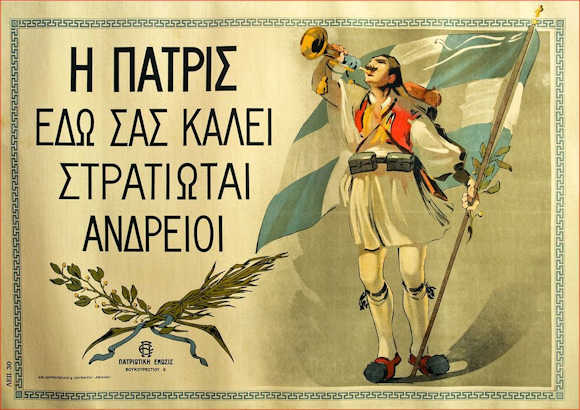
Greek War Poster


The 1914–1918 period ranks among the most complex, controversial and decisive in the history of the modern Greek state. At the military level, the direct engagement of the Greek army in the hostilities, even if materialized only in the final year of the war, is considered to have offered an important contribution to the final Allied victory on the Macedonian Front. 

In the diplomatic field, in the early years of the war Greece found itself in the focus of the attention of the two rival alliances, as each of them sought in multiple ways to secure Greek support for its own cause. This resulted in multiple violations of the initial neutrality of the country, in continuous threats to its territorial integrity,  as well as to a painful schism on the domestic political scene, where King Constantine was a firm supporter of Greece’s (pro-German) neutrality, while Eleftherios Venizelos, Prime Minister during the first year of the war, adopted an explicit pro-Entente stance. 

At the culmination of the crisis, the situation in the country was pretty much similar to that of a civil war, with many incidents of violence and bloodshed. The most significant and well-known case is the bloody clashes that erupted between Greek soldiers and Allied troops in the centre of Athens on 1 and 2 December 1916,  followed, in the next days, by scenes of extreme violence between supporters of the two rival camps on the Greek political scene.  Last but not least, a further significant aspect of the war lies in the fact that many soldiers from other countries lost their lives in various military or other violent incidents inside the Greek state or in its near periphery. 


The two protagonists of the Greek political scene during
World War I: King Constantine I of Greece (left) and
Prime Minister Eleftherios Venizelos (right)


A large part of the references concerned the international post-war scene, which was about to take its definitive shape during the peace negotiations in Paris. The Greek claims, predominantly, but also the international dimensions of this process appeared regularly in Greek dailies. The contribution of Greece to the Allied victory was highlighted in many ways, in coordination with the efforts of the country’s leadership to maximize gains in the ongoing diplomatic procedures. In the first months of 1919, articles and various references focused much more on the milestone of 14 July (and not on 11 November). In that year this important date acquired an additional symbolic dimension, as the National Day of France was directly related to the victory in the Great War that had ended a few months earlier. The particularly impressive celebration of 14 July 1919 in Paris, with the Greek Army participating in the great military parade, provided an excellent opportunity to promote the role of Greece as an indispensable member of the Entente alliance, as well as to stress the particular importance and good momentum of Franco-Hellenic relations in that period.

A few years after the end of the hostilities, a new factor began to occupy the public sphere in Greece in relation to the Great War, influencing public opinion and the image Greeks had of this war. It was the issue of paying tribute to the fallen soldiers of the war and building war memorials in Greek territory. This issue concerned not only victims of Greek nationality but also soldiers of other countries who had lost their lives in Greece or in neighbouring geographical areas. It is important to remind that the construction of war memorials became quickly one of the major issues of interest in several ex-belligerent countries during the afterwar years, as the immense human losses suffered during the war required new ways of commemorative expression for the acts of heroism and sacrifice.


The Greek Army Mobilizing in 1915


In this context, the Greek state began efforts to build monuments, tombs or steles, though only after the end of the Greco-Turkish War of 1919–1922, in order to honour the dead not only of the First World War but of all recent wars, including the Balkan Wars of 1912–1913, the Great War and the Greco-Turkish War. Thus, after 1922 the bones of the Greek soldiers who had fallen during the Balkan Wars and had been buried in Bulgaria (in Gorna-Dzhumaya) and in Albania were transferred to Greece. A large loan was made available to the Ministry of Military Affairs for the erection of monuments, while it was ordered that each city or community should build, until the end of 1925, their own tombs or monuments at the places where Greek soldiers had fallen. Memorial columns were also erected for the Greek officers and soldiers killed in foreign territories—such as those killed during the Great War in Pirot, Serbia;  lastly, and only in 1932, the Greek monument to the Unknown Soldier was inaugurated in front of the Greek Parliament on Syntagma Square.


Greek Artillery Later in the War


[So why is the Great War Forgotten for the Most Part in Today's Greece?]

a) Greece’s involvement in the First World War—even the long, bloody and traumatic conflicts of the years 1914–1917—constituted, as most historians have pointed out, only part of a series of important events for the Greek history that took place in the frame of a whole decade, from 1912 to 1922. This period was inextricably linked first to the apogee and the glory, then to the tragic failure and collapse of the “Great Idea” for the expansion of the Modern Greek state to all neighbouring territories inhabited mainly by ethnic Greek population. 

b) The role of Greece in the armed conflicts of the First World War was largely and for a long time indirect and distant. This resulted in a rather limited number of heroic or traumatic pages arising from purely military action. The successes of the Greek army on the Macedonian Front did find their place in the pages of Greek military history, but it was clear that they counted much less in the collective memory when compared to the Balkan Wars or the disastrous developments on the Asia Minor Front in 1922

c) Historical events in Greece during the following decades were so forceful and dramatic, that they almost erased remembrance of the Great War. The 1940s, in particular, are dominating until nowadays the field of contemporary Greek history, whether in academic research and historiography, or in terms of public interest and debate. The famine of the winter of 1941/2 and, more generally, the hardships suffered under the German and Italian occupation overshadowed the memories of the corresponding moments of 1916–1917. 

Sources:  Heritage and Memory of the First World War in Greece during the Interwar Period A Historical Perspective,  Elli Lemonidou, University of Patras

Sunday, December 17, 2023

Verdun's Ouvrage de Froideterre


Overhead View
Note How It Seems Fitted into the Terrain


Built in 1887–1888 as an intermediate infantry works, the Ouvrage de Froideterre was rebuilt in 1903 as a small fort for defending the  gap between the fortifications on the east side of the Meuse and those on the west side. Located on the Hauts de Meuse ridge, just off present-day road D913b, it was mainly built from reinforced concrete, with an interior courtyard  and three independent firing blocks,  further protected by cast-iron and steel armor plating. Set slightly back from the ridge, Froideterre was hidden in the folds of the hillside designed to protect the structure and garrison from artillery fire. The ouvrage, protected under additional layers of soil, could accommodate 143 soldiers in barracks with food and water supplies. On its perimeter, a network of barbed wire and spike metal railings prevented  the enemy from crossing the ditch surrounding the fort.


Location on the Verdun Battlefield


In the center of the works,  a firing block was equipped with a retractable rotary turret with two 77mm guns having a range of 5,500 meters,  allowing them to cover the interval between the  Thiaumont and Douaumont strong points and the approaches to the Meuse River. Sitting on the flanks in separate concrete blocks were armored observation posts and retractable turrets with twin machine guns. A bunker known as a "casemate de Bourges" was added in 1903 with two 75mm field pieces to cover the flanks of the fortifications at Charny on the opposite side of the Meuse. 


Interior Courtyard
Penetrated in June 1916


Froideterre played an important role in the fighting on the right side of the 1916 Verdun battlefield, especially after Forts Douaumont and Vaux had fallen. It withstood the detonation of nearly 30,000 enemy artillery shells over the 10 month battle. It served as an observation post, communications link and shelter for soldiers while guarding the multiple command posts and supply depot located at the nearby "Quatre Cheminées" bunker.  


Schematic Layout


The fortification experienced its most intense fighting during the German attack of 22/23 June when it was surrounded and almost fell.  After suffering a nighttime artillery and gas barrage, Froideterre was attacked the following morning by the 10th Bavarian Infantry Regiment, which captured the courtyard and caused a storeroom of French grenades to detonate. In desperation, the dual 75 turret was ordered to turn its fire on Froideterre's own superstructure.  The enemy was finally driven off by over 100 shrapnel shells fired at close range and reinforcing French infantry sent to relieve the ouvrage.


Exterior of Casemate de Bourges


Today, Froideterre, because of its graspable  size compared to the major forts and interesting configuration, is one of the more popular stops on tours of the Verdun battlefield.


Double Artillery Turret That Drove German Attackers
Off of the Superstructure


Sources:  Webmatters, Chemins de mémoire, Verdun Tourism


Saturday, December 16, 2023

The Short Destructive Life of Dicke Bertha (Big Bertha) — A Roads Classic


Contributed by Marc Romanych


In the first days of World War I, Germany unveiled a secret weapon—the 42cm M-Gerät siege gun. The howitzer was a mobile fort killer purposely designed to destroy Belgian and French fortifications that could either block the advance of field armies or tie forces down in protracted sieges. To the Allies, who had no similar weapon, the existence and destructive power of the howitzer was a shocking surprise.

When war was declared, the German Army had only two M-Gerät howitzers. Upon mobilization, both were rushed to Liège where they easily demolished two forts—Pontisse and Loncin—and brought the siege to a quick end. Jubilant over the success of the howitzers, the crews nicknamed them Dicke Bertha (in English, "Big" or "Fat" Bertha) after the owner of the armament works that built the howitzers. 


Target: Fort de Leveau, Maubeuge
Left: Two Barracks of the Fort Destroyed by a Single Shell (Former Door Frames Shown) Your Editor, Who Is 6ft, 2in, with an Unexploded Big Bertha Shell That Hit the Fort in 1914

The Big Berthas then moved on to Namur where they met up with eight mobile Austrian Škoda M.11 30.5cm mortars. Under intense fire from the siege guns, the forts fell like dominos and the fortress surrendered in just five days. During the bombardment the two M-Gerät howitzers proved more effective than the eight Škoda mortars; having fired fewer rounds (126 versus 573) to destroy as many forts. However, to protect the secrecy of the M-Gerät howitzers, the Škoda mortars were given credit for destroying the fortress.

Next, came the French fortress of Maubeuge. There, the Big Berthas and Å koda mortars were joined by several rail-transportable German 30.5cm Beta and 42cm Gamma guns which had been delayed en route by sabotaged railroads. Despite the great number of siege guns, ammunition shortages limited the intensity of the bombardment, and ten days were needed to reduce the fortress and force its surrender. 

The final siege for 1914 was at Antwerp. Declared the strongest fortress in Europe, it fell in 12 days. The siege artillery, led by the mobile Big Berthas and Å koda mortars, relentlessly pounded several forts into rubble, opening a gap in the fortress ring. The Belgians conducted an aggressive defense, but the siege guns were unstoppable, and as more forts were destroyed, Belgian forces and British naval infantry abandoned the fortress. The rapid fall of Antwerp was attributed, by both Germans and Allies, to the devastating firepower of the 42cm M-Gerät and Gamma howitzers which were responsible for destroying most of the forts. 


Read More In


In 1915, Big Bertha and the other siege guns repeated their feats of destruction on the Eastern Front at PrzemyÅ›l, Kovno, and Novogeorgievsk. But on the Western Front, the importance of the big guns waned with the spread of trench warfare until, at Verdun in 1916, the German siege artillery had its swan song. There, despite their large numbers, the siege guns failed to destroy the main French forts, which were more modern than the Belgian forts of 1914. 

The era of the siege gun had passed, and although they continued to operate on the both the Western and Eastern Fronts, little was heard of Big Bertha in the last years of the war.

Friday, December 15, 2023

A Photo Album of Austria-Hungary's Submarine Fleet


In June 2019 the Free Trieste Movement hosted in the club at the first floor of its Piazza della Borsa 7 office the historical photo exhibit 1914-18: Trieste and Austria-Hungary’s Submarines organized by Civiltà Mitteleuropea and curated by Alessandro Mlach. Here are a selection from that exhibit.


In Pola with Unidentified Battleship


SMU-12’s crew, with Commander Egon Lerch


Meeting at sea after a long mission


Action in the Adriatic


Commander Georg von Trapp’s SMU-5


SMU-1 in Trieste


Loading a torpedo on an SMU


Submarine Sailor of the Dual-Monarchy


Source: Il Corriere di Trieste, 14 August 2019


Thursday, December 14, 2023

Father Duffy on the Wait Before the Big Fight


It's the middle of July, 1918.  The 165th Infantry (AKA the "Fighting Sixty-Ninth") is in the line east of Reims. The Germans are expected to launch their fifth major offensive of the year shortly. The unit's chaplain, Father Francis Duffy, is making the rounds with the boys:

At present we are not in the front line trenches, but in what are called the intermediate ones.The General's idea is to hold the front line with a few French troops who will make themselves as safe as possible against the vigorous shelling expected and withdraw behind our lines when the German Infantry make their attack.Then our fellows are to have the task of keeping goal. It's Going to bring the battle right down to our doors, as the battalion and company headquarters are only one or two city blocks from where the hand to hand fighting will have to take place.

I spend most of my time amongst the men and am very much interested in finding out how their minds react at the prospects of their first big battle. The other German drives against the British and the French have been so overwhelmingly successful that I was afraid the soldiers might think that whenever the Germans get started they were just naturally bound to walk over everything. I am delighted to find that these bits of recent history have not affected our fellows in the slightest. Jim Fitzpatrick of E Company expressed the feeling of everybody when he said : "Why would I be afraid ov thim? They're just Dootchmen, a'int they? and I never in me loife seen any four Dootchmin that I couldn't lick." 

I have often read statements by reporters about men being anxious to get into a battle, I never believed it. But I find now at first hand that here at least are a lot of men who are anxious to see Heinie start something. I tell them that I am desirous of getting into our first mix-up right here. This Division has started out hunting trouble and if we don't find it here they will keep us sloshing all over France until we run into it somewhere. 

They will have need of all their courage, for if this general attack is made it's going to be a tremendous one. The opinion of the French General staff seems to be that  this line will not be able to hold. At any rate they have been making preparations with that contingency in view. The whole plain behind us is organized for defense with our other two battalions in rough trenches and the Engineers in reserve. I hear they are bringing up also a Polish Legion to take part in the support. They have Seventy-fives in position for direct fire on German tanks, and machine guns stuck everywhere with beautiful fields of fire across the sloping plain. Everything is so charmingly arranged, that I have a feeling that some of the people behind us have a sneaking hope that the Germans will sweep across the first lines so that they can be met by the pleasant little reception which is being prepared for them further back.


Men of the 165th with French Advisors


However, I think that our friends back there are going to be disappointed unless the Germans can spare a Division Or two to smother this battalion. Their orders are "Fight it out where you are," which is Anderson's translation of Gouraud's phrase, "No man shall look back ; no man shall retreat a step."

Last night Major Anderson  and I made the rounds of all the trenches.General Gouraud had picked it as a probable night for the big attack, so we started around to get the men in right spirits for it. The Major's method was characteristic.As the bright moonlight revealed the men in their little groups of two or threes, the Major would ask, "What are your orders here?" The answer always came, quick as a flash, though in varying words, "To fight it out where we are, sir." "To let nothing make me leave my post, sir," and one, in a rich Munster brogue,  "To stay here until we're all dead, sir." "Then, will you do it?" "Yes, sir." Soldiers are not allowed to make speeches, but there's the  most wonderful eloquence in all the world in the way a good man carries his shoulders and looks at you out of his eyes. We knew they would stick.
 

I had my own few words to say to each of them, whether they were of the old faith or the new or no faith at all. We were two satisfied men coming back for we knew that the old regiment would give a good account of itself if the assault were made.

The night  passed uneventfully and this morning I was happy to have another Sunday for my own work. A French priest, a soldier in uniform (a brancardier) , said Mass for Company F in the picturesque little soldier's chapel that gives the woods its name, and gave General Absolution and Communion, while I did the same in successive Masses for Company G and Company H, and the Wisconsin fellows. [After mess]  I ran into Major Donovan, who as usual walked me off my feet. I had to visit every foot of his position on both sides of the Jonchery road and I was glad when Major Grayson Murphy came along in a staff car and offered me a lift any place I wanted to go.

On our way back to P. C. Anderson, the Corps Officer who was with him, gave his opinion that judging by past performances the Germans should be able to advance at least one kilometer in the massed attack that was threatened. I didn't say anything but it gave me a shivery feel-ing, especially when I measured out a kilometer on one of Anderson's maps and wondered just what would have happened to poor me by the time the gray mass of Germans would reach the point that the gentleman from the Staffhad conceded them in his off-hand way. I needed the trip around the trenches for my own reassurance and I stretched myself out last night for a sleep with the comfortable feel-ing that the decision in this matter was in the hands of an aggregation of Irish stalwarts who care little for past performances or Staff theories. We are going to celebrate tonight. Lieutenant Reratisto bring over a few of the French Officers and the admirable John Pleune is off scouring the countryside and theFrench canteens for something to celebrate with. . . 

July 14th, 1918 11:00 p.m.

We are here in Kelly's iron shack. Lieutenant TomYoung, a thorough soldier and a good friend of mine, and old boy Finnerty and Harry McLean are waiting for the bombardment. Everything that can be done for the men has been done. There remains the simplest task in the world, though often the hardest—waiting. We are going to celebrate tonight. Lieutenant Rerat is to bring over a few of the French Officers and the admirable John Pleune is off scouring the countryside and the French canteens for something to celebrate with. . .

Our little Hands Across the Seas dinner was a jolly affair [but] just then the Adjutant of Colonel Arnoux stepped in to give us the news that the attack was certain and midnight the hour. So we toasted France and America and departed for a final inspection of positions. Everybody is as well fixed as he can be made and I have picked this as the handiest central place to await developments.


Waiting Out the Artillery Barrage in a
Deep Dugout


July 15th, 1918

It was 12:04 midnight by my watch when it began. No crescendo business about it. Just one sudden crash like an avalanche; but an avalanche that was to keep crashing forfive hours. The whole sky seemed to be torn apart with sound—the roaring B-o-o-o-m-p of the discharge and the gradual menacing W-h-e-e-E-E-Z of traveling projectiles and the nerve racking W-h-a-n-g-g of bursts. Not that we could tell them apart. They were all mingled in one deafening combination of screech and roar, and they all seemed to be bursting just outside. . .

Over the next few days the regiment would help halt the last German offensive of World War I. Total casualties of the regiment during World War I amounted to 644 killed and 2,587 wounded. Sixty members of the 165th earned the Distinguished Service Cross. Three more were awarded the Medal of Honor.  The story of their fighting in this action can be found HERE and an account of a later action HERE.

From Father Duffy's Story


Wednesday, December 13, 2023

Palmanova: A Renaissance City at War


Palmanova, Italy, Today


The beautiful and intriguing  fortress city of Palmanova is located in the Friuli region of Italy roughly midway between Venice and Trieste. With its perfect nine-pointed star shape, monumental entrance gates, and the three circles of fortifications from the 16th, 17th and 19th centuries,  Palmanova is at the same time a model Renaissance city and an example of military architecture that reveals in concrete detail the technical developments of the science of fortification construction in the modern era. It was built at the end of the 16th century by the Venetian Republic and intended as both a major trading site and a citadel. The military architect Giulio Savorgnan designed it to be a Venetian military station on the eastern frontier as protection from the Ottoman Empire. Italy declared the entire town a national monument in 1960.


The City's Beautiful Architecture


During the First World War it was positioned just to the rear of the Italian force deployed along the Isonzo River and served as a strategically key logistics center. It was at a rail and roads crossroads and proved an excellent site for warehouses and hospitals, and its massive central Piazza Grande served as an excellent exercise field for drilling troops. Early in the war, because of its key position, the city was also a center for processing and evacuating refugees from the combat zone.


The Massive Piazza Grande


Despite the destruction of most official documents concerning Italy's brutal policy regarding summary executions for the troops (loosely called decimation and described as "extreme measures of coercion and repression" by commanding general Luigi Cadorna in his private papers), Palmonova is believed to be the site of at least one of the major group executions during the war.


Damage at Palmanova's Train Station from Enemy Artillery


With the rout of Caporetto in October 1917 and the retreat of the Italian Second Army to the south, Palmanova was bombarded, abandoned by its remaining defenders, and occupied by a garrison of about 2,500 Austro-Hungarian Troops until the last days of the war.  In the Second World War, its major function was as a base for suppressing anti-fascist resistance in the region.


Monument at the Austro-Hungarian Cemetery


The Austro-Hungarian cemetery of Palmanova is one of the main war cemeteries in Friuli and accommodates the remains of over 19,000 soldiers, most of them from the battlefields around Gorizia. The entrance sign identifies them as "captured" rather than killed in action, so it might be the case that a large percentage of them died while in captivity. It contains a chapel and two large mass graves where the remains of over 13,000 unknown soldiers were buried. 

Tuesday, December 12, 2023

Ace, POW, and Author: Captain Duncan William Grinnell-Milne MC, DFC, RFC/RAF


Duncan Grinnell-Milne


Captain Duncan William Grinnell-Milne MC, DFC, (1896–1973) was an English Great War pilot credited with six confirmed aerial victories, a prisoner of war who escaped from German captivity, a flying ace, and an author.  After serving with his brother in the 7th Royal Fusiliers, Grinnell-Milne was seconded to the Royal Flying Corps in 1915. After training, he joined 16 Squadron in France, where he scored his first victory flying the B.E.2. Toward the end of 1915 he was shot down and captured, spending more than two years as a POW before escaping back to France in early 1918. 

Later that year, Grinnell-Milne assumed command of 56 Squadron and scored five more victories as an S.E.5a pilot in the final weeks of the war. In 1919 and 1920, he served with 214 Squadron and 14 Squadron in Egypt. After serving as assistant air-attaché in Paris, he left the Royal Air Force in 1926 with more than 2000 hours of flight time in various aircraft. During World War II, Grinnell-Milne returned to service, flying Wellington bombers over Libya in 1940 before health problems forced him out of the RAF. He took a job with the BBC, remaining there until 1946. 

In later life, he became a well-known author, publishing several books including his memoirs Wind in the Wires and An Escaper's Log. The two World War I works were republished a number of times in the past century. In this latest version they have been combined in a single volume. Here are some excerpts that I feel give a sense of the excitement and authenticity of his accounts:

His first student flight: 

"After listening awhile to the engine, the pilot waved hands. . . and the machine moved forward slowly, lurching in slightly over the uneven ground like a a cow going out the pasture. . .the forest of struts, the network of piano-wire, the nacelle with its occupants, all hanging rather mysteriously together, moved away at increasing speed.  The draught from the propeller rippled the grass, rushing back to make us duck and clutch our caps.  When I looked  again the Longhorn was scurrying across the aerodrome at the most alarming speed. . . the noise of the receding engine made me think of nothing so much as a lawnmower running amok.. I watched, holding my breath. And—lo!—it began to unstick from the earth. It rose a few inches; it flew! O wondrous contrivance: 'Hail to thee, blithe spirit, bird thou never wirt!' Shelley should have been a pilot."

"Once I had got used to it [anti-aircraft fire], it had not seemed so terrible after all. I imagined that it could never be as unpleasant as heavy shelling on the ground. . . Flying was always like that: at one moment you were splitting your sides at a harmless joke, at the next shuddering at a tragedy”

“Youth, adventure, high spirits – those wound up for us the mainspring of life. We would have fought just as well without propaganda; we had no bitter hatred. So it may have been in the days of chivalry”

He recalled the feeling of shame as he crashed behind enemy lines. “I had a sensation of misery, depression and hopelessness, which grew so strong as time went on that I felt almost physically sick.”

Returning to flying after two years as a POW, he observed “a sort of devil-may-care, hard-drinking recklessness about, that earlier pilots, by this point sadly killed or captured, lacked.”

Looking back [from 1933?]: " After all the war left its mark on all who fought and shellshock is a convenient label. That is not to say that all war-writers are shell-shocked—at least, I hope that I shall not be placed in the doleful category. I never suffered much from shell-shock since that is the especial misfortune and privilege of infantrymen; yet, although the memory does not encourage brooding upon such things, I have not forgotten the horrors, the crashes, the burnings to death, the mutilations, the carnage below and aloft. But some of our cleaner fights I can live again, those in which the enemy gave nearly as much as he took. I can hear once more the wires scream [. . .] Sometimes I dream of those days with regret—were they not a part of Youth? - but I do not lose much sleep over them. For, by some odd mental twist, my worst dreams are those in which I fancy myself in gaol or fortress.  . .  From that nightmare of unrest I shall never be free." 


Monday, December 11, 2023

The Cult of Hindenburg Started with Tannenberg


Berlin 1915


Tannenberg (26–30 August 1914), the best-known battle of the Eastern Front, was primarily planned by the staff of the German Eighth Army as their commander was being replaced. Able to track the advancing Russian Second Army because of their poor signal security, the Germans spotted their opportunity to thoroughly defeat it. Their new leadership decided to transfer German forces southward via rail. There they found the Russian forces widely dispersed and were able to defeat the corps guarding each flank and drive back their center. Ignoring orders, I Corps commander General von François cut the enemy's line of retreat. About half of the Second Army was surrounded and eventually surrendered. Their commander General Samsonov went into the forest and shot himself.

Nine days later, the duo moved north and delivered a second dramatic victory for Germany at Masurian Lakes (9–14 September 1914). After the victory at Tannenberg, Ludendorff decided to focus again on the Russian First Army back to the north. Reinforced by two corps from the western theater, Eighth Army attacked with the intent of driving the Russian forces, which had moved to a more defensible position after the annihilation of Second Army, to the coast. A successful attack by General François's I Corps against the southern First Army flank compelled a retreat. A complete route was prevented by a two-division Russian counterattack in the center that allowed a withdrawal to proceed. It was the second massive defeat for the Russian Army and led to the dismissal of Army Group commander Zhilinsky. With the two victories, Hindenburg and Ludendorff had eliminated any direct threat to the German homeland. On 1 November 1914 Hindenburg was appointed Ober Ost (commander in the east) and was promoted to field marshal.


Ludendorff and the Man Most Responsible
for the Tannenberg Victory, Max Hoffman


Despite their minimal conceptual contribution to the victory at Tannenberg, the new partnership received full credit from the Kaiser and the Army for the successes. Being the face of the leadership, Hindenburg received all the public glory and honors as the savior of East Prussia. The news of the victories in the east—for the time being—counteracted the implications of the defeat at the Marne, that the promising start in the west had been halted and that a long war was now a certainty.

Within weeks of Tannenberg, the German population exalted Hindenburg to mythical heights. He became a symbol of victory and unity at home—a role traditionally reserved for the Kaiser. The new national hero was showered with official honors, and the country was flooded with Hindenburg souvenirs. Known for his sangfroid, Hindenburg seemed to personify Germany’s superior mental strength, a key theme of German war propaganda. His rectangular features and broad frame projected a specific type of masculinity and virile gravitas. He was often depicted as a rock in the ocean that kept back the tidal waves of the enemy’s onslaught. Hindenburg turned into Germany’s supreme symbolic figure and soon eclipsed Emperor Wilhelm II's public standing, raising concerns that his popular appeal had introduced a plebiscitary element into German politics that threatened the monarchy. The field marshal was not shy about using his symbolic capital for political gain. From 1915 onward, Hindenburg, supreme commander of German troops on the Eastern Front since November 1914, repeatedly threatened the Kaiser with his resignation in order to push through his own agenda. By 1916, when the war started taking a bad turn for Germany, the partnership would be well placed for further advancement.

Sources: Encyclopedia 1914-1918 Online; Over the Top, December 2014


Sunday, December 10, 2023

A Decisive Moment at Gallipoli: The Battle for Scimitar Hill


Scimitar Hill Today


The Battle of Scimitar Hill was a major piece of the last offensive mounted by the British at Suvla during the Battle of Gallipoli in World War I. It was also the largest single-day attack ever mounted by the Allies at Gallipoli, involving three divisions. The purpose of the attack was to remove the immediate Ottoman threat from the exposed Suvla landing and to link with the ANZAC sectors to the south. Launched on 21 August 1915 to coincide with the simultaneous attacks on Hill 60 and W Hills to the south  The attacks south were defeated, and the attack on Scimitar Hill  was a costly failure, in which the Turks were forced to use all their reserves in "severe and bloody fighting" far into the night, with some Turkish trenches lost and retaken twice. For the third time in the Gallipoli Campaign, the Allies had the misfortune of confronting forces under the command of Mustafa Kemal, who uncannily reinforced Hill 60 and Scimitar Hill at critical moments in the fighting.

The attack on Hill 60 was a failed attempt by the Allies to capture a prominent hill feature between Anzac Cove and Suvla Bay. The attack was led by General Cox and his 3,000 troops, fighting continued there after 21 August but that attack was abandoned by Anzac commander William Birdwood on 28 August. Meanwhile, the attempt to capture the West  Hills also failed. The division sent to capture the hills lost its bearings and was unable to find its way. 


Turkish Commander Mustafa Kemal During the Fighting at Suvla


Following a preparatory but ineffective   artillery barrage starting at 1430 hours on 21 August 1915, the 29th Division attack on Scimitar Hill, began at 1500 hours through scrub that had been ignited by the artillery fire.The attempt initially succeeded despite the dense smoke, the crest was reached about 1600 hours.  Unfortunately, the men were in an untenable position as Turkish artillery from the  Anafarta Hills to the East brought deadly direct fire to bear while the immediate enemy stood on their parapets firing from the hip and throwing hand grenades. 


Allied Commander de Lisle (Seated) During the Fighting—Note Contrast with Kemal Above


As the day wore on and attack after attack broke under the fire of the resolute defense, the brush caught fire and hundreds of wounded lying in the open ground between the lines were cremated alive; the sights and sounds of that day would never be forgotten by the survivors. Reserves sent by IX Corps Commander MG Henry de Beauvoir de Lisle were thrown back after suffering heavy losses while charging uphill.


Turkish Monument Atop Scimitar Hill


Allied casualties in the Scimitar Hill action reached some 5,300, many of which were incurred after British artillery shrapnel resulted in surrounding bush catching fire. Turkish losses were put at 2,600. Demoralized by the mounting losses, Hamilton telegraphed war minister Lord Kitchener in London with a request for another batch of troop reinforcements, this time comprising 95,000 men. Kitchener offered 40,000, but the government in London was already considering evacuation options.

Sources: The History Junkie, It's a Long Way to Gallipoli; Wikipedia; Australian Military History podcast