Now all roads lead to France and heavy is the tread
Of the living; but the dead returning lightly dance.
Edward Thomas, Roads

Monday, March 7, 2016

Battleships with Torpedo Tubes?

Contributed by Naval Historian Steve McLaughlin

Almost all battleships were fitted with torpedoes up until World War I. The image below is of the torpedo room of the USS Oregon, heroine of the Spanish-American War, 1898. Torpedo ranges had increased from about 3,000 yards in 1905 to about 10,000 yards by 1914, so their running distance was comparable to gun ranges. But it took about ten minutes for a 30-knot long-range torpedo to travel 10,000 yards, so hitting an individual ship was, quite literally, a long shot. 

Torpedo Room, USS Oregon

Fired against a long line of ships (as in line-of-battle — the British battle line at Jutland was about 12,000 yards long), however, there was a fair chance that a salvo fired from all of your battleships would hit some of the enemy's battleships. This was a tactical factor that exercised a great deal of influence through World War I. Battleships and battle cruisers fired a total of 21 torpedoes at one another during the Battle of Jutland (British capital ships fired 13, German ships 8), without scoring a single hit. The only other instance of a battleship-on-battleship torpedo attack seems to have been by HMS Rodney against the Bismarck on 27 May 1941. The general consensus is that Rodney did not score a hit. Many navies removed underwater torpedo tubes from their battleships after the First World War.

Battleship HMS Marlborough Both Fired a Torpedo and
Suffered a Torpedo Hit at Jutland Launched by SMS 
Wiesbaden
(corrected from original) 

I should note that torpedo speed could be traded for longer range. In most cases during World War I, submarines fired torpedoes from within 1,000 yards of their targets, so the torpedoes could be set for maximum speed (40–45 knots), which, combined with the short range, gave a much better chance of hitting, giving a travel time of less than a minute. To get longer range, you had to set the torpedo for a slower speed. During the war both the British and Germans developed 15,000-yard torpedoes, but the speed had to be reduced to 20 knots or less, which meant a running time of about 20 minutes —again, a real long shot.

Sunday, March 6, 2016

An AEF Veteran Looks Back on His Enlistment Ten Years Later

Abian Wallgren (1892–1948) was a cartoonist who enlisted in the Marine Corps in 1917. His drawing talent somehow pushed or pulled him to the Doughboy's newspaper, the Stars and Stripes, where he became resident cartoonist.  Later he worked on the American Legion Weekly. Ten years after his enlistment, he took a nostalgic look back to what he experienced as a new member of the American military.  These appeared in the Weekly.


By the way, commentator James Lileks has an excellent collection of Wallgren's wartime cartoons  HERE

Saturday, March 5, 2016

Lest We Forget: The Man with a Donkey


Simpson, 1915
In 2008, John Simpson Kirkpatrick, the man with the donkey and one of the most enduring of all Anzac legends, was denied the ultimate recognition of courage and sacrifice — the Victoria Cross. In the early fighting at Gallipoli Private Simpson was killed ferrying wounded soldiers to safety from the front line.

Although his commanding officer, Lieutenant-Colonel Alfred Sutton, recommended him for the country's highest military award, the Defence Honours and Awards Tribunal disqualified Simpson from being posthumously awarded the medal. That is because his bravery was not supported by the required documentation: the sworn statements of at least three witnesses to his actions.

Witness accounts of Simpson's deeds exist, but they are mostly unspecific diary accounts of his journeys from battlefield to dressing station. Simpson was fatally wounded in the chest by Turkish gunfire on the morning of 19 May 1915,and was buried at 6:30 that evening at Hell Spit, on the southern end of Anzac Cove.

The day after Simpson's death, Colonel John Monash, then the commander of the Australian Imperial Force's 4th Infantry Brigade at Gallipoli, sent a submission to Australian and New Zealand Divisional Headquarters. Monash (later General Sir John) wrote: "I desire to bring under special notice, for favor of transmission to the proper authority, the case of Private Simpson…(who) has been working in this valley since 26th April, in collecting wounded, and carrying them to dressing stations."


Sutton, the commanding officer of the 3rd Australian Field Ambulance, who had tied his own Red Cross armband around Simpson's donkey, wrote in his diary on 1 June 1915: "I think we will get a VC for poor Simpson."

Simpson's feats have immortalized him in the minds of Australians, but he will apparently never receive the honor his commander sought for him.

Source: TheAge.com.au

Friday, March 4, 2016

High-Stakes Poker: The End Game on the Eastern Front


Trotsky
A German courier arrived in Petrograd on the morning of 23 February 1918 with Germany's new and more brutal peace terms. Since the Russians had stalled throughout the peace process, employing radical, indeed shocking, diplomatic practices which necessitated the German Army's return to operational activity, and since the Russians obviously had no capital or the prospect of raising capital in the immediate future to pay indemnities, the Germans decided to extract their pound of flesh in territorial annexations that outstripped the line Hoffman showed to Trotsky earlier on 30 January. The Germans now expected the Soviets to cede the following territories: Finland, Russian Poland, Estonia, Livonia, Courland, Lithuania, Ukraine, and Bessarabia. In addition, the Bolsheviks also had to cede to Turkey the provinces of Ardaham, Kars, and Batumi. Although this ultimatum came with a 48-hour deadline, half of this period had elapsed by the time Lenin saw it. When Bukharin stubbornly opposed agreeing to this draconian peace, Lenin calmly yet firmly announced to the Central Committee that there was no time for theoretical meanderings. In Lenin's mind, these brutal conditions were in fact a last chance to save the revolution from the imperialists.

The only task remaining was to sign a document that is the infamous Treaty of Brest-Litovsk. In an effort to convince the Germans that the Soviets had decisively shifted course, Trotsky resigned as commissar of foreign affairs and was replaced by one Grigorii Sokolnikov as the acting commissar. He went to Brest-Litovsk, where General Max von Hoffman, who ultimately negotiated this peace at gunpoint, waited. The treaty was signed with little fanfare on 3 March 1918. The Germans stuck to their claim that they had not annexed any territory. Instead they were safeguarding the rights to national self-determination of the peoples of Central Europe. Moreover, the Germans also maintained that they sought no indemnities from the Russians. But the appendix to the Treaty of Brest-Litovsk revealed a financial agreement that granted them the status of conquering power and the Russians that of a dependent colony.


German General Max von Hoffman
While the Germans had accomplished their goal of achieving peace in the east in time for the spring campaigns in the west, the Treaty of Brest-Litovsk did little to solve their crushing problems. For the bounty of Ukraine to have an impact on Germany, the Germans now needed more time for the crops to be planted, to grow, and be harvested. The Entente's ultimate victory prevented the Germans from enjoying the spoils gained at Brest-Litovsk. Even more demoralizing, the German soldiers on the Eastern Front who had come into contact with the Russians had been infected with Bolshevism, thereby rendering them ineffective as operational forces. Instead of being able to transfer vast numbers of soldiers to the Western Front, the German army in Russia remained in place, acting as a pseudo police force until November 1918.

Germany's collapse in the autumn of 1918 proved Lenin to be correct, at least in part. Lenin viewed the treaty as a political necessity that he would obey only as far as her was forced. The Treaty of Breat-Litovsk did grant the infant Soviet Union a brief breathing space from the upheavals of war and revolution, but Lenin still had to wage a tenacious battle with stiff inner party opposition before he won confirmation of the treaty at the Fourth Party Congress, 14–16 March. Leftwing radicals did indeed get their revolutionary war, but it proved to be very different from the conflict they envisioned. Instead of a war to liberate the workers of the world from capitalistic bondage, the Russians found themselves embroiled in a brutal civil war. Fortunately for the Bolsheviks, when Trotsky resigned as commissar of foreign affairs, Lenin appointed him commissar of war, and in April/May 1918 they would start the process of winning the civil war and consolidating the power and authority of the Bolshevik party over the Russian people.

When the Germans lost the Great War the Treaty of Brest-Litovsk was negated and the Bolsheviks managed to gain back much territory ceded to the Germans once they emerged victorious from the civil war. The challenge that the Bolsheviks placed before the world was not lost on the leaders of the Entente. Because of Woodrow Wilson's 14 points, the Germans arrived at Versailles believing that they were about to negotiate a peace without annexation and indemnities. Despite the best efforts of President Wilson, the Europeans were not ready to pursue peace without draconian consequences for the defeated foe. 

Lenin
The Germans did it to the Russians, and in the minds of the French and British, it was now their (the Germans') turn to suffer a devastating defeat. Ironically, the Russian Imperial Army fell victim to the collapse of Russian society and was not decisively defeated by the Germans. In addition, the German military entered the postwar period believing that the failure of civilians and politicians—not military operational performance —allowed the Entente to dictate the terms of the Treaty of Versailles.


From a paper delivered by Professor John W. Steinberg at the 2001 Conference, "The Great War on the Eastern Front."

Thursday, March 3, 2016

Great Informational Kiosks on the Italian Front


If you plan to travel to Italy and Slovenia to tour the Italian Front, you will be pleased to discover that they are very tourism friendly.  One dimension to this is their outstanding system of informational kiosks at the key sites.

This one marks a frontline trench on the Carso Plateau where the early battles of the Isonzo were fought.  Note the trench map, period photos, and multilingual descriptions of the sites. Below are segments of other kiosks at sites I've visited with my groups over the years. 


At the northern end of the Carso overlooking the key city of Gorizia is Monte San Michele, one of the most legendary battlefields of the war.  After capture, Italian forces converted its quarry to the fortified artillery position shown here.


The high-water mark for the Austro-Hungarian Empire on the Italian Front was at Val Magnaboschi on the Asiago Plateau in June 1918, during what is known as the Battle of the Solstice. At the entrance of the valley is a concentration of memorials and cemeteries.


Monte Zovetto was the site of a British Army outpost in 1918. The Tommies who manned it are pictured here. The locals refer to the site as the "Scottish Trenches."


On the Montello, above the Piave river, Italy's greatest ace, Francesco Baracca, fell in 1918.  A beautiful temple-like memorial marks his crash site.


Fort Verena fired the first shots of the Great War on the Italian Front in 1915. The fort is at the crest of a ski slope today and can be visited on a chair lift.


Wednesday, March 2, 2016

Goeben and Breslau: Fateful Warships


SMS Goeben (left below) was the second of two Moltke-class battlecruisers of the Imperial German Navy, launched in 1911 and named after the German Franco-Prussian War veteran General August Karl von Goeben. Several months after her commissioning in 1912, Goeben, with the light cruiser Breslau (right ship in photo), formed the German Mediterranean Division and patrolled there during the Balkan Wars.


After the outbreak of World War I on 28 July 1914, Goeben and Breslau under the command of Admiral Wilhelm Souchon evaded British naval forces in the Mediterranean and reached Constantinople. When the German embassy was informed of the arrival of the Goeben and the Breslau, Ambassador Baron Hans von Wangenheim persuaded the Turks to allow the ships to enter the harbor. Once Souchon's ships were safely in the harbor, the German diplomat reminded the Turks that Great Britain had recently broken a contract to supply two new battleships to the Turkish government. The British Admiralty, nervous about the threat of a European war, had decided to keep the new warships for its own use instead of transferring them to Turkey. The Germans now offered to provide the Turks with the ships they needed by selling them Goeben and Breslau. After several hours of negotiation, the Turks agreed to purchase the German ships.

The two ships were transferred to the Ottoman Empire on 16 August 1914, and Goeben became the flagship of the Ottoman navy as Yavuz Sultan Selim. On 30 October 1914, Turkey officially joined the war on the German side, substantially won over by the acquisition of the powerful German warships. The decision by the Young Turks to join the hostilities radically shifted the dynamics of the war and had an earthshaking impact on Middle East, which is still being felt in the 21st century. Yavuz Sultan Selim remained the flagship of the Turkish navy until she was decommissioned in 1950.

Adapted from Trenches on the Web and Wikipedia articles.

Tuesday, March 1, 2016

The Last Great Cavalry Charge
reviewed by Michael P. Kihntopf


The Last Great Cavalry Charge: 
The Battle of the Silver Helmets, Halen, 12 August 1914
by Joe and Janet Robinson and Francis Hendriks
Fonthill Media, 2015


Depiction of the Charge

Since 2009, authors Robinson (ably assisted by co-authors) have given military aficionados a factual, colorful, and riveting picture of the Kaiser's army as it approached the Great War. From those excellent previous works I was reminded of the two old soldiers, neither of whom had seen combat in their lengthy peacetime careers, sitting to whiskies and talking over tales of their collective past. All the stories centered on how they turned country bumpkins into smart and effective soldiers. When all the yarns had been spun one of the soldiers leaned back in his wicker chair and sighed. With the sigh came the question: "I wonder how my men would have done under fire?" This book answers that question for the most prestigious and perhaps the most highly trained branch of the German Army, the cavalry, through a detailed account of an overlooked battle at an obscure crossroads—an overlooked battle which pitted elite horsemen of Germany against the small Belgian Army before the French could rally and before the British arrived.

Authors Robinson and Hendriks begin The Last Great Cavalry Charge with details which should educate the novice on just how well trained and equipped the German cavalry was. This plumber's description of accouterments and tactics is well tempered by an excellent analysis of the cavalryman's character which played so heavily into how that group performed on the first battlefield. What a glowing picture of cavalry emerged in those few pages; however, beneath the luster was a tarnish whose discoloration was in how the German General Staff structured the command lines in cavalry organization and its use in an age of machine guns, magazine rifles, and quick firing artillery.

Site of the Charge Today

From the Militär-Wochenblatt of the late 19th century a cavalryman speaks out: "No technology comes to our aid. We have only that which our ancestors had a thousand years ago: a man, a steed, and iron — everything else we have to create out of ourselves." (Quoted in The Kaiser's Army, Eric Dorn Brose, 2001, page 15). The German cavalry was charged with screening the right wing of the army as it swung itself across Belgium in the early days of the war. In the screening mission was an important subtask—contain the Belgian army by keeping it away from the fortress complex at Antwerp. To achieve these tasks, the cavalry had a vast distance to cover, and speed was of the essence. As a result, the zealous horsemen quickly outdistanced their supply and communications lines within hours of crossing the Belgian border. Everything was in short supply, and the whereabouts of the enemy and the terrain that had to be crossed was even more of a mystery. These deficiencies became apparent when the cavalry came into contact with the enemy that decided to stand its ground on 12 August near Halen.


Order Now
The Belgian force consisted primarily of cavalry and bicycle units. Cavalry facing cavalry should have been the make-up of the first battle, lance upon lance, saber to saber. But the Belgians had read the reports of cavalry actions in the Boer and the Russo-Japanese Wars. They decided that they should meet the Germans with dismounted troopers wielding carbines, machine guns, and supported by field artillery. The Germans had read the reports too, but they decided to meet the enemy mounted. The results of the decision to meet bullets with horseflesh are highly predictable. Eight assaults were made on the Belgian line; each one left more German casualties on the field than the previous one. But the injured and dead were not all caused by enemy fire. Poor intelligence had missed terrain features which included unseen sunken roads that became man and horse traps and barbed wire barriers which deterred the momentum of the charge.

The authors amply quote battle participants' journals and reminiscences to enhance their narratives. The declaration of the victor of a battle has always depended on who had possession of the battlefield at the end of the day. Although the Belgians chose to evacuate the area in the face of overwhelming odds, the Germans had clearly suffered the most with the loss of 472 men and the demise of the cavalry.

The Last Great Cavalry Charge very graphically provides an answer to those old soldiers who have left their drinks tumblers to the servants. The bravado of the professionals, no matter how well trained, is often no match for reality. Practices of the parade ground are just that, a parade. I highly recommend this book.

Michael P. Kihntopf

Monday, February 29, 2016

Recommended: How World War I Helped Popularize the Bra

From: Today I Found Out


By Terynn Boulton

Wartime Bra Advertisement (I Guess You Need the Free Style Book)

Corsets dominated the undergarments of wealthier women in the Western world for centuries, until WWI. So how did the war help popularize the bra? In a word, or two words in this case: metal shortage. The making of corsets required quite a bit of metal.  Thus, in 1917, the U.S. War Industries Board asked American women to help their “men win the war” by not wearing or buying corsets.

This may seem like it would only make a small difference, but, in fact, during the war it is estimated that they freed up around 28,000 tons of steel [a battleship or two] by this change.  (Similar reasoning later led to the banning of pre-sliced bread in the U.S. during WWII, with much less success.)

Obviously This Would Be Tough to Do in a Corset

Besides conserving resources, other aspects of the war also contributed to the demise of the corset and the rise of the bra.  For instance, during the war, American women found themselves working in factories, places where it simply wasn’t possible to function properly wearing an ultra-tight, ultra-restrictive corset. Women still needing some support in these active jobs, the bra became the most used alternative.

By the end of the war, fashion-conscious women in North America and Europe were now mostly wearing brassieres and soon mass production of bras ramped up, despite there no longer being metal shortages or as many women still working factories and the like. Women in Asia, Africa, and Latin America followed the trend. 

1922 Advertisement:  No Mistaking the Product Here

The reason the switch was more or less made permanent was that corsets were designed to accentuate the curvy Victorian ideal of beauty by cinching the waist and boosting the breasts. In the process, this made it very difficult to breathe and squeezed women’s waists so much that it could even displace organs and cause certain internal problems, along with symptoms such as fainting, gynecological issues, flushing, and nausea, among others. With corsets out, women could move and breathe.

Read the complete article here:

Sunday, February 28, 2016

Photos of the Dead

By Tony Langley

Contrary to modern myth, during the war itself, many photographs of the dead were published in news magazines in all the warring countries. There are some general trends that are evident, however. British news editors were apparently not so keen as their French allies to show great numbers of dead soldiers. An occasional corpse or two was quite sufficient for the staid Englishman, say, a dead sniper who had got his just deserts, or an unlucky Hun who had bitten the dust. 


French news editors, on the other hand, seemed to positively delight in showing photographs of Boche corpses, the more the better. Many of the working-class news magazines such as Le Miroir, J'ai Vu, or Sur le Vif printed quite grisly scenes at times, trenches full of slain Germans or heaps of enemy bodies piled up for burial after a battle. Even illustrious magazines such as L'Illustration had no qualms about showing photos of the enemy dead or of executed "spies" and Le Pays de France, a solid and otherwise respectable magazine, appears to have published more photos of dead German corpses than of their live British allies. Here are three images from the French magazine Le Miroir:


Saturday, February 27, 2016

Remembering a Veteran: Ernest Wrentmore of Ohio:The Youngest Doughboy


Ernest Wrentmore of Ohio served the United States in three wars. His service included fighting with considerable distinction with the AEF's 5th Division in the Argonne Forest. There is one detail, however, that sets Wrentmore apart from all the other troops who served with the AEF. 

The photo shown was taken after the Armistice when Wrentmore was all of 14 years old—he actually had enlisted when he was still 12 years old! Later, he served in the Army Air Force and U.S. Air Force, attaining the rank of full colonel as an intelligence officer. After his death in 1983, a bill was introduced in Congress to award Wrentmore the Medal of Honor, but it was not passed. 


His grave marker at Arlington includes an entry on the back citing him as the AEF's youngest soldier.

Friday, February 26, 2016

Elsie and Marie: The Angels of Pervyse


Many of those [women] who initially rushed to sign up [for war work] had never been farther than the boundary of their village, or town, and had known few people outside their neighbors and, later, those they worked with. Going to war was to be the big adventure, which brings me to two women who immediately saw the opportunity to blend adventure with service: Elsie Knocker and Mairi Chisholm, who, arguably, became the most famous women of the Great War, as news of their courage reached Britain and, indeed, the rest of the world. They became known as the "Angels of Pervyse" after the village north of Ypres where they cared for the wounded for almost four years. 


"Elsie wanted to get away from the dreary post-Victorian life she was leading," says Flemish historian Patrick Vanleene, "and young Mairi thought Elsie could lead her to an adventurous life". In a letter to her aunt shortly after arriving in Belgium, Mairi wrote: "Fancy […] lolling about doing nothing when there is such a tremendous lot to do here. It's too rotten to think of."

An early turning point came when the women realized how many soldiers were dying because they were not treated soon enough, as the front lines were far from the base hospitals. Elsie and Mairi decided to do something about it. They left Munro's team, broke out on their own, and moved to the heart of the battle zone in Pervyse.  Here the two women set up their first aid post in autumn 1914. Their run-down cellar house, Le Poste de Secours Anglais, as it became known, was just meters away from the Belgian front line. At first, they had help from former colleagues, but by the beginning of 1915, it was just Mairi and Elsie, risking their own lives to help save those of the Belgian soldiers.


As well as their medical work, Mairi and Elsie were a constant presence on the front line, often handing out hot cocoa and soup to the grateful Belgian soldiers. They were regularly mentioned in soldiers' diaries, poems, and songs and were given presents too. Before long, the women were known as the Madonnas or Angels of Pervyse.

As their reputation soared, so too did the publicity that surrounded the Angels of Pervyse. "People really wanted to meet them and to see the conditions they were living in, and in many ways just to be able to say they'd met them," says their biographer Diane Atkins.

Elsie and Mairi became celebrities of their day—British visitors to the Flanders Front would go to meet them; they were lauded in the press and treated like stars on their visits back to British soil. Their work continued throughout the war years, but in 1918 both were seriously injured in a gas attack and returned to the UK for treatment. The momentum behind their work was lost and neither was in Pervyse when the Armistice came.

From Jackie Winspear's blog, Tony Langley, and the BBC

Thursday, February 25, 2016

The Big Three of Germany's Zeppelin Program


This photo shows the three most important contributors to Germany's military and commercial zeppelin efforts.


The story of the father of the German airship, Ferdinand Adolf August Heinrich Graf von Zeppelin (center), is well known.  Ferdinand von Zeppelin entered the Prussian army in 1858. Zeppelin went to the United States in 1863 to work as a military observer for the Union Army in the American Civil War and later explored the headwaters of the Mississippi River, making his first balloon flight while he was in Minnesota.

He served in the Franco-Prussian War of 1870–71, and retired in 1891 with the rank of brigadier general. Afterward, the count spent nearly a decade developing the dirigible. The first of many rigid dirigibles, called zeppelins in his honor, was completed in 1900. He made the first directed flight on 2 July 1900. In 1910, a zeppelin provided the first commercial air service for passengers. The military potential for observation and bombing was clear, and both the German army and navy embraced it for wartime use.  Zeppelin died of pneumonia during the war on 8 March 1917 at the age of 78.


Captain Peter Strasser (right) was the dynamic leader of Germany's emergent Naval Airship Division. He said the airships were "a certain means of victoriously ending the war." His attacks on England continued virtually unchallenged into 1916, but eventually countermeasures made the zeppelin attacks unfeasible.

He subsequently died while aboard the height-climber L-70 when it was shot down over the English Channel on 5 August 1918. The event marked the end of the airship as a strategic bomber. Despite the zeppelins' mixed success as strategic bombing platforms, their attacks on cities left an indelible impression on their opponents. They were banned, and surviving airships were required to be surrendered under the Treaty of Versailles.


Hugo Eckener (left), an early supporter of Count Zeppelin and important technical contributor, would go on to lead Germany's postwar airship program. Though he had remained a civilian during World War I, Eckener was deeply involved in Germany’s use of zeppelins during the war.  Eckener was the senior advisor to the German navy’s airship chief, Peter Strasser, and as director of airship training for the German navy, Eckener trained more than 50 flight crews, comprising more than 1,000 men.  

Although the Zeppelin company was almost out of business after the war, Eckener spotted an opportunity due to the reparations laid on Germany. Eckener convinced the Allies to allow the Zeppelin Company to build a new ship, LZ-126, to be delivered to the Americans as USS Los Angeles in partial satisfaction of these reparation obligations. The transatlantic flight of LZ-126 from Germany to America was an aviation triumph, and Eckener, and his crew were given a ticker-tape parade up Broadway in New York City and greeted at the White House by U.S. President Calvin Coolidge.

The construction of LZ-126 kept the Zeppelin Company alive, maintaining not only its plant and equipment, but also its workforce of its highly skilled employees. The construction and operation of LZ-126 also provided Eckener and his colleagues with the knowledge and experience they would use to build Graf Zeppelin and Hindenburg. The crash of the Hindenburg and the death of 36 people at Lakehurst, New Jersey, however, would end Eckner's dream of civilian air travel by airship.

Wednesday, February 24, 2016

Jean Charlot: Artist and Poet in the French Heavy Artillery

By Kimball Worcester


Moi
24 September 1919. Pencil and wash. 10 1/8" x 14 5/8"
© The Jean Charlot Estate LLC. With gracious permission.


Louis Henri Jean Charlot (1898, Paris – 1979, Honolulu) contributed to the visual and poetic arts of the 20th century with depth and talent, inspired by his deep Catholic faith, his love of folk imagery, and, early on, his experience in the Great War.

Upon his call-up in Feb 1917, Charlot was just 19 years old and had not completed his baccalaureate. This was the year of mutinies for the French, so he was moved into service fast as one of the replacements. Charlot writes of his motivation in the war —

And I will die not at all for a flag, for that cloth and that wood. Nor for those words where the
dream ricochets, those empty things, nor for France, that torch, that great nation, but because it is
Your Will that I suffer on this corner of earth, that I die for a carnal and imperfect France.

His son John writes in his biography of Charlot* that this is a "clear expression of Charlot's search for a religiously permissible attitude to making war." Submission to God was a driving factor for Charlot, more than patriotism or politics.

Sent to train in Orléans, Charlot created this ink lithograph celebrating the patron saint of artillerymen, Ste. Barbara. It was the first of a proposed series of saints that was not completed. “Those are actually my guns, copied directly from them,” states Charlot.* He explains further, "2cc at the top is canonnier conducteur; that is the boys who were on the horses. The only way of carrying our guns were horses at the time. 2cs at the underneath is canonnier servant, who were serving the guns, and the 2 means that it was the lowest possible rank in the army."*

Ste. Barbe
Lithograph 16.25" x 10.75" (41.3cm x 27.3cm) Smithsonian American Art Museum. Gift of Jack Lord 1971.291.1[http://americanart.si.edu/collections/search/artwork/?id=4640]


Charlot's artillerist training gave Charlot the muralist a distinctive training as well:

The measurement of a painting is not physical but optical...In artillery, the unit is not physical but optical: whatever happens to be measured as one inch when seen at one mile. For a greater distance, a physically larger object will be needed to fill that inch, but for the artilleryman, that inch will still be the unit of measurement. What we have here is not a constant measurement on the ground, but a constant angle in the eye.

His next training post was Sézanne, in Champagne (which he charmingly misspelled "Cezanne" at first). Charlot's egalitarian nature welcomed this life with the common soldiers and his lowly rank due to his lack of a baccalaureate. 

Be blessed and thanked, you who have made me similar
to other men and without gold braiding or stripes;
blessed, you who have crushed me under the heels
of those men who are accountable for other men.


He was posted to the 105th Heavy Artillery, which deployed the celebrated 75mm cannon. In June 1918 his unit was in the center of the German Gneisenau offensive at the Battle of Matz. Charlot himself served as a radio operator during the battle. Once in combat he could draw only with limitation, with "a little pocket sketchbook," so he focused more on poetry for his artistic outlet.

Soon after, in July 1918, he was called to the artillery school at Fontainebleau for officer training, in spite of his lack of a baccalaureate and probably because of his social standing and apparent abilities. This kept him from the 2nd Battle of the Marne, likely saving his life. Once he acquired his lieutenant's rank (aspirant) he was posted to the illustrious Moroccan Division, in the 5/101st Heavy Artillery, in October 1918. With the Moroccans he served in the occupation of the Rhine from December 1918 until his demobilization in 1921.

This work with its confident solidity speaks to the murals Charlot would famously paint later in Mexico and the United States. It also conveys, appropriately enough, the occupier in the style of the ancient equestrian conqueror. Interestingly, Charlot had none of the anti-German bigotry so common for a Frenchman; his father had had extensive business connections in Germany and the family spoke fluent German. So Charlot was a benevolent occupier while in the Rhineland.

L'Occupation
29 July 1919.  Pencil, wash, and gouache on paper, 10.25" x 14.75"
© The Jean Charlot Estate LLC. With gracious permission.  

Charlot's father, Henri, had died during the war, and he and his mother, whose family came from Mexico, emigrated to that country. Charlot began a rich and varied postwar artistic career there, becoming involved with the Mexican muralists, Rivera and Orozco, among others. Charlot and his mother moved to New York in 1928 where he continued his significant and prolific work. He lived briefly in Colorado Springs in the late forties and finally moved to Honolulu, Hawaii, in 1949, yet another place that inspired his art through folk imagery and artistry and their intercultural influences.

An immediate postwar self-portrait, in the Cubist style, reflects that questioning of identity and existence and survival suffered by so many veterans of the Great War —

Self-Portrait, Cubist Style
21–24 January 1919. Pen and wash on paper, monochrome
8.5" x 12"
© The Jean Charlot Estate LLC. With gracious permission.


The Jean Charlot Foundation http://www.jeancharlot.org/jcf/ is in Honolulu.
*For a thorough and scholarly treatment of Charlot's life and artwork see http://www.jeancharlot.org/onJC/books/BIO%20WEB%20PUB/, 
the primary source for this post.
See also http://library.manoa.hawaii.edu/departments/charlotcoll/J_Charlot/charlotthompson.php
             

Tuesday, February 23, 2016

Fear: A Novel of World War I
reviewed by David F. Beer


Fear: A Novel of World War I
by Gabriel Chevallier
Paris, 1930; English Translation 2011

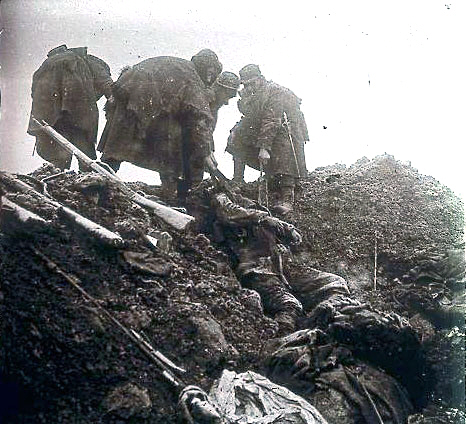
Removing the Dead from the Battlefield

Although we're all familiar with classic WWI autobiographical novels such as Remarque's All Quiet on the Western Front, Jünger's Storm of Steel, or Barbusse's La Feu (Under Fire), we're not as likely to have heard of another work which rightfully belongs in the same class: Gabriel Chevallier's Fear (La Peur). Written in 1930, this book wasn't translated into English until 2011, and even the French version was unavailable for several years since it was considered seditious.

It's also interesting that the 2014 paperback edition of this extremely powerful book is entitled Fear: A Novel of World War I. No earlier editions include this subtitle. I suspect it was added to define the book in the reader's mind as a novel even though in some ways it could be seen as a memoir, reminiscent of Blunden's Undertones of War, Graves's Goodbye to All That, or Frederic Manning's Her Privates We.


Order Now
Fear, like every work mentioned above, is written by an author who saw the Great War firsthand. Narrated by an educated and sardonic young man named Jean Dartemont who is called up in 1915, the book presents his experiences and opinions as he goes through the war. There is little doubt that Dartemont is Chevallier's alter ego. Like Chevallier, he sees action in the trenches, at the Chemin des Dames, in Champagne, and almost everywhere else except Verdun. He comes to know the horror of battle. Throughout the novel the author is unsparing in his description of this horror. Dartemont stumbles upon his first corpse early on in his soldiering and is horrified by its expression. But as they advance it turns out that

...this deadman was like the watchman for a whole kingdom of the dead. This first French corpse preceded hundreds of other French corpses. The trench was full of them…Corpses contorted into every possible position, corpses which had suffered every possible mutilation, every gaping wound, every agony (p. 62).

Almost a whole page follows with terribly graphic descriptions of these bodies. Other horrors follow. A field of wounded poilus are slowly burned alive by retreating Germans who set fire to the grass as they flee. Individual casualties are hideous, and corpses are always profuse after contact with the enemy:

The plain was covered with our comrades, cut down by machine guns, their faces in the mud, arses in the air, indecent, grotesque like puppets, but pitiable like men, alas! Fields of heroes, cargo for the nocturnal carts. . . (p. 62)

At one point Dartemont and his comrades, advancing toward the front lines, run into these carts piled high with what at first seems debris but which turns out to be fellow soldiers. In response Dartemont observes:

So they were withdrawing our predecessors from the morning, the first waves of the unstoppable offensive that had come to a standstill ahead of us. They were cleaning the battlefield. 'A fine turn-out by the hearse section,' said one wag. Each cart carried grief to a score of families (p. 56).

Collecting the Corpses

As the title indicates, this book examines fear engendered by horror in the countless ways it could be experienced by a soldier during the Great War. No aspect of fear is ignored; it runs deep and is agonizingly constant in the bodies and minds of the poilus. Men returning from Verdun are characteristic in this respect:

The survivors, men who have already endured dangers and torment beyond normal human comprehension, speak of Verdun with great horror. They say that when they got out they couldn't eat properly for several days because their stomachs had been so knotted with fear, because everything filled them with disgust. They have remembered nothing from Verdun except terror and madness (p. 155).

There is rarely any relief. Even in the quiet zones, "shells always find a few victims." Dartemont's only reprieve from fear is when he is wounded and spends several weeks in hospital. An awkward interview with the hospital chaplain leaves them both angry and Dartemont realizing that "the war has killed God." Extended conversations with nurses and fellow patients give him a chance to express at length his feelings for war, the chain of command, politics, profiteers, and civilians safely at home. It's in the hospital that he is really able to voice his thoughts on the situation — ideas that certainly could be considered seditious. And while on convalescent leave he admits:

It's true that I'm a malcontent hero. If I am asked about the events of the war, I have the bad and unsociable habit of describing them as I found them. This liking for truth is incompatible with civilized behavior (p. 138).

Later he admits that if his officers knew what he thought, he would be shot. Just as he shocks his comfortable listeners at home, Jean Dartemont does not hesitate to denounce thuggish NCOs, incompetent officers, and a higher command snugly ensconced in chateaux while gathering honors and promotions because of their "bravery":

. . . it is accepted, by some strange aberration, that a great loss of men proves the courage of those who command them — by virtue of that axiom of the military hierarchy which states that the valour of soldiers is created by the valour of their leaders, an axiom which does not have a converse form (p. 154).

Burial

This novel gives deep and indelible insights into the horrors of war and the nature of fear as only someone who has experienced them can. As I mentioned earlier, Gabriel Chevallier's Fear well deserves to stand beside other classics written in the decade or so after the Armistice. Not only is it a compelling read, but its vision of the war through a blend of piercing description and cynically intelligent questioning gives us some surprises and insights that we might greatly appreciate.

David F. Beer

Monday, February 22, 2016

Verdun 1916: The First Ten Days


21 February–1 March: The Opening Attack

On 21 February, at 0715 hrs the Germans opened fire on the two banks of the Meuse, over a front of 40 kilometers. Simultaneously, Verdun proper was systematically bombarded, the first shells falling on the cathedral grounds. Fire was kept up for nine hours, the 1200+ German artillery pieces included a high proportion able to fire heavy-caliber shells.

Lt. Col Driant (Center) with His Officers at Bois des Caures

The infantry attack was launched out of the north at 1615 hrs, just before dusk, from the Haumont-Ornes Woods. The first strong resistance they met was from Chasseurs deployed in Bois des Caures commanded by Lt. Col. Emile Driant, who became the first hero of the battle after being killed the second day.

Over the next few days the terrain and villages between the Bois des Caures and Fort Douaumont were systematically conquered.

Recent Aerial View of Fort Douaumont
(Note Autos in Left Parking Lot to Gauge Size)

Click Image to Enlarge

The massive fort, which was almost abandoned, fell without resistance on 25 February. It would later be written that this failure cost France 100,000 lives.

General Henri-Philippe Pétain took command over the army of Verdun the same day. To better organize the defenses, he implemented a rotational system for the defending troops and improved the only supply route to the City, the Bar-le-Duc-Verdun road, which came to be known to posterity as the Voie Sacrée or Sacred Way.

Pétain and His Staff at Verdun