Now all roads lead to France and heavy is the tread
Of the living; but the dead returning lightly dance.
Edward Thomas, Roads

Friday, May 13, 2022

Out-Eating the Enemy: How Latin America Helped Feed the Allied Armies in Europe


Fray Bentos Corned Beef from Uruguay
Fed the British Tommies

By  Phillip Dehne St. Joseph’s College, New York, USA

When looking at the First World War, Latin America presents a conundrum. It was a place firmly outside the core military story that inevitably and justly dominates histories of the Great War. But despite this, Latin America was far more important to the outcome of the war than many of the military sideshows in Africa and the Pacific, which despite their unimportance to the overall outcome of war are often described or at least mentioned in general histories of the war. Supplies from Latin America were critical for the Entente’s war effort, helping to feed fighting men and civilians.

Latin America played a big role in allowing the Allies to maintain reasonable supplies, particularly in the critical year of 1918 when France received more than a third of its wheat imports from Argentina. Significant amounts of the tinned meat and lukewarm coffee consumed by the poilus of the French Army came from Uruguay and Brazil. Regardless of its culinary appeal, such food was better in quality, freshness and quantity than what German soldiers got, and the morale of the German civilians and troops correspondingly plummeted in the summer of 1918.  Although they did not fall into true famine by 1918, the German military and civilians had certainly worn down due to deprivation that would not have existed if the Entente simply allowed Germany to trade with all the world’s neutrals. 

Certainly the bulk of food for the Entente came from the English-speaking North American states, but critical food supplies, particularly meat and grains from the River Plate, flooded across the Atlantic and fed the civilians and soldiers of the British and French empires. The grain crops of South America were available on the opposite seasonal cycle from the supplies from North America, filling pivotal supply gaps in the early months of each year. These supplies were far quicker to ship to Europe than those from India, Australia, and New Zealand, and with significantly less usage of scant shipping. Throughout the war, food bought and paid for sat unshipped on Australian docks. 

The frozen meat supplied from the River Plate to the Allies made up more than half of the meat imported from overseas into Allied territories throughout the war, in 1917 supplying nearly four times the meat of Australia and ten times more meat than the United States. Without a doubt, Latin American food tremendously improved the ability of the British and French militaries and societies to resist the German offensives during the pivotal final year of war. 

Although it is not quite acceptable historical practice to speculate about what did not happen, one could easily imagine that a lack of available Latin American food would have simply meant that less food would enter Allied territories, leading their people and armies closer to starvation and perhaps creating unrest similar to that which developed in Germany in the early days of November 1918. It is probably impossible to calculate whether this food imbalance abetted by Latin American supplies meant that the war lasted a few days, a few weeks, or a few months less than if the Allies had not relied on Latin American produce. Regardless, it is fair to conclude that Latin American supplies contributed significantly to the Allies’ critical (and perhaps even decisive) ability to out-eat their German opponents. 

After the War: Starving Europe

Perhaps not surprisingly, access to food and financial supplies after the war exposed again the unique place of Latin America in the Great War. Throughout the Paris Peace Conference in the first months of 1919, representatives from all the victorious powers had to grapple with the competing imperatives of feeding the starving populations of defeated central Europe while sucking out of Germany as many tangible resources for reparations as possible. Latin America was one of the rare places where there was agreement between these imperatives. The inability of the victorious Allies to simply sequester German property in Latin America (in other words, their failure to really win the war on the “far western front”) meant that the German grain businesses and banks there still had resources that could be used to purchase and send food to the starving peoples of Germany.

By early May, German authorities had already purchased 100,000 tons of River Plate flour.  Germany did not need to send money or gold, because Argentina and other South American countries remained the one place in the world where the miserable, defeated, nearly failed state of Germany still had credit.

Source: "How Important Was Latin America to the First World War?,Iberoamericana, XIV, 53, 2014

Thursday, May 12, 2022

Wednesday, May 11, 2022

The World's Largest (and Longest) War Memorial Is in Australia


Great Ocean Road Memorial Arch at Eastern View

The Great Ocean Road is an Australian National Heritage-listed 240-kilometer (150 mi) stretch of road along the southeastern coast of Australia between the Victorian cities of Torquay and Allansford. Built by returned soldiers between 1919 and 1932 and dedicated to soldiers killed during World War I, the 151-mile-long road is the world's largest war memorial. 


The Great Ocean Road stretches between Torquay and Allansford and lies on the south end of the state of
Victoria in Australia.

Around 3000 ex-soldiers, paid ten shillings per eight-hour shift,  helped to build the Southern Coast Road, and it wasn’t easy. They worked on rough terrain, through treacherous weather and on rocky cliff sides. Unsurprisingly, a few of the soldiers died during construction. Using tools such as explosives, picks, and shovels they carved the road into the cliff side, camping in the bush as they went.

Island Archway

On 18 March 1922, officials opened the first section of road from Eastern View to Lorne. To recoup some of the building costs, travelers had to pay a toll of two shillings for cars and ten shillings for wagons with two or more horses.


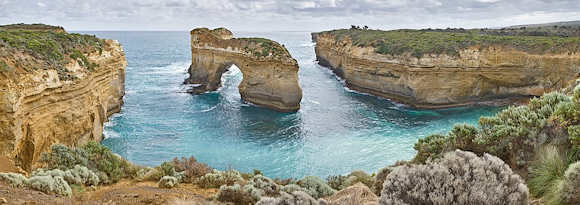
The Twelve Apostles


In November 1932, the road had its full official opening, celebrated with a weekend of festivities held near Lorne’s Grand Pacific Hotel. Officially renamed the Great Ocean Road, it was then acknowledged as the longest war memorial in the world. When the State Government acquired the road in 1936, they abolished all tolls.


1930s Toll Ticket


Sources:  Various Australian Tourism Sites and Wikipedia


Tuesday, May 10, 2022

Krithia: Gallipoli


By Stephen Chambers
Pen & Sword Military, 2021
Jim Gallen, Reviewer


French Artillery Firing in the Third, Final, and Unsuccessful Battle to Take Krithia


Krithia is a village on the Gallipoli Peninsula that was a first-day objective of the troops who landed at Cape Helles on 25 April 1915. In his work Krithia, Author Stephen Chambers shows—like the overall Gallipoli campaign—the attempt to capture this village was a failure, but  also suggests it was also the start of a learning curve for the British Army. 

The book begins with a description of  the fighting on the landing beaches which were about 4.5 miles distant from the village. It then follows the course of battle through broad attacks in three Battles of Krithia from 28 April to 6 June, followed by more focused offensives until evacuation on 13 January 1916. At the conclusion of the Dardenelles campaign the Allied line was still 1.5 miles from the village.

Chambers draws heavily on letters and other writings from the warriors themselves. The many maps supplement the narratives. The photographs and drawings, both historic and contemporary, permit comparisons between scenes in war and peace. The portraits of the fighters put faces to the names. Perhaps the most poignant pictures are those of the soldiers next to those of their grave markers.

Red Line Indicates Allies Farthest Advance
Yellow Section Shows First Day Probe from Y Beach


Without disregarding the big picture, Krithia is what I term “small history”, history through the gunsights. It is full of tales of individuals, their backgrounds, experiences, and opinions. Each reader can select his favorites. I was intrigued by the description of William Forshaw, the “Cigarette VC” who had to keep his cigarette to light the fuses of the bombs he threw. Do not miss the drawing of him on page 233. I felt sympathy for the French Jesuit, Marie Lafont de Contagnet, who left his academic career in the Levant to serve as a chaplain at Gallipoli, where he lost his life.

Perhaps most telling is the uncensored letter from MP Captain Harold Cawley, another fatality, to his father who was also an MP, in which he described Major General Sir William Douglas:

He has a third-rate brain, no capacity to grasp the lay of the land, and no originality or ingenuity…He has been in the trenches three times since he landed, hurried visits in which he saw next to nothing...He is always thinking of himself, his food, his promotion, his health (p.181).

This is reminiscent of the correspondence of another politician-soldier, Theodore Roosevelt, to Sen. Henry Cabot Lodge in which he spoke of his commander, Major General William Shafter; “Our General is poor; he is too unwieldy to get to the front…Not since the campaign of Crassus against the Parthians has there been so criminally incompetent a general as Shafter.”

I had a general knowledge of Gallipoli, Churchill’s unsuc-cessful attempt to force the Bosporus first by naval then by land assault, in which Australia and New Zealand won their nationhood. Krithia gave me a much deeper understanding. The ANZACS remain a giant memory in the Antipodes, but most of the Allies involved were from Britain and its Empire, and the French outnumbered the ANZACS. Both Britain and France relied heavily on their colonial troops: the British, Indians; and the French, Senegalese. Gallipoli was a complex campaign, with three thrusts, including diversionary attacks such as that against Krithia. Though its goals were not achieved, it would serve as a case study that would yield benefits both in the Great War and World War II.

With the text ending on page 226 and with many pictures, Krithia is a fairly quick but worthwhile read. In my mind it converted Gallipoli from a name in a long-ago war to a place in which people to whom I can relate fought and died. Formerly seeming unfathomably remote, I can now envision it as a site at which tourists can learn, appreciate, and pay homage. Author Stephen Chambers, who has written a guidebook of Gallipoli, also describes six battlefield tours, gives advice to tourists, and considers the Gallipoli Legacy. I recommend Krithia to anyone seeking a more personal, up-close view of the Gallipoli campaign.

Jim Gallen

Sunday, May 8, 2022

The Russian-German Wolf Armistices


Source: War History Online


I ran into this surprising account at War History Online. In IMHO,  Hollywood (which seems to hate WWI these days) could—with a little literary license—convert this tale into a delightful horror film. (Full illustrated article HERE.) MH

The consequences of the fighting during the First World War on the Eastern Front had an impact on the inhabitants of the animal world, such as wolves. The Eastern Front extended from the Black Sea in the south to the Baltic Sea in the north. Wolves had attacked livestock and people in various areas.

In February 1917, there was a message from Berlin stating that large packs of wolves had moved from the forests of Lithuania and Volhynia to the interior of the German Empire.

A report, which appeared in the El Paso Herald, said, “As the beasts are very hungry, they penetrate the villages and kill calves, sheep, goats, and other livestock. In two cases children have been attacked by them.”

During the winter of 1916–1917, in the area of Lithuania and Belarus in the Kovno-Wilna- Minsk district (near modern Vilnius, Lithuania), starving wolves began to attack German and Russian soldiers. Prolonged hunger and despair had become stronger motivators for the animals than their fear of people.

In this area, the number of wolves near the location of the armies and cities began to increase significantly. At first, packs of wolves attacked lonely victims, but soon they grew bolder and began to attack groups of soldiers.

During one of the battles, the Russian and German scouts saw that a large pack of hungry wolves had attacked and were eating the wounded soldiers. Seeing what was happening, the opponents immediately stopped the fight and jointly began to kill the predators.

In one of the messages of the newspaper Oklahoma City Times it said, “Parties of Russian and German scouts met recently and were hotly engaged in a skirmish when a large pack of wolves dashed onto the scene and attacked the wounded. Hostilities were at once suspended, and Germans and Russians instinctively attacked the pack, killing about 50 wolves.” After the attack was repulsed, all the soldiers separated and returned to their original positions.

The wolf attacks did not end there but were repeated at the most inappropriate moments. The soldiers tried their best to kill the fearless and hungry animals. There were repeated attempts to poison the wolves or kill them with rifles, machine guns, and even grenades.

However, such efforts were only temporary and did not stop the attacks. The number of wolves was so great that new ones came in place of those killed every time. In addition, large Russian wolves are known for their aggressiveness, which was, at that time, bolstered by hunger.

Based on the current situation, the commanders of the German and Russian armies were forced to announce a temporary truce and join forces to fight the wolves. The New York Times report for July 1917 describes this incident:

“As a last resort, the two adversaries, with the consent of their commanders, entered into negotiations for an armistice and joined forces to overcome the wolf plague. For a short time, there was peace. And in no haphazard fashion was the task of vanquishing the mutual foe undertaken. The wolves were gradually rounded up, and eventually several hundred of them were killed. The others fled in all directions, making their escape from carnage the like of which they had never encountered.”

Thanks to the coordinated efforts, the soldiers managed to kill several hundred wolves and force the rest to scatter. After the predator problem was solved and the wolves no longer posed a threat to the troops, fighting resumed, and all thoughts of cooperation were forgotten.

From article by: Rusian Budnik


Saturday, May 7, 2022

George Bellows, American Realist and War Artist — A Roads Classic


Click on Images to Enlarge

The Germans Arrive


The realist painter George Bellows (1882–1925) created two of the most famous boxing paintings of American art, Stag Night at Sharkey's and Dempsey and Firpo. Apparently though, despite his familiarity with physical violence, something snapped when Bellows heard the partly true, but sometimes exaggerated, accounts of German atrocities in Belgium. He appears to have decided that German policy was to trample on the Queensberry rules, the Geneva Convention, and common decency. 


Massacre at Dinant


He produced a series of paintings which are, possibly, grimmer than anything turned out by the various propaganda ministries during the war. The image above of brutal German soldiers removing both of the young man's hands in the company of swooning ladies and another recently deceased fellow citizen is one of the less ghoulish works in the series.

The Murder of Edith Cavell


To see more examples and learn more about Bellows and his grievances, visit the excellent blog My Daily Art Display

Friday, May 6, 2022

OMG! Its First Use for "Oh My God" Was by a WWI Celebrity


Correspondents Winston Churchill and
Admiral Jackie Fisher


By James Patton

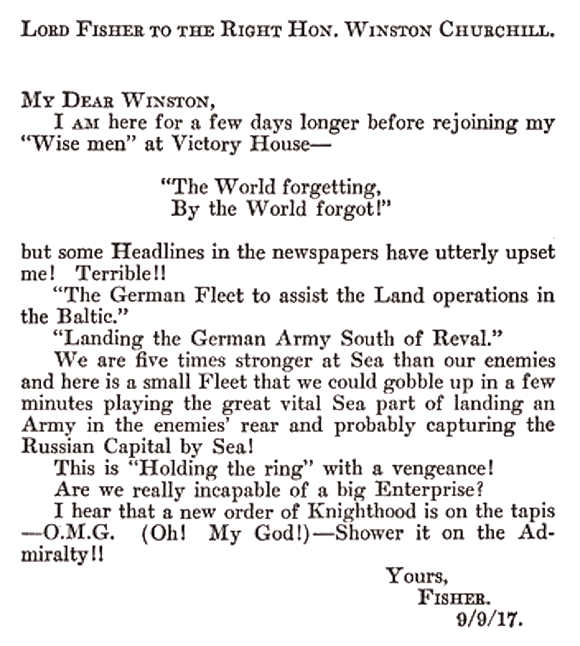
This abbreviation, now part of the popular vernacular, was used by Admiral of the Fleet John A. (Jackie) Fisher (1841–1920), 1st Baron Fisher, in a letter written to The Right Hon. Winston Churchill, MP. These two were close friends and frequent correspondents; Lord Fisher was the First Sea Lord from 1904 to 1910 and also from 1914 to 1915, while Churchill was the First Lord of the Admiralty from 1911 to 1915. 
Fisher was an admiral and naval innovator, who began World War I as First Sea Lord but resigned in 1915. By 1917, his naval career was over. Here’s the letter:

From Smithsonian Magazine


In other correspondence, the two snickered about the King’s January1918 Honours List, upon which they found that Prime Minister David Lloyd George (1863–1945) had placed his private secretary, Miss Frances Stevenson (1888–1972) in line for a CBE. Lloyd George and his secretary had been intimate since 1913 (apparently a requirement for the job), and that relationship continued until after the death of his wife, whereupon he married Stevenson in 1943. Meanwhile, Stevenson had borne him a daughter in 1929. Lloyd George did not receive a peerage until 1945, less than three months before his death, but Frances was able to enjoy life as the Dowager Countess Lloyd George of Dwyfor for 27 years.


Perhaps they should have given Stevenson an OMG as well?

Originally presented in Kansas WWI, 2 May 2019

Thursday, May 5, 2022

Before the War: The Emerging Fear of Aerial Bombardment


By  Christopher Warren

“The strategic air offensive is a means of direct attack on the enemy state with the object of depriving it of the means or the will to continue the war.” This definition of strategic bombing, supplied by Sir Charles Webster and Noble Frankland writing about the Second World War,  is no doubt applicable to the Great War as well. Deprivation of the means, i.e. war material and supplies, and the will, i.e. specifically targeting civilians in an attempt to damage public morale was legitimized during the First World War. Although the Napoleonic Wars are often cited as the first example of “total war,” the Great War from 1914–1918 was truly the first war where civilians located hundreds of miles from the warring armies came under attack.

Strategic bombing of cities and civilians by aerial means was not a new concept in 1914. Beginning with the Montgolfièr experiments with manned flight in 1783, the possibility of using balloons and eventually heavier than air machines for military use was envisioned. Initially used as observation posts and artillery spotters, the idea of using airships and aircraft offensively soon found enthusiasts. It was not until the advent of the internal combustion engine, however, that the potential of aerial bombardment from a controlled platform became realistic. In an 1893 letter to the chief of staff of the German Army, Count Ferdinand von Zeppelin, developer of the rigid airship that would bear his name and theorist on strategic bombing, wrote that his machine could perform not only observation and transport roles, but also “bombard enemy fortifications and troop formations with projectiles.”

In popular literature and science fiction, the inevitability of airships cruising over cities and dominating future warfare was a popular topic by the late nineteenth century. Jules Verne, no stranger to prescient fiction, wrote in his 1887 story "Clipper in the Clouds" about an aerial battle between two airships loosely resembling the German dirigibles of the First World War. However, it was H.G. Wells who envisioned the strategic bombing of population centers in the future. In his 1908 novel The War in the Air, Wells described a scene in which a fleet of German airships bombed New York City, eerily predicting the fear and terror felt by the public in London and Paris during the Great War. As the historian Lee Kennett argued, so profound and persuasive at capturing public attention was this type of futuristic literature around the turn of the century, that by the time reliable airships and aircraft finally appeared en mass, “extravagant and impossible things would sometimes be expected of them.” During the war, dirigibles and aircraft were seen as an extension of scientific advancement akin to other innovations such as submarines, machine guns, tanks, and poison gas.


So profound were the concerns over the possibility of airborne bombardment, even before the technology to accomplish such a task was near ready, politicians throughout Europe and the United States attempted to regulate aerial warfare. The 1899 Hague Convention, proposed by Russian Tsar Nicholas II in an attempt to regulate armaments and warfare, passed a resolution “agree[ing] to prohibit, for a term of five years, the launching of projectiles and explosives from balloons, or by other new methods of similar nature.”

By the time of the second Hague Convention in 1907, flight technology had changed the possibility and increased the danger of destruction from the air. In 1903 Wilbur and Orville Wright had proved that controlled, powered, heavier-than-air flight was possible with their flight at Kitty Hawk, North Carolina. By the second convention many nations had expressed interest in aviation’s military capabilities, though curiously the United States was at first lukewarm to the idea. Foreshadowing aerial bombardment as a means of “total war,” the 1907 Hague Convention attempted to outlaw strategic bombing of undefended cities and populations.

Because many at the 1907 conference believed it would be easier to restrict bombing to legitimate military targets rather than outlaw it altogether, the Hague agreements concerning land warfare were extended to cover aerial bombardment as well. Since bombing of undefended cities by traditional artillery was already prohibited under Article 25 of the Convention on Land Warfare, conference participants simply changed the article to state “the attack or bombardment, by whatever means, of towns, villages, dwellings, or buildings which are undefended is prohibited.” The insertion of “by whatever means” into the article was an attempt to extend the prohibition to include aerial bombardment.

Despite its intentions, the language of the article was too vague to be effective and left many questions unanswered. For instance, what was the definition of an undefended town? Did that mean military members were not within town limits or just the absence of soldiers specifically tasked to guard against invasion or bombardment? How could an attacker tell the difference?

Should a city without traditional defenses but housing an arsenal, a military storehouse, or a weapons manufacturing plant really be considered “undefended?” These issues and many others rendered the treaty useless and were routinely cited as justification for strategic bombing of cities when the First World War began.

Although tactical aerial bombing in support of combat operations was employed as far back as 1911 when Italian airplanes dropped the first bombs in combat on Turkish forces in Libya, 1914 saw the first strategic use of bomber aircraft to “strike at the very foundation of the enemy’s war effort-the production of war material, the economy as a whole, [and] the morale of a civilian population.” A few days after the beginning of the First World War, German pilots dropped a few small bombs on Paris in August 1914. In October of that year the British achieved the first substantial strategic success when one airplane destroyed a zeppelin airship in its shed at Dusseldorf, Germany. By December 1914 the Germans were dropping bombs directly on England.

Selected from: "The First Battle of Britain: British Response to German Strategic Bombing in the First World War," Air & Space Journal, Summer 2018

Wednesday, May 4, 2022

Some New WWI Numbers


David Knight of the Movement for the Abolition of War has gathered some interesting statistics on the war I've not seen in other sources. One group covered the scale of destruction in France during the war. Another focused on opposition to the war, mostly in Britain. The first group is shown as a table, the second  as bullet points.   If you wish to check on his sources, they are listed HERE.


Damage in St. Mihiel, France


In a Wartime Camp


Tuesday, May 3, 2022

John Galsworthy and the First World War


John Galsworthy (1867–1933)


With the outbreak of World War I, the novelist and playwright John Galsworthy, best known for The Forsythe Saga and for later receiving the Nobel Prize for Literature, was a strong supporter of the war in 1914 and considered the invasion of Belgium an outrage against an innocent nation. His attitude about the war shifted as he experienced it. During the First World War he worked in a hospital in France as an orderly, after being passed over for military service, and in 1917 turned down a knighthood, for which he was nominated by Prime Minister David Lloyd George.

By this time, Galsworthy was struggling to comprehend its "monstrous calamity and evil" and to decide what his further role in the war effort should be. He confided to his diary that "the heart searchings of this War are terrible. . .I think and think what is my duty."' For the next four years, Galsworthy tried to answer this question. The mangled and immobilized bodies he had seen on the front and wer returning home seemed to mock his conviction that the Allies were fighting a war to defend freedom and played powerfully on his imagination and conscience. 

In the spring of 1918, he finally found a way to reconcile his hatred for war with his duty to serve his country: he agreed to edit a small journal for the Ministry of Pensions about and for disabled soldiers, Recalled to Life, which he renamed Reveille. He would use it to awaken the nation to its obligations to the war wounded.

First Issue


Granted complete editorial liberty (or so he believed) and generous funding by the ministry, Galsworthy was determined that Reveille would be no mere mouthpiece to disseminate reassuring platitudes. In addition to soliciting articles by experts on disability, he enlisted an extraordinary array of artistic talent and transformed the publication of an obscure technical journal on military orthopedics and disability pensions into a minor literary event.  Contributors included Max Beerbohm, Rudyard Kipling, Joseph Conrad, J.M. Barrie, Enid Bagnold, and Jerome K. Jerome. 

Galsworthy's passionate introductory editorial is perhaps the journal's most remarkable document, not the least because of its bleak candor at a time when the war's outcome was still uncertain. He observed:

In every Street, on every road and village-green we meet them-crippled, half crippled, or showing little outward trace, though none the less secretly deprived of health. Those who encouraged such men to "drift" into shiftless despair were "guilty of ingratitude, and will be the first to show impatience and heartlessness, when, five or ten years hence, we see him cumbering the ground, hopeless and embittered, often out of work, and always an eyesore to a nation which will wish to forget there ever was this war.

For Galsworthy, the fate of Britain's disabled war veterans was linked to the intertwined politics of remembering and forgetting the war itself. He keenly appreciated the fact that the maimed bodies of countless soldiers signified the ambiguities of the end of war for victors and losers alike or, rather, that the official cessation of hostilities between nations did not coincide with the end of war's consequences for its victims.


A Photo from an Issue of Reveille 


In what proved to be the last issue of Reveille, Galsworthy returned to these themes.

The State, like the humblest citizen, cannot have it both ways. If it talks-as talk it does, with the mouth of every public man who speaks on this subject-of heroes, and of doing all it can for them, then it must not cheese-pare as well, for that makes it ridiculous. Britain has climbed the high moral horse-as usual-over the great question of our disabled; she cannot stay in that saddle if she rides like a slippery lawyer. 

It is not difficult to understand why many officials at the Ministry had grown uncomfortable with their celebrated editor. With the signing of the armistice and mounting pressure of censorship by ministry officials on him, Galsworthy resigned his duties, and the journal closed down. Yet, Galsworthy's words were prophetic of developments in the 1920s and 1930s.

Sources:  Adopted from "John Galsworthy and Reveille," by Susan Neeson in the February 2006 St. Mihiel Trip-Wire, which included excerpts from: "Remembering and Dismemberment: Crippled Children, Wounded Soldier, and the Great War in Great Britain," by Seth Koven from American Historical Review, October, 1994


Monday, May 2, 2022

Secrecy Before the Battle of Amiens


8 August 1918 by Will Longstaff, showing German
 prisoners of war being led toward Amiens

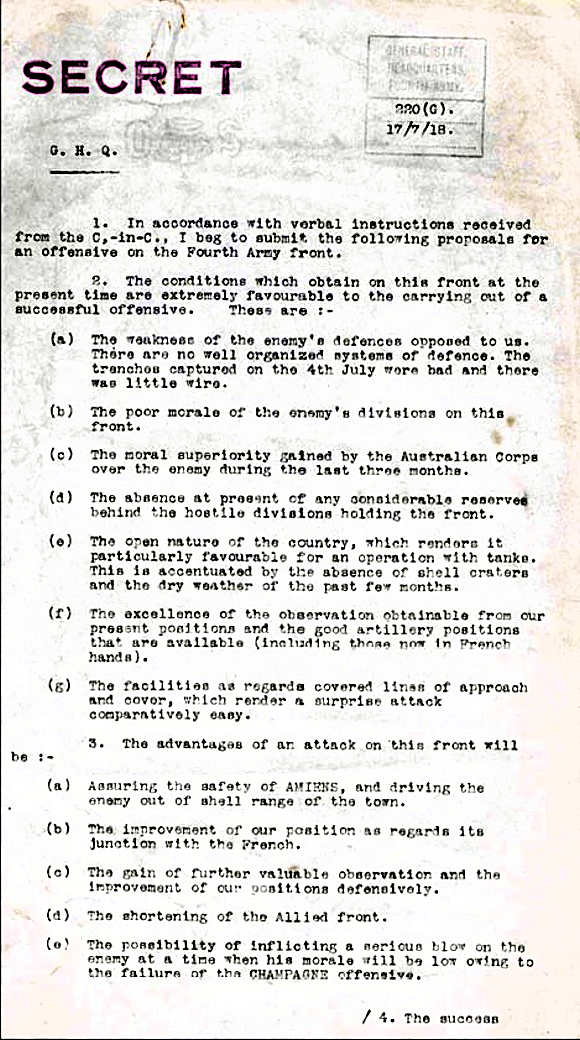
The British-led Battle of Amiens, fought between 8 and 12 August 1918, was a decisive Allied victory. It marked the beginning of what has come to be known as the Hundred Days offensive, which saw the collapse of the German Army on the Western Front. This is the first of three blog posts covering that advance: the prelude, the battle and its consequences.

Despite the confidence with which the battle was launched, and its ultimate success, its significance was born out of the first of the German spring offensives in March 1918. With manpower released from the Russian collapse on the Eastern Front in 1917, these were the last significant attacks made by the German armies in any theatrer. In an attempt to divide British and French forces, capture points of strategic importance and force a favorable peace, these German offensives marked a final effort to break Allied resolve. One significant objective had been Amiens.

Although militarily unimpressive and of little political significance, Amiens held strategic value as the principal rail hub of the Allied war effort. Holding the main railway communications between the British base at Le Havre and the British Expeditionary Force (BEF) front, as well as the direct routes between the northern ports and Paris, it was the hub through which flowed the means of feeding, arming and reinforcing Commonwealth and French soldiers. [WO 95/434/1]

The first of these German assaults pushed towards Amiens and fell upon the British Fifth Army, which was still in the process of completing its defenses. German advances were alarmingly fast and allowed them to push beyond 60 kilometers in places; however, on the Somme the offensive eventually stalled on the high ground at Villers Bretonneux. Around 15 kilometers in front of Amiens, this position changed hands a number of times until a determined counter-attack by Australian units secured the line. [WO 95/434/1]

By the end of April, the threat of Allied collapse had largely passed, while French-led counteroffensives on the Marne in July had finally and convincingly ended the German advance. Failure to break through Allied lines had left the German army in possession of a number of salients, the largest of which jutted out towards Amiens. 

Now operationally vulnerable and exhausted by these costly efforts, the Germans could do little more as American soldiers and vast quantities of materiel poured into the theater. The Australians, now in force between Villers Bretonneux and Morlancourt, also began to wear down their enemy.  With resources in his favour, and inspired by recovering morale, Marshal Ferdinand Foch—supreme Allied commander since March 1918—planned a series of offensives that would keep the German army under pressure, allowing it no time to recover. The battle at Amiens was designed as the first step in irreversibly breaking German resistance.

The task fell to General Sir Henry Rawlinson, now commanding the reformed Fourth Army, which occupied the sector straddling the River Somme. This was made up of British III Corps, the Canadian Corps and the Australian Corps, along with most of the Tank Corps and the Cavalry Corps. Further south of the Somme, two French corps—XXXI and IX—were to play a supporting role in the battle. By August, not only had the Fourth Army amassed more than 2,000 pieces of artillery, it had more tanks and armored cars at its disposal than had been seen in any previous battle, and nearly 2,000 British and French aircraft. This diverse commonwealth and French force, supported by vast quantities of technology, brimmed with confidence—a characteristic now lacking in its opponent. 


Above all else, great weight was placed on the importance of secrecy and misinformation during planning – in particular the move of the Canadian Corps south from First Army. It was recognised for its central contribution to recent offensives, and its presence would have signalled an imminent attack. Tanks, too, were concentrated and camouflaged in the villages of the Somme Valley, while all troop movements were conducted at night. Brigade commanders were not informed of the true plans until 4 August – four days prior to the attack – while nothing would reach the men in the firing line until 36 hours prior to zero.


A limited German attack on 6 August, directed toward British 18th Division north of the River Somme, caused some concern about the enemy’s intentions. Nonetheless, Zero Hour was fixed for 04:20 on 8 August: approximately one hour and ten minutes before sunrise. The attack was to be spearheaded south of the river by the experienced Canadian Corps and Australian Corps, alongside the bulk of the tank battalions. In an effort to achieve surprise, their combined advance was to rely on the tanks’ firepower and a creeping barrage in place of a lengthy preliminary bombardment. The French, who lacked armored support, were to start their advance 45 minutes later after a short bombardment.

The stage was set for the beginning of the end.

Source:  British National Archives


Sunday, May 1, 2022

What Was Nivelle's "Winning" Formula for 1917?


Nivelle (Left) with Joffre at Souilly (Verdun HQ), 1916


Robert Nivelle (1856–1924) started the war as an artillery colonel. By December 1916 he would be the commander-in-chief of the French Armies on the Western Front. He had proved himself an unusually gifted gunner and excelled at the Marne and Aisne Battles of 1914, subsequently earning promotion to the command of the 61st Reserve Division and later the III Corps on the eve of Verdun. His meteoric rise accelerated after he replaced General Pétain as commander of the Second Army, responsible for the defense of Verdun and the rollback of the German gains. His "formula," which worked at Verdun,  involved a saturation bombardment to suppress enemy artillery and defenses, a deep initial infantry penetration behind a rolling artillery barrage to displace the enemy, and a rapid followup advance to exploit and expand the breakthrough. The "formula," however, had been applied over a 5-mile-wide front at Verdun in 1916.  How would this work on the main section of his 1917 offensive, the key 25-mile-wide front line just below the Chemin des Dames?

Nivelle's approach for 1917 was first shared with the transmission of 16 December 1916. He wrote that, first, breakthrough to the enemy's lines as far as the main lines of his heavy gun batteries was possible in 24 to 48 hours, on condition that the operation be mounted as a single, sudden action.

Second, the artillery preparation had to cover a zone of about 8 kilometers deep to include all the enemy's heavy batteries, hence modern rapid-firing and mobile guns had to be pushed as far forward as possible, and if necessary, the destruction completed by the long guns.

Third, the rupture must be followed immediately by a bold lateral exploitation to destroy gun batteries, to occupy the enemy's lines of communication, and to ensure the capture of enough railways to be able to resupply themselves.

Finally, a bridgehead must be established as far forward as possible to cover the concentration of troops needed to take the battle to any remaining enemy forces. In sum—breakthrough, followed by lateral exploitation—all to be carried out speedily, hence to be prepared in minute detail beforehand. Infantry advances were to be carefully regulated involving single bounds by different units, with rolling artillery barrages supporting the attack. Despite the fact that the 1915 battles and those on the Somme in 1916 had attempted to follow much the same principles, Nivelle seems to have convinced his political leaders (and Lloyd George) that somehow, under his command, things would be different in 1917. The fighting in October and December 1916 at Verdun, however, had proved to him that the method worked. He was confident that his successful recapture of Forts Douaumont and Vaux had given him the “formula” for success against the German army. 

Nivelle's operational plan involved the BEF, France's Northern (Oise-Aisne sector), and the renamed Reserve (Chemin des Dames sector) Army Groups. On 30 and 31 December 1916 the two army group commanders received their instructions. They were to bring about “the destruction of the principal mass of enemy forces on the Western Front, by means of a decisive battle waged against all the enemy's available forces, and followed by an intensive exploitation.” North of the Northern Army Group, the British were to attack north of Bapaume as far as Arras and Vimy Ridge.


Original Concept: Nivelle Offensive 1917


The main task for the offensive fell to the Reserve Army Group, which was to exploit the opening success of the BEF and Northern Army Group by making a violent attack, aiming to conquer, right at the start, the entire zone occupied by the enemy's artillery and pushing troops through the breach thus created. 

Group commander Joseph Micheler, however, was skeptical of the scheme. Micheler had political connections, including the ears of fellow skeptics Senate president Antonin Dubost and war minister Paul Painlevé. Nivelle's subordinates were encouraged by the politicians to speak up against the plan. Matters came to a head on 4 April at a conference Painlevé had demanded during which Nivelle threatened to resign if the offensive was canceled. The war minister yielded after extracting a promise (not subsequently honored) that Nivelle would stop the offensive if the anticipated breakthrough did not occur within 48 hours. The final (hoped-for) aim for the Reserve Army Group was to reach the line Craonne–Guise, with help from the Northern Group St. Quentin, while the British continued toward Cambrai and Le Catelet. Of course, we know now in hindsight that this was all something of an episode of magical thinking. Nivelle neither had the right “formula” nor had he the quality Napoleon most valued in his generals—luck. 

Source: "Summing Up 1916: The French Perspective,"  Elizabeth Greenhalgh, Over the Top, December 2016

Saturday, April 30, 2022

Friday, April 29, 2022

Deadliest Locale for the Spanish Flu: Western Samoa


(Note: Most sources I've consulted list the death rate at Western Samoa as 24%... This article, cites 22%  In any case, I think you will find it quite informative. MH)


In New Zealand governed Western Samoa—not including the adjacent territory of American Samoa—30% of the men, 22% of the women, 10% of all children died from the Spanish Flu.

The  global influenza pandemic came to Western Samoa on board an island trader, the Talune, on 4 November 1918. The acting port officer at Apia was unaware that there was a severe epidemic at the ship's departure point, Auckland. On board were people suffering from pneumonic influenza, a highly infectious disease already responsible for hundreds of thousands of deaths around the world. Although the Talune had been quarantined in Fiji, no such restrictions were imposed in Samoa.


Steamship Talune


As a result he allowed passengers ashore, including six who were seriously ill with influenza. Within a week, influenza had spread throughout the main island of Upolu and to the neighboring island of Savai'i. The disease spread rapidly through the islands. Samoa's disorganized local health facilities and traumatized inhabitants were unable to cope with the magnitude of the disaster and the death toll rose with terrifying speed. Grieving families had no time to carry out traditional ceremonies for their loved ones. Bodies were wrapped in mats and collected by trucks for burial in mass graves.Approximately 8500 people—more than one-fifth of the population—died.

The influenza pandemic took a terrible toll on Samoa’s population. In a single week, the prominent businessman and community figure O.F. Nelson lost his mother, one of his two sisters, his only brother, and a daughter-in-law. S.H. Meredith lost seven close relatives. Of the 24 members of the Fono a Faipule (the colonial legislature), only seven survived the pandemic. The total number of deaths attributable to influenza was later estimated as 8500, 22% of the population. According to a 1947 United Nations report, it was "one of the most disastrous epidemics recorded anywhere in the world during the present century, so far as the proportion of deaths to the population is concerned."


The One-Week Toll on the Nelson Family


Responsibility for the pandemic clearly lay with New Zealand. In 1918, Western Samoa was still occupied by New Zealand forces that had seized the German colony at the beginning of the First World War. In addition to not placing the Talune under quarantine, the New Zealand Administrator, Colonel Robert Logan, did not accept an offer of assistance from the Governor of nearby American Samoa that may have reduced the death toll.  A Royal Commission called to enquire into the allegations found evidence of administrative neglect and poor judgement. Logan seemed unable to comprehend the depth of feeling against him and his administration. He left Samoa in early 1919 and did not return. His successor, Colonel R.W. Tate (1920–23), was faced with immense grief and ongoing resentment.

The influenza pandemic had a significant impact on New Zealand's administration of Samoa. Many older matai (chiefs) died, making way for new leaders more familiar with European ways. For survivors, the incident was seared into memory. It became the foundation upon which other grievances against the New Zealand authorities would be built. In 2002, New Zealand Prime Minister Helen Clark made an official apology to the Samoan people for the actions of the New Zealand authorities. Western Samoa had become an independent republic in 1962 and in 1997 adopted the name Samoa.  The U.S. Territorial possessions in the Samoan Islands are known as American Samoa.

Sources:  New Zealand History; Journal of Pacific History