Now all roads lead to France and heavy is the tread
Of the living; but the dead returning lightly dance.
Edward Thomas, Roads

Tuesday, October 10, 2023

The Ottoman Army and the First World War


By Mesut Uyar
Routledge, 2021
Reviewed by Michael Tyquin
 British Journal for Military History, 7.1 (2021)


Ottoman Artillery Battery Passing Through Constantinople


The Ottoman Army and the First World War is a thorough analysis of the Ottoman Army on all fronts during the Great War. It describes its operational military history and military effectiveness during that war, and it is difficult to disagree with Uyar in his assessment that Western historiography has for too long ignored the so-called peripheral campaigns of the war.

He reminds us that in 1914 it was by no means a foregone conclusion that the Ottomans would join the Central Powers. Once committed, the author contends that the First World War exposed Ottoman unpreparedness, having taken no steps prior to the war to secure stocks of food, fuel or munitions. Another of the book's themes is the constant interference of Germany's High Command and Ottoman acquiescence to both its strategic vision and its demands.

Western scholars have long struggled with access to Turkey's war archives, let alone the translation of both old and modern Turkish. If only for this reason Uyar's book is tremendously important for those interested in the Ottoman contribution to the First World War. The footnotes contain some archival material which sees the light of day for the first time. There is an extensive and up-to-date bibliography providing a handy synthesis of non-English language sources, although the author has not included Klaus Wolf's 2020 in-depth study of the German-Ottoman Alliance.


The Turkish Soldier—Tough, Tenacious, and Enduring

Uyar highlights the problems found in the wake of army reorganization when, in 1911, triangular divisions were established but insufficient attention was given to doctrine and combat services support, which were ignored. He details the vastly over-stretched military resources of the Ottoman Empire in the lead-up to and subsequent prosecution of the First and Second Balkan Wars.

The author examines the genesis of German military advisors and support. Initially the German alliance appeared to provide security against the territorial aspirations of both greater and lesser powers. But the optimism of the German High Command in using pan-Islamism as a force multiplier soon foundered on the reality of regional and tribal politics. In the body of the text, it is refreshing to see that Austro-Hungarian units and armaments deployed to Turkey receive more than a passing footnote. Little-known Ottoman contributions to Macedonia, Galicia, and Romania are also included in this study.

While the Ottoman Army of 1914 was far more representative of the empire's population than that of any other period, it lacked well-trained NCOs. This hindered the effectiveness of mobilization and the sudden appearance of tens of thousands of new recruits. In this the empire was not alone. The British Dominions shared a similar experience. The Ottoman Army was initially hampered by the total absence of aviation assets and any organization to manage line of communications issues. In addition, much heavy equipment and weapons had been lost in the Balkan Wars (1912/13). Unfortunately, the Ottoman High Command made no systematic effort to resolve or at least reduce the impact of these problems. Lack of a good road and rail network did not help matters. In 1914 the Ottoman Army was burdened by the inheritance of a dying empire: rampant corruption; inefficiency, and inadequate lines of communications; and hopelessly inadequate medical and veterinary care.

There was an abysmal lack of understanding in Berlin of not only the cultural and political mores of its Ottoman ally, but the challenges facing a collapsing empire from 1917 onward. We learn too that as early as April 1914, senior German advisors worked actively to deny Ottoman officers positions of influence and kept them uninformed of developments on the Western Front. The author also highlights fundamental tactical flaws in General von Sanders' initial defense plan for the Dardanelles in March-April 1915, where his interference further exacerbated tensions between the Ottoman staff and their German advisors.

Michael Tyquin

Monday, October 9, 2023

Charles Nordhoff's Memories of Ambulance Driving


Charles Nordhoff (Right) with Fellow Author and
Aviator James Norman Hall

The first published work by ambulance driver/ aviator/ author Charles Nordhoff was a war memoir titled The Fledgling that focused on his days flying with Escadrille SPA 99 of the Lafayette Flying Corps. Some reflections on his earlier service as an ambulance driver with the American Field Service worked its way into the narrative:

I was on the road all day yesterday, afternoon and evening, getting back to the post at 10 P.M. One of the darkest nights I remember – absolutely impossible to move without an occasional clandestine flash of my torch. Far off to the right (twenty or thirty miles) a heavy bombardment was in progress, the guns making a steady rumble and mutter. I could see a continuous flicker on the horizon. The French batteries are so craftily hidden that I pass within a few yards of them without a suspicion. The other day I was rounding a familiar turn when suddenly, with a tremendous roar and concussion, a "380" went off close by. The little ambulance shied across the road and I nearly fell off the seat. Talk about "death pops"-these big guns give forth a sound that must be heard to be appreciated. . .

The siege warfare to which, owing to strategic reasons, we are reduced in our part of the lines, with both sides playing the part of besieged and besiegers, gives rise to a curious unwritten understanding between ourselves and the enemy. Take the hospital corps, their first-aid posts, and ambulances. The Germans must know perfectly well where the posts are, but they scarcely ever shell them-not from any humanitarian reason, but because if they did, the French would promptly blow theirs to pieces. 

It is a curious sensation to live in such a place, with the knowledge that this is the only reason you enjoy your comparative safety. Likewise our ambulances. I often go over a road in perfectly plain view of the Boche, only a few hundred yards distant, and though shells and shrapnel often come my way, I am confident none of them are aimed at me. The proof of it is that no one has ever taken a pot-shot at me with rifle or machine-gun, either one of which would be a sure thing at the range.

Sunday, October 8, 2023

World War I As a Game of Chicken


"Chicken" Scene from Rebel Without a Cause with 1914 Drivers


By Erik Garzke and Yonatan Lupu

Excertped from "Trading on Preconceptions: Why World War I Was Not a Failure of Economic Interdependence," International Security, Spring 2012


Taken together, these effects of the Balkan Wars created increasing incentives for the great powers to solidify their alliance relationships in the region. The European alliance system was arguably created by the great powers as a deterrent to reduce the likelihood of war. This was the case beginning with the Bismarckian system created in the 1870s and 1880s, designed to protect the newly unified Germany from its neighbors, but also with the Triple Alliance and Triple Entente, designed in part to deter each other. The dilemma facing the great powers in the early twentieth century was how to effectively signal their resolve to fight as a means to deter the other side. 

Winning at the game of Chicken involves commitment. To increase their resolve, great powers such as Germany and Russia were increasingly forced to limit their options in crisis situations. As Thomas Schelling explains, decision makers in a crisis can improve expected payoffs by constraining their ability to act with discretion. German and Russian leaders tied their hands in two ways during this era.

First, they increasingly ceded decision making authority to the military by putting in place processes that, once an initial decision was made to begin hostilities, made it costly for civilian leaders to back down. As a result, Joll writes, "The general staffs were taking decisions which often committed them to irreversible military actions if war threatened: and consequently in a crisis the freedom of action of the civilian ministers was often more circumscribed than they themselves realized." The second way in which German and Russian leaders limited their options was by tightening alliance commitments. For example, after failing to support its ally in the Second Balkan War, G.J. Meyer argues that German policy was that "never again must Vienna have reason to doubt the value of its alliance with Germany." The effect of tightening alliances, however, was that of "chain-ganging." Tighter alliance commitments allowed the weaker partner to draw on the power of the stronger partner in crisis bargaining, thereby increasing the prospects for diplomatic success. 

This leverage, however, also increased the hazard that a great power would be drawn into a larger dispute. John Maurer notes, for example, that "it was clear to Russian decision makers that a confrontation with Austria-Hungary entailed running the high risk of conflict with Germany." Attempting to increase the leverage of their allies, the foreign policies of the interdependent powers were gradually being signed over to allies in the Balkans, which lacked both economic ties and interests in maintaining a wider peace in Europe. As a result, German and Russian leaders faced an increasingly difficult choice between honoring alliance commitments and losing credibility in European affairs. The former put in jeopardy the trade and capital networks that now fueled their increasingly destructive military machines, while the latter threatened to nullify their ability to achieve gains diplomatically, without the need to use force. Credibility and support for their partners required increasingly binding commitments, but these in turn created increasingly diametric alternatives for the integrated powers. 

Backing down meant suffering increasing reputational costs, whereas failing to do so required that their counterparts would suffer a similar fate. Ironically, interdependence accentuated this logic, as the high stakes for a contest and previous experience convinced both sides that their opponents would blink first.

Again and again, Balkan crises failed to spread as either Germany or Russia chose to back down. This reassured the interdependent powers that the European system was robust to such crises and that, in future crises, someone (else) would act with greater discretion.

We thus offer [two. . .] points about the period between the Franco-Prussian War and World War I. First, disputes among the highly interdependent powers were generally resolved peacefully in the pre-World War I era. Second, disputes among the less interdependent powers generally escalated to wars, except where the (interdependent) great powers saw it in their interests to intervene to mediate disputes and prevent them from drawing in other powers. Finally, as a result of a series of crises, leaders in Germany and Russia, the pivotal states in the alliance system, increasing found the need to bind their fates, and the fate of Europe, to that of their allies Austria-Hungary and Serbia. That a general war did not break out before 1914 is, in many ways, attributable to German and Russian decisions to back down rather than to support regional allies. This in turn led to excessive confidence that wider war would be averted, in no small part because all involved recognized the mutual economic benefit of avoiding a wider contest. 

In 1912 and 1913, Germany and Russia averted war. Why did 1914 end differently? . . Both Germany and Russia honored their alliance commitments to the point of starting a general war. German support for Austria-Hungary enabled the latter’s action against Serbia, and the war would not have spread . were it not for Russian intervention. The question then becomes why Germany and Russia made these decisions in 1914. . . 

A few aspects of the game of Chicken that characterizes the crises leading up to World War I are worthy of additional attention.  There are two pure-strategy Nash equilibria in a standard two-player game of Chicken: one in which player A swerves and one in which player B swerves.  Yet, these equilibria assume that players are fully informed about what the other will do. The assumption of full information is inconsistent with the larger logic of brinkmanship and tying-hands commitments through alliances. If the players are uncertain about each other’s intentions, then a more complex set of outcomes is possible. If, for example, A overestimates B’s willingness to swerve, then the worst possible outcome can ensue.  With incomplete information, equilibria can occur in the game of Chicken in which neither player swerves, as it seems happened with Germany and Russia in 1914.

More generally, the iterated game of Chicken played by Germany and Russia leading up to the war created increased incentives to convince the other to back down by signaling a resolve to fight. Having learned in previous crises that the other could be brought to heel, especially in the face of firm resolve, each state was intent on pushing the other to its limit.  Austrian leaders believed that giving Serbia an ultimatum supported by Germany would reduce the risk of Russian intervention  The kaiser, in a change in policy from the Balkan Wars, decided to support Austria-Hungary unconditionally, recognizing that failure to do so risked the destruction of the alliance.  As Jack Levy notes, "German decision makers hoped and expected that an Austrian fait accompli against Serbia in the immediate aftermath of  the royal assassination, backed by German warnings to Russia, would minimize the likelihood of Russian intervention."  

German Foreign Minister Gottlieb von Jagow famously remarked that "the more determined Austria shows herself, the more energetically we support her, so much the more quiet Russia will remain."  Prior to the assassination of the archduke Franz Ferdinand, the Kaiser met with and urged Austria-Hungary to go to war with Serbia, believing that Russia would stay out of the fight. 

Russian officials were convinced that Germany and Austria would relent if pushed far enough. Having already lost the Russo-Japanese war and in the 1908-09 Bosnian crisis, Russia did not want to appear weak again  Vigorous Russian support, in turn, strengthened Serbian resolve.  As Joll puts it, "the Austrians had believed that vigorous actions against Serbia and a promise of German support would deter Russia: the Russians had believed that a show of strength against Austria would both check the Austrians and deter Germany. In both cases the bluff had been called, and the three countries were faced with the military consequences of their actions." 

Russia mobilized first, and Germany responded by declaring war. Historians have debated the reasoning for Germany’s decision for decades, mostly famously following Fischer’s argument that Germany courted the war and was largely responsible for it.  We will certainly not settle this complex and enduring debate here, but we can perhaps contribute two points. First, to the extent Germany appeared to be pushing Austria-Hungary toward war, our argument suggests that Germany may have done so not because it sought war but because it sought to convince Russia to back down. 

Second, once Russia had mobilized, Germany’s options were perhaps quite limited. If a major power war were to be fought, Germany preferred that it be fought immediately rather than waiting for the French and Russians to have more time to mobilize. As Meyer points out, "an open-ended postponement of hostilities...would have destroyed Germany’s chances of defeating France before having to fight Russia." Indeed, as James Fearon argues, "part of what made the Russian mobilization in 1914 an informative signal of Russia’s willingness to fight was that it was under-taken in the knowledge that it would increase Germany’s incentive to choose preemptive war." Thus, that the kaiser opted for war in July 1914 may not indicate that Germany had a preference for war (which would be damaging to commercial liberal theory). Rather, it may indicate that Germany opted for a war that seemed the best of limited options. 

To be clear, it was far from inevitable that both Germany and Russia would back their allies in 1914. It was entirely possible that at least one patron would back down again, as had happened previously. Yet, each succeeding crisis increased the incentive for Germany and Russia to heighten their commitments, adding to the cost of backing down and increasing the danger of war. 


Saturday, October 7, 2023

A Turkish Officer Speaks Candidly About the Armenian Deportations


Deportation Caravan During World War I


A Conversation with Turkish Police Captain Shukri

As we rode our horses side by side, our conversation about the deportations and massacres [continued, and] I finally reached a point where I was no longer able to restrain myself. Stiffened by this unfathomable and crushing story, I turned to Shukri, who was relating all this as if it were a children's fairy tale, and said, "But Bey, you are an elderly Muslim. How did you have this without feeling any remorse or guilt, when they were neither conspirators nor rebels? Won't you remain accountable for this innocent blood spilled, before God, the Prophet [Muhammad], and your conscience?"

"Not at all," he replied. "On the contrary, I carried out my sacred and holy obligation before God, my Prophet, and my caliph. . .A jihad was proclaimed. . .The Sheikhul-Islam [the highest Sunni religious authority] had issued a fatwa to annihilate the Armenians as traitors to our state, and the caliph, in turn, ratifying this fatwa, had ordered its execution. . . And I, as a military officer, carried out the order of my king. . . Killing people during war is not considered a crime now, is it?

Following this shameless and abhorrent statement, I fell silent, because there was nothing I could say in reply to an executioner who had likened the merciless massacre of unarmed, defenseless women and infants to killing people in war. In total, he was responsible for the murder of 42,000 innocent people.

Source: Armenian Golgotha, Grigoris Balakian

Over the years we have featured several articles looking at the Armenian Genocide from various perspectives.  A list of those articles can be found HERE. 

Friday, October 6, 2023

The Great War, America's Farms, and the Great Depression


American Farm Family, 1920s


By David Walbert

After the Civil War, farmers had increasingly struggled economically. The growth of cities and railroads opened new markets for farm products, and industrialists found new ways to process them into convenience foods, but little of the money from these new markets went to farmers—instead, it went to railroads, other distributors, and processors. (This trend—in which farmers get less and less of what consumers pay for food—has continued to the present day.) New technologies, meanwhile, made farmers more efficient—they could produce more with less work from the same land. But expensive machinery introduced what economists call an economy of scale: Only bigger farmers could afford the technology, so farmers had to expand—or be forced off the land, as many were. (That trend, too, would continue throughout the 20th century.)

During World War I, demand for farm products skyrocketed. In Europe, farms were being destroyed by war, while the men who worked them were drafted into armies. Suddenly, farmers in the U.S. had a market for as much as they could possibly grow and more. Americans faced food shortages and were urged to save food and plant gardens. The U.S. Government guaranteed prices for farm products to supply the army. To meet the demand, farmers increased their acreages and expanded their herds—in many cases, by borrowing money—and for a few years, they enjoyed a rare prosperity.


When Truckers Went on Strike, Farmers Sold
at "Farmer's Markets"


As quickly as the boom had begun, though, it ended. With the war's end, the government no longer guaranteed farm prices, and they fell to prewar levels. Farmers who had borrowed money to expand during the boom couldn't pay their debts. As farms became less valuable, land prices fell, too, and farms were often worth less than their owners owed to the bank. Farmers across the country lost their farms as banks foreclosed on mortgages. Farming communities suffered, too. During the boom years of the war, rural states and communities borrowed money to build new roads and schools, and now the high taxes needed to pay off those debts added to farmers' burdens. In rural areas, many banks failed, went bankrupt, and closed because they were unable to collect anything of value on loans they had made to farmers. Anyone who had money in these banks lost their savings. For farmers and farm communities, the Great Depression began in the 1920s.

Nationwide, this "agricultural depression" also helped bring about the Great Depression. Since the 1880s, industries had increasingly marketed their products to farmers, not only farm technology but also clothing, household goods, and toys. That market now dried up, and industries had fewer places to sell their goods.

The stock market crash and everything that followed—bank failures, failing businesses, unemployment—made life even harder for farmers. Farmers were still producing more food than consumers were buying, and now consumers could buy even less. Farm prices fell even further. Cotton had sold for 35 cents a pound in 1919 but only 6 cents a pound in 1931. National farm income fell from a high of $16.9 billion in 1919 to only $5.3 billion in 1932. The Agricultural Adjustment Act (AAA) of 1933 paid farmers to reduce the number of acres they planted in crops such as tobacco, peanuts, and cotton. By restricting production, the law was intended to boost prices. This was the first "farm bill" in the U.S., and it introduced a new era of government regulation of and support for agriculture. A second AAA followed in 1938.


A Dust Storm Envelopes Stratford, Texas


The AAA barely had time to work, though, before a new crisis hit. Across the South and the Midwest, a terrible drought struck. The years 1930 and 1931 had been unusually dry, but 1934 brought drought to 80 percent of the U.S., and extreme drought returned in 1936, 1939, and 1940. In the Great Plains, where farmers had plowed millions of acres of prairie, the dry, unprotected topsoil blew away in the wind, creating what came to be known as the Dust Bowl. Black clouds of dust rolled across the region, some even reaching New York and Washington, DC. Refugees from Oklahoma and northern Texas, where the drought was worst, packed up and migrated to places like California in hopes of finding work, but in the Depression, there was little work to be had, and communities resented these newcomers—the "Okies" of John Steinbeck's The Grapes of Wrath. Many of those who remained often survived on government relief programs. By 1937, 21 percent of farm families in the Great Plains received federal emergency relief.

[Only] World War II turned the tide for farmers. 

Source:  "The Depression for Farmers," North Carolina Encyclopedia


Thursday, October 5, 2023

Serbia's Unknown Soldier Memorial

Click on Image to Enlarge


The Republic of Serbia's Monument to the Unknown Hero is located atop Mount Avala, southeast of Belgrade. The memorial, designed by sculptor Ivan Meštro vić, was built between 1934 and1938 on the site where an unknown Serbian World War I soldier was buried. The current structure replaced a smaller monument to the unknown dedicated in 1922. The unknown was transferred to the present memorial when it was dedicated.


The Tomb: Inscription Includes Balkan Wars and WWI


The monument is in the form of a sarcophagus made of black granite, said to resemble the Tomb of Cyrus the Great in Iran. The sarcophagus in surrounded by statues representing all the peoples of the Kingdom of Yugoslavia. They depict Bosnian, Montenegrin, Dalmatian, Croatian, Slovenian, Vojvodina’s, Serbian, and South Serbian mothers of fallen soldiers. The top of the sarcophagus is marked with an inscription reading "Alexander I, King of Yugoslavia to the Unknown Hero." The tomb is marked only by the date "1912–1918," the duration of the Balkan Wars and World War I. The monument is placed on a five-step pyramid that symbolizes the five centuries of Ottoman occupation of Serbia. Caryatids, who are keeping the peace and sanctity of the burial place, actually represent mothers of the fallen soldiers.


Mothers of the Fallen


As in other countries, the site is used for commemorations of important historical events, such as 15 September, when in World War I the Macedonian Front was broken by the Allies.

Sources: Atlas Obscura; Wikipedia

Wednesday, October 4, 2023

Major George Hamilton at Ground Zero on the U.S. Marines' Costliest Day of the Great War, 4 October 1918


Marker at the Site of the Fifth Marine Fighting of
4 October 1918 (Bruce Malone)


By Mark Mortensen and the Editors

One hundred and five years ago today a very poorly planned action at Blanc Mont Ridge in the Champagne region of France fought by the AEF's Second Division under overall French command resulted in the costliest single day for the United States Marine Corps in World War I. In the midst of that grim battlefield was the man whom many now consider the greatest Marine Corps hero of that war, Major George W. Hamilton, commander of the 1st Battalion of the Fifth Marine Regiment. As we will discuss here, that day could have turned out even more tragic had not he been present that day. His distinguished service at Belleau Wood and on the last night of the war will be discussed in future articles on Roads to the Great War.


George Hamilton, USMC, After the War


Blanc Mont

As one Marine Corps historian put it: "In October the 4th Marine Brigade was given its toughest assignment of the Great War, the seizure of Blanc Mont Ridge in the Champagne region." 

The second day of the operation, 4 October, would be the costliest single day's fighting in the history in the history of the Fifth Marines (and of the war for the Marine Brigade), and Major George Hamilton would render his greatest feats of battle that day. After the war, Hamilton's regimental commander that day, Brigadier General Logan Feland, shared this in a letter to him: "On October 4th 1918, in the Champagne, aided by a few others of the same resolution and bravery, saved the regiment from disaster and enabled it to stand against the strongest efforts of the enemy to dislodge it from the position won without support and held it without support."

After a bloody, but successful, two-hour initial assault on the morning of 3 October, all four infantry regiments of the Second Division—now commanded by the senior Marine in France, Maj. Gen. John Lejeune—found themselves around the ridge and its reverse slope but separated—each partly surrounded and forced to fend off an uncountable series of counterattacks. The French units on either side had been unable to match the speed of advance of the Americans and had left them almost floating free in enemy territory, without support on either flank. Consequently, the German defenders and reinforcements were in a position to infiltrate and attack from almost every direction.


Main Site of 4 October Fighting in Green


4 October 1918

At 6 a.m., without artillery support due to confused orders and with pressure from the French staff to advance without delay, Colonel Feland's Fifth Regiment, with 3,000 plus men, headed up a road toward St. Etienne with Major Henry Louis Larsen's 3rd Battalion going first, followed 500 yards back by Hamilton and his 1st Battalion, and then Major Robert Messersmith with 3rd Battalion another 500 yards in the rear.  St. Etienne was a village almost two miles northwest of Blanc Mont. On this day Colonel Harry Lee's Sixth Regiment was selected to follow in support. Just as the Fifth Regiment had to cover the left flank on the prior day, the Sixth Regiment was now called upon to perform the same task. Meanwhile, on the Marines' right flank, the division's Third [Army] Brigade had spent the morning defending the advanced position it had captured the previous day.


Depiction of the Fighting by Participant
John W. Thomason, USMC


By the middle of the morning, 3rd Battalion had aggressively moved forward into a  dangerous position, receiving heavy machine gun fire, and they requested immediate support from the other two battalions of the Fifth Regiment. Hamilton and his men eventually moved up while continuing to cover the exposed left side. French support on the flank was nowhere in sight, and the void of flank coverage was now an extremely serious issue. Marine stretcher bearer Clarence Richmond described the situation: "We soon detected that were being fired on from almost the rear on our left, indication that no advance had been made by whoever was on our left flank. There became about as much danger of being shot from the rear as front the front. We were pursuing a course almost parallel with a main highway, and as a consequence were under direct observation."

Further, the Sixth Regiment was not able to advance and relieve the pressure, as they were caught up with fighting similar to what the Fifth Regiment had faced on the prior day. Without backup, the Fifth Regiment now had to handle on their own whatever came their way. There was also now a constant stream of wounded Marines filling the makeshift dressing station.

At around noon the battle intensified as heavy shelling increased and machine gun fire began buzzing everywhere, from two sides, then three. Gas masks had to be donned as well. It was pure survival time. It was around this time when he was faced with a very unexpected and troubling situation. He took care of the confrontation first and then reported to Colonel Feland:

". . . At about 1:30 P.M. the regiment started to advance with 1st Battalion in support of 3rd Battalion and the 2nd Battalion in reserve.  Immediately a heavy machine gunfire was laid down from the left flank. The woods which the companies had entered was heavily shelled and about 2 P.M. there were numbers of men seen running to the rear.  In some instances officers were leading in what appeared to be a grand rout. . . Lt. Nelms ran out and endeavored to turn the men back.  His task was a hard one and attempted at great personal exposure. . . We then were force to draw pistols, and it was only by this method that we were able to stop the retreat.  Then, as best we could we disposed the men along the edge of the woods and made them dig in."


By Thomason


By almost to 4:30 p.m. the surviving men of the 3rd and 2nd battalions had formed a line, while the 1st was farther away trying once again to seal off the group's left flank. Hamilton's battalion was under intense fire and searching for any type of protective cover. Few options were available. The major decided the best way to break up the continuous [enemy] attack was to take it head on by charging up a hill into direct fire to secure a better vantage point. Captain Hunt, commanding the 17th Company later stated: "no one but those present will  ever know of full appreciate what the battalion went through during that charge up this hill. The rate of casualties was far above anything we had experienced, but the men kept on."

Once the battalion was on top of the ridge, Hamilton's men gathered their many casualties and regrouped. About 100 prisoners, as well as several machine guns had been captured. They were in need of rest, but within 15 minutes all  sorts of fire was once again being sent their way. In the near distance there was another ridge which looked down upon them. The enemy was now giving the battalion everything they had from this higher ridge and the exposed rear flank behind them. It was time to move again, and the major got his men to advance toward St. Etienne. Initially the fire seemed to be reduced but after making a gain of about 200 yards they face intensive fire from head on. Hamilton's battalion was now boxed in on the slope of a hill enduring extremely hot incoming fire. The battalion was facing total annihilation. Lt. Eugene West wrote home about the fighting a few weeks later: "At 4 however they threw 3 regiments to each of ours and caught us on the slope of a hill, What a fight. Bayonets--it's too horrible to write about. We organized a position with what men we had left and sent back word we needed help but that we were going to hold. And hold we did. They sent up no help except ammunition. That sure saved us. The Germans attacked 3 times before dark and we just slaughtered them before they could get at us."

Now surrounded , the major prepared to fight until his last breath, and his men were devoted to doing the same. Realizing the Germans were set for a tremendous counterattack, he ordered Lt. Francis J. Kelly, Jr., the only walking officer of 66th Company, to find a more secure location. Instead, although outnumbered three to one, Kelly ordered the few men left in 66th Company to advance. The attack was successful, and the enemy assault was broken up.

At 1800, Major Hamilton had his members move back toward the road for some cover. Later, they would connect with the other battalions of the Fifth Regiment and relocate near the original jumping-off spot. 


By Thomason

Colonel Feland dispatched a message to the regiment via Major Hamilton to be prepared to continue the attack in support of the Sixth Regiment as they passed through and confirm that the French  had pressed the attack on the division’s flanks. Major Hamilton replied, noting again his battalion’s strength and the impracticality of it being able to cover any frontage or liaison to support the Sixth Regiment or its flank to the west. His message grimly stated:

"This battalion will go, or attempt to go, where you order it. You should understand though that your regiment is now much depleted, very disorganized and not in a condition to advance as a front-line [sic] regiment even though the enemy forces in our front are found to be small. It is hard to say “can’t,” but the Division Commander should thoroughly understand the situation and realize that this regiment can’t advance as an attacking force. Such advance would sacrifice the regiment."

Colonel Feland’s response showed an emerging appreciation for the sacrifice already paid; he simply noted the battalions should await further orders before advancing in support of the Sixth Regiment. Though the Fifth Regiment had been rendered combat ineffective, it would hold its position, offering what combat support it could in the coming day with what rifles were still held by those within its ranks.

With dusk at hand, the 1st Battalion was reduced on this single day by deaths, wounds, and missing to 168 officers and men. Those losses constituted a majority of the 1,097 casualties reported for the Fifth Regiment on 4 October 1918, which in turn constituted the large majority of the 1,308 casualties for the Fourth Marine Brigade that day. With good reason, the survivors forever referred to their deadly location as "The Box."
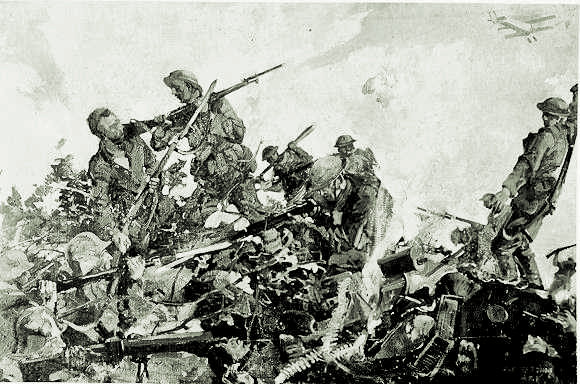


"The Capture of Blanc Mont" by War Artist George Harding


Major Hamilton's Leadership

You can't be any more in the center of the action than Major Hamilton was in "The Box."  In his first  battle as a battalion commander he displayed firm leadership under the most trying conditions.  

Hamilton's regimental commander, Colonel Feland, submitted this recommendation for the Distinguished Service Cross on 17 October 1918:

"During the 4th October. . . in the Battle of Blanc Mont Ridge. . . finding that certain elements had become disorganized by the shock of battle, [Major Hamilton] displayed the highest type of leadership by immediately taking charge of the situation and reorganizing the position.  In carrying out this self-assumed task, he displayed extraordinary heroism by fearlessly exposing himself to heavy shelling and direct and indirect machine gun fire, while personally placing in line the elements which had become disorganized."

Alas, this recommendation, as was his earlier Medal of Honor recommendation for his performance at Belleau Wood, was declined. His sole award for the day's effort, a Silver Star for his Victory Medal, today seems inadequate for his contributions at Blanc Mont.

Much has been written about Blanc Mont in the ensuing 105 years, multiple official and unofficial histories, some outstanding memoirs by the participants, and the 2011 full biography of George Hamilton by Mark Mortensen, the principal author of this article. This body of literature gives a fuller view of  Hamilton's leadership that day than was included in Colonel Feland's recommendation. A more thorough summary of George Hamilton's performance on 4 October 1918 might look something like this.

1.  As Colonel Feland put it in his postwar letter, "At the most critical moment of the day,—when the ill-conceived attack was failing and panic was in the air—Major Hamilton 'Saved the regiment from disaster.'"

2.  He also recognized and on his own initiative did his utmost to remedy through the course of the day, the regiment's and the division's greatest exposure, a left flank exposed due to the absence of French support.  

3. His skill and leadership at turning back the numerous enemy counterattacks likely staved off the annihilation of the entire Marine force.

4.  Despite being trapped in the killing zone that came to be known as "The Box," Major Hamilton maintained full control of his unit and kept it as an effective combat unit  despite suffering enormous casualties.

Sadly George Hamilton did not live long after the war. Here is his grave Arlington.


Sources: The bulk of this article has been selected from Mark Mortensen's,  George W. Hamilton, USMC: America's Greatest World War I Hero (See icon for ordering at the right),  with supplemental material from A Hideous Price: the Fourth Brigade at Blanc Mont by Lt. Col. Peter Owen and Lt. Col. John Swift, USMC;  "A Calamity of Errors: the Untold Story of the 5th Regiment at Blanc Mont Ridge on 4 October 1918" by James Gregory Jr., Drawings from Fix Bayonets! by John A. Thomason, USMC; "Capturing Blanc Mont Ridge" at the Doughboy Center Website; "Recollections of a Buck Private" by Clarence Richmond, USMC; Letter, "The Battle of Blanc Mont" by Eugene West, USMC.


Tuesday, October 3, 2023

The Beauty and the Sorrow, An Intimate History of the First World War


By Peter Englund
Vintage, 2012
Jane Mattisson, Reviewer


Arras Cathedral, Destroyed 1914


The Beauty and the Sorrow by the eminent Swedish historian Peter Englund is a European bestseller. Already available in 18 different languages, it is currently being translated into Estonian and is shortly to be translated into Chinese. Drawing on the diaries and letters of 20 individuals from both sides and from all around the world, The Beauty and the Sorrow is not a conventional history of the war. Instead, through personal letters, diaries, and other materials the book offers a unique insight into how the First World War was experienced, incorporating its tragedy, horror, absurdity, monotony, and even beauty. The selected individuals are not exceptional; they represent the experience of the average individual: male and female, soldier and non-combatant.

Peter Englund, professor, historian, and writer, was appointed permanent secretary of the Swedish Academy in 2008. He was awarded the August Prize in 1993 and the Selma Lagerlöf Literature Prize in 2002. His first collection of essays, Förflutenhetens landskap (1991, The Landscape of the Past) incorporates both "large history" in the form of war, revolution, and battlefields and "small history," focusing on the personal specifics of such entities as time, dirt, and terror.

The combination of the two is a recurring theme in Englund's work. He has also been a reporter for the Swedish newspapers Expressen and Dagens Nyheter, operating in such areas as Croatia, Bosnia, Afghanistan, and Iraq. A specialist in 17th-century history, he has published widely on the twentieth century, including Brev från nollpunkten (1996; Letters from Ground Zero). He has taught the First World War at university level for many years.


Author Peter Englund


Both the content and style of The Beauty and the Sorrow make it read like a novel. The twenty individuals listed at the beginning of the book as "Dramatis Personae" are presented as "characters" with specific wartime occupations. Their ages are also included, and through their eyes we experience a vast panorama of the horrors, hardships and even small pleasures that the war brought to countless individuals in every theater of conflict. Englund was surprised to discover that the diaries of women were particularly useful in identifying feelings. This isn't a question of gender, he maintains, but of circumstance: men were often to be found at the center of dramatic events; time for reflection or emotion was limited.

The Beauty and the Sorrow describes each year of the war in separate sections containing material by the 20 individuals selected. Each section opens with a chronology of the year to give context. The entries are accompanied by copious footnotes explaining references and place names, and provide useful background information. The entries are chosen on the basis of their relevance to the selected days and months of the year. Variety is ensured by the avoidance of two consecutive entries by the same individual. The number of entries is particularly large for the years 1915-1917. This, according to Englund, is due to the fact that the war did not begin until August 1914, and the most important battles and events took place between 1915 and 1917. In the edition to be published in 2014 (of which more shortly), additional material will be added to the section on 1918, most notably on the American involvement in the war.

It's particularly interesting that the content of The Beauty and the Sorrow is amended for each language and country: new individuals are introduced and others excluded to suit the country for which the edition has been translated. Englund has studied more than 1,000 individuals in total; this number is increasing as new editions are produced. Plans are under way to produce a collected edition incorporating all the translations and their various additional characters, and this comprehensive volume is to be published in 2014. All versions of the book include an excellent bibliography and a large selection of high-quality illustrations, including portraits or specific areas of fighting: the Western Front, East Africa, the Eastern Front, the Italian Front, the Balkans and the Dardanelles, and the Middle East. The index, comprising 15 pages, is detailed and informative.

In a telephone conversation I had with the author in 2013, he reflected on his position as a Swede recording the history of a war in which his own country played no active part. The Beauty and the Sorrow is dedicated to Carl Englund, a distant relative of the author. While Peter Englund is currently investigating the war career of this distant relative, he stresses that the latter has had no significant impact on the contents of The Beauty and the Sorrow. With regard to Englund's Swedish nationality, he sees this is an advantage because it gives him a political and personal distance to the subject. World War II is much better known in Sweden and is taught in secondary and high schools as well as at university. Englund hopes that The Beauty and the Sorrow will stimulate Swedish interest in World War I. His book is already an important addition to the human history of the Great War for readers of at least a score of languages.

Jane Mattisson

Monday, October 2, 2023

How the Bolling Mission Helped Create an American Air Force


Raynal Bolling, Corporate Lawyer


Air-mindedness [in the United States after the Wright Brothers' first flight] owed much to civic organizations, especially the Aero Club of America, founded in 1905, which drew its leadership from the captains of industry. The Aero Club was actually a federation of aviation clubs from across America that sponsored flying exhibitions, issued pilot’s licenses, and promoted a nascent aviation industry. Promoters of aviation envisioned growth of an aircraft industry as revolutionary as the automobile industry, which was then transforming American society. The Aero Club was a powerful lobby and had been largely responsible for legislation establishing the Aviation Section of the Signal Corps in 1914. The club also lobbied for the establishment of aviation units in the National Guard. Bolling organized one of these units in New York.

A Harvard-educated lawyer and an aviation enthusiast, Arkansas-born Raynal Bolling (1877–1918) served on several of the Aero Club’s executive committees, including those dealing with law, government affairs, and military aviation. He would become one of the key architects of American airpower. Many readers will recognize Bolling as the name of the USAF base near the Pentagon in Washington, DC. Bolling merited this honor for his role in creating American airpower during the Great War. He was also the senior U.S. Airman killed in action during the war. His part in the birth of American airpower exemplifies how the National Guard and reserves played an important role in the formation of an American air force—the prologue to today’s total force.

Bolling initially rose to fame as the chief lawyer for US Steel. At that time, it was the largest corporation in America and vitally important to any war effort. He helped defend US Steel from being broken up by President Theodore Roosevelt, “Teddy the Trust Buster.” He was also a member of the New York National Guard. “The Guard was a hotbed of early interest in aviation, and there were many efforts to form Guard aero units in various states, the most prominent being the New York.” Bolling’s interest in aviation, combined with financial support from the Aero Club of America, led to his founding of the 1st Aero Company of the New York National Guard in 1915.


Raynal Bolling, Aviator


Bolling’s command expanded to become the 1st Reserve Aero Squadron (1st RAS) after the passage of the National Defense Act of 1916, which originated the nation’s air reserve. His squadron was among the first aviation units sent to France in the summer of 1917. It was the core organization that built and expanded into a huge American aviation training center at Issoudun, France. Bolling’s second-in-command, Capt James Miller, took charge of the squadron after Bolling left and became the first commander at Issoudun. Another member of this squadron was 1st Lt Quentin Roosevelt, the youngest son of President Roosevelt. Captain Miller and Lieutenant Roosevelt later became pilots in the 1st Pursuit Group (1st PG), the ancestor of today’s 1st Fighter Wing. Both men were killed in air-to-air combat with the Germans.

Bolling did not accompany his squadron to France because he was called to Washington to help plan the creation of a wartime air force. His aviation expertise, contacts with industry, and knowledge of the law made him an especially valuable asset in crafting legislation to create American airpower. He and Foulois drafted the bill that became the $640 million appropriation. Foulois had also only recently come to Washington. He was one of the most experienced aviators in the regular Army.

After the passage of the historic aviation bill, Foulois and Bolling focused on the next major problem—how to translate the huge appropriation into a practical plan to man, train, organize, and equip an American air force. The United States was unprepared for war, and a strict policy of neutrality had minimized contact with the European allies. An air force needed modern combat aircraft, well-trained pilots, mechanics and support personnel, and a host of other items to create combat-ready squadrons. Bolling was sent to Europe to figure out what types of airplanes America should build.


The Bolling Mission Visiting the Italian Front

The “Bolling Mission”

Bolling led a group of officers, technicians, and other experts (more than 100 personnel) on what became known as the “Bolling Mission” to Europe to determine what types of airplanes the United States should manufacture. They met with aviation officials in Britain, France, and Italy. As a result of these meetings, Bolling realized that American aviation technology was so far behind that it would be necessary, at least initially, to rely upon the European Allies for airplanes. At this point in aviation history, the airplane reflected an immature technology, and unlike today, improvements were inexpensive and rapid. Also, the proximity of European aircraft designers and their factories to the battle area gave them a distinct advantage in turning out improved models based on combat experience.

As it turned out, American industry had so much difficulty producing acceptable warplanes that most of the AEF’s airplanes came from foreign sources. It was a scandalous failure for the nascent American aircraft industry, especially given the huge aviation bill passed by Congress. This disgrace resulted in a series of congressional investigations after the war. Accordingly, it is no surprise that France, which had the largest aviation industry in the world, supplied 80 percent of the AEF’s airplanes.

Bolling’s aircraft purchases were of great consequence. As one historian noted, “The Bolling Commission actually played one of the most important roles in the war.” This is because the numbers and types of aircraft that he recommended for production in the United States, as well as those purchased from the Allies, would shape the air strategy in terms of the weight of effort for air superiority, observation, and bombardment. The contract he negotiated with the French, known as the 30 August Agreement, in 1917, called for 875 training planes and 5,000 service-type aircraft. Since the war would be over in a little more than 14 months, these early decisions had significant impact. In the event, however, French manufacturers were unable to deliver on time, resulting in aircraft purchases from Britain and Italy.

General Pershing was so impressed with Bolling that he retained him in France, promoted him to colonel, and appointed him as chief of the Air Service’s line of communications. In addition to aircraft procurement, Bolling was responsible for logistics, reception of aviation units, and pilot training. The other main part of the Air Service was called the Zone Advance, where the training and organization centers were located. Col William “Billy” Mitchell was in charge of it.


USAF Headquarters Bears Raynal Bolling's Name

Benjamin Foulois, who had been organizing the Air Service and its facilities back in the States, arrived in France in November 1917 and reassigned both Bolling and Mitchell, effectively demoting them and replacing them with his own handpicked officers. The move would prove a major setback for the U.S. Air Service.

Foulois appointed Bolling as a liaison officer to the Royal Air Force. Bolling became the senior airman killed in the war when his car was ambushed by a German patrol while he was attempting to visit elements of two American aero squadrons that were attached to the British. The Germans had just launched their long-anticipated spring offensive, and the front line had dissolved in that sector.  His body, however, was never recovered.  

Bolling was the most knowledgeable officer on aircraft procurement. His loss contributed to the unhinging of the Foulois regime, but that's another story to be told elsewhere. Colonel Raynal Bolling was posthumously awarded the Distinguished Service Medal. His citation reads (in part): 

Colonel Bolling's service to the United States Aviation was distinguished for an accurate and comprehensive grasp of aviation matters; for a sound and far-sighted conception of the measures needed to establish an efficient American Air Service in Europe; for initiative and resourcefulness in attacking the problems of a young Air Service; for brilliant capacity in arranging affairs with foreign governments, for boldness and vigor in executing determined policies.

He is remembered on the wall of the missing at the Somme American Cemetery, Bony, France. Bolling Field, District of Columbia, now a part of Joint Base Anacostia-Bolling, was opened on 1 July 1918, and named to commemorate Bolling. Bolling Air Force Base has served as USAF Headquarters since 1947.

Source: Excerpted from "The Birth of American Airpower in World War I," by Dr. Bert Frandsen, Air University, 2017 


Sunday, October 1, 2023

Guarding the Siberian Railroads


The military intervention into Siberia can be divided into three stages. These divisions are based more on official clarifications of duties, rather than any changes in military policy. A continuity, a consistency is present throughout the entire period of U.S. intervention, primarily to facilitate counterrevolution. The first stage is the period between the landing of U.S. troops and the acceptance by Washington of the Inter-Allied Railway Agreement (IARA) on 9 February 1919. The IARA imposed military control on the Siberian railways by clearly defining the respective responsibilities of the intervening forces on various sectors of the railway. For the Americans, this would confirm duties already assumed and create new ones.

The Railway Agreement of February formalized some of these winter arrangements and added others. Although finalized in February, it took an additional two months to sort out which Allied force would protect each specific sector. (See map above.) Some 550 U.S. troops became responsible for the line running immediately out of Vladivostok to the town of Nikolsk-Ussuri, 68 miles north. Nikolsk-Ussuri, a town of 52,000 inhabitants, served as the juncture of the Ussuri line continuing to Khabarovsk and the Chinese Eastern Railroad, which crossed Manchuria, later to reenter Siberia. At Spasskoe, continuing north, 1,700 troops were responsible for the length of line leading to the town of Ussuri and the 40-foot-long bridge crossing the river Ussuri 217 miles from Vladivostok. Another 1,900 troops were assigned to guard a branch line from Ulgonaya to the coal mines at Suchan. Two thousand men were also stationed 1,700 miles west to maintain the stretch of line between Verkhe-Udinsk and Mysovaya, where the Trans-Siberian reached the network of 38 tunnels linking eastern and western Siberia.


U.S. Railroad Guard Detail


With the railway agreement practicably enacted, U.S. troops were immediately confronted by the dilemma of professed "non-interference" while participating in counterrevolution. Graves continued to maintain his "neutrality" regardless, which in essence was to keep his expeditionary force as disentangled from the mire of civil war as long as possible. In a proclamation given to his troops to distribute in their sectors he outlined that:

The sole object and purpose of the armed forces of the United States of America. . . is to protect the railroad and railway property and ensure the operation of passenger and freight trains through such sector without obstruction or interruption.


Hospital Car on American Train


The proclamation initially left the partisan guerrillas wondering just who the "Amerikanskij soldat" was. They soon made up their minds. As such order on the railroad only benefited one side, the U.S. soldiers soon became justifiable targets of the partisans. Just as it allowed supplies to roll to counterrevolution forces in western Siberia, Allied control of the railways made White control of the east possible. White representatives in eastern Siberia used order on the railroad to either starve or attack "Bolshevist" areas. "We are making this condition possible," Graves wired Washington, "by our presence here."

Even before U.S. sectors were chosen, U.S. troops north of Vladivostok were preparing for "anticipated...guerrilla warfare or general revolution with the recession of winter" due to the "unsettled political and economic conditions in eastern Siberia." As early as 14 March, partisans fired upon trains and "information was received that the partisans were recruiting for a vigorous spring drive against the Kolchak government." By late spring, U.S. forces finally settled in their allotted sectors, became swept up in that vigorous drive. Throughout March and April, attacks on rail freight, tack, and bridges increased. In May, Graves decided that to properly maintain "order" on the railways, U.S. troops would have to follow the attacking partisans into the surrounding countryside. 

The first active campaign began on 21 May in the vicinity of Maihe in the Ulgonaya-Suchan sector. Throughout the summer of 1919, the history of the AEF in eastern Siberia is one of skirmishes, attacks, and forays into the surrounding hills and valleys. On numerous occasions American combat patrols fought in conjunction with White Russian and Japanese forces. Thirty-five U.S. soldiers were to fall in this partisan war and an additional 52 were wounded. Eighteen died on the morning of 25 June near the village of Romanovka during a dawn raid on their encampment. [Figures corrected 8 October 2023.]

Source:  St. Mihiel Trip-Wire, June 2020