Now all roads lead to France and heavy is the tread
Of the living; but the dead returning lightly dance.
Edward Thomas, Roads

Monday, April 11, 2016

Sheldon, When Are You Going to Connect the Big Bang Theory and the Great War?

Dr. Sheldon Cooper, Well-Known Theoretical Physicist

Eidetic memory, or what is commonly described as photographic, is possessed by few.  The Wikipedia article about credible claimants to the almost magical ability has a very short list with only a few recognizable names like Nikola Tesla, Arturo Toscanini, and (surprise!) Ferdinand Marcos. However, TV fans know one name left off the listing is that of the internationally known theoretical physicist from east Texas, Sheldon Cooper.

And I have a grievance to address to Dr. Cooper today.

In eight seasons as the star of a series titled The Big Bang Theory, in which you have chosen to share almost every arcane fact of science running around in the enormous brain of yours, you have thus far failed to mention the fascinating connections of the actual "Big Bang Theory" (henceforth the BBT) with the First World War. For shame! Could it be possible that your eidetic memory has never been exposed to the pertinent details?  

Father Lemaître Proudly Wearing
His Military Medals
If that's the case, perhaps one of our readers located around Hollywood or Pasadena, California, will pass this on, so you can absorb it and share it with your millions of viewers.

The two individuals most important for the formulation and acceptance of the BBT were both soldiers in the First World War. One was even an artillery officer. (Artillery pieces make big bangs — get it, Sheldon?)

Georges Lemaître was the artillery officer.  After serving in the war with Belgian Army, he became a priest, and a distinguished astrophysicist. He first posited that the universe began as a condensed primeval singularity that exploded, creating the force by which the universe is still expanding.  

His theory did not  get much support at first because the theorists of the time, such as the already incredibly famous Albert Einstein, believed in a steady-state model of the universe.  However, another Great War veteran came along,and provided the first supporting evidence for the BBT.


Edwin Hubble During the War
Edwin Hubble formerly a commander of an infantry battalion of the 86th Division, American Expeditionary Force, (who probably also heard a lot of big bangs on the Western Front) later found himself head astronomer of the Wilson Observatory with a really big telescope at his disposal. He was the first to offer observational evidence supporting the theory of the expanding universe. 

He noted that the more distant a galaxy, the greater its red shift and hence its velocity relative to our galaxy.  In other words, the universe is expanding roughly uniformly, a finding consistent with the BBT and contrary to the steady-state model.

Advocates of the two theories wrestled about it over several decades, but more evidence came in, including from the Hubble Telescope (named after the former infantryman). Possibly Dr. Sheldon Cooper at Cal Tech is working on another model, but most of his colleagues today accept the BBT.

Sunday, April 10, 2016

Recommended: "Into the Trenches: The U.S. Army Artists of WWI"


The National Museum of the United States Army has put together a remarkable display of their official art from the Great War.  Some pieces on display have seen considerable circulation, but some I've seen for the first time, including one of gas victims as moving as Sargent's famous painting at the Imperial War Museum.

Here is one action-oriented piece from the collection, by my favorite of the eight official U.S. Army artists, George Matthews Harding —


Commentary:

In this charcoal sketch of the fighting during the Meuse-Argonne Offensive, American infantrymen, supported by a light tank, storm a German machine gun nest at bayonet point. A German potato masher grenade flies overhead, attesting to the ferocity of the hand-to-hand fight. The artist George Harding recalled, “…there is little chance of studying the subject beforehand. If an attack is scheduled, it happens rain or shine, night or day…to know his material, the war artist puts on a steel helmet, his gas mask, his trench boots, his trench coat and laden with only a sketch book, a couple of pencils and some emergency rations in his pockets, like any soldier present, he takes his chances…”

View All the Collection:

Saturday, April 9, 2016

A Verdun Chronology


 As the centennial of the Battle of Verdun unfolds I thought a chronology would help our readers follow the big anniversaries of the Great War's longest battle. Today 100 years ago the German Army launched a major operation to capture the heights of Mort Homme and Cote 304 on the left bank of the Meuse.

Verdun Chronology


21 Feb: Offense begins on right (east) bank of Meuse

25 Feb: Fort Douaumont captured; Pétain takes over 2nd Army and the defense of Verdun

6 Mar: German offensive expands to left bank of Meuse


German Assault Troops

9 April: Major attack on left bank against Mort Homme and Hill 304

30 April: Robert Nivelle replaces Pétain as Second Army commander

8 May: Explosion in Fort Douaumont kills 679 German soldiers
General Nivelle

7 June: Fort Vaux surrenders

12 June: Bayonet Trench incident

23 June: Nivelle's order of the day "They shall not pass!"

29 June: Hill 304 in German hands

1 July: Battle of Somme begins relieving pressure on the French

12 July: Assault on Fort Souville on right bank marks German high-water point at Verdun

29 August: Falkenhayn resigns as chief of the German General Staff; replaced by Paul von Hindenburg

4 Sept: Explosion in Tavannes Tunnel kills over 500 French

24 October: Fort Douaumont abandoned by Germans and recaptured

2 Nov: Fort Vaux recaptured

15 Dec: Major French attacks push line back close to February position on right bank


Fleury Village

18 Dec: Major operations around Verdun halted

1917
20 Aug: Mort Homme recaptured by French

1918
12 & 26 Sep: U.S. First Army launches major offensives in Verdun sector


Friday, April 8, 2016

A Belgian-American Wartime Friendship Recalled Due to Recent Events


Contributed by Alexa Gregory

Marion Otis Mitchell
As we recover from the shock of the terror in Belgium and send our thoughts and prayers their way, I am reminded of the incredible connection I recently made with one of their own over a poem written nearly 100 years ago.

I have been working on the letters of my great-aunt Marion Otis Mitchell sent from the back of the front from 1917 to 1918 for over a year now and created a website to share my progress with whoever may be interested. Just over a month ago, I got an email through the website from a Jacques Van Melle, who said he had found our site, MitchellSisters.com after searching for Marion Mitchell. He said: 

I am the grandson of Georges Van Melle (1888–1944) Belgian soldier at the 9 ième régiment de ligne of the Belgian army and poet (poète-soldat) at the front near the river the Yser (in Flanders Fields). He went regularly to Nancy to visit his brother Joseph Van Melle who was during the war a publisher of books for the Belgian government.

I made a study of my grandfather during the war years and discovered some letters where he speaks of a Miss Marion Mitchell working for the American Red Cross in the neighborhood of Nancy. Via his brother my grandfather Georges knew Marion Mitchell. According to the notes my grandfather made, it is possible they met for the first time the 16th of July 1918 during an excursion with his brother Joseph at Liverdun near Nancy.


Boating at Liverdun:
Unknown, Unknown, Joseph, Georges, Marion (L-R), 16 July 1918

Marion translated a poem of Georges's, "La mort Rode," around September 1918. It could be translated as "Death seeketh whom he may devour". This translation that I do not possess was strongly appreciated by Georges in his letters to his brother. Is it possible for you to confirm this is really the woman my grandfather met and is there a trace of him in writings of Miss Mitchell, and possibly do you possess the manuscript of the famous translation of his poem? It would be very important for me to know if I'm right and I would be very grateful if you could react to this mail.

Georges and Joseph Van Melle, 25 July 1916

I had seen Joseph Van Melle (1884–1970) director of Berger-Levrault, a publishing house in Nancy, France, mentioned in some of Marion’s letters and in fact Marion translated a guidebook to Nancy for Joseph towards the end of the war, of which I have a copy. I went to the scrapbooks I inherited from Marion and found not only pictures of the Van Melles but also a typed transcription of the poem that Georges so liked and that Jacques had been searching for. 

Thank you very much for these unique documents. I didn't know Marion translated some other poems and writings of my grandfather such as Nuits d'hiver (Winter Nights) which is in my view his most patriotic poem, "apparition" is a beautiful hymn addressed to the Belgian soldier and homing thoughts (la pensée du retour) was the reality of these soldiers during four long years; their parents and loved ones lived in occupied Belgium only some 50 kilometers from the trenches but they did not see each other for four long years.

Marion wrote on the top of this clipping:

“Geo. Van Melle is “our” Van Melle’s brother. I am translating a long poem by him, which I am going to send to the Atlantic if it is good enough. The original is splendid. “


Georges was certainly not an adorer of the war, he was influenced by Romain Roland the great pacifist author and this you can read in La mort Rôde so well translated by Marion as "Death is abroad" but more intensely in some other poems like "le tourment dominical" (not publicized during the war…too dangerous...). Georges died during the second war in 1944 due to the permanent illness (cardiac problems) directly caused by the very hard conditions at the Yser front in the winter of 1915 and 1916. He left his wife with 5 young children...

Georges at the Front
In correspondence with Jacques a couple of days ago, after making sure he and his family were safe, Jacques responded with this: 

This barbarism shows we have to fight every day for keeping our values of tolerance, democracy, values our grandparents always kept in mind even during la Grande Guerre. . .

This project of finding ways to share the story of my grandmother and great-aunt in France during the Great War has been an amazing journey and has brought me many new friends united by what happened one hundred years ago. I look forward to the next serendipitous connection and discovery. 

The photos of Georges Van Melle in uniform and with his brother are courtesy of Jacques Van Melle. Other photos are from the Mitchell Sisters collection.


About Our Project:

Alexa Gregory
alexa@mitchellsisters.com

An American Woman's WWI Journal: At the Back of the Front — Marion Otis Mitchell
Editors: Alexa Gregory and Vicki Rondeau

Follow us on:
mitchellsisters.com
Facebook.com/mitchellsisters

Thursday, April 7, 2016

The Order of the White Feather


This is a replica of a "certificate" from the so called "Ancient and Disloyal Order of the White Feather." Some patriotic women felt that young and able men who had not enlisted to fight were cowards and hoped to shame them into action by handing them a white feather as a symbol of cowardice. In fact, many of those who were not fighting were medically unfit, working in essential occupations, had fought and been discharged with injuries that were not obvious, and so on. Many conscientious objectors did serve as stretcher bearers and medics rather than fight. 

The words handwritten around the edge of this "certificate" read

You dirty cowardly skunk. When heroes return you will know it. The finger of scorn will be pointed at you coward.


Source: Story of Leicester Website

Wednesday, April 6, 2016

The Centennial at the Grass Roots: California and the Great War in 1916

I have been supplying some information to the lead state agency in California, the Department of Veterans Affairs, for proposing a Centennial World War I Commission for our state.  To respond to possible questions along these lines, "How was California involved before the April 1917 Declaration of War?" I sent the following email. I believe some similar statement could be made for every state in the Union.  I invite our readers to submit similar entries for your states or hometowns.

Captain Nelson Holderman, on the Left, Served with the California National Guard 
on the Mexican Border in 1916 and  Later Would Receive the Medal of Honor 
for Service with the Lost Battalion in the Argonne Forest

1.  In 1916 California mobilized 135,000 National Guardsmen for service on the Mexican border. Frankly, most of the troops and most Americans didn't quite understand the Wilson Administration's policy with respect to Mexico. However, this whole brouhaha is considered part of the American run-up to involvement in the Great War, connected to the preparedness of the army, General Pershing, and the Zimmerman Telegram of early 1917, which tried to entice Mexico into joining the war against America.

More on this at:
http://www.militarymuseum.org/MexBdr1916.html

Aftermath of the Preparedness Day Bombing

2.  The Preparedness Day bombing in San Francisco on 22 July 1916 that killed about ten people and injured many more was a BIG DEAL at the time, and it links the terrorism of the times to the world of today.

More on this at:
http://www.history.com/this-day-in-history/preparedness-day-bombing-in-san-francisco

Holt Tractor Model 120, Note the Tracks, Later Adapted for Tanks

3.  The Holt Tractor Company of Stockton, California, was intimately involved in the development of the tank, which debuted in combat on 15 September 1916 in the Battle of the Somme.

More on this at:
http://www.firstworldwar.com/atoz/holttractor.htm

Tuesday, April 5, 2016

A Higher Form of Killing
reviewed by David F. Beer


A Higher Form of Killing: Six Weeks in World War I That Forever Changed the Nature of Warfare
by Diana Preston
Bloomsbury Press, 2015

Zeppelin Bomber


In 1835 the poet Tennyson wrote in "Locksley Hall" how he had

Heard the heavens fill with shouting, 
 And there rain'd a ghastly dew 
 From the nations' airy navies 
 Grappling in the central blue. . .,


and just over a century later a perceptive Archbishop of Canterbury, referring to the aerial bombardment of Guernica in 1937, coined a phrase we are all only too familiar with today:

Who can think at this present time without a sickening of the heart of the appalling slaughter, the suffering, the manifold misery brought by war to Spain..? Who can think without horror of what another widespread war would mean, waged as it would be with all the new weapons of mass destruction?

Weapons of mass destruction. We rarely think of them as originating in the First World War, yet, as Diana Preston convincingly argues in her impressive A Higher Form of Killing, such weapons ominously made their first significant appearances in a brief six-week period in 1915. These six weeks were to see the appearance of poison gas, the sinking of ships (including passenger ships) by submarines, and the beginning of mass aerial bombing — first by zeppelins and then by bombers. Preston chronicles the development and employment of the first use of each of these means of destruction in WWI. She is a master of detailed description. We learn much about the technology of each of these means of warfare and also much about the people involved in creating, using, and suffering from them. Prominent leaders are cited, as are soldiers in the trenches and civilians in the streets. Throughout the book, American involvement is not neglected.

 "Order Now
Although we may be familiar with a lot of what the author deals with, there are also plenty of surprises — at least there were for me. I had very little knowledge, for example, of the international movements before the war that dealt with, as the author calls it, "Humanising War." In the initial chapters Preston gives a lively account of the history, planning, philosophizing, ethical questioning, and politics leading up to the Hague Conferences of May 1899 and June 1907. These were as fascinating and busy (and ultimately disappointing) as the Versailles gathering of 1919. In the light of eventual experience, we can only wish the conferences had been attended by delegates who were less cynical and more well intentioned. As it turned out, Germany was to be the first to violate the protocols that did emerge from the conferences.

In the accounts of poisonous gas development and use we frequently meet the ultimately tragic figure of Fritz Haber, the German-Jewish patriot and "father" of poison gas weapons. As a chemist and head of the Kaiser Wilhelm Institute he worked on various projects in support of Germany's war effort and created increasingly dreadful types of poisonous gas. He oversaw the release of chlorine gas at Ypres in 1915 and developed cyanide and mustard gas. After the first gas attack, the Times informed its readers that

. . .the wholesale employment of asphyxiating gases against the French is a fresh indication of the temper in which the Germans are now waging war. It is to the use of these gases in a manner forbidden by the Hague Convention, which Germany signed, that the retirement of the French on Thursday is attributed (p. 116).

Depiction of the First Gas Attack on the Western Front

This was all too much for Haber's wife, who committed suicide on 1 May. But her death was not enough to prevent her husband from making a trip within hours to Russia to supervise the deployment of gas against Russian troops near Warsaw (and missing her funeral). Ironically, he was awarded the Nobel Prize for Chemistry in 1919. Haber's sad later years are also described by Preston, and we end up with a full picture of this now almost forgotten figure.

The background and operation of Britain's blockade and Germany's U-boat war are as fully treated in these pages as are gas and bombing. No one, sailor or civilian, is immune to the submarine and its torpedoes. Starvation is the basic goal of both sides — Germany's to sink enough British tonnage to starve the nation to submission while Britain's aim is to prevent as much food and other supplies as possible from getting to Germany. Introductory to this saga is the "wilful and wholesale murder" perpetrated on 1198 people aboard the Lusitania and the political and moral questions that inevitably arise in both Britain and America. Preston's discussion of this, plus a riveting description of the ship's end, maintain the overall quality of her book.

When Preston turns to aerial warfare she is as thorough and captivating as she is in the rest of this volume. From the structure of the zeppelins to their various payloads and the strains placed on their crews, the author provides numerous details. Her description of these "sausages" over London and elsewhere are eerily graphic. Air warfare develops even further with the appearance of bombers, especially the Gothas, and the damage to life and property, especially in London, eventually totals considerably more than many of us realize. The terrible vision of Tennyson has come true, as we hear in the words of the American reporter William G. Shepherd:

Suddenly you realize that the biggest city in the world has become the night battlefield on which seven million harmless men, women and children live. Here is war at the very heart of civilization, threatening all the millions of things that human hearts and human minds have created in past centuries. (p. 211)

U-boat Sinking a Sailing Ship

As we read A Higher Form of Killing, we come to see the dreadful irony behind the title the author has chosen. Moreover, no matter how much we know about the Great War, this book gives us a lot of information that is not particularly well known. It also provides some refreshingly new insights and ways of looking at the historical facts. As a bonus, we find that the clear and breezy style in which the author presents her material adds to the appeal of an informative and thought-provoking read.

David F. Beer

Monday, April 4, 2016

Verdun's Greatest Hero: Henri-Philippe Pétain


Henri-Philippe Pétain is most remembered today as the convicted traitor of the Second World War, but he truly endeared himself to the French nation during World War I. Verdun played the biggest part of his ascension to national hero.

By April 1916 Pétain's Role at Verdun Was Already Well Recognized

Beginning the war as an obscure 58-year-old colonel in command of an infantry brigade, Pétain rose quickly in rank, assuming command of the Sixth Division in September 1914, the Thirty-third Corps in October, and the Second Army in June 1915. From the start, he distinguished himself by his meticulous attention to detail, his careful preparation, and his reliance on artillery. His talents became most apparent when his Second Army played a large role in the September 1915 offensive in Champagne. The French failed to break through German defensive lines, but Pétain’s after-action report identified shortcomings in French methods and provided important ideas about future operations.

On 25 February 1916,  the day Fort Douaumont fell, Pétain became commander of French forces at Verdun. In the terrible destruction of what the French soldiers called the “furnace,” he finally succeeded in halting the Germans. Though the French suffered huge losses, Pétain’s careful husbanding of his troops avoided even greater bloodshed. Among his innovations, he introduced the noria system, which rotated divisions in and out of the trenches without permitting them to become ineffective in combat. (The noria system was named after a device used to raise water from a well, which consisted of a revolving chain of buckets that filled at the bottom of the well and emptied at the top.) Despite Pétain’s success and his concern for his soldiers, General Robert Nivelle was chosen to replace General Marshal Joseph Joffre as commander of French forces; Nivelle then brought France to the edge of disaster with his ruinous offensive in April 1917. With much of the army in mutiny, Pétain replaced Nivelle in May.

Joffre and Pétain at the Souilly Headquarters on the Voie Sacrée

In subsequent months, Pétain revived the French Army by meting out a combination of rewards and punishments, including about 55 executions (not the hundreds that some critics have alleged). He also insisted on limited offensives in which massive amounts of artillery prepared the way for the infantry. In October Pétain launched an attack on the fortress of La Malmaison in the Chemin des Dames, near where Nivelle’s offensive had failed, and successfully seized this dominating piece of terrain. His success and his careful methods convinced French soldiers that he would not needlessly waste their lives. For the remainder of the war, Pétain remained in command of French forces, though General Ferdinand Foch leaped over him to become supreme commander of Allied forces. Other French leaders, including Foch, frequently criticized Pétain for his pessimism and caution, but he nevertheless established a particularly strong relationship with the American commander, General John J. Pershing.

Pétain had a significant influence over French forces in the interwar period, but his role has sometimes been exaggerated. Others made greater contributions in structuring and preparing French forces for the next war. Nevertheless, he played an important part in the design and placement of the Maginot line; he himself chose the best sites for its major fortresses. Eventually, however, another war would come and Pétain's reputation would crash.

Source: History Today and the History Channel

Saturday, April 2, 2016

New Art Exhibit at the National World War I Museum

IMAGES OF THE GREAT WAR: 
The European Offensives, 1914–1916


Just opened and on display until October is this exhibition focusing  on the art and events of the first two years of the Great War, beginning with the invasion of Belgium and the campaign on the Marne and concluding with the fruitless efforts of the Allies to break the stalemate on the Somme. This selection includes works by French, British, Italian, German, Dutch, Austrian, Turkish, and Swiss artists and is truly a visual representation of World War I from multiple perspectives.

The exhibition was organized by Brown University Library and The President Woodrow Wilson House, a National Trust Historic Site, Washington, D.C., curated by Peter Harrington and Stephanie Daugherty and sponsored by the Abend Family Philanthropic Fund. It is on display through 9 October 2016 at the:

NATIONAL WORLD WAR I MUSEUM AND MEMORIAL
100 W. 26th Street, Kansas City, MO 64108 

Here are a few of the works to be seen:

Vorposten by Bernhardt Winter

French soldiers leading German prisoners by Hansi

Attaque de bersaglieri italiens contre les troupes autrichiennes
sur les hautes et âpres montagnes de l'Isonzo
by Cesare Tallone

Infantryman Asleep in Cave Shelter by Anton Sussman


Friday, April 1, 2016

The Western Front in My Back Yard


I have been blessed with a hiking location just a few miles from my home in the East Bay area of Northern California, which — for reasons that will be explained below — provides me with many reminders of the Western Front. As you might guess, this is quite inspiring for someone who regularly leads tours of the actual battlefields.  Before I share a little history of this site, let me show you some images of my favorite walking trails, at 2,300 acre Point Pinole Regional Shoreline, and share how some of the stops bring distant locations to mind.

Entrance Signage


Crossing the Rail Bridge from the Parking Lot into the Main Park, Reminds Me of
Hill 60 at Ypres and the Site of Caterpillar Mine Crater to the Right


A Bunker in the Woods


There Are Trench Remains Everywhere You Look
Just One Example Here


Demolished Site, Reminiscent of Y-Ravine at Beaumont Hamel on the Somme


A Sunken Artillery Position


Hillside Pillbox


Field Fortification


Same Site Up Close


Different Vegetation, But This Always Reminds Me of the Wheat Field
the Marines Crossed at Belleau Wood 

Point Pinole has been a regional park since 1973. The previous owner was the Atlas Powder Company, one of several firms that manufactured gunpowder and dynamite at the site for a century. This is why it has bunkers and protected areas all over the site. There are craters formerly used as blast and burning areas and what appear to be trails where the routes for the mini-trains used to shuttle material around the site.  These companies have an interesting financial history tracing back to the entrepreneurship of none other than Alfred Nobel and the anti-trust breakup of the DuPont Powder Company. 

As you might guess, this West Coast plant for Atlas Powder did a lot of work during the Great War.  I don't have statistics for the Pinole site, but the firms derived from the trust breakup are said to have manufactured 40 percent of the munitions used by the Allies and the U.S. in the war, making well over a billion dollars (1914 dollars) during the war years.

What I do know for sure is that we ended up with a great and evocative park.


Thursday, March 31, 2016

The Great War and the Growth of Government, Part II:
Governments Sponsoring Scientific Research


According to the American Association for the Advancement of Science, the current federal spending on R&D is $146 billion, slightly more than half of which is defense related. From early days the U.S. government has taken an active interest in scientific matters. During the 19th century the Coast and Geodetic Survey, the Naval Observatory, the Department of Agriculture, and the Geological Survey were established. The First World War, however, helped establish and entrench state-sponsored and -directed Research and Development as a public duty and necessity. Rapid development of new weaponry, ersatz strategic materials, and more productive manufacturing processes became an imperative of national survival in total war.

Rocketry Pioneer Robert H. Goddard
Developed the Prototype for the Bazooka During WWI

The World War I  model of the command economy in these new technologies, as well as in investment and distribution, was enduring and seductive. Thorstein Veblen, Herbert Hoover, and assorted technocrats invoked it in the United States.  Later, their successes in the war would inspire the New Deal of the future President, Assistant Navy Secretary Franklin Roosevelt.

As the American Civil War produced the National Academy of Sciences and Land Grant colleges, the Great War produced the National Research Council and NASA's predecessor, the National Advisory Council for Aeronautics. The Smithsonian Institution was called upon to recommend scientists to advise and staff many projects, such as Dr. Goddard's work for the Navy..

Source: The Heavens and the Earth by Walter McDougall, National Science Foundation

Wednesday, March 30, 2016

The Great War and the Growth of Government, Part I:
FOOD: A Great Excuse for Invasive Government


One of the lasting effects of the Great War is that it showed governments they could invent novel excuses for new intruding into the lives of their citizens.  All of this was done out of "best intentions," of course, but it was a very big step toward the bureaucratization and regulation of American life, ever-increasing as it has been up to today. One case study from the U.S. National Archives involved FOOD.  


Even in peaceful times Americans frequently debate fundamental questions about government: What should the federal government do? What does the Constitution sanction? What does it prohibit? What is the relationship between governmental action and volunteerism? During wars, declared or not, Americans argue even more fervently as they often witness government undertaking different and more numerous roles than it undertakes during peacetime.

From the outbreak of World War I in Europe until the signing of the Versailles Treaty, the Wilson administration proposed and implemented an extraordinary number of programs that affected the lives of Americans in their everyday activities. Even the Progressives, who tended to favor more state and federal responsibility, must have been dazed at the expansion of government action beyond the conventional arenas of public policy.

The Lever Act of 1917 represents both the normal working of American government and the extraordinary circumstances of World War I. The process of creating the Lever Act certainly followed the "legislative dance" outlined in the Constitution and by congressional custom. Entries in the indexes to the New York Times for 1917 testify to the accepted but various interests of members of Congress in supporting or opposing the legislation; other entries show the range of lobbyists interested in supporting or opposing the bill. In this, the legislative dance seemed typically American: proposed legislation, support or opposition from special interest groups, legislative revision, and congressional hearings. In August 1917, the dance ended. Congress passed the Food and Fuel Control Act (40 Stat. 276), also known as the Lever Act.

Passage of the bill did not immediately impact the American public. Like any federal legislation, the Food and Fuel Control Act faced the next normal step: implementation, the stage of policy making between the establishment of a policy and the consequences of the policy for the people it affects. With the authority and power granted to him by Congress in the legislation, on 10 August 1917, President Woodrow Wilson issued Executive Order 2679-A creating the U. S. Food Administration. In doing so, he created a government entity to replace an existing volunteer organization. The U. S. Food Administration, operating in each state, was to

  • Assure the supply, distribution, and conservation of food during the war,
  • Facilitate transportation of food and prevent monopolies and hoarding, and
  • Maintain governmental power over foods by using voluntary agreements and a licensing system.
  • Using the same authority, Wilson created two subsidiaries, the U. S. Grain Corporation and the U. S. Sugar Equalization Board. Together these bodies would extraordinarily impact American lives.

Herbert Hoover, former head of the Belgian Relief Organization, lobbied for and won the job of administrator of the Food Administration. Hoover had made clear to President Wilson that a single, authoritative administrator should head the effort, not a board. This, he believed, would ensure an effective federal organization. He further insisted that he accept no salary. Taking no pay, he argued, would give him the moral authority he needed to ask the American people to sacrifice to support the war effort. As he later wrote in his memoirs, his job was to ask people to "Go back to simple food, simple clothes, simple pleasures. Pray hard, work hard, sleep hard, and play hard. Do it all courageously and cheerfully."

Herbert Hoover, January 1917
As head of the U. S. Food Administration, Hoover, given the authority by Wilson, became a "food dictator." [Apparently, the phenomenon of Federal "czars" is not a new one.] The Lever Act had given the president power to regulate the distribution, export, import, purchase, and storage of food. Wilson passed that power on to Hoover. To succeed, Hoover designed an effort that would appeal to the American sense of volunteerism and avoid coercion. In designing the program, he adopted a federal approach, combining centralized power and decentralized power. He oversaw federal corporations and national trade associations, and he sought cooperation of local buyers and sellers. Through it all he called for patriotism and sacrifices that would increase production and decrease food consumption. "Food," Hoover and the administration proclaimed, "will win the war."

"No aspect of the people's lives remained unchanged," wrote one historian in assessing the effect of this board and its companions, the War Industries Board and the Fuel Administration. Under Hoover's direction, the Food Administration, in league with the Council of Defense, urged all homeowners to sign pledge cards that testified to their efforts to conserve food. The government boards issued the appeal on a Friday. By the following week, Americans had embraced wheatless Mondays, meatless Tuesdays, porkless Saturdays. According to a sesquicentennial article in the Milwaukee Journal Sentinel, in Wisconsin's Green Lake County 100 percent of the housewives signed on and 80 percent of Milwaukee did. Schoolchildren joined housewives in supporting the effort by signing this pledge: "At table I'll not leave a scrap of food upon my plate. And I'll not eat between meals, but for supper time I'll wait." In support of the war effort, Americans discovered nouveau menus filled with dogfish, sugarless candy, whale meat, and horse steaks. They planted victory gardens and prized leftovers. Even President Wilson cooperated, grazing sheep on the White House lawns. The emphasis on voluntary support worked.

While Hoover preferred the emphasis on the "spirit of self sacrifice," he also had authority to coerce. He set wheat prices and bought and distributed wheat. Coercion plus volunteerism produced results. By 1918 the United States was exporting three times as much breadstuffs, meat, and sugar as it had prior to the war.

To achieve the results, the Food Administration combined an emphasis on patriotism with the lure of advertising created by its own Advertising Section. This section produced a wealth of posters for both outdoor and indoor display. One proclaimed: "Food is Ammunition—Don't waste it." Another featured a woman clothed in stars and stripes reaching out to embrace the message: "Be Patriotic sign your country's pledge to save the food." A third combined patriotism with a modern healthy diet message. At the top, the poster encouraged readers to: "Eat more corn, oats and rye products–fish and poultry—fruits, vegetables and potatoes, baked, boiled and broiled foods." At the bottom, the poster concluded, "Eat less wheat, meat, sugar and fats to save for the army and our allies." All of these posters, now part of Record Group 4, the Records of the U. S. Food Administration, testify to the intent of the government to mobilize the food effort during World War I. As much as possible, it did so under a banner of volunteerism, rather than coercion. In doing so, the Wilson administration created a program that did affect the everyday lives of Americans during World War I.

An executive order of 21 August 1920, terminated the remaining branches of the U.S. Food Administration.

Source: U.S. National Archives and Records Administration Website

Tuesday, March 29, 2016

Tommy: The British Soldier on the Western Front 1914–1918
reviewed by Jane Mattisson Ekstam


Tommy: The British Soldier on the Western Front 1914–1918
by Richard Holmes
Harper Perennial, 2004


Tommies After a Victory

Tommy is an interpretation of the personal lives of British soldiers during World War One. It addresses such wide-ranging issues as battle, rest, trench love affairs, the shooting of prisoners, barbed wire, rats, horses, nicknames, communal singing, and food. Because much of what we know has come through literature, it is important to provide a different story, argues Holmes, one that is not preoccupied with battles, political, strategic and operational issues but with "the men who actually fought the war" (xxiii). Tommy is based neither on interviews nor on memory but on what people thought at the time. Letters, diaries, and an assortment of ephemera are Holmes's most important sources. He illustrates, for example, that "there is something unutterably poignant about a diary entry written by somebody who didn't know whether he would be alive to eat his supper that day" (xxiv). Divided into six chapters ("The old front line," "Flesh and blood," "Brain and nerve," "Earth and wire," "Steel and fire," and "Heart and soul"), Tommy contains numerous personal accounts of soldiers of different ranks and from different social classes. A few examples are given below to show the range and poignancy of the material. With respect to diaries, Corporal John Lucy describes the retreat from Mons in August 1914 and the enormous pressure on the men:

I rate Tymble for lurching out of his section of fours, and he tells me to go to bloody hell. I say: 'Shut up, cover over, and get the step.' He tells me that bastards like me ought to be shot for annoying the troops and it would not take him long to do it. I get annoyed, and moving close to him ask him what he would suppose I would be doing while he was loading up to shoot me. His comrade nudges him. He twitters like a drunkard, wipes his mouth wearily with his sleeve, and says he is sorry. A bad business. Too much on the men when they begin to talk like that (31).


Order Now
Diary entries are highly evocative not only because the writer does not know if he is about to die but also because of their sparseness. An entry from Captain Rowland Fielding's diary, which covers two consecutive days in May 1915, is a case in point. The first day begins at 5 p.m. with Fielding's arrival in the trenches. This is followed by a series of messages (each outlined in brief); these begin at 6:45 p.m. and continue until 2 a.m. Fielding goes to bed at 3:30 a.m., is woken at various points during the night to respond to messages, orders the re-burying of "a Fritz who, owing to a night's rain, has suddenly appeared in Regent Street" (186), and receives an unexpected visit from the brigadier-general and staff. The brevity of the latter's order serves to emphasize Fielding's frustration — "everything that has been dug out [is] to be filled in and everything that has been filled in [is] to be dug out" (186). It is not clear to what extent this should include the body of "Fritz." When the brigadier-general leaves, the officers turn to "eating chocolates, writing letters home to children and picking flowers off the bank" (186), a temporary but clearly much needed retreat from the harsh reality of war.

Soldiers' letters are equally evocative. Holmes includes an extract by the war poet Wilfred Owen. The letter is dated 31 December 1917:

But chiefly I thought of the very strange look on all faces in that camp; an incomprehensible look, which a man will never see in England, though wars should be in England; nor can it be seen in any battle, but only in Etaples. It was not despair, or terror, it was more terrible than terror, for it was a blindfolded look, and without expression, like a dead rabbit's (346).

The literary nature of the letter is in sharp contrast to the sparse diary entries, but both are evocative in their different ways. Holmes's study also contains letters from ordinary soldiers.

Chaplains' notes are also a valuable source of information about conditions at the front. Chaplains often took dictation from men who wanted to send letters home, they comforted the injured and helped with first aid. Holmes quotes notes by among others Julian Bickersteth, dictated by a young private:

The worst wounded seemed often to feel less pain than those who had slighter wounds. The shock of a shattered limb seemed to destroy the nerves in that part of the body. One lad said to me, 'Oh my leg is so stiff, Sir,' and the boy's leg was smashed altogether … But I heard no word of complaint, and scarcely a groan, 1 July 1916. (476).

Tommies Heading Down That Long, Long Trail A-Winding

Holmes concludes his story of the war with the comment that we can only "judge the men who fought the war by their motives and achievements, not by the conflict's origins or results" (631). He urges us to honor the memory of the men. The final sentence — "And let us do better for their great-grandchildren than we did for them" (631) — is a clear challenge. The first step is to ensure that we understand the extent of the sacrifices made by the British Tommy. Holmes's study is an excellent starting point with its numerous extracts from private documents, copious black and white photographs and illustrations, and its comprehensive bibliography. Tommy shows the best and the worst of men who took part in a struggle for which they were ill-equipped but where everyone did his best, in his own way. Such sacrifices shall not be forgotten.

Jane Mattisson Ekstam

Monday, March 28, 2016

Daily Mail Official War Photos


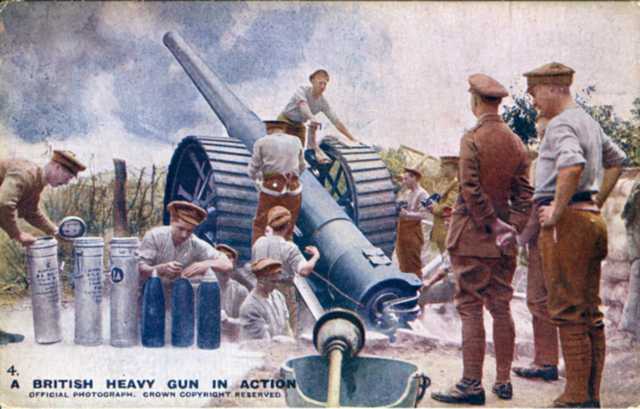
As the Battles of the Somme raged on the Western Front, the Daily Mail newspaper secured the rights to print and publish a long series of picture postcards, many of them colored. Most appear to be from photos, others seem to be from illustrations. The images were of scenes and incidents, which occurred during the Somme offensive. I found most of these at the website of the New York Public Library, which has vast WWI holdings.