Now all roads lead to France and heavy is the tread
Of the living; but the dead returning lightly dance.
Edward Thomas, Roads

Monday, October 14, 2013

The 1918 Road to Damascus: Over the Golan Heights

Photos Contributed by Steve Miller

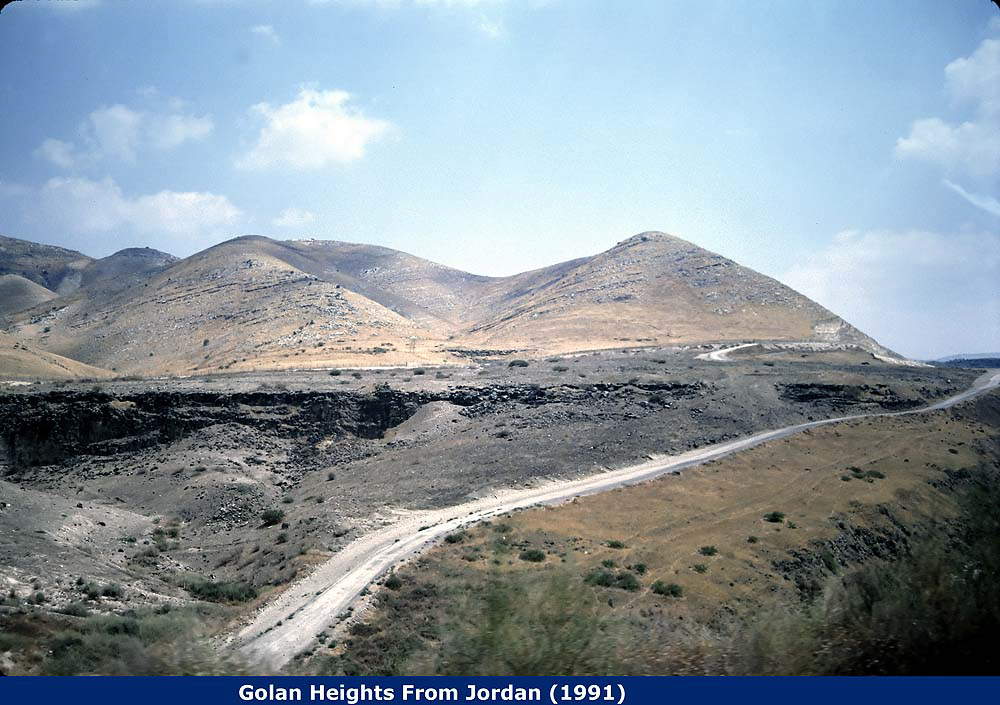
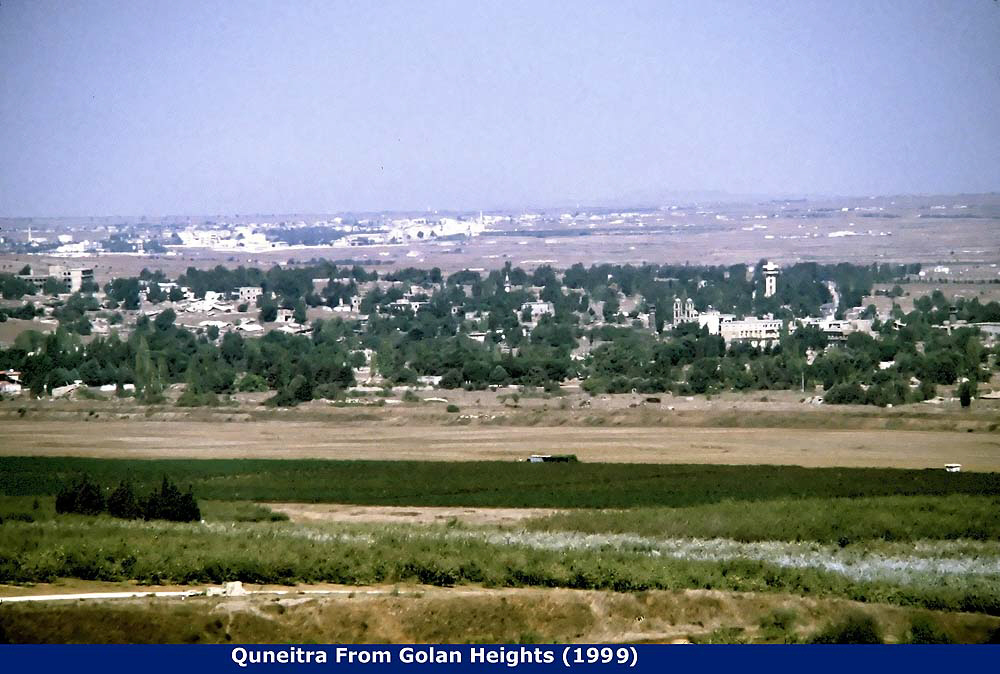
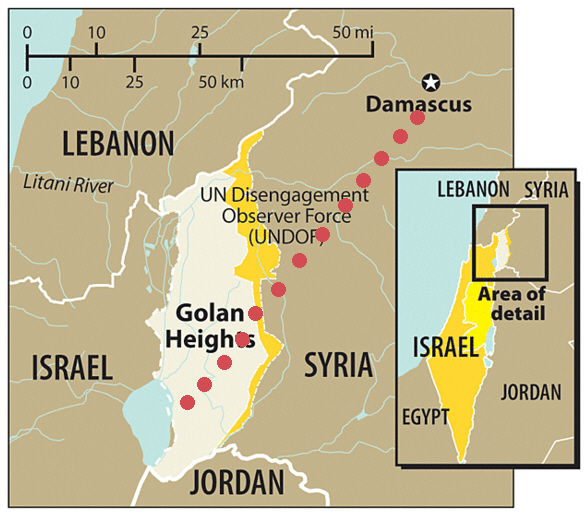
After his decisive victory in the Battle of Megiddo in September 1918, General Sir Edmund Allenby's forces pursued retreating Turkish troops toward Damascus. One column, composed of his 5th Indian Mounted and Australian Cavalry Divisions, advanced directly over the Golan Heights. Interestingly, this movement followed the historic path of St. Paul, who was converted to Christianity on the road from Jerusalem to Damascus. The Allied soldiers most certainly passed through the traditional site of the conversion, the village Kokab, just northeast of Quneitra, which is shown below.  The majority of the Heights were captured by the Israeli Army in the Six-Day War of 1967 and were a major battleground in the Yom Kippur War of 1973. These photos are from regular contributor Steve Miller, who visited the Heights in 1991. Sadly, we were unable to find any photos of the 1918 fighting, nor of St. Paul's earlier trip on Google images


Click on Image to Expand

Approximation of the cavalry advance, begun 27 September 1918. (Map from the Christian Science Monitor.)


Click on Image to Expand

The Golan Heights are highland of more than 600 square miles created by volcanic activity, averaging a height of 300 meters in the south and 1100 meters in the north. The characteristic steep slopes on the west and south sides of the Heights are shown in this photo.


Click on Image to Expand

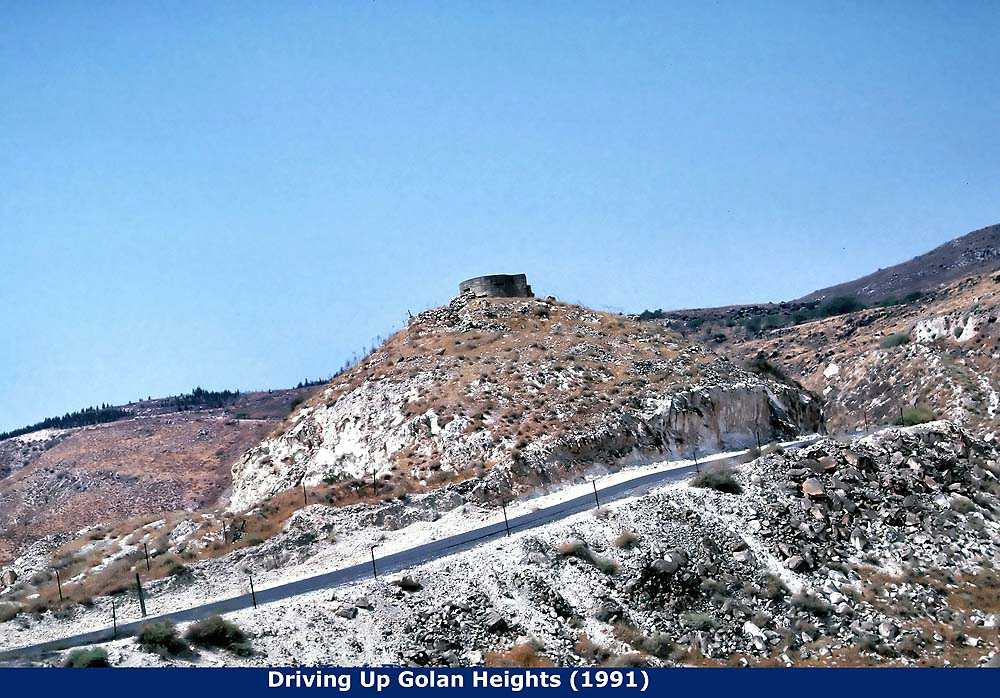
The pursuing cavalry departed the region of the Sea of Galilee and moved immediately on to the heights on 27 September 1918.


Click on Image to Expand

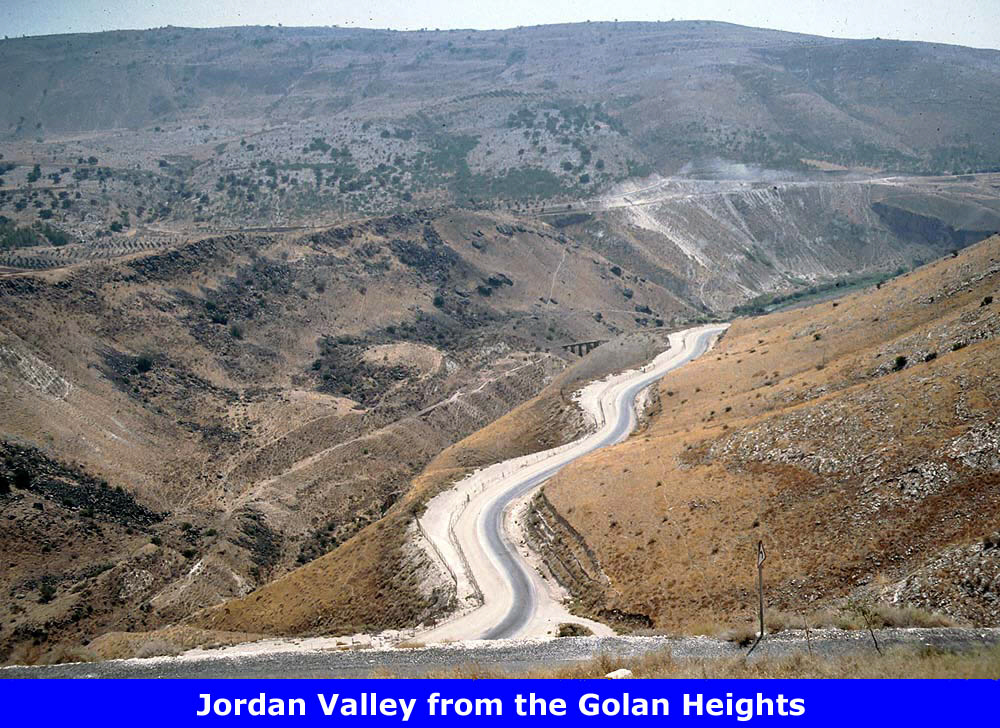
Looking south from the Heights


Click on Image to Expand

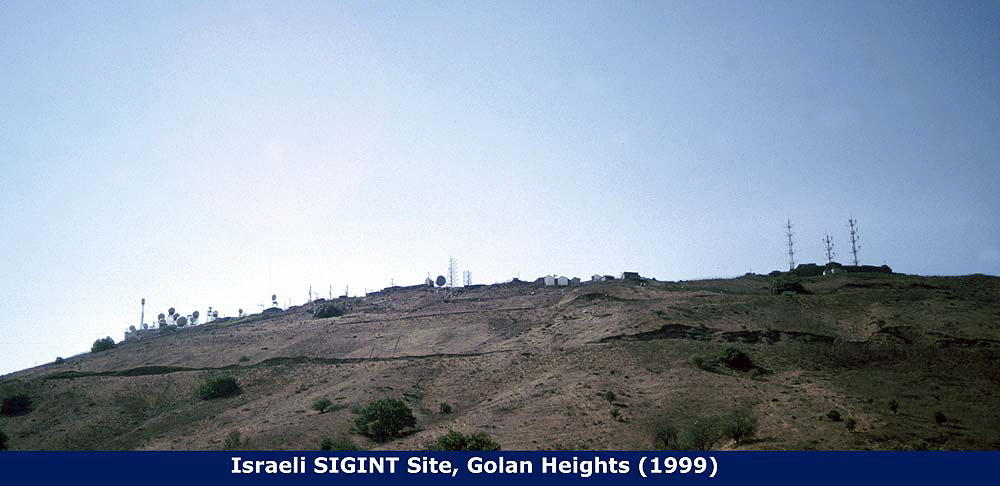
An Israeli observation post positioned to dominate the Golan Heights


Click on Image to Expand

On 29 September 1918 Allied cavalry routed the Turkish rear guard at the village of Quneitra.  This left the road to Damascus open and the city fell on 1 October. Almost two thousand years earlier, St. Paul (then known as Saul of Taurus) received his spiritual enlightenment nearby.


Click on Image to Expand

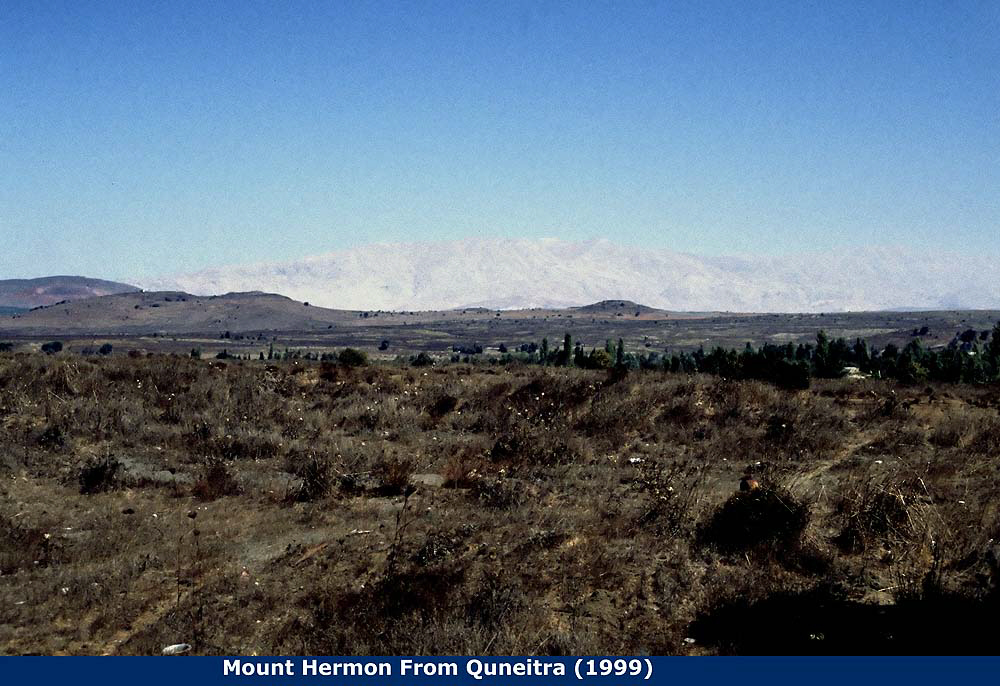
Mount Hermon on the northern edge of the Heights, most of which is claimed by Israel today, has the nation's highest point at 2,224 meters.


Sunday, October 13, 2013

Panoramic Images from the American Memory Collection of the Library of Congress

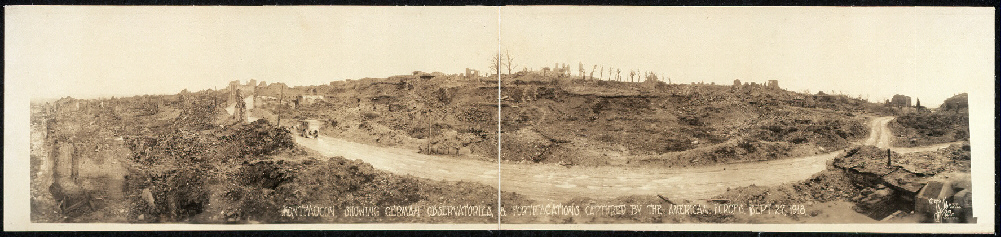
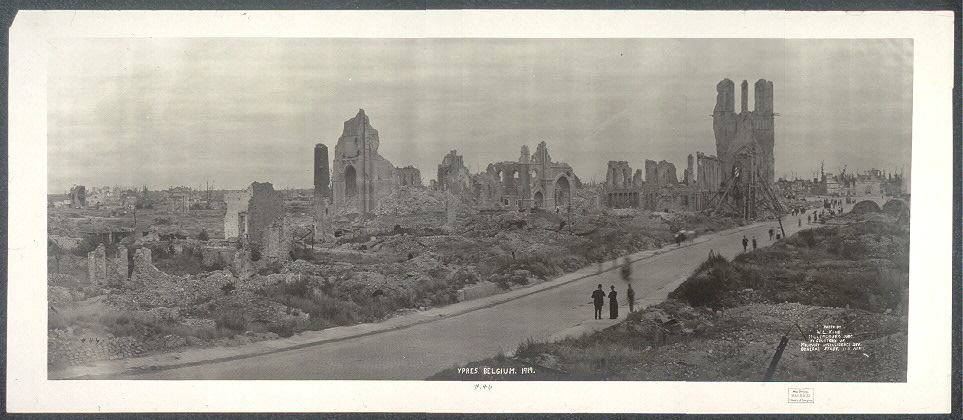
A tremendous online resource exists on the American Memory Website of the Library of Congress. They provide thousands of downloadable high-resolution images of the nation at war. The truly unique aspect of the collection is their set of panoramic images. Generally, these are not combat images (you will need to explore the Army Signal Corps collections for those). The wide-format photographs tend to focus on the preparations at home and "after the battle" images of the European battlefields and the troops of the AEF returning home. Below are some outstanding examples from the collection. To search for additional images visit the search page at: http://memory.loc.gov/ammem/collections/panoramic_photo/


Click on Image to Expand


1919 Image of Montfaucon, Captured 27 September 1918 During the Meuse-Argonne Offensive


Click on Image to Expand


1919 Image of Ypres, Belgium — Ruins of Cloth Hall and St. Martin's Cathedral


Click on Image to Expand


April 1919, the 363rd Infantry, 91st "Wild West" Division at San Francisco's Palace of Fine Arts, Prior to Discharge at the Presidio


Click on Image to Expand


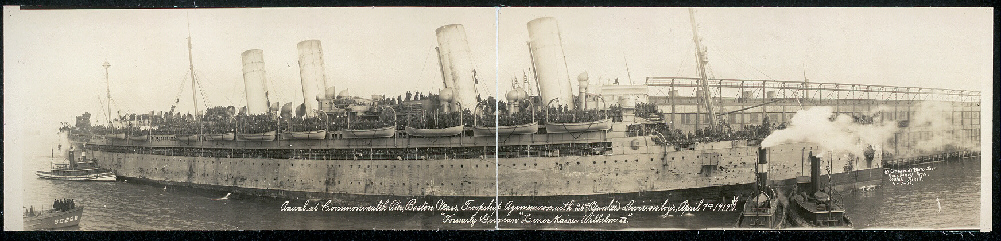
April 1919, USS Agamemnon Arrives at Boston Harbor with Troops of the 26th "Yankee" Division


Saturday, October 12, 2013

HMS Dreadnought at War

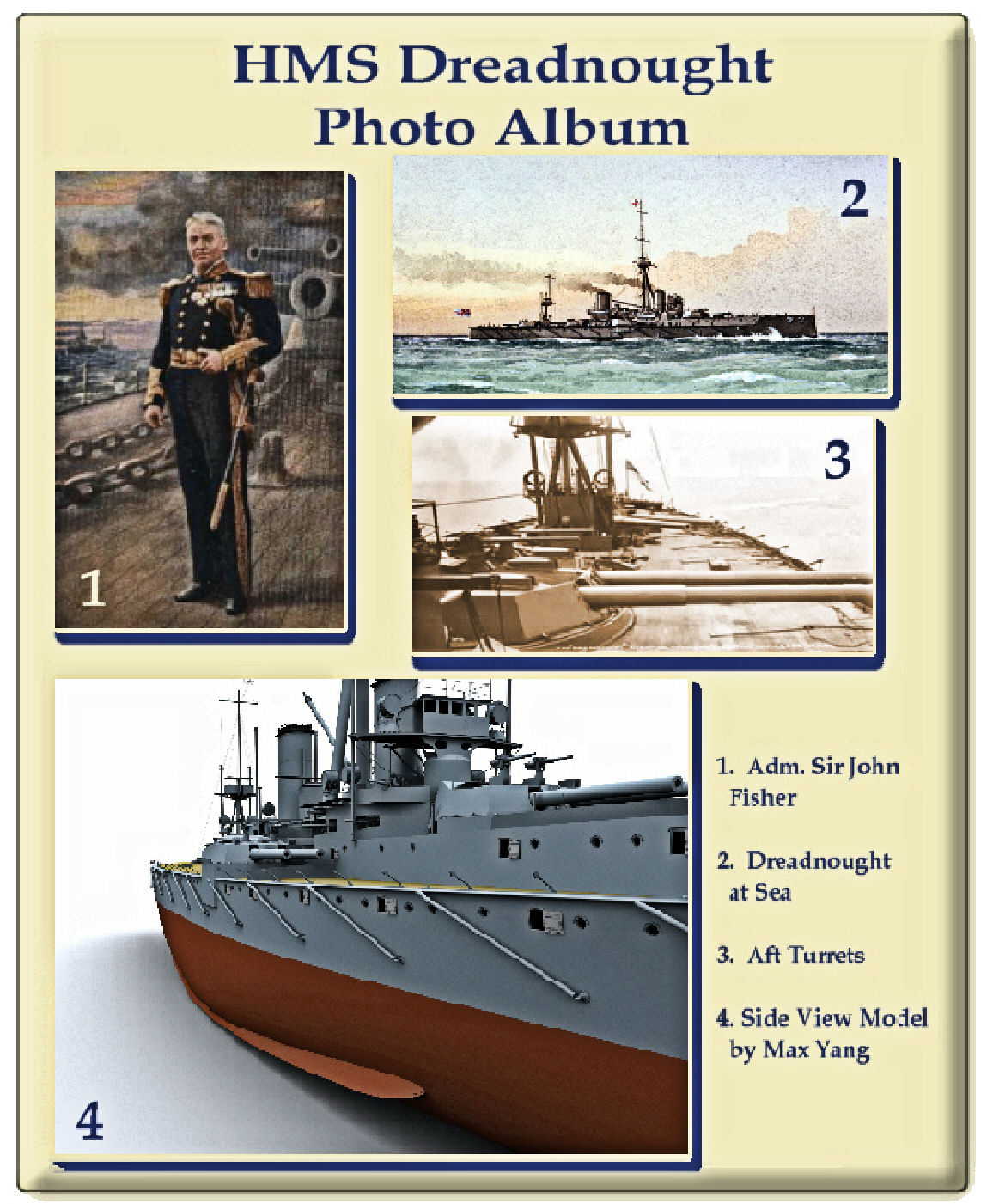
HMS Dreadnought, brainchild of Admiral Sir John Fisher, was launched in 1906. The one thing that set Dreadnought apart was her battery of ten 12-inch guns, of which eight could be fired on either broadside. Soon all the major naval powers – and some minor ones, too – were building or buying dreadnoughts, and the dreadnought race between Britain and Germany contributed to the growing tensions between these two nations.


Click on Image to Expand


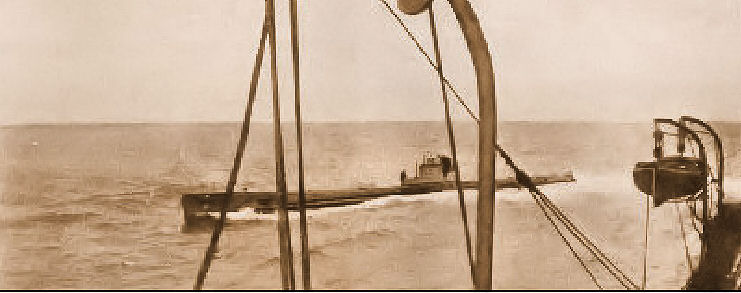
When the great struggle finally came, though, Dreadnought was a bit "long in the tooth." By May 1916 she had been transferred out of the Grand Fleet to a squadron of pre-dreadnoughts based in the Thames Estuary. Earlier, however, she accomplished a singular feat. On 18 March 1915 she rammed and sank U-29 [below] in the North Sea. HMS Dreadnought holds the distinction of being the only battleship to sink a submarine in combat.


Click on Image to Expand

Friday, October 11, 2013

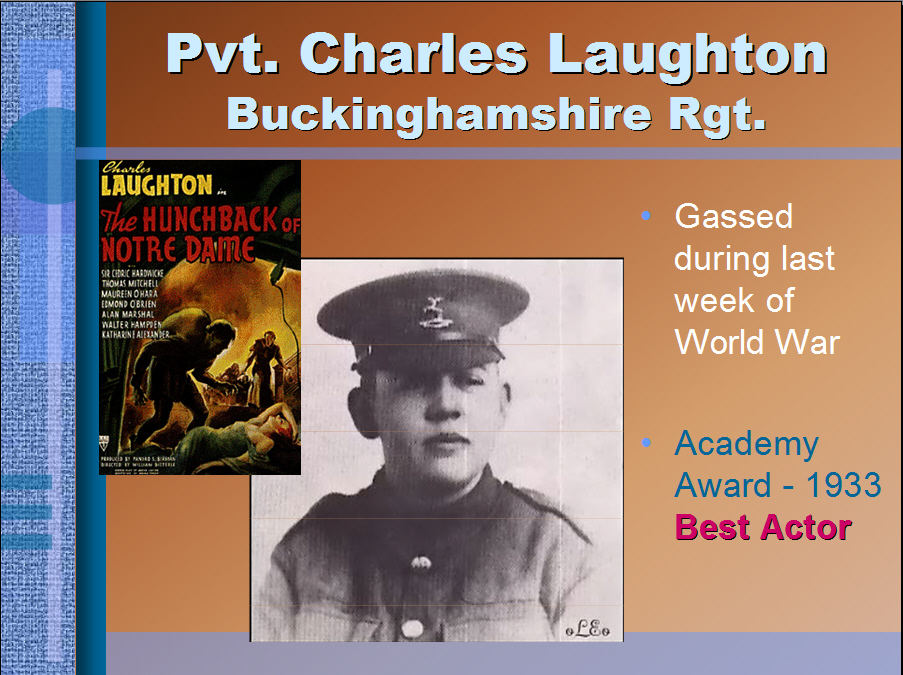
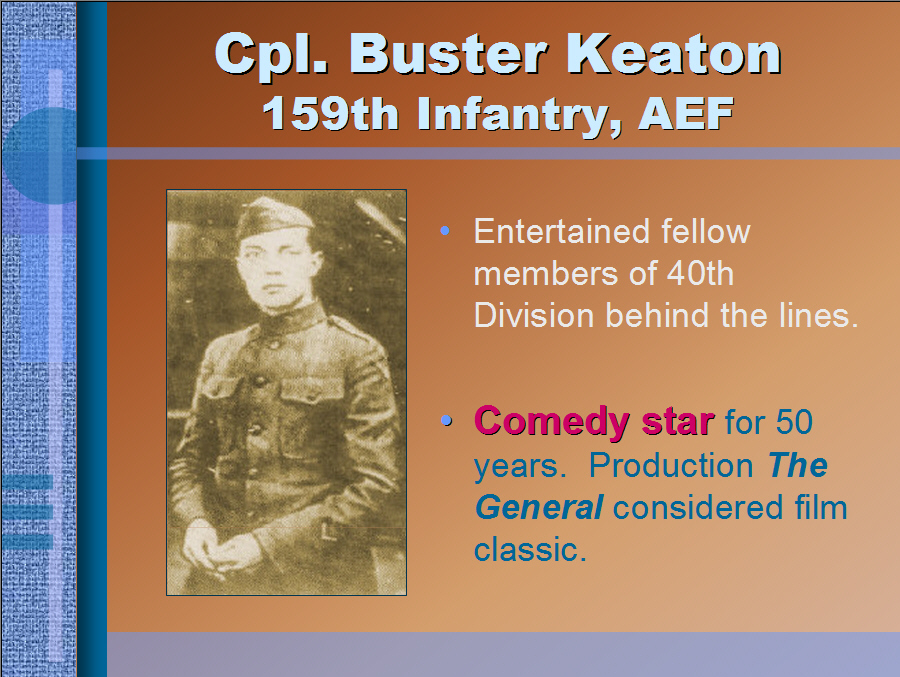
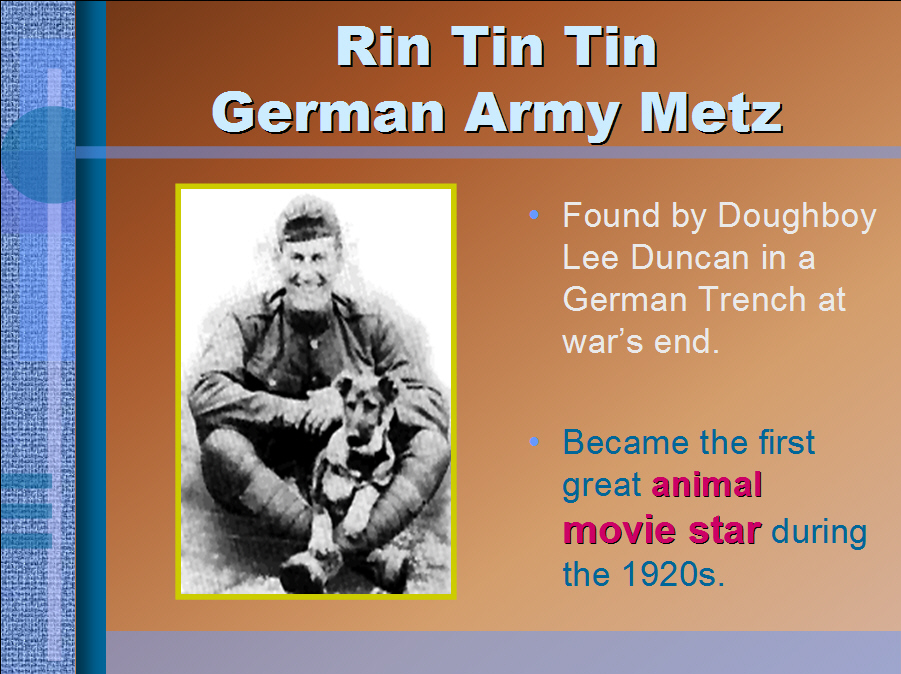
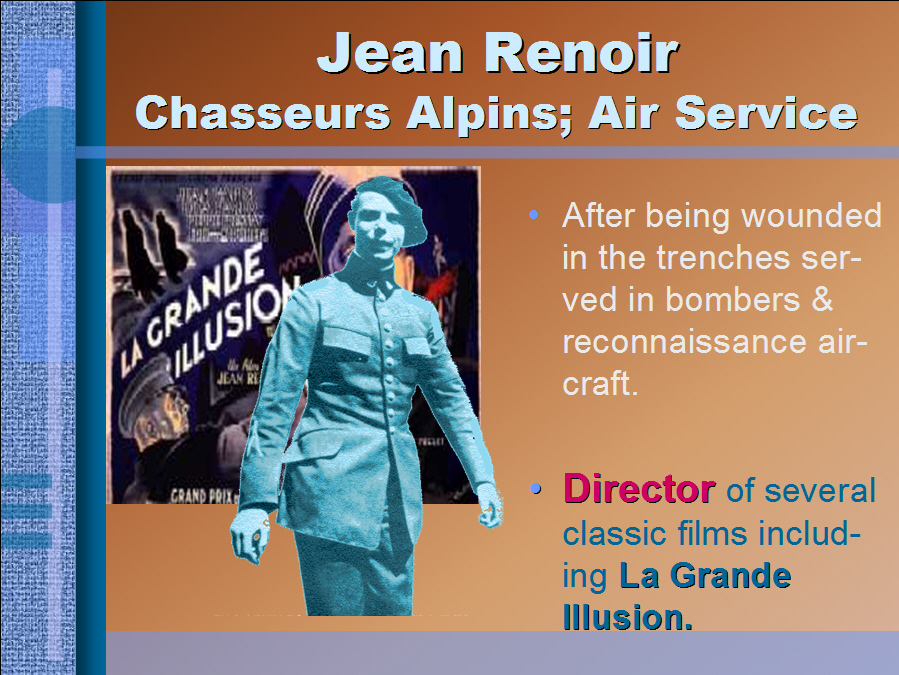
Hollywood and the Great War

Click on Image to Expand


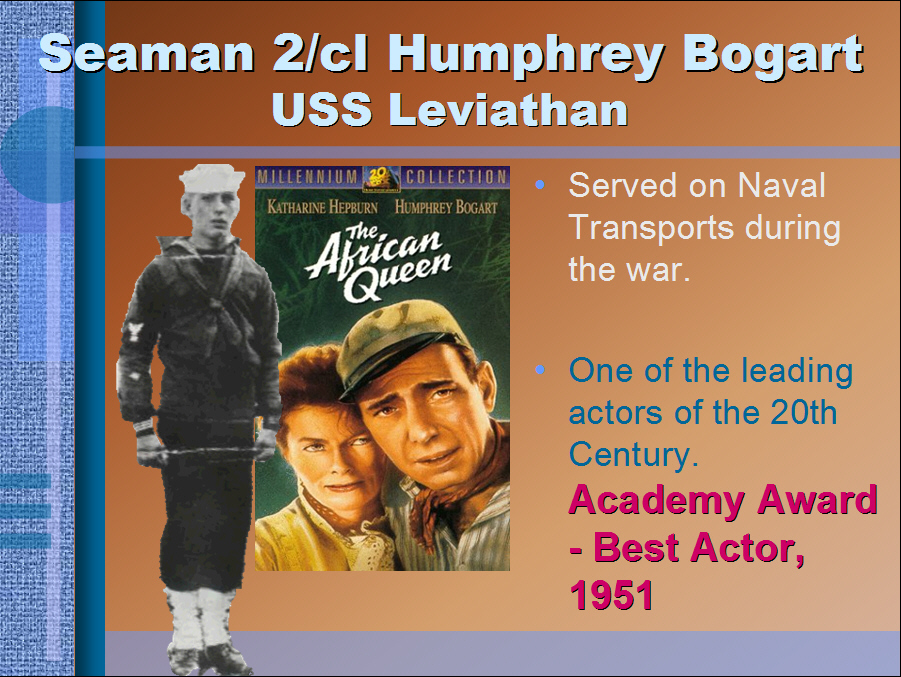
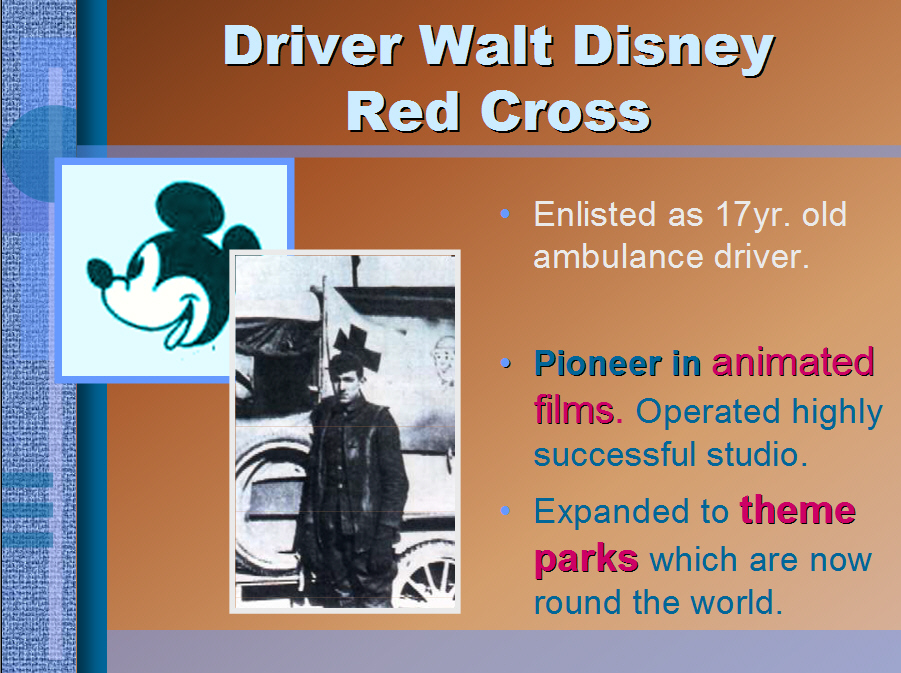
The "Golden Age" of Hollywood drew on a great number of World War I veterans. Presented here is a small sampling of some of the most influential. Especially important was the expatriate community of former members of the British Army that included such well-known stars as Basil Rathbone, Cedric Hardwicke, and Victor McLaughlin. One of my favorite former Doughboys was a mule skinner in the 26th "Yankee" Division, who was invited to the studio because he could bray like a donkey and that sound effect was needed for a film. That's how Walter Brennan started his acting career.


Click on Image to Expand


Click on Image to Expand


Click on Image to Expand


Click on Image to Expand


Click on Image to Expand


Click on Image to Expand


Thursday, October 10, 2013

Rudyard Kipling's Views on War Propaganda

Some interesting 1918 notes on propaganda for newspaper magnate Lord Beaverbrook prepared by Rudyard Kipling:

Beaverbrook and Kipling

PROPAGANDA FOR MUNITIONS FACTORIES


As far as I can make out it is more important just now to feed munition-works with steadying propaganda than any other class; because they seem to be the most isolated.

What they need, among other things, is news and description of the actual work done by the material they produce . . . Oratory of some sort or another is the workman’s intellectual excitement – he has a great respect for the gift of the gab – and his education for the past seven or eight years has made him peculiarly accessible to both oratory and the cinema. The two together are the strongest combination.

NEWS FOR AEROPLANE FACTORIES

Take first the case of Aeroplanes. When once a machine is despatched, no word of its performances in the field comes back to the factory. This is as stupid as preventing trainers and ostlers in a racing stable from being told what their horses are doing on the turf. I suggest . . . that arrangements could be made with the Air Service whereby the make and types of the machines employed in any special success should be communicated to the factory that produced them. 

This in conjunction with cinema work of aerodrome and air stunts. It is not generally realized that a large number of aeroplane workers in factories have the very sketchiest ideas of what an aeroplane does or can do. I should go so far as to say that a lecturer on the development of the aeroplane would find his most interested audience in an aeroplane factory.


The Sort of Factory That Needed Propagandizing


GUN FACTORIES

The same idea holds good with guns – specially big guns. The results of big “shoots” appear to be tabulated at the front, and are given from time to time in the press. It would be amply worth while where guns from certain makers (there are not many of them) are worked together to give the workers in the factories concerned the results, as far as ascertained, of our counter-battery work, expenditure of munition etc, together with any details of guns which had noticeably exceeded or fallen below the average of a gun’s life. The whole to be posted from time to time in the dining rooms as in the case of aeroplanes, and to be followed up by cinemas of guns in action, dumps, explosion of dumps, and the general life of the battery. . . . 


As I have said above the operatives have astonishingly small knowledge either of how one factory uses the goods turned out by another, or what is done with the material. The old hands are naturally ignorant of war; the young fellows taken on at fifteen or sixteen who are now eighteen or nineteen are, by the very necessities of their work almost equally ignorant of what has taken place during the war; the women look at life from a different angle to the men, and the discharged soldiers who have come back to the factories do not – quite rightly – talk much about war.

Source: Excerpted from National Archives Documents by the Times Literary Supplement Website; Photos from the National Portrait Gallery and Tony Langley Collection

Wednesday, October 9, 2013

The Centennial at the Grass Roots Series: Frank Buckles – Pershing's Last Patriot

As you know, I've dedicated all of my publications to support America's World War I Centennial Commemoration.  One of the grassroots efforts to honor the nation's sacrifice in the war is David Dejonge's  biographical documentary exploring the dramatic life of  the Last Doughboy – Frank Buckles, who was an absolutely wonderful representative of his generation.  This is a project close to my heart because I served as master of ceremonies for the dedication of the paving stone honoring Mr. Buckles at the Liberty Memorial & National WWI Museum in Kansas City.

David needs your help – $14,000 of pledges – to turn his rough-cut into a professional-level theatrical film.  He is using a site called Kickstarter for gathering contributions and telling the story of his project. Please visit the site.  I've already contributed, and I hope you will too.

Mike Hanlon


Remembering a Veteran:
Sgt. Stubby

Sergeant Stubby, 26th "Yankee" Division, AEF


I probably get at least one request each month for a story on the legedary AEF canine veteran Sgt. Stubby. I recently found that there is a definitive article on the good sergeant at "The Price of Freedom: Americans at War" section of the Smithsonian National Museum of American History website. A taxidermied Sergeant Stubby is on display at the museum.  Their website has a lot of other features on the First World War and all of America's wars, and can be visited here:
amhistory.si.edu/militaryhistory/exhibition/flash.html


Tuesday, October 8, 2013

The Circling Song
Reviewed by David F. Beer


The Circling Song

By Russel Cruse

Published by Amazon Kindle and Lulu.com

This is a most unusual book. At first I was reluctant to read it because its format didn't appeal to me ,but I'm glad I overcame that block. In fact I ended up reading it twice — the second time to make sure I was catching everything, or at least not missing anything significant. The effort was well rewarded.

The author states that this book, one of three he has written, is a novella. One might quibble with this designation since the book is 161 pages long. Other novels based on WWI such as Rebecca West's The Return of the Soldier, Marc Dugain's The Officers' Ward, and J. L. Carr's A Month in the Country all consist of fewer pages and claim to be novels. These books, however, are not accompanied by as much white space since they are written in the usual narrative style of a novel. Cruse's book however is one of those fairly rare books that might be designated as an epistolary novel, one where the narrative consists of a series of letters and other documents. In this case letters, fragments of journals and diaries, memoranda, communiques, a casualty form, and finally three poems all combine to portray the character of Private (later Corporal) Henry Lawrence and his experiences from First Ypres through the Battles of Loos, the Somme and Passchendaele.


Order Now
Lawrence's external experiences, harrowing as they are, are less the focus of the story than his internal ones, which are, to say the least, unique. He survives a bullet wound in the head, but the results of the wound have far-reaching consequences that mystify most around him. An army doctor in England, where Lawrence is sent to recuperate, becomes intrigued by the change that is taking place in Lawrence. To put it briefly, due to his head injury Lawrence has become a savant whose head injury has caused him to experience a neurological condition known as synesthesia. As the doctor explains in a letter to a mathematician friend,

. . . it refers to the capacity demonstrated by some individuals to sense the same stimulus in more than one way. Thus, a person would experience a sound and the sensory response might be a combination of the mundane (i.e. audible) and the less so, for example, a sight or even a scent. Imagine a musical note whose effect one could smell or see as well as hear!

This is not all however, as both the doctor and his mathematician friend (who later becomes his wife) are to discover. Lawrence's condition allows him to actually see patterns in the movement of air and sound and to gradually work out the mathematical equations that govern them. The work of Einstein, Planck, Kirchoff, Shrödinger, and Heisenberg, and the idea that the entire universe could be described in a series of mathematical equations, have all filtered into Lawrence's mind as a result of his savantism. How he finally uses his new knowledge — perhaps not as grandiosely as we might expect, but nevertheless very effectively — brings his story to an end.

Although most of us aren't used to the epistolary novel format it's surprising how the various documents that make up the chapters in The Circling Song — some quite brief — give us a sense of immediacy and also allow the tale to flow smoothly and quickly. There are a few minor subplots and brief glances at some of the familiar motifs of the war such as a terrible trench scene, the confusion of troops in battle, attitudes to shell shock, and the need for protective helmets (which were not issued to all the troops until mid-1916). The quote from George Meredith's poem "The Lark Ascending" at the front of the book reveals where the author got his title and ties in nicely with the uncanny and mystical transformation that Henry Lawrence undergoes when his head wound thrusts him into the world of synesthesia and arcane mathematics.

David F. Beer 


Monday, October 7, 2013

Worms and Voracious Rats: Rickword's Vision of War

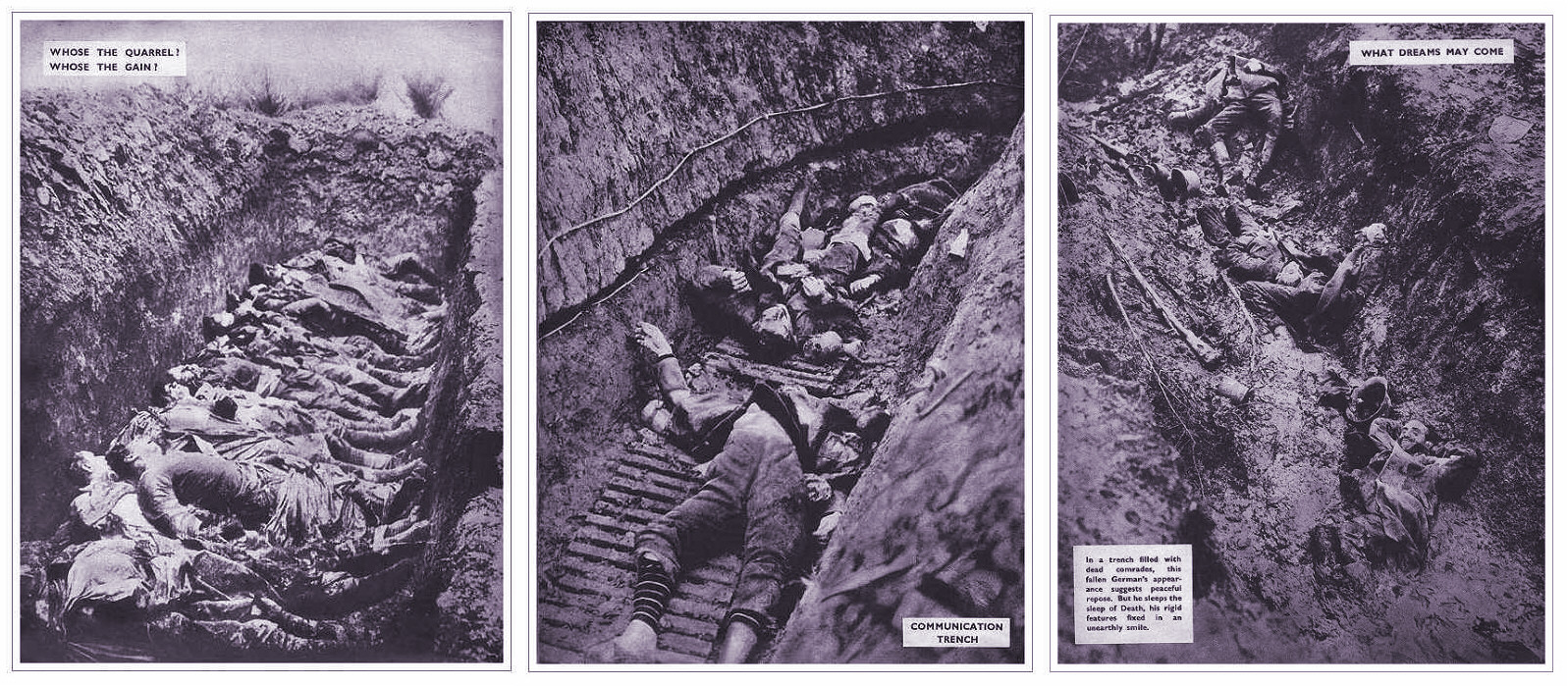
I find re-reading this poem a nice antidote whenever I find myself losing touch with the essential character of the war.


Click on Image to Expand

German Dead on the Western Front


John Edgell Rickword (1898-1982) served on the Western Front and wrote a number of war poems. His war poetry was published in 1921 in a volume entitled Behind the Eyes. After the war he went on to a long career in publishing, editing, and writing.


Trench Poets

I knew a man, he was my chum,
but he grew blacker every day,
and would not brush the flies away,
nor blanch however fierce the hum
of passing shells; I used to read,
to rouse him, random things from Donne–
like "Get with child a mandrake-root."
But you can tell he was far gone,
for he lay gaping, mackerel-eyed,
and stiff, and senseless as a post
even when that old poet cried
"I long to talk with some old lover's ghost."

I tried the Elegies one day,
but he, because he heard me say:
"What needst thou have more covering than a man?"
grinned nastily, and so I knew
the worms had got his brains at last.
There was one thing that I might do
to starve the worms; I racked my head
for healthy things and quoted Maud.
His grin got worse and I could see
he sneered at passion's purity.
He stank so badly, though we were great chums
I had to leave him; then rats ate his thumbs.

Sunday, October 6, 2013

Weapons of War: Monster Artillery


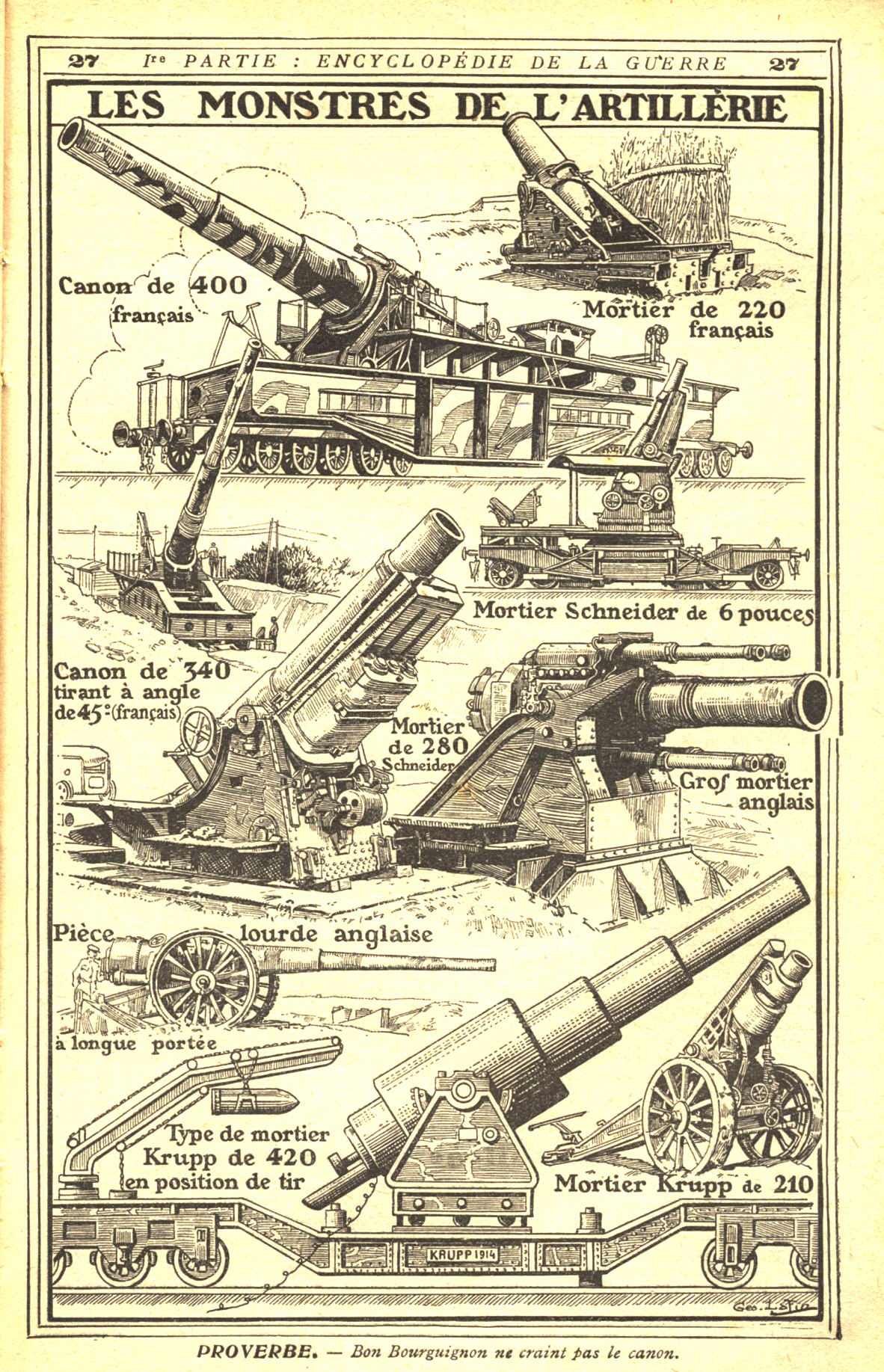
As a follow-up to our early article "Not Big Bertha," we present this French wartime depiction of the large artillery pieces of the combatants that were known by 1918. One especially notable piece is the 400mm French railroad gun that played a key role in the recapture of the Verdun forts, and the Paris Gun is not shown. It was unveiled in March 1918 during the first Ludendorff Offensive and was probably either not experienced yet or fully understood when this was presented in the Almanach Hachette of 1918. Incidentally, the proverb is roughly translated: "The Good Burgundian does not fear the cannon."

Click on Image to Expand


The two best books on super-sized weapons in the war.

Order Now

Order Now

Saturday, October 5, 2013

Stereoscopic Views of the Battlefield Come to Life


You may have seen collections of the stereoscopic (3-D) images of the First World War. Many of these images are great, but they require handheld or large box-shaped viewers to examine. And even with this equipment, though, the images are small and never quite come to life. Well, things are changing. Carlos Traspaderne of the Casa de la Imagen Cultural Center in Spain has decided to apply new technology to viewing these images and the results have been terrific. He says he uses mirrors to improve the clarity and enlarge the images. He has developed a four-minute sampler film of what he can do with the originals, which come on cards with two slightly offset versions of the same image.

1. Click on Image to Access Page
2. Click Full Screen for Best Viewing

WWI Battlefields in High-Quality 3-D Images


Carlos is interested in producing books and films using stereoscopic images. If you have a set of these, he would like to hear from you. Also, let him know what you think of his project and whether you might be interested in purchasing some of his products. He can be contaced at: info@casadelaimagen.com

Friday, October 4, 2013

The T.E. Lawrence – Robert Graves Connection

On Tuesday, 1 October 2013, we published a review of Robert Graves classic, Good-bye to All That. It reminded me that we had published an article in another of our publications on a lesser-known aspect of Graves's career. Here it is:

Lawrence & Robert Graves

By Assistant Editor Kimball Worcester


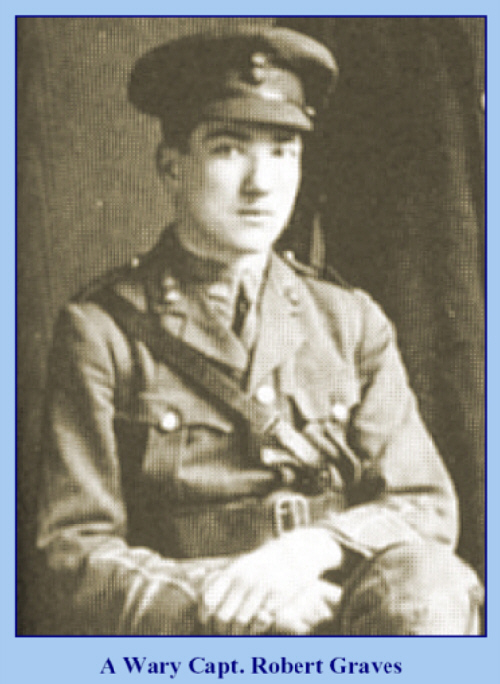
The Great War fronts of combat experienced by T.E. Lawrence and Robert Graves could not have been more different. Graves served in the trenches and woods of France and Flanders that epitomize the stagnation of the Great War. Lawrence's war was one of movement across the Arabian desert and into the Levant. They both, however, carried the war with them for the rest of their lives and found in each other mutual understanding and appreciation.

Graves and Lawrence first met in 1919 at an Oxford dinner. Before that, Lawrence had worked with Graves's older brother in Cairo. He knew of Graves also as a poet, whose work he admired. Graves had married in 1918 and was already embarked on what was to become a family of four children in rapid succession. His wife was Nancy Nicholson, a talented artist and daughter of Sir William Nicholson. Their life was fraught, impoverished, and haunted by Robert's harrowing experiences in the war, which included his near-fatal wounds at the Battle of the Somme in 1916.

By 1927 Lawrence was an international celebrity, having published Seven Pillars of Wisdom in 1922 and been crowned as "Lawrence of Arabia" by press and populace alike. His publishers pushed for him to follow up Seven Pillars with an autobiography. Lawrence himself was hesitant, for he was not comfortable with the fame and accolades. He did see, however, the opportunity to help his friend Robert Graves — Lawrence agreed to the biography being published but only if Graves wrote it and that this stipulation be kept secret from Graves to spare him embarrassment. The publishers agreed, approached Graves and received his acceptance only on the condition that Lawrence's approval be sought!

Upon publication in 1927, Graves's book was an instant success and ensured solvency and even comfort for Graves and his family for some time to come. Lawrence's generosity came at a time of very low spirits for Graves and went a long way toward bolstering the morale of a poet and writer who Lawrence knew to be capable of significant contributions to twentieth-century literature. Graves more than sustained Lawrence's faith in him.

T.E. Lawrence died in 1935 of injuries from a motorcycle accident. Robert Graves lived until 1985 and is remembered as a significant poet, novelist, and mythologist. For a thoughtful, thorough, and adept biography of Robert Graves in three volumes see Robert Graves: The Assault Heroic 1895-1926 (1987); Robert Graves: The Years with Laura, 1926-1940 (1990); Robert Graves and the White Goddess, 1940-1985 (1995), all by Graves's kinsman Richard Perceval Graves.

Thursday, October 3, 2013

General George Marshall Tells Us About His Old Boss — General John J. Pershing

The biographer of General George C. Marshall, Forrest Pogue, published the preliminary interviews he made with his subject in 1957.  In Tapes 6 and 7, which cover Marshall's time with the AEF during which he played critical roles as the chief of operations of the 1st Division and then the First Army, Pogue asked a number of questions about General John J. Pershing with whom General Marshall had a long relationship during and after the war. (Pershing lived until 1948.)  Here is a selection of Marshall's memories of his old chief. I've regrouped comments that deal with similar themes and indicated the interviewer's question when necessary.


General Pershing and Colonel Marshall After the War

The Pershing Style of Leadership

FP Question:  How did Pershing operate as top American commander? What is your estimate of him as a leader?

General Pershing as a leader always dominated any gathering where he was. He was a tremendous driver, if necessary; a very kindly, likable man on off-duty status, but very stern on a duty basis.

General Pershing, as top commander, operated very largely through his operational staff — that was General Fox Conner, who was the head of the G-3 organization — so far as fighting was concerned. He would make a temporary headquarters at the front. And, of course, for quite a long time he commanded the First Army before it was split up into two armies, and then he commanded the group of armies. But he would either live on his train or otherwise get disposed up on the battle front in order to be near the fighting and continue to command. Every now and then he would have to go off to Paris when some momentous meeting would occur.

I have never seen a man who could listen to as much criticism, as long as it was constructive criticism and wasn't just being irritable or something of that sort. You could talk to him like he was discussing somebody in the next county and yet you were talking about him personally. It might be about a social thing, certainly about an official thing. You could say what you pleased as long as it was straight, constructive criticism. He did not hold it against you for an instant. I never saw another commander that I could do that with. Their sensitivity clouded them up so it just wouldn't work. I've seen some that I could be very frank with, but I never could be frank to the degree that I could with General Pershing.

FP Question:  I have read statements that you absorbed from General Pershing his insistence on "spit and polish" and strong discipline. Is this true?

I don't think I learned from him the spit and polish part. I knew how to do that long before I ever saw him. It has a decided place and is pretty much evidence of the general state of discipline of the command. The point is when it's overdone, of course, it's harmful as anything is, as a rule, that is harmful and that would be particularly harmful if it took away a lot of time from the other training.

I might accentuate the fact that [General Pershing] was very delightful, very delightful to go along with when we weren't working. He was almost boyish in his reactions and we would have a very pleasant time. The minute we came to work, he then was the very serious-minded, you might say almost implacable executive.

Pershing the Strategist

FP Question:  I understand that General Pershing wanted to go on to Berlin. What was your own view?

At the time of General Pershing's problem of maybe going on to Berlin, one of the great troubles was there wasn't the transport. The horses were all gone, largely. When they started the [occupation] march into Germany, I had to unhorse brigade after brigade of artillery and leave them on foot near the railheads and take their horses for the units that were going into Germany. We were very hard put in those respects, and if the battle had been carried on into Berlin...

President Pershing?

I think early in General Pershing's period of return from France, some of his friends deluded him into this presidential aspect. I know one group came up from Tennessee and I sent them back home. He was away at the time and he was furious with me. I didn't even consult him. I knew pretty well what the general reactions were, and I thought it was a shame that he might in some way cut down his prestige by being involved in that sort of a thing unless it was almost by acclamation.

Pershing's Heritage

FP Question:  What was the impact of General Pershing on the U.S. Army? Did he raise the soldierly standards of the army by his insistence on discipline? 

I think he did raise the standards of the army by his insistence on [his] type of discipline. Very naturally, he would. He was a very imposing and impressive man.

Wednesday, October 2, 2013

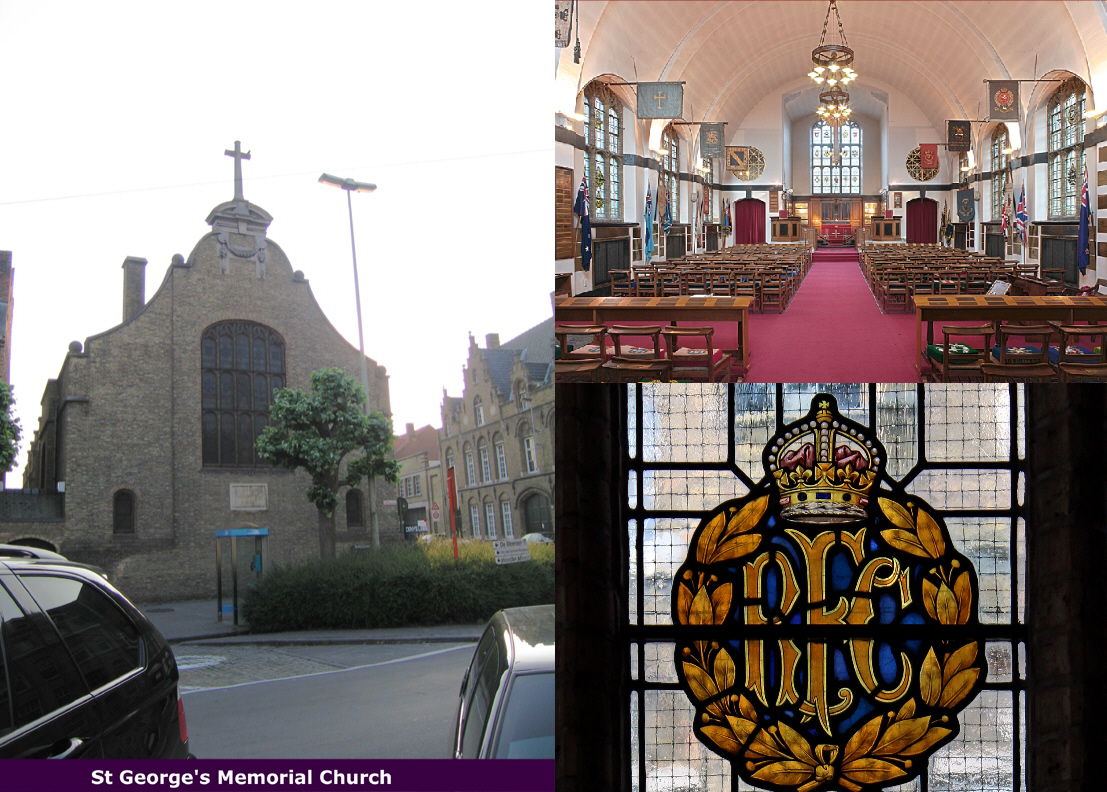
St. George's Memorial Church, Ypres

St George’s is an Anglican church within the Church of England’s Diocese in Europe. It is one of the must-see stops on a visit to the Ypres Salient.


Click on Image to Expand

Exterior of the Church, Located Across the Street from St. Martin's Cathedral; Interior; Detail, RFC Insignia on Stained Glass Windows


History

St George’s is a pilgrimage church for the many thousands of people who visit the World War One sites of the Ypres Salient battlefields.  There is a small resident congregation who live in Ypres and surrounding area of Belgium and Lille(northern France).

The first mention of the building of an Anglican church in Ypres was in August 1919. A few months later an article was published in the Times that an Anglican church was to be built in Ypres to serve both as permanent memorial to the dead but also as a meeting place for the visiting relatives. Opinion on this was however, divided as illustrated by a letter sent to the editor of the Times indicating that an Anglican church would not be appropriate both because many of the soldiers who were killed were not members of the Church of England and also because Belgium was a predominantly Roman Catholic country.

The movement to build such a church only really got underway with the foundation of the Ypres League in 1920. The president was a Canadian, Lieutenant-Colonel Henry Beckles Willson, who had acted as town major of Ieper in 1919 and was also instrumental in the creation of the Imperial War Museum. through the help of the Imperial War Graves Commission a suitable plot of land was found on the corner of the A. Vandenpeereboomplein. The idea to build a school attached to the church had been discussed. The school would be paid for by donations made by Old Etonians and would serve as a memorial to the approximately three hundred and forty pupils who had given their lives in the Ypres Salient.

In the spring of 1927, Blomfield's plans were complete. He had designed a simple space that would be able to accommodate two hundred people. The interior furnishings were to be provided by families of the fallen. Almost every item in the church serves as a permanent memorial to a soldier who gave his life in France and Flanders. There are also memorials to people who died in the Second World War. The school too was simply designed, comprising one classroom and a staff room. The Bishop of Fulham opened the church and the school on 24 March 1929, Palm Sunday. 


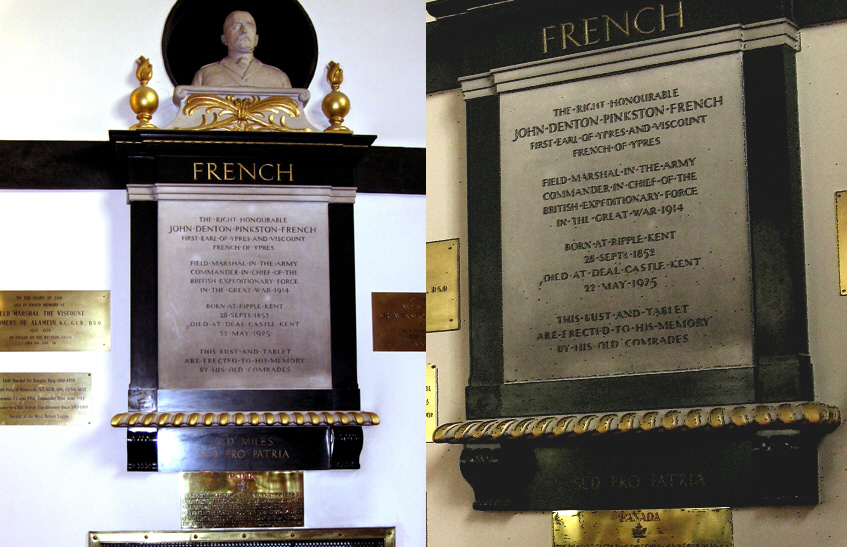
Field Marshal Sir John French


Click on Image to Expand

Field Marshal French Commemorative Section; Detail –  Dedication Plaque

A striking feature of the church is the emphasis and visibility placed on honoring Sir John French, who was the British commander-in-chief during the first two years of the war, a period covering the first two Battles of Ypres. This, compared to the relative downplaying of the later commander Field Marshal Douglas Haig.

Sources: The St. George's Website; photos by Steve Miller and Tony Langley

Tuesday, October 1, 2013

Good-Bye to All That
Reviewed by Michael Kihntopf


Good-Bye to All That

An Autobiography of Robert Graves

Published by  Anchor Books (Doubleday), 1957 and 1985 

Written while Graves was convalescing from wounds, Good-Bye to All That was first published in 1929. The author revised it in 1957, as he wrote in his new prologue, to correct errors and fill out areas earlier left vague because of wartime censors, because he didn't wish to hurt still living friends, and because he didn't originally know all the facts surrounding the incident he was writing about.

Good-Bye to All That is definitely an autobiography, and because it is self-written, some of it should be scrutinized using other sources as references. The first chapters delve deeply into the author's family, recounting numerous ancestors, relatives, acquaintances, and various other people who came into contact with the aforementioned people. The list of the people who crossed Graves's life before the Great War is quite dizzying and reads as a who's who of the British, German (his mother's contribution), and Irish literary and political world. But those chapters do more than name-drop. They paint a socio-scape of life before the Great War à la Downton Abbey and provide a very detailed exposé of the British public school life from the student's stand point. It is almost as if the author laments the passing of that world.


Order Now
The meat of the work is in Graves's description of his service with the Royal Welch Fusiliers from 1914 through 1919. The reader is provided with minute details about one of the most honored and oldest regiments in the British Army, details which include uniform accoutrements and how junior officers were to deport themselves at mess or when interacting with officers who had been with Kitchener in the Sudan and South Africa. Although Graves found the atmosphere stifling, he apparently highly respected it and used it as a benchmark when dealing with those who replaced the Old Guard when they became casualties.

He makes that quite clear when he assesses replacement officers he trains in 1917: Though the quality of the officers had deteriorated from the regimental point of view, their greater efficiency in action amply compensated for their deficiency in manners. Once again, there is a regret that things have changed. Graves's detailed accounts of the Battle of Loos in which he participated and trench life are masterpieces but bear the marks of an after-the-fact summation. Nevertheless, he provides both a strategic and tactical picture that clearly defines how ill prepared the pre-1914 army was for conducting war against a similarly armed and led European army.

A reader must be aware of just who Robert Graves was as he scans through these pages. The author was a poet of great renown whose work brought him acclaim during and after the war. His popularity was rewarded by being one of the sixteen Great War poets who are commemorated in the Poets' Corner of Westminster Abbey. Counted among his peers are Wilfred Owen and Siegfried Sassoon. He was also the author of I, Claudius and Claudius the God. With his literary accomplishment in mind, the reader can be more appreciative of what is written in Good-Bye to All That. One can also assess just what the title was meant to convey: the Great War changed the world so much that those who lived before it would long lament the ways and people that made that world. This book has never gone out of print and for good reason.

Michael Kihntopf 


Monday, September 30, 2013

The October 2013 ST. MIHIEL TRIP-WIRE Now Available Online

The October issue of our sister publication, the St. Mihiel Trip-Wire is now online at:

www.worldwar1.com/tripwire/smtw.htm

If you haven't visited the Trip-Wire before, imagine a full month's entries of Roads to the Great War in a single, easy-to-read issue. Pictured here are some of the sites, battles, and personalities featured in the latest issue, including: British tank models, George M. Cohan and "Over There," the MacArthur Memorial's centennial preparations, first and last ships sunk in the war, the Albanian crisis of 1913, the 10th Battle of the Isonzo–precursor to Caporetto — and much more!

Click on Image to Expand

Remembering a Veteran: Sgt. Alan L. Eggers, 107th Machine Gun Company, 27th Division, AEF

Contributed by James Patton


Yesterday, Roads to the Great War featured cartoonist Raeburn Van Buran of New York's 7th Infantry from the National Guard. Today we feature another alumnus of the "Silk Stocking Regiment." Alan Eggers was born in 1895 at Saranac Lake, NY. His youth was spent in Summit, NJ, and he attended Cornell University from 1915 to 1917, leaving before the end of his second year to join the 7th Regiment NYNG. He was one of the group called The Summit Gunners, which became the nucleus of the 107th Machine Gun Co. Three men from this unit — Eggers, Sgt. John Latham and Cpl. Thomas O’Shea — received Medals of Honor after the only instance in the war where three medals were awarded for the same action.

On 29 September 1918 the 107th MG Co. was part of the assault on the Hindenburg Line at the St. Quentin Canal Tunnel. From the start things didn’t go well. The Medal of Honor citation reads:

Becoming separated from their platoon by a smoke barrage, Sgt. Alan L. Eggers, Sgt. John C. Latham and Cpl. Thomas E. O'Shea took cover in a shell hole well within the enemy's lines. Upon hearing a call for help from an American tank, which had become disabled 30 yards from them, the 3 soldiers left their shelter and started toward the tank, under heavy fire from German machine-guns and trench mortars. In crossing the fire-swept area Cpl. O'Shea was mortally wounded, but his companions, undeterred, proceeded to the tank, rescued a wounded officer, and assisted 2 wounded soldiers to cover in a sap of a nearby trench. Sgt. Eggers and Sgt. Latham then returned to the tank in the face of the violent fire, dismounted a Hotchkiss gun, and took it back to where the wounded men were, keeping off the enemy all day by effective use of the gun and later bringing it, with the wounded men, back to our lines under cover of darkness.


It is heroic to risk your life to rescue a comrade, especially under fire. For this reason alone the deeds of these three warranted consideration for the Medal of Honor. Moreover, Latham and Eggers made more than one trip under fire to the disabled tank.


Furthermore, for several hours the left flank of the attack was held by the M1909 Hotchkiss manned by Latham and Eggers. By effectively deploying this gun and manning it under heavy fire, all the while out of contact with their own forces, they played a key role in the eventual success of the attack, which was another act of heroism.

Finally, they managed to extract themselves, three wounded men (two of whom couldn’t walk without help) and the 27-pound machine gun (presumably with ammunition), and somehow found the stabilized positions, in the dark. This was a third act of heroism.

Eggers returned to the Cornell Law School, graduating in 1921. He worked on Wall Street until 1959. He married in 1935 and had two sons. He died in 1968 and is buried in Arlington National Cemetery.

Sunday, September 29, 2013

Doughboy Cartoonist: Raeburn Van Buren

Contributed by Stephen Harris

My great uncle was Raeburn Van Buren, a private in the 107th Regiment, the "Old Seventh" National Guard of upper-crust New Yorkers from Manhattan's East Side, where its great armory stands on Park Avenue.

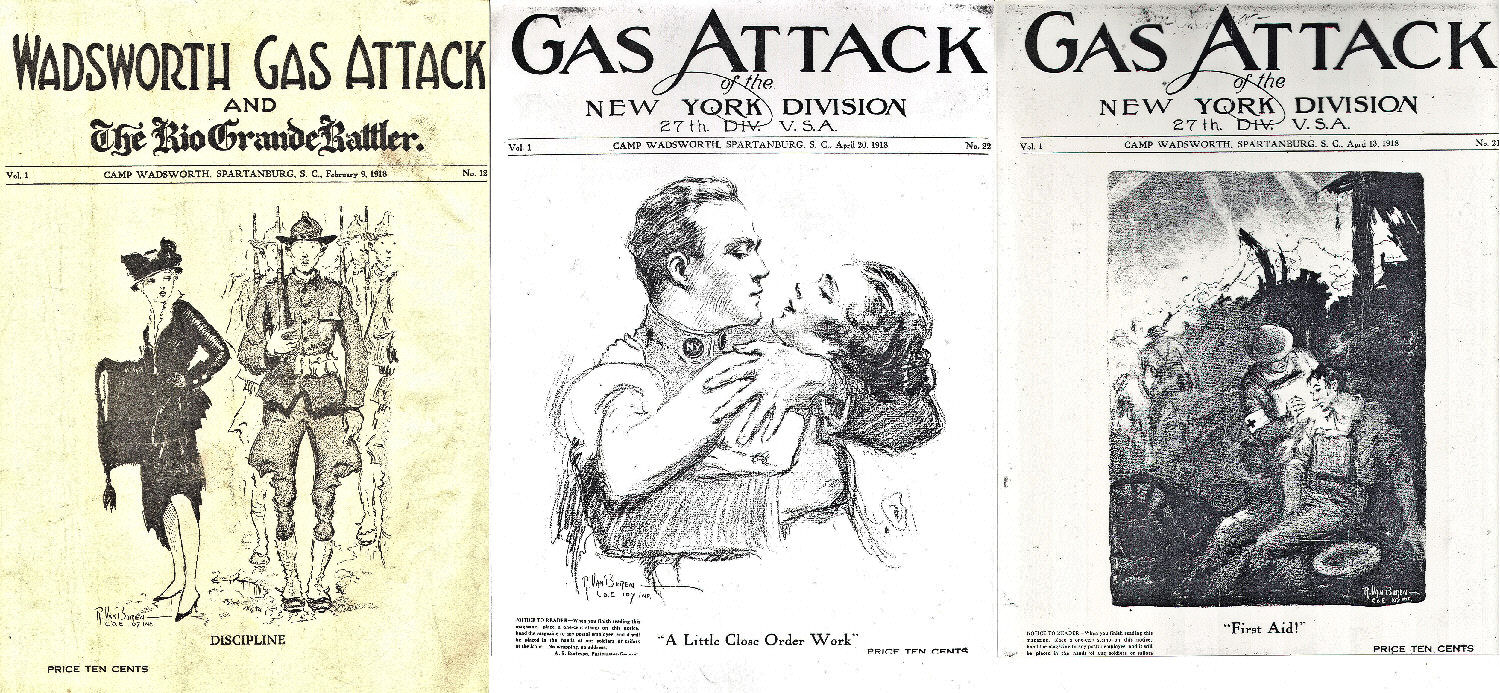
Van Buren was a magazine illustrator when he enlisted in the 7th, which was incorporated into the 27th Division of the AEF that was attached to the British during WWI. He was assigned to the 27th's HQ as art editor of Gas Attack magazine, which had been started in 1916 when the National Guardsmen were posted on the Texas border. Then it was named the Rio Grande Rattler. When the 27th Division was in training later at Camp Wadsworth in Spartanburg, SC,  it temporarily held the cumbersome name of Camp Wadsworth and the Rio Grand Rattler, before settling on Gas Attack.

The New York Times called Van Buren the American Bairnsfather, after the British illustrator, Bruce Bairnsfather. After the war Raeburn edited 300 stories for the Saturday Evening Post and a like number for Collier's. He then, in 1937, created the comic strip Abbie an' Slats with Al Capp, the originator of Li'l Abner. If you haven't seen his wartime work, I'll hope you get a kick out of some of Raeburn's personal art, Gas Attack covers, and cartoons.

Steve


Click on Image to Expand

Raeburn (upper right) often added charming illustrations to his personal correspondence.


Click on Image to Expand

A selection of Gas Attack covers. These seem to be the most formal of his military drawings.


Click on Image to Expand

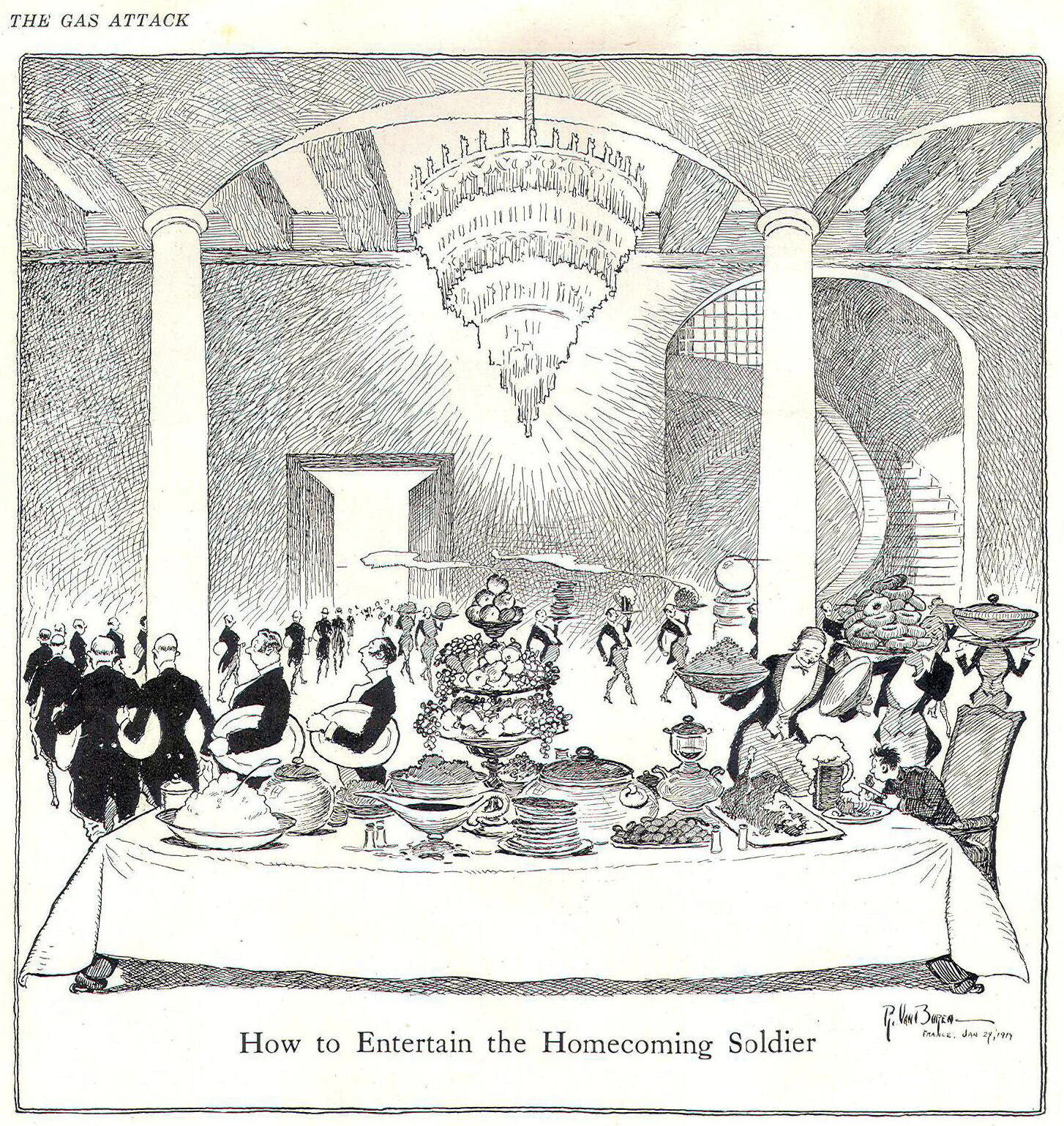
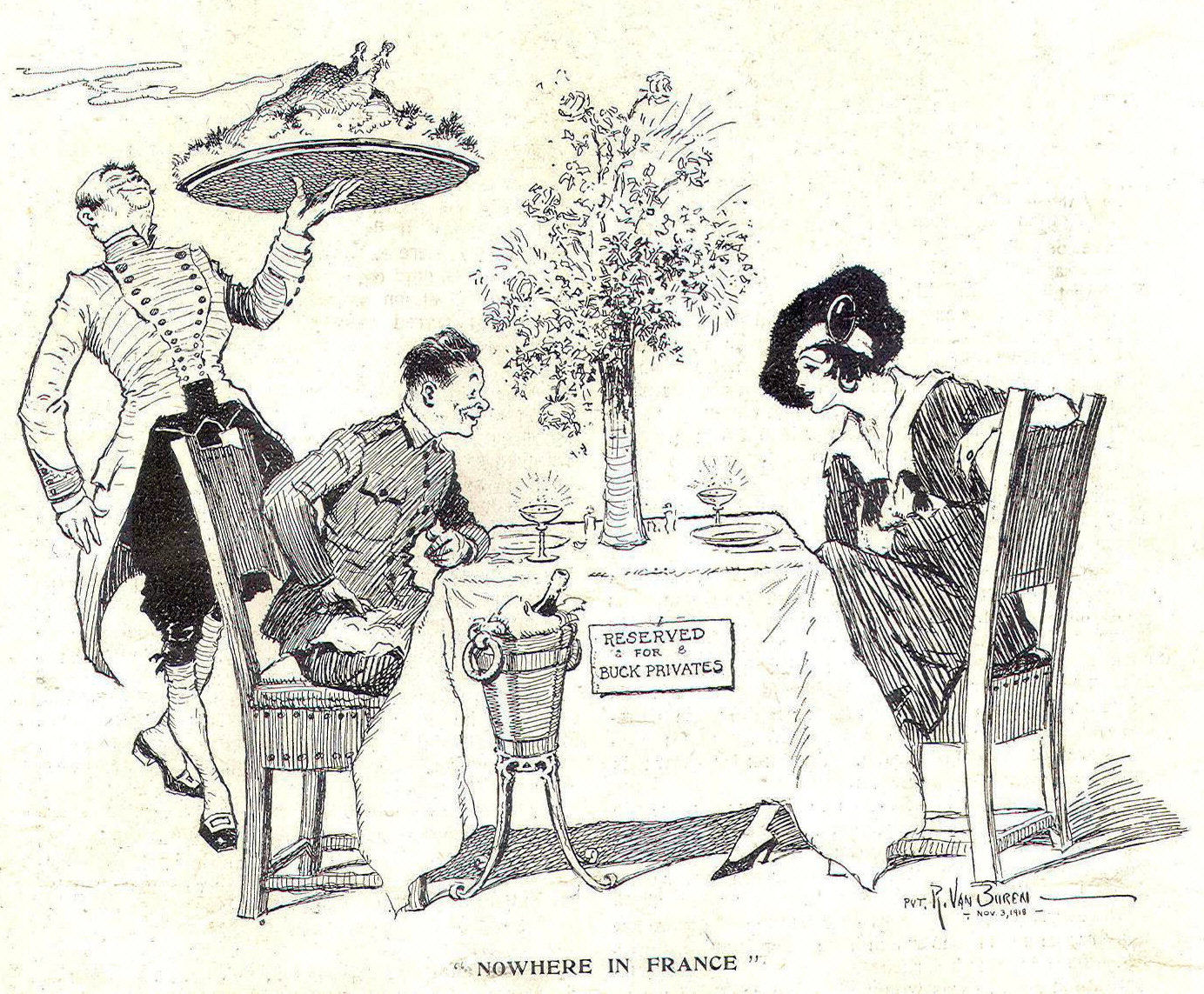
In the cartoons he prepared for Gas Attack, Raeburn had several themes he returned to regularly. Here are three from the overlapping "dreams of the enlisted man" and "returning home" series. Above we share a buck private's impossible dream: a fabulous meal in a fancy French restaurant with a beautiful sophisticated woman.


Click on Image to Expand

The homecoming dream feast.


Click on Image to Expand

Getting out of that uniform.


Stephen Harris told the story of Raeburn's old outfit, the New York 7th Infantry, in Duty, Honor, Privilege from his outstanding trilogy on representative regiments of the AEF.

Order Now

Saturday, September 28, 2013

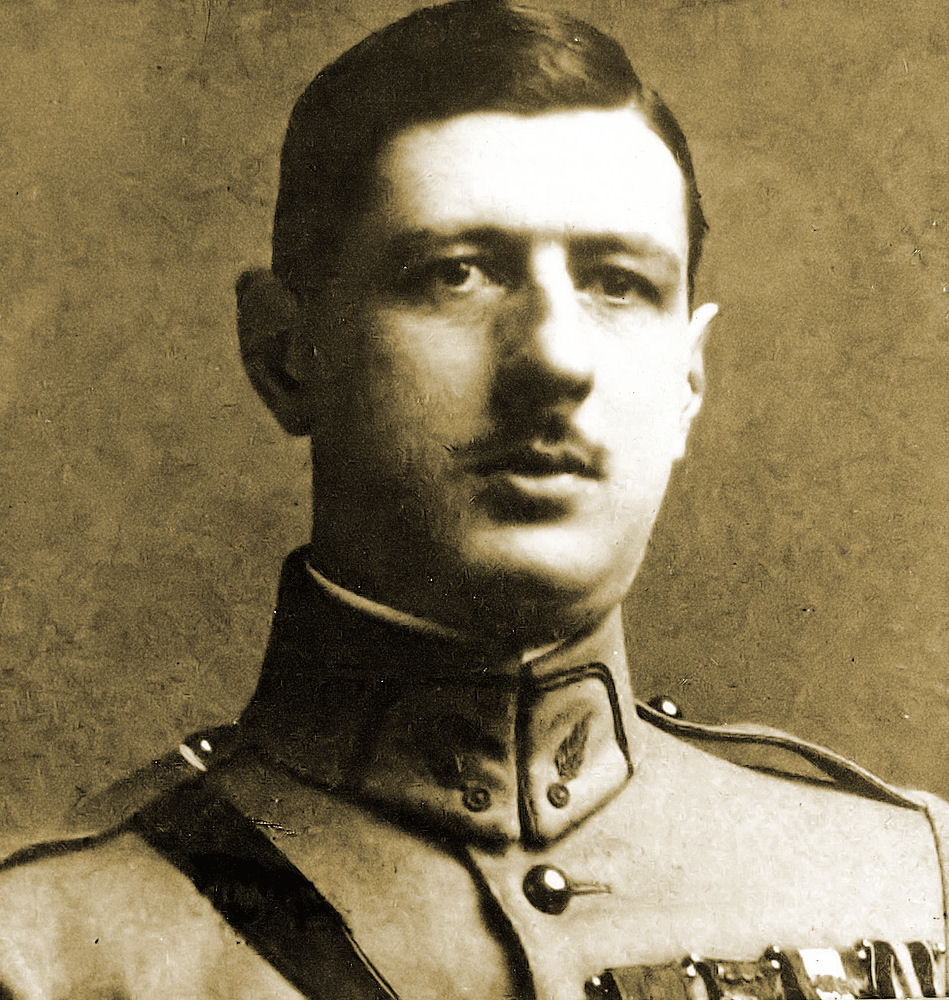
Captain Charles de Gaulle,
Military Historian, Political Philosopher and More

Since 2002 a fine translation of Charles de Gaulle's 1924 analysis of Germany's defeat in the Great War, La Discorde Chez l'ennemi (The Enemy's House Divided) has been available in English. It was the first literary effort of the wounded veteran and one-time prisoner of war. It was recognized as a brilliant effort, yet has always been impossible to pigeonhole. Like the writings of T.E. Lawrence, De Gaulle's ideas were wide-ranging, far beyond typical military history works. Here, for example, his thoughts begin with the pitfalls of leadership and end in a French garden:


Click on Image to Expand


The German military leaders, whose task it was to guide and coordinate such immense efforts, gave proof of an audacity, of a spirit of enterprise, of a will to succeed, of a vigor in handling resources, whose reverberations have not been stilled by their ultimate defeat. Perhaps this study—or, more precisely, the disclosure of the events that are its object may make evident the defects common to these eminent men: the characteristic taste for immoderate undertakings; the passion to expand their personal power at any cost; the contempt for the limits marked out by human experience, common sense, and the law.

Perhaps reading this will cause the reader to reflect that the German leaders, far from combatting these excesses in themselves, or at least concealing them as defects, considered them instead as forces, and erected them into a system; and that this error bore down with a crushing weight at the decisive moments of the war. One may perhaps find in their conduct the imprint of Nietzsche's theories of the elite and the Overman, adopted by the military generation that was to conduct the recent hostilities and which had come to maturity and definitively fixed its philosophy around the turn of the century.

The Overman with his exceptional character, his will to power, his taste for risk, his contempt for others who want to see him as Zarathustra—appeared to these impassioned men of ambition as the ideal that they should attain. They voluntarily resolved to be part of that formidable Nietzschean elite who are convinced that, in pursuing their own glory, they are serving the general interest; who exercise compulsion on "the mass of slaves," holding them in contempt; and who do not hesitate in the face of human suffering, except to hail it as necessary and desirable.
Perhaps, finally, in meditating upon these events, one may wish to measure with what dignity we should clothe that superior philosophy of war which animated these leaders and which could at one time render futile the harshest efforts of a great people and at another constitute the most universal and surest guarantee of the destinies of the fatherland.


Professor Robert Eden of Hillsdale College did a wonderful job with this translation.

Order Now

This study will have attained its object if it helps in a modest way to induce our military leaders of tomorrow, following the example of their victorious models in the recent war, to shape their minds and mold their characters according to the rules of classical order. It is from those rules that they may draw that sense of balance, of what is possible, of measure, which alone renders the works of energy durable and fecund.

In the classical French garden, no tree seeks to stifle the others by overshadowing them; the plants accommodate themselves to being geometrically arranged; the pond does not aspire to be a waterfall; the statues do not vie to obtrude themselves upon the admiring spectator. A noble melancholy comes over us, from time to time. Perhaps it comes from our feeling that each element, in isolation, might have been more radiantly brilliant. But that would be to the detriment of the whole; and the observer takes delight in the rule that impresses on the garden its magnificent harmony.

Friday, September 27, 2013

The Meuse-Argonne Offensive, Part II:
Victory Commemorated

Yesterday, we presented a review of the Meuse-Argonne Offensive as it was fought in 1918. Since it was America's largest battlefield in the war, every effort was made afterward to honor the effort and sacrifice of the participants. Here are the major memorials and a selection of the unit, state, and individual memorials that can be found there today.


Click on Image to Expand

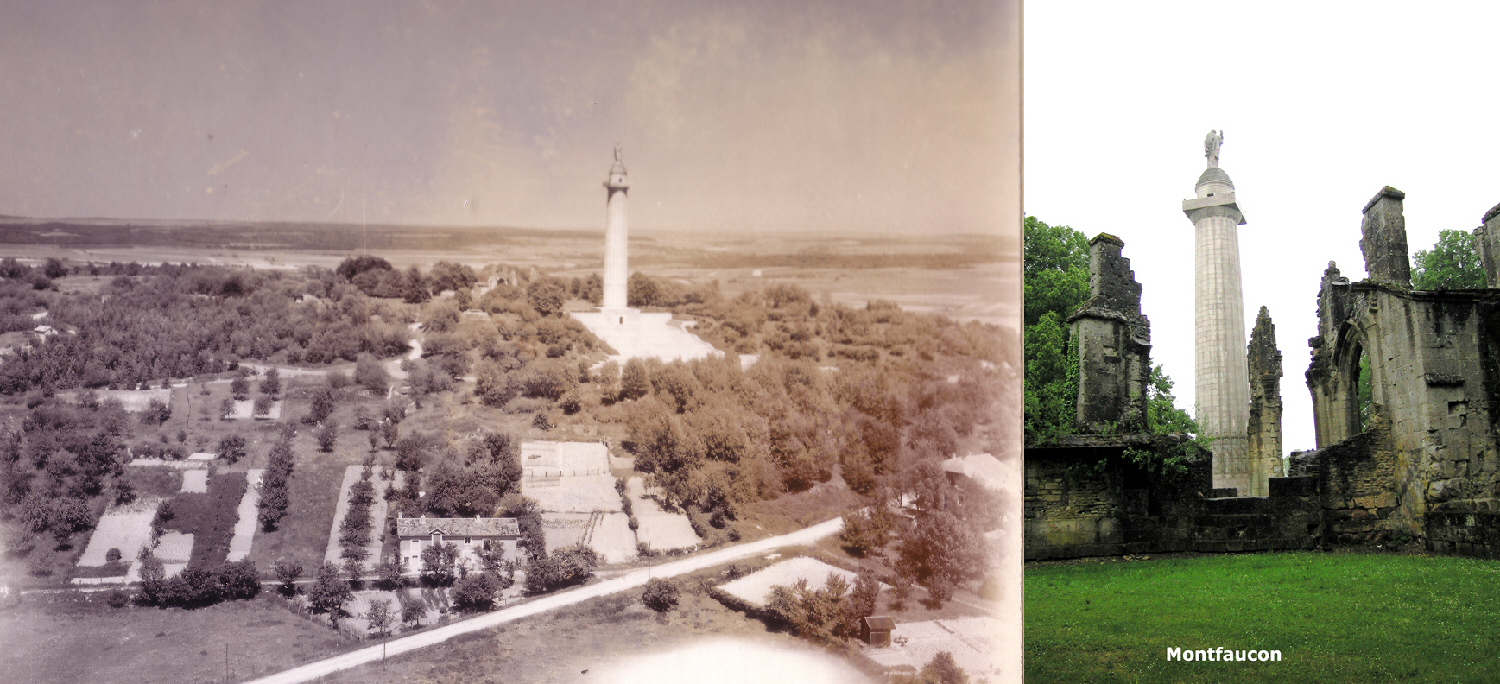
Montfaucon (Mount Falcon) was the most important opening objective of the operation and is, today, the location of the national memorial to the battle. It consists of a massive granite Doric column, surmounted by a statue symbolic of Miss Liberty, which towers more than 200-feet above the war ruins of the former village and an abbey. The observation platform on top of the memorial affords magnificent views of the battlefield. The photo on the left, taken from a B-17 shortly after VE-Day in 1945, shows why the position was so important. It gave the German defenders a 360-degree view of the surrounding countryside. Behind Montfaucon can be seen the open country that would have allowed the U.S. assault a rapid advance had the hill been taken quickly. Montfaucon, however, was held through the second day, allowing reinforcements to be called in to slow the American advance.


Click on Image to Expand

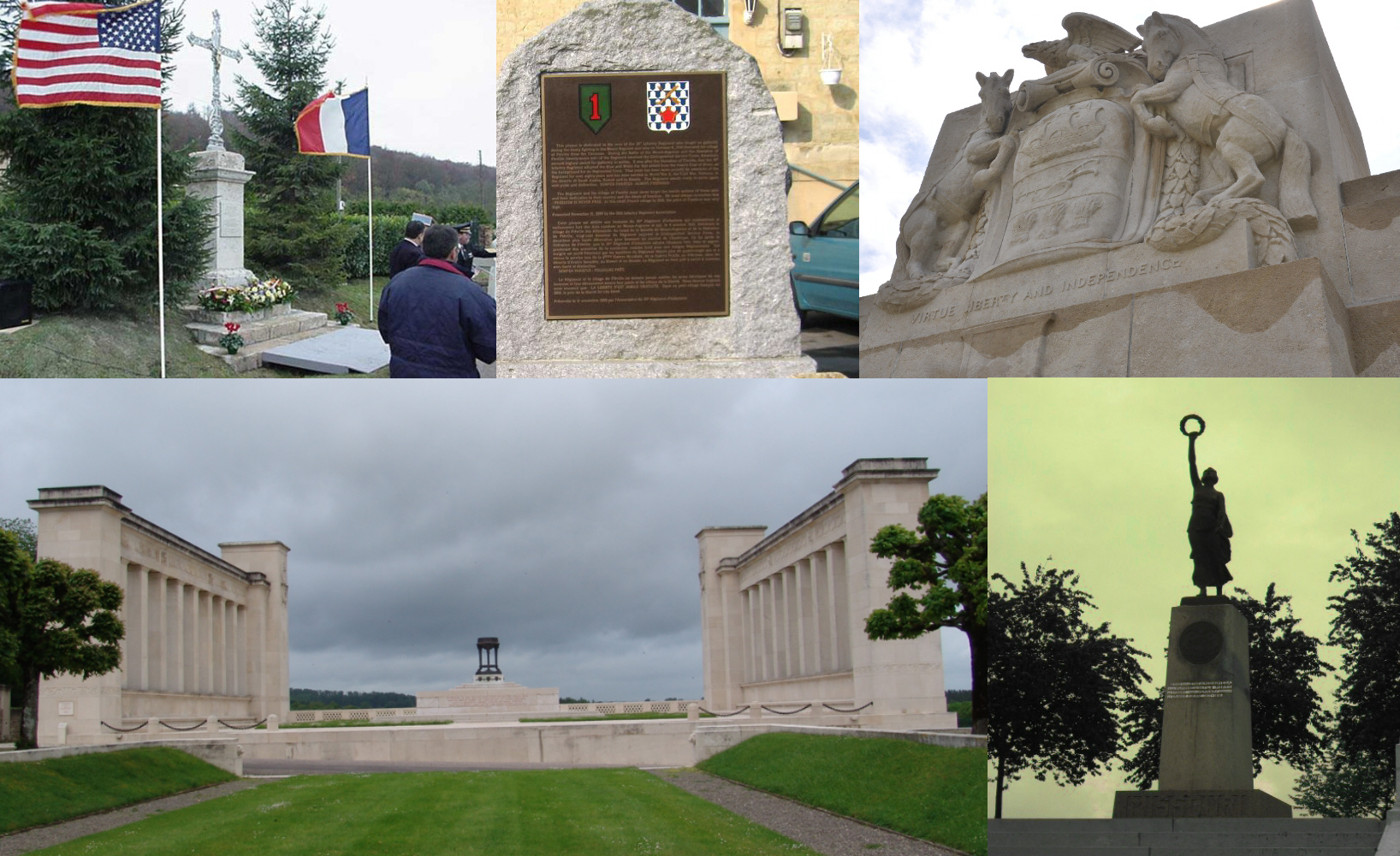
A number of monuments are concentrated in the early zone of the American advance. From the top left: the Lt. Frank (Balloon Buster) Luke memorial near Murvaux, just east of the Meuse, where he crashed and had his fatal gun battle with German soldiers; a plaque honoring the 16th Infantry, 1st Division, at Fleville; the 80th Division Monument at Nantillois. Below: the enormous Pennsylvania Monument at Varennes; and the nearby Missouri State Monument.


Click on Image to Expand

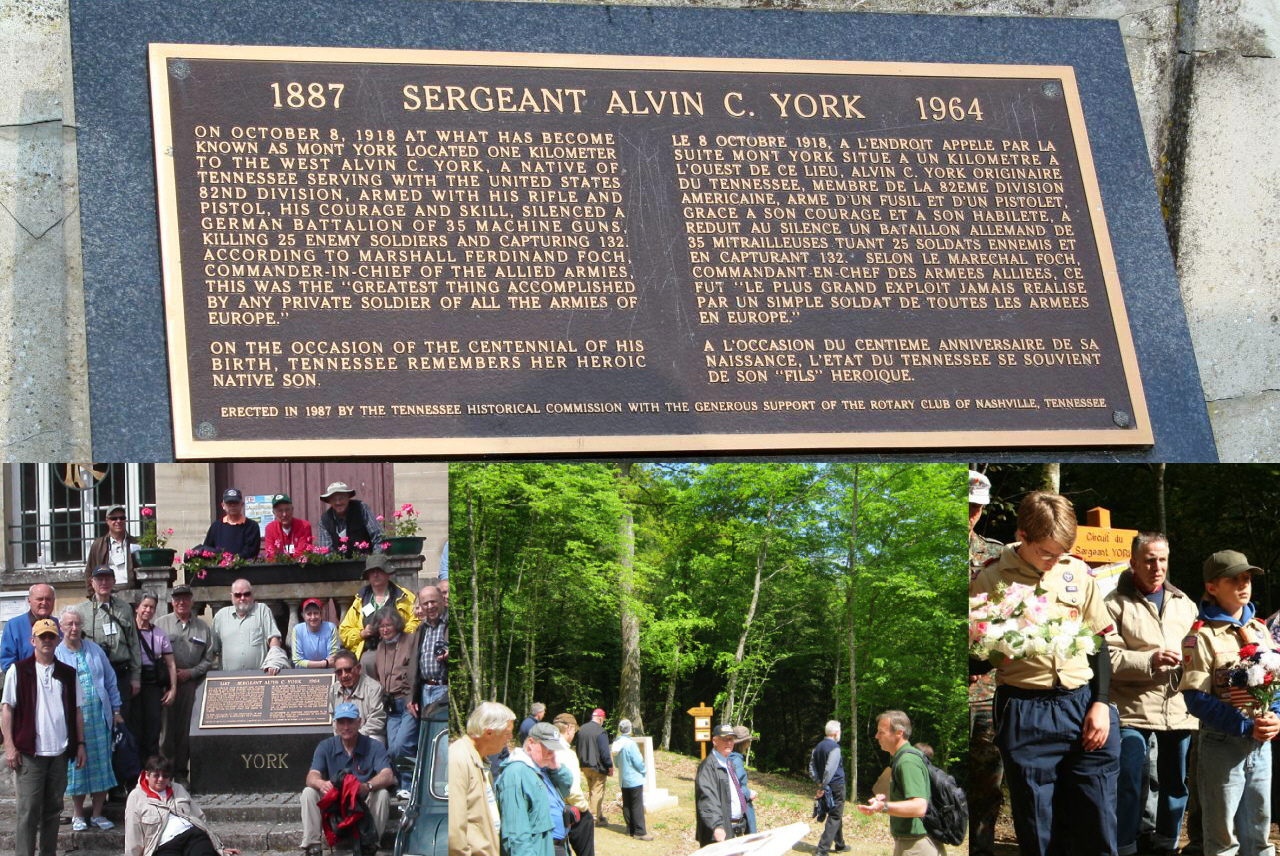
Chatel-Chéhéry in the Argonne Forest was the location of one of two great legends of the battle: Alvin York's Medal of Honor feat on 8 October 1918. The town hall is the site of the main commemorative plaque. To the north of the village is the new commemorative trail that follows York's activities that day. The Boy Scouts photographed at the trail's dedication are sons of American military stationed in Europe, who volunteered to help restore the trail.


Click on Image to Expand

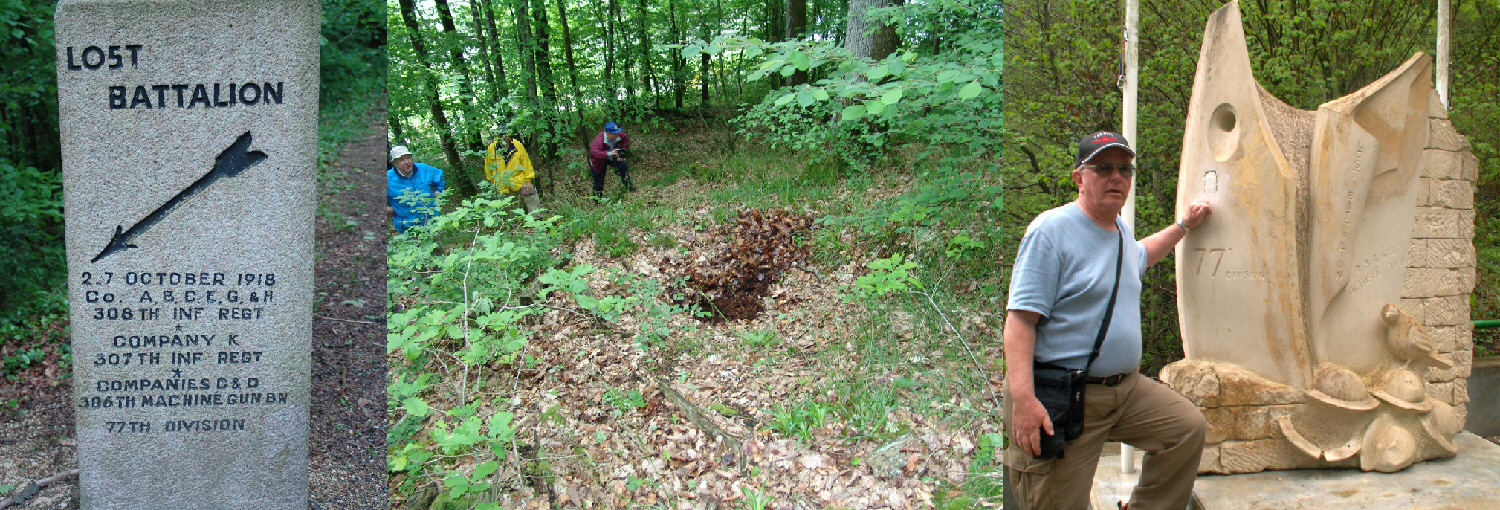
Nearby, at Charlevaux Mill, is the site of the Lost Battalion incident of early October 1918. The actual site (one of the rifle pits is shown in the middle) has become more difficult to access in recent years but can be viewed from the distance near the new roadside monument (right image) dedicated on the 90th anniversary of the event.


Click on Image to Expand

There are fewer markers commemorating the last stage of the battle, since it involved a very rapid advance. On the left side above is a view of Sedan taken from the hill near Pont Magus, which was the farthest northern point of advance for the offensive. Below is a view of  the River Meuse, site the last attack of the war. The first has no U.S. commemorations. A small 2nd Division marker on the Meuse indicates the crossing point, while small divisional and corps markers can found on the ridge above, marking the extent of the advance by the Armistice. On the right are shown two memorials close to the farthest easternmost point of the American advance: top is the new monument to Henry Gunther of Baltimore, Maryland, and  the 79th Division, who was the last man killed in action during the Great War; and below is an impressive tower above the village of Sivry honoring the 318th Infantry of the 80th Division.


Click on Image to Expand

The military cemetery at Romagne is the nation's largest in Europe. It covers 130.5 acres and has a total of 14,246 burials. The cemetery lies adjacent to last level of the Hindenburg Line, the German Army's main defensive position in 1918. The left image is an aerial view in which the shield-like shape of the cemetery can be discerned. The right view from the visitor's center toward the chapel and memorial complex. Panels on either side of the chapel contain the "Tablets of the Missing" with 954 names, including those from the U.S. expedition to northern Russia in 1918–1919.


Sources: Steve Miller, ABMC publications, and American War Memorials Overseas