Now all roads lead to France and heavy is the tread
Of the living; but the dead returning lightly dance.
Edward Thomas, Roads

Monday, June 15, 2015

Robert Service's Bio-Warfare WWI Sci-Fi Novel


After he had parted ways with Dan McGrew, the Lady known as Lou, and Clancy of the Mounted, Robert Service, the poet laureate of the Yukon, found his way to the Western Front as an ambulance driver.  His Rhymes of a Red Crossman has some interesting war pieces, and his postwar Parisian writings include the classic "The Absinthe Drinkers".  He stayed in France, married a French lady, and wrote mediocre novels, including one about werewolves.  He never quite gave up on the war, however.


Of his several novels, The Master of the Microbe: A Fantastic Romance (1926) is science fiction, featuring a deadly "Purple Pest" virus developed by a German mad scientist who wishes to wreak vengeance on Europe for the German defeat in World War One by infecting the continent with plague; but it is stolen from him by an antihero master-criminal. The further action involves proto-superhero behavior on the part of characters whose costumes disguise their true identity. Europe is saved in the end. One reviewer described the work as a "gripping but unlikeable thriller."


Sunday, June 14, 2015

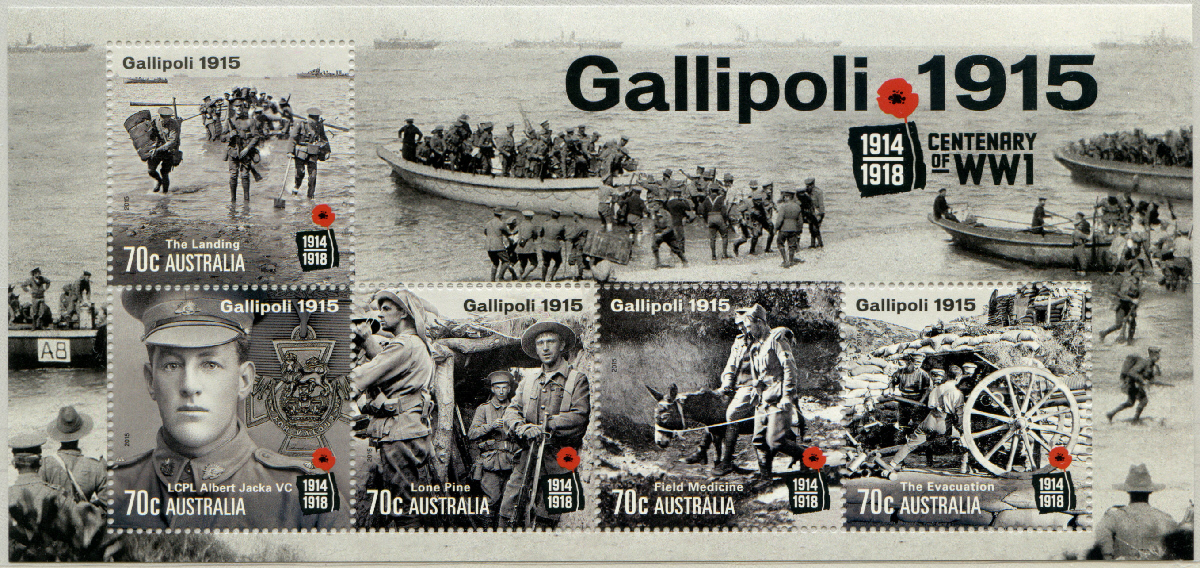
ANZAC Commemorative Stamps from "Down Under"

The lands "Down Under", of course, are pulling out all stops in commemorating the Gallipoli Campaign of 1915 during its Centennial Year.  One way they are doing so is through issuing commemorative stamps. Both Australia and New Zealand are issuing their own series, and they have also developed a bi-national ANZAC joint issue.  Details are below.  Click on the images of the First Day Covers to see a larger version.  There is a nice illustrated online bulletin that gives philatelic information on the Australian and Joint issues, and information on ordering the associated products like stamp packs and postcards at: http://issuu.com/stamps/docs/bulletin_333l

Australia's "Gallipoli 1915" Series


This five-stamp issue is the second in a five-year series commemorating World War I and focuses on Gallipoli, a campaign that would in time be seen as crucial in shaping Australian national consciousness. The  events represented spanned from 25 April 1915 to 8 January 1916.  The subjects are the 25 April landing, Lance Corporal Albert Jacka, VC,  the August Battle at Lone Pine, "The Man with a Donkey" – John Simpson Kirkpatrick (representing field medicine) and the evacuation from the peninsula.

New Zealand's "The Spirit of ANZAC" Series


Also, the second set of a five-year program New Zealand's 1915 series features ten stamps of various denominations.   It subjects include yhr 25 April Landing, nurse Evelyn Brooke, hospital ship The Haneno, the action of August at Chunuk Bair, and several traditions assoicated with the war.
See a detailed listing under "issue information" at:

New Zealand — Australia Joint Issue


The special connection between New Zealand and Australia is reflected in the design of the stamps and coins of this commemorative issue. The 80c stamp features the iconic Australian golden wattle and incorporates hues that represent Australia’s sunburnt earth and blue skies, while the $2.00 stamp features New Zealand’s silver fern and integrates the lush greens and blues of New Zealand’s fertile landscape. Across both stamps and coins stand two soldier silhouettes from an Anzac memorial service - a catafalque sentry and a bugler sounding the Last Post. A background image of Anzac Cove, Gallipoli extends over both stamps and coins, creating a design reflecting the unity of our Anzac alliance.


Saturday, June 13, 2015

The Horrors of Aleppo 1915: An Eyewitness Account

The Armenian Genocide:
Dr. Martin Niepage, German Technical School at Aleppo


When I returned to Aleppo in September 1915 from a three months' holiday at Beirut, I heard with horror that a new phase of Armenian massacres had begun which were far more terrible than the earlier massacres under Abd-ul-Hamid, and which aimed at exterminating, root and branch, the intelligent, industrious, and progressive Armenian nation, and at transferring its property to Turkish hands.

Such monstrous news left me at first incredulous. I was told that, in various quarters of Aleppo, there were lying masses of half-starved people, the survivors of so-called "deportation convoys." In order, I was told, to cover the extermination of the Armenian nation with a political cloak, military reasons were being put forward, which were said to make it necessary to drive the Armenians out of their native seats, which had been theirs for 2,500 years, and to deport them to the Arabian deserts. I was also told that individual Armenians had lent themselves to acts of espionage.

After I had informed myself about the facts and had made enquiries on all sides, I came to the conclusion that all these accusations against the Armenians were, in fact, based on trifling provocations, which were taken as an excuse for slaughtering 10,000 innocents for one guilty person, for the most savage outrages against women and children, and for a campaign of starvation against the exiles which was intended to exterminate the whole nation.

To test the conclusion derived from my information, I visited all the places in the city where there were Armenians left behind by the convoys. In dilapidated caravansaries (hans) I found quantities of dead, many corpses being half-decomposed, and others, still living, among them, who were soon to breathe their last. In other yards I found quantities of sick and starving people whom no one was looking after. In the neighbourhood of the German Technical School, at which I am employed as a higher grade teacher, there were four such hans, with seven or eight hundred exiles dying of starvation. We teachers and our pupils had to pass by them every day. Every time we went out we saw through the open windows their pitiful forms, emaciated and wrapped in rags. In the mornings our school children, on their way through the narrow streets, had to push past the two-wheeled ox-carts, on which every day from eight to ten rigid corpses, without coffin or shroud, were carried away, their arms and legs trailing out of the vehicle.

After I had shared this spectacle for several days I thought it my duty to compose the following report:


"As teachers in the German Technical School at Aleppo, we permit ourselves with all respect to make the following report :

"We feel it our duty to draw attention to the fact that our educational work will forfeit its moral basis and the esteem of the natives, if the German Government is not in a position to put a stop to the brutality with which the wives and children of slaughtered Armenians are being treated here.

"Out of convoys which, when they left their homes on the Armenian plateau, numbered from two to three thousand men) women and children, only two or three hundred survivors arrive here in the south. The men are slaughtered on the way: the women and girls, with the exception of the old, the ugly and those who are still children, have been abused by Turkish soldiers and officers and then carried away to Turkish and Kurdish villages, where they have to accept Islam. They try to destroy the remnant of the convoys by hunger and thirst. Even when they are fording rivers, they do not allow those dying of thirst to drink. All the nourishment they receive is a daily ration of a little meal sprinkled over their hands, which they lick off greedily, and its only effect is to protract their starvation.

"Opposite the German Technical School at Aleppo, in which we are engaged in teaching, a mass of about four hundred emaciated forms, the remnant of such convoys, is lying in one of the hans. There are about a hundred children boys and girls) among them, from five to seven years old. Most of them are suffering from typhoid and dysentery. When one enters the yard, one has the impression of entering a mad-house. If one brings them food, one notices that they have forgotten how to eat, Their stomach, weakened by months of starvation, can no longer assimilate nourishment. If one gives them bread, they put it aside indifferently. They just lie there quietly, waiting for death.

"Amid such surroundings, how are we teachers to read German Fairy Stories with our children, or, indeed, the story of the Good Samaritan in the Bible? How are we to make them decline and conjugate irrelevant words, while round them in the yards adjoining the German Technical School their starving fellow-countrymen are slowly succumbing? Under such circumstances our educational work flies in the face of all true morality and becomes a mockery of human sympathy.

"And what becomes of these poor people who have been driven in thousands through Aleppo and the neighbourhood into the deserts, reduced almost entirely, by this time, to women and children? They are driven on and on from one place to another. The thousands shrink to hundreds and the hundreds to tiny remnants, and even these remnants are driven on till the last is dead. Then at last they have reached the goal of their wandering, the 'New Homes assigned to the Armenians,' as the newspapers phrase it.

"'Ta'alim el aleman' ('the teaching of the Germans') is the simple Turk's explanation to everyone who asks him about the originators of these measures.


"The educated Moslems are convinced that, even though the German nation discountenances such horrors, the German Government is taking no steps to put a stop to them, out of consideration for its Turkish Ally.

"Mohammedans, too, of more sensitive feelings—Turks and Arabs alike—shake their heads in disapproval and do not conceal their tears when they see a convoy of exiles marching through the city, and Turkish soldiers using cudgels upon women in advanced pregnancy and upon dying people who can no longer drag themselves along. They cannot believe that their Government has ordered these atrocities, and they hold the Germans responsible for all such outrages, Germany being considered during the war as Turkey's school-master in everything. Even the mollahs in the mosques say that it was not the Sublime Porte but the German officers who ordered the ill-treatrnent and destruction of the Armenians.

"The things which have been passing here for months under everybody's eyes will certainly remain as a stain on Germany's shield in the memory of Orientals.

"In order not to be obliged to give up their faith in the character of the Germans, which they have hitherto respected, many educated Mohammedans explain the situation to themselves as follows: 'The German nation,' they say, 'probably knows nothing about the frightful massacres which are on foot at the present time against the native Christians in all parts of Turkey. Knowing the German love of truth, how otherwise can we explain the articles we read in German newspapers, which appear to know of nothing except that individual Armenians have been deservedly shot by martial law as spies and traitors? Others again say: 'Perhaps the German Government has had its hands tied by some treaty defining its powers, or perhaps intervention is inopportune for the moment.'

"I know for a fact that the Embassy at Constantinople has been informed by the German Consulates of all that has been happening. As, however, there has not been so far the least change in the system of deportation, I feel myself compelled by conscience to make my present report."


At the time when I composed this report, the German Consul at Aleppo was represented by his colleague from Alexandretta—Consul Hoffmann. Consul Hoffmann informed me that the German Embassy had been advised in detail about the events in the interior in repeated reports from the Consulates at Alexandretta, Aleppo and Mosul. He told me that a report of what I had seen with my own eyes would, however, be welcome as a supplement to these official documents and as a description in detail. He said he would convey my report to the Embassy at Constantinople by a sure agency. I now worked out a report on the desired lines, giving an exact description of the state of things in the han opposite our school.

Consul Hoffmann wished to add some photographs which he had taken in the han himself. The photographs displayed piles of corpses, among which children still alive were crawling about.

In its revised form the report was signed by my colleague, Dr. Graeter (higher grade teacher), and by Frau Marie Spiecker, as well as by myself. The head of our institution, Director Huber, also placed his name to it and added a few words in the following sense: "My colleague Dr. Niepage's report is not at all exaggerated. For weeks we have been living here in an atmosphere poisoned with sickness and the stench of corpses. Only the hope of speedy relief makes it possible for us to carry on our work."

The relief did not come. I then thought of resigning my post as higher grade teacher in the Technical School, on the ground that it was senseless and morally unjustifiable to be a representative of European civilisation with the task of bringing moral and intellectual education to a nation if, at the same time, one had to look on passively while the Government of the country was abandoning one's pupils' fellow countrymen to an agonising death by starvation.


Those around me, however, as well as the head of our institution, Director Huber, dissuaded me from my intention. It was pointed out to me that there was value in our continued presence in the country, as eyewitnesses of what went on. Perhaps, it was suggested, our presence might have some effect in making the Turks behave more humanely towards their unfortunate victims, out of consideration for us Germans. I see now that I have remained far too long a silent witness of all this wickedness.

Our presence had no ameliorating effect whatever, and what we could do personally came to little. Frau Spiecker, our brave, energetic colleague, bought soap, and all the women and children in our neighbourhood who were still alive—there were no men left—were washed and cleansed from lice. Frau Spiecker set women to work to make soup for those who could still assimilate nourishment. I, myself, distributed two pails of tea and cheese and moistened bread among the dying children every evening for six weeks; but when the Hunger-Typhus or Spotted-Typhus spread through the city from these charnel houses, six of us succumbed to it and had to give up our relief work. Indeed, for the exiles who came to Aleppo, help was really useless. We could only afford those doomed to death a few slight alleviations of their death agony.

What we saw with our own eyes here in Aleppo was really only the last scene in the great tragedy of the extermination of the Armenians. It was only a minute fraction of the horrible drama that was being played out simultaneously in all the other provinces of Turkey. Many more appalling things were reported by the engineers of the Bagdad Railway, when they came back from their work on the section under construction, or by German travellers who met the convoys of exiles on their journeys. Many of these gentlemen had seen such appalling sights that they could eat nothing for days.

One of them, Herr Greif, of Aleppo, reported corpses of violated women lying about naked in heaps on the railway embankment at Tell-Abiad and Ras-el-Ain. Another, Herr Spiecker, of Aleppo, had seen Turks tie Armenian men together, fire several volleys of small shot with fowling-pieces into the human mass, and go off laughing while their victims slowly perished in frightful convulsions. Other men had their hands tied behind their back and were rolled down steep cliffs. Women were standing below, who slashed those who had rolled down with knives until they were dead. A Protestant pastor who, two years before, had given a very warm welcome to my colleague, Doctor Graeter, when he was passing through his village, had his finger nails torn out.

The German Consul from Mosul related, in my presence, at the German club at Aleppo that, in many places on the road from Mosul to Aleppo, he had seen children's hands lying hacked off in such numbers that one could have paved the road with them. In the German hospital at Ourfa there was a little girl who had had both her hands hacked off.

In an Arab village on the way to Aleppo Herr Holstein, the German Consil from Mosul, saw shallow graves with freshly-buried Armenian corpses. The Arabs of the village declared that they had killed these Armenians by the Government's orders. One asserted proudly that he personally had killed eight.

In many Christian houses in Aleppo I found Armenian girls hidden who by some chance had escaped death; either they bad been left lying exhausted and had been taken for dead when their companions had been driven on, or, in other cases, Europeans had found an opportunity to buy the poor creatures for a few marks from the last Turkish soldier who had violated them. All these girls showed symptoms of mental derangement; many of them had had to watch the Turks cut their parents' throats. I know poor things who have not had a single word coaxed out of them for months, and not a smile to this moment. A girl about fourteen years old was given shelter by Herr Krause, Dept Manager for the Bagdad Railway at Aleppo. The girl bad been so many times ravished by Turkish soldiers in one night that she had completely lost her reason. I saw her tossing on her pillow in delirium with burning lips, and could hardly get water down her throat.

A German I know saw hundreds of Christian peasant women who were compelled, near Ourfa, to strip naked by the Turkish soldiers. For the amusement of the soldiers they had to drag themselves through the desert in this condition for days together in a temperature of 40 degrees Centigrade, until their skins were completely scorched. Another witness saw a Turk tear a child out of its Armenian mother's womb and hurl it against the wall.

There are other occurrences, worse than these few examples which I give here, recorded in the numerous reports which have been sent in to the Embassy from the German Consulates at Alexandretta, Aleppo and Mosul. The Consuls are of opinion that, so far, probably about one million Armenians have perished in the massacres of the last few months. Of this number, one must reckon that at least half are women and children who have either been murdered or have succumbed to starvation.

It is a duty of conscience to bring these things into publicity, and, although the Turkish Government, in destroying the Armenian nation, may only be pursuing objects of internal policy, the way this policy is being carried out has many of the characteristics of a general persecution of Christians.


All the tens of thousands of girls and women who have been carried off into Turkish harems, and the masses of children who have been collected by the Government and distributed among the Turks and Kurds, are lost to Christendom, and have to accept Islam. The abusive epithet "giaour" is now heard once again by German ears.

At Adana I saw a crowd of Armenian orphans marching through the streets under a guard of Turkish soldiers; their parents have been slaughtered and the children have to become Mohammedans. Even here there have been cases in which adult Armenians were able to save their lives by readiness to accept Islam. Sometimes, however, the Turkish officials first made the Christians present a petition to be received into the communion of Islam, and then answered very grandly, in order to throw dust in the eyes of Europeans, that religion is not a thing to play with. These officials preferred to have the petitioners killed. Men like Talaat Bey and Enver Pasha, when prominent Armenians brought them presents, often tempered their thanks with the remark that they would have been still better pleased if the Armenian givers had made their presents as Mohammedans. A newspaper reporter was told by one of these gentlemen, "Certainly we are now punishing many innocent people as well. But we have to guard ourselves even against those who may one day become guilty." On such grounds Turkish statesmen justify the wholesale slaughter of defenceless women and children. A German Catholic ecclesiastic reported that Enver Pasha declared, in the presence of Monsignore Dolci, the Papal Envoy at Constantinople, that he would not rest so long as a single Armenian remained alive.

The object of the deportations is the extermination of the whole Armenian nation. This purpose is also proved by the fact that the Turkish Government declines all assistance from Missionaries, Sisters of Mercy and European residents in the country, and systematically tries to stop their work. A Swiss engineer was to have been brought before a court-martial because he had distributed bread in Anatolia to the starving Armenian women and children in a convoy of exiles. The Government has not hesitated even to deport Armenian pupils and teachers from the German schools at Adana and Aleppo, and Armenian children from the German orphanages, without regard to all the efforts of the Consuls and the heads of the institutions involved. The Government also rejected the American Government's offer to take the exiles to America on American ships and at America's expense.

The opinion of our German Consuls and of many foreigners resident in the country about the Armenian massacres will some day become known through their report I can say nothing about the verdict of the German officers in Turkey. I often noticed, when in their company, an ominous silence or a convulsive effort to change the subject when any German of warm sympathies and independent judgment began to speak about the Armenians' frightful sufferings.

When Field-Marshal von der Goltz was travelling to Bagdad and had to cross the Euphrates at Djerablus, there was a large encampment of half-starved Armenian exiles there. Just before the Field-Marshal's arrival, so I was told at Djerablus, these unhappy people, the sick and dying with the rest, were driven under the whip several kilometres away over the nearest hills. When von der Goltz passed through, there were no traces left of the repulsive spectacle; but when I visited the place shortly afterwards with some of my colleagues, we found corpses of men, women and children still lying in out-of-the-way places, and fragments of clothes, skulls and bones which had been partly stripped of the flesh by jackals and birds of prey

The author of the present report considers it out of the question that, if the German Government is seriously determined to stem the tide of destruction even at this eleventh hour, it would find it impossible to bring the Turkish Government to reason. If the Turks are really so well inclined to us Germans as people say, cannot they have it pointed out to them how seriously they compromise us before the whole civilised world, if we, as their Allies, have to look on passively while our fellow-Christians in Turkey are slaughtered in their hundreds of thousands, their women and daughters violated, their children brought up as Mohammedans? Cannot the Turks be made to understand that their barbarities are reckoned to our account, and that we Germans will be accused either of criminal complicity or of contemptible weakness, if we shut our eyes to the frightful horrors which this war has produced, and seek to pass over in silence facts which are already notorious all over the world? If the Turks are really as intelligent as is said, should it be impossible to convince them that, in exterminating the Christian nations in Turkey, they are destroying the productive factors and the intermediaries of European trade and general civilisation? If the Turks are as far-sighted as is said, can they blind themselves to the danger that, when the civilised States of Europe have taken cognisance of what has been happening in Turkey during the War, they may be driven to the conclusion that Turkey has forfeited the right to govern herself and has destroyed once for all any belief in her tolerance and capacity for civilisation? Will not the German Government be standing for what is best in Turkey's own interest, if it hinders Turkey from mining herself morally and economically?

In this report I hope to reach the Government's ear through the accredited representatives of the German nation.

When the Reichstag sits in Committee, these things must no longer be passed over, however painful they are. Nothing could put us more to shame than the erection at Constantinople of a Turco-German palace of friendship at huge expense, while we are not in a position to shield our fellow-Christians from barbarities unparalleled even in the bloodstained history of Turkey. Would not the funds collected be better spent in building orphanages for the innocent victims of Turkey's barbarities?

After the massacres of 1909 a kind of reconciliation banquet was held at Adana, in which the heads of the Armenian clergy took part as well as high Turkish officials. The German Consul, Buge, who was present, related that an Armenian ecclesiastic got up and said in his speech "It is true that we Armenians have lost much in these days of massacre—our men, our women, our children and our goods. But you Turks have lost more; you have lost your honour."

If we persist in treating the massacres of Christians as Turkey's internal affair, which is not important for us except as making us sure of the Turks' friendship, then we must change the whole orientation of our German culture policy. We must stop sending German teachers to Turkey, and we teachers must give up telling our pupils in Turkey about German poets and philosophers, German culture and German ideals to say nothing of German Christianity.

Three years ago I was sent by the Foreign Office as higher grade teacher to the German Technical School at Aleppo. The Prussian Provincial School Board at Magdeburg specially enjoined upon me, when I went out, to show myself worthy of the confidence reposed in me in the grant of furlough to take up this educational post at Aleppo. I should not be fulfilling my duty as a German official and an accredited representative of German culture, if I consented to keep silence in face of the atrocities of which I was a witness, or to look on passively while the pupils entrusted to me were driven out to die of starvation in the desert.

If anyone enquires into the motives which induced the Young Turkish Government to decree and carry out these frightful measures against the Armenians, one might give the following explanation :

The Young Turk has the European ideal of a united national state always floating before his eyes. He hopes to turkify the non-Turkish Mohammedan races—Kurds, Persians, Arabs, and so on—by administrative methods and through Turkish education, reinforced by an appeal to their common interests as Mohammedans. The Christian nations—Armenians, Syrians and Greeks—alarm him by their cultural and economic superiority, and he sees in their religion an obstacle to turkifying them by peaceful means. They have, therefore, to be exterminated or converted to Mohammedanism by force. The Turks do not suspect that, in doing this, they are sawing off the branch on which they are sitting themselves. Who is to bring progress to Turkey if not the Greeks, Armenians and Syrians, who constitute more than a quarter of the population of the Empire?

The Turks, the least gifted of all the races living in Turkey, are themselves only a minority of the population, and are still far behind even the Arabs in civilisation. Where is there any Turkish trade, Turkish handicraft, Turkish manufacture, Turkish art, Turkish science? Even their law, religion and language, so far as it can be given literary form, have been borrowed from the conquered Arabs.

We teachers who have been teaching Greeks, Armenians, Arabs, Turks and Jews in German schools in Turkey for years, can only declare that the pure Turks are the most unwilling and incapable of all our pupils. When, for once in a way, a Turk achieves something, in nine cases out of ten one can be certain that one is dealing with a Circassian, an Albanian, or a Turk with Bulgarian blood in his veins. From my personal experience I can only prophesy that the Turks proper will never achieve anything in trade, manufacture or science.

We are told now in German newspapers of the Turks' hunger for education and of how they are thronging eagerly to learn German. There are even reports of language courses for adults which have been started in Turkey. They are certainly started, but with what results? They go on to tell one of a language course at a Technical School which opened with twelve Turkish teachers as pupils. The author of this story forgets, however, to add that, after four lessons, only six pupils put in an appearance; after five lessons, five; after six lessons four, and, after seven lessons. only three, so that after eight lessons the course came to an end, through the laziness of the pupils, before it had properly begun. If the pupils had been Armenians they would have persevered until the end of the school year, learnt patiently, and come away with a respectable mastery of the German language.

What is Germany's duty and, indeed, the duty of every civilised Christian nation in face of the Armenian massacres? We must try every means of saving the half million of Armenian women and children who may still be alive in Turkey to-day, and who are abandoned to death by starvation, from an end which would be a disgrace to the whole civilised world. The hundreds of thousands of deported women and children who have been left lying on the borders of the Mesopotamian desert, and on the roads leading thither, can only maintain their miserable existence a short time longer. How long can people really support life by picking grains of corn out of horse-dung and depending for the rest upon grass? Months of insufficient nourishment and the prevailing dysentery will have brought countless numbers into a state past help. But at Konia a few thousand Armenians are still alive--educated people from Constantinople, who were in easy circumstances before their deportation, doctors, writers, merchants—and these could still be helped before they too succumb to the fate that threatens all. There are 1,500 Armenians in good health—men, women and children, including grandmothers sixty years old and many children of six and seven-who are still at work on a section of the Bagdad Railway between Eiran and Entilli, near the big tunnel, breaking stones and shovelling earth. For the moment they are being looked after by Herr Morf, Superintendent Engineer of the Bagdad Railway; but the Turkish Government has registered their names too. As soon as their work is finished, as it will be in perhaps two or three months' time from now, and they are no longer wanted, "new homes will be assigned to them,"—that is, the men will be taken off and slaughtered, the pretty women and girls will find their way into harems, the remainder will be driven hither and thither without food through the desert until all is over.

The Armenian nation has a claim to German help. When Armenian massacres threatened to break out in Cilicia several years ago, a German warship appeared off Mersina. The Commander called on the Armenian Katholikos at Adana and assured him that, so long as Germany had any influence in Turkey, massacres like those under Abd-ul-Hamid would be impossible. The same assurance was given by the German Ambassador, von Wangenheim, to the Armenian Patriarch and to the President of the Armenian National Council in an interview last April. [1915]

Even apart from our common duty as Christians, we Germans are under a special obligation to stop the complete extermination of the half-million Armenian Christians who still survive. We are Turkey's allies and, after the elimination of the French, English and Russians, we are the only foreigners who have any say in Turkish affairs. We may indignantly refute the lies of our enemies abroad, who say that the massacres have been organised by German Consuls. We shall not be able to dissipate the Turkish nation's conviction that the Armenian massacres were ordered by Germany, unless energetic steps are at last taken by German diplomatists and officers. And even if we cleared ourselves of everything but the one reproach that our timidity and weakness in dealing with our ally had prevented us from saving half a million women and children from slaughter or death by starvation, the image of the German War would be disfigured for all time in the mirror of history by a hideous feature.

It is utterly erroneous to think that the Turkish Government will refrain of its own accord even from the destruction of the women and children, unless the strongest pressure is exercised by the German Government. Only just before I left Aleppo last May, [1916] the crowds of exiles encamped at Ras-el-Ain on the Bagdad Railway, estimated at 20,000 women and children, were slaughtered to the last one.

Sources:  Armeniapedia.org
1975 Reprint of Dr. Martin Niepage's original 1917 report. 
Photos from Armenian National Archives and Wikipedia


Friday, June 12, 2015

100 Years Ago Today: West Point's "Class the Stars Fell On" Graduates

The "Class the Stars Fell On" in the Great War


By James Patton

On 12 June 1915, 164 cadets graduated from the United States Military Academy at West Point and were commissioned in the Army. Fifty-nine of these men would attain the rank of general, an unprecedented number to this day. Two 1915 graduates, Dwight D. Eisenhower and Omar N. Bradley, were two of the five Generals of the Army (five-star) ever. Another two, James Van Fleet and Joseph McNarney, were generals (four-star). There were also seven lieutenant generals, 24 major generals, and 24 brigadier generals from this class. 

Bradley was 44th in the class and Eisenhower 61st. The top man in the class, William E. R. Covell, was a two-star general, while Brig. Gen. John Keliher graduated 159th. 

It is well known that neither Eisenhower nor Bradley served in France during the war, but 90 other classmates did. Amongst these were 29 of the future generals. Here are brief descriptions of the war records of some of these:

Gen. James Van Fleet: Commissioned in the Infantry. Arrived in France in July 1918. Commanded the 17th Machine Gun Battalion. Wounded in the Meuse-Argonne November 1918. Ended the war as a major. 

Major Van Fleet After the War and Later as a General

Lt. Gen. Thomas Larkin: Commissioned in the Engineers. Arrived in France in December 1917. Served with the British Royal Engineers until June 1918, then served as a battalion commander with the 2nd Engineers, 2nd Division at 2nd Marne, Oise-Vesle, and the Meuse Argonne. Ended the war as a lieutenant colonel.

Lt. Gen. John Leonard: Commissioned in the Infantry. Arrived in France in June 1918. Served as a battalion commander in the 6th infantry, 5th Division. Awarded the DSC for heroism on 14 October 1918 in the Meuse-Argonne. Wounded on 16 Oct. Ended the war as a lieutenant colonel.

Maj. Gen. Paul J. Mueller: Commissioned in the Infantry. Arrived in France in June 1918. Commanded a battalion in the 64th infantry, 7th division. Received a divisional citation for bravery in action near the Bois de Puvenelle, 10 October 1918. Ended the war as a major. 

Maj. Gen. Charles Ryder: Commissioned in the Infantry. Arrived in France in December 1917. Served as a company and battalion commander in the 16th infantry, 1st Division, at Toul, Montdidier, Soissons, and Meuse-Argonne. Awarded the DSC for heroism at Soissons, 21 July 1918, and a second DSC for heroism near Fleville on 9 October 1918. Wounded on 21 July. Ended the war as a lieutenant colonel.

West Point's Class of 1915

Maj. Gen. John Wogan: Commissioned in the Coast Artillery. Arrived in France in September 1917. Commanded a battery in the 52nd Artillery in the Champagne and Alsace (first U.S. heavy artillery at the front), then commanded a battalion in the 43rd Artillery in St. Mihiel and Meuse Argonne. Ended the war as a major.

Brig. Gen. Michael Davis: Commissioned in the Infantry. Qualified as an aviator May 1917. Trained in the UK from February to May 1918, then flew an SE5a with the celebrated (24 aces) No. 40 Squadron RAF until July 1918. Ended the war as a major.

Three 1915 graduates were killed in action, three died of disease, two were killed in aircraft crashes, and two in vehicle mishaps.


Thursday, June 11, 2015

The Centennial at the Grass Roots: Golden Age Air Museum, Bethel, PA

In my experience, no aspect of the First World War has more allure than its aviation dimension. It has it all: legends & heroes (aces and barnstormers), technology, and relevance right down to our current day. One of the aerodromes keeping this tradition alive is the Golden Age Air Museum at Bethel, PA.  (link)

The museum has an inventory of WWI replicas, including a SPAD XIII now being completed, as well as aircraft from the 1920s and '30s. Here's one example from their collection – a Fokker Dr.I, just like the Red Baron flew.


Better News:

This weekend the museum is hosting an air show promising "Daredevil Flying & Death Defying Excitement!" The event includes the opportunity to take a ride in a vintage biplane. Don't miss it, if you're in the neighborhood.  


Wednesday, June 10, 2015

How World War I Changed Mourning

On my recent trip to the Western Front, I saw Käthe Kollwitz's "Grieving Parents" (shown below) in person at Vladso German Cemetery in Belgium for the first time. It was, of course, powerfully moving. However, after returning home, I ran across this article that raises the question "Did parents of the war's dead really grieve like this?"


The British anthropologist Geoffrey Gorer, the author of Death, Grief, and Mourning, argues that, at least in Britain, the First World War played a huge role in changing the way people mourned. Communities were so overwhelmed by the sheer number of dead that the practice of ritualized mourning for the individual eroded. Other changes were less obvious but no less important. More people, including women, began working outside the home; in the absence of caretakers, death increasingly took place in the quarantining swaddle of the hospital. The rise of psychoanalysis shifted attention from the communal to the individual experience. In 1917, only two years after Émile Durkheim wrote about mourning as an essential social process, Freud’s “Mourning and Melancholia” defined it as something essentially private and individual, internalizing the work of mourning. Within a few generations, I read, the experience of grief had fundamentally changed. Death and mourning had been largely removed from the public realm. By the 1960s, Gorer could write that many people believed that “sensible, rational men and women can keep their mourning under complete control by strength of will and character, so that it need be given no public expression, and indulged, if at all, in private, as furtively as...masturbation.” Today, our only public mourning takes the form of watching the funerals of celebrities and statesmen. It’s common to mock such grief as false or voyeuristic (“crocodile tears,” one commentator called mourners’ distress at Princess Diana’s funeral), and yet it serves an important social function. It’s a more mediated version, Leader suggests, of a practice that goes all the way back to soldiers in the Iliad mourning with Achilles for the fallen Patroclus.

I found myself nodding in recognition at Gorer’s conclusions. “If mourning is denied outlet, the result will be suffering,” Gorer wrote. “At the moment our society is signally failing to give this support and assistance...The cost of this failure in misery, loneliness, despair and maladaptive behavior is very high.” Maybe it’s not a coincidence that in Western countries with fewer mourning rituals, the bereaved report more physical ailments in the year following a death.

Source:  The Long Goodbye: A Memoir by Meghan O'Rourke

Tuesday, June 9, 2015

The First World War on Cigarette and Trade Cards: An Illustrated and Descriptive History
Reviewed by David Beer


The First World War on Cigarette and Trade Cards: An Illustrated and Descriptive History
by Cyril Mazansky
Schiffer Publishing, Ltd., 2014


You don't have to be a card collector to thoroughly enjoy this splendid publication. Anyone interested in the Great War and open to gaining a fresh perspective on its numerous aspects through the lens of what once was a popular hobby will enjoy Cyril Mazansky's book. I know I did. In fact I found myself spending several enjoyable hours reading through the informative and clearly written text while at the same time admiring the artistic nature of the numerous cars illustrated on almost every page. The fact that the book is produced on fine quality paper stock and that both print and illustrations are of exceptional quality all added to my enjoyment.

The book is divided into two main sections. Section 1 is an informative introduction to the history and nature of card collecting and is enlightening for anyone not familiar with the hobby. These cards originated as simple stiffeners for the paper packets that cigarettes were sold in toward the end of the 19th century. It wasn't long before tobacco companies hit on the idea of not just advertising their product on these cards but of illustrating popular events and notable people, with some brief related information printed on the back. If a certain topic could be extended into a series, so much the better, since the desire to collect the series would encourage smokers and collectors to continue buying that brand.


Thus began the hobby of cartophily, which involves the collecting of cards and other illustrative items. The author gives a brief history of cartophily and provides examples of some of the earliest cards. The rest of Section 1 consists of an overview of the war, a timeline, and a brief consideration of what the war meant to individual soldiers and civilians.

Section II is organized into ten chapters. These illustrate almost every aspect of the war through photographically reproduced British cards mainly from 1914–1918. Chapters on allies, monarchs, political and military leaders all give us a wide view of war-related personalities. Chapter 9 is devoted to cards that depict Victoria Cross winners. A chapter interestingly entitled "Armamentarium" deals with series of cards on military vehicles, tanks, guns, chemical and naval weapons, ships, aircraft, and balloons. Most of the cards are in color.


They are especially impressive when dealing with military uniforms (Chapter 11) and war scenes (Chapter 8). Other chapters are devoted to the home front and war humor and reveal that cigarette cards could be just as propagandistic as posters of the era. In fact, many of these cards reflect the same recruiting and nostalgia themes as wartime posters and postcards. A final chapter considers some German cards of the time that were issued in complete sets. The author's narrative throughout the book is extensive, clear, and to the point. In parallel with the cards it provides a detailed and absorbing popular history of World War One.

You will find many familiar names as you go through this book. Cigarette companies such as Wills, John Player, Morris, the American Tobacco Co., and Ogden's were all reliable producers of cards in their time, as were companies rarely heard of today such as Westminster Tobacco, Ardath Tobacco, and Teofani & Co. Producers of other goods sometimes followed suit, placing cards in their chocolate, tea, or biscuit boxes. The author has provided an appendix with an extensive list of the companies whose cards appear in his book.

Order Now


It's not surprising that cigarette and trade cards were so popular prior to the war and for some years afterward. As the author points out, in the late 1800s people were far less literate than they are today. Many couldn't afford books or newspapers (which were rarely illustrated anyhow), and posters and illustrated cards provided a kind of visual entertainment not easily found elsewhere. They also provided a source of information and even education for many. In the aggregate these cards soon provided a wealth of knowledge about the war and related matters that many people might never have been exposed to otherwise. Thus, card collecting was popular for several decades, well into the 1940s. It still survives today. Individual and sets of cards are sold and traded on the Internet and several card-collecting organizations exist around the world, including the largest, the Cartophilic Society of Great Britain.

By focusing on World War One in the context of this unique and socially relevant tradition, Cyril Mazansky's admirable and fascinating book has provided a great service to the history and study of both. It is a book well worth having, no matter what your particular aims in studying the war might be.


David Beer


Monday, June 8, 2015

The War's Most Famous Female Soldier

The new issue of the Hoover Digest has this interesting tidbit.

Maria Botchkareva, a Russian peasant who fled an abusive family life to join the Imperial Russian Army in 1914, was the war’s most famous female soldier. She was not alone: an estimated 400 to 1,000 women and girls enlisted in the tsar’s army. Botchkareva faced ridicule and sexual harassment, as did other female soldiers, but she proved herself in battle. After the Romanovs fell in March 1917, the Provisional Government allowed her to form the Women’s Battalion of Death, whose heroic example, she hoped, would shame demoralized Russian men into resuming the fight against Germany and Austria. 


After the Bolshevik Revolution, she traveled to America, where she dictated her memoirs and met President Wilson. Returning to her homeland in 1918, she tried to oppose the Bolsheviks but was captured. She was executed by firing squad in 1920. [Hoover Institution Library]

Sunday, June 7, 2015

World War I Views from the Eiffel Tower

Images by Steve Miller


Looking northwest: The Trocadéro, now site of the Palais de Chaillot, was formerly the location of a hill village outside Paris. Overlooking the Seine and the Left Bank, it presents wonderful views of the city and has two notable Great War monuments.


Left: "Monument to the Glory of French Armies", a massive bas-relief by Paul Landkowski (Christ over Rio), was completed in 1956 and depicts the French Army Corps of World War One. Landkowski completed a number of memorials connected with the war, including the tomb of Marshal Foch at Les Invalides (below) and the haunting "Phantoms", the memorial to the Second Battle of the Marne, said to have inspired "Glory. . ." 
Right: Equestrian Statue of Marshal Ferdinand Foch (1851s1929) honors the famous general as a marshal of both France and Poland. France sent support for Poland's postwar struggle with the Red Army. The statue was not completed until 1944. It is paired with a facing equestrian statue across the Seine of fellow marshal of France Joseph Joffre, who commanded the French Army at the start of the war.


Looking southeast: During the Great War the Eiffel Tower was used as an observation post and wireless transmission and intercept station. There are many tales connecting the tower and the Great War that are hard to confirm: that the tower was "saved" because of it value as a war resource, that its station jammed German radio transmissions during the Battle of the Marne, and that it hosted a detachment of parrots that reputedly had acute hearing able to detect approaching aircraft. During the war, incidentally, Gustav Eiffel dedicated himself to aviation research.


At the École Militaire, the massive military school on the Champs de Mars, is an equestrian statue of Marshal  Josef Joffre (1852–1931), who commanded the French Army in the early years of the war. The statue lists the important battles he commanded including the Marne and Verdun. It directly faces the similar statue of Ferdinand Foch across the River Seine atop the Trocadéro.


In the 17th century Louis XIV decided to build a "hotel" (the term for a city mansion) to house his disabled and blinded soldiers. It was completed after his death and included a magnificent golden dome over its chapel. In 1842 the chapel was modified to accommodate the Invalides' most famous feature, the tomb of Napoleon Bonaparte. Many aspects of the complex, however, are connected with the First World War. It was on the Esplanade of the Invalides that the legendary "Taxicabs of the Marne" were assembled to transport 4,000 men of the 7th Division to a battlefield northeast of Paris for the critical battle of the 1914 campaign. The buildings house the war museum, Musée de l'Armée, that was opened in 1905, and is today one of the largest military museums in the world. Visiting its First World War pavilion is utterly essential for any student of the events of 1914–1918. Two monuments on the grounds are also notable. Marshal Joseph Gallieni's (1849–1916) statue honors the military governor of the city during the critical opening of the war, and in an alcove off of Napoleon's Tomb lies the crypt bearing the remains of Marshal Ferdinand Foch, Generalissimo of the Allied effort in 1918.


Saturday, June 6, 2015

Recommended: "Why Study War?" An Essay by Victor Davis Hanson


Military history teaches us about honor, sacrifice, and the inevitability of conflict.

Presented in City Journal, Summer 2007

The Western Front: Almost Any Day in World War 1

Try explaining to a college student that Tet was an American military victory. You’ll provoke not a counterargument—let alone an assent—but a blank stare: Who or what was Tet? Doing interviews about the recent hit movie 300, I encountered similar bewilderment from listeners and hosts. Not only did most of them not know who the 300 were or what Thermopylae was; they seemed clueless about the Persian Wars altogether.

It’s no surprise that civilian Americans tend to lack a basic understanding of military matters. Even when I was a graduate student, 30-some years ago, military history—understood broadly as the investigation of why one side wins and another loses a war, and encompassing reflections on magisterial or foolish generalship, technological stagnation or breakthrough, and the roles of discipline, bravery, national will, and culture in determining a conflict’s outcome and its consequences—had already become unfashionable on campus. Today, universities are even less receptive to the subject.

This state of affairs is profoundly troubling, for democratic citizenship requires knowledge of war—and now, in the age of weapons of mass annihilation, more than ever.

Continue Reading at:

http://www.city-journal.org/html/17_3_military_history.html

Friday, June 5, 2015

Celebrate National Doughnut Day!


Contributed by Dennis Skupinski of Michigan's WWI Centennial Project


During World War One, Salvation Army workers were in the fighting zones of France. Approximately 250 Salvation Army volunteers were there primarily to give spiritual aid and comfort to the American soldier. They were there to be a link with home and family.

Salvation Army volunteers sought to boost soldiers' morale with food. They started out by baking pies but found that baking pies in the trenches was impractical. The Salvation Army's Ensign Margaret Sheldon and Adjutant Helen Purviance of Indiana cleverly thought of frying doughnuts in soldiers' helmets at first. Later they began frying them on camp stoves, seven at a time. The Salvation Army provided writing supplies, stamps, clothes-mending and home-cooked meals, and of course, doughnuts, to the soldiers on the front lines.

National Doughnut Day commemorates the "doughnut lassies," who provided assistance to American soldiers in France during World War One.


The Salvation Army started National Doughnut Day during the Great Depression (1938) as a way to raise funds and remind the soldiers of the Great War of the Salvation Army's social service programs.

Last year, 30 million Americans received assistance from the Salvation Army's 3,600 officers, 60,000 employees, and 3.4 million volunteers.

Celebrate National Doughnut Day by:
  • Enjoying a doughnut (Forget those calories today!)
  • Donating to the Salvation Army
  • Learning more about the Doughnut Lassies and Michigan's WWI Centennial by viewing our video:

Thursday, June 4, 2015

Italy's Elite Bersaglieri


The story of the Bersaglieri begins with Captain Alessandro Ferrero De La Marmora of the grenadiers. On 18 June 1836 he approached His Majesty King Carlo Alberto of Piedmont-Sardinia with the idea of creating a new corps of light infantry which would become the Bersaglieri. Other armies, for some time, had been developing rifle companies and light infantry to act as scouts, screen for the main army, act as skirmishers and to use their sharpshooting skills to weaken the flanks of the enemy during a battle. The captain proposed developing an elite corps of riflemen to perform these same functions. So it was that the Bersaglieri was born, light troops who were trained to be bold, even a bit reckless, disregarding personal danger and, usually, doing their duty with just a little extra dashing flair.

The single most noticeable aspect the Bersaglieri has always been their unique headgear, a broad-brimmed moretto hat decorated with a flowing bunch of black grouse/capercaillie feathers hanging down from the right side. Originally, officers were distinguished by the use of green ostrich feathers , but later all used the same black capercaillie feathers. For formal parade dress as many as 400 plumes could decorate each hat, but for combat duty this was usually reduced to around 100 plumes. The first time the headgear changed was when the Bersaglieri wore tropical sun helmets while on duty in Africa but still decorated them with the traditional black feathers. This mostly remained the same even when the switch was made to steel helmets for combat duty and, depending on the circumstances and the individuals involved, some Bersaglieri can still be seen even today with their helmets decorated in the traditional fashion. This made the Italian light troops stand out and a similar style was adopted in various ways by other troops around the world. In the United States, during the American Civil War, Italian-American units in both the Union and Confederate armies wore feather-decorated hats in imitation of the famous Bersaglieri.

In the Dolomites During WWI
The Bersaglieri also adopted the fez after serving alongside French Zouaves in the Crimean War. The Bersaglieri were also issued with special greased, unpolished brown boots, similar to those worn by the elite Alpine troops. Many also adopted daggers for close-combat assaults. Traditionally, they were always on the run, including their accompanying drum and bugle corps. As light infantry, their speed and mobility was always prized, and by World War I this meant that several companies of each Bersaglieri battalion were mounted on bicycles.

During the First World War, the 12 regiments of Bersaglieri distinguished themselves, especially the four regiments grouped together in the 47th Infantry Division. Of the 210,000 men who served in Bersaglieri regiments, 32,000 were killed and 50,000 wounded. Probably the most notable Bersaglieri veteran of the war was Benito Mussolini, who was discharged after a grenade accident while serving along the Isonzo Front.

The Bersaglieri continue to serve Italy today.

Sources:  The Italian Monarchist and La Grande Guerra

Wednesday, June 3, 2015

On the Western Front: A New War Horse Memorial


On my recent trip to the Western Front we stopped at this striking new monument at Vlamertinge on the N38, the road from Ypres to Poperinge, in commemoration of the war horses who served and died in great numbers during hostilities. It is called "Agonie" and was created by Flemish sculptor Luc Coomans. Dedicated in May 2013 it seemed to be inspired by the stage puppet equines of the play War Horse, but I've not read any confirmation of that.


Tuesday, June 2, 2015

Naval Aviation in the First World War: Its Impact and Influence
Reviewed by Editor/Publisher Michael Hanlon

Naval Aviation in the First World War: Its Impact and Influence
by R.D. Layman
Naval Institute Press, 1996


My late friend, R.D. "Dick" Layman, made a singular contribution to the Great War's historical literature with his 1996 work Naval Aviation in the First World War: Its Impact and Influence. Now I would like to take another shot at making sure his work is not forgotten. Under a barrage of Layman's well-aimed facts, the misconceptions that World War I aero-naval warfare was merely experimental in nature, minimal in scope, fully embraced by neither admirals nor admiralties, and generally inconsequential are smashed in this concisely written book. Most important are his case studies of the successes and missed opportunities of naval aviation in its most significant role of the war — strategic reconnaissance during such operations as Jutland and Gallipoli.

Depiction of German Seaplanes Attacking a Royal Navy Cruiser

The volume also contains an assortment of pithy introductions to subjects like aerial combat, just how operations differ over land and sea, airship design, and other topics on which much cluttered thinking has been published. These essays serve to clear one's head of both extraneous details and romantic "aviators as knights" nonsense. The chapter "Defending the Sea Lanes", for instance, gets to the nub of the tactical usefulness of aircraft in anti-submarine warfare: "The submarine of 1914–18 was for all practical purposes simply a submersible torpedo-boat. . . At average submerged cruising speed of 4 kts, the craft could travel scarcely more than 60 nautical miles before having to surface to recharge. . . Thus it was by forcing them to submerge, not by sinking them, that aircraft contributed most significantly to helping defeat the U-boats."

In six years in the U.S. Air Force, much of it with the now defunct Strategic Air Command, I never read or heard as succinct a summary and critique of air power theory as is provided in Chapter Seven of this book. Additionally, during his award-winning career as an aero-naval historian, Layman collected an inspired library of fascinating details, anecdotes, and surprising statistics. Here are two favorites:


  • Admiral Dewey of Manila was one of the earliest boosters of naval-air power.

  • In April 1917, zeppelin L-23 intercepted the Norwegian schooner Royal off the Danish coast, determined she was carrying contraband, put a prize crew aboard, and sailed the ship back to Germany. (Consider what this must have involved!)

    Order Now


    Two final commendations are due the author and his editors: they cover all theaters of operations equally well (they do not disproportionately focus on the North Sea and Atlantic), and they provide a tremendous selection of photographs supporting the text. If you have any interest in the air, naval, or aero-naval aspects of the war, this is an essential addition to your library. The book has been out of print for years and ought to be reissued, but copies can be found through Amazon or other dealers.

    M. Hanlon
  • Monday, June 1, 2015

    New WWI Medal of Honor Recipients

    The Medal of Honor is to be awarded tomorrow to Army Sergeant William Shemin and to Army Private Henry Johnson for conspicuous gallantry during World War I. 


    Sergeant William Shemin will receive the Medal of Honor posthumously for his actions while serving as a member of Company G, 2nd Battalion, 47th Infantry Regiment, 4th Division, American Expeditionary Forces. Sergeant Shemin distinguished himself during combat operations in the vicinity of the Vesle River, Bazoches, France, on 7–9 August 1918. 

    Sergeant Shemin entered the Army on 2 October 1917. He was assigned as a rifleman to Company G, 47th Infantry Regiment, which moved from Syracuse, New York, to Camp Greene, North Carolina, joining the 4th Infantry Division. The division arrived in France in May 1918. 

    While serving as a rifleman from 7–9 August 1918, Sergeant Shemin left the cover of his platoon’s trench and crossed open space, repeatedly exposing himself to heavy machine gun and rifle fire to rescue the wounded. After officers and senior noncommissioned officers had become casualties, Shemin took command of the platoon and displayed great initiative under fire, until he was wounded, 9 August.


    Private Henry Johnson will receive the Medal of Honor posthumously for his actions while serving as a member of Company C, 369th Infantry Regiment, 93rd Division, American Expeditionary Forces. Then-Private Johnson distinguished himself during combat operations in the vicinity of the Tourbe and Aisne Rivers, northwest of Saint Menehould, France, on 15 May 1918.

    Private Johnson entered the Army on 5 June 1917. He was assigned to Company C, 15th New York (Colored) Infantry Regiment, an all-black National Guard unit that would later become the 369th Infantry Regiment. The regiment was ordered into battle in 1918, and Private Johnson and his unit were brigaded with a French Army colonial unit in frontline combat. 

    While on night sentry duty on 15 May 1918, Private Johnson and a fellow soldier received a surprise attack by a German raiding party consisting of at least 12 soldiers. While under intense enemy fire and despite receiving significant wounds, Johnson mounted a brave retaliation resulting in several enemy casualties. When his fellow soldier was badly wounded, Private Johnson prevented him from being taken prisoner by German forces. Private Johnson exposed himself to grave danger by advancing from his position to engage an enemy soldier in hand-to-hand combat. Displaying great courage, Private Johnson held back the enemy force until they retreated.

    The awards will be made at the White House on 2 June 2015. Command Sergeant Major Louis Wilson, New York National Guard, will join the President at the White House to accept the Medal of Honor on Private Johnson’s behalf. Ms. Elsie Shemin-Roth of Webster Grove, Missouri, will join the President at the White House to accept the Medal of Honor on her father’s behalf.

    ADDITIONAL INFORMATION

    THE MEDAL OF HONOR:
    • The Medal of Honor is awarded to members of the Armed Forces who distinguish themselves conspicuously by gallantry above and beyond the call of duty while:
    • Engaged in an action against an enemy of the United States;
    • Engaged in military operations involving conflict with an opposing foreign force; or serving with friendly foreign forces engaged in an armed conflict against an opposing armed force in which the United States is not a belligerent party.


    The meritorious conduct must involve great personal bravery or self-sacrifice so conspicuous as to clearly distinguish the individual above his or her comrades and must have involved risk of life. There must be incontestable proof of the performance of the meritorious conduct, and each recommendation for the award must be considered on the standard of extraordinary merit.

    Source:  White House Website