Now all roads lead to France and heavy is the tread
Of the living; but the dead returning lightly dance.
Edward Thomas, Roads

Thursday, July 10, 2014

Remembering a Veteran: General Sir Arthur Currie


From Articles by Joyce Kennedy and Michael Iavarone

A former militia volunteer, Arthur Currie [b. 1875] advanced through ability and force of personality to become the senior Canadian officer of the Great War. After surviving with distinction as a brigade and division commander, he was ready for more responsibility. Currie was an advocate of intense planning and preparation before going into battle — "Thorough preparation must lead to success. Neglect nothing." Canadian Corps Commander Sir Julian Byng let him apply his theories, placing him in charge of the training and preparations for the assault on Vimy Ridge. After that great success he succeeded Byng in command and subsequently led his troops in the conclusion of the Third Battle of Ypres [Passchendaele] and a string of victories commencing at Amiens in August 1918.

Knighted after his accomplishments at Vimy Ridge, Arthur Currie became Canada's first full general in 1919. He then served as Principal and Vice Chancellor of McGill University until his death in 1933.

Facts:

  •     Born in 1875 at Napperton, Ontario
  •     Enlisted in the militia at the beginning of the war and made his way up the ranks to become a lieutenant colonel of the artillery
  •     Was part of the First Canadian Division and fought at the battles of Ypres and Saint Julien
  •     Made a strong case for keeping Canadian soldiers together in a true Canadian division
  •     Was successful in establishing a Canadian division and was the first Canadian promoted to the rank of general
  •     Believed in fully preparing his troops before a battle, right from the officers to the lowly private.
  •     Was successful for the planning and execution of the battle of Vimy Ridge (the battle that many feel recognized Canada as a true nation)
  •     Was considered aloof from his troops and nicknamed "Guts and Gaiters"; however, often visited his troops at the front
  •     Involved in the controversy over the fighting at of Mons in 1918, when a number of troops were killed hours before the Armistice
  •     Knighted by King George V in 1917
  •     Honours received: Commander of the Bath, Legion of Honour, Knight Commander of the Order of St. Michael and St. George, Croix de Guerre, Distinguished Service Medal (U.S.) 

Quotes:

"... it is quite time that some corps commanders were told to go to blazes."

"I am a good enough Canadian to believe, if my experience justifies me in believing, that Canadians are best served by Canadians."

"We have shown that even in trench warfare it is possible to mystify and mislead the enemy."

"Thorough preparation must lead to success. Neglect nothing."

Address to Canadian Corps, March 1918:
"To those who fall I say: You will not die but step into immortality. Your mothers will not lament your fate but will be proud to have borne such sons. Your names will be revered forever and ever by your grateful country, and God will take you unto Himself."

Wednesday, July 9, 2014

An AEF Setback: August 1918


28th Division

Setback at Fismette


Study of a Fiasco


Fismette & River Vesle from Fismes


These are official reports of this incident and have the coldness of such documents with a sprinkling of CYA.  For a personal and chilling account of this American defeat, read Hervey Allen's great memoir, Toward the Flame. This affair is one of the reasons the emblem of the 28th Pennsylvania National Guard Division became known as the "Bloody Bucket." A memorial bridge built by the Commonwealth of Pennsylvania now stands across the River Vesle connecting the two villages discussed here.


Extract from III Corps History
Enemy Attack Against Fismette
27 August 1918

I. SITUATION: On the night of August 26/27, 1918, the village of FISMETTE was held by Companies G and H, 112th Infantry. These two companies totaled six officers and 200 men. This garrison relieved the previous garrison at 2 a.m. August 27.

II. OPERATION: At 4 a.m. on the same day a heavy enemy barrage was placed in and around the town of FISMETTE. After 20 minutes the barrage lifted and the enemy attacked with a force estimated at about one battalion. The attacking troops were evidently picked troops, being referred to in the German communiqué as "Baden troops." The attacking forces were apparently divided into three columns, one attacking from the northeast. another from the northwest, and the third from the north of the town. The attack followed immediately upon the lifting of the heavy bombardment, and caught our troops while they were more or less demoralized as a result of same. The platoon occupying the east edge of the lawn put up a good resistance. but the platoons to the north and west gave way with feeble resistance ante. resulting in the enemy practically enveloping the remaining defenders on the lawn, some of whom escaped to the south and crossed the VESLE. The enemy attack was accompanied by low-flying airplanes, which dropped bombs and fired machine guns. There is a report that a soldier in an American uniform ran through the streets shouting that the lieutenant in command said resistance was useless and had ordered his men to surrender. It is not definitely settled as to whether or not this man was an American soldier or any enemy in disguise.

III. RESULT: The result of the enemy operation was the loss of the village of FISMETTE by our troops and the loss of four officers and 161 men missing. These figures include our killed and wounded as well as prisoners who were left in the village when it was captured.

IV. CONCLUSION: The following conclusions are drawn:

(1) The attack, following immediately after relief, caught our troops before they had become familiar with the positions occupied.

(2) The possibility of utter demoralization caused by an enemy in our uniform or a cowardly soldier of our own creating a panic among our men.

(3) Our troops apparently assumed that the bombardment was a usual one, and consequently were not on the alert to repel an attack.

(4) There was culpable negligence in not requesting artillery support.

(5) There was not the spirit among the garrison holding the west and north of the town to fight to the last man.

(6) The effectiveness of accompanying even a local attack by airplanes is shown. It is not so much a question of actual damage done by the airplane, but its effect upon the morale of the troops attacked.

(7) Our defensive organization of the village itself was doubtless faulty, as no provision was made for the defense of the village in case flank attacks should occur. And no provisions were made to properly deploy our machine guns and rifle fire for the protection of the rear and flanks of the platoons in position.


Streets of Fismette


From: Capt. Withers, 28th Division
To: G-3, III Corps

Telephone message from 112th Inf. to 28th Division.
Received at 28th Div. at 10:15 hrs, 27 August 1918.

Absolutely unable to get patrols into FISMETTE. Got down as far as 100 yards from bridge. Streets of FISMES running north and south covered by machine-gun fire and one-pounders. Two casualties in one patrol of six men. REIMS Road covered with machine-gun fire from left. Noticeable absence of flares. FISMETTE very quiet. No firing on FISMETTE since 1000 hrs., August 27. If there any of our men in FISMETTE they are very few and scattered and in hiding. No evidence to confirm any of our men holding out. Will make further reconnaissance. We still control FISMES down to the river and we are constantly patrolling river front along entire front of sector. Relief of machine gun companies complete. Stokes mortars and one-pounders are in position.

Action at Fismette
III ARMY CORPS, AEF,
A. P. 0. 754, August 28, 1918.
General J. W. McAndrew.
G.H.Q., A.E.F.

My dear General:

I am informed that today's German communiqué (which I have not seen) states that the Germans captured FISMETTE yesterday and 250 Americans. A part of my command until yesterday occupied FISMETTE. I had there some 190 officers and men altogether, infantry, If you will look upon the map you will see the position of FISMES, a large village on the south bank of the VESLE. Just opposite FISMES on the north bank is the small village of FISMETTE. The village of FISMETTE and no more was occupied by us. Ten days ago, after a German attack upon FISMETTE which almost succeeded, I saw that FISMETTE could not be held by us against any real attempt by the Germans to take it and that to attempt to continue to hold it would, on account of the lay of the surrounding terrain. involve the sure sacrifice of its garrison. Help could not be sent except by driblets at night.

I, therefore. decided and began to withdraw the garrison of FISMETTE some 300 meters back across the VESLE River into FISMES. Before this was finished the French General commanding the Sixth Army, to which I belong, arrived at my headquarters and learning of my orders for withdrawal from FISMETTE himself, in person, directed me to continue to hold FISMETTE and how to hold it. My orders were changed in his presence and his orders were obeyed. Yesterday morning the Germans made a strong attack upon FISMETTE from two directions, taking the village and killing or capturing almost all of our men.

I request that the Commander-in-Chief be acquainted with the facts in this case.

R. L. BULLARD.
Major General. N.A.
Commanding III Army Corps.


Advancing on the North Side of the Vesle

The Fismette and the north bank of the Vesle were finally secured by the AEF on the night of 3-4 September 1918.

Read more on the actions of the AEF in France at our Doughboy Center Website:

Worldwar1.com/dbc/

Tuesday, July 8, 2014

The Care and Management of Lies: A Novel of the Great War — Reviewed by David F. Beer


The Care and Management of Lies: A Novel of the Great War
by Jacqueline Winspear
HarperCollins, 2014

If you've read the Maisie Dobbs mystery series set in WWI then you're familiar with the engaging writing of Jaqueline Winspear, a British author now living in California. However, The Care and Management of Lies breaks the mold of her Maisie Dobbs series. It's a "stand-alone" novel, still set in WWI but now involving two old friends, Kezia Marchant and Thea Brissenden, and Thea's brother Tom Brissenden, a farmer who marries Kezia in July of 1914. The relationship between the two women becomes complicated as war threatens and Thea, now a pacifist and suffragette, resents Kezia giving up her independence to cheerfully strive to become an ideal farmer's wife. As a wedding gift Thea sardonically gives her friend a copy of The Woman's Book (actually written by a Florence B. Jack and first published in 1911). A product of its times, the book gives copious advice on how to be the perfect woman and wife.

The touchy relationship between the two women is only one of several subtle psychological conflicts that run through the book and which Winspear handles with considerable depth and insight. Tom struggles to come to terms with the war and to enlist in spite of being exempted as a badly needed farmer. Being happily married to Kezia, a truly loving wife, makes the decision even harder for him. The constant toil and sweat required to run a farm, especially when young farmhands have gone off to the army and the government has imposed its own requirements on farmers, is a constant theme in the novel.


Order Now
Another backdrop for the novel is Kezia's experimental cooking. Starting pretty much from scratch, she learns to cook delicious if rather surprising meals for the men on the farm. Her efforts and recipes are often given enthusiastic and detailed description in the book, leading me to suspect that Jacqueline Winspear herself is an enviable cook. Interestingly, when Tom goes off to war he is able to have vicarious enjoyment of Kezia's meals because in her frequent letters she describes at sensuous length what she would be cooking for him that day had he been home. That Tom's fellow soldiers take great pleasure in listening to him as he reads the descriptions of the meals to them serves ironically to emphasize the lack of good food experienced by the men in the trenches.

The frequent passages on Kezia's cooking appeal most of all to the sense of taste, but the whole novel can be considered a sensual novel in that the author so skillfully calls on all our senses. No writing could illustrate the Western Front of WWI without heavy dependence on sound, sight, and smell, and no wounds or trench life in general could be described without the sense of touch. The author skillfully uses these appeals to the reader's senses to portray an immediate feel for what is going on in combat and within the soldiers' lives. I found that sometimes all our senses were called upon in a single paragraph.

The muted conflict between Thea and Kezia is gradually resolved in the course of the novel, but the conflict between Tom, the army, and the war is another matter. He is endlessly bullied by a brutal sergeant even though he is an exemplary soldier and well liked by his comrades. Anxious to know how these conflicts are resolved — quite surprisingly, as it turns out — is what keeps us reading. As the novel progressed, I found it harder and harder to put down.

The 1911 Book That Inspired  The Care and Management of Lies

How did this novel get its title? I don't know — although I wouldn't go as far as one reviewer did to call the title "unfortunate." It's clear from Thea's early agenda that many, especially the pacifists, consider the war itself to be based on lies, and the commonly voiced assurance that "it would all be over by Christmas" is far from the truth. In the spring of 1915 Kezia is still able to tell herself that Tom will be home "very soon." In the trenches the bullying sergeant twists the facts as much as he can to harm Tom. Letters home to the bereaved tell how their loved one died instantly and painlessly with great bravery — often a far cry from the facts. Even the detailed descriptions of the sumptuous meals Kezia would make for Tom if he were home, although not in any way intended to deceive, allow the tired, dirty, hungry, and often scared soldiers to tell themselves for a few brief minutes that they are not in the trenches but in the glowing warmth of a welcoming kitchen about to enjoy a delicious feast.

Fans of Maisie Dobbs will enjoy The Care and Management of Lies, especially if they are open to a quite different kind of novel by Jacqueline Winspear. Here we are carried along not by the "who dunnit" force of a mystery but by involvement in relationships, the nature of love and separation, sensual culinary imagery, and the ongoing illusion and savagery that war brings. I am not managing to lie when I say that this is a novel well worth reading.

David F. Beer

Monday, July 7, 2014

Some Images from the Somme

No, we haven't forgotten that July is also the month of the anniversary of the opening of the Battle of the Somme in 1916.  Here is a selection of evocative images from Tony Langley presented without commentary to help us remember:


Sunday, July 6, 2014

Professor Matthew Bruccoli, 1931-2008: Scholar, Student of the First World War, and Friend

Recently we ran a piece featuring a famous quote from F. Scott Fitzgerald that was from the archives of the University of South Carolina. I received several inquiries as to why that particular college should have an impressive inventory of World War I material. It is because of one individual, Professor Matt Bruccoli. I think this rather personal article on my part tells the story of Professor Bruccoli 's dedication to telling the story of the Great War. It first appeared in the St. Mihiel Trip-Wire in August 2008. Incidentally, the Bruccoli Collection grew so large, it had to be shared with a second college, the University of Virginia.


Matthew J. Bruccoli

I made a new friend this past March and lost him by June. He was Professor Matthew Bruccoli of the University of South Carolina, the world's leading authority on F. Scott Fitzgerald and the other authors of the Lost Generation. It was his work on the First World War, however, that led me to call him at his office one day — I wanted to interview him about the series of WWI literary classics that is being reissued by his university's press under his guidance and about his two vast collections of publications, memorabilia, and art from the war. I suspected the key to his enthusiasm for studying the war was the fact that all his projects are dedicated to the memory of his father Joseph, a veteran of the AEF, but I wanted to confirm this and learn more about the professor's projects.

After introductions and outlining my initial questions — the sources of his interest in the war, his father's military experience, the literary impact of the war — the professor, whom I immediately read as being of the "gruff" personality type that does not suffer fools one iota, responded comprehensively. He held forth with passion, humor, and enormous pride on all the topics I raised and on some I should have raised. He was both scathing and hilarious when I asked him how a patriot like himself got along in an academia now dominated by people hostile to American traditions and position in the world. Believe me, after hearing about his many battles in the halls of academe, it was clear to me that he taken on all comers in those struggles for 40 years with glee and, I believe, with great success.


9 Mai 1915, Les ouvrages blancs — Artois, Marcel Durieux,
Joseph M. Bruccoli Great War Collection, University of South Carolina


The key — as I anticipated —  to all of his effort to encourage study and scholarship on the war was really his father, and what I learned about him was fascinating. When Joseph Bruccoli was called to arms in 1917 he happened to bring along a unique skill. He could drive the difficult-to-learn Pierce-Arrow truck of the era, of the type that was being sold to the French Army. So he was detailed to a group of Doughboys assigned to drive for the French forces, bringing supplies to the front line in every zone on the Western Front. This proved extremely hazardous for Joseph, who returned from the war wounded, shell-shocked, and with eight campaign badges. Despite his rough period of service, though, he found the war had intensified his love and admiration for his country and especially those who served in her military. He passed these values on to his son Matthew, who was born at the height of the Depression. I found the respect and love that Matt expressed for his dad admirable and touching.


Pvt. Joseph Bruccoli, AEF
Our further conversation involved a lot of discussion about the literature of the war, which I won't get into here, but I strongly recommend the series of books Matt selected for the university press to re-issue: (Link). At some point in our chat, however, some floodgate opened —  we each realized we were dealing with kindred souls. He was excited to discover that I led tours to the battlefields and asked me to design and lead a tour for himself and a group of students next year. Then, we talked about my magazine OVER THE TOP, and he was particularly happy to hear we had published James M. Cain's "The Taking of Montfaucon", which he considers one of the best stories to come out of the First World War. Spontaneously, he offered a war story by Thomas Wolfe from his collection for publishing in my magazine [which I did.] After two hours, or so, he had other matters to attend to, but we agreed to talk again when I returned from my spring trip to the Western Front. I looked forward to our future collaboration. Less than a week after our chat, I received a whole box of material from Matt, copies of all the books in the series published thus far, the Thomas Wolfe story, material from the Great War archives named after his dad, and a list of places he wanted to visit with his students on the forthcoming trip to France.

I got back from Europe in mid-June and had a lot of catching-up to manage, having been away for over two weeks. On my to-do list, though, was renewing contact with the professor. You can imagine the shock I felt, then, when one of our readers sent me the announcement that Matthew Bruccoli had died of a brain tumor on 4 June. Apparently, he learned of his illness only a month before, so Matt went fairly quickly. His passing was a big loss both for American literature and for students of the Great War. For me, it was personal blow. Our direct contact had lasted no more than 120 minutes, but I really liked that man and looked forward to working with him.   MH


Saturday, July 5, 2014

The First Indian Code Talkers Were from the Choctaw Nation

Hollywood and some history books get this one wrong. The first Indian code talkers to serve the American military were not the Navajo Marines of World War II, but Choctaw Nation soldiers in the First World War.


During World War I, Choctaw soldiers were organized into Company E of the 142nd Infantry, part of the Texas and Oklahoma National Guards' 36th Division. That division's big moment in the Great War came when it was called upon to relieve the Marines and Doughboys of the 2nd U.S. Division in the brutal Battle of Blanc Ridge in the Champagne in October 1918.  

Upon occupying trenches formerly held by the Germans near the village of St. Etienne, American troops discovered telephone lines left intact by the enemy. Colonel A.W. Blair, commander of the 142nd Infantry, deduced that the Germans had intentionally left the lines in order to bait the Americans into using them. He reasoned that the enemy troops would be able to tap into their former communication network and, thereby access any messages the Americans might send. With no time to spare for laying new lines, Blair chose to take advantage of the communications system the Germans had left behind but with a "code" in place he felt the enemy couldn't possibly break. By using Choctaw members of Company E to transmit messages in their traditional language, with at least one Choctaw placed in each field company headquarters, the tactic was a complete success. 

It’s reported that a captured German officer later confessed that his intelligence personnel were completely confused by the Choctaw language and were unable to de-code any American messages they intercepted. The U.S. Army and Marine Corps remembered the lesson for future wars.

Friday, July 4, 2014

Western Front Virtual Tour — Stop 25: Australian Memorials at Pozières


Australia’s official war correspondent, Charles Bean, described what these views would have looked like between July and September 1916: "Over the whole face of the country shells have ploughed up the land literally as with a gigantic plough, so that there is more red and brown earth than green. From the distance all the colour is given by these upturned crater edges, and the country is wholly red." The troops called the area "Mash Valley"

Between July and August 1916, the small village of Pozières became the central focus of the Battle of the Somme. Strongly defended Pozières  was stormed by Australian soldiers and captured from the German forces that had invaded and taken over the French village. In a few short weeks Australia suffered 23,000 casualties and 10,000 lives lost. There are two major Australian memorials to the two divisions that served here: the First Division monument (top), which is just southwest of the village, and the Second Division's (bottom), just to the east on the Albert-Bapaume Road. 

First Division: The monument is viewed from the ruins of the Gibraltar strong point at the southern edge of Pozières village, which was captured by Australian soldiers when they seized the village on 23 July 1916.  The dedicatory plaque lists the battle honours of the division, and the first name on the plaque is "Pozières". The whole landscape to the right of the memorial was the scene of further Australian advances beyond the village.

Second Division: A rough mound is all that remains of the windmill that stood here for centuries until 1916. It marks the highest point of the entire Somme battlefield (known as Hill 160). The Germans converted the ruins of the windmill to a machine gun post and concrete fortifications can still be seen on the mound. 

Thursday, July 3, 2014

The Centennial at the Grass Roots: TMC's WWI Film Festival

Tomorrow night, the Turner Movie Classics network is launching an outstanding World War One film festival to mark the 100th anniversary of the start of the conflict. Below is the schedule for opening night alongside the list of films to be seen on future Friday evenings. Almost all the best-known classics are included ( I don't see The African Queen or Hell's Angels), but — most exciting for me — are the hard to find oldies like The Better Hole (Bairnsfather's Old Bill brought to the silver screen) and the original Waterloo Bridge


Wednesday, July 2, 2014

Remembering Mesopotamia


Turkey's entry into the war on 29 October 1914 immediately prompted Britain to open a new military front in the remote Ottoman province of Mesopotamia (present-day Iraq).

British and Indian troops, sent to the Persian Gulf in early November to protect British oil interests at Abadan, made rapid progress inland against weak Turkish resistance. In less than a month they had occupied the towns of Basra and Kurna, capturing more than 1,000 Turkish prisoners and losing just 65 of their own men.

Indian Troops in Mesopotamia

Despite the unforgiving climate, British forces continued to march steadily up the River Tigris in 1915. By 28 September, under the leadership of General Charles Townshend, they had taken the town of Kut-al-Amara just 120 miles south of Mesopotamia's major city, Baghdad. Scornful British estimates of Turkish fighting capabilities seemed to be amply borne out by events — witness, for example, the timorous surrender of 2,000 Turkish soldiers to a tiny British advance force in the garrison town of Amara in June 1915.

Ctesiphon

The tide turned quickly, however, at the Battle of Ctesiphon (22–26 November 1915). Envisaged as a trouble-free prelude to the final march on Baghdad, it was a bloody affair, in which Turkish troops — under the command of  Yusef Nur-ed-Din — withstood heavy casualties to defeat Townshend's attacking forces. More than half of the 8,500 British and Indian troops who fought at Ctesiphon were killed or wounded. The survivors then endured a dangerous and exhausting retreat to Kut-al-Amara without decent medical or transport facilities.

The Siege of Kut-al-Amara

Bolstered by 30,000 reinforcements, Turkish troops besieged Townshend's forces in Kut-al-Amara before the Allied troops could act on the British War Cabinet's advice to withdraw farther down the Tigris. The siege of Kut-al-Amara lasted 147 days, before the 11,800 British and Indian troops inside the garrison town finally surrendered on 29 April 1916.

General Townshend in Custody After the Surrender

Conditions during the siege were appalling. In bitterly cold weather and with little medical treatment, many of the soldiers did not survive the winter. Several attempts were made to relieve the besieged town, but they encountered stubborn Turkish resistance and all ended in failure. For instance, the relief force under the command of General Aylmer suffered heavy losses at  Hanna in January 1916 and at Dujaila two months later.

Brutal Treatment

The surrender of Townshend's army in late April 1916 shocked people in Britain, for whom the Mesopotamia campaign had previously a distant — and largely successful — venture. Kitchener rushed to defend the honour of the British and Indian forces at Kut-al-Amara, but it was impossible to avoid the fact that — after the humiliating retreat at Gallipoli — Allied forces had suffered another defeat at the hands of the despised Turks.

While the surrender of Kut-al-Amara led in London to the creation of a parliamentary committee of enquiry into operations in Mesopotamia, far more horrific repercussions were taking place on the ground. Captured British and Indian soldiers were brutally treated on their march to Turkish prisoner-of-war camps in Anatolia. Of the 11,800 men who left Kut-al-Amara with their captors on 6 May 1916, 4,250 died either on their way to captivity or in the camps that awaited them at the journey's end.

Despite the setback at Kut-al-Amara, the British position in Mesopotamia was far from hopeless. Indeed, with reinforced troop divisions and a new leader in General F S Maude, British and Indian forces again advanced rapidly up the Tigris in early 1917.

British Troops Entering Baghdad

Kut-al-Amara was recaptured on 24 February, and Ctesiphon, where the previous British advance had been checked in November 1915, was taken soon afterward. On 11 March, British troops finally entered Baghdad. The path was cleared for an advance into northern Mesopotamia, toward the heart of the Ottoman empire in Anatolia. When the war with Turkey ended on 30 October 1918, British forces in Mesopotamia had reached as far north as the oil-rich district of Mosul, which was captured on 3 November.

During the four years of fighting in the region, more than 31,000 officers and men from the British and Indian armies had died in combat or from disease.

Source: British Public Records Office

Tuesday, July 1, 2014

We Will Not Go to War — reviewed by Jane Mattisson Ekstam


We Will Not Go to War
by Felicity Goodall
The History Press, 2010


We Will Not Go to War is not a textbook but a series of snapshots from people's lives, told in their own words. Based on interviews that are complemented by unpublished memoirs, letters, and published memoirs, We Will Not Go to War explores what it was like to question one's conscience and decide not to go to war. The personal stories are told with straightforwardness and honesty. Goodall argues that conscientious objectors were courageous both in withstanding the pressure from the general public and in upholding their beliefs in the face of imprisonment and/or execution. Goodall's study counteracts the general view of pacifism as cowardly and shameful


Order Now
The 21 chapters discuss a wide range of subjects, from conscription and the Non-Combatant Corps to working on the land. The first eight chapters deal specifically with World War One; the remaining 13 show how the legacy of World War One influenced pacifism in World War Two. Chapter four, "Prison," contains heartrending comments by conscientious objectors. A case in point is Quaker journalist Hubert Peet, who describes the conditions as follows:

Now I want to tell you [his three daughters] about the little room in prison in which I have been living. It is about as big as the scullery at Peak Hill with a [sic] iron door with no handle on the inside and a little window with iron bars on it high up in the wall. All it has is a little table, a stool, a few pots and a wooden bed without any legs. This is put up against the wall during the day with the bed clothes over it. I have a spoon to eat with, a funny tin knife, a tin plate and a mug which I wash up myself after every meal. For breakfast and supper I just have porridge and brown bread and that's all. No butter or jam or cake. Then for dinner I get bread and potatoes and sometimes suet pudding, sometimes soup and sometimes a little bit of meat.

Anti-Conscientious Objector Poster
 

On completion of their sentence, conscientious objectors were released and returned to barracks —where they would disobey orders and be returned once again to prison. Periods of depression were common among conscientious objectors. Mark Hayler, for example, wrote that

Men would shout out in the night, yell anything to break the monotony. And when things went on month after month and went into years, it seemed as though there would never be an end to it . . .


Chapter 6, "Those at home," investigates the situation for wives, focusing on their emotional and financial stress. It contains letters in which wives express their distress at seeing other families together, men home on leave, and the general financial well-being of such families. Chapter 8, "Aftermath," is the shortest chapter in the book but contains important details about the fate of conscientious objectors at the end of the war. Most were not released from prison until April 1919, after which they were disenfranchised for ten years. It was also extremely difficult for them to get a job.

Similar Anti-C.O. Poster


John Brocklesbury, one of the 50 early resisters shipped to France (See my earlier introduction 'Thou Shalt Not Kill'), expresses his surprise at the strength of public feeling against him:

I was surprised to find how bitter local feeling was against me; it seemed much worse than in 1916. I had thought that having proved myself sincere they would give me credit for it. But no, they had suffered the poisoning effects of nearly three more years of war. Possibly they had thought that the British army, the only God that many of them trusted, would certainly break such resistance. But we had beaten the military and they hated us for it. I could feel it as I walked the streets, and I saw it in the faces of people who at one time pretended to be friends.

We Will Not Go to War is highly readable and copiously illustrated with photographs of conscientious objectors. The set of challenges in the final chapter, "Hindsight," is highly topical and reminds the reader that conscientious objection plays an important, albeit underestimated, role in wartime democracy. As Ernest Lenderyou writes in the quotation that concludes Goodall's study, pacifists contributed "to the maintenance of sanity and humanity in public life." Goodall concludes that "Moral courage is a rarer commodity than bravery in battle."

Jane Mattisson Ekstam

Monday, June 30, 2014

The Black Sox and the Great War

Dissension in baseball's ranks started during the 1918 season.  The number of games had to be reduced because of the war and the emergence of the influenza pandemic, and this cut into every team's revenues. The World Series was played in September rather than October as was normally the case.

Facing a shortened season, baseball's team owners decided to save money by releasing all players from their contracts and saving themselves an estimated $200,000 in salary.  The owner's association further exacerbated matters by threatening to withhold part of players shares of the participating teams in the World Series, the Chicago Cubs and Boston Red Sox. A players' strike was just averted, but they felt cheated afterwards.

Players throughout baseball seethed over these moves over the winter, and when the 1919 season was again shortened  (reduced from 154 games to 140) — cutting into the owners' profits as well — many of the players were again given pay cuts. Such actions increased the players to deep resentment of the owners and set the stage for what happened in the 1919 World Series.  


The 1919 White Sox in Happier Days

Among the stingiest of the owners was Charles Comisky of the highly talented Chicago White Sox, who won their league's pennant.  Gambler Arnold Rothstein, smelling an opportunity, decided he could make a major killing by fixing the outcome of the Series by bribing key players of the heavily favored White Sox to lose games. His plan succeeded and the White Sox threw the series, but the bribery was inevitably uncovered. It became the greatest scandal in American sports. The key players were banned from baseball for life and the 1919 White Sox became immortalized as the Black Sox.

Sunday, June 29, 2014

A Great (and Free) Centennial Resource for Families: Fold3's Honor Wall

Fold3 is Ancestry.com's military records subscription service for which they charge an annual fee. However, the have included a wonderful national resource as part of the site at no charge to visit or post information. The name of the service, "Fold3", refers to the triangular shape of the folded American flag with the stars of the blue field visible. 

Fold3's Honor Wall is an effort to create a searchable listing and, when possible, to allow the posting of photos, biographical data, anecdotes and tributes for every individual who has served in America's wars since the Revolution.  Here is a snapshot of the World War I homepage, note the search box and the collage of individual images, which is actually a constantly rotating carousel of photos:


To visit this page and search for WWI veterans, just click on:
(Click on the World War I icon.)

The best feature of the site is the capability to create galleries [albums] to honor any veteran listed on the site. Contributors are required to register (again at no charge), but this will allow the posting of a whole range of data and images to honor a specific veteran.  Here is one page from the gallery created for notable aviator Frank Luke of the 27th Aero Squadron.


This is one way families can record honor their service to the nation.  In a future posting we will discuss another way, provided through the Veteran's History Project of the Library of Congress.

Saturday, June 28, 2014

Sarajevo, 28 June 1914:
100 Years Ago
by Tony Langley


The Archduke's Vehicle About to Make a Fateful Wrong Turn
Note the Beer Bottle Sign

If ever it were justified to talk of a "shot heard round the world," then those fired by Gavrilo (Gabriel) Princip in Sarajevo on 28 June 1914 would surely top the list. Two pistol shots fired by an underage Serbian nationalist killed the heir apparent to the Austro-Hungarian throne, Archduke Franz Ferdinand, and his wife by morganatic marriage, Sophie, the Duchess of Hohenberg, setting off a chain of events and machinations that would ultimately cause the Great War of 1914–1919. Princip was part of a Serb nationalist conspiracy to assassinate the archduke during a state visit to Sarajevo. There were six active and mostly underage members who traveled 300 hazardous miles overland from Belgrade in Serbia to Sarajevo in recently annexed Bosnia-Herzegovina, with concealed guns and bombs. All six had vowed to assassinate the archduke and commit suicide afterward to avoid capture.

A first attempt to kill Franz Ferdinand was by throwing a bomb into his moving car. This failed, and the bomb thrower, 19-year-old student Nedeljko Čabrinović after attempting suicide by ingesting cyanide powder, was caught by the police and arrested.

The royal visit was not aborted, and after continuing with the planned upon itinerary, by the greatest ill fortune imaginable, the open limousine containing the royal couple took a wrong turn and while attempting to back out of the street, came to a stop almost directly in front of the unsuspecting conspirator Gavrilo Princip. He took out his pistol and blindly shot twice into the car, mortally hitting both the archduke and the duchess.


Actual Site Shortly After the Assassination
Princip Had Just Purchased a Sandwich at the Delicatessen

Princip, too, took his non-fatal suicide potion and was prevented from using his own pistol to kill himself by a bystander. He was arrested on the spot and taken, vomiting from the cyanide, into police custody. Anti-Serb riots broke out in the city immediately the news was spread.

Eventually all six conspirators were arrested and brought to trial. Due to the complexities of Austrian law, all were charged with high treason and another 19 people as accomplices in varying degrees. No murder charge was brought. Unsurprisingly, all six main conspirators were found guilty and three were sentenced to death. The others, being under 20 years of age, were by Austrian law not subject to the death penalty. Nine of the lesser defendants were acquitted, though one of these was still in captivity at the war's end. Princip and two others received 20 years. The rest received lesser sentences.

This does not mean they were treated with any leniency or even much humanity. Far from it, for they were severely beaten and starved during their imprisonment, condemned to wear a ball and chain, to being handcuffed to walls, and to enhanced solitary confinement and fasting days every month, with additional hardships imposed on anniversaries of the assassination. Food was issued in five-day rations at a time so that it spoiled before new rations were brought. There was no lighting or heating in the cells. Reading matter was forbidden, as was anything but the most elementary medical care of bandaging wounds. In fact, because of their continuing beatings by guards and other ill-wishers, all prisoners developed large suppurating sores on their bodies and several died during captivity in 1916. Princip himself developed tuberculosis of the bones, had his left arm amputated after continued requests and died on 28 April 1918 in the fortress prison of Terezin, or Theresienstadt, which would during the Second World War be turned into a "model" concentration camp by the Nazi regime.

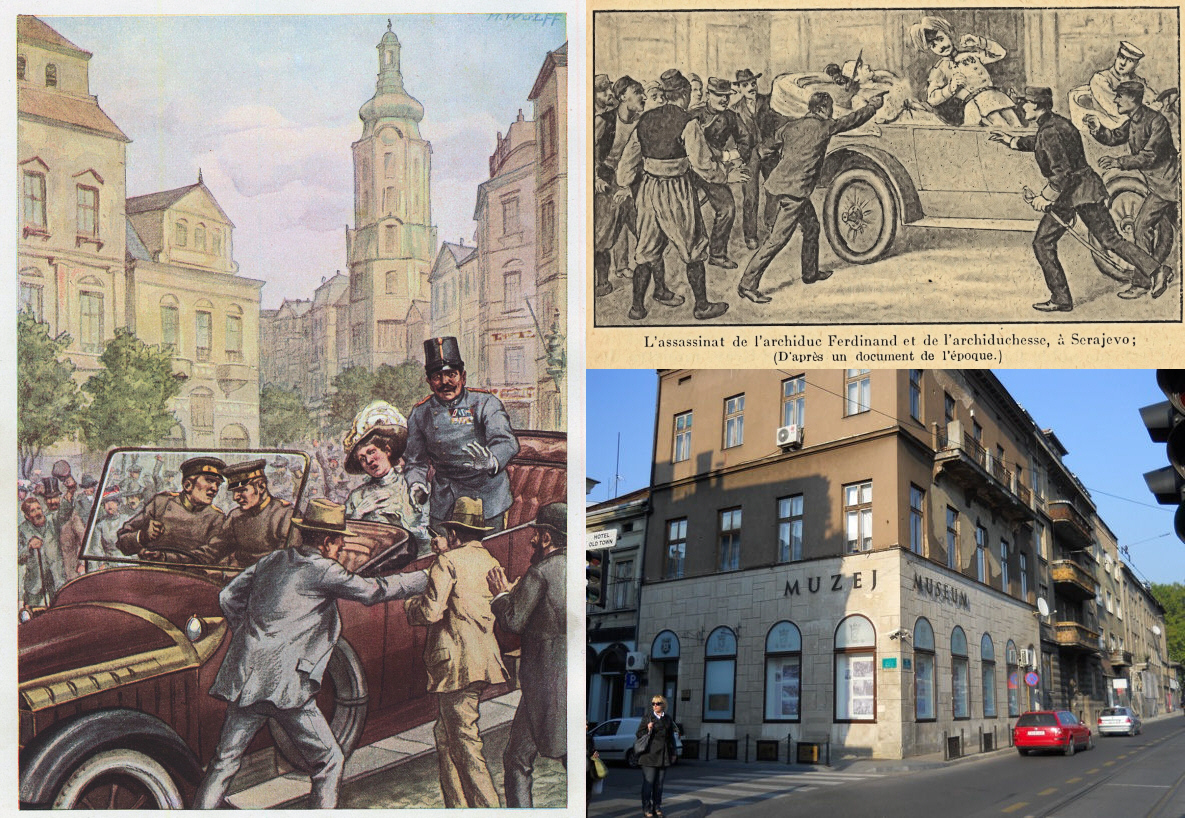
Naturally the events of 28 June 1914 were the subject of intense coverage by the media in all countries, and while several photos were made of events immediately after both assassination attempts, the actual shooting was not caught on photo. This meant that magazines, newspapers, and, later on, history books would commission illustrations and drawings of the shooting.

Click on Image to Expand

Two Depictions of the Assassination from the Period and a Recent Photo of the Site

The two commercial illustrations were not really accurate renderings of the events. In the two shown above, there is a confusion about which side of the limousine Princip shot from and the setting (see current photo of the site) is not accurately captured. In one drawing the archduke is shot from the left and in the other from the right. In both drawings he is standing up, seemingly aware of the impending danger and thereby striking a more masculine and defiant pose. In reality the shots came unawares to the couple. In one of the drawings it appears as if the duchess was shot first and that the archduke is trying to protect her. In reality, he was shot first and instinctively fell over his wife, trying to protect her from bullets. This is just as commendable an action as that portrayed in the drawing, but somehow less heroic-looking. Moreover, Princip, when pulling the trigger, averted his head and turned away from the car, shooting blindly, and by the cruelest of circumstances mortally hitting both archduke and duchess with one bullet apiece. And so theatrical-looking heroics and determined villains end up trumping actual events.

Nevertheless, despite these consistent inaccuracies portraying the assassination, the image of a single assassin shooting into an open limousine has become an almost iconic and recognizable historic event.

Sarajevo images from the collections of Tony Langley and Steve Miller. This article was originally published one year ago on the 99th anniversary of the event.

Friday, June 27, 2014

Western Front Virtual Tour — Stop 24: Mametz Wood

Today I found in Mametz Wood
A certain cure for lust of blood. . .
                                   Robert Graves, Poem

The 38th (Welsh) Division was recruited from battalions of the Welsh Regiment, South Wales Borderers, and Royal Welsh Fusiliers in 1914. Lloyd George had a heavy hand in the raising of the formation, one of his sons being an officer in the division. It crossed to France in late 1915 and came down to fight on the Somme in July 1916. The first attack on Mametz Wood was on 7 July, when the division lost heavily in "Death Valley" during the advance on the "Hammer Head". The next attack went in on the 10th, and by 14 July the wood was cleared -- but at the cost of over 5,000 casualties in the 38th (Welsh) Division. A memorial was placed in Mametz Church in the 1920s, but this Red Dragon monument was placed here in the late 1980s on the wishes of a number of Mametz Wood veterans.

Text Source:  Paul Reed's Somme Battlefield Website: http://www.somme-1916.com/


Thursday, June 26, 2014

100 Years Ago: Quotes from June 1914

Pressure from the southern Slavs is bound to increase.
The Nation, 4 June 1914

Thunderstorm in London


The giant storm [of 14 June] that broke over South London was a phenomenon quite outside the previous experience of any who lived through it.  At high noon, day became night — illuminated by sheets of blood red lightning and accompanied by a racketting thunder seemingly orchestrate by a malevolent intent on an evil outcome to the excesses of Nature's power. . . In the area of Wandworth Common eleven people were struck by lightning. Seven of them died.
Newspaper Accounts

Released in Book Form June 1914

Iron

Guns,
Long, steel guns,
Pointed from the war ships
In the name of the war god.
Straight, shining, polished guns,
Clambered over with jackies in white blouses,
Glory of tan faces, tousled hair, white teeth,
Laughing lithe jackies in white blouses,
Sitting on the guns singing war songs, war chanties.

Shovels,
Broad, iron shovels,
Scooping out oblong vaults,
Loosening turf and leveling sod.

I ask you
To witness--
The shovel is brother to the gun.
Carl Sandburg, published in Poetry Magazine, June 1914

We stand for the Reality of the Present — not for the sentimental future. . . We need the unconsciousness of Humanity — their stupidity, animal-ism and dreams.  We believe in no perfectibility except our own.
Vorticist Manifesto, Blast, No. 1, 20 June 1914

But it is too late. The attempts at the suppression of a feeble effort like THE WOMAN REBEL only add fuel to the fire, only strengthen our cause, create new interest, and rejuvenate the revolutionary spirit in women. It is altogether too late to attempt a suppression of this idea of free bodies among working women.

If THE WOMAN REBEL were allowed to publish with impunity elementary and fundamental truths concerning personal liberty and how to obtain it, the birth control movement would become a movement of tremendous power in the emancipation of the working class. The attempted suppression is thus primarily a blow at the entire working class of America, intended for no other purpose than to retard the economic and spiritual emancipation of working men, women and children. . . Nothing will cause the downfall of parasitic institutions like the Church, the State, and Big Business more than these attempts at suppression.
Margaret Sanger,  "Suppression," The Woman Rebel, Vol. 1, No. 4, June 1914

Published June 1914

The [recent economic] troubles are not political, but social. Human history and experience teach that things go around in circles. We are now in a part of the circle which I shall not endeavor to classify. We are troubled with an epidemic of emotion among people who don’t stop to reflect. Radical doctrines are merely a sign of the times. Some day there will be a further swing around the circle and then you will see a change.
Senator George Edmunds (Vermont), Interview, 25 June 1914


What is the good of your speeches? I come to Sarajevo on a visit, and I get bombs thrown at me. It is outrageous.
Archduke Franz Ferdinand, Sarajevo City Hall, 28 June 1914

Wednesday, June 25, 2014

Coming Soon in America [I hope]: 37 Days

My correspondents in the UK have sent word that an excellent three-part docudrama on the July Crisis of 1914 has been presented on BBC2.  Titled 37 Days [28 June – 4 August 1914], it covers the period from the assassination of the Archduke to Britain's entry into the war. As one reviewer described it, "Judging by the unshowy casting, 37 Days isn't supposed to be the flagship drama of the BBC's centenary season, but it's terrifically well written, all the same. The dialogue, in particular, does an excellent job of conveying both the prevalent political mood and any diplomatic subtleties that might otherwise be lost on modern viewers."

Naturally, I'm unable to find any plans to show the series in the U.S. — I've checked the "usual suspects", PBS and BBC America, but have not seen any announcement yet. Please let me know if you see something about its broadcast in the States and I will pass it on to the readers. Here are some stills from the series. The casting might have been "unshowy", as the reviewer put it, but — as is almost invariably the case in UK productions — the actors look perfect for their roles. [Except Churchill, middle photo far right,  looks a little too lean. Maybe he sounds Churchillian.] 

[Regular Contributor Steve Miller has pointed out that they got the seating positions incorrect here. Sophie was on the right side in all photos of the day. Good catch Steve.]


Tuesday, June 24, 2014

The Assassination of the Archduke: Sarajevo 1914 and the Romance That Changed the World — reviewed by Jim Gallen


The Assassination of the Archduke: Sarajevo 1914 and the Romance That Changed the World
by Greg King and Sue Woolmans
St. Martin's Press, 2013


The Assassination of the Archduke tells the history of the first family tragedy of World War I, affecting as it did both the family of nations and the family of Archduke Franz Ferdinand. The family story is complicated. Franz Ferdinand was not born heir to the throne. He reached it through a series of misfortunes. The Emperor's son Rudolph, the heir, embarrassed the Imperial Family by committing suicide after murdering his mistress. That made Franz Ferdinand's father, brother of the Emperor, heir presumptive until his death in 1896, at which time the title of heir was assumed by Franz Ferdinand.

Franz Ferdinand and his wife Sophie were star-crossed lovers who made their own way to their tragic end. As merely a countess and lady-in-waiting, Sophie was an unsuitable match for an heir to the Habsburg throne. Although the Emperor reluctantly gave his permission for a morganatic marriage, in which neither Sophie nor their children would hold royal titles, he and his court never lost an opportunity to enforce distinctions in rank between the lovers. Besides the problems of his marriage, Franz Ferdinand's relatively liberal political views made him an outsider among the Empire's ruling elite.


Order Now
Franz Ferdinand's position as inspector general of the army brought him to observe maneuvers near Sarajevo. His plans to make a low-key trip without a visit to the city were foiled by the insistence of Oskar Potiorek, governor of Bosnia-Herzegovina, and the orders of the Emperor. All of the warnings were ignored. St. Vitus Day, 28 June, the Serb national holiday commemorating the 1389 Battle of Kosovo when the Turkish army reduced Serbia to vassal status in the Ottoman Empire, was a likely occasion for a demonstration by Black Hand Serbian nationalists.

Pamphlets denouncing the visit were circulated in advance. Leaving the train station, the motorcade passed several assassins along the route. The first threw a bomb that exploded under the following car. While speeding to the Town Hall the royal party passed three other assassins. At the Town Hall reception the Archduke expressed outrage over the bombing. Deciding to visit victims of the morning's bombing, the party headed toward the hospital. A wrong turn took them past the leader of the assassins, Gavrilo Princip, who fired one shot each into Franz Ferdinand and Sophie. Both were pronounced dead at the governor's residence.

Fanciful Depiction of the Assassination from Le Petit Journal

The authors point out that the assassination need not have ignited the firestorm that it did. Franz Joseph did not seem overly disturbed by the assassination of his troublesome nephew. The murder actually provided the opportunity Austria had been seeking to put the Serbs in their place. Kaiser Wilhelm advised Franz Joseph to deal with Serbia before any other powers could get involved. Ultimatums and responses flew back and forth between Vienna and Belgrade while Serbia consulted Russia. Within a month Europe was mobilizing and in its death waltz of war.

It is a multifaceted story. The art of authors Greg King and Sue Woolmans is to weave the threads into a tapestry that tells the tales: the story of a loving family pressed on all sides by an intolerant court, the intrigue of the Austrian courtiers, the plots of the Serbian nationalists, and the falling dominoes of the entangling alliances. The authors also raise questions that remain unanswered and, perhaps, unanswerable. Was the royal couple set up by their own monarch and court? Was the Serbian government involved in the plot? How would the empire and the world have been different had Franz Ferdinand lived longer, or if Franz Joseph had died sooner? We will never know, but readers of The Assassination of the Archduke will have a better grasp of what happened, some understanding of why it all happened, and, in the end, a sense of tragedy in which history is more moving than the finest fiction.

Jim Gallen

Monday, June 23, 2014

Remembering a Veteran: Roland Garros, French Air Service


French pilot Roland Garros (6 October 1888 – 5 October 1918) of Escadrille MS 23 is one of the great figures of aviation history. He was a prewar aviation pioneer and was the first pilot to cross the Mediterranean. He gained aviation immortality after allowing his Morane Saulnier Type L to be equipped with deflector plates on the propeller. This enabled him to fire his Hotchkiss machine gun through the airscrew. Garros achieved the first-ever shooting-down of an aircraft by a fighter firing through a tractor propeller, on 1 April 1915; two more victories over German aircraft were achieved on 15 and 18 April 1915.

Subsequently downed and captured, he escaped after a long imprisonment but was eventually killed in action in the Champagne supporting an American operation a month before the Armistice. The French National Tennis Center is named for Garros, an amateur tennis champion.

Late addition:  Regular contributor Steve Miller just sent these images in. From his collection are these photos of Garros's grave at Vouziers, close to the sit of his fatal crash.


Sunday, June 22, 2014

Preliminary Report: U.S. Centennial Commemoration Commission Event, 14 June 2014, Washington DC

On 14 June an event was held in Washington, DC, at the Jones Day law firm that brought together the U.S. Centennial Commemoration Commission,  national organizations, and grassroots organizations and individuals, all of whom are working on the remembrance of the war.  I was invited to make a presentation to the assemblage and chose to take the opportunity to offer all the outlets of Worldwar1.com both  to bring attention to their efforts and help them raise funds.  If there was one overriding concern shared by everyone, it was that everyone needed funding to do things properly.  In future postings here on Roads to the Great War and in the monthly St. Mihiel Trip-Wire, we will be focusing on individual projects, so our readers can judge their merits and choose to contribute if you wish.

In this article I'm presenting a selection of images from the conference that was billed as a "Trade Fair", but proved to be much more.  I had a great time meeting so many fellow enthusiasts, and I think you will agree that this breadth of the programs and projects that were represented was very impressive.

Mike Hanlon, Editor/Publisher


From the Top:  the Audience, Slides for a New Documentary and the Library of Congress's Forthcoming Book on the Great War, and a Selection of Displays and Kiosks


From the Top:  Commissioner Edwin Fountain Discussing the Pending Proposal for a National WWI Memorial in Washington, Kiosks for the Saving Hallowed Ground and Ancestry.com Projects, Your Editor at the Podium, Mark Levitch of the National Gallery of Art Speaking on the WWI Memorial Inventory Project.

Saturday, June 21, 2014

French Politics After Verdun and the Somme

Verdun and the Somme, in 1916, added a further 350,000 Frenchmen dead and missing. The successful defense at Verdun was to permit the success of a major Franco-British offensive that would follow on the Somme, but that hope failed to materialize. From that point on, the fate of General Joffre was politically sealed. Prime Minister Briand elevated Joffre to the rank of Marshal of France and replaced him with General Nivelle, who had successfully recaptured much of the lost ground at Verdun, during the fall of 1916.

Nivelle and Joffre at Souilly, Late in the Battle of Verdun

General Nivelle proceeded to prepare a spring offensive in order to recapture the German positions on the Chemin des Dames, to the north of Paris. His efforts at convincing the French and British political leaderships overcame their skepticism. However, the French minister for war, General Liautey, resigned in order not to have his name attached to what he predicted would be a failure. A negative result was also predicted by Pétain. Prime Minister Briand also resigned at the same time. After much internal debate, however, the ill-fated Chemin des Dames  offensive went ahead on 16 April and quickly ground to a halt. The dead and missing between the period April to June 1916 in that sector alone mounted to well over 100,000 men.

It took this failure and mutinies affecting half the French Army, to bring Georges Clemenceau into the post of prime minister in November 1917. In contrast with the timidity of his predecessors, Clemenceau boldly increased civilian control over the military leadership, which now was in the hands of Pétain and Foch. Furthermore, he involved himself personally with the Allies to coordinate the applications of basic military strategies. Thus he found no major difficulties in convincing Lloyd George and President Wilson to accept Foch as overall military leader of the Alliance, in the spring of 1918. At the French military operational level, for instance, he pressed Pétain to move up French divisions to help Haig take the brunt of the Ludendorff Spring Offensive in April 1918. At a later date he also pressed Foch to request British divisional support in Champagne, after Ludendorff had shifted his assaults onto the French sector.

During the weeks preceding the 11 November armistice, another political debate involving the generals took place. Pétain agreed with the American position, expressed by Pershing, which advocated not to sign an armistice before Allied troops had penetrated into the Rhineland. As to Foch, he approved the British strategic goals, which had set as a priority the military liberation of Flanders and Belgium. Clemenceau, after convincing Lloyd George, ignored their advice and imposed the signature of an armistice immediately. By that date the French nation had lost nearly 1.4 million military personnel, dead or missing in action.

Source:  THE POLITICS OF FRENCH MILITARY LEADERSHIP 1914-1918 by Pierre Miguel