Now all roads lead to France and heavy is the tread
Of the living; but the dead returning lightly dance.
Edward Thomas, Roads

Wednesday, February 15, 2017

The Centennial at the Grass Roots: "The Great War: Kentucky & Beyond"


Roads to the Great War contributor Margaret Spratt is the curator for a new World War I  exhibit at the Hopewell Museum in Paris, Kentucky, that opened this past Sunday. The displays and accompanying presentations are designed to help remember Kentucky's experience in the war. The program runs until October, and more information can be found HERE about the museum and special events associated with "The Great War: Kentucky & Beyond."

Our Friend, Professor Margaret Spratt, Helped Organize the Exhibit

Uniforms and Kit of a Kentucky Soldier and Nurse


Lt. Pfanstiel Was Originally Assigned to the 335th Inf. of the 84th Division But Was Reassigned to the 79th Division, Probably as a Replacement

Dr. Edith Smith of Cynthiana, KY, Was a Surgeon Who Saw Frontline Service
During the War


Aviation Corner
Solomon Lee Van Meter, Jr. of Lexington, Kentucky, in July 1916 Received a Patent for the Backpack Style Parachute 


Tuesday, February 14, 2017

Star Shell Reflections 1914 – 1916
Reviewed by David F. Beer

Star Shell Reflections 1914 – 1916: The Illustrated Great War Diaries of Jim Maultsaid


Barbara McClune, Editor
Pen & Sword Military, 2015


I have tried to place before you a true and faithful picture of the life we boys lived during those years. Many writers of war books (and some of the best sellers) have made their name in describing the filth and misery, the horrible sights, the pain and suffering of war and all that starkness. Let me give you a glimpse of the bright side and an insight into the lives of those wonderful chums of mine. Kind true hearts beat beneath war-worn khaki tunics-read between the lines and find that indomitable spirit, the spirit that went on to win the war, that swept through the boys from Ulster in the 36th Division...(vii)


This book is an entertaining diary and also an intriguing collection of sketches and photographs. Even though the dust cover states he was often "described as the unofficial war artist," James Alexander Bovaird Maultsaid never claimed to be an artist; however, his sketches are captivating and take us, often in a cartoon-like style, into the heart of the everyday soldier's life on the Western Front. His prose entries are almost always brief and record his experiences in a factual manner, sometimes with humor and even nostalgia. He's surprisingly upbeat in his response to the grim life in the trenches and always seems to find something positive to say about what he goes through or sees. In this he is notably different from most writers who have recorded their life in the trenches.

The author had an interesting early life. He was raised in Donegal, Ireland, but was born in the U.S. to Irish parents who decided to return home. Thus he was an American citizen who later joined the British Army in Belfast. When he left school at age 13 he was already somewhat talented in writing and drawing and worked in the Belfast shipyards before volunteering for the Royal Irish Rifles on 14 September 1914. He was badly wounded on the first day of the Somme, and, although then unfit for active service, he was commissioned in 1917 to work with the Chinese Labour Corps. His experiences with them are recorded in a second volume, War! Hellish War! (also published by Pen & Sword).

Little seems to be left out of the WWI soldier's experience in this diary. From jam and bully beef, hard tack, mail from home and rum rations (Maultsaid himself was a strict teetotaler), to bayonet drill, endless marching, sleeping in the rain, and a rat that became his pet for a week, the author gives us an intimate chronicle through words and pictures. Interestingly, while he describes the fighting he says little about his pals who died, feeling that their memories are sacred and to be kept to himself.

Some entries are more detailed than others. The author describes a group of "colored" troops practicing a kind of wild dance and knife-throwing: "These were Indian troops, Gurkhas, I think, but I'm not quite sure." One dramatic episode involves a plump hen that sadly "Westward went" and which "never, never in this world would grace that old farmyard" again. Some two pages provide sketches of regimental colors. He expresses his admiration for "The Air Boys" at length and includes a unique aerial photo taken by a captured German pilot.

In spite of the fighting, there was often time for a sports day and the competition between teams was fierce, the officers often joining in. Infantry attacks coordinated with "the Skins" (The Royal Inniskilling Fusiliers) were frequent, and "a finer lot of fellows than our friends the Skins you could never meet" (125). Maultsaid lists his impressions of all the nationalities he meets during the fighting and has this to say about "the Yanks"—

Some great lads here! Most of them came from English, Irish and Scottish stock, mostly Irish. Put in some real good work, but did not win the war. I think more of them could have been used, some in fact after months 'out there' never got firing a shot even, much to their disgust (p. 79).

Jim Maultsaid After He Was Wounded
As he put his diary and sketches in order—later to be published by his granddaughter Barbara Anne McClune—Jim Maultsaid often found himself looking back at the war with mixed feelings. He remembers the happy times as well as the heartbreaking ones. Sometimes he begins a sentence by appealing to our memories, as though the reader had been there too—"Do you remember how we looked for the postman?" or "Yet…with it all, can't you remember the share-and-share alike spirit?" "Can't you still hear…"

Thus, with reader-friendly prose and sketches that sometimes reflect the "Old Bill" cartoons, we get a surprisingly full picture of an Irish soldier's thoughts, impressions and actions in the trenches and in battle from 1914 to 1916. This is an easy read that nevertheless leaves us feeling we know more about personal experience in the war than we did before. I'm eager now to get the second volume of this diary and to learn how Jim Maultsaid fared with the Chinese Labour Corps!

David F. Beer

Monday, February 13, 2017

About Those Passchendaele Casualty Figures


In preparing for my spring battlefield tour to Flanders, I'm starting to review some of my notes on the 1917 Third Battle of Ypres, aka Passchendaele. I'll occasionally share some of my re-discoveries with our readers here.

The number of casualties (that is, those killed, wounded, missing, and taken prisoner) incurred by the British Expeditionary Force in the Third Battle of Ypres is popularly supposed to have been the most grievous of the whole war, either by total number or per-day losses. This belief is mistaken as this table demonstrates:


Sunday, February 12, 2017

A Dozen More Quotes from the Great War


The earlier version of "A Dozen Quotes" got a lot of response from our readers, so I thought I'd share 12 more. These all appeared in our other Worldwar1.com publications in the past.

1.  War had been declared, and the following Sunday I went with a friend of mine to Shepherd's Bush Empire to see the film show. At the end they showed the Fleet sailing the high seas and played "Britons Never Shall Be Slaves" and "Hearts of Oak". And you know one feels that little shiver run up the back and you know you have got to do something. I had just turned seventeen at that time and on the Monday I went up to Whitehall—Old Scotland Yard—and enlisted in the 16th Lancers.
Pvt. William Dove, 16th Lancers

2.  I don't know what is to be done. This isn't war.
Horatio Kitchener
Quoted in J.F.C. Fuller's, The Conduct of War

3. I am obliged to report that, at the present moment, the Russian Empire is run by lunatics.
Ambassador Paleologue, 14 January 14 1917


4.  Like the planet Neptune, the discovery of the dreadnought was inevitable, but luckily we saw her in the heavens before the other chaps and got our unparalleled lead! Thank God!
Admiral Jacky Fisher, 1910

5.  The Christmas truce was the last twitch of the 19th century. By that, I mean it was the last public moment in which it was assumed that people were nice, and that the Dickens view of the world was a credible view...A wonderful ironic moment. And, they were exchanging cigarettes and addresses and exchanging insignias, treating each other like friends. It was a high emotional moment I would say. It's the last gesture of the 19th-century idea that human beings are getting better the longer the human race goes on. Nobody could believe that after the First World War, and certainly not after the Second.
Paul Fussell

6.  I don't know whether war is an interlude during peace, or peace an interlude during war.
Georges Clemenceau


7. The vast field of shell-holes had been turned into a sea of mud by the heavy rain…Its depths were particularly dangerous in the low-lying ground of the Paddebeek. On my zigzag course I passed many a lonely and forgotten corpse. Often only a head or a hand projected from the shell-hole whose circle of dirty water reflected them. Thousands sleep like that, without one token of
love to mark the unknown grave.
Lt. Ernst Jünger, 73rd Hanoverian Fusiliers
Describing Passchendaele

8. Tread softly here—Go reverently and slow,—Yea, let your soul go down upon its knees,—And with bowed head and heart abased—Strive hard to grasp the future gain in this sore loss.  For not one foot of this dank sod—But drank its surfeit of the blood of gallant men—Who for their Faith, their Hope, for Life and Liberty—Here made the sacrifice. Here gave their lives, and right willingly for you and me.
Inscription
Newfoundland Park, Somme Battlefield

9. A mixture of contradictories which never were—perhaps could never have been—harmonised.
John Buchan on T.E. Lawrence


10, When I took a decision or adopted an alternative, it was after studying every relevant—and many irrelevant—factor. Geography, tribal structure, religion, social customs, language, appetites, standards—all were at my finger-ends. The enemy I knew almost like my own side.
T.E. Lawrence
Intelligence Preparation of the Battlefield

11. Our nerves are ruined by mistreatment. If anyone should say that he was not haunted by visions of burning airships, then he would be a braggart. But nobody makes this assertion; everyone has the courage to confess his dreams and thoughts.
Pitt Klein, Crew Member German Navy Airship L31

12. Our story takes you down this shadowed path to a remote and guarded building in the English Midlands, Melbridge County Asylum. Grimly proud of its new military wing, which barely suffices in this autumn of 1918 to house the shattered minds of the war that was to end war.
Opening Line, Random Harvest

Thanks to our pal in France, Olivier Pierrard, for the images.


Saturday, February 11, 2017

Yanks at British Hospitals


There was an unexpected windfall for the Allies when America joined the war—help with the enormous load of casualties in the 1917 campaign. The first American military installation in France during World War I was Base Hospital No.4 (Cleveland), which arrived on 25 May 1917 to cheering French crowds on, 19 days ahead of General Pershing and the nucleus of his American Expeditionary Force staff. Also known as the Lakeside Unit, the Cleveland unit served at Rouen throughout the war. American physicians, nurses, and enlisted men such as these would be the earliest AEF participants to face the possibility of death and destruction—actually months before the first American soldiers would see combat. 


The British relied heavily on these American units. By 1917 their Medical Department was having trouble handling the massive numbers of casualties. The numbers of casualties treated by the American base hospitals with the British demonstrates the heavy load of patients. 

Base Hospital No.4 treated 82,179; No. 10 treated 47,811; and No. 21 treated about 60,000. These numbers do not include the numbers of patients the Americans treated at the Casualty Clearing Stations or while working with British units. Overall, a daily average of approximately 800 officers, 600 nurses, and 1,100 soldiers was serving with the British. 


One of the hazards they faced was German night bomber raids, which attacked hospitals despite the Red Cross markings. Tragedy struck on 4 September 1917, when the Germans bombed Base Hospital No. 5 at Camiers, killing Lieutenant William T. Fitzsimmons and Privates Oscar C. Tugo, Rudolph Rubino, Jr., and Leslie G. Woods, who became the first A. E. F. casualties by enemy action.

Sources: U.S. Army Surgeon General Reports and Official History

Friday, February 10, 2017

Visuals from the New American Experience Series: The Great War


Like many of you, I'm looking forward to the new PBS series on the U.S. in the First World War. The network and the producers are starting to released promotional pieces, so I thought I would share what I've seen so far with our readers.


Wednesday, February 8, 2017

War Service of the Dreyfus Affair Principals

In a supreme irony of history only one of the French principals of "Affaire Dreyfus"  actually fought in the defense of his country during the Great War. 

Col. Sandherr
Major Henry
Colonel Sandherr, who with his subordinate Major Henry  manufactured the disinformation about Dreyfus,  died of natural causes (a stroke) in 1897. 

Major Henry, himself,  committed suicide with his razor in his prison cell, on 31 August 1898. 

Major Esterhazy, actual perpetrator of the deed for which Dreyfus was accused, died of natural causes near London in 1923. He did not participate in the war. 

Major Esterhazy
Col. Picquart
Colonel Picquart, who discovered Dreyfus's innocence, became minister of war in Clemenceau's cabinet, in 1908. It is during his tenure that the number of 75 batteries in the French Army was voted by the Chamber of Deputies to be doubled! The Army entered the war in 1914 with a thousand 75mm batteries of four guns each. Picquart died from a fall, while practicing horsemanship, on 19 January 1914. 

However, one principal of the "Affaire Dreyfus" did serve with distinction in the Great War. Although he was already beyond normal retirement age, Alfred Dreyfus returned to active duty as a lieutenant-colonel of artillery in 1914 and served for the entire war, including frontline duty in 1917. Alfred Dreyfus was later raised to the rank of officer of the Legion of Honor just before the Armistice, in November 1918. 


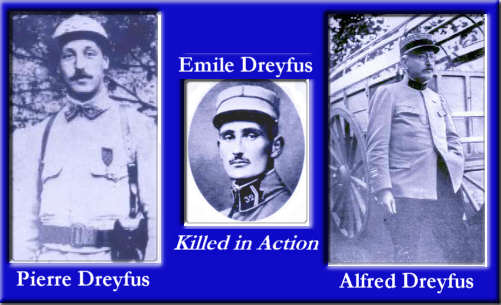
His long-suffering family shared in the sacrifice and call to duty. Alfred Dreyfus's son, Pierre Dreyfus, served as a lieutenant and later a captain in 75mm batteries on the Western Front. Pierre Dreyfus participated in the Marne, Verdun, the Somme and in the final drives during the summer and fall of 1918. He survived to receive the Croix de Guerre with palms and other decorations. Alfred Dreyfus's two nephews, Emile Dreyfus and  Ado Reinach also fought as artillery officers in 75mm regiments, but both lost their lives on the field of honor, thus striking the family with further devastation. Alfred Dreyfus, himself, died quietly in bed on 11 July 1935. 

Tuesday, February 7, 2017

The Path to War: How the First World War Created Modern America
Reviewed by Jolie Velazquez


The Path to War: How the First World War Created Modern America


by Michael S. Neiberg
Oxford University Press, 2016


For those who read and appreciated Dr. Neiberg's earlier book, Dance of the Furies: Europe and The Outbreak of World War One, you will be extremely pleased to hear that he has turned his efforts to the United States' entry into the Great War. He has once again trained his analytical eye onto a complex subject and delivered a cogent and highly readable book.

Ordinary American Linked Germany to the Issues
with Mexico. Pancho Villa (Shown Here as a Snake)
Had Bragged About His Support from Germany, and
Mexico Was Believed a Base for Spies and Saboteurs

The Path to War takes a bottom-up approach toward understanding why America finally associated itself with the Entente (France, England, Russia, etc.) in the fight against Germany and its allies after three years of carnage. In the absence of today's kind of polling techniques, Dr. Neiberg scoured a mountain of primary materials to get at what the general public was thinking about the war.

His major thesis is that Americans were way ahead of the government, and especially President Woodrow Wilson, in understanding that we had to be part of the war "to save civilization" and suppress Germany's aggressive ambitions. Other approaches that concentrate only on the diplomatic and power-center players are important, but the author manages to upturn the narrative we are used to hearing—that the American public suddenly changed its peace-at-any-cost opinion as soon as war was declared.

Using memoirs, newspaper columns, magazine articles, private and public letters, and the speeches of Preparedness advocates, Dr. Neiberg shows us the organic change taking place from 1914 to 1917 in our so-called isolationist population, and how the pressure from ordinary people, and his own advisers, dragged Wilson to a place he did not want to go. The chapter titled "Awaiting the Overt Act" is especially suspenseful, and even if you know what's coming next, you let out your breath when the dénouement arrives.

Having done some research on this subject myself, I do have a contrary opinion on some points. For example, Dr. Neiberg insists that there was no economic imperative for the American decision to go to war, a belief that he has repeated on the book tour circuit. I appreciate all the other indicators he has brought to light to bolster his argument, but I think he discounts economics (i.e. war debt) too much. Knowing what we do about American bankers and newly-created millionaires, this could not have been an insignificant consideration. However, his refreshing viewpoint emphasizing the idealism, thoughtfulness, and good sense of the American public is certainly persuasive. Once again, his natural writing style makes this book an enjoyable as well as informative endeavor that I can recommend without hesitation to anyone interested in the subject.

Jolie Velazquez

Monday, February 6, 2017

American Forces at Peking, 1900


The U.S. 14th Infantry Relieves the Russian Contingent at Peking

The decade following the Spanish American War gave the generation of American officers destined to serve in command positions during the Great War a remarkable number and variety of missions to perform. Of course, none of these challenges were comparable in scope to the fighting that would come on the Western Front, but they did allow these men to develop their capacity to grasp large, complicated, and unusual military operations. Serving in deployments remote from the American heartland and with duties far beyond what individuals of their age and rank would normally face, they gained an awareness of the greater world and learned to bear the weight of great responsibility. The first such challenge would come, surprisingly, in China.

Peking 1900

The longstanding commitment to keep a strong American presence in the Pacific was reasserted in 1900 when nearly 15,000 soldiers and Marines under the command of future Army chief of staff Adna Chaffee were sent to China to support the mission to relieve Peking during the Boxer Rebellion. One byproduct of this effort was the exposure to the professional officers and soldiers of almost all major nations that would participate in the Great War. The mission and the American contribution to it were considered a great successes and a notable beginning for the 20th-century American military.

Perhaps most striking was the quick patching together of an expeditionary force and deploying it 5,000 miles to the far side of the Pacific. The joint-service force was assembled from the Philippines, ships at sea, and U.S. garrisons. Once in China, the troops impressed the foreign contingents with their ability to move quickly and adjust to a foreign environment. General Chaffee also displayed great tact and flexibility in dealing with a loose international command structure, providing a model for General Pershing's later leadership of the AEF.

Company H, 9th Infantry, Peking, 1900

On the downside, communications between the military and diplomats, and between both of those parties and the home country were inadequate and slow. In weaponry, the lesson that improvements in firepower, with machine guns and new artillery, gave great advantage to defenders was not absorbed by any of the relief mission participants, with the possible exception of the Japanese, who would display a tactical superiority in their war with the Russians a few years later.

Nevertheless, for the American military, Peking, was a major landmark in its preparations for the Great War and for waging war across another ocean.

Sunday, February 5, 2017

Recommended: Everyday Lives in War


This is an excellent university consortium website (Hertfordshire University has the leading role) that produces excellent articles on "the impact of war on everyday life between 1914 and 1918 and on subsequent generations." The editors sponsor and assist with local remembrance projects around the UK and add their own excellently researched articles. Here is  a representative entry I found especially interesting.

Foxhunters in Khaki —

Foxhunting and the County Yeomanry During the First World War

Posted on January 3, 2017
Contributed by Nick Mansfield


The mobilization of the Welsh Horse Yeomanry at Lampeter in west Wales, in August 1914. The Yeomanry found it difficult to recruit further volunteers. One hundred years ago, the British government for the first time introduced conscription for compulsory service in the armed forces; a response to the high battlefield casualties and the need for mass mobilization to defeat Germany. Exemptions were granted both on conscientious grounds, or for reasons of urgent and vital work for the national interest. Such appeals were heard by local military service tribunals. One of the most unusual of these was heard in Shropshire when, in 1916, the South Shropshire Hunt applied for exemption from conscription for their kennelman, one of their full-time and professional hunt servants. At a time when the bloody battle of the Somme was at its height, what might have been thought of as a frivolous and unworthy appeal, was agreed in full by the tribunal. Its chairman declared that "the military had no objection at all to the application. It was recognised that hunting should be kept up." Such was the power of the vested rural interest of foxhunting and its military wing of the county Yeomanry.

The mobilisation of the Welsh Horse Yeomanry at Lampeter in west Wales, in Aug 1914
The Yeomanry found it difficult to recruit further volunteers.

The latter were originally formed from local foxhunting packs around 1800, as part-time mounted home defense force to oppose Napoleonic invasion. They were socially exclusive; mainly farmers’ sons, officered by the county gentry. After 1815 the Yeomanry continued as a paramilitary gendarmerie used to act against a wide range of early 19th-century protesters.  Their methods were often violent, with Manchester’s Peterloo Massacre only one example of their handiwork. The Yeomanry were also very political and overwhelmingly supported conservatism. Their policing role if the countryside was superseded by the new county constabularies, but the Yeomanry continued their existence as old-fashioned military auxiliary units, still built around fox hunting and the associated, and often raucous, social and political activities. Continued. . .

Finish reading the article HERE.


Homepage for EVERYDAY LIVES IN WAR.

Saturday, February 4, 2017

Consider Romania


A secret prewar member of the Triple Alliance, it stiffed their former associates when war cam in August 1914. Its leaders hemmed and hawed for two years and finally came into the war on the side of the Allies. Romania was then soundly thrashed in the campaign of 1916, suffering over 200,000 military casualties with two-thirds of the country falling under a harsh occupation regime.  Its allies, especially Russia, stuck with a new front to defend, fared badly as well. Later when revolution came to Russia, the Romanians submitted to the onerous terms of the Peace of Bucharest (7 May 1918). Included were territorial losses, especially Dobrogea and the Carpathian passes; longtime concessions of Romanian natural resources; and sequential demobilization of their army.

Yet the worm turned one last time for them.  After their enemies opened armistice negotiations [Bulgaria (29 September), Austria (4 November) and Germany (7 November)], the Romanian government  re-mobilized and declared war on Germany, just hours before the armistice of 11 November.  And somehow, Romania came out of the war as one of the victors.


The final settlement of the Paris Peace Conference awarded to Romania a frontier approximately 50 kilometers to the east of this line. It also sanctioned Romania’s acquisition of Bukovina, Bessarabia, and half of the Banat. This settlement virtually doubled Romania’s prewar territory and population, with attendant economic gains. However, it also brought with it dissatisfied minorities and hostile neighbors. In the Second World War, Bukovina and Bessarabia were lost, but what has remained to become contemporary Romania is a reasonable fulfillment of the aims for which the nation entered the First World War.

Source: "Romania and the Great War" by Glenn Torrey at Russia's Great War & Revolution.     


Friday, February 3, 2017

Edmund Allenby 1917: A Scapegoat in the Spring, A Rising Star in the Fall


General Allenby

Lt. General Edmund Allenby's Third Army had minimal responsibility for 1916's Battle of the Somme. The following year, however, it had principal responsibility for the British portion of the main Allied initiative. Third Army was to drive east from Arras and hopefully hook up with the French forces of General Nivelle, which were to be concurrently attacking the Chemin des Dames and breaking through from the south.

His plans, however, were undermined by the German retreat to their new defenses along the Hindenburg Line. Allenby's superior, General Haig, refused his request for a delay to allow for re-planning the offensive.

At first, though, the Arras offensive went well with the Third Army breaking through the German lines and advancing three and half miles in one day.  However, the Germans reinforced the sector and sent staff officers with expertise in defensive tactics. There followed weeks of heavy fighting that deteriorated into trench-fighting positional warfare with heavy casualties to 3rd Army. Allenby and Haig mutually lost confidence in one another. Haig expressed the opinion that Allenby "was lacking in aptitude for high command." His time on the Western Front was not to extend much 
longer.   

Allenby was dismayed by the criticism he was receiving, but his skills were better suited for open warfare than the trenches and no one appreciated this more than the Chief of the Imperial General Staff  William Robertson. Earlier in 1917 the Egyptian Expeditionary Force under the command of Sir Archibald Murray, was having problems.  It failed twice in its efforts to take Gaza.  Murray's failure at Second Gaza left officials in London no choice but to replace him with a commander who could achieve much-needed results in an otherwise gloomy war effort.  Prime Minister David Lloyd George initially offered command to Gen Jan Smuts, but the South African declined in the belief that he would not receive support from the War Office  for a "sideshow" effort. Upon Chief of Staff Robertson's recommendation, command fell to Gen Allenby.  He was relieved of command of the Third Army, awarded a fourth star, and sent to relieve General Murray.

Allenby and Staff, Conquerors of Jerusalem, December 1917

General Allenby was 56 years old when he took command of the EEF in June 1917. Within days of arriving in Palestine, the new commander of the EEF would dispel any misgivings regarding his capacity for independent command. EEF's change in command climate: "Allenby went through the hot, dusty camps of his army like a strong, fresh, reviving wind." He immediately moved the general headquarters from Cairo to the field, thus sending a strong message to front line troops. Allenby kept up a vigorous pace his first few weeks in theater, visiting units, making corrections, and developing a general framework for his first campaign. Almost immediately, he sought the advice of his senior subordinates. As commander of the 4th Cavalry Division Maj Gen George Barrow related, "Allenby was always glad to listen to other opinions and advice, provided this was backed by knowledge and common sense. What angered him was stupidity, negligence, and, most of all, disregard of orders."

In the remaining 17 months of the war, Allenby would earn the reputation as one of the finest field commanders of the Great War.  His achievements will be the subject of numerous postings on Roads to the Great War and in the other publications at Worldwar1.com in the months ahead.

Sources: Over the Top, Wikipedia, British Army Museum

Thursday, February 2, 2017

What Happened on the Bainsizza Plateau in 1917?


Austrian Defensive Position on the Rugged Bainsizza


The Bainsizza (Banjšice in Slovene) is a semi-mountainous plateau to the north of the strategic city of Gorizia on the Italian Front of 1917.  The city had been captured during the the Sixth Battle of the Isonzo in 1916 in hopes that it would provide a launch pad for the Italian Army to the highly prized port city of Trieste. However, Austro-Hungarian forces retained control of several key mountains north of the city and most of the rugged Carso Plateau to the south. During the previous ten battles along the Isonzo, the Bainsizza was considered impassable by both sides, and it remained lightly defended during the summer of 1917.  


The Italian Army had previously resisted attacking the area, which presented incredibly challenging terrain. It is a hybrid of pretty pastoral farmland and towering limestone mountains separated by narrow ravines. However, by this stage of the war there was a secondary issue north of the Bainsizza. Near the town of Tolmino, the enemy held a bridgehead across the Isonzo.  It was great strategic threat to both Italian armies in the area and had to be dealt with. Commando Supremo concluded that both challenges could be overcome by a major attack through the Bainsizza—the Tolmino bridgehead and the mountains around Gorizia could both be flanked by a successful breakthrough. From past experience, the planners knew that the plateau would be lightly defended, at least for the opening assault.


Benign Looking Farmland on the Plateau

This was the genesis of the Eleventh Battle of the Isonzo. The main objective was to capture the Bainsizza Plateau. Unfortunately, the planners combined this somewhat creative solution with the old standby scheme for capturing Trieste by just pounding very, very hard through the Carso. Guided by this two-pronged strategy, Italy's Second and Third Armies began the largest of all the Isonzo Offensives on 19 August 1917.


Looking Directly South at the Rugged Bainsizza from
One of the Assault Points


The new target for 1917, the Bainsizza, rises so rapidly and so high from the Isonzo that a frontal assault would be nearly suicidal. For once, however, tactics were adjusted to the situation. In an admirable bit of creativity it was decided that the plateau, with the help of 14 bridges to be placed across the river by engineers, would be assaulted from the north at a section where the terrain was not as challenging for assault troops. Despite heavy casualties, the men of the 24th Corps crossed the river, advanced behind an effective artillery barrage, forced their adversaries to withdraw, and eventually occupied about half of the plateau. On the south edge of the plateau a secondary attack was staged from Mte Kuk, resulting in the capture of Mte Santo, which had resisted the Italians in the Tenth Battle. These advances around the plateau stopped, however, when the artillery support was not able to follow farther and the Austro-Hungarian forces—always good on the defense—started taking advantage of the many caverns and hiding places provided by the Bainsizza's weird geology. 


Fourteen Foot Bridges Were Quickly Built by Engineers
for the Attack


The Italian Army, which entered the fighting with a huge manpower advantage, still suffered 150,000 killed and wounded, the Austro-Hungarian 5th Army about two-thirds of that figure by the 12 September conclusion of the battle. Nevertheless, after the success of the Sixth Battle of the Isonzo when Gorizia was captured, the Eleventh Battle was the most impressive military achievement by the Italian Army on the Isonzo. Their opponents were nearing the breaking point and were about out of troops to reinforce the sector. However, their concerned  German allies were watching and the decision was near for them to help their partner. Italian Supreme Commander Luigi Cadorna sensed the Germans were about intervene and decided to get ready. His preparations, though, would prove  inadequate in preventing the cataclysm to come, at Caporetto.

Wednesday, February 1, 2017

Remembering a Veteran: Sgt. William Wellman, Lafayettte Flying Corps

By Andrew Melomet

Future Film Director William Wellman in the Cockpit of a Captured German Rumpler

William Augustus Wellman was born 29 February 1896 in Brookline, Massachusetts. A notable athlete in his youth, he was seen playing professional ice hockey by Douglas Fairbanks, who was appearing in "Hawthorne of the U.S.A." at the Colonial Theatre in Boston.

With the help of his uncle, Francis Wellman, a lawyer and author of The Art of Cross-Examination, Wellman went to France, joined the Norton-Harjes Ambulance Corps and then transferred to the French Foreign Legion. After training on Bleriots and Nieuports he went into the Lafayette Flying Corps. Once he was assigned a mission to drop pamphlets on the Germans. While performing aerobatics over German lines his motor quit, but he managed to crash land and flipped upside down. He couldn't get loose and was rescued by French troops.

Wellman was nicknamed "Wild Bill" by the French for his one-man "dawn patrols" over enemy lines where he would bomb and strafe the Germans. He had two confirmed kills and was eventually shot down by AA fire. In the crash he broke his back in two places, his control stick went into the roof of his mouth and he ended up with a permanent limp and a silver plate in his head. Wellman's exploits were publicized by the press, and Fairbanks cabled him with a message: "When it's all over, you'll always have a job."

When Wellman was discharged as a sergeant from the French forces in March 1918 he left with the Croix de Guerre with two Palms, the Medaille Militaire, and the citations A L'Ordre de L'Armee and Le Pilote Americain, Marshall de Logis.

Wellman joined the U.S. Air Service and was assigned to Rockwell Field, San Diego, as a flight instructor. He would fly his SPAD up to Pickfair, Fairbanks and Mary Pickford's estate in Hollywood, and land on the polo field to attend parties. Fairbanks started Wellman in the movie business as an actor, but Wellman disliked the way he looked on the screen and asked for Fairbanks to move him into production.


Three Views of  Wellman: Aviator, Flight Instructor, and Hollywood Director

He was working as a mail boy at Goldwyn Studios when General "Black Jack" Pershing visited the studio. Goldwyn had all the veterans wear their uniforms and medals to honor the general. Pershing picked Wellman out of the line-up and asked if they had ever met before. They had, at a brothel in Paris, but Wellman replied "General, I'd rather not say right here." Pershing remembered their previous encounter (Wellman had stolen and then returned Pershing's uniform pants at the brothel) and asked Wellman what he could do for him. Wellman asked that Pershing take him aside and talk to him for a while to make Wellman seem important. Pershing was glad to comply, and the next day Wellman was asked to come to Goldwyn's private office and was made an assistant director.

While working as an assistant director on The Eleventh Hour, Wellman shot footage to cover for the director who was indisposed after a drinking binge. Wellman was rewarded by being named a director in his own right. Between 1923 and 1926 Wellman directed 11 features, many of them Westerns starring Buck Jones.

Wellman was eventually selected as the director of Wings, based on his flying and wartime experiences. The story of how that film went on to win the Best Picture award is well known. Another Wellman film with a strong WWI connection is the long-forgotten Heroes for Sale.

The original story idea of Heroes for Sale came from Darryl F. Zanuck. (Zanuck was the only studio head to serve on the front lines during World War I.) Wellman considered Zanuck "one of the greatest reportorial producers" for his ability to take a headline from a newspaper and "make a picture faster than anybody in the business."

Richard Barthelmess starred as Tom Holmes, the victimized protagonist of the story. Barthelmess had a well-deserved reputation for portraying "the screen's champion underdog" as Barthelmess called himself. The New York Herald Tribune called him "Hollywood's most serious-minded citizen."

While on a prisoner-seeking raiding party in no-man's-land led by Roger Winston (Gordon Westcott), the son of a banker, Holmes captures a prisoner but is wounded and left for dead by the wealthy and cowardly Winston. Found by the Germans, Holmes is treated fairly and kindly and is given morphine to control the pain. After he returns to work for Winston's father (Berton Churchill) in the bank, Holmes is revealed to be an addict and is fired. Roger Winston refuses to admit to his father that he stole Holmes's glory and did not deserve his medals.

Holmes spends time on a "narcotic farm" to be cured of his habit and relocates to Chicago where he meets Mary Dennis (Aline MacMahon), who runs a restaurant and a boarding house. He also meets Ruth (Loretta Young), who works at a laundry. Another boarder is Max (Robert Barrat) a Communist, who spends his time inventing labor-saving machinery. Tom prospers at the laundry and marries Ruth. He becomes half-owner of Max's machine and becomes rich. He tries to stop a workers strike after the laundry is acquired by new owners, and in a street battle his wife is killed.

Depression-era Scene from Heroes for Sale

Holmes is accused of being a Communist agitator, blamed for leading the riot he tried to stop, and is sentenced to five years in the penitentiary. While Tom's inside, Max turns capitalist and Tom discovers that he's rich himself because of his investment in Max's machines. When he's released and returns to Chicago he's hounded out of town by the "Red Squad" and hits the road. He even meets up with Roger in a hobo camp. Roger and his father stole from their depositors and the bank went bust. Roger's father committed suicide and Roger served two years. Both Tom and Roger are reduced to homeless wanderers in Depression-era America, but Tom never loses his optimism and belief in America.

Heroes for Sale reflects the contemporary confusion and turmoil of a nation in the depths of the Great Depression. Shooting started on 6 March 1933 just two days after all the banks in the United States were forced to close. And just two days before, President Franklin Roosevelt had enacted the Emergency Banking Bill that started the era of the New Deal. Wellman worked quickly and efficiently; Heroes for Sale was shot in just 23 days, coming in under schedule. It was released on 21 July 1933 and premiered at The Strand in Times Square in New York City.

Heroes for Sale suffers from a confused script, but it was one of the major "topical films" from 1933. The Baltimore Sun said in its review, "If we didn't know better, we would suspect that the American Legion, the American Civil Liberties Union, and Comrade Stalin of Moscow collaborated in writing Heroes for Sale." The mud-and-rain battle sequence has a swooping moving camera that shows how Wellman had a strong control of the war genre. Throughout the film themes common to Wellman's works are on display—sacrifice and survival. The scenes of jobless men searching for work foreshadow the work of Dorothea Lange and Walker Evans. The hobo camp sequences presage The Grapes of Wrath.

Gold Diggers of 1933 with the famous "forgotten man" number was in production at the same time as Heroes for Sale at the Warner Studio.

The Forbidden Hollywood Collection, Volume Three includes six pre-Code feature films directed by William Wellman: Other Men's Women, The Purchase Price, Frisco Jenny, Midnight Mary, Wild Boys of the Road, and Heroes for Sale. This set includes two documentaries: Wild Bill: Hollywood Maverick and The Men Who Made the Movies: William A. Wellman. Among the bonus features are three original S.S. Van Dine detective mysteries written for the screen. One of the shorts, The Trans-Atlantic Mystery has a plot twist based on an Armistice Day poppy.