Now all roads lead to France and heavy is the tread
Of the living; but the dead returning lightly dance.
Edward Thomas, Roads

Thursday, March 10, 2022

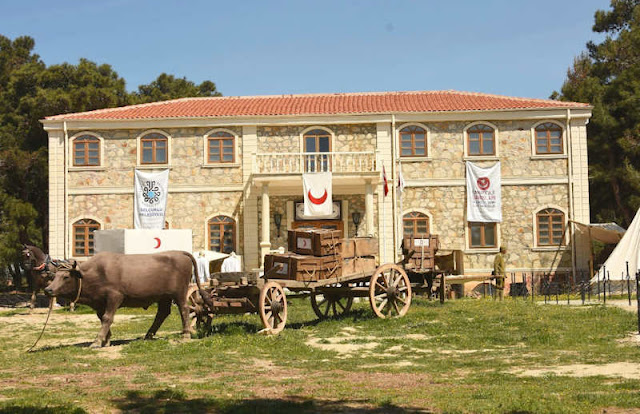
Çanakkale Martyrs' Hospital Museum at Alçıtepe (Krithia)


Alçıtepe, known during the Gallipoli campaign by its former name, Krithia, is a small village on a commanding high plateau in the Eceabat District of Çanakkale Province, Turkey, about four miles from Cape Helles, the tip of the Gallipoli Peninsula. It was to be captured the first day of the land assault, but never fell to the attacking Allied forces. During the recent Centennial of the Great War, since it had been the site of extensive medical facilities for the Turkish and German defenders, it became the location of a hospital museum honoring both the staff and the men who were wounded or died in the nearby fighting. It was dedicated on 18 March 2018, the 103rd anniversary of the defeat of the Allied naval  assault on the Dardanelles, which the Turks consider the decisive event of the Gallipoli Campaign.


The museum is of the old style with artifacts, dioramas, and mannequins and is devoid of high-tech gimmickry. Everything about it, though, radiates a strong feeling of authenticity. The building, located on the northern edge of Alçıtepe  served [I believe but have been unable to confirm] as a hospital during the 1915 fighting. From the photos it seems to be an impressive effort to show the medical aspect of the fighting on the peninsula and well worth visiting if you can make the trip to Gallipoli. Displayed here are ten photos of the museum. They are displayed at 580px width and when clicked on, can be viewed and downloaded at 800px.


Wednesday, March 9, 2022

The Battle of Cantigny: Dawn of the Modern American Army (Video)


The Battle of Cantigny marked the first significant U.S. offensive battle in World War I, boosting Allied morale at a critical point in the war. In this video join Executive Director of the First Division Museum at Cantigny Park, Colonel Paul Herbert, U.S. Army (retired), as he discusses the First Division and the Battle of Cantigny, exploring how this watershed operation marked the U.S. Army’s transition into a modern military force. Presented at the National World War One Museum, Kansas City, MO, in partnership with the First Division Museum at Cantigny Park, Wheaton, IL.

Here's a map to help follow Colonel Herbert's presentation.


Tuesday, March 8, 2022

Handstreich! The Disastrous German Sneak Attack on Liège


By Joe and Janet Robinson and 
Randal Gilbert
Independently published, 2021 
Michael P. Kihntopf


Joe and Janet Robinson (esteemed members of the World War I Historical Association), accompanied by Randal Gilbert, have given us another excellent, inspired work about events at the very beginning of the Great War.  This book complements their other works, The Great War Dawning and The Last Great Cavalry Charge, in that it highlights the ineptitude, driven by over-confidence and prejudice, of the German General Staff or GGS at the beginning of the war.  As with the authors’ other books, the pages are crammed with statistics which justify the use of the word “disastrous.”

Our readers know quite well the story of the Schlieffen Plan that most historians see as the plan the GGS executed at the war’s beginning.  In a nutshell, the GGS launched four armies into Luxembourg and Belgium with the idea of pivoting on the Belgian plain to march south and envelop the French army, which was supposed to be pinned down in front of Alsace-Lorraine by the Crown Prince’s Fifth Army.  Schlieffen had devised this plan in the late 1800s and early 1900s based on his obsession with Hannibal’s battle against the Romans at Cannae in 216 BCE.  

In that obsession, Schlieffen missed some glaring facts. First, Cannae was a battle of relatively small forces and on a very small battlefield.  Second, both sides were pitting their entire armies within sight of the commanding generals. Third, there were few logistical problems. In Schlieffen’s scheme, rivers were crossed over intact bridges, supplies followed on strong rail connections, men marched without regard to speed and endurance, and the intermediate enemy, the Belgians, offered no appreciable resistance. As the authors point out, one should never assume away the opponent or the logistics.

As the years after Schlieffen’s retirement progressed, the plan took on new aspects.  Its initial execution called for the violation of Belgian and Dutch neutrality.  The new chief of the GGS, Helmuth von Moltke, the Younger, found that the idea of violating both countries’ neutrality to be risky. Belgium was of no consequence, but the Netherlands was another story. If that country became an opponent and Britain imposed a blockade, then Germany would have no way of tapping into American resources for a continued war. Judiciously, he set aside an invasion of the Netherlands along the Maastrict enclave. There had been method to Schlieffen’s concept. By invading the Netherlands, one army could avoid confrontation with the strong fortresses of Liège and Namur. Von Moltke’s modification required that two armies, by avoiding the Netherlands enclave, pass between the Liège and Namur fortress complexes—a very tight fit considering that each would have to use the same roads.

German Postcard Depicting the Fall of Liège

     
To support this modification, the GGS came up with a plan, specified as Handstreich or Coup de Main, for taking the Liege complex before the invading armies would pass before its cannons. The sensitivity of such a plan is obvious and, as a result, it was kept secret from everyone including the six brigades which would have to execute it. In that secrecy was the beginning of the rub which would fester into a disastrous rash.  

The Robinsons and Gilbert are quick to point out that the German force, comprised of peacetime strength units which are often half of war strength, was not to wait for mobilization to fill its ranks. As soon as war was declared, they were to jump off.  That meant bringing them up to the frontier long before war was declared. These were to be the first soldiers across the border. And things got more complicated. The Belgians, surmising that an invasion was imminent by the tone of the German ultimatum to let its armies pass without resistance, had already begun the destruction of bridges, rail lines, tunnels, and the clogging of roads with all kinds of impediments, plus bringing up reserves to fortify the fortresses and specifically Liège.

The authors glean information from German regimental histories with the hands of surgeons extracting vital data and developing it to show the day-by-day operations of both sides in that struggle. I was amazed to find not only dates but times for arrival, receiving fire, and withdrawals to safer positions. I could feel the frustration of trying to meet a timetable in capturing Liège as well as the desperateness of the defending force. Modern play by play sports commentaries pale in the light of these pages. There are excellent and numerous maps which actually have the villages that are referenced in the text.

This book is a must for the shelf of Great War enthusiasts who read this blog. It is concise, highly detailed, and a pleasure to read. I particularly enjoyed the part Erich Ludendorff, the man who would go on to nearly rule Germany after 1916, played in securing Liège. It was less dramatic than Ludendorff’s own description that he laid out in his autobiography. But above all, I appreciated the exposure of the ineptitude of the GGS at the beginning of the war.  Operations then were not of scalpel cuts but ones of smashing hatchets.

Michael P. Kihntopf

Monday, March 7, 2022

10 Interpretations of Who Started World War I (Part 2, 6-10)

The March to War


Originally Presented by the BBC, 12 February 2014
(Part 1, 1-5 was presented yesterday on Roads to the Great War

6. Dr Annika Mombauer—The Open University

Austria-Hungary and Germany

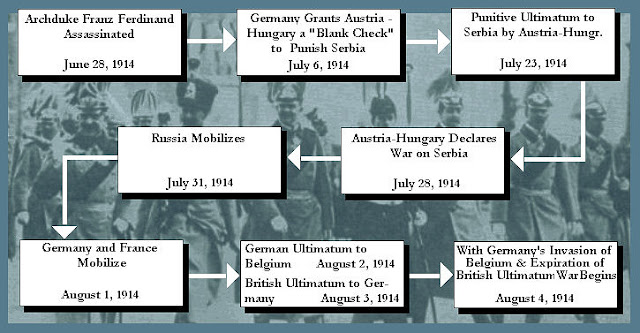
Whole libraries have been filled with the riddle of 1914. Was the war an accident or design, inevitable or planned, caused by sleepwalkers or arsonists? To my mind the war was no accident, and it could have been avoided in July 1914. In Vienna the government and military leaders wanted a war against Serbia. The immediate reaction to the murder of Franz Ferdinand on 28 June 1914 was to seek redress from Serbia, which was thought to have been behind the assassination plot and which had been threatening Austria-Hungary's standing in the Balkans for some time. Crucially, a diplomatic victory was considered worthless and "odious." At the beginning of July, Austria's decision-makers chose war.

But in order to implement their war against Serbia they needed support from their main ally Germany. Without Germany, their decision to fight against Serbia could not have been implemented. The Berlin government issued a "blank cheque" to its ally, promising unconditional support and putting pressure on Vienna to seize this golden opportunity. Both governments knew it was almost certain that Russia would come to Serbia's aid and this would turn a local war into a European one, but they were willing to take this risk.

Germany's guarantee made it possible for Vienna to proceed with its plans—a "no" from Berlin would have stopped the crisis in its tracks. With some delay Vienna presented an ultimatum to Serbia on 23 July which was deliberately unacceptable. This was because Austria-Hungary was bent on a war and Germany encouraged it because the opportunity seemed perfect. Victory still seemed possible whereas in a few years' time Russia and France would have become invincible. Out of a mixture of desperation and over-confidence the decision-makers of Austria-Hungary and Germany unleashed a war to preserve and expand their empires. The war that ensued would be their downfall.

7.  Sean McMeekin—assistant professor of history at Koc University, Istanbul

Austria-Hungary, Germany, Russia, France, Britain and Serbia

It is human nature to seek simple, satisfying answers, which is why the German war guilt thesis endures today.

Without Berlin's encouragement of a strong Austro-Hungarian line against Serbia after Sarajevo—the "blank cheque"—WWI would clearly not have broken out. So Germany does bear responsibility.

But it is equally true that absent a terrorist plot launched in Belgrade the Germans and Austrians would not have faced this terrible choice. Civilian leaders in both Berlin and Vienna tried to "localise" conflict in the Balkans. It was Russia's decision—after Petersburg received its own "blank cheque" from Paris—to Europeanise the Austro-Serbian showdown which produced first a European and then—following Britain's entry—world conflagration. Russia, not Germany, mobilised first.

The resulting war, with France and Britain backing Serbia and Russia against two Central Powers, was Russia's desired outcome, not Germany's. Still, none of the powers can escape blame. All five Great Power belligerents, along with Serbia, unleashed Armageddon.

8.  Prof Gary Sheffield—professor of war studies, University of Wolverhampton

Austria-Hungary and Germany

The war was started by the leaders of Germany and Austria-Hungary. Vienna seized the opportunity presented by the assassination of the archduke to attempt to destroy its Balkan rival Serbia. This was done in the full knowledge that Serbia's protector, Russia, was unlikely to stand by and this might lead to a general European war.


Germany gave Austria unconditional support in its actions, again fully aware of the likely consequences. Germany sought to break up the French-Russian alliance and was fully prepared to take the risk that this would bring about a major war. Some in the German elite welcomed the prospect of beginning an expansionist war of conquest. The response of Russia, France and later Britain were reactive and defensive.

The best that can be said of German and Austrian leaders in the July Crisis is that they took criminal risks with world peace.

9. Dr Catriona Pennell—senior lecturer in history, University of Exeter

Austria-Hungary and Germany

In my opinion, it is the political and diplomatic decision-makers in Germany and Austria-Hungary who must carry the burden of responsibility for expanding a localised Balkan conflict into a European and, eventually, global war. Germany, suffering from something of a "younger child" complex in the family of European empires, saw an opportunity to reconfigure the balance of power in their favour via an aggressive war of conquest.

On 5 July 1914 it issued the "blank cheque" of unconditional support to the crumbling Austro-Hungarian Empire (trying to reassert its dominance over the rebellious Serbia), despite the likelihood of this sparking war with Russia, an ally of France and Great Britain. However, Austria-Hungary's actions should not be ignored.

The ultimatum it issued to Serbia on 23 July was composed in such a way that its possibility of being accepted was near impossible. Serbia's rejection paved the way for Austria-Hungary to declare war on 28 July, thus beginning WW1.

10.  David Stevenson—professor of international history, LSE

Germany

The largest share of responsibility lies with the German government. Germany's rulers made possible a Balkan war by urging Austria-Hungary to invade Serbia, well understanding that such a conflict might escalate. Without German backing it is unlikely that Austria-Hungary would have acted so drastically.

They also started wider European hostilities by sending ultimata to Russia and France, and by declaring war when those ultimata were rejected—indeed fabricating a pretext that French aircraft had bombed Nuremberg.

Finally, they violated international treaties by invading Luxembourg and Belgium knowing that the latter violation was virtually certain to bring in Britain. This is neither to deny that there were mitigating circumstances nor to contend that German responsibility was sole.

Serbia subjected Austria-Hungary to extraordinary provocation and two sides were needed for armed conflict. Although the Central Powers took the initiative, the Russian government, with French encouragement, was willing to respond.

In contrast, while Britain might have helped avert hostilities by clarifying its position earlier, this responsibility—even disregarding the domestic political obstacles to an alternative course—was passive rather than active.

Source: BBC, 12 February 2014

Sunday, March 6, 2022

10 Interpretations of Who Started World War I (Part 1, 1-5)


Originally Presented by the BBC, 12 February 2014

Some of the Key Participants in the July Crisis of 1914
(As Portrayed in the Docudrama 37 Days)

1.  Sir Max Hastings - military historian

Germany

No one nation deserves all responsibility for the outbreak of war, but Germany seems to me to deserve most.

It alone had power to halt the descent to disaster at any time in July 1914 by withdrawing its "blank cheque" which offered support to Austria for its invasion of Serbia.

I'm afraid I am unconvinced by the argument that Serbia was a rogue state which deserved its nemesis at Austria's hands. And I do not believe Russia wanted a European war in 1914 - its leaders knew that it would have been in a far stronger position to fight two years later, having completed its rearmament programme.

The question of whether Britain was obliged to join the European conflict which became inevitable by 1 August is almost a separate issue. In my own view neutrality was not a credible option because a Germany victorious on the continent would never afterwards have accommodated a Britain which still dominated the oceans and global financial system.

2.  Sir Richard J Evans - Regius professor of history, University of Cambridge

Serbia

Serbia bore the greatest responsibility for the outbreak of WW1. Serbian nationalism and expansionism were profoundly disruptive forces and Serbian backing for the Black Hand terrorists was extraordinarily irresponsible. Austria-Hungary bore only slightly less responsibility for its panic over-reaction to the assassination of the heir to the Habsburg throne.

France encouraged Russia's aggressiveness towards Austria-Hungary and Germany encouraged Austrian intransigence. Britain failed to mediate as it had done in the previous Balkan crisis out of fear of Germany's European and global ambitions - a fear that was not entirely rational since Britain had clearly won the naval arms race by 1910. 


The generally positive attitude of European statesmen towards war, based on notions of honour, expectations of a swift victory, and ideas of social Darwinism, was perhaps the most important conditioning factor. It is very important to look at the outbreak of the war in the round and to avoid reading back later developments - the German September Programme for example (an early statement of their war aims) - into the events of July-August 1914.


3.  Dr. Heather Jones - associate professor in international history, LSE

Austria-Hungary, Germany and Russia

A handful of bellicose political and military decision-makers in Austria-Hungary, Germany and Russia caused WW1.

Relatively common before 1914, assassinations of royal figures did not normally result in war. But Austria-Hungary's military hawks - principal culprits for the conflict - saw the Sarajevo assassination of the Austro-Hungarian Archduke Franz Ferdinand and his wife by a Bosnian Serb as an excuse to conquer and destroy Serbia, an unstable neighbour which sought to expand beyond its borders into Austro-Hungarian territories. Serbia, exhausted by the two Balkan wars of 1912-13 in which it had played a major role, did not want war in 1914.

Broader European war ensued because German political and military figures egged on Austria-Hungary, Germany's ally, to attack Serbia. This alarmed Russia, Serbia's supporter, which put its armies on a war footing before all options for peace had been fully exhausted.

This frightened Germany into pre-emptively declaring war on Russia and on Russia's ally France and launching a brutal invasion, partly via Belgium, thereby bringing in Britain, a defender of Belgian neutrality and supporter of France.

4.  John Rohl - emeritus professor of history, University of Sussex

Austria-Hungary and Germany

WW1 did not break out by accident or because diplomacy failed. It broke out as the result of a conspiracy between the governments of imperial Germany and Austria-Hungary to bring about war, albeit in the hope that Britain would stay out.


After 25 years of domination by Kaiser Wilhelm II with his angry, autocratic and militaristic personality, his belief in the clairvoyance of all crowned heads, his disdain for diplomats and his conviction that his Germanic God had predestined him to lead his country to greatness, the 20 or so men he had appointed to decide the policy of the Reich opted for war in 1914 in what they deemed to be favourable circumstances.

Germany's military and naval leaders, the predominant influence at court, shared a devil-may-care militarism that held war to be inevitable, time to be running out, and - like their Austrian counterparts - believed it would be better to go down fighting than to go on tolerating what they regarded as the humiliating status quo. In the spring of 1914, this small group of men in Berlin decided to make "the leap into the dark" which they knew their support for an Austrian attack on Serbia would almost certainly entail.

The fine-tuning of the crisis was left to the civilian chancellor Theobald von Bethmann Hollweg, whose primary aim was to subvert diplomatic intervention in order to begin the war under the most favourable conditions possible. In particular, he wanted to convince his own people that Germany was under attack and to keep Britain out of the conflict.


5. Gerhard Hirschfeld - professor of modern and contemporary history, University of Stuttgart

Austria-Hungary, Germany, Russia, France, Britain and Serbia

Long before the outbreak of hostilities Prussian-German conservative elites were convinced that a European war would help to fulfil Germany's ambitions for colonies and for military as well as political prestige in the world.


The actual decision to go to war over a relatively minor international crisis like the Sarajevo murder, however, resulted from a fatal mixture of political misjudgement, fear of loss of prestige and stubborn commitments on all sides of a very complicated system of military and political alliances of European states.


In contrast to the historian Fritz Fischer who saw German war aims - in particular the infamous September Programme of 1914 with its far-reaching economic and territorial demands - at the core of the German government's decision to go to war, most historians nowadays dismiss this interpretation as being far too narrow. They tend to place German war aims, or incidentally all other belligerent nations' war aims, in the context of military events and political developments during the war.


Part II will be presented tomorrow on Roads to the Great War

Saturday, March 5, 2022

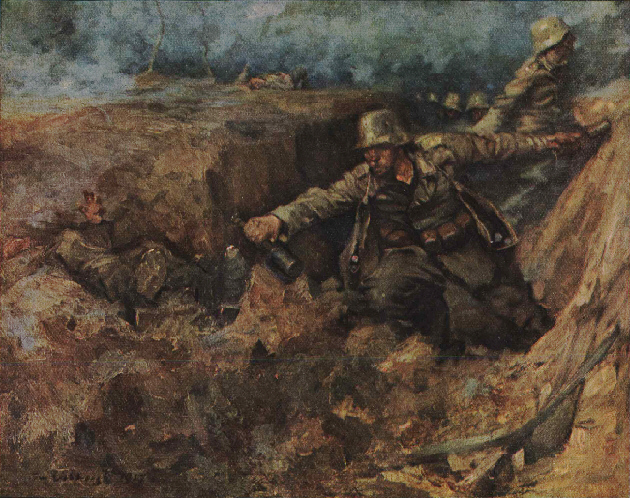
Two Noted Artists Depict the Battle of the Somme


Top: German artist Franz Eichhorst portrays a German defensive trench. (Note partially buried corpse.) He was an artist in both World Wars. (See selected works.) Below: French-American artist, Charles Hoffbauer, in one of a series of six paintings (see set) from the Somme Sector, shows German prisoners under French guard.

Friday, March 4, 2022

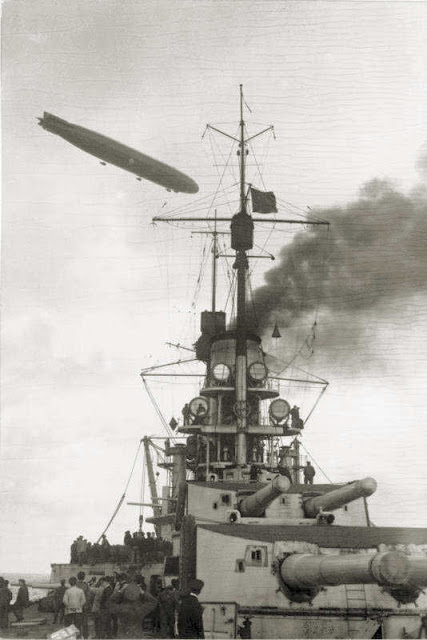
German Naval Air at Operation Albion


A Naval Dirigible Flies Over a German
Battleship During Operation 
ALBION 


By Richard Dinardo, USMC University

For far too long, the eastern front in World War I has remained, in Winston Churchill’s words, “the unknown war.” Despite the best efforts of Dennis Showalter, Holger Herwig, Norman Stone, and others, the course of affairs in the east is still largely a blank slate, especially in the period between Tannenberg and the Russian revolutions. This article will attempt to address this gap by covering German air operations on the eastern front, focusing in particular on  operation ALBION, mounted to seize the Baltic islands of Oesel, Moon and Dagö in October 1917. [The original article also addressed the 1916 campaign in Rumania.]

After the Romanian campaign, the scene of action on the eastern front shifted to the north, specifically to the Baltic. With Russia crumbling internally, OHL sought advanced positions from which to launch a possible thrust at Petrograd. The most notable of these was Riga, which General Oskar von Hutier’s Eighth Army seized on 1 September 1917, using the tactics that would later bear his name.

In order to make Riga useful both logistically and as a naval base for light forces, however, it was necessary to occupy the islands of Oesel, Moon and Dagö, which controlled access to and from the Gulf of Riga. Both OHL (in reality, Paul von Hindenburg and Erich Ludendorff) and the head of the German Admiralty’s staff, Admiral Henning von Holtzendorf, agreed on 13 August 1917 to undertake the operation against the islands after the capture of Riga.  

The invasion force would consist of some 300 ships, including ten of the Navy’s newest battleships, wrested away from Admiral Reinhard Scheer’s High Seas Fleet by the German Admiralty. The landing itself would be left to the XXIII Reserve Corps, in effect the heavily reinforced 42nd Infantry Division plus some corps-level assets, a total of about 24,000 men.

Supporting these forces would be Army Captain Holtzman’s 16th Air Detachment (6 aircraft) and Detachment Baerens (8 seaplanes and the seaplane tender St. Elena, commanded by Navy Lieutenant Baerens). The Navy also committed six zeppelins (ranging from the older L 30, L 37, LZ 113, and LZ 120, to the newer SL 8 and SL 20) to the operation. Also supporting the operation were aircraft detachments at Windau and Libau. Calculating the number of aircraft involved in the operation is difficult, as the numbers vary. One source gives the number of aircraft (not including zeppelins) as 101, although the total number of operational aircraft available on any one day of the operation probably did not exceed 65. Aside from Holtzman’s unit, all of the aircraft (regardless of service) and zeppelins came under the command of Rear Admiral Ludwig von Reuter, the commander of the 2nd Scout Group.

Operation ALBION


Despite their small numbers, aircraft undertook a variety of roles before and during ALBION. As always, the first of these was reconnaissance. Aircraft tried to provide information on the dispositions of the Russian garrison on the island, as well as those Russian Navy units positioned in Moon Sound that might threaten the invasion force. German aircraft and zeppelins were also used to bomb various parts of the island, with varying degrees of success. Under no circumstances, however, were German aircraft to drop bombs near the landing sites, especially Tagga Bay, the principal landing area. It was feared that any kind of bombing attacks against the Russians there would tip them off as to the location of the landing sites, thus forfeiting the element of surprise.

Weather severely hindered the ability of aircraft to make much of an impact on the operation. On the day of the landing, for example, weather precluded any kind of activity by the zeppelins. Just as worrisome for the zeppelins was the increasing shortage of hydrogen gas. The Baltic Airship Detachment had to use a mixture of air and hydrogen, which increased the risk of fire. This danger eventually caught up with the Germans on 16 October 1917, when L 37 returned to its base at Seerappen having sustained heavy damage in a mid-air fire after a bombing mission.

Fixed wing aircraft also suffered at the hands of the weather. Just as zeppelins were grounded on 12 October 1917, weather limited German aerial coverage of the landings to a pair of artillery spotter aircraft and one bomber during the first hour of the landing, followed in the second hour by one bomber and one reconnaissance plane. The 42nd Infantry Division regarded this as completely inadequate. On the 13th, rain and snow precluded effective reconnaissance flights, and although three seaplanes did make brave attempts at flying reconnaissance, two of the three aircraft were damaged upon landing, killing Naval Lieutenant Anton Priemes. 


The Gotha WD-11 Torpedo Bomber Proved
Unsuccessful During the Naval Battle


Despite the adverse conditions, aircraft did make some positive contributions to the conduct of ALBION. Aircraft operated with infantry units as “infantry aircraft,” as prescribed by German doctrine at the time. When the weather allowed, these aircraft did conduct a number of reconnaissance missions. When the breakdown of wireless radio communications prevented passing the information to the ground forces via radio, pilots resorted to the time-honored back up method of tying messages to strips of cloth and then dropping them next to the units. At times this procedure involved aircraft having to fly through Russian ground fire several times. Aircraft would also “lead” infantry columns, circling around and then flying off in the direction the infantry was supposed to march.

The Germans were certainly fortunate that Russian air opposition during ALBION was negligible, although Russian anti-aircraft fire could pose problems for planes. The only known Russian air activity was on 14 October, when a German naval aircraft was attacked by three Russian Nieuports. When Holtzman’s 16th Air Detachment moved to an airfield next to Oesel’s largest town, Arensburg, all they found were four Nieuports the Russians had destroyed and abandoned

What insights can we draw from these operations? The first thing we can draw from the air operations described here is that although they were on a far smaller scale than those on the western front, they nonetheless illustrate nearly the full scope of flexibility inherent in airpower. With the exceptions of air superiority and the then still nascent concepts of aerial re-supply and rescue, German aircraft in [ALBION] undertook every other kind of operation associated with air warfare. In addition, the Germans took advantage of the relatively benign conditions in the east as an opportunity to test newly fielded aircraft, especially bombers.

Much of the German air effort was spent flying reconnaissance. . . Although ALBION did not require much in the way of bombing, German aircraft undertook a large number of reconnaissance missions, although success in these varied considerably, partly because of the weather, but also for other reasons that will be discussed momentarily. The most intriguing aspect of airpower here was the use of aircraft as a means of communications, particularly as a replacement for wireless radio.


An aerial view of Arensburg (Kuressaare) flying station on
the island of Osel (Saaremaa) The hangars were destroyed
by bombs dropped by a German flying boat, October 1917.


The German expectation was that the majority of wireless radio message traffic, both land and naval, would be handled through the wireless radio station aboard the invasion force’s flagship, the battle cruiser Moltke. Once collected, information would then be passed on to General von Hutier, the overall commander, who was at his headquarters in Libau. In some cases individual aircraft were tied into specific ships by wireless radio for purposes of artillery spotting. In addition, a system of colored ground signals and signal flares was set up to facilitate communications between aircraft and ground troops. 

Actual experience showed many of these expectations to have been overly optimistic. To be sure, there were instances when the combination of aircraft and wireless radio paid dividends, such as when the aircraft spotting for the torpedo boat G-104 was able to provide the information needed for the boat to knock out a Russian field battery.  Too often, however, radio communications were simply overwhelmed by the sheer volume of traffic. With some 300 ships to command, not to mention Army traffic, the Moltke’s wireless radio station was quickly overloaded. This also applied to the command ships of the sub-elements of the invading force. Some of the Army’s after-action reports noted the need for the Army to establish its own communications system as rapidly as possible once the ground forces were ashore. German air doctrine stressed this for the air forces as well, even before ALBION was undertaken.

The communications problems described above severely impacted German air operations in ALBION. Even when zeppelins were able to fly reconnaissance and bombing missions, the overloaded wireless radio communications prevented the immediate reporting of their results, thus rendering the information gained useless. This applied to fixed wing aircraft as well. Fixed wing aircraft did have the alternatives of either dropping written messages on the units they were supporting, or literally landing by the headquarters of the units and delivering the information personally. Given the difficult weather and at times unsuitable ground on Oesel, however, the latter method increased the chances of aircraft suffering damage when landing, as occurred a few times during the operation. Nonetheless, the combination of airpower and wireless communication held great promise for the future.


Infantry Heading for Shore—ALBION Was the Most Successful Amphibious Operation of the War


One aspect of operations in general the Germans should have brought away from this experience concerned joint operations. One of the senior German naval commanders in the Baltic, Rear Admiral Albert Hopman, wrote to his wife on 19 September 1917 that “our army commanders have no idea of naval warfare.”  The reverse was true in ALBION at the lower levels, at least in terms of the support provided to the Army by naval aircraft. The 42nd Division’s after-action report on the operation complained that many of the reconnaissance reports from naval aircraft were either inaccurate or simply false, owing to the fact that naval aviators were unfamiliar with land warfare. The report also called for Army and Navy pilots to be trained for joint operations. . .

In this case, the Germans generally failed to learn from ALBION. . . Organizationally, [for the next war] one thing the Germans should have brought away from ALBION was the need for a robust naval air arm. . .  For the Germans, however, the idea of a strong naval air arm never came to fruition. Although plans for German naval expansion did call for the building of an aircraft carrier, the projected Graf Zeppelin, it never reached completion. Nor did Germany’s top naval commander, Grand Admiral Erich Raeder, consider the aircraft carrier to be anything more than a prestigious adjunct to the battleship. 

Source: "From Bucharest to the Baltic German Air Operations on the Eastern Front, 1916-1917,"  Chronicles Online Journal, Air University, 2007


Thursday, March 3, 2022

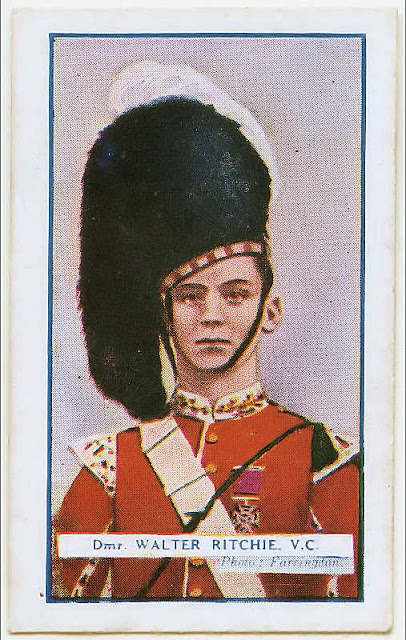
A VC for Sounding "Charge"


Drummer Corporal Walter Potter Ritchie (1892–1965) 2nd Bn, Seaforth Highlanders, was awarded the Victoria Cross for his actions on the first day of the Battle of the Somme.

For the award of the Victoria Cross

For most conspicuous bravery and resource (North of Beaumont Hamel), when on his own initiative he stood on the parapet of an enemy trench, and, under heavy machine gun fire and bomb attacks, repeatedly sounded the "Charge" thereby rallying many men of various units who, having lost their leaders, were wavering and beginning to retire.

This action showed the highest type of courage and personal initiative. Throughout the day Drummer Ritchie carried messages over fire-swept ground, showing the greatest devotion to duty.

Walter Ritchie was invested with his Victoria Cross by King George V at Buckingham Palace on 25 November 1916. He eventually made Drum Major  and left the Army in 1929. He died in Edinburgh on 17 March 1965. 

Source: National Portrait Gallery; Musicians' Company Archive

Wednesday, March 2, 2022

The Great War's "Hamburger Hill": Mte Piana in the Dolomite Alps


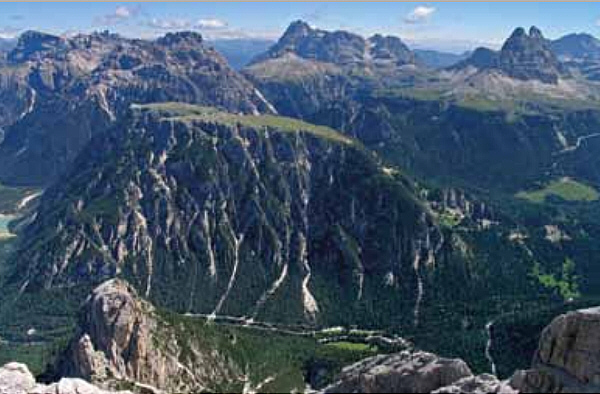
Mte Piana Looking NE—Austrian Forces Occupied the
Smaller Section—Italian Troops, the Larger Southerly Section

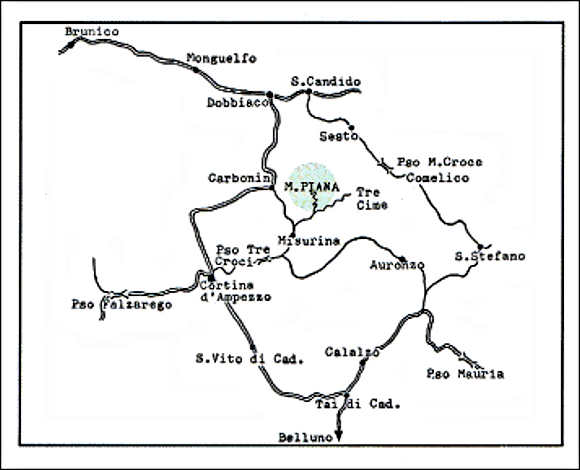
One candidate for the title "World's Most Spectacular Battlefield" is certainly Monte Piana, located about 12 km northeast of the ski resort of Cortina, Italy. At least it has some of the most dramatic views for the poor guys stuck in the trenches. Its aesthetic value derives from its confirmation—Monte Piana is a high plateau, mostly flat—but lower than the surrounding mountains, which are some of the most impressive of the Alps.


During the First World War Austrians and Italians fought each other atop Monte Piana (7,625-ft elevation on the southern peak). This mountain of the Sexten Dolomites range was the scene of a slow but gruesome attritional war. The area overlaps the former 1753 frontier between the Republic of Venice (Serenissima) and Tyrol. A boundary stone is still visible on site.  Consequently, it was accessible to both sides at the opening of the war on the Italian Front.  Also, anyone force controlling its flat top had a 360-degree view of  the activity in several passes through the nearby range. A more desirable observation outpost could hardly be conceived.


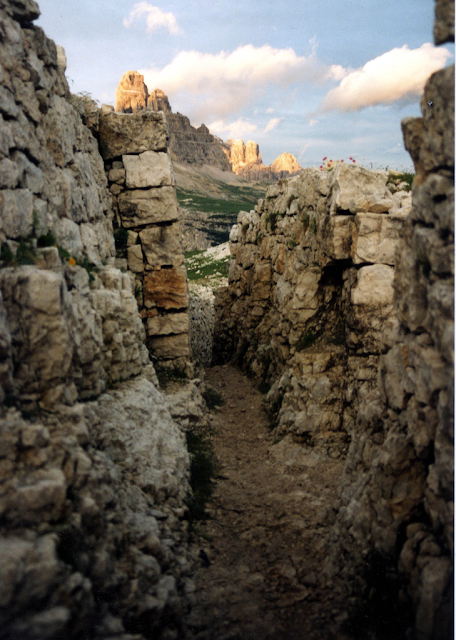
An Austrian Trench


Immediately after the war's outbreak, in early June 1915, the troops of Standschützen tried to gain the dual summits. Heavy casualties took place on both sides and resulted in a stationary front line with the mountain's north summit occupied by the Austrians, the southern (slightly higher) summit by the Italians. The two sectors were split by a deep ditch named the Valley of the Castrati by the soldiers. The outposts, trenches, and tunnels of the opposing sides were only a few meters apart in places. This made for the worst kind of attrition warfare, with raids, sniping, and random bombardments, all intended to push the opposing forces off the plateau, but which neither side could allow. The situation stabilized until the Italian defeat in the October 1917 Battle of Caporetto forced the entire front south. Fourteen thousand soldiers, Italians and Austrians, lost their lives on this single mountain over a span of 30 months.


Today Mte. Piana Is an Outdoor Museum


In 1977 the Dolomitenfreunde, a group of volunteers headed by Walther Schaumann, restored the trenches and the former positions of the two fronts and the resulting path is now a really instructive and easy itinerary with breathtaking views appearing on each side. A jeep/snowcat shuttle is operated from nearby Lake Misurina to a refuge near the summit.

A Lone Artillery Piece from the 1915-17 Struggle

Source:  La Granda Guerra

Tuesday, March 1, 2022

The Zeppelin Offensive: A German Perspective in Pictures & Postcards


By David Marks
Pen & Sword, Ltd., 2019
Peter L. Belmonte, Reviewer


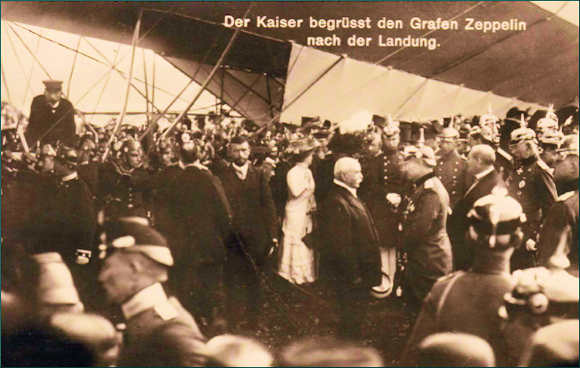
1909: Kaiser Wilhelm Congratulates Count Zeppelin
on the Success of His New Technology


German Zeppelin raids on Britain during World War I have drawn a fair amount of attention from historians. Most of the writing has been from the British perspective; some writers have focused upon specific attacks or on attacks on a specific area. In this book, airship historian and author David Marks shows us the German perspective as reflected in postcards and other ephemera. Marks has previously written about how the British used comic postcards to boost morale during the years of the zeppelin raids. In this volume, he uses his own massive postcard collection to illustrate German use of this popular medium to influence its own citizenry relative to the zeppelin.

Marks covers the topic chronologically, the postcards in each chapter illustrating the progression of the use of zeppelins for raids. His brief narrative for each chapter puts the cards themselves in perspective and explains the meanings of some of the depictions and the words printed on them. Some cards depict children playing at war and including makeshift zeppelins in their tiny armies. Many others depict Count Ferdinand von Zeppelin throwing bombs from “his” airships or watching approvingly as others do.

One interesting chapter discusses the fate of the airship L19 that crashed in the North Sea after a raid on Britain on 1 February 1916. The British civilian fishing vessel King Stephen came upon the zeppelin in the water with the surviving aircrew atop its massive frame; the skipper of the King Stephen refused to rescue the stranded airship crew, and Marks covers the repercussions and the propaganda postcards issued in the wake of this tragic incident.


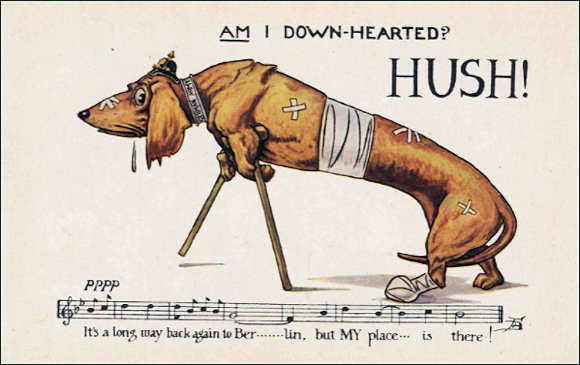
Sample Anti-German Postcard


Throughout the narrative, the author describes the propaganda impacts of the postcards, and he analyzes the various themes the artists and writers employed. Marks makes the interesting observation that “German artists and their publishers… [generally] displayed a more heavy-handed approach in their mockery of their opponents” (p. xi). In addition, many of the German cards reflect scatological humor, often showing, or implying, that zeppelin raids induce enemy soldiers and civilians on the ground to befoul themselves in terror.

This isn’t an in-depth history of zeppelin raids, of course. The comparatively brief narrative serves to highlight the postcards; it is the cards themselves that are the “stars” of this book. The postcards and other items of ephemera are very well produced, and they are a pleasure to look at. The art varies from comic depictions (very common) to strikingly realistic illustrations of raids. They evoke the feelings and spirit of a time long gone by. The author’s captions are informative, and each card is identified by its publisher, when known.

This book is highly recommended for anyone interested in World War I propaganda and for those interested in popular and material culture of the war years.

Peter L. Belmonte