Now all roads lead to France and heavy is the tread
Of the living; but the dead returning lightly dance.
Edward Thomas, Roads

Saturday, February 11, 2023

The Aussie's Underground City at Naours


Entrance Naours Caves, Picardy, France


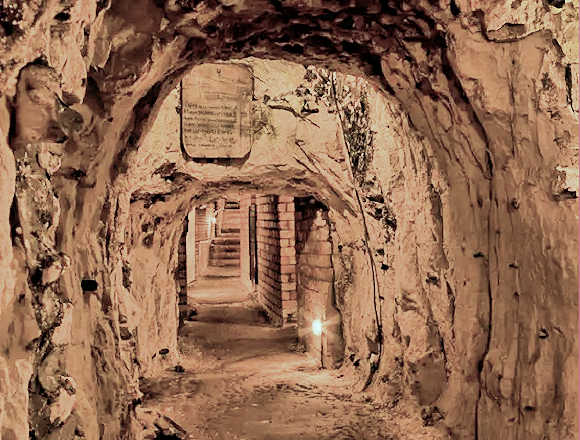
The underground portion of Naours began as a quarry in antiquity that was steadily enlarged over successive centuries. The empty subterranean chambers gave area residents a convenient place to store goods and take shelter from the elements, and to hide from raiders and roving armies looking for supplies. By the 17th century, thanks to the rampant destruction of the Thirty Years’ War, the underground city had a large and fairly well-settled contingent of residents. As Western Europe stabilized and hiding in caves for long periods of time became less necessary, the existence of this underground complex was forgotten until it was rediscovered in 1887.


Tunnels


Graffiti


Henry Holloway (left) and his mate, John Castree (right) of the 15th Battalion AIF left their marks before heading along to the Pozieres sector. 

Sources:  Agence Somme Tourisme; Explore France; Atlas Obscura; Monash Centre


Friday, February 10, 2023

Action on the Isonzo Front — A Roads Collection


Sectors 1 and 2 are Along the Isonzo (Soca) River


Note:  Our numerous articles on the Battle of Caporetto and its impact are not included here.  They will be the subject of a future special Friday feature.  If this is your spicific interest, just type "Caporetto" in the search box, upper left on this page. MH


Articles


The Soška fronta/Isonzo Front 1915–1917—A Slovenian Perspective


Map Series #6: The Isonzo Sector of the Italian Front


The Worst Battlefield of the Italian Front: The Carso Plateau (Video)


23 June 1915: The First Battle of the Isonzo


End of the First Year on the Italian Front


Gorizia: Strategic City on the Italian Front


1916 on the Isonzo, Italy's Most Successful Advance


Austro-Hungarian Defenders on the Carso


What Happened on the Bainsizza Plateau in 1917?


Sveta Gora: Holy Site Destroyed in the Great War


The Tenth Battle of the Isonzo Winds Down


Colle Sant' Elia, Remembrance Park at Redipuglia


Scenic Battlefield: The Isonzo Sector of the Italian Front — Part 1, the North


Scenic Battlefield: The Isonzo Sector of the Italian Front — Part 2, the South


Austria-Hungary's Bravest of the Brave


View from Monte San Michele, Carso Plateau


Reviews


The Isonzo, Forgotten Sacrifice of the Great War


Ungaretti of the Carso

__________________


A Reminder: This is a representative listing, not inclusive of all the articles we have published on this topic in Roads to the Great War.  To search our archives for other articles on this topic, or to explore other World War One interests of yours, take advantage of the site search engine at the top left corner of every page on Roads to the Great War. MH

Thursday, February 9, 2023

The Doughboys' Rifles of the Great War


Gary Cooper Was Armed with a Springfield 03,
But Alvin York Carried a Model 1917 "American Enfield"

By Len Shurtleff

When America entered the Great War in April 1917, it was short of just about everything upon which a modern army depends. Not the least of these shortages was that of small arms, or individual weapons: the rifles and pistols carried by the foot soldiers. The story of how the U.S. Army grappled with this shortfall and the confusion about which rifles were issued to which units are part of the reason why the movie makers had Cooper carrying the wrong rifle—the famous Springfield 03—(and the wrong pistol, as well) when he portrayed Medal of Honor recipient Alvin York in the 1940 classic film Sergeant York. It is also the story of "the other rifle" carried by the vast majority of Doughboys who fought in World War One.

The British Enfield Rifles. The story starts in August of 1910 in Great Britain. The War Office was undertaking a number of basic reforms as the result of experience in the Boer War in South Africa, and as a consequence of informal staff talks with the French Army. Among these was the design of a new rifle to replace the Short Magazine Lee-Enfield (SMLE) rifle chambered for the .303 inch rimmed cartridge.


SMLE Lee-Enfield


The Small Arms Committee charged by the British War Office with drawing up requirements for the new rifle agreed on the following specifications, among others:

  • Length, weight and recoil as near as possible to the Short Lee-Enfield
  • The rifle should fire rimless cartridges from a 10-round detachable magazine (later reduced to five rounds)
  • The breech should be of the Mauser type
  • And, the sighting system should be of the aperture backsight variety.

The rifle developed from these specifications by the Royal Small Arms Factory at Enfield came to be known as the Pattern 1914 Enfield. It was chambered for a new .276 rimless cartridge presaging the later trend toward smaller bore, higher-velocity infantry assault weapons which culminated in the M-16 and the AK-47. The new .276 round had a muzzle velocity of 2,785 feet per second versus the .303's 2,440 feet per second. Consequently, it had a longer range and flatter trajectory than the .303. The Pattern 1914 rifle was stronger overall than the SMLE and simpler in that it had fewer parts and could be field-stripped without tools, another requirement set by the War Office.

When England entered the war against Germany in mid-1914, it abandoned the idea of introducing a new cartridge let alone retooling assembly lines for a totally new infantry rifle. The British had to avoid disrupting vital small arms production and complicating ammunition supply at a time of extreme national emergency and explosive growth of the armed forces. So, they retained the flanged, or rimmed .303 cartridge, and rapidly expanded domestic production of the Short Magazine Lee-Enfield (SMLE) while farming-out production of the new Pattern 1914 rifle in .303 caliber to overseas manufacturers specifically Winchester, Remington, and Midvale Steel in the United States.

Now, the British Tommy was not necessarily displeased with this turn of events. The Pattern 1914 Enfield was some two inches longer and a pound heavier than the Lee-Enfield. So, many Tommies preferred their beloved SMLE. It was easy to handle, held 10 rounds instead of five in the new Pattern '14 and its bolt action was smooth and reliable if less robust than the Pattern 1914's. So fast could experienced British riflemen handle their weapon that German frontline troops thought they were facing massed machine gun fire in the opening battles of 1914. The Pattern 1914 Enfield was relegated to a role as the sniper's rifle for the British Army and was still in use in the early days of WWII. By 1916, the British were turning out sufficient rifles, with modifications and improvements to the SMLE, in their own factories. So, they canceled the U.S. contracts for the Pattern 1914 Enfield. On the existence of these lapsed contracts hangs part of our tale.


American Rifles


Springfield 03


The American Springfield Rifle, Model 1903,  was a direct outgrowth of the Spanish-American War of 1898. U.S. ordnance experts recognized the superiority of the German-designed Mauser magazine rifles with which the Spanish were armed and studied them carefully. Over a period of time, a new design, the Model 1903 patterned unabashedly on the Mauser, was developed at the U. S. government's Springfield Arsenal in Massachusetts. (The U.S. government paid Germany for the use of certain Mauser design components.) It was issued to American troops beginning in 1904. This rifle had a 24-inch barrel, some six inches shorter than the 1898 Krag (also known as the Krag-Jorgensen after its Norwegian inventors)—the U.S. Army's first bolt action, smokeless powder rifle—which it replaced. The real improvements in the Springfield over the Krag were in the quality of the ammunition and in the ease of loading the new Springfield. 

The Model 1903 was loaded from a single five-round stripper clip rather than by dropping five separate loose rounds into the magazine as in the Krag. The ammunition was also modified from the round-nosed Krag and early Springfield .30-40 caliber cartridge with a rounded 220-grain bullet to a pointed 150-grain round known as the .30-'06 (thirty-ought-six) patterned again after the German-designed spitzer—or pointed—bullet. The "ought six" in the cartridge's name refers to the year the new round was adopted: 1906. The rimless .30-'06 cartridge survived as the standard in the U. S. Army through the Korean War. The Springfield was replaced as the standard infantry rifle in 1936 by the semiautomatic Garand firing the same caliber round. But, the highly-accurate .30-'06 Springfield rifle Model 1903 with various modifications was in limited use in WWII (as a sniper rifle) and a generation later even in Vietnam.


Marines Issued with Springfield Rifles


The Crisis of 1917 

When war was declared in 1917, America was entirely unprepared. The presidential election of the previous year was fought and won by Thomas Woodrow Wilson (his second term) on the platform "He Kept Us Out of War." Sentiment in Congress and among the electorate did not favor intervention. Millions of Americans traced their ancestry back to Germany. Another major ethnic group, the Irish, had no love for Great Britain. And powerful pacifist, populist, and Progressive legislators blocked any arms buildup save that for a larger "defensive" navy. A majority of voters in the Midwestern states from Michigan, Minnesota, Illinois, and Indiana south into Kansas and Oklahoma were no more than lukewarm warm to America's entry into the war and many outside the northeast and California were opposed. So politically volatile was the issue of preparedness that the U. S. Army staff was specifically instructed by the Secretary of War not to plan for a European intervention, or even for wartime military and industrial mobilization.

Moreover, in 1917 there was almost no excess industrial capacity to support mobilization and expanded war production. The American economy was going full tilt. U.S. factories, foundries, mills, and shipyards were running at 94 to 96% of capacity as a result of heavy wartime demands from England and France. American farmers were working overtime to produce wheat, corn and livestock (including horses and mules) needed to feed Allied armies and civilians. Rural and urban unemployment was, as a result, practically nonexistent. Moreover, the flood of immigration from Europe, which had provided the ready source of cheap, willing labor that fueled the massive post-Civil War economic expansion, had dried up as a result of the war. Thus, both labor and industrial capacity were already stretched to the utmost. There was no excess capacity available as there was to be in 1939 and 1940 at the outset of World War II, when America was emerging from a long, hard, and cruel economic depression to retool as the Arsenal of Democracy, to use the term coined by Franklin Delano Roosevelt.


The Rock Island Arsenal Produce 114,000
Springfield Rifles During the War


When war did come to America in April 1917, the Army in particular was woefully unprepared. Everything had to be done at once. Recruiting, housing, training, arming and transporting an army to Europe was a monumental task almost beyond the talents and capacity of America's tiny professional military officer corps and a minuscule Federal bureaucracy. Small arms were a number-one priority. But, only two government-owned factories—the Springfield and the Rock Island (Illinois) Arsenals, were producing the army's Springfield Model 1903 rifles. Army planners correctly judged that production at these arsenals could probably not be increased significantly, and certainly not fast enough to arm the four million men the army envisaged mobilizing.

And America was under tremendous pressure. The French and the British were desperate for American troop reinforcements to meet expected German reinforcements moving to the Western Front from Russia, which was out of the war. They demanded we mobilize faster and send raw drafts for training in England and France and incorporation into their own army formations. Wilson, backed by his Secretary of War Newton Baker and by General John Pershing, refused. American troops would fight under American command, and they would be trained and armed under American direction. For this, the army needed infantry weapons, and they needed them fast.


The Army had only three choices for getting these weapons:

  • Increase current production
  • Issue obsolete rifles from current stocks
  • Or, obtain rifles from the Allies.

Out of necessity, they chose all three options.


Finding Another Rifle

In looking for Allied rifles, their eyes immediately fell on American factories which had been producing the Enfield Pattern 1914 rifle in .303 caliber for Great Britain. The U. S. bought out British interest in the Remington and Winchester plants for some 900 thousand dollars, far less than the two million dollars England spent to acquire and equip these facilities. Of course, the factories had to be retooled to produce rifles firing the standard U. S. .30-'06 rimless cartridge. Fortunately, this meant only relatively minor modifications to the machinery producing rifle barrels, receivers and magazines. Less minor were persistent labor problems of workforce turnover as scarce skilled workers migrated from one firm to another seeking ever higher wages, as well as shortages of such key items as high-quality steel for rifle barrels and receivers, and seasoned hardwood for rifle stocks. Eventually, the raw material and labor problems were resolved, and production of the American Enfield reached 10,000 rifles per day by the end of the war. Nonetheless, thousands of American Doughboys were sent overseas without basic musketry training. Some significant number never even fired a rifle before being sent to the trenches in France, or Belgium.


US Model 1917 Rifle — the  "American Enfield"


Model 1917


What about this other rifle called "The American Enfield"? The Model 1917, or The American Enfield, as it was popularly called, was two inches longer and nine tenths of a pound heavier than the Model 1903 Springfield rifle. But it was exceptionally strong. Some said it was the most rugged bolt action rifle ever manufactured. And, it remained in U. S. inventories until World War II when over a quarter of a million American Enfields were shipped to our allies under the Lead Lease Act.

Estimates differ on how many rifles of what type were produced by America during World War One. The latest available figures indicate that some 379,000 Springfield Model 1903 and nearly 2.2 million Model 1917 American Enfields were produced in 1917 and 1918. Over 1.1 million Enfields were made my Midvale Steel at Eddystone, Pennsylvania, the largest single maker. The rest were produced by Remington Arms at its Olean, New York plant and by Winchester in New Haven, Connecticut. The Springfields were all produced at the U.S. Government's Rock Island and Springfield Arsenals.


Doughboys Equipped with Model 1917 Rifles
Demonstrating Its Grenade Launching Capability


Only the first United States infantry and Marine units (mainly the First and Second Divisions) arriving in France were equipped with the Model 1903 Springfield rifle. Almost all the rest, the vast majority, carried the Model 1917 American Enfield, but some, particularly engineer and pioneer infantry units, were armed with the obsolete Model 1896 or 1898 Krag. One entire division (the 27th, which fought under British and Australian command throughout the war) was equipped with British .303 Lee-Enfield rifles (the SMLE), as were other independent and detached artillery, engineer, and infantry units serving with British and Commonwealth forces.

Three Negro National Guard infantry regiments (the 369th, 370th and 372nd) and one National Army infantry regiment (the 371st) made up of Black American draftees sent to France to make up the 93rd Infantry Division were assigned, instead, to the French Army. These segregated regiments were entirely armed with French Model 07/15 rifles, French helmets and other French gear with the exception of their uniforms. They fought under French divisional command throughout the war.

Corporal York's Rifle. What about Sergeant York (or Corporal York, as he was at the time)? The classic 1940 film starring Gary Cooper and directed by Howard Hawks, (himself a World War I U.S. Army flying instructor) depicts York as using a Springfield Model 1903 to pick off the enemy one by one. This is the deed that earned Alvin York of Tennessee the Medal of Honor, America's highest award for valor. The only problem with the scene in the film is that York did not use the Springfield rifle on 8 October 1918 in the Argonne. Rather he used the other rifle, the Model 1917 American Enfield that was issued to the men of his division, the 82nd. York, a non-commissioned officer, is correctly depicted as carrying and firing a sidearm. 

In the movie, it's a P-08 Luger 9mm German semiautomatic pistol. In the Argonne Campaign, York actually carried a Model 1911 .45 caliber APC semi-automatic pistol, the same one those who served in the U.S. Army or Marines remember firing in training. The problem was that Hawks could not find any .45 caliber APC blank ammunition when it came time to film the battle scenes for Sergeant York. So Gary Cooper used the 9mm Luger instead.


No, the Doughboys Were Not Issued German Lugers


Still, despite these minor lapses in authenticity, it's a great movie and a great true story about a genuine American hero—even if he did carry a British-designed rifle.

Source:  This is an slightly updated version of an article the late Len Shurtleff wrote for the Doughboy Center website.

Tuesday, February 7, 2023

Little Italy in the Great War: Philadelphia’s Italians in the Battlefield and Home Front


Both Flags Fly at a Wartime Event in Philadelphia's Little Italy


By Richard N. Juliani
Temple University Pres, 2022
Peter L. Belmonte, Reviewer

Somewhere around twenty to twenty-five percent of the United States armed forces during World War I were immigrants to this nation. Immigrants from Italy probably made up the largest national immigrant group represented in the U.S. military. Little Italy in the Great War: Philadelphia’s Italians in the Battlefield and Home Front looks at one specific Italian immigrant group and how they adapted to wartime in America. Author Richard N. Juliani, Professor of Sociology, Emeritus, at Villanova University, has written extensively about the Italian immigrant experience, specializing in Philadelphia’s Italian population. In this book, Juliani “seeks to examine the impact of the war on men who served in the ranks of the military and civilians who defended the nation in industrial and civic roles on the home front” (p. 5). In doing so, Juliani points out the nuanced differences from previous works on immigrants showing their successful assimilation during the war.

Juliani’s survey of the community is vast. He discusses the origins of the war and the call from Italy for her army reservists to return for service in the war in 1915. This occasioned a deep interest in the war in the Italian community. Juliani discusses how the various sources of information and misinformation impacted the community. This, of course, is a microcosm of how the war was “marketed” to the American public in general during those years.

Juliani’s lengthy discussion of Italian immigrants in the U.S. military is thorough and helpful in understanding how these men served and how they viewed their service. The author also discusses various means of “Americanizing” immigrant soldiers of all nationalities, hundreds of thousands of whom enlisted or were drafted into the military. He provides plenty of examples and vignettes of those who served, including those who served stateside and those who served in combat. Final chapters cover the home front and the soldiers’ return to Philadelphia. A concluding chapter discusses the overall effects of the war on the veterans and the community in general.

In the end, Juliani concludes that while Philadelphia’s Italians had demonstrated their loyalty during the war, subsequent (1924) immigration quotas impacted the renewal of their prewar life and language. Reformers’ efforts at assimilation were, according to Juliani, “made unnecessary alongside the inherent and inevitable results of daily life in America” (p. 260). Thus, Juliani sees the war as one step in the slower process of “Americanization” or assimilation that impacted individuals in different ways.

Juliani consulted a wide array of primary sources to bring us this important work that sheds light on a little-studied aspect of the war and American society. Little Italy in the Great War is a thorough analysis of how World War I impacted Philadelphia’s Italian community. It is a fine synthesis of military, social, urban, and immigration history. Our understanding of America's war effort would benefit from similar analyses of other immigrant communities. This book is highly recommended to anyone interested in Italian American history, as well as those interested in how American immigrants adapted to wartime in their new home country.

Peter L. Belmonte

Monday, February 6, 2023

The Saddest Farewell Story You Will Ever Hear


An Earlier Photo of the Future Sgt. Major Cavan


A First World War soldier who was called to the Western Front at short notice made a desperate bid to say goodbye to his family by scribbling a note in a matchbox and throwing it from a moving train.

Sergeant Major George Cavan hurled the message onto the platform of Carluke train station in South Lanarkshire, Scotland, and shouted to an onlooker [probably known to him]  to give it to his wife, Jean.


Dearest wife and bairns, off to France, love to you all, Daddy


The serviceman and his unit were suddenly called to fight in the Ludendorff Offensive—Germany's last major effort to win the war—from their base in Glasgow, but didn't have time to tell loved ones.

Just 15 days after penciling the note, Sgt Maj Cavan died after being wounded in the battle, though his body was never found.

The note, which read "Dearest wife and bairns, off to France — love to you all, Daddy," was eventually given to his wife, Jean Cavan.


George Cavan's wife, Jean, and their three children
(L-R) Lucy, Jean, and Georgina


She kept the letter and matchbox for the rest of her life and handed it to her daughter Lucy who in turn left it to her daughter, Maureen Rogers. Mrs Rogers, [then] 72, said: "The matchbox and letter were treasured by my grandmother for the rest of her life.  My grandfather must have thought "How on Earth am I going to let my family know I am going to war?"


Sources: Article  –  Daily Mail, 26 February 2015; Photos – Private  Collection of Maureen Rogers

Sunday, February 5, 2023

Battlefield Survivor:  Verdun's  Caverne du Douaumont aka Abri 320


Interior View Today

Abri 320 is an underground  brick and concrete shelter  for soldiers who might be fighting in the  sector. Built between 1889 and 1891, after the Franco-Prussian war of 1870–71. It was also to serve as a dressing station and a command post. The shelter dates from the same time than the defense forts of Douaumont, Vaux, Froideterre and Souville. The shelter is located  at 334 meters above sea level, at the foot of the Douaumont National Cemetery and Ossuary.


Position on the Battlefield


Topside View:  Note Position of the Two Chimneys


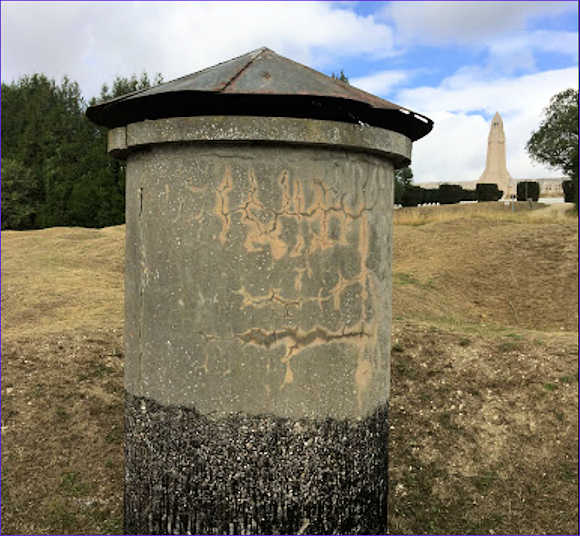
The structure, covered by 12 feet of earth, consists of a 60-meter-long main gallery, capable of holding 300 men, with two lateral entrance tunnels. Ventilation was provided by two massive concrete metal chimneys which are still visible today.


Schematic Plan: The Entrances Are on the Backside of
the Above Photo

Abri 320 was deactivated in 1915, during the phase of disarmament of the surrounding forts. However, the  great German offensive of February 1916 forced the government to reopen it and it became the main command post for the Thiamont sector of the battle.  In June, the Germans first forced its evacuation, after which its possession went back and forth until the French drove the enemy back to Fort Douaumont and secured it for good.


Partially Filled Entrance


Both Chimneys Survived All the Bombardments of the Battle

Abri 320 was bombarded by both sides through the battle, but it's structural integrity was never compromised. The ground located above and around the shelter has been left in its wartime condition, although the terrain has been softened somewhat by time and the weather.


The Terrain Around Abri 320, a Century Later


Source: De la Fortification Séré de Rivières


Saturday, February 4, 2023

South Africa's Jackie the Baboon Who Served on WWI's Front Line


By Katie Serena

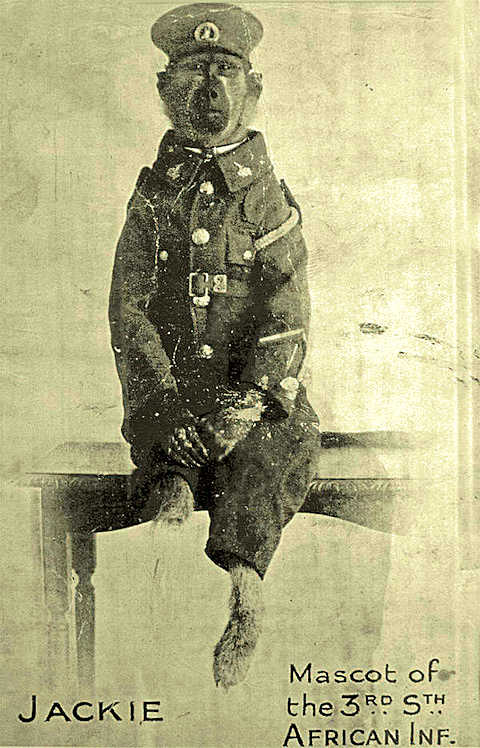
Due to his dedication to the army, Jackie became the official mascot of the 3rd Transvaal Regiment and was taken everywhere with the soldiers. Jackie the baboon started out as a pet to a man named Albert Marr. Marr found Jackie wandering around his farm and decided to take him in and train him as a member of the family. As one does.

Jackie lived with Marr for several years, learning how to be a respectable young baboon. Then, in 1915, Marr was enlisted to join the war. Unwilling to leave Jackie behind, he asked his superiors if Jackie, too, could join the army. Much to everyone’s surprise, they said yes.

Once he was enlisted, he was treated just like all of the other soldiers. He was given a uniform, complete with buttons and regimental badges, a cap, a pay book, and his own set of rations.

He even acted like all of the other soldiers. When he saw a superior officer pass by he would stand and salute them correctly. He would also light cigarettes for his fellow officers and stand sentry, a job he excelled at due to his heightened sense of smell and hearing.  He spent time in the trenches in France and was even wounded by enemy fire.


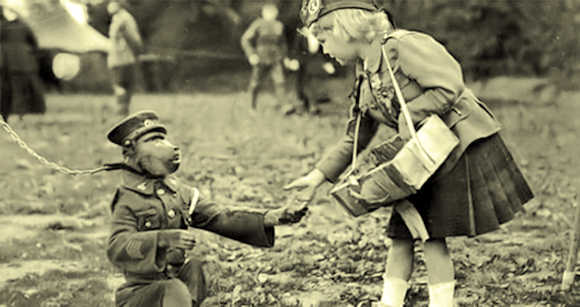
Jackie with a Young Supporter

During an explosive shootout in one of the trenches, Jackie was seen building a wall of stones around himself for protection. While he was preoccupied, a piece of shrapnel flew over his wall and hit his right leg.

The regiment’s doctors took Jackie via stretcher to the camp’s hospital and tried to save his leg, but unfortunately, it had to be amputated. Due to being knocked out with chloroform, and the unknown effects of chloroform on baboons, the doctors were not confident that he would recover. However, within a few days, Jackie had done just that. For his bravery, Jackie was awarded a medal for valor, as well as promoted from private to corporal.

Eventually, near the end of the war, Jackie was discharged at the Maitland Dispersal Camp in Cape Town. He left with his discharge papers, a military pension, and a civil employment form for discharged soldiers. Like a true friend, Jackie returned to the Marr family farm, giving up his life of service for a life of leisure as a pet, until his death in 1921.

Source:  All That's Interesting, 31 January 2019 

Thursday, February 2, 2023

But the End Came Surpisingly Fast! — The Armistice Through the Doughboys' Eyes


False Hope: 8 November 1918

. . . The night of November 8 was indeed a wild one. It was on this night that the first report, or rather the false report, of the signing of the Armistice was received. Parades formed immediately: Flags appeared from every window and from all balconies. The cafes and restaurants were crowed to capacity. Everybody seemed happy. The next morning, however, the real facts were learned and the spirits of the people somewhat damped.

Sgt. Albert Haas, 78th Division, In Vichy, France recovering from wounds
Diary


Anticipation: 0800 Hrs, 11 November 1918

And this is the end of it. In three hours the war will be over. It seems incredible even as I write it. I suppose I ought to be thrilled and cheering. Instead I am merely apathetic and incredulous. . .

Robert Casey, 33rd Division
Letter


1100 Hrs, 11 November 1918: The AEF's Happiest Day

Again stern orders were given to roll our packs for a final drive. It was now twenty minutes to eleven, November 11th, 1918. We fell in line and marched onward.

We had had no official word yet that the armistice was to be signed. In fact we had heard so often about Germany's peace talk that we paid no attention to wild rumors.

Exactly at eleven o'clock, came the message from Marshal Foch's headquarters, the "Armistice was Signed." Instantaneously wild shrieks, shouts and yells of thousands and thousands of voices could be heard. The night had been a thing of horror! Daylight brought her joyful tidings to thousands of wearied fighters! Visions of home and dear ones, of transports homeward bound, waiting for the boys who answered the call of their country - the boys in khaki - the Yanks!

Pvt. Mathew Chopin, 356th Inf., 89th Div
Letter


As noon approached, we became conscious of an unusual quietness all around us. Firing of all kinds had almost entirely ceased. The Germans were not firing even a machine gun, though our artillery continued to send over a shell now and then. The Germans occupied the crest of the ridge along the river, and if they had had sufficient numbers, could easily have cleaned us up. After eleven o'clock, all firing ceased entirely, not a sound any where. Soon everyone was talking about it. No word had reached us yet.

A wounded fellow from our company was discovered, down near the river bank, where he had laid since before daylight. Getting a stretcher, McDermott and I went to him and dressed his wound. He was shot through the hip, and just about unconscious, as a result of his exposure to the cold. We wrapped him in a blanket, and laid him on the stretcher.

While we were getting ready to take our wounded man to the rear, a runner appeared' with the official news that an Armistice had been signed. Most everybody let out a few healthy yells, but I did not. For one reason, didn't feel much like yelling. I had some difficulty getting three more fellows to help me carry the stretcher. The one I did get had to stop every few minutes and rest. I kept urging the necessity of getting the fellow under medical care as soon as possible, for he was badly in need of attention. As we had to go back along the river bank to where we had crossed during the preceding night, I had a good opportunity to see just what we had done, and the hazardness of our undertaking.

Pvt. Clarence Richmond, 5th Marines, 2nd Division
Diary


FINALLY CAME NEWS of the Armistice. Somehow we could not believe it was true the war was actually over. Then, on Dec. 7, we saw a beautiful sight. Here came a passenger train flying U.S. flags. We climbed aboard. We were leaving German territory. I had been in a prison camp only 58 days, but felt as if I had been there 58 years.

Pvt. Charles Dermody, 132nd Infantry; 33rd DivisionPrisoner of War at Rostatt, Germany at time of Armistice
Letter


GREAT DAY !!! THE WAR HAS ENDED !!! PEACE HAS COME !!!!!!!!!!!!!!!!!!!

While we were eating mess, a French soldier came running by waving a flag and yelling "Finis la guerre!" Later, an official communication affirmed the great news. We are all overjoyed. . .

Sgt. Edwin Gerth, 51st Artillery
Diary


On Monday at 11:30 am when the sound of cannon boomed the joyful news that the longed for peace had come ... The French seemed stunned at first--they couldn't in a moment throw off these four years of horror and grief. But [we in] the Red Cross turned out strong. [Outside, in the street], a drum appeared from somewhere ... and in a moment the crowd was singing the Marseillaise. So many people were crying that it was a little difficult. Then a procession formed ... If you could have seen me marching between a Tommy and a wounded Poilu, the latter helping me carry the flag with his good arm. A French boy scout carried the French Flag. The whole of Paris seemed to join in the parade. You never saw anything like it.

Elizabeth Ashe, American Red Cross
Memoir


Somebody came out waving a white flag. An American officer stepped forward to greet the German. Then the German kids started coming down. We celebrated that day with the German soldiers. They came down and we mixed all up. Some of them could speak English and we could speak German. . . They were glad to see it over with, too.

Gene Lee, USMC, 51st Company, 2nd Division
Interviewed at age 104, 7 November 2003


Nov 11: Fighting stopped.We hardly knew what to do with ourselves for a while it seemed rather queer to not hear the screech of a shell or the sharp reports of rifles and machine guns. Tents were pitched in a nearby field the farmers furnishing straw to floor them with and we could have fires, smoke or anything else after dark.

On the morning of Nov 17th we started on a hike for Germany with the French making about 15 miles to a place called Dikilvenue where the company slept in a brewery and in the morning started on another hike to Borsbeke where we stayed for two days.

Pvt. Robert L. Dwight, 148th Infantry, 37th Division
Letter


Wednesday, February 1, 2023

Remembering 100,000 Veterans: Sandy the War Horse and All the Other "Walers"


Sandy

By James Patton

In 2011 Stephen Spielberg’s film War Horse was a box office smash hit, grossing $177.6 million. Spielberg’s subject character was fictional, but the move sparked an outpouring of stories written about the real "war horses." It has been estimated that at least eight million horses must have died in the First World War.

According to the Australian War Memorial, Australia sent about 136,000 horses overseas during that war. Most of these were Australian "Walers," a breed developed on the cattle stations in the outback of New South Wales that are roughly equivalent to American cow ponies. Walers were strong, quick, fast, nimble, possessed of great stamina and adapted to arid conditions. In 2015 the Australian Broadcasting Corporation produced a feature-length documentary The Waler: Australia’s Great War Horse, which has never been broadcast in the U.S.

Only one of these 136,000 horses was ever returned to Australia. He was a Waler, a bay named Sandy. At 16 hands he was slightly taller than an American Quarter Horse. Due to his gentle disposition, he was picked by Major General Sir William Bridges KCB CMG (1861–1915), the commander of the 1st Australian Division. He had three mounts, but Sandy was his favorite. (See Jim Patton's earlier article on General Bridges HERE.)

Sandy’s back story is brief. He was foaled in 1907 in the "old" village of Tallangatta, Victoria, near the border with New South Wales, which was submerged by Lake Hume in the 1950s. He was owned by the O'Donnell Brothers, brickmakers.

At the outbreak of war in 1914, the O'Donnells sent Sandy to the war effort, and he was on the first convoy of ships to sail for Egypt. Somewhere along the way, he caught the eye of Bridges, though with a longish, slightly hooked nose, Sandy wasn't classically handsome.

He never landed at Gallipoli; he was one of 6,100 horses sent there, but the ship was turned around before they could be landed, as it was obvious that there would be no place for them at ANZAC Cove. He was returned to Egypt and was shipped to France six months later, where he was attached to the Australian Veterinary Corps Hospital at Calais. Though he was not used in the fighting, he was ridden by the veterinary personnel. One of his riders died in a gas attack but Sandy survived.


Walers of the Australian Light Horse


In October 1917 the Australian Minister of Defence, Sir George Pearce KCVO (1870–1952), decided that Sandy should be shipped home and stabled at Duntroon. There is a symmetry here. Bridges, who was fatally wounded at Gallipoli, was one of just two of the 60,000 Australians who died overseas in the First World War to be returned home for burial. His grave is at Duntroon, the Canberra-area military  college that he founded in 1910.

Sandy was taken from France to England in May 1918 and embarked on the voyage from Liverpool to Australia in September. He arrived in Melbourne in November, but the war was over so he never got to Duntroon, spending the rest of his life at the central depot called Fisher’s Stables, on Remount Hill, at Maribyrnong, Victoria, which is now a part of metropolitan Melbourne. He had been there before, in 1914, when he and many other horses sent to the war had begun that journey.

He lived there until 1923, when blind and sick, he was put down. Most of Sandy’s remains are still buried there, in an unmarked site, but his head was mounted by a taxidermist and, along with one hoof, was displayed at the Australian War Memorial in Canberra. These artifacts are still there but have been in storage for a long time now. Another hoof was silver plated and given to the Royal Military College at Duntroon. The photo at the top is the only known photograph of Sandy taken when he was alive.

Today funds are being raised to erect memorial statues of Sandy at sites in both the "new" village of Tallangatta and at the site of the depot in Maribyrnong. There is also a memorial to all of the Walers and the Light Horsemen who rode them at Tamworth, New South Wales, and talk of another Waler memorial to be erected at Albany, Western Australia.

And what became of all of Australia's other war horses? Around 30,000 died in field service. Several thousand who were over 12 years of age or in poor health were put down. Some were sold off in France, mostly for slaughter. The rest were transferred to the British and Indian armies. The Australian government had judged it to be too expensive to ship the horses back to Australia where they would be surplus to military needs, glut the market and sold for cheap, thereby bankrupting horse breeders.

It is said that around 250 light horsemen couldn't bear to leave their Walers to an uncertain future in Palestine or Egypt so they shot them instead. This poem was written about one of these men:

I don’t think I could stand the thought of my old fancy hack

Just crawling round old Cairo with [Egyptians] on his back

Perhaps some English tourist out in Palestine may find

My broken-hearted Waler with a wooden plough behind

No: I think I’d better shoot him and tell a little lie

“He floundered in a wombat hole and then lay down to die”.

Sources: the Sydney Morning Herald, Australian War Memorial