Now all roads lead to France and heavy is the tread
Of the living; but the dead returning lightly dance.
Edward Thomas, Roads

Monday, November 15, 2021

Post-Cambrai: JFC Fuller's Evolving Tank Tactics


JFC Fuller


Dr. David Payne

John Frederick Charles Fuller (1878–1966), later to be known as "JFC" or "Boney"—due his facial likeness to Napoleon—was a Light Infantryman (Oxfordshire and Buckinghamshire) who spent the first two years of the Great War training officers for the British Expeditionary Force (BEF).  In December 1916 he was appointed, somewhat to his amazement, to the post of Chief General Staff Officer of the Machine Gun Corps Heavy Branch that was soon to become the Royal Tank Corps. His amazement was due to his not knowing anything about the new tanks and mechanical devices in general and to his conviction that the "tank concept" wouldn't work on the Western Front.   

Once in post, Fuller soon began to see the potential of the new tank in trench warfare. From the outset he astutely foresaw the need to ensure that the tanks were deployed only where the terrain was suitable for their operation and that they would operate best when closely supported by aircraft. He also saw the infantry as supernumeraries to the tank and not vice versa, as was the consensus in much of the British Army. 

After the challenges and many disappointments for the Tank Corps at the Somme and Passchendaele, it was decided that the next major deployment of the tank in large numbers would be at Cambrai on 20 November 1917. Cambrai was part of the formidable German defense-line called by the British the Hindenburg Line, located in Artois, east of the 1916 Somme battlefields. Here the terrain was chalky and dry, which was considered ideal for the new Mark IV tanks.  


Early German Depiction of Fighting Tanks


Fuller's tank tactics were generally considered to be a success. But even the new Mark IV tanks were still too slow, mechanically unreliable, and overly susceptible to skillful artillery and anti-tank fire. However, there had been big territorial gains: the British infantry swept forward the next day to make a 5 km break in the German line that allowed a penetration of up to 6 km in depth. However, poor coordination between the tanks and the British infantry caused a loss of momentum. The tanks blindly proceeded according to plan—without the benefit of the infantry's "critical eye" on the battlefield—and ran smack bang into the ranks of German 77mm cannons. The Germans waited until tanks crested Flesquières Ridge and fired over open sights into the elevated hulls. In this sector alone, 28 were knocked out by artillery fire, nine by a single German gunner. Many of the other tanks were brought to a premature halt by a design fault in the caterpillar track system. They, too, became easy targets for the German guns. The exposed British infantry were left at the mercy of the ever-alert German machine gunners. 

By 27 November 1917 the British were forced to call off the attack; the town of Cambrai was beyond their reach. But their ordeal was by no means over. On 30 November 1917 the Germans counterattacked with seven divisions and had huge success using their new infiltration tactics of the Sturmtruppen (storm troopers). On 7 December 1917 the British were, in places, back behind the line whence they started. In the latter stages of this retirement, the tanks, further encumbered by snowfall, were only minimally effective. It was back to classic trench warfare and hand-to-hand fighting

The disappointment of Fuller and the entire Tanks Corps at the failure of the tanks at Cambrai to effectively "turn the tide" can only be imagined. Fuller was left with the conundrum of how to realize the potential of this new weapon. On the other hand, the German Army still showed little enthusiasm for it.


Successful Canadians at Amiens, 1918


The New Tactics

Paradoxically, the solution to the more effective deployment of the tank, apart from the obvious one of making it faster and more mechanically reliable, appeared to be to improve the coordination between the RFC ground-support aircraft and the movement of the tanks. Toward this end the RFC introduced armored ground-support aircraft with better camouflage and more sophisticated communication backup.

The new tactics were tried successfully in the Battle of Hamel in July 1918 on the old Somme battlefield, when 60 of the new, improved Mark V tanks were backed by intelligent artillery support of 600 guns and phosgene gas was used extensively.

Next came the Battle of Amiens, which began on 8 August 1918, when even more tanks were deployed than at Cambrai—552—which represented almost the total operational tank force on the Western Front. Included for the first time in numbers was the new, fast British light Whippet tank as well as some armored cars.

Well protected by a creeping barrage, the troops and the tanks made an advance of up to 13 km deep in the enemy defenses. Many of the tanks,  however, again broke down or were knocked out by artillery fire.

The following day—9 August—the Canadians advanced another 6 km, and reaching the limit of their artillery and depleted tank support, they halted. Finally, General Sir Henry Rawlinson's "bite and hold" strategy was being put into effect. 

General Ludendorff declared the 8th of August 1918 to be "Germany's Blackest Day," and the pernicious seeds of pessimism were sown in the higher ranks of the German High Command.


The Mark V Would Have Been the Main Heavy of 1919


JFC Fuller's Plan 1919

While the Hamel and Amiens attacks were going on, Fuller was already  producing a plan for 1919 in which he envisaged a mechanized army with heavy air support using the following principles:

 * The first objective would be to storm and breach the enemy lines with the heavier, but slower, Mark V tanks.

 * Artillery support would be intense and carefully targeted to keep up with the advancing troops.

 * Large numbers of armored ground-attack aircraft would be deployed in a coordinated way to support the advance. (Whether the newly formed and independent RAF would have gone along with this highly dangerous concept is another matter).

 * Once a tenable breach in the enemy's front line had been achieved, the new 20 mph Medium "D" Type tanks would then swarm in and head for the German rear. Their objective was to neutralize the German command structure, rear-area support organization, and general communications in effect roll up the enemy's defenses from behind.

 * The infantry, transported by lorries, would follow through on the tank attack, hold the ground and mop up the remaining enemy defenses.

Because of the Armistice in November 1918, Plan 1919 was never put in action. 

Source:  Winter 2009 Relevance


Sunday, November 14, 2021

The Wreck of Von Spee's Flagship Was Found in 2019


SMS Scharnhorst 

In the fall of 2019, the wreck of the World War One German armored cruiser SMS Scharnhorst was located off the Falkland Islands, 98 nautical miles southeast of Port Stanley. where it was sunk by the British navy the first year of the Great War  The man-of-war  was the flagship of German Vice-Admiral Maximilian Graf von Spee's East Asia Squadron.

It was sunk on 8 December 1914 with more than 800 men on board, including Vice-Admiral von Spee himself. The leader of the search for the wreckage said the moment of discovery was "extraordinary."

The search for SMS Scharnhorst began in 2014, on the 100th anniversary of the Battle of the Falkland Islands, but was not successful at first. Search teams resumed their operation in 2019 using a sub-sea vessel, the Seabed Constructor, and four autonomous underwater vehicles. They found the Scharnhorst on the third day of the search, at a depth of 1,610m (5,282ft). The wreck was not disturbed during the operation, and the Falkland Maritime Heritage Trust is seeking to have the site formally protected in law.


Deck Gun on SMS Scharnhorst


The armored cruiser had played a key role in the Battle of Coronel, fought between the British Royal Navy and Germany's Imperial Navy off the coast of Chile. It was Britain's first naval defeat of World War One, and it was a devastating one. The Germans sank two of the four British ships with the loss of more than 1,600 lives. Not a single German sailor died. 

The defeat at Coronel sent shock waves through the British Empire and beyond. The Royal Navy dispatched ships from the North Sea down to the South Atlantic and confronted the Germans at the Falkland Islands five weeks later.  The British squadron pursued and engaged the German squadron and caught it on 8 December 1914. Modern battlecruisers HMS Invincible and HMS Inflexible inflicted substantial damage on SMS Scharnhorst, causing it to sink with all 860 people on board. The Royal Navy then gave pursuit to the remaining German ships. Vice-Admiral von Spee's two sons also died, Heinrich on board SMS Gneisenau and Otto aboard the light cruiser SMS Leipzig. In total, 2,200 German sailors died in the battle.


Tribute to Von Spee and His Sons

The head of the von Spee family said that the discovery of the wreck was "bittersweet." "We take comfort from the knowledge that the final resting place of so many has been found, and can now be preserved, whilst also being reminded of the huge waste of life," Wilhelm Graf von Spee said.

"As a family we lost a father and his two sons on one day. Like the thousands of other families who suffered unimaginable loss during the First World War, we remember them and must ensure that their sacrifice was not in vain."

The Battle of the Falkland Islands had a lasting effect on World War One because as a result, the East Asia Squadron, Germany's only permanent overseas naval formation, effectively ceased to exist and could no longer engage in commerce raiding.

Sources:  BBC; The Falklands Maritime Heritage Trust

Saturday, November 13, 2021

Caring for America's Dead During the War

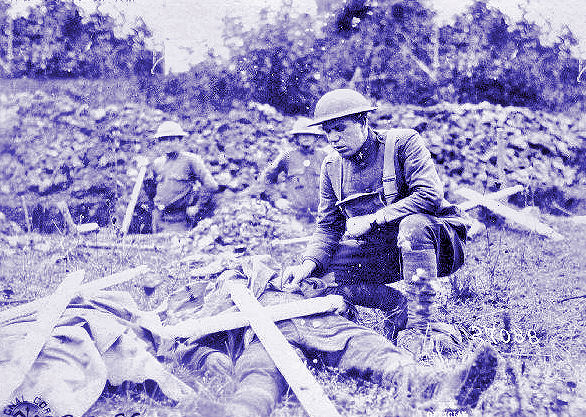
Chaplain of the U.S. 33rd Division Identifying the Dead


By Colin Baker and Lynn Rainville

The soldiers who died during combat posed an ethical dilemma for their surviving comrades: how to safely and properly care for their corporeal remains while fighting for one’s life? During World War I, temporary burial sites were created that ranged from hastily dug, individual burials to mass graves. Various military units were responsible for managing these temporary resting places, including sanitary squads and the Pioneer Infantry. Military chaplains played an important role in presiding over the funerals for the individuals buried in these impermanent graves. The mass casualties of trench warfare often dictated that chaplains had to bury the dead immediately in the vicinity of the front line, occasionally even under fire. Twenty-three U.S. Army chaplains died during World War I. Several are buried at the Meuse-Argonne cemetery. Many demonstrated tremendous bravery under fire administering last rites to fallen soldiers, oblivious to the fire around them, or dashing out into the open to rescue the wounded without regard for their own lives.

From the military standpoint, identification and burial were matters of both accounting and morale. Nothing was more depressing to the frontline soldier than to see unburied dead around them. For civilians, there was a new human need that diverged from the earlier practice of mass anonymous burials for lower ranks. Because mass “death at a distance” was so traumatic, the public demanded “rights” to recover and identify the body. Families required an individual body or grave as a focus of their grief.


U.S. Burial Detail


Burial detail, often performed by specialized units, notably African American in the U.S. Army, was among the most unpleasant and unpopular tasks of the war. Burial groups were supplied with rubber gloves, shovels, stakes to mark the location of graves, canvas, and ropes to tie up remains amongst other tools and materials. Men remarked that it was “the most dreadful experience I’ve ever had.” One chaplain assigned to this detail described the post-traumatic effects of such work as causing a trying “of the nerves…and a curious kind of irritability that was quite infectious.”

After the war ended the first burial task was to consolidate thousands of isolated graves, next to combine small cemeteries into larger ones, and finally to locate and identify the large numbers of the missing at cemeteries. Only after this process, in the 1920s, did the re-interment into large permanent cemeteries, such as the Meuse-Argonne Cemetery at Romagne, become feasible.

When hostilities ended, the Americans and their allies had to decide how and where to bury their dead. Mass graves had been commonly used in past conflicts, such as the 6,000 British soldier deaths from cholera during the Crimean War. One could argue that the American ethic of individualism influenced the decision to bury each soldier under a named headstone whenever possible. Moreover, the American ethos of democracy led to the historically unusual circumstances of egalitarian cemetery plots where majors were buried alongside privates. In Europe, America negotiated the long-term lease of hundreds of acres of land in order to bury their dead in "American cemeteries." After World War I, the Americans laid out eight cemeteries along the former "Western Front."

Source: American Battle Monuments Commission, "Teaching with the Meuse-Argonne Cemetery"

Friday, November 12, 2021

Were the Seeds of World War I Planted with Bismarck’s Decision to Take Alsace-Lorraine?


Patrie by Georges Bertrand


NO, says historian Geoffrey Wawro.

Was collision inevitable between this reformed, newly confident French nation and the nervous German Empire? Were the seeds of World War I planted with Bismarck’s decision to take Alsace-Lorraine? Had the Germans, as Tsar Alexander II declared in 1870, “created an inexpugnable hatred between the peoples?”  It certainly looked that way in 1871, when the Bordeaux Convention that ratified Thiers’s controversial armistice rang with pugnacious, wounded rhetoric. One deputy called the treaty “a sentence of death,” another expressed his shock that “universal manhood suffrage should give approval to the dismemberment of France.” Victor Hugo concluded an impassioned speech with the vow that France would “exact a terrible revenge . . . and rise up to retake Lorraine, then Alsace, then . . . Trier, Mainz, Cologne and Koblenz.” But tempers had cooled considerably by 1914 when most French had reconciled themselves to the loss of Alsace and Lorraine. “As for me,” the celebrated French thinker Remy de Gourmont wrote on the eve of World War I, “I wouldn’t give the little finger of my right hand for those forgotten provinces. My hand needs it to rest on as I write. Nor would I give the little finger of my left hand. I need it to flick the ash from my cigarette.”  French statesmen were hardly more aggressive: Rene Viviani, the notoriously provincial French premier in July 1914, was just sophisticated enough to know that he must not repeat Gramont’s error of July 1870, namely “falling into the trap laid by Bismarck in the form of the ‘Ems telegram’ . . . declaring war on Prussia [and] thereby forfeiting international support.”  In fact, it would take another round of German aggression – the Kaiser’s “blank check” to Austria and the Younger Moltke’s invasion of Belgium and France – to trigger the Great War with its 38 million dead, wounded and missing. We must look then at Germany to see the real scar left by 1870–71.

Riven internally, the new German Empire was not well-equipped to manage what would become sharp rivalries with a defeated France, a leery England, and an ever more confident and assertive Russia. Besides the suffocating power of Bismarck, who stifled new men and opinions, the war of 1870–71 had given a “fresh baptism of moral legitimacy” to a Prussian court and establishment that had seemed backward before the war  By forging a German nation and realizing the idealistic hopes of 1848 – when German liberals had tried and failed to create a German nation-state – the Prussian king and Junkers had grafted themselves tightly on to the German state. The war thus empowered a whole class of militarists who linked Germany’s health to war and expansion. Clear-headed Germans recognized this even in 1870 when one commentator deplored Wilhelm I’s creation of a “warrior state . . . based on the permanent use of war” to achieve political objectives. To his credit, Bismarck restrained the soldiers after the war, famously declaring the Reich a “satiated power” and constructing a complex alliance system that kept the peace for a time. Nevertheless, the constitution that he had devised for the North German Confederation in 1867 and for the German Empire in 1871 facilitated the triumph of militarists once Bismarck passed from the scene in 1890. Determined to buttress his own power and preserve ancient prerogatives of the Prussian king, Bismarck created a system that was likely to fail in the twentieth century, and bound to fail once the German crown passed to twenty-nine-year-old Kaiser Wilhelm II in 1888.

Source: The Franco-Prussian War, Cambridge, 2003

Thursday, November 11, 2021

The Centennial of the Unknown Soldier


Have a Happy and Reflective

Armistice and Veterans Day


In December 1920, New York Congressman and World War I veteran Hamilton Fish, Jr. proposed legislation that provided for the interment of one unknown American soldier at a special tomb to be built in Arlington National Cemetery. The purpose of the legislation was “to bring home the body of an unknown American warrior who in himself represents no section, creed, or race in the late war and who typifies, moreover, the soul of America and the supreme sacrifice of her heroic dead.”

On 24 October 1921, in a ceremony in the French city of Châlons-en-Champagne, the unidentified soldier to be interred in the United States Tomb of the Unknown Soldier at Arlington National Cemetery was selected from four possible persons. Sgt. Edward F. Younger of Headquarters Company, 2nd Battalion, 50th Infantry, American Forces in Germany, was chosen to select the Unknown Soldier. Sgt. Younger selected the Unknown by placing a spray of white roses on one of the caskets. The chosen casket was then transported to Washington, DC, aboard the Navy cruiser USS Olympia, which experienced a hazardous journey across the Atlantic.  An estimated 90,000 visitors, including war mothers, Supreme Court justices, General Pershing, and ambassadors of foreign nations came to pay their respects. Upon arrival, the Unknown Soldier was taken to the Capitol Building. Those candidates remaining in France were interred in the Meuse-Argonne American Cemetery.

On 11 November 1921, the Unknown was placed on a horse-drawn caisson and carried in a procession through Washington, DC, and across the Potomac River. A state funeral was held at Arlington National Cemetery’s new Memorial Amphitheater, and the Unknown was interred in the Tomb of the Unknown Soldier. Nationwide, Americans observed two minutes of silence at the beginning of the ceremony. President Warren G. Harding officiated at the ceremony and placed the Medal of Honor, the nation’s highest military decoration, on the casket. Numerous foreign dignitaries also presented their nations’ highest awards.

Originally, the Tomb of the Unknown Soldier consisted of a simple marble slab. During its early years, thousands of visitors came to Arlington National Cemetery to mourn at the Tomb and to pay their respects to the Unknown Soldier and the military personnel he represented. The tombstone itself, designed by sculptor Thomas Hudson Jones, was not completed until 1932.

The tomb sarcophagus is decorated with three wreaths on each side panel (north and south). On the front (east), three figures represent Peace, Victory, and Valor. The back (west) features the inscription: “Here rests in honored glory an American soldier known but to God.”


America's Unknown Soldier

By Steve Miller


Wednesday, November 10, 2021

Was America World War One's Marchingest Country?


Of Course, the New Troops Did a Lot of Marching


Even Their Commander-in-Chief Joined In


The Marching Began Even Before the USA Entered the War
Preparedness Day in San Francisco, 22 July 1916


This Liberty Loan Parade in Philadelphia During the Spanish Influenza Led to an Explosion in Cases


Working Men in Washington, DC


Patriotic Children on Canal Street in New Orleans


Seattle


Suffragettes


The Women's Land Army


After the Armistice:  St. Louis Welcomes Home
the 138th Infantry


Tuesday, November 9, 2021

The Great War in Africa: Multimedia


We developed this list to supplement an interview with Edward Paice, author of Tip and Run: The Untold Tragedy of the First World War in Africa, which we also highly recommend.  Most of these works, books and films, can be purchased using  the Amazon.com application in the right-hand column. (You may need to suppress any AD-Suppression software you are using to see the app.)


Monday, November 8, 2021

What Happened at the St. Eloi Craters in 1916?


A Single Soldier at One of the Six St. Eloi Craters


The Battle of St. Eloi Craters was fought from 27 March to 16 April 1916 during the First World War. The attack over the soggy terrain of Belgium was the first major engagement for the 2nd Canadian Division (see Canadian Expeditionary Force). It was a disaster for Canada and its Allies.

Mine Warfare

By late 1915, armies on both sides of the First World War were using extensive mining as a part of trench warfare. Sappers dug tunnels across the battlefield to plant explosives under enemy positions and would then retreat and blow them up. The fields near the Belgian village of St. Eloi, located five kilometers south of Ypres, were pockmarked with craters from repeated underground explosions.


Two Views of the Mine Craters


In the spring of 1916, the Canadian Corps’ 2nd Division was sent to fight Germans on the front line at St. Eloi. The Canadians were rushed to the battlefield, leaving no time to prepare for the attack. The plan was for the seasoned British troops to strike and then for the Canadians to take over and hold the line.

The fighting started at 4:15 a.m. on 27 March with heavy gun fire. Six British mines were set off one after the other, shaking the earth “like the sudden outburst of a volcano” and filling the sky with yellow smoke and debris, according to the Canadian Expeditionary Force's war record. The explosion was heard in England. German trenches collapsed.


Fighting from Craters


Lewis Gun Used for Anti-Aircraft at St. Eloi


The mines created huge craters in no man’s land. The British soldiers rose from their positions in the cold mud and attacked, quickly capturing three craters and the third German line. For several days, British soldiers fought hand-to-hand with Germans, advancing until 3 April.

The British soldiers grew confused as to where they were as the mines had reshaped the landscape. Four mines blew up so close to each other that the craters formed an impassable lake that was 15 m deep and 55 m across. (It later became a recreational fishing lake for a summer cottage).

British troops fought from inside the craters, crouching in mud or standing in waist-deep water, unable to sit. High winds, sleet, and mud created nightmarish conditions. Hundreds of men were killed on either side in a week of chaotic shooting and shelling. The exhausted British were relieved by the Canadians at 3 a.m. on 4 April.

Canadians Enter Fray

The excited Canadians were eager for their first taste of battle. Arriving at St. Eloi, however, they found a shortage of steel helmets, machine guns and defensive positions. They had only a vague idea where they were and where the Germans were. The 2nd Canadian Pioneer Battalion improved the defences and attempted to drain the trenches of water. At the same time the entire front line came under constant bombardment on 4 and 5 April, and hundreds more men were killed.


Critical Period of the Battle
(Click Map to Enlarge)


Canadian Private Donald Fraser, a 34-year-old bank clerk from Calgary, described the scene: “When day broke, the sights that met our gaze were so horrible and ghastly that they beggar description. Heads, arms and legs were protruding from the mud at every yard and dear knows how many bodies the earth swallowed. Thirty corpses were at least showing in the crater and beneath its clayey waters other victims must be lying killed and drowned. A young, tall, slim English lieutenant lay stretched in death with a pleasant, peaceful look on his boyish face. Some mother’s son, gone to glory.”

"Walking on Dead"

Frank Maheux, another Canadian, wrote to his wife that “we were walking on dead soldiers” as they tried to advance. Wounded and traumatized men streamed back to the medical officers. Some had been fighting standing in cold water and mud for 48 straight hours, and officers had been awake for 100 hours.

At 3:30 a.m. on 6 April, two German battalions attacked down the ruins of the main road. The confused Canadian troops often lost communication with each other and were quickly pushed back. As the sun rose over the muddy wasteland, the Germans had recaptured all of the ground taken from them at the start of the battle.

The Canadians fought back with bombs but could not advance in the heavy rain. Troops attempting to recapture two craters got stuck in the mud and were shot dead before they could throw their grenades. A group of Canadians recaptured Craters 6 and 7, but thought they were in Craters 4 and 5. In the confusion they were cut off and left open to the German onslaught.

Canadians Driven Back

As night fell on 8 April, the Canadians again attacked but were stopped by German rifles and machine guns. Incessant rain made porridge of the battlefield. Germans attacked the next day but were likewise repelled. The Canadian leadership had little idea which craters they held and which were held by Germans. The leadership did not know what was happening at the front, as disoriented Canadians pinned down by artillery shells could not relay messages. Even the pigeons used to carry messages were dead.

Both sides shot at each other in the miserable conditions of the craters for another two weeks. More than 1,370 Canadians were killed or wounded, along with about 480 Germans. Aerial photography on 16 April finally showed the Canadians that they were in a terrible position, and the divisional headquarters ordered the battle stopped.


Canadians Regrouping After the Battle


Still, the German attack continued with tear gas; the exhausted Canadians fought off the enemy again on 17 April. A German night raid through pounding rain drove the Canadians back further. Mud stopped Canadians guns from firing. Half of the remaining men in the craters surrendered to the Germans, and half crawled away. The Battle of St. Eloi’s Craters ended with the Germans in control of the battlefield, as they had been at its start.  St. Eloi's experience with mine warfare had not ended yet, however.  In June 1917 it would be the location of the largest mine exploded in the opening of the Battle of Messines.

As a result of the battle both the commander of the Canadian Corps, Lt. General Edwin Alderson, and the commander of the 2nd Canadian Division, Major General Sir Richard Turner, VC, were sacked. A British career officer, Sir Julian Byng, was named commander of the Canadian Corps. Under Byng the Canadian Corps began its change from a fledgling, colonial army to one of the finest and most revered fighting formations of the war.

Sources:  Canadian Veterans, the Canadian Encyclopedia, and the Kenora Great War Project

Sunday, November 7, 2021

The Sergeants of Blunden's "Pillbox"


In Edmund Blunden's "Pill Box" two sergeants he served with in the 11th Battalion of the Royal Sussex Regiment. are mentioned by name. My impression is that this a rare occurrence.  


In the poem, one of the NCOs is fatally wounded and a second unsuccessfully urges his mate to fight through.  The wounded sergeant is Frank Albert Hoad of Eastbourne, who was killed in action 3 September 1916 somewhere along the Menin Road.  His friend was Sergeant Frank Worley, DCM, of Sussex, who continued to serve with the distinction and survived the war, albeit with a case of shell shock. Worley and Blunden remained lifetime friends.  On the occasion of his death in 1954 Blunden wrote a second poem in tribute to his friend.  About the same time he wrote another piece mentioning Worley and some additional sergeants whose actual existence I've not been able to confirm:  It's clear, Blunden, unlike some junior officers I've known, fully appreciated to dedication and critical role sergeants play in any military organization or operation.


Where are the sergeants, passed beyond?:

Unsted the quick-moving, clear-eyed Marshall,

  Great-hearted Worley of Worthing the pride,

My Wally Ashford astute and impartial

  Seall of the runners, and Luck who plied

  With the rations up through the wild night-tide.:

Saturday, November 6, 2021

The French Eagle of the Royal Scots Greys on the Western Front


The Scots Greys' badge depicts the French 45th Line Infantry Regiment's eagle that Sergeant Charles Ewart captured at Waterloo in 1815.


By James Patton

Only four regiments that had captured a French Imperial Eagle in battle were granted the right to display this image on their badge. Without a doubt the most illustrious was the 2nd Dragoons (Royal Scots Greys), named after the color of their horses. Dating from 1678, the regiment garnered fame over and over, from Blenheim to Balaclava. The iconic painting titled Scotland Forever depicts the regiment’s near-suicidal charge at Waterloo that broke an entire division of French and gained the Greys the eagle. I have an ancestor who was a Grey and survived that action. 


Farriers of the Scots Greys at Work in France, 1918


During the First World War, the Greys were rushed to Belgium at the start of the Great War, arriving just in time to fight dismounted at Mon,  Le Cateau, and the Marne. They then spent most of 1915 in the trenches of the Salient and later fought at Arras (1917) and  Amiens (1918). The Greys were combined in 1971 to form the Royal Scots Dragoon Guards.

Photos from the National Army Museum


Friday, November 5, 2021

Recommended: When the 1% Sent Their Sons to War


All Four of Theodore Roosevelt's Sons Served in the War


By Marc Wortman
Originally Presented in the Daily Beast, 5 May 2017

In April 1917, more than two and a half years into the bloodiest war the world had yet seen, nearly half of the 9 million soldiers, sailors and airmen, and the 5 million civilians who would be killed in the First World War already lay dead. Some 65 million men were at arms, more than all previous wars combined. Day after terrible day, some 5,000 men died on average. The names of once unknown places where millions died rang out like mournful bell tolls: Somme, Verdun, Gallipoli, Tannenberg, Marne, Ypres, Passchendaele. Despite the unprecedented violence of the first truly mechanized war, the opposing forces of Germany, the Austro-Hungarian Empire and their allies—the Central Powers—and the Allied armies of France, Great Britain, Russia, and Italy, rarely advanced in this awful war of attrition.

Only one great power still stood aloof from the carnage. The United States had remained at peace, following President Woodrow Wilson’s dictate that Americans “must be neutral in fact as well as in name” and “impartial in thought as well as in action.” Even the infamous torpedoing of the British liner the Lusitania, drowning 1,198 people including 128 Americans, and the sinking of multiple American freighters by German U-boats could not arouse the nation for war. Although by and large sympathetic to the Allied nations, the U.S. maintained an army smaller than the Great War combatants lost in a typical month’s fighting. Its modern naval fleet had not trained for the realities of undersea warfare practiced by its potential enemies. And the dawning third dimension of the battlefield, the air war, barely figured into military thinking; the nation supported air forces smaller than Bulgaria’s.

As the battle for European dominance became a world war, no country remained an island; the globalization that has grown suspect today had already sprung fully upon the world in the form of ocean-going international trade. Demand for American products and raw materials from around the world had transformed the nation into an industrial powerhouse. As increasing numbers of ships carrying American-made goods went to the bottom of the ocean, though, more and more voices called for the country to fight to maintain freedom of the seas. Former President Theodore Roosevelt led the chorus calling upon America to enter the battle against what they decried as the Central Powers’ lawlessness.

The U.S. government largely ignored the protests. Wilson won reelection in 1916 with the slogan “He Kept Us Out of War.” But a group of men—boys, really, almost all of them too young to vote—decided that even if the government refused to prepare for war, they would do something about the situation. If the U.S. did go to war, they wanted to lead the way and they wanted to do it in the most daring and ambitious service of all, as pioneering pilots in the new age of aerial warfare. They led the country into its air power future.

Today the children of the one-percenters rarely join the military. These young men, however, most of them college students at Yale, came from the nation’s most privileged families. Among them were a Rockefeller and a Taft, one whose father headed the Union Pacific railroad empire, and another whose father served as managing partner of J.P. Morgan & Co., the world’s most powerful investment bank. Several had fathers managing and making millions on Wall Street. Some traced their lineage to the Mayflower; several counted friends and relatives among presidents and statesmen.

Despite being scions of the Gilded Age’s loftiest families, they considered it their duty to serve their country. They grew up in a time when their privileged position brought with it special responsibilities that may seem distant to us today. Barely a decade and a half after the Wright brothers’ first flight, they were convinced that America needed an air force. Given the country didn’t have one, or barely so, they decided to create their own.

A dozen learned to fly in the summer of 1916 at the splendid Long Island, New York, Gold Coast family estate of the group’s founder, F. Trubee Davison. They trained on bi-wing flying boats over the Long Island Sound. As managing partner of J.P. Morgan and Co. on Wall Street, Davison’s father, Henry P. Davison, was perhaps the most powerful banker in the world. Since the war’s outbreak, keeping the Allied powers in the fight had become Morgan’s chief business. The bank floated bonds on behalf of the British and French. Morgan also served as agents for Allied purchases of U.S. weapons and munitions, grain, iron, steel and oil, spending up to $10 million per day.

Some questioned whether the House of Morgan wasn’t pushing the reluctant nation into the war to protect its financial interests. Others accused Morgan and the British government of engineering the sinking of the Lusitania, which was known to carry ammunition in its cargo hold. In the 1930s backlash against the Great War, a Senate committee held numerous hearings, berating witnesses including partners from J.P. Morgan, in the words of a senator, for being “merchants of death” who pursued war for the “profit for the few.”


Members of the Yale Unit Training on Long Island


Nobody could accuse them, however, of not having put their own blood at risk. Returning to the Yale campus in New Haven, CT, for the school year, the young men enlisted more of their friends and classmates in their flying scheme; eventually 28 joined together to form the “Yale Aero Club.” Davison went to Washington to offer the organization’s services to the Navy as a reserve unit. However, the Secretary of the Navy lacked the imagination to envision the potential value of their services for his surface fleet. Nonetheless, the farsighted Davison and his friends continued with their own family money to pursue flight training, convinced that this disruptive new technology would one day overturn the hidebound Navy’s ways of making war. With the help of a young Assistant Secretary of the Navy, Franklin D. Roosevelt, Davison and some of his classmates did fly from New Haven occasionally to the New London Navy Submarine Base where they went out with their own aircraft on patrol to see if they could spot submerged submarines and to teach the submariners to avoid detection from the air. (As president during World War Two, Roosevelt would call the Yale men back to service in building up and guiding the nation’s air power.)

Early in 1917, the German Kaiser determined upon starving out Great Britain, by attacking even neutral shipping. As more and more American ships and goods went under the waves, war fever began to grip the land. Woodrow Wilson and the Navy finally realized they needed an air force. They had the seeds for one in the prescient young men from Yale. The Navy enlisted them in March 1917 and called up the First Yale Unit, the first-ever squadron in the Naval Air Reserve.

Of course the Navy still had no budget for their training. This being the “gold spoon brigade,” that wasn’t a problem. J.P. Morgan and Co. and their families paid the bill. The entire U.S. Navy Air Reserve boarded a three-car private train in New York City, including their crated-up aircraft, and went—where else?—to Palm Beach, FL, to train. Not surprisingly, the press following their exploits dubbed them the “Millionaires’ Unit.”

On April 6, 1917, the U.S. declared war. With “civilization itself seeming to be in the balance,” President Wilson now called for war so that the world might “be made safe for democracy.”

All of the Millionaires’ Unit’s pilots won their wings of gold—made up by Tiffany and Co., of course—as naval aviators, making them among the Navy’s first 100 flyers. All except one: Davison crashed during his test flight, breaking his back, an injury that would leave him disabled for the rest of his life.

Before the end of the summer of 1917, these flyers provided the nucleus of the burgeoning navy air service. Naval airmen were the first uniformed Americans to reach France and enter combat. Yale Unit members helped build the first American overseas airbase, a training station at Le Moutchic, France, from the ground up. Robert Lovett from the Yale Unit became the first American in uniform to fly in the European theater. He was also the first uniformed American to fly on a heavy bomber mission. He was a brilliant and resourceful leader who rose up the ranks fast. He eventually devised and helped plan the nation’s first strategic bombing campaign and headed its night bomber wing. In the Second World War, he served as Assistant Secretary of War for Air, using what he had learned in the First to build up the bomber and fighter force that helped crush Germany. After that war, as one of the so-called “Wise Men” during the Cold War and a Secretary of Defense during the Korean War, he guided the development of American strategic air power.

Artemus Gates from the Yale Unit eventually commanded the dangerous Dunkirk Naval Air Station. He undertook a daring, single-handed rescue of a plane that went down at sea, for which he was nominated for the Medal of Honor. In the next war, he returned as the Assistant Secretary of Navy for Air, giving him responsibility for building up the carrier aircraft that proved so decisive against the Japanese.

A dauntless risk-taker, David S. Ingalls, great-nephew of President William Howard Taft, became the Navy’s first air ace during the war. He returned to naval service in the Second World War, becoming commander of the Pearl Harbor Naval Air Station.

Erl Gould took command of the Key West Naval Air Station at age 22, making him one of the youngest officers ever to lead such a large military facility. He, too, went back into the navy during the next war. Making his way into the Pacific, he headed up the forward construction operations during the fighting at Tarawa that built the air fields needed in the air campaign against Japan.

Some of the Unit members gave their all. Albert Sturtevant became the first uniformed American killed in air combat. German fighters shot down his plane over the English Channel during a U-boat patrol. Two more of his Yale brothers-in-arms would die in the air war over Europe. One was Kenneth MacLeish, brother of Archibald, later a poet and playwright and three-time winner of the Pulitzer Prize.

By the time of the armistice, 11 November 1918, members of the Millionaires’ Unit had fought in the air war throughout Europe, helped to sink subs, provided convoy protection, trained and led hundreds of men, tested aircraft and weapons, and commanded numerous air stations, doing everything for an air service that grew from almost nothing to a 40,000-man force that rivaled any in the war.

“The war to end all war” did nothing of the kind. It brought down centuries-old royal families, set off rebellions and revolutions, redrew the map of the world, unleashed a devastating flu epidemic, wiped out a generation of young men, and made the United States an unrivaled economic giant. An Austrian corporal gassed in the trenches on the Western Front vowed revenge for the treacherous “Jewish conspiracy” that he believed had undermined his nation and the vengeful treaty imposed on Germany. The Yale Unit flyers would take what they had learned during the First World War as their foundation for finishing the job against Adolf Hitler in the Second.

Admiral William Sims, commander of all U.S. Navy forces in Europe during the Great War, described the young men of the First Yale Unit as “twentieth-century Paul Reveres” and credited their efforts as the “romantic beginnings” of American naval aviation. He wrote, “The great aircraft force which was ultimately assembled in Europe had its beginnings in a small group of undergraduates at Yale University.”

Half a century after that war ended, Robert Lovett was asked what motivated these young men who had everything to live for to risk it all. Despite their great wealth, high birth and unlimited opportunity, they were no different in that respect than all those who have served in the century since they invented American air power. Lovett said “You could have the satisfaction of loyalty, of service, of doing something you believed in with a group of friends that you loved and respected. That’s what kept us going. No question.”

Thursday, November 4, 2021

Munich–7 November 1918–Revolution

 As Described by Rainer Maria Rilke


Rene Karl Wilhelm Johann Josef Maria Rilke was born on 4 December 1875 in Prague, then in the Austro-Hungarian Empire, now in the Czech Republic. His father was Josef Rilke and his mother Sophie Entz. Living in Germany at the outbreak of the First World War, Rilke was called up in 1916.  After basic training, influential friends ensured that he was given a desk job at the War Records Office.  He was discharged from the Army in June 1916.  He was present in Munich when revolution came. Rilke died on 29 December 1926.


Demonstration on Theresienwiese in Munich on
7 November 1918

Sources: Lost Poets of the First World War and the Bavarian State Archives

Event Announcement: 11 November 2021, Dedication of Montgomery, Alabama's, Return from the Argonne Memorial


Sculptor James Butler, RA, with His New Work

On 11 November 2021, 103 years after the Armistice that ended WWI and 100 years after the return of the American Unknown Soldier to Arlington Cemetery, a bronze sculpture entitled The Return from the Argonne, from British sculptor James Butler, RA, will be inaugurated in front of Montgomery Union Station. This gift is made to the city of Montgomery by the Croix Rouge Farm Memorial Foundation through the generosity of longtime community, business leader, and Korean War veteran Nimrod T. Frazer, Silver Star.

The Return from the Argonne will complement The Rainbow Soldier, another bronze sculpture from James Butler located at Union Station, which remembers specifically the legacy of the 167th Infantry of the Rainbow Division. It was from this very same Victorian Railroad station that these National Guardsmen departed for France in August 1917 and where they returned in May 1919. The memorial also will honor all the Alabamians who fought in the Meuse-Argonne campaign, and the African American soldiers, mostly from Alabama, from the 366th Infantry of the 92nd division. The Return from the Argonne will remember them as well as another Alabama native son, the famous band leader James Reese Europe from Mobile, who served in the Argonne. He led the military band of the 369th regiment (Harlem Hellfighters) which brought jazz to Europe.

The public is invited to attend this historic event. Among those who will be attending the 11 a.m. statue dedication at Montgomery's Union Station on 11 November 2021, will be representatives from France, as well as military leaders, elected officials and business and community leaders.

Thanks to Monique Seefried for contributing this material.


Wednesday, November 3, 2021