Now all roads lead to France and heavy is the tread
Of the living; but the dead returning lightly dance.
Edward Thomas, Roads

Monday, July 11, 2022

Recommended: Ike vs. the Spanish Flu


Major Eisenhower, Commanding Officer,  with Visiting
Officers at Camp Colt

By Jon Tracey
Orignially Presented at Battlefields of the American Battlefield Trust, 20 September 2021


In Gettysburg, rich stories of the town's past are often overshadowed by the leviathan of the battle that unfolded in the summer of 1863. Nevertheless, Gettysburg holds a great deal of additional history that extends beyond the Civil War. Future five-star general and president Dwight D. Eisenhower is a key figure in one of these layers of history as the Army Tank Corps commander at Camp Colt atop the fields of Pickett’s Charge. While commanding the camp, Eisenhower developed his leadership abilities, honing skills that would assist him for the rest of his life as Supreme Commander of the Allied Expeditionary Force during World War II, as well as president of the United States. In the First World War, Eisenhower's most critical moments as a young officer were during the outbreak of the Spanish influenza in the Fall of 1918, an unfortunately topical historic event as we witness a new pandemic.

By late September 1918, the epidemic had come to Camp Colt. Soldiers from Camp Devens, Massachusetts, were reassigned to Gettysburg and many soldiers brought the Spanish influenza with them. They were not deemed ill when they left Massachusetts, however, and they were not placed in quarantine upon arrival. By the time the illness became apparent throughout camp, the men from Camp Devens had already been divided amongst the rest of the camp and had already infected the camp and town. The Sanitary Report for the Month of September 1918 indicates that Eisenhower had quickly enacted several measures to curtail the spread of illness, including:

Admit all serious cases to hospital promptly but not crowd it with light cases to the exclusion later of more serious cases.

Every man in camp required to have throat and nose sprayed with germicidal solution daily and be checked off on company roster.

Every man examined when sprayed to prevent hiding symptoms of influenza, and if suspicious signs are present have case followed closely...

(f)   Places of amusement in Gettysburg closed to soldiers and military police prevent soldiers entering stores except in small numbers at one time.

(g)  Organizations not allowed to intermingle or form groups in areas of the camp.

(h)  Beds and bedding aired and sunned for entire day. Tents furled for entire day.


Tank Trainees at Camp Colt


These precautions were extremely useful in slowing the spread of the virus. However, many of the measures were extremely unpopular amongst the men, especially the banning of group gatherings. One of the medical personnel later recalled with frustration that the regulations had put an end to craps games. Eisenhower ordered more tents to be put up to allow for isolation of any men with any sort or symptoms, even if the isolation was simply a canvas partition between beds. Additionally, he ordered inoculations against smallpox, typhoid, and other contagious or infectious diseases to be given so that they could not complicate the situation.

Eisenhower also had the forethought to cooperate with the town in order to control the spread of the epidemic. An emergency hospital was created on the upper floor of St. Xavier’s Catholic School, and the local chapter of the American Red Cross provided much needed assistance. There was a lack of army nurses, and the Red Cross helped to recruit additional assistance as well as providing medical supplies and comfort foods for the ill. Whenever possible, army medical personnel were sent to assist the townspeople as well. In addition to the use of town buildings and volunteer nurses, Eisenhower helped coordinate the donations of “chicken, meats, eggs, butter, squabs, jellies, fruits, and vegetables,” along with gifts of medical supplies and bedding.

During the epidemic, accusations of Eisenhower's incompetence as camp commander spread but were found to have no substantial proof. In October, Private Boyd F. Shriver died of pneumonia at Camp Colt. His grieving family, attempting to come to terms with the death of their loved one, wrote a letter to Bishop Arthur Hall in Washington, D.C. asking “Why can’t [the ill soldiers] be attended at the hospital? He wrote to us a week before he died for God’s sake to send some medicine and the doctors would not give him a thing and to send some money that he might get it. He was spitting blood then had pneumonia and they let him die like a dog.” Bishop Hall took this letter to Frederick Wright, Acting Surgeon General. Taking the complaint seriously, Senator Howard Sutherland of West Virginia began to exert pressure for a full inspection of medical care at Camp Colt. The Medical Corps immediately sent S.J. Morris to represent the Medical Corps and carry out a formal inspection of Camp Colt, especially pertaining to the system of care at the camp for those suffering from pneumonia or the Spanish flu. He admitted the pneumonia cases were not properly segregated from those with Spanish influenza and were instead placed aside in a corner or along one side. However, he had very good things to say about the sanitation of both Xavier Hall and the camp hospital, mentioning that the floors were scrubbed daily with antiseptics. In response to accusations that the camp was under supplied, he wrote that everything was in ample supply, and concluded that “the situation is being handled in a generally satisfactory manner in so far as conditions will permit. The Camp Surgeon and his assistants have very thoroughly carried out the prevailing instructions in regard to such an epidemic.” As far as the United States government was concerned, the report stated that Eisenhower had made the best of a poor situation.


Healthy-Looking Men at Camp Colt


As explained in a letter to Senator Sutherland that cited Morris’s report, any inadequacies of care were due to the fact that Camp Colt was never designed as a permanent military installation. Camp Colt operated a hospital made only of some frame buildings and some tents. However, those conditions met the requirements of a small, short-term camp. Inspectors found it “to be well administered and well adapted to furnish adequate care for the sick” but admitted that “It was, of course, overtaxed by the influenza epidemic as have been the hospitals in other camps and in civil communities.” Private Boyd’s letter had been sent either in late September or early October, which was the height of the epidemic. As quickly as possible, Eisenhower had expanded the camp hospital into a solid building in town, solving many issues. The Medical Corps concluded that the camp’s medical care was operating in a satisfactory manner, and the conclusion was merely that pneumonia patients should be moved to separate rooms, and that the camp needed more nurses designated to it.

By the end of October, the epidemic had finally abated. The majority of men were able to return to duty, and Xavier Hall was no longer needed as a hospital. The quarantine was lifted, and few new cases developed. The deaths at the camp had reached 148 by October 26 and eventually grew to 175, but that number was below the average for army camps. Eisenhower’s quick reaction, early declaration of quarantine, and cooperation with the town of Gettysburg helped keep a terrible situation under control. In fact, once the outbreak was deemed under control, the War Department requested that Eisenhower send thirty of the doctors to explain the measures they took so that they could be replicated elsewhere.

Eisenhower never went overseas during the First World War, and shortly after the epidemic abated, the Armistice ended combat on 11 November 1918. Despite his disappointment about staying stateside, Eisenhower’s men fondly remembered his excellent command and management of the Spanish influenza epidemic. Veteran Walter Hard later wrote that Eisenhower had “integrity and genius tempered with compassions,” and that he “liked Ike 34 years before those I Like Ike buttons appeared.” Another soldier, Chester Beymer, wrote that “Camp Colt, except for the Spanish Flu, was a happy camp. It appeared to us GI’s as a very efficient and well organized operation. Very little of the ‘hurry up and wait.’ Discipline was good and there were hardly any gripes to be heard.”


Forty Years Later, President Eisenhower—Then a Gettysburg Farm Owner—Brought Guests to Visit.  Here He Is with Former WWII Colleague Bernard Montgomery on Little Round Top, Overlooking the Civil War Battlefield and the Site of Camp Colt.


There, on the same fields that witnessed bloodshed in 1863, a future p and eventual Gettysburg resident led his command through the outbreak of a deadly illness. Many of Eisenhower’s actions in 1918 likely sound familiar to a modern audience. Quarantining those who come in contact with an illness, closing “places of amusement,” creating an area solely for the treatment of those sick with the illness, and banning group gatherings happened both then and now. History isn’t so simple as to only repeat itself, but patterns and similarities may nevertheless teach us lessons. Perhaps we can look back at Eisenhower’s example and see that through perseverance a pandemic can be overcome.

Sunday, July 10, 2022

The "Russian Ford"—Great War Industrialist A.P. Meshcherskii

by Assistant Editor Kimball Worcester


Russian Locomotive Under Construction at the Sormovo Plant

The industrialist Aleksei Pavlovich Meshcherskii (1867–1938) had the reputation of being the “Russian Ford.” He was a self-made industrialist—a nobleman from an illustrious but impoverished family—whose daughter wrote a detailed memoir following their family through the last years of the tsars, the Great War, the revolution, civil war, and emigration to the West. Four Thirds of Our Life has been published in Russian, translated into French, and will be published this fall in English (translated by Kimball Worcester). Meshcherskii studied engineering and became the director of several important factories producing steam ships, locomotives, and railway components, including the Sormovo and Kolomna factories, which his daughter describes at length. Her childhood on the Volga at these factories was an idyll before the storm, but she later learned her father had a serious concern about the rolling stock he was manufacturing:


“. . . As the head of so many factories, he gradually came to understand that there was something wrong; he thought with horror about what would happen in the event of . . . war. The thought haunted him.

            He was one of the first people, while producing the majority of freight cars in the country, to anticipate that the slow pace of the freight trains would at some point turn fatal. He felt it was technically easy to correct if they could change out the braking systems.  He presented this several times to the minister of transport, [Sergei Vasilievich Rukhlov (1858–1918), railways minister 1909–1915], but the fellow didn’t want to accept the extraordinary importance of this matter, and the braking system on freight trains stayed as it was. In the 1930s in Paris, when my father reminisced quite a bit with me, he would say that he considered the honorable Rukhlov as one of the major culprits of the military catastrophe of 1914–17, since precisely because of the absence of a new braking system, military equipment got to the front so slowly and was less effective than it should have been.

            A few years before the war, my father started coming up with a plan to transfer heavy industry beyond the Urals and even farther east. This plan was little understood by the government of the day. At the same time, he formed a plan for combining heavy industry into some kind of “trust,” a chain of factories supplying each other and streamlining the fulfillment of orders.”


Forthcoming—We Will Announce Its
Availability in a Future Posting


Meshcherskii and his wife escaped to Finland in 1918. His daughter, Nina, the author of this memoir, also fled to Finland, at the end of the year. Her moving and detailed memoir was first published in Russian as part of Aleksandr Solzhenitsyn’s All-Russian Memoir Library, which he established in the late 1970s upon his expulsion from the Soviet Union.  


Saturday, July 9, 2022

Gas! GAS! Quick Boys!


The most vivid and famous literary description of a gas attack is contained in Wilfred Owen's poem, "Dulce et Decorum Est." Surprisingly, Owen's unit never experienced a gas attack while he was deployed in the front lines with it.


Gas! GAS! Quick, boys!—An ecstasy of fumbling

Fitting the clumsy helmets just in time,

But someone still was yelling out and stumbling

And flound’ring like a man in fire or lime. –

Dim through the misty panes and thick green light,

As under a green sea, I saw him drowning.


In all my dreams before my helpless sight,

He plunges at me, guttering, choking, drowning.


If in some smothering dreams, you too could pace

Behind the wagon that we flung him in,

And watch the white eyes writhing in his face,

His hanging face, like a devil’s sick of sin;

If you could hear, at every jolt, the blood

Come gargling from the froth-corrupted lungs,

Obscene as cancer, bitter as the cud

Of vile, incurable sores on innocent tongues. . .


Thursday, July 7, 2022

The Great War Was NOT the Bloodiest War in History to That Point


The Rebel Army of the "Heavenly Kingdon"
at a Victorious Moment


Fifty years before World War I  broke out, southern China was torn apart by an even bloodier conflict. Conservative estimates of the dead in the 14-year Taiping Rebellion start at between 20 million and 30 million. Around 17 million soldiers and civilians were killed during World War I.

The origins of the Taiping Rebellion lay some years prior in the First Opium Wars fought between the British and the Qing Empire of China from 1839 to 1842.  In the Opium Wars  the British, being militarily superior to the Chinese, were able to force China to accept the British importation of the highly addictive drug. The defeat in the First Opium War (1842) was a national humiliation for China and its leaders.


Main Fighting Area (Solid) and Earlier
Abandoned Area (Hatched)

The 1850–1864 revolt against the Ching Dynasty was led by Hung Hsiu-chuan, a delusional visionary who evolved a political creed including elements derived from Protestantism. Believing from his dreams that he was the son of the Christian God, Hung intended to found a new dynasty, called the "Taiping" or "Great Peace."  He seemed dedicated to bringing heaven to earth. After an attempt to seize Beijing was repelled, Hung chose to cease conquest and concentrate on building an administration in Nanjing. Over the next 11 years, Taiping soldiers carried out widespread massacres of Manchus, the ethnic minority of the ruling Imperial House. Meanwhile, the Ching government also engaged in massacres, most notably against the civilian population of the Taiping capital, Nanjing. The greatest killers in the rebellion, however, were the famine and plagues induced by the fighting and massive dislocations. In addition to the rebellion, the Ching army was fighting the British and French in the Second Opium War (1856–1860), further dividing their resources.

The rebels were finally defeated by new provicial armies and through the involvement of western powers. A Chinese army led by British General Charles G. "China" Gordan successfully defended Shanghai in a critical operation. Hung was found dead in May 1864, believed to have been poisoned, though it’s unknown whether it was suicide or assassination. Nanjing was put under siege and fell several months later. The Taiping occupiers were massacred, with some gathering in crowds and immolating themselves. Hung’s son was named the new King of Heaven but was later executed.

Source:  Dan Snow via BBC; Today in History, Columbia Encyclopedia

23 June 1915: The First Battle of the Isonzo


Isonzo River Viewed from the Austro-Hungarian
Defensive Position


On 24 May, Italian fortresses on the perimeter of the Asiago Plateau fired the first shots of the war on the new front. Supreme Commander Luigi Cadorna mounted a surprise opening offensive, known as Primo Sbalzo [the First Jump], in late May 1915 to improve his army's position in selected sectors. In northeast Italy he ordered an advance across the 1866 border to the banks of the Isonzo. The Second Italian Army, under General Frugoni, captured Caporetto [Kobarid] in the north and the mighty peak of Mte Krn [Mte Nero] beyond the Isonzo. In the south, the Duke of Aosta's Third Army also advanced, but was confronted by enemy units deployed across the river before Gorizia and on its surrounding mountains, thus preventing a quick capture of that key city. It was only in this last sector, however, that Italian territorial ambitions—their sole reason for joining the Allies—could be fulfilled.

The 60- mile-long valley of the Isonzo [Soca] River running from the Julian Alps south to the Adriatic Sea bisected the only practical area for offensive operations by the Italian Army during the Great War. Throughout most of the rest of the mountainous 400-mile length of the S-shaped Italian Front the dominating positions almost everywhere were in the hands of the Austro-Hungarian forces. A Delimitation Commission following the war of 1866 had intentionally given Austria a highly defensible frontier. But by attacking across the coastal plain east of the lower end of the river, they could, so judged Cadorna, feasibly acquire a series of territorial objectives from Gorizia to Trieste down to the Dalmatian Coast. Secondarily, farther to the north they believed they could leapfrog the mountains bracketing both sides of the river and strike a strategic blow against their opponent's rear.


Opening Position for First Battle of the Isonzo


The Isonzo sector, however, presented its own difficult obstacles. The river itself was susceptible to flooding, and the war years featured record rainfalls and snow melts. In the more mountainous northern sector of the front the Italian high command confronted a dilemma they never managed to resolve—to cross the river successfully, they needed to neutralize the forces atop the overlooking mountains; but to occupy those mountains, they had to cross the river first. The lower coastal zone seemed to present more possibilities for advancing, but it featured some peculiar geography that aided defending forces—a plateaued howling wilderness between Gorizia and the Adriatic, known as the Carso.

These disadvantages combined with the Italian determination to achieve their expansionist war aims plus the defensive skills of General Borojevic von Bojna, commander of the Austro-Hungarian Fifth Army, would turn the Isonzo into one of the greatest killing zones of the First World War. Italy would suffer half of their 600,000 killed and Austria-Hungary would suffer 200,000 of its WWI total of 1.2 million dead along the Isonzo. Italian soldier and poet Giuseppe Ungaretti would later write, "The Isonzo scoured me like one of its stones."

Four battles would be fought on this front in 1915, five in 1916, and two in 1917. The First Battle of the Isonzo would begin with a week-long artillery barrage from General Cadorna's forces on 23 June 1915.


Italian Troops During the First Isonzo


The fighting began in similar fashion to the French and British attacks of early World War I on the Western Front with an inadequate, week-long artillery barrage the length of the front. Some early successes were achieved. However, the inability to drive the Austrians from the rest of the high ground west of Tolmino and the river would one day haunt the Italian Army as this bridgehead would be the launch pad for the catastrophic 1917 Caporetto Offensive by the Central Powers. For a few short hours the Italians were able to advance far enough to look down into the streets of Gorizia, but were eventually beaten back. On the Carso they gained small footholds at Adgrado and near Redipuglia and little else.

After failing to make any other significant progress, Cadorna halted on 7 July. He realized his artillery was inadequate, and he was further hindered by a chronic shortage of shells which was never to be resolved. Thus, besides his own flawed strategic thinking, ordnance problems would also limit the offensive capabilities of his armies throughout the war. Nonetheless, he would order three more offensive operations along the Isonzo in 1915.

Source: La Grande Guerra Website

Wednesday, July 6, 2022

Who Was General Peter Hains?


Answer: The Only U.S. Soldier to Serve on Active Duty During Both the Civil War and World War I


General Hains During the First World War


By James Patton

Born 188 years ago today, Maj. Gen. Peter Conover Hains (1840–1921) was a Corps of Engineer  officer who was very instrumental in the development of the District of Columbia. He graduated from West Point in the top tier of the Class of 1861 (George A. Custer was at the bottom) and served as a horse artillery battery commander during the First Battle of Bull Run. Shortly thereafter he secured a transfer to the engineers and proceeded to serve in that capacity in 29 other engagements as well as two sieges. He acted as the chief engineer of the XIII Corps at the siege of Vicksburg, reporting directly to (then) Maj. General Ulysses Grant. Hains was brevetted (temporarily promoted) three times and at war’s end was a lieutenant colonel. 

Reverting to his regular rank of Captain, Hains remained on active duty after the war and engaged for nearly 40 years in public works projects. For several years he served as the senior army engineer on then-Capt. George Dewey’s Lighthouse Board and designed several lighthouses on the East Coast. In 1882 Congress determined to get rid of the noxious swamps in the District of Colombia and appropriated $400,000 (equivalent 2022 project cost of $784 million) for the project. Maj. Hains was assigned to head up this effort, and 650 acres of land were reclaimed to become the East Potomoc Park, which includes Hains Point. Dredging also improved river navigation. 


Cadet Hains at West Point


At the onset of the Spanish-American War in 1898 Col. Hains was given the command of the 2nd Brigade, 1st Division I Corps, which unit captured Puerto Rico in a short campaign. Hains then returned to engineering, serving on both the Nicaragua and Panama Canal Commissions. He was a strong advocate for the Panama choice, even though the Nicaraguan proposal was for a sea level canal. He retired as a brigadier general in 1904 after 43 years of service. 

His retirement was not to be a quiet one. His son Capt. Peter C. Jr. (1872–1955) had been commissioned in the army from Annapolis as an artilleryman, but his military career was cut short by scandal in 1908. Peter C. Jr., abetted by his brother Thornton, a popular author of dime novels, were accused of the murder of magazine editor William E. Annis, who was romantically involved with Peter C. Jr.’s wife. This event occurred in front of many witnesses at a yacht club in New York and was popularly called the "Murder at the Regatta." The subsequent trials became notorious front-page copy. Thornton pled temporary insanity and was acquitted in January 1909. Peter C. Jr. put forth a defense based on a psychiatric pathology of the time called Dementia Americana, which sought to explain why a cuckholded husband was justified in killing his wife and/or her lover. As a result, in May 1909 Peter C. Jr. was convicted of the reduced charge of manslaughter, received a custodial sentence of eight years, and was remanded to the state prison known as Sing Sing. His military career was over, but in 1911, after strident appeal by his father, he was pardoned by the governor of New York. His father had spent much of his wealth and energy in the defense of his two sons.

In 1916 Hains was promoted to major general (ret.), which didn’t involve an increase in his pension, and at this rank he was recalled to active duty in September 1917. He was appointed the chief engineer of the Eastern Division, based at Norfolk, VA.


Lt. Hains During the Civil War


Thus Maj. Gen. Peter C. Hains uniquely served in the Civil War, the Spanish-American War and World War I. He was also America's oldest active-duty soldier to serve in the Great War. His grandson Peter C. III (1901–1998), who was raised by Hains and his wife, graduated from the USMA in 1924, competed in the 1928 Olympics, served as an armor officer and also attained the rank of major general in WWII.  Hains’ great-grandson Peter C. IV and two great-great grandsons have also served as senior army officers. 

Sources GhostsofDC.org and the Washington Post


Tuesday, July 5, 2022

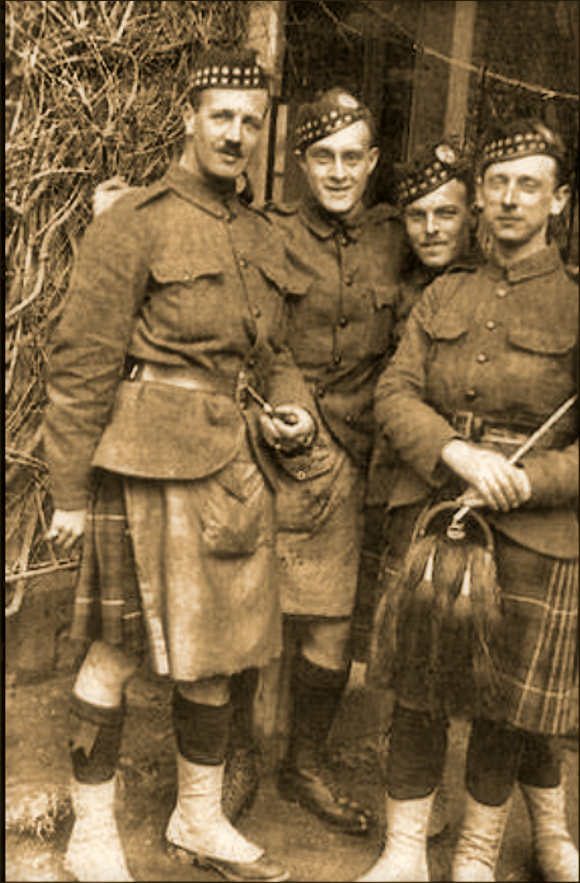
Those Bloody Kilts: The Highland Soldier in the Great War


By Thomas Greenshields
Helion and Company, March 2022
David F. Beer, Reviewer


The kilt was a unique dress, ironically, by virtue of extraordinary custom and tradition, the most blatantly masculine dress in the Army…” (p. 171).

What would you be thinking if you were part of a Highland Scots regiment going over the top in your kilt? Hard to say, but you would be following a long and proud history of Celtic warriors going to war wearing an ancient and honored garb. This is made clear in Thomas Greenshields’s Those Bloody Kilts, an almost magisterial book of over 500 pages, with copious notes, and many photographs. It examines in extraordinary detail not only the wearing of the kilt but also the use and meaning of the bagpipes and practically every other aspect of life in a Highland regiment during the Great War. 

Those Bloody Kilts is the result of the author’s tireless research among letters, diaries, notes, accounts, and reports of both officers and everyday soldiers, carried out in the Imperial War Museum, the National Library of Scotland, the Liddle Collection, plus various regimental museums. Seventeen chapters run from the part historically played by Highland regiments in the British Empire to organizational matters, kilts, the pipes, discipline, comradeship, ferocity, identity, and courage. Kilted regiments in Canada and South Africa are included in this study.

Three chapters are devoted to the kilt, and its mystique, tradition, correct wearing, and its hazards in stormy weather and combat. It was the tradition to wear nothing under the garment and many Highland soldiers followed this even though it could be problematic on gusty days, riding a bicycle, or going upstairs in buildings or a bus. In the trenches, the kilt could acquire more than its share of lice, accumulate heavy mud around its hem, prove chilly on cold days, and could catch on barbed wire. One touching report describes how several Highlanders were mowed down by machine guns on going over the top and how later the chaplain went among the bodies, rearranging their kilts with his cane so that nothing too personal was exposed. Nevertheless, the martial honor, pride, and glamor in wearing the kilt remained.


Kilted Dead on the Western Front


The kilt was, indeed, such a source of pride that at least two American Medical Officers attached to Highland battalions desired to wear it. One at least succeeded. ‘He was as proud as Punch, but he created a great deal of amusement. The kilt would not sit properly on him. His hind quarters could not make it wiggle waggle. It was no use, the kilt would have soon been down to his knees, but for the use of braces’ (pp. 156-157)

Just as the kilt was an important factor in the morale and esprit de corps of Highland regiments, so were the pipes. (Both still are.) Traditional bagpipe music can be stirring, wistful, inspiring, and mournful, and Scots bagpipers played an important role in the Great War. As Douglas Haig (a Scot himself) wrote:

The Pipers of Scotland may well be proud of the part they have played in this war. In the heat of battle, by the lonely grave, and during the long hours of waiting, they have called to us to show ourselves worthy of the land to which we belong. Many have fallen in the fight for liberty, but their memories remain. (p. 228)


Reviewer David Beer Is a Piper, Himself


Many pipers lost their lives in the Great War, but contrary to the glorious image of a piper leading troops over the top, this was not commonly the case. As far as combat was concerned, most pipers played to companies going up to the trenches or collecting them when they returned. Their safety, however, was never guaranteed.

Chapter 9 on "Discipline" analyses the very human side of the Scots soldier and reveals him to be no different than others. Although allegedly with a weakness for alcohol, the statistics show no more drunkenness among Scots than among other soldiers. Other sins are interestingly covered in this chapter, including disobedience, neglect, cheating on censorship, looting, theft, self-inflicted wounds, suicides, cowardice, gambling, and mutiny. After this litany, I was surprised to find a further section on "Other misdemeanors” (p. 274).

Chapter 15, “Ferocity and Compassion,” is an interesting amalgam of the darker side of warfare. A popular impression of the Highlander was that of the ferocious bayonet-toting soldier (p. 410). This image has numerous reports to support it, such as the following:

Two Kilties caught a German who shouted for mercy and said he was a Christian. The fellows said, ‘Alright, you’ll be an angel tomorrow,’ and bayonet him. Other 2 caught 2 officers & 4 men who were asking for mercy; they: ‘By ----you’ll get mercy this time,’ and bayoneted the lot.” (p. 422)

Plenty of evidence of German perfidy is given to justify such actions, and it’s impossible to judge a person who is in the heat of battle. The author also gives several citations from soldiers and stretcher bearers who felt pity for the wounded or defeated enemy.

Chapter 17, "Final Thoughts," nicely brings together the myriad topics covered in the first sixteen. This very readable book could almost be considered an encyclopedia of the experiences of kilted Highland regiments in World War One, and it is impossible to do it justice in a short review. 


By the time I finished the book, however, I could at least partly empathize with the written words of Lieutenant C.B. Anderson on foreseeing his own death:

“. . . don’t grieve, there are worse deaths than leading a platoon of Highlanders into action.” (p. 481)

David F. Beer

Monday, July 4, 2022

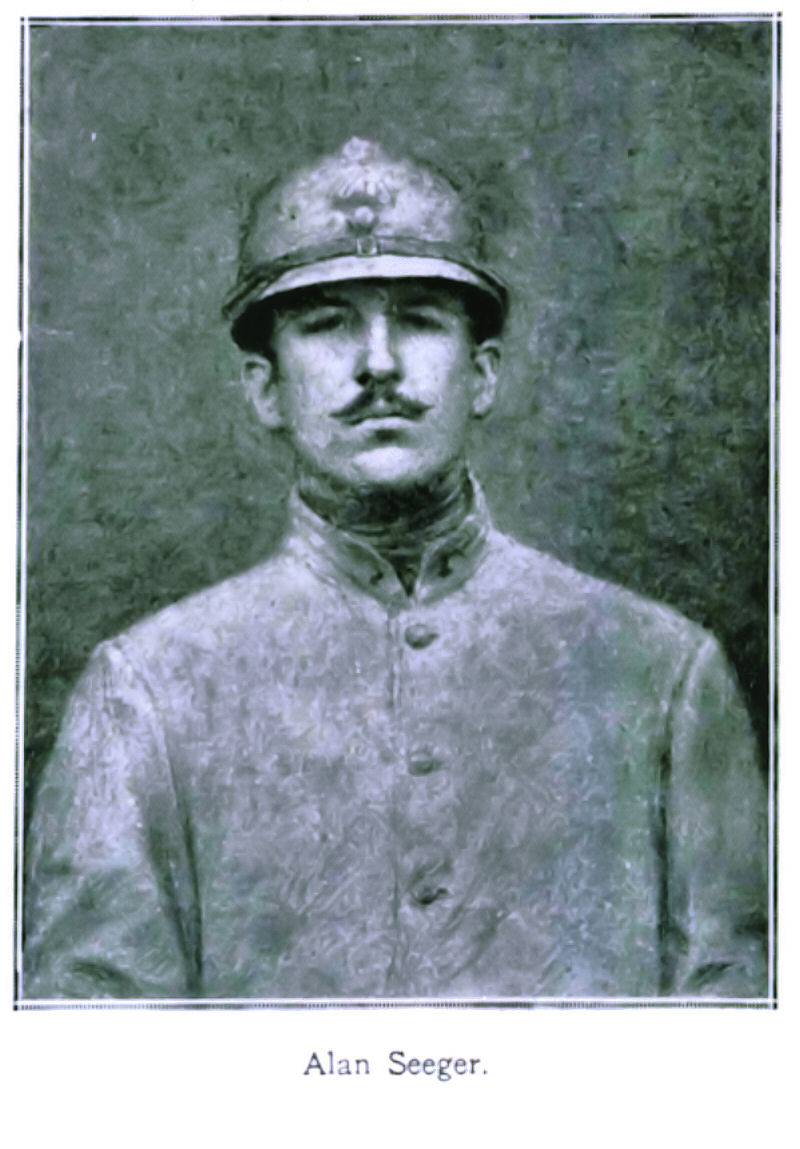
Alan Seeger Makes His Rendezvous at the Somme: 4 July 1916
By David Beer – A Roads Classic


Alan Seeger was born in New York in 1888. Encouraged by his family, he was attracted to literature at an early age, especially poetry, and was an enthusiastic contributor to the in-house magazine his family enjoyed producing. His wealthy family sent him to private school and then to Harvard College, where he was particularly interested in Celtic literature and edited and wrote poetry for the Harvard Monthly.

His parents were dismayed when, after graduating from Harvard, he moved to Greenwich Village, where he lived a bohemian life. They sent him to Paris in 1912 to study at the Sorbonne, but this further encouraged his eccentric lifestyle and intensified his love of poetry. He also became interested in politics and wrote several sonnets and other poems on the events of the day that were leading up to the World War. Although he was visiting London when war was declared, he at once rushed back to Paris and enlisted with some 40 other Americans in the French Foreign Legion. The training was demanding, but he appears to have been happy and proud to be fighting for a country he had come to love. His poems and letters home were now taking on a more fatalistic theme and also expressed the classical sentiment that death for a good soldier could be a beautiful and noble thing.

Seeger was soon to see action with the 2nd Foreign Regiment, action which gave him experience and also material for his poetry. "The Aisne (1914-1915)" describes his first experience of battle along the Chemin des Dames. By September 1915 he was in the thick of the Battle of Champagne, which he vividly described in his letters home. There, after seeing grape pickers busy not far from the fighting, he wrote a long poem in which he appealed to wine drinkers to "Drink sometimes…to those whose blood, in pious duty shed/Hallows the soil where that same wine had birth" (Champagne 1914-1915).


Romantic poet, dedicated diarist, and warrior,  Seeger's life in this bio.

Order Now

After a spell of sick leave and recuperation for bronchitis he returned to the front. He was scarcely inactive. According to one biographer, "He delighted in sneaking off on solitary scouting excursions, bringing back scraps of German newspapers, and leaving his visiting card on the German wire…he longed for the Croix de Guerre."

When the blood baths of Verdun and then the Somme developed, Seeger longed to be in the thick of things, and at this time he wrote what is considered by many to be the best American poem of WWI—"I Have a Rendezvous with Death."

I have a rendezvous with Death
At some disputed barricade,
When Spring comes back with rustling shade
And apple-blossoms fill the air—
I have a rendezvous with Death
When Spring brings back blue days and fair.

It may be he shall take my hand
And lead me into his dark land
And close my eyes and quench my breath—
It may be I shall pass him still.
I have a rendezvous with Death
On some scarred slope of battered hill,
When Spring comes round again this year
And the first meadow-flowers appear.

God knows 'twere better to be deep
Pillowed in silk and scented down,
Where love throbs out in blissful sleep,
Pulse nigh to pulse, and breath to breath,
Where hushed awakenings are dear...
But I've a rendezvous with Death
At midnight in some flaming town,
When Spring trips north again this year,
And I to my pledged word am true,
I shall not fail that rendezvous.

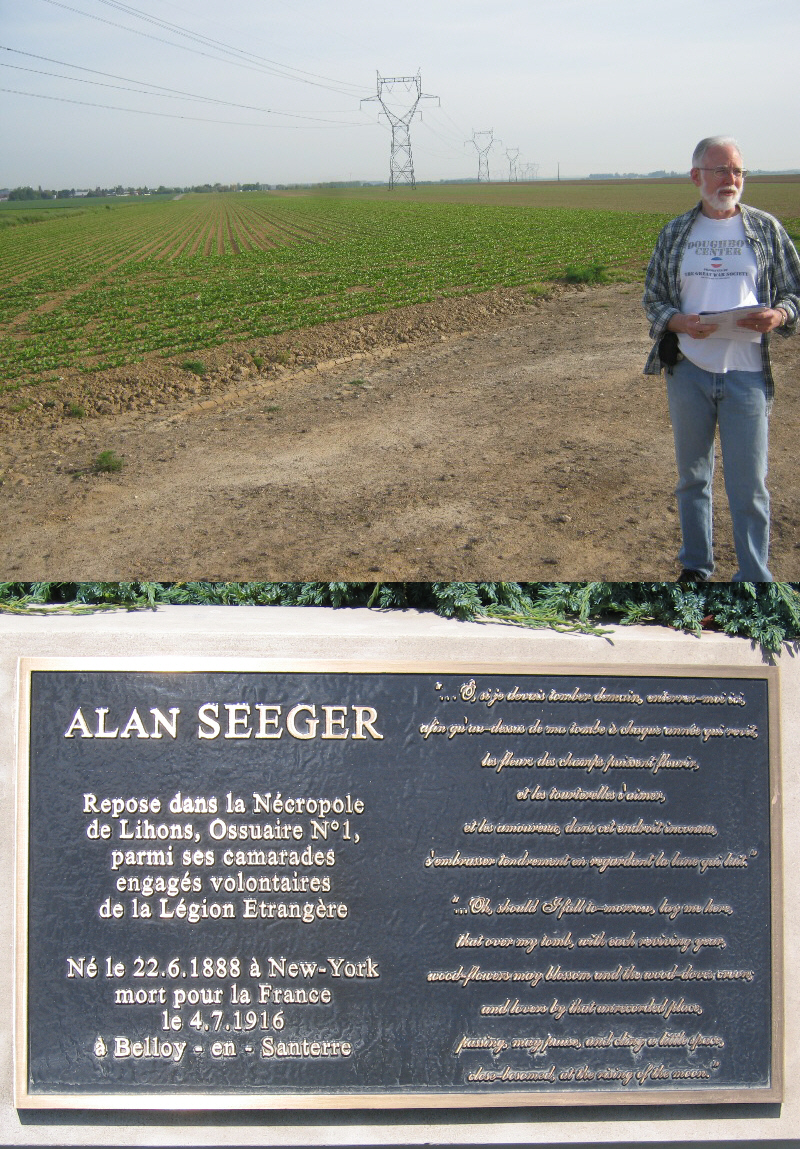
Few poems have been so fatalistic and at the same time cruelly prophetic. On 4 July 1916, Seeger's section was ordered to take the village of Belloy-en-Santerre. As he charged forward, German machine guns opened up from a nearby hollow, and Legionnaire Seeger made his rendezvous.


Click on Image to Expand

At Belloy-en-Santerre

Above (top), Mike Hanlon's late friend and traveling-mate Mark Fowler of Dallas, Texas, reads "Rendezvous" at the field where Seeger fell during the Battle of the Somme. Below is the marker in the village of Belloy-en-Santerre honoring Seeger and identifying his burial site.

Sunday, July 3, 2022

The Fascinating Champagne


Trench at La Main dé Massignes, Champagne Sector


Forget about that bubbly stuff, there's another good reason to visit France's Champagne. It  holds an endless series of  unforgettable sites for the military history enthusiast. We have highlighted a number of them on the region's standard tourism kiosk map below with a photo and some details about each stop lower down. Point  #1 (unfortunately, off the map) should be the starting point of any visit to Champagne. It's the magnificent Rheims Cathedral—a World War I veteran—one of the world's greatest treasures. This is a highlights listing, though. In Champagne there are countless monuments and markers and, of course, more military cemeteries than we could possibly list here.


Click on Image to Enlarge


1. Cathedral of Our Lady of Rheims (off the map)

The cathedral was targeted especially early during the war, and its wounds can still be viewed. After the spring of 1915,  international outrage led the the German Army to halt its regular targeting of the cathedral, but random impacts still occurred, especially when fighting intensified in the local area.


2. Fort de la Pompelle (off the map)

Located five miles southeast of the cathedral on N44, Fort de la Pompelle defended Rheims eastern flank for most of the war and is now the site of one of the best museums on the Western Front, which includes the world's largest collection of German Pickelhaube helmets.


3. 1917 Nivelle Offensive Remembrances 

In the spring offensive of 1917, the only minimally successful French attacks were in the hills east of Rheims.  Relevant sites to see include the monument on the left located on D931, the bronze sculpture on the right located at Nauroy, where there are two villages détruits nearby, and a German cemetery.


4. Russian Expeditionary Force

Russia sent an expeditionary force of two brigades to the Western Front. The troops trained, fought, and sometimes mutinied in the Champagne. The chapel, cemetery,
and a memorial across the road honor their service.


5. Aubérire Triple Cemetery

Farther east on D931, this cemetery has sections for French, German, and Polish Foreign Legion fallen. The tomb marker above recognizes the service of Legionaires killed in the 
1917 fighting.


6. Four Corporals of Souain Memorial

In 1915, four corporals in the French Army were shot by firing squad as an example to the rest of their companies during the First World War. The executions, which occurred in the vicinity of Souain on 17 March 1915, are considered to be the most egregious and most publicized military injustice during World War I in France. The events inspired the 1957 American antiwar film Paths of Glory. It is located in the town square at Suippes, where they were court-martialed.


7. Souain French and German Cemetery

The largest French cemetery in the Champagne-Marne sector is located at a dramatic hillside location outside Souain and includes 60,000 French burials. An adjacent German cemtery contains the remains of nearly 14,000 additional fallen from the war.


8. Navarin Farm Memorial and Ossuary

The Navarin Farm Monument to the Champagne Battles is the principal French memorial in the Champagne region. It marks the site where French forces were stymied throughout 1915, stayed in place for three years, and waged a notable defense in the opening of the Second Battle of the Marne, July 1918. The crypt contains  the remains of 10,000 unnamed soldiers along with General Gouraud, commander of the 4th French Army in 1918.  The figure on the right atop the pyramidal ossuary is an American soldier.  The battlefield and trenches around the monument have remained untouched since 1918.


9. Blanc Mont (Sommepy) U.S. Memorial

The Blanc Mont monument honors the American and French soldiers who fought together in the Champagne region of France between July 15 and October 27, 1918, including the American 2nd, 36th, 42nd, and 93rd divisions. The monument is located on the ridge of Blanc Mont, a key point in the German defenses that was captured by the American 2nd Division on  3 October 1918 during the opening of the operation that forced the enemy to abandon the Champagne.  Interestingly, its "Lookout Tower" style was conceived of by Arthur Loomis Harmon, principal architect of the Empire State Building.


10 St-Étienne-à-Arnes

In the later stages of the battle for Blanc Mont Ridge, this fortified village was the focus of action with the local cemetery (shown above) being a key positions for enemy defenders. On 8 October 1918 a mixed force of U.S. Marines from the 36th Division and Oklahoma National Guardsmen from the 36th Division captured St-Étienne.  In the ensuing fighting, Choctaw Nation soldiers from the 36th Division became America's first Code-Talkers.


11. 369th (Harlem Hellfighters) Infantry Memorial

Honoring the segregated American 369th Infantry (formerly 15th New York) that fought under French command, this monument honors their distinguished service in capturing the village of Sechault on 29 September 1918. The action earned the Croix de Guerre for the entire regiment. A twin monument for the regiment stands in New York City.  Sgt. Henry Johnson of the regiment was recently awarded the Medal of Honor for his actions earlier in the war.


12. La Main dé Massignes


The results of a restoration effort that began in 2012 the former French trenches at La Main dé Massignes are now considered to be the most authentic example of such restored trenches on the Western Front. (Compare to the photo at the top of the page.) As of July 2022, they are reported to be open every afternoon, 1-6 p.m., except Mondays and holidays.


Saturday, July 2, 2022

The Somme: Then and Now–Video


I found this film about the Somme experience both informative and moving. You'll feel intimacy, like you're part of a stretcher detail or helping Royal Marines fire a 15.5 inch howitzer. The editor uses the technique of overlaying combat footage (black and white) on contemporary color views of the battlefield to great effect. However, let me say, you will not enjoy this unless you are an active viewer. It's tough to visually integrate the two types of film and a lot of clues (the graphics, for example, are very helpful but on the small side) will be missed if you take a passive approach.  Anyway, happy viewing.  MH


Friday, July 1, 2022

The Lusitania and the Preparedness Movement—A Roads Collection


O Lusitania, Empress of the Sea,

Art thou dead an buried in the deep,

With all thy freight of human souls,

Victims of the Huns' most hellish darts.

O Lusitania, my tears are falling for thee. . .

Phoebe Amory, Survivor 


The sinking of RMS Lusitania was a powerful human tragedy, as H.G. Wells later wrote, "All the achievements of 19th century civilization seemed to many to be following in the downward wake of the Lusitania." We are not a attempting a comprehensive look at the event, though. Here we are focusing on one important result of the disaster—how the sinking helped shape the decision by the United States to fight in what had started out as a European war, from which the nation had determinedly tried to remain neutral. 

The sinking of the great ship did not cause America to declare war—that would not come for two more years—but it decisively shifted American public attitudes against Germany and toward the Allies, and resulted in the departure of the last "true neutral" among President Wilson's advisors, Secretary of State William Jennings Bryan. However, it was former President Theodore Roosevelt's response that best captured the nation's immediate response:  "That's murder . . . this represents not merely piracy,  but piracy on a vaster scale of murder than any oldtime pirate ever practiced. This is the warfare which destroyed Louvain and Dinant, and hundreds of men, women and children in Belgium. It is warfare against innocents traveling on the ocean, and to our fellow countrywomen, who are among the sufferers. It seems inconceivable that we can refrain from taking action." ( 7 May 1915, Interview)


Articles


Eyewitness: Through the Periscope: RMS Lusitania


News of the Lusitania Arrives at the World's Fair


Joyce Kilmer's Lusitania Poem


Lusitania Propaganda Posters


Countdown to America’s Entry into the Great War


Preparedness Fever: The Parades of 1916


The Plattsburg Movement: Where General Pershing Found His Officers


Who Was Josephus Daniels?


Newton Baker and the National Defense Act of 1916


Representative Julius Kahn, the American Military's Biggest Booster in Congress


Henry Ford's Peace Ship


Preparedness Parade


Book Reviews


Dead Wake: The Last Crossing of the Lusitania


Crusader Nation: The United States in Peace and the Great War, 1898–1920


The Path to War: How the First World War Created Modern America